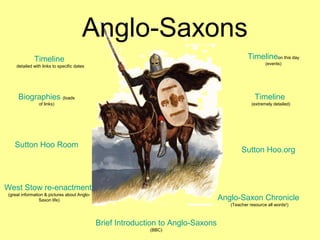
Anglo-Saxons
Timeline
detailed with links to specific dates
Timelineon this day
(events)
West Stow re-enactment
(great information & pictures about Anglo-
Saxon life) Anglo-Saxon Chronicle
(Teacher resource all words!)
Biographies (loads
of links)
Brief Introduction to Anglo-Saxons
(BBC)
Sutton Hoo.org
Sutton Hoo Room
Timeline
(extremely detailed)
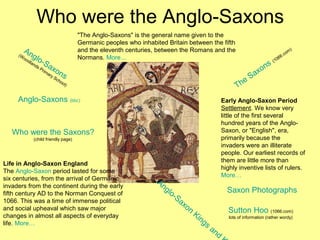
Who were the Anglo-Saxons
"The Anglo-Saxons" is the general name given to the
Germanic peoples who inhabited Britain between the fifth
and the eleventh centuries, between the Romans and the
Normans. More…
Anglo-Saxons
(W
oodlands Primary School)
Who were the Saxons?
(child friendly page)
Life in Anglo-Saxon England
The Anglo-Saxon period lasted for some
six centuries, from the arrival of Germanic
invaders from the continent during the early
fifth century AD to the Norman Conquest of
1066. This was a time of immense political
and social upheaval which saw major
changes in almost all aspects of everyday
life. More…
Early Anglo-Saxon Period
Settlement. We know very
little of the first several
hundred years of the Anglo-
Saxon, or "English", era,
primarily because the
invaders were an illiterate
people. Our earliest records of
them are little more than
highly inventive lists of rulers.
More…
The Saxons (1066.com)
Saxon Photographs
Sutton Hoo (1066.com)
lots of information (rather wordy)
Anglo-Saxon
Kings
and
Anglo-Saxons (bbc)
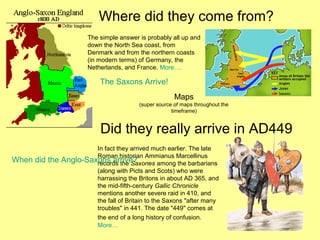
Where did they come from?
The simple answer is probably all up and
down the North Sea coast, from
Denmark and from the northern coasts
(in modern terms) of Germany, the
Netherlands, and France. More….
Did they really arrive in AD449
In fact they arrived much earlier. The late
Roman historian Ammianus Marcellinus
records the Saxones among the barbarians
(along with Picts and Scots) who were
harrassing the Britons in about AD 365, and
the mid-fifth-century Gallic Chronicle
mentions another severe raid in 410, and
the fall of Britain to the Saxons "after many
troubles" in 441. The date "449" comes at
the end of a long history of confusion.
More…
The Saxons Arrive!
When did the Anglo-Saxons arrive?
Maps
(super source of maps throughout the
timeframe)
The People
People
(list format places etc)
Anglo-Saxon Literature
Did you know…
The ancient Anglo-Saxons
celebrated the return of spring
with a carnival commemorating
their goddess of offspring and of
springtime, Eostre. The word
carnival possibly originated from
the Latin ‘carne vale' meaning
"flesh, farewell" or "meat,
farewell." The offerings were
rabbits and coloured eggs,
bidding an end to winter.
Being a Child in Saxon Times
Sutton Hoo Treasures
What Saxons looked like
Hermits
Women and Children…
Anglo-Saxon women appear to have
enjoyed considerable independence,
whether as abbesses of the great ‘double
monasteries’ of monks and nuns founded
during the seventh and eighth centuries,
as major land-holders recorded in
Domesday Book (1086), or as ordinary
members of society. More…
Social class
The main division in Anglo-Saxon
society was between slave and free.
Both groups were hierarchically
structured, with several classes of
freemen and many types of slaves.
More…
Life expectancy
Work and Leisure
Leisure
When they weren't fighting (one
wonders when that was) the
favourite pastimes of the Dark
Ages were dice and board games
such as chess. More..
Anglo-Saxon Past-times
Anglo-Saxon Games
British & Saxon Minstrels
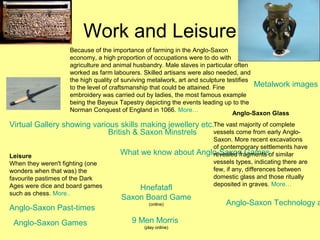
Because of the importance of farming in the Anglo-Saxon
economy, a high proportion of occupations were to do with
agriculture and animal husbandry. Male slaves in particular often
worked as farm labourers. Skilled artisans were also needed, and
the high quality of surviving metalwork, art and sculpture testifies
to the level of craftsmanship that could be attained. Fine
embroidery was carried out by ladies, the most famous example
being the Bayeux Tapestry depicting the events leading up to the
Norman Conquest of England in 1066. More…
9 Men Morris
(play online)
Hnefatafl
Saxon Board Game
(online)
What we know about Anglo-Saxon Games
Virtual Gallery showing various skills making jewellery etc.
Anglo-Saxon Technology a
Metalwork images
Anglo-Saxon Glass
The vast majority of complete
vessels come from early Anglo-
Saxon. More recent excavations
of contemporary settlements have
revealed fragments of similar
vessels types, indicating there are
few, if any, differences between
domestic glass and those ritually
deposited in graves. More…
Anglo-Saxon homes, how and
where they lived
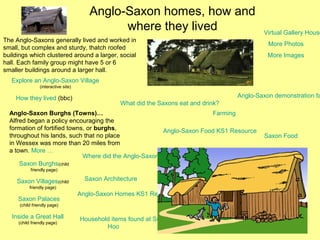
The Anglo-Saxons generally lived and worked in
small, but complex and sturdy, thatch roofed
buildings which clustered around a larger, social
hall. Each family group might have 5 or 6
smaller buildings around a larger hall.
How they lived (bbc)
Explore an Anglo-Saxon Village
(interactive site)
Saxon Burghs(child
friendly page)
Saxon Villages(child
friendly page)
Saxon Palaces
(child friendly page)
Inside a Great Hall
(child friendly page)
Household items found at Sutton
Hoo
Anglo-Saxon Burghs (Towns)…
Alfred began a policy encouraging the
formation of fortified towns, or burghs,
throughout his lands, such that no place
in Wessex was more than 20 miles from
a town. More …
What did the Saxons eat and drink?
Where did the Anglo-Saxons live?
Virtual Gallery House
More Photos
More Images
Anglo-Saxon Homes KS1 Resource
Anglo-Saxon Food KS1 Resource
Saxon Architecture
Saxon Food
Farming
Anglo-Saxon demonstration fa
Religion, Gods & Burial
Saxon Churches(child
friendly page)
The Saxon ChurchWhat
was it all about?
Pagan Saxons
Saxons become Christia
Monasteries
Books & Manuscripts
The Lindisfarne Gospel
Items found in Saxon Graves
The Sutton Hoo Burial Ship
Who was buried there?
Missionaries
Saxon Gods
Famous Saxon Churches
Tappa Tump
burial treasures
Images of Items
The Prittelwell Prince
A Saxon Cathedral discovered in Canterbury
Anglo-Saxon Death
Virtual Gallery Finds from BurialsCremation Urns images
Anglo-Saxon Soldier buried
with his horse
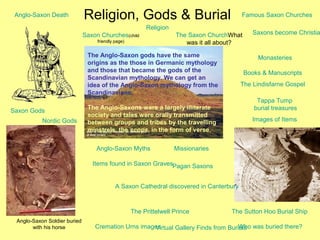
The Anglo-Saxon gods have the same
origins as the those in Germanic mythology
and those that became the gods of the
Scandinavian mythology. We can get an
idea of the Anglo-Saxon mythology from the
Scandinavians.
The Anglo-Saxons were a largely illiterate
society and tales were orally transmitted
between groups and tribes by the travelling
minstrels, the scops, in the form of verse.
Anglo-Saxon Myths
Nordic Gods
Religion
Anglo-Saxon Clothing,
Jewellery & Art
Saxon Ladieswear
Saxon Men
Jewellery
Saxon Carving
Saxon Dress
Silverfound
atSutton
Hoo
Anglo-Saxon costumes
Anglo-Saxon Women Anglo-Saxon Men
Anglo-Saxon Costume
How did the Anglo-Saxons make their
clothers?
Dress Cyneburg
to go to the Feast
(interactive activity)
Virtual Gallery Jewellery etc.
VirtualGallerycircularBrooches
Buckles, bracelets & Pins
More Brooches
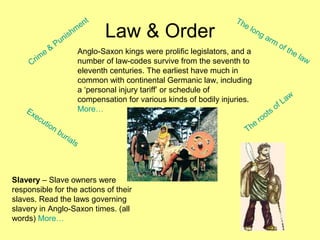
Law & Order
Execution burials
Slavery – Slave owners were
responsible for the actions of their
slaves. Read the laws governing
slavery in Anglo-Saxon times. (all
words) More…
Anglo-Saxon kings were prolific legislators, and a
number of law-codes survive from the seventh to
eleventh centuries. The earliest have much in
common with continental Germanic law, including
a ‘personal injury tariff’ or schedule of
compensation for various kinds of bodily injuries.
More…
Crim
e
&
Punishm
ent The long arm
of the law
The
roots of Law
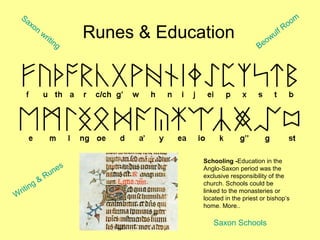
Runes & Education
Saxon
writing
Saxon Schools
Beowulf Room
W
riting &
Runes
Schooling -Education in the
Anglo-Saxon period was the
exclusive responsibility of the
church. Schools could be
linked to the monasteries or
located in the priest or bishop’s
home. More..
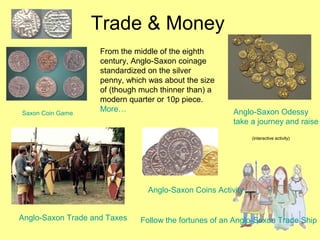
Trade & Money
From the middle of the eighth
century, Anglo-Saxon coinage
standardized on the silver
penny, which was about the size
of (though much thinner than) a
modern quarter or 10p piece.
More…Saxon Coin Game Anglo-Saxon Odessy
take a journey and raise
(interactive activity)
Anglo-Saxon Trade and Taxes
Anglo-Saxon Coins Activity
Follow the fortunes of an Anglo-Saxon Trade Ship
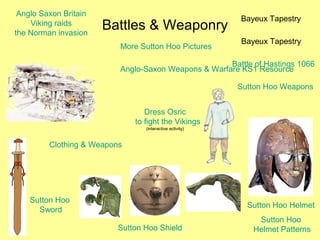
Battles & Weaponry
Battle of Hastings 1066
Anglo Saxon Britain
Viking raids
the Norman invasion
Sutton Hoo
Sword
Sutton Hoo Helmet
Sutton Hoo
Helmet Patterns
Sutton Hoo Weapons
Sutton Hoo Shield
More Sutton Hoo Pictures
Dress Osric
to fight the Vikings
(interactive activity)
Clothing & Weapons
Anglo-Saxon Weapons & Warfare KS1 Resource
Bayeux Tapestry
Bayeux Tapestry
Teacher Resources
Hidden Animals on the Ang
(interactive activity)
Doomsday Game
(interactive activity)
Anglo-Saxon Stew
(download the recipe)
Stories of King Arthur
(read and see)
Friendship Bracelet Activity
(instructions)
History Hunt
(Interactive activity)
Beowulf’sDragon
(Storylinkpluspaint&
sendina
dragonBritishMuseum)
Treasures of a Saxon King
(site showing archaeological
discoveries)
Make an Anglo-Saxon Manuscript
Solve the Anglo-Saxon Riddle
Anglo-Saxon Rune Activity Sheet
Make your own Timeline
Spot the objects that do not fit into Anglo-Saxon Times Activity Sheet
Help Hild
find the objects she needs for the feast
(interactive activity)
Arrival & Settlement KS2
(interactive research unit – an ideal ICT Lesson)
Bede
King Alfred
Everyday Life
Evidence
Anglo-Saxon
Anglo-Saxon Clothing KS1 Resource
Anglo-Saxon History KS1 Resource
Anglo-Saxon Weapons & Warfare KS1 Resource
Anglo-Saxon Food KS1 Resource
Printable
worksheets from
BBC education

Anglo saxons

  • 1.
    Anglo-Saxons Timeline detailed with linksto specific dates Timelineon this day (events) West Stow re-enactment (great information & pictures about Anglo- Saxon life) Anglo-Saxon Chronicle (Teacher resource all words!) Biographies (loads of links) Brief Introduction to Anglo-Saxons (BBC) Sutton Hoo.org Sutton Hoo Room Timeline (extremely detailed)
  • 2.
    Who were theAnglo-Saxons "The Anglo-Saxons" is the general name given to the Germanic peoples who inhabited Britain between the fifth and the eleventh centuries, between the Romans and the Normans. More… Anglo-Saxons (W oodlands Primary School) Who were the Saxons? (child friendly page) Life in Anglo-Saxon England The Anglo-Saxon period lasted for some six centuries, from the arrival of Germanic invaders from the continent during the early fifth century AD to the Norman Conquest of 1066. This was a time of immense political and social upheaval which saw major changes in almost all aspects of everyday life. More… Early Anglo-Saxon Period Settlement. We know very little of the first several hundred years of the Anglo- Saxon, or "English", era, primarily because the invaders were an illiterate people. Our earliest records of them are little more than highly inventive lists of rulers. More… The Saxons (1066.com) Saxon Photographs Sutton Hoo (1066.com) lots of information (rather wordy) Anglo-Saxon Kings and Anglo-Saxons (bbc)
  • 3.
    Where did theycome from? The simple answer is probably all up and down the North Sea coast, from Denmark and from the northern coasts (in modern terms) of Germany, the Netherlands, and France. More…. Did they really arrive in AD449 In fact they arrived much earlier. The late Roman historian Ammianus Marcellinus records the Saxones among the barbarians (along with Picts and Scots) who were harrassing the Britons in about AD 365, and the mid-fifth-century Gallic Chronicle mentions another severe raid in 410, and the fall of Britain to the Saxons "after many troubles" in 441. The date "449" comes at the end of a long history of confusion. More… The Saxons Arrive! When did the Anglo-Saxons arrive? Maps (super source of maps throughout the timeframe)
  • 4.
    The People People (list formatplaces etc) Anglo-Saxon Literature Did you know… The ancient Anglo-Saxons celebrated the return of spring with a carnival commemorating their goddess of offspring and of springtime, Eostre. The word carnival possibly originated from the Latin ‘carne vale' meaning "flesh, farewell" or "meat, farewell." The offerings were rabbits and coloured eggs, bidding an end to winter. Being a Child in Saxon Times Sutton Hoo Treasures What Saxons looked like Hermits Women and Children… Anglo-Saxon women appear to have enjoyed considerable independence, whether as abbesses of the great ‘double monasteries’ of monks and nuns founded during the seventh and eighth centuries, as major land-holders recorded in Domesday Book (1086), or as ordinary members of society. More… Social class The main division in Anglo-Saxon society was between slave and free. Both groups were hierarchically structured, with several classes of freemen and many types of slaves. More… Life expectancy
  • 5.
    Work and Leisure Leisure Whenthey weren't fighting (one wonders when that was) the favourite pastimes of the Dark Ages were dice and board games such as chess. More.. Anglo-Saxon Past-times Anglo-Saxon Games British & Saxon Minstrels Because of the importance of farming in the Anglo-Saxon economy, a high proportion of occupations were to do with agriculture and animal husbandry. Male slaves in particular often worked as farm labourers. Skilled artisans were also needed, and the high quality of surviving metalwork, art and sculpture testifies to the level of craftsmanship that could be attained. Fine embroidery was carried out by ladies, the most famous example being the Bayeux Tapestry depicting the events leading up to the Norman Conquest of England in 1066. More… 9 Men Morris (play online) Hnefatafl Saxon Board Game (online) What we know about Anglo-Saxon Games Virtual Gallery showing various skills making jewellery etc. Anglo-Saxon Technology a Metalwork images Anglo-Saxon Glass The vast majority of complete vessels come from early Anglo- Saxon. More recent excavations of contemporary settlements have revealed fragments of similar vessels types, indicating there are few, if any, differences between domestic glass and those ritually deposited in graves. More…
  • 6.
    Anglo-Saxon homes, howand where they lived The Anglo-Saxons generally lived and worked in small, but complex and sturdy, thatch roofed buildings which clustered around a larger, social hall. Each family group might have 5 or 6 smaller buildings around a larger hall. How they lived (bbc) Explore an Anglo-Saxon Village (interactive site) Saxon Burghs(child friendly page) Saxon Villages(child friendly page) Saxon Palaces (child friendly page) Inside a Great Hall (child friendly page) Household items found at Sutton Hoo Anglo-Saxon Burghs (Towns)… Alfred began a policy encouraging the formation of fortified towns, or burghs, throughout his lands, such that no place in Wessex was more than 20 miles from a town. More … What did the Saxons eat and drink? Where did the Anglo-Saxons live? Virtual Gallery House More Photos More Images Anglo-Saxon Homes KS1 Resource Anglo-Saxon Food KS1 Resource Saxon Architecture Saxon Food Farming Anglo-Saxon demonstration fa
  • 7.
    Religion, Gods &Burial Saxon Churches(child friendly page) The Saxon ChurchWhat was it all about? Pagan Saxons Saxons become Christia Monasteries Books & Manuscripts The Lindisfarne Gospel Items found in Saxon Graves The Sutton Hoo Burial Ship Who was buried there? Missionaries Saxon Gods Famous Saxon Churches Tappa Tump burial treasures Images of Items The Prittelwell Prince A Saxon Cathedral discovered in Canterbury Anglo-Saxon Death Virtual Gallery Finds from BurialsCremation Urns images Anglo-Saxon Soldier buried with his horse The Anglo-Saxon gods have the same origins as the those in Germanic mythology and those that became the gods of the Scandinavian mythology. We can get an idea of the Anglo-Saxon mythology from the Scandinavians. The Anglo-Saxons were a largely illiterate society and tales were orally transmitted between groups and tribes by the travelling minstrels, the scops, in the form of verse. Anglo-Saxon Myths Nordic Gods Religion
  • 8.
    Anglo-Saxon Clothing, Jewellery &Art Saxon Ladieswear Saxon Men Jewellery Saxon Carving Saxon Dress Silverfound atSutton Hoo Anglo-Saxon costumes Anglo-Saxon Women Anglo-Saxon Men Anglo-Saxon Costume How did the Anglo-Saxons make their clothers? Dress Cyneburg to go to the Feast (interactive activity) Virtual Gallery Jewellery etc. VirtualGallerycircularBrooches Buckles, bracelets & Pins More Brooches
  • 9.
    Law & Order Executionburials Slavery – Slave owners were responsible for the actions of their slaves. Read the laws governing slavery in Anglo-Saxon times. (all words) More… Anglo-Saxon kings were prolific legislators, and a number of law-codes survive from the seventh to eleventh centuries. The earliest have much in common with continental Germanic law, including a ‘personal injury tariff’ or schedule of compensation for various kinds of bodily injuries. More… Crim e & Punishm ent The long arm of the law The roots of Law
  • 10.
    Runes & Education Saxon writing SaxonSchools Beowulf Room W riting & Runes Schooling -Education in the Anglo-Saxon period was the exclusive responsibility of the church. Schools could be linked to the monasteries or located in the priest or bishop’s home. More..
  • 11.
    Trade & Money Fromthe middle of the eighth century, Anglo-Saxon coinage standardized on the silver penny, which was about the size of (though much thinner than) a modern quarter or 10p piece. More…Saxon Coin Game Anglo-Saxon Odessy take a journey and raise (interactive activity) Anglo-Saxon Trade and Taxes Anglo-Saxon Coins Activity Follow the fortunes of an Anglo-Saxon Trade Ship
  • 12.
    Battles & Weaponry Battleof Hastings 1066 Anglo Saxon Britain Viking raids the Norman invasion Sutton Hoo Sword Sutton Hoo Helmet Sutton Hoo Helmet Patterns Sutton Hoo Weapons Sutton Hoo Shield More Sutton Hoo Pictures Dress Osric to fight the Vikings (interactive activity) Clothing & Weapons Anglo-Saxon Weapons & Warfare KS1 Resource Bayeux Tapestry Bayeux Tapestry
  • 13.
    Teacher Resources Hidden Animalson the Ang (interactive activity) Doomsday Game (interactive activity) Anglo-Saxon Stew (download the recipe) Stories of King Arthur (read and see) Friendship Bracelet Activity (instructions) History Hunt (Interactive activity) Beowulf’sDragon (Storylinkpluspaint& sendina dragonBritishMuseum) Treasures of a Saxon King (site showing archaeological discoveries) Make an Anglo-Saxon Manuscript Solve the Anglo-Saxon Riddle Anglo-Saxon Rune Activity Sheet Make your own Timeline Spot the objects that do not fit into Anglo-Saxon Times Activity Sheet Help Hild find the objects she needs for the feast (interactive activity) Arrival & Settlement KS2 (interactive research unit – an ideal ICT Lesson) Bede King Alfred Everyday Life Evidence Anglo-Saxon Anglo-Saxon Clothing KS1 Resource Anglo-Saxon History KS1 Resource Anglo-Saxon Weapons & Warfare KS1 Resource Anglo-Saxon Food KS1 Resource Printable worksheets from BBC education