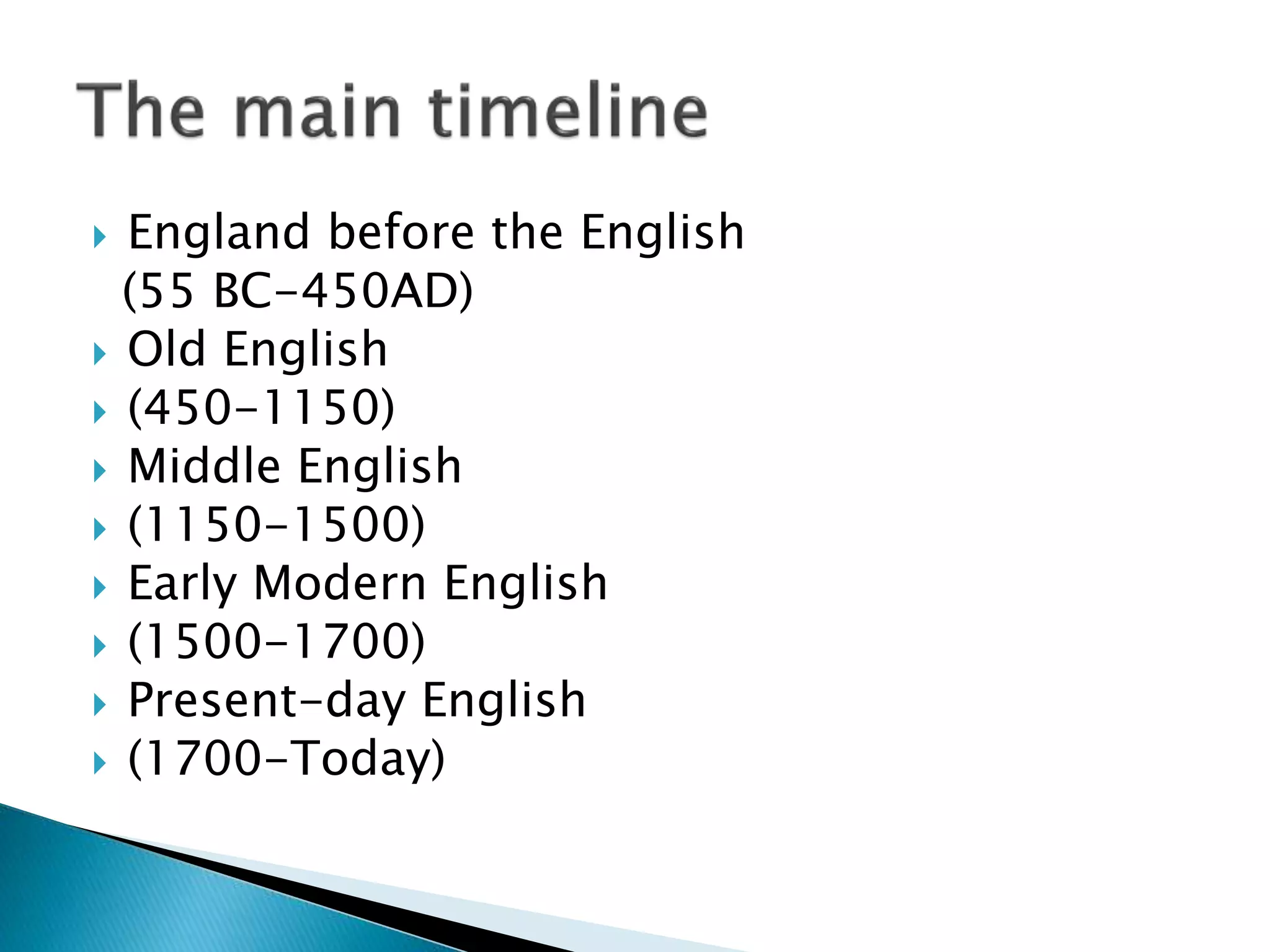

 England before the English
(55 BC-450AD)
 Old English
 (450-1150)
 Middle English
 (1150-1500)
 Early Modern English
 (1500-1700)
 Present-day English
 (1700-Today)
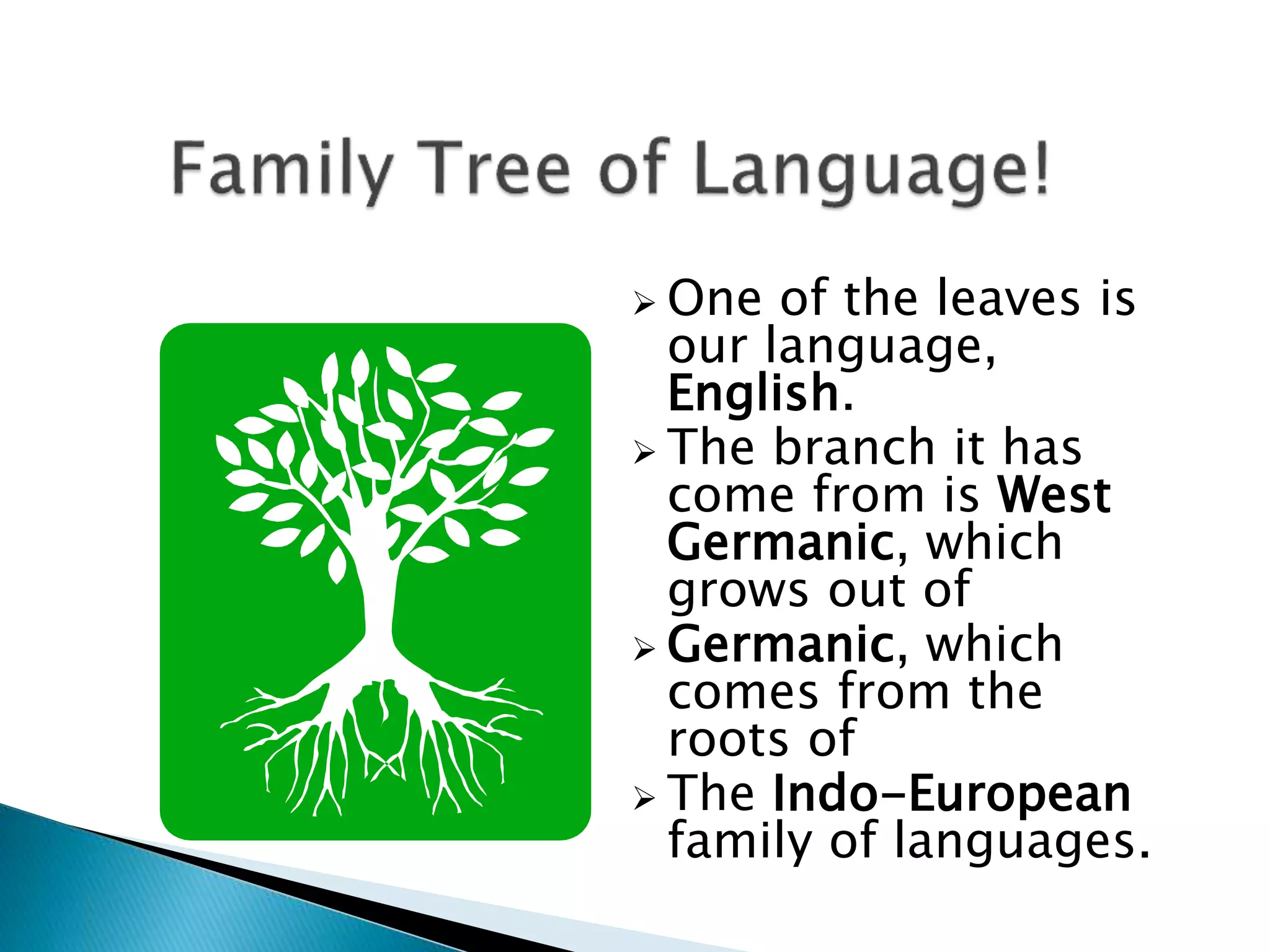
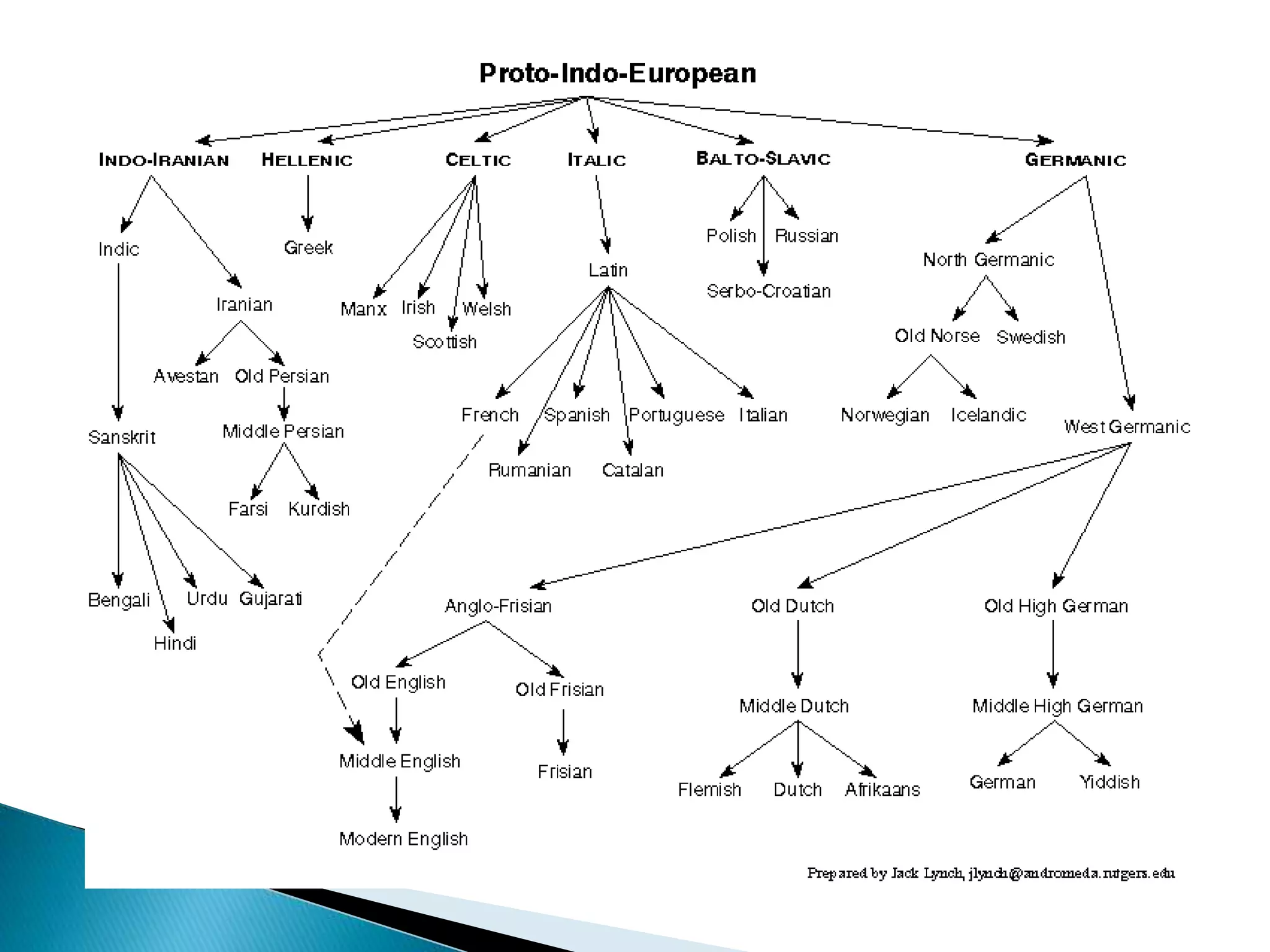
 One of the leaves is
our language,
English.
 The branch it has
come from is West
Germanic, which
grows out of
 Germanic, which
comes from the
roots of
 The Indo-European
family of languages.
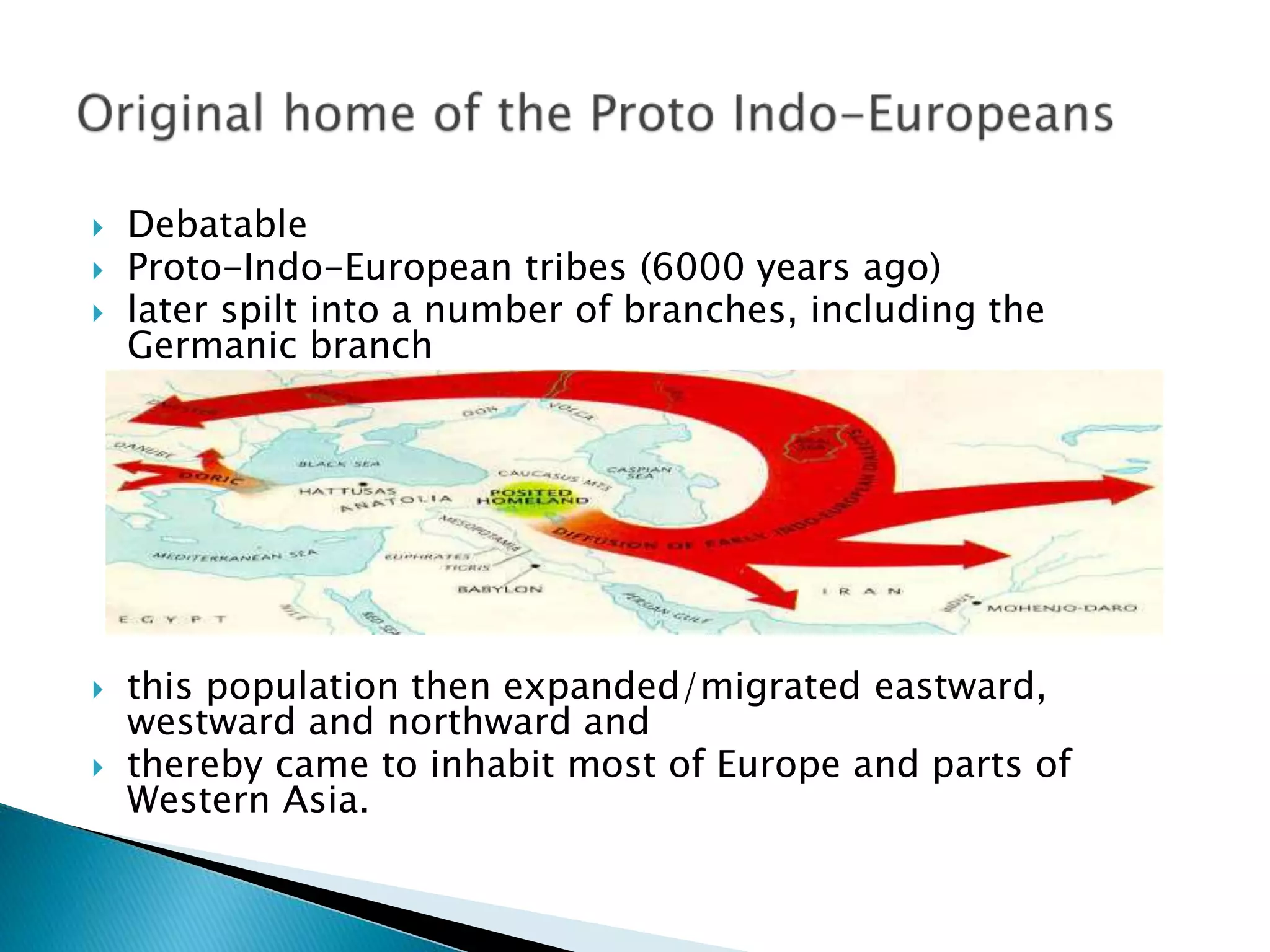
 Debatable
 Proto-Indo-European tribes (6000 years ago)
 later spilt into a number of branches, including the
Germanic branch
 this population then expanded/migrated eastward,
westward and northward and
 thereby came to inhabit most of Europe and parts of
Western Asia.
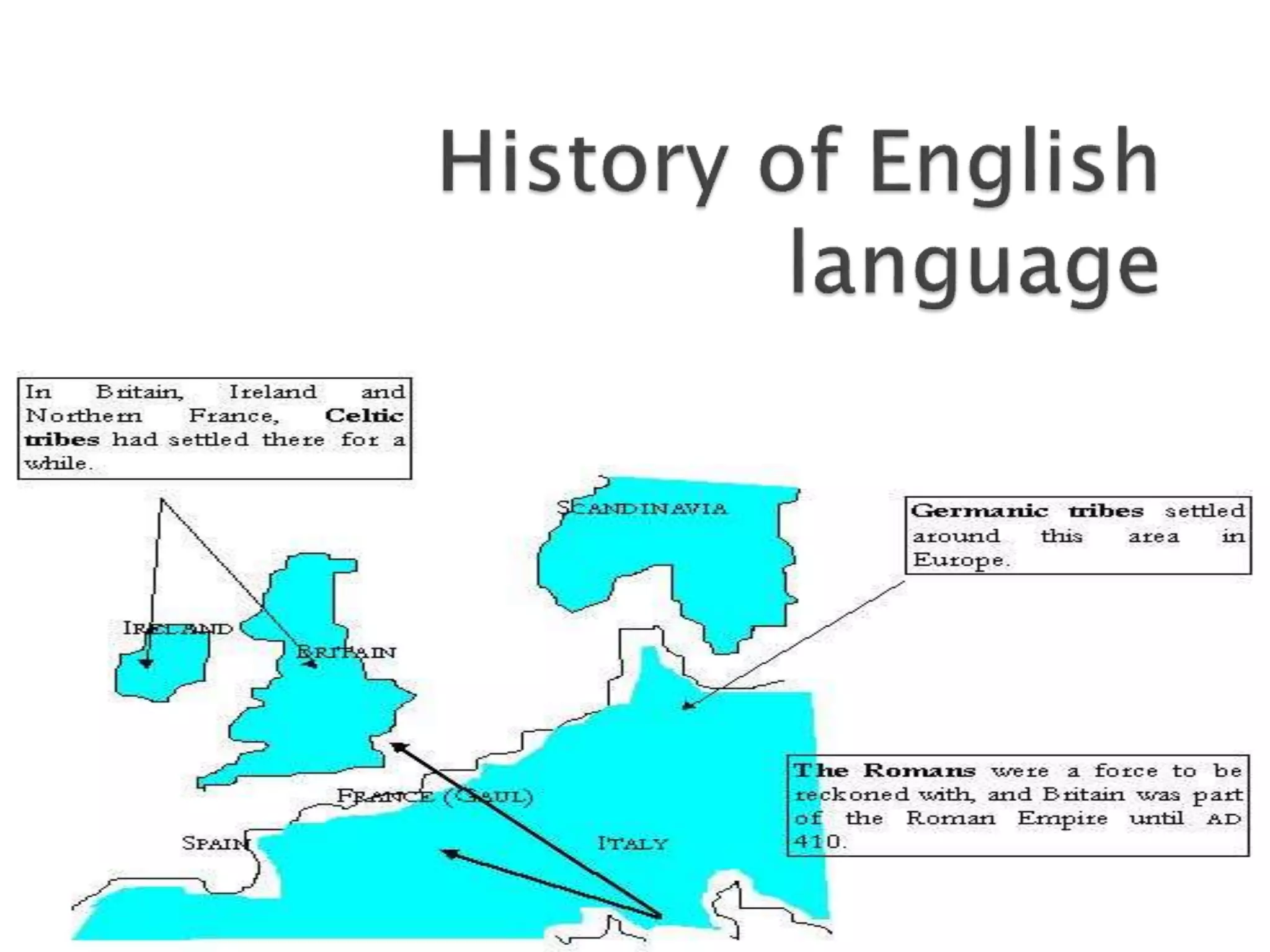
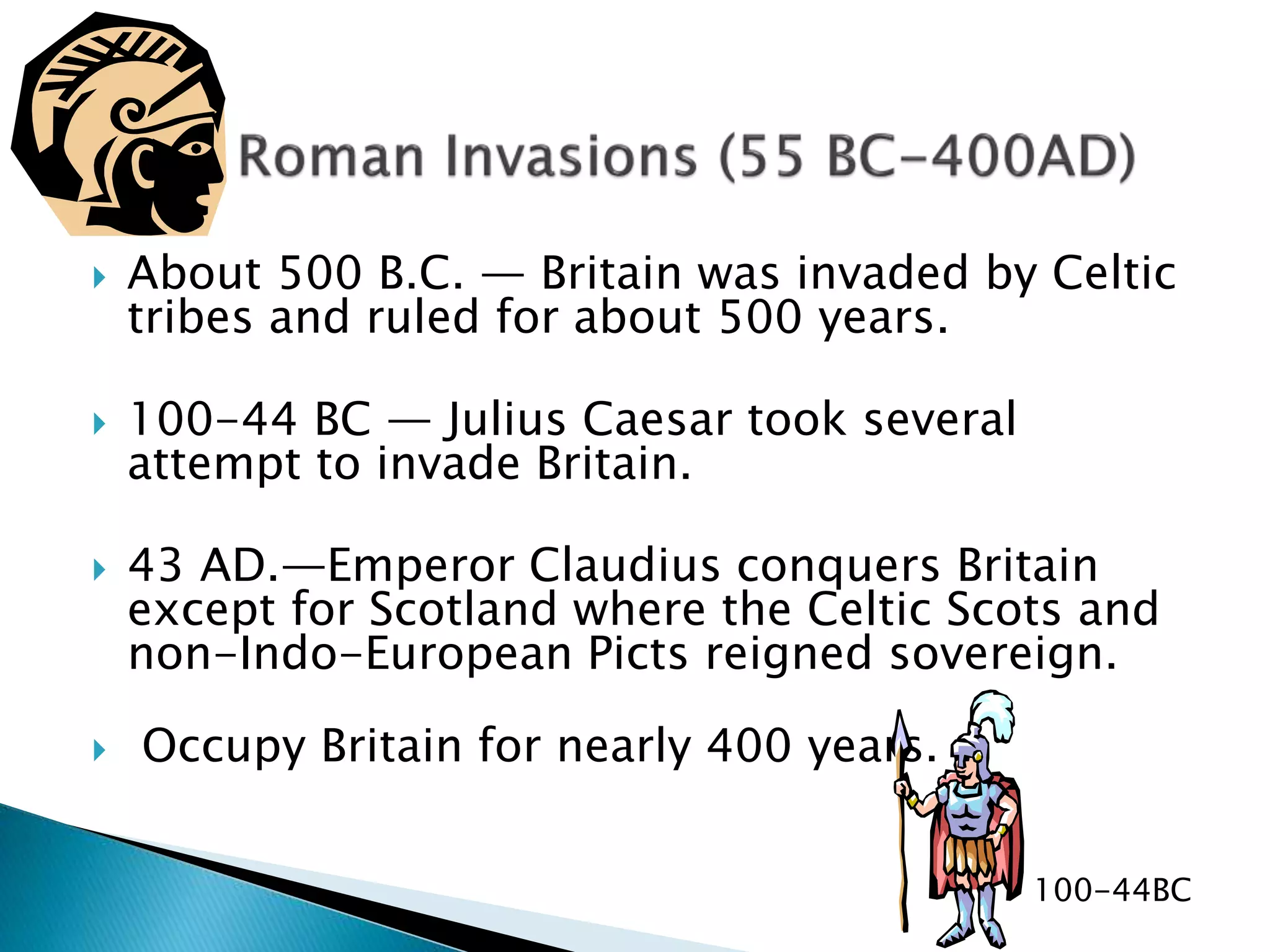
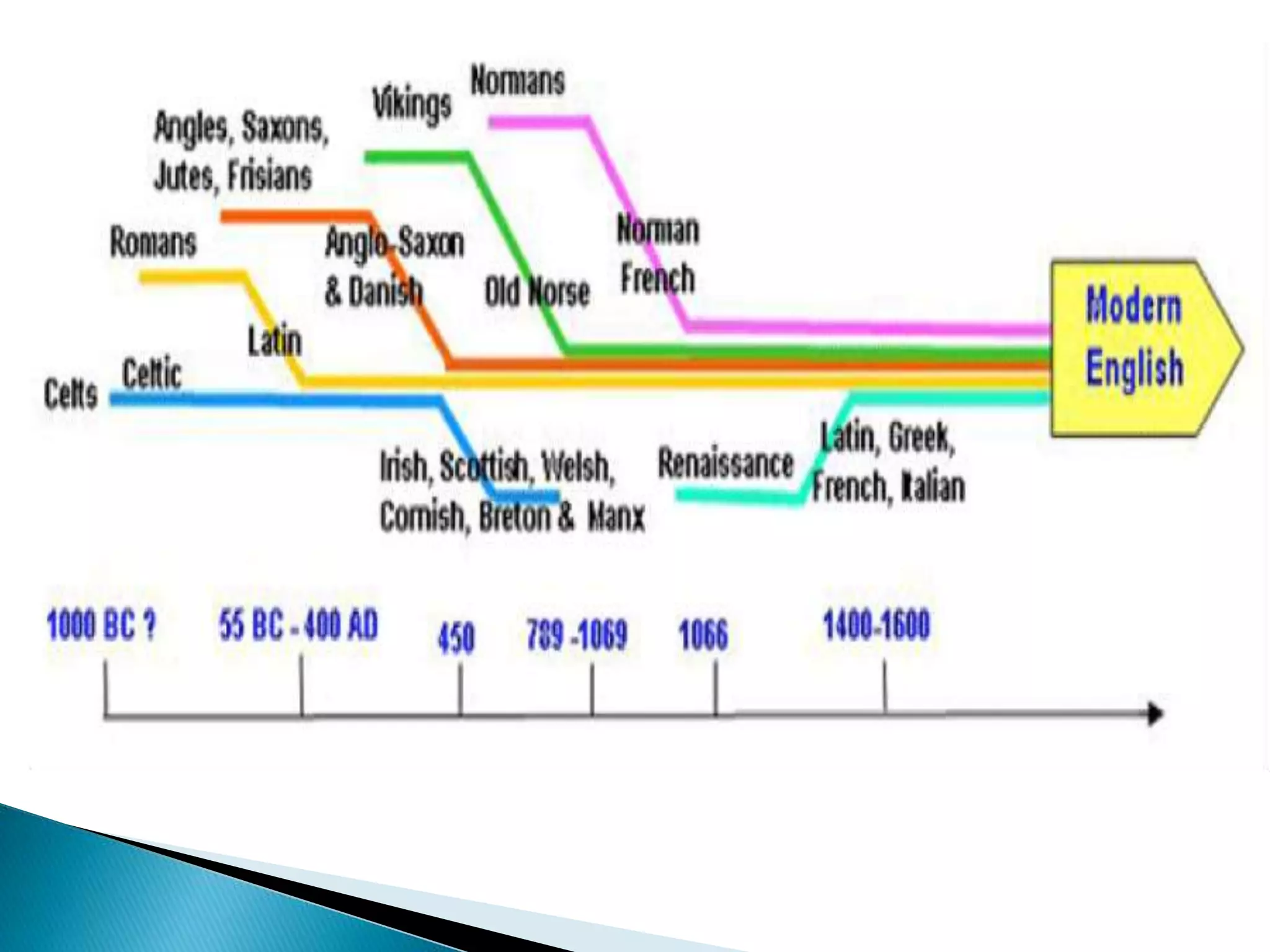
 About 500 B.C. — Britain was invaded by Celtic
tribes and ruled for about 500 years.
 100-44 BC — Julius Caesar took several
attempt to invade Britain.
 43 AD.—Emperor Claudius conquers Britain
except for Scotland where the Celtic Scots and
non-Indo-European Picts reigned sovereign.
 Occupy Britain for nearly 400 years.
100-44BC
 Founded cities
 Built walls, baths, roads, theaters
 Intermarried with Celts.
 Place names—Lancaster, Manchester,
Winchester, London, Bath
 Latin becomes the prestige
language of education
and social life
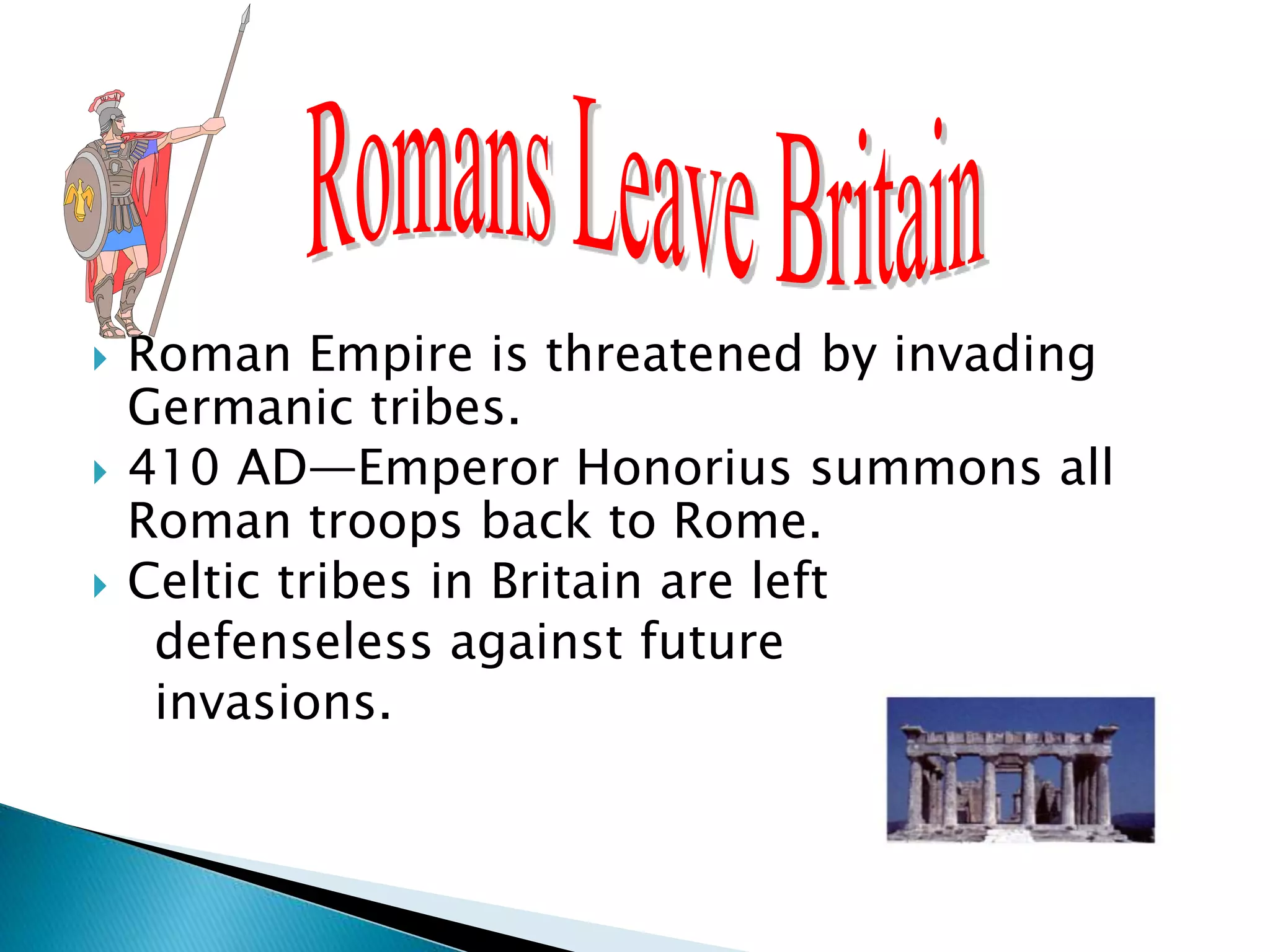
 Roman Empire is threatened by invading
Germanic tribes.
 410 AD—Emperor Honorius summons all
Roman troops back to Rome.
 Celtic tribes in Britain are left
defenseless against future
invasions.
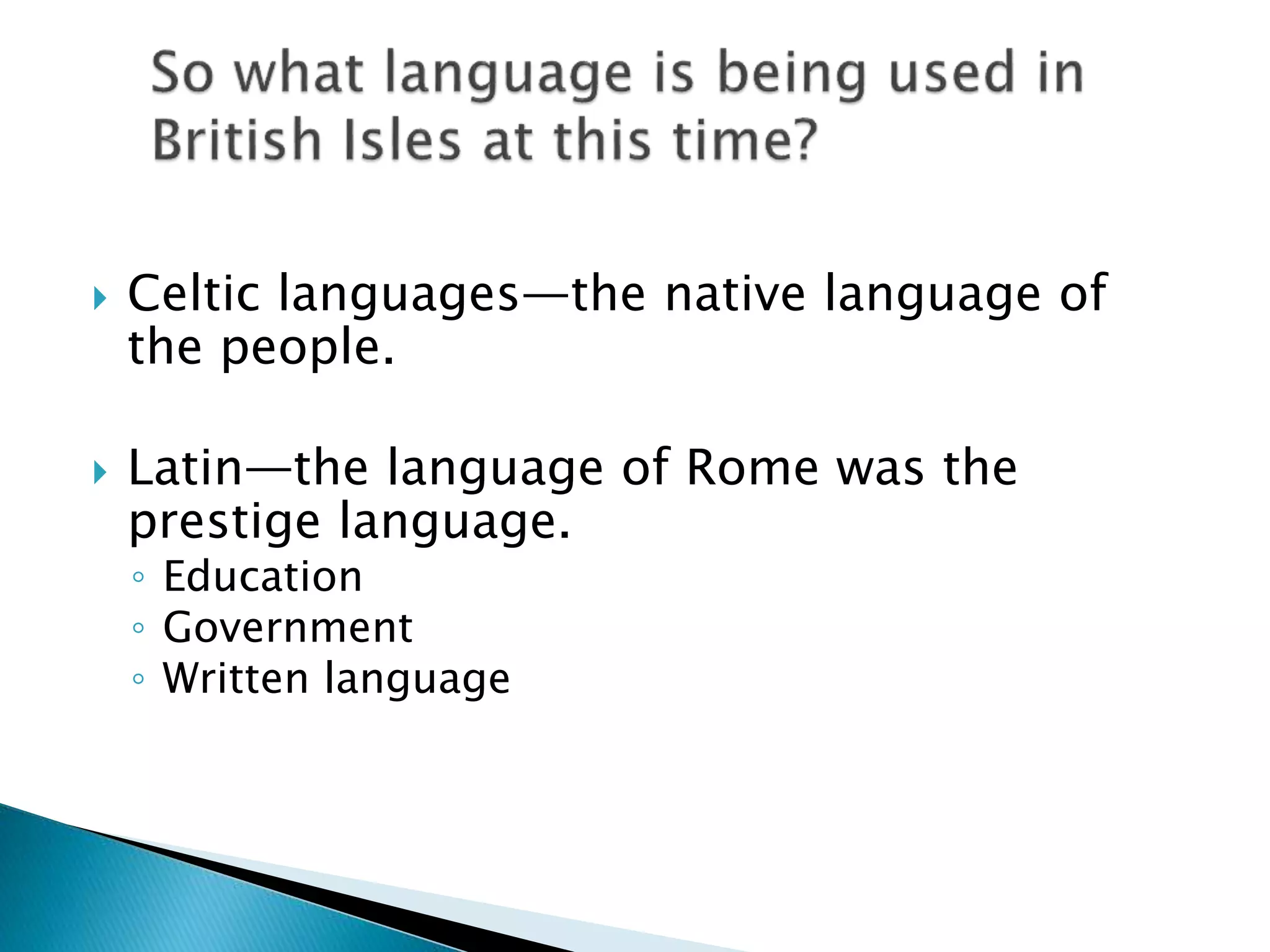
 Celtic languages—the native language of
the people.
 Latin—the language of Rome was the
prestige language.
◦ Education
◦ Government
◦ Written language
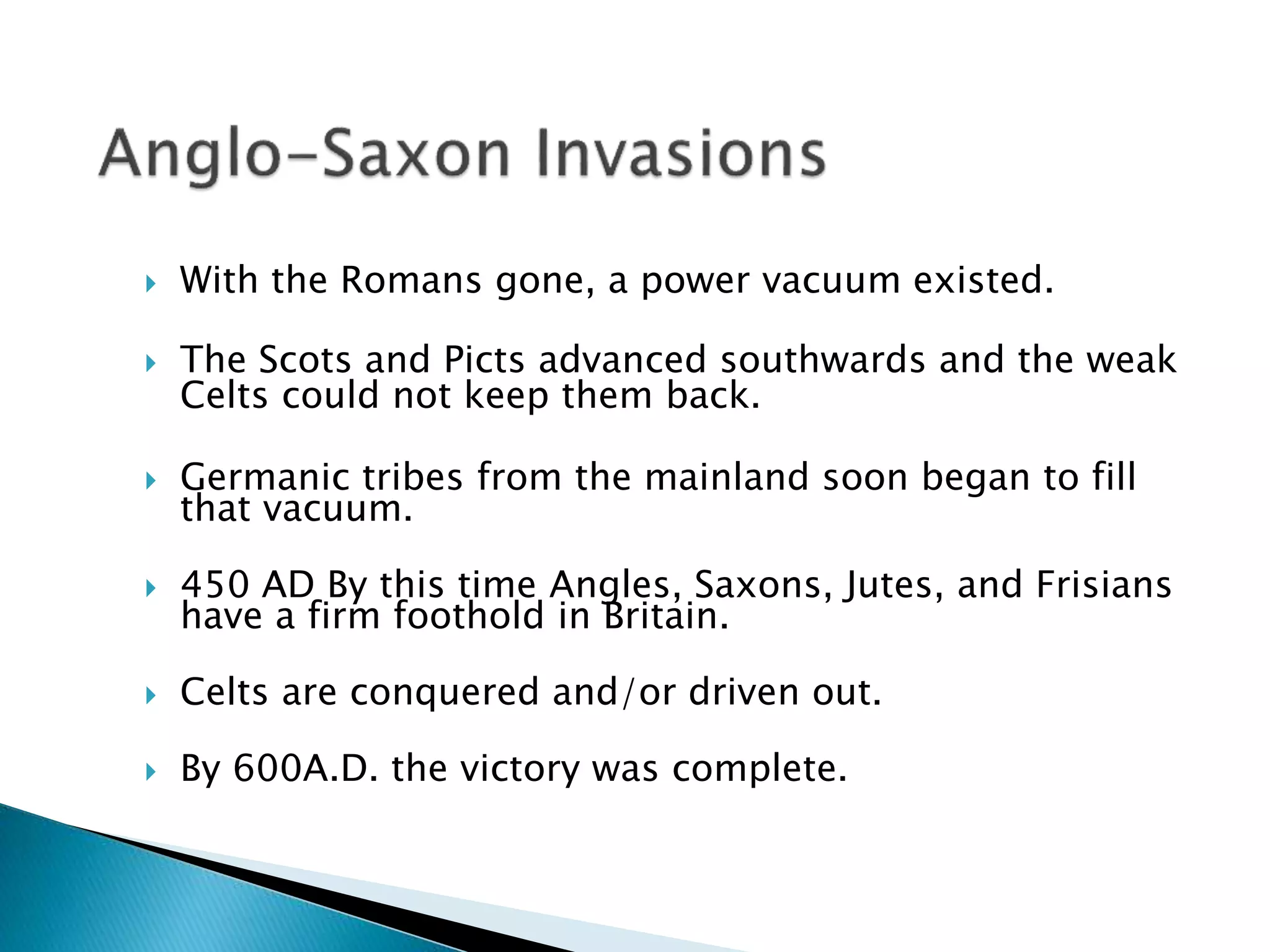
 With the Romans gone, a power vacuum existed.
 The Scots and Picts advanced southwards and the weak
Celts could not keep them back.
 Germanic tribes from the mainland soon began to fill
that vacuum.
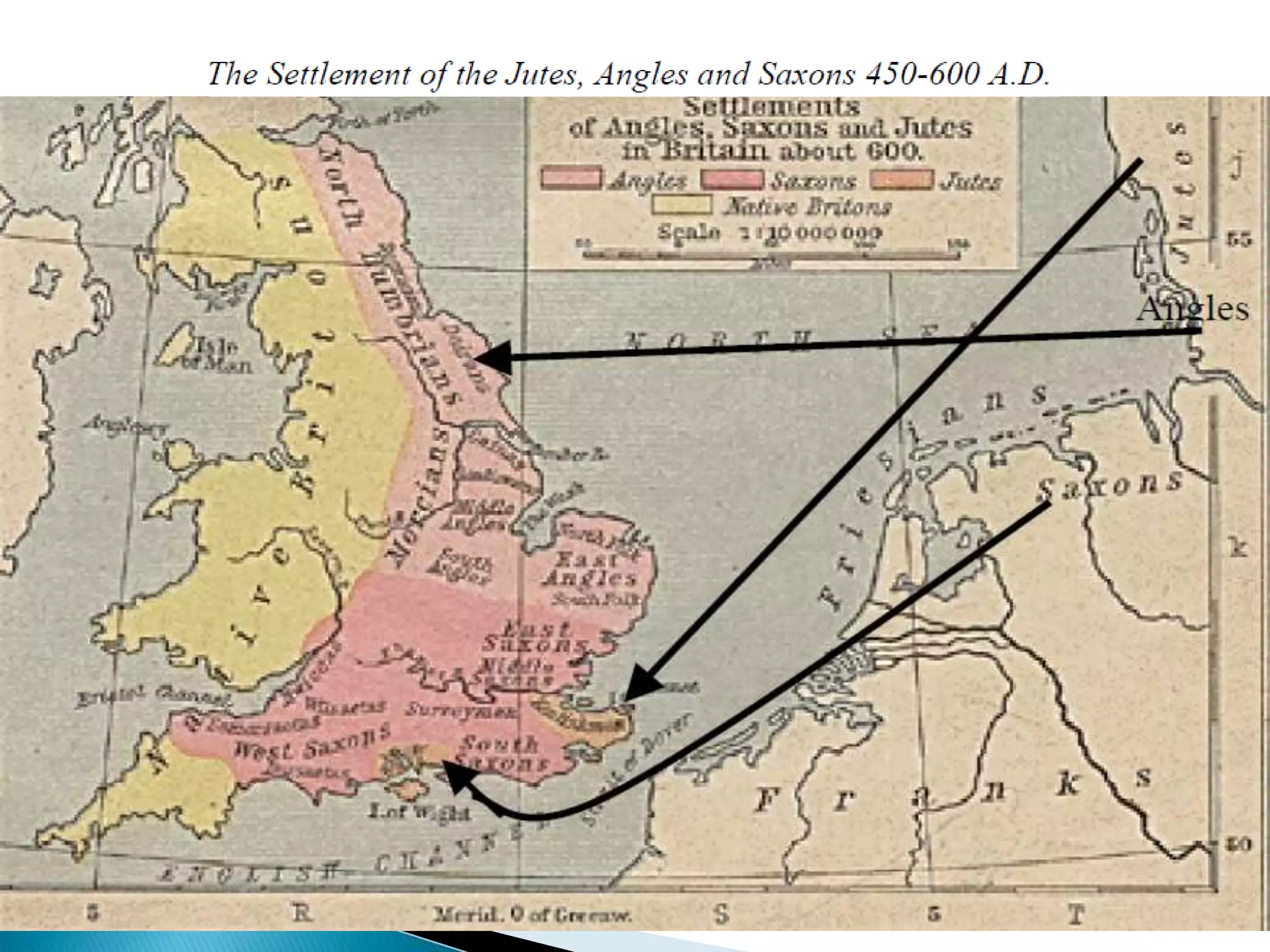
 450 AD By this time Angles, Saxons, Jutes, and Frisians
have a firm foothold in Britain.
 Celts are conquered and/or driven out.
 By 600A.D. the victory was complete.
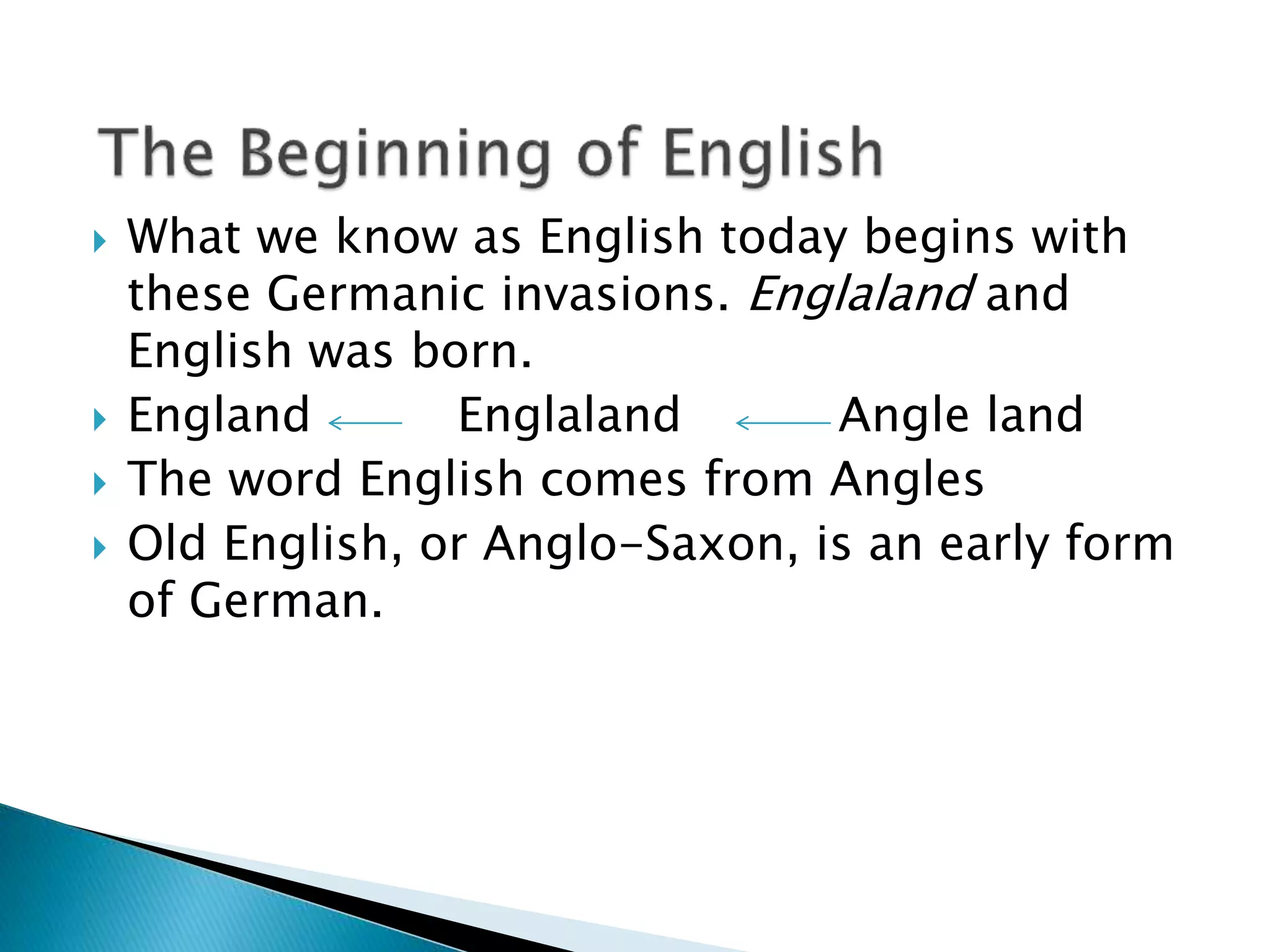
 What we know as English today begins with
these Germanic invasions. Englaland and
English was born.
 England Englaland Angle land
 The word English comes from Angles
 Old English, or Anglo-Saxon, is an early form
of German.
 Kent
 Essex (East Saxon)
 Sussex (South Saxon)
 Wessex (West Saxon)
 Mercia (angeles)
 Northumbria (Angeles)
 East Angeles
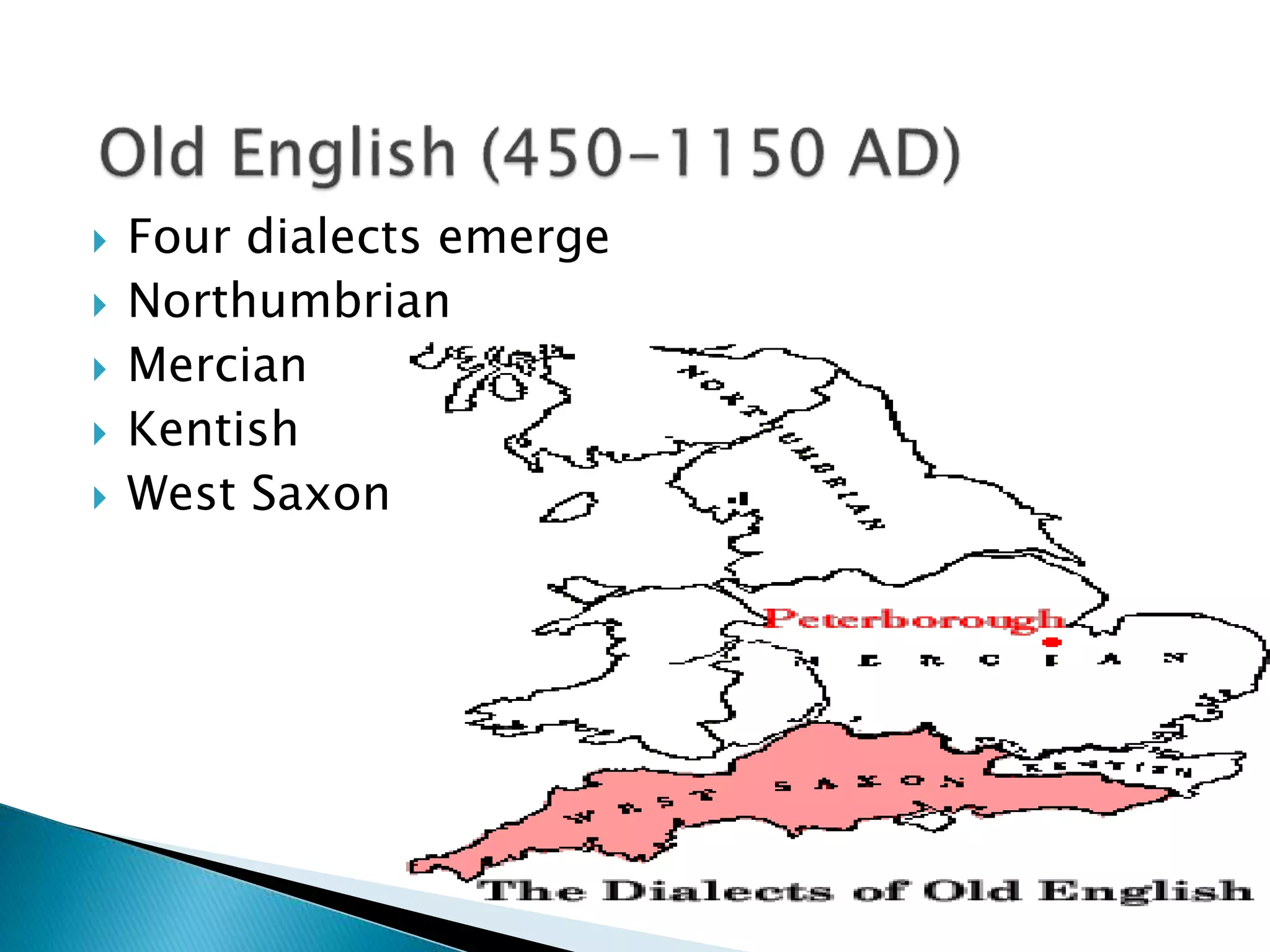
 Four dialects emerge
 Northumbrian
 Mercian
 Kentish
 West Saxon
 Most important OE dialect
 Most OE literature is in West Saxon
 Dialect of King Alfred (AD 899)
 Dialect of government and church
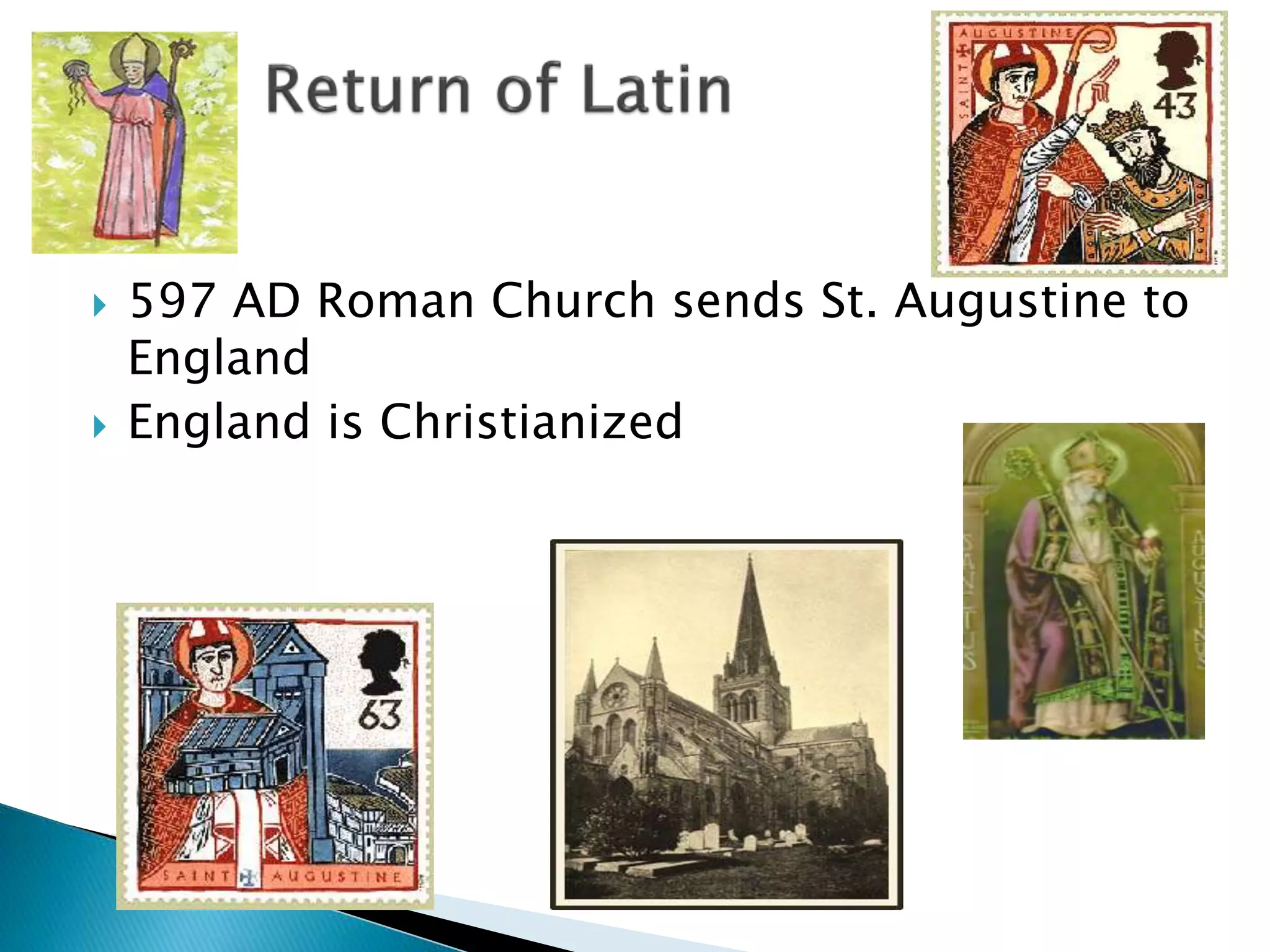
 597 AD Roman Church sends St. Augustine to
England
 England is Christianized
 Latin is the language of the church
 Latin once again becomes prominent in
education
 Latin is the written language of the time
 Various dialects of Old English
 All these dialects are forms of German
 These dialects also adopt some words from
Celtic languages and from Latin
 Most powerful people of their time
 793 AD. Vikings invade England
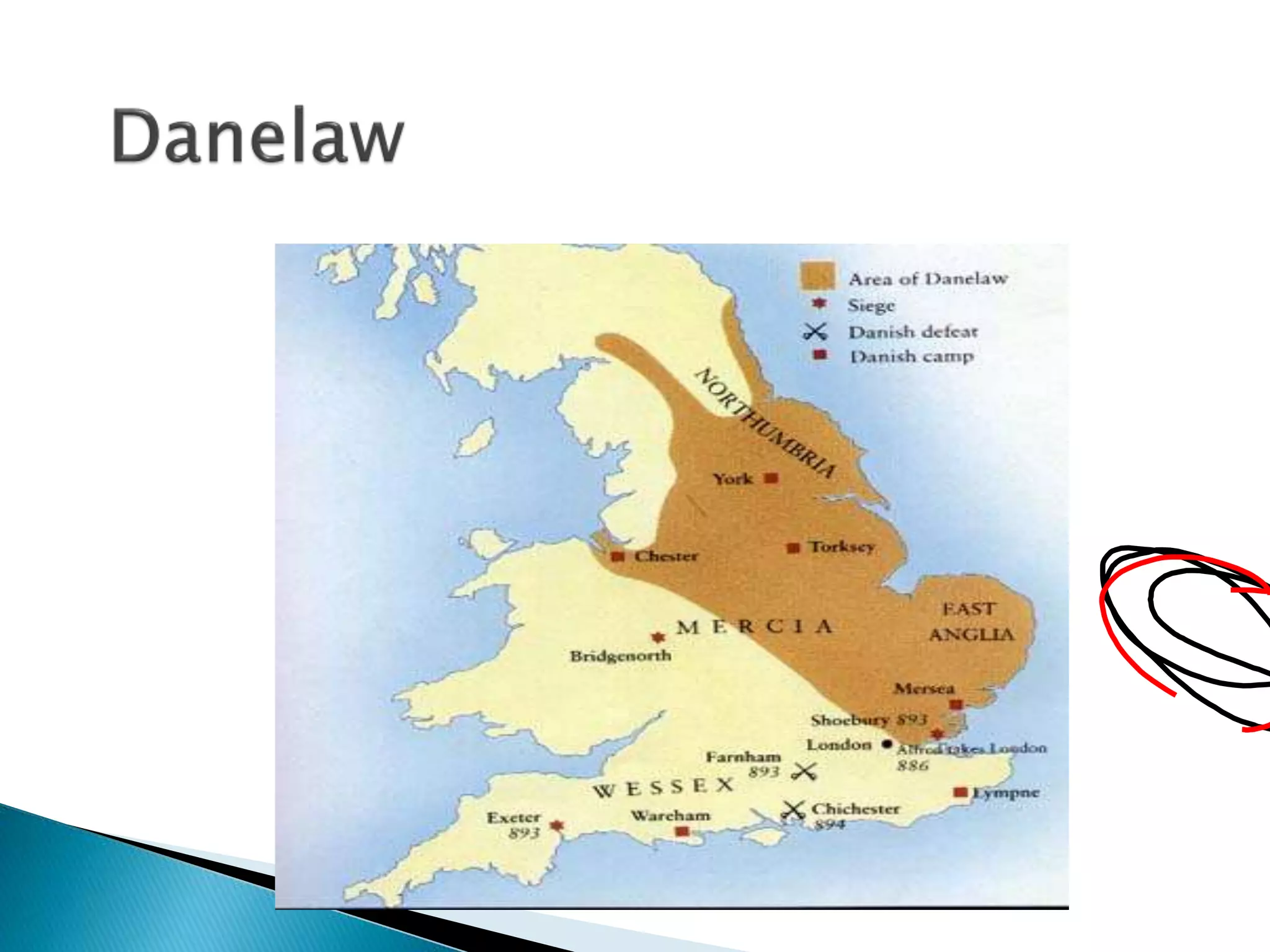
 Eventually, Vikings control much of England
◦ The Vikings, usually referred to as ‘Danes’
◦ This area is called the Danelaw
 Anglo-Saxons continued to control much of
the south
 Alfred the Great put up resistance them and
eventually forced the Viking troops to
surrender in 878.
 Various dialects of Old English
 These dialects continue to be influenced by
Latin and Celtic
 They are also now influenced by Scandinavian
languages
 Anglo-Saxon words: to, and, for, in, man,
wife, child, fight, love, sleep, eat, house,
Tuesday, Wednesday, Thursday, Friday
 Latin words: altar, monk, preach, priest,
hymn, noon, candle, offer
 Viking words: lift, take, give, husband, sky,
dirt, skull, leg, rotten, crawl, clasp
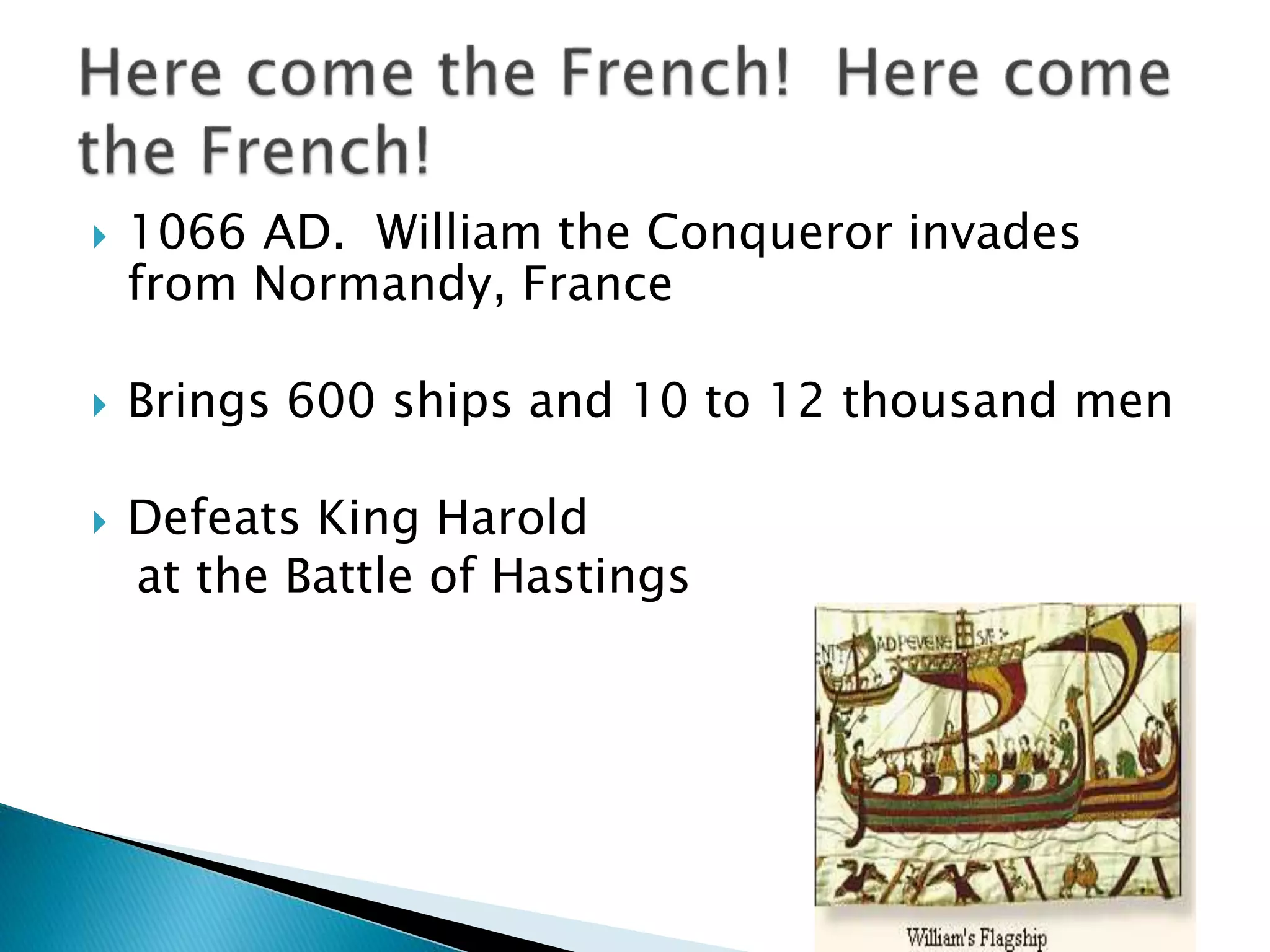
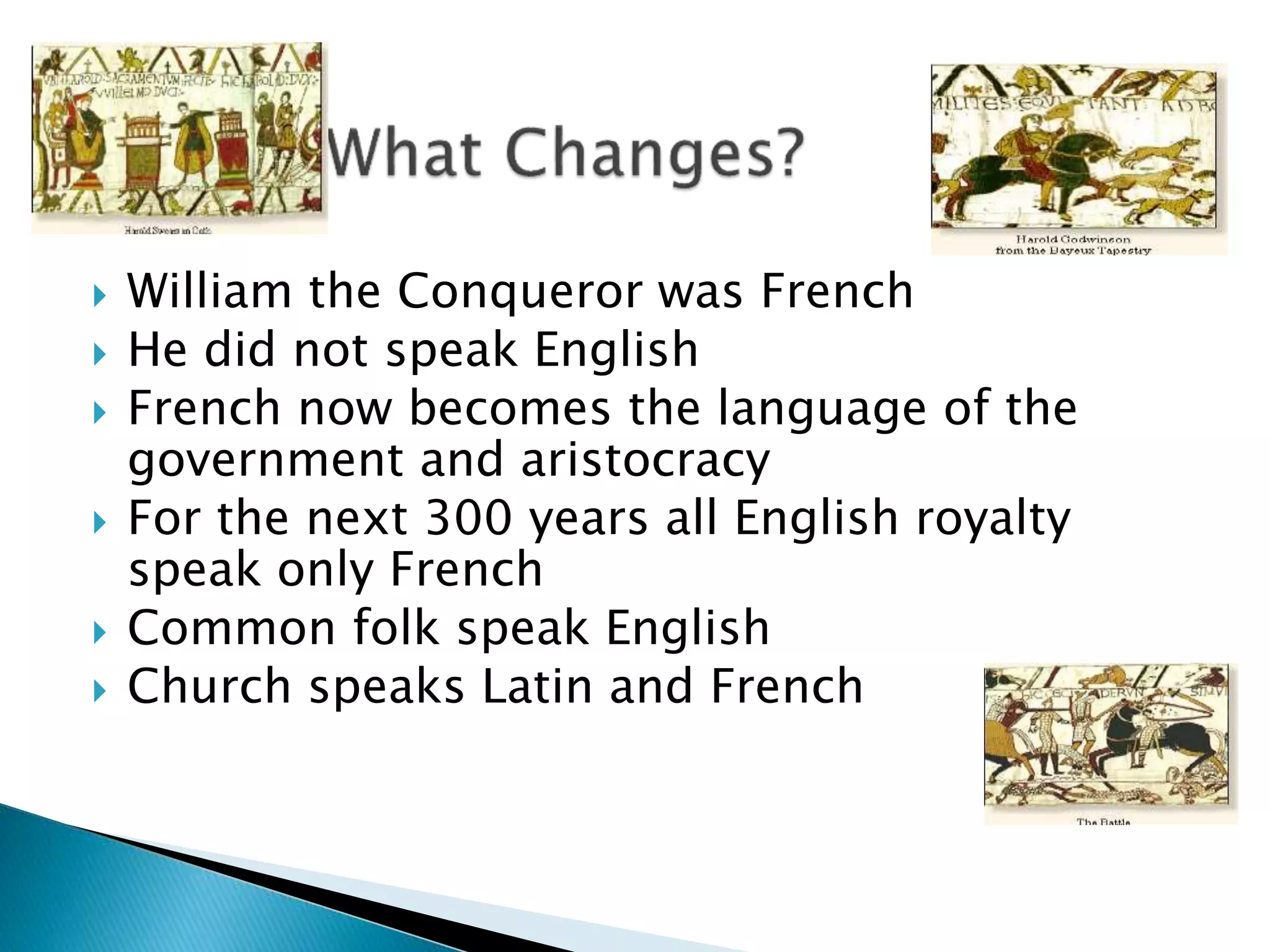
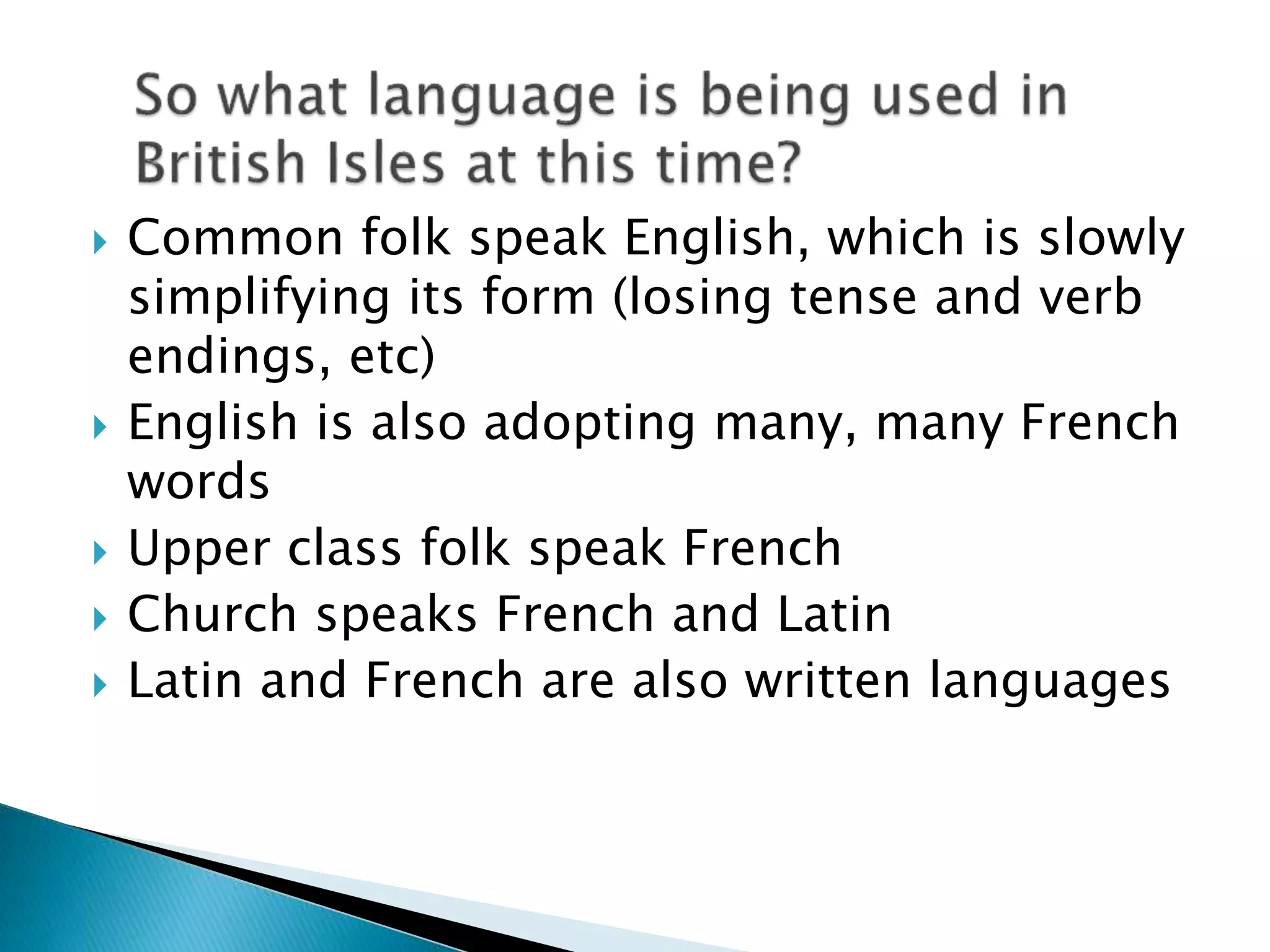
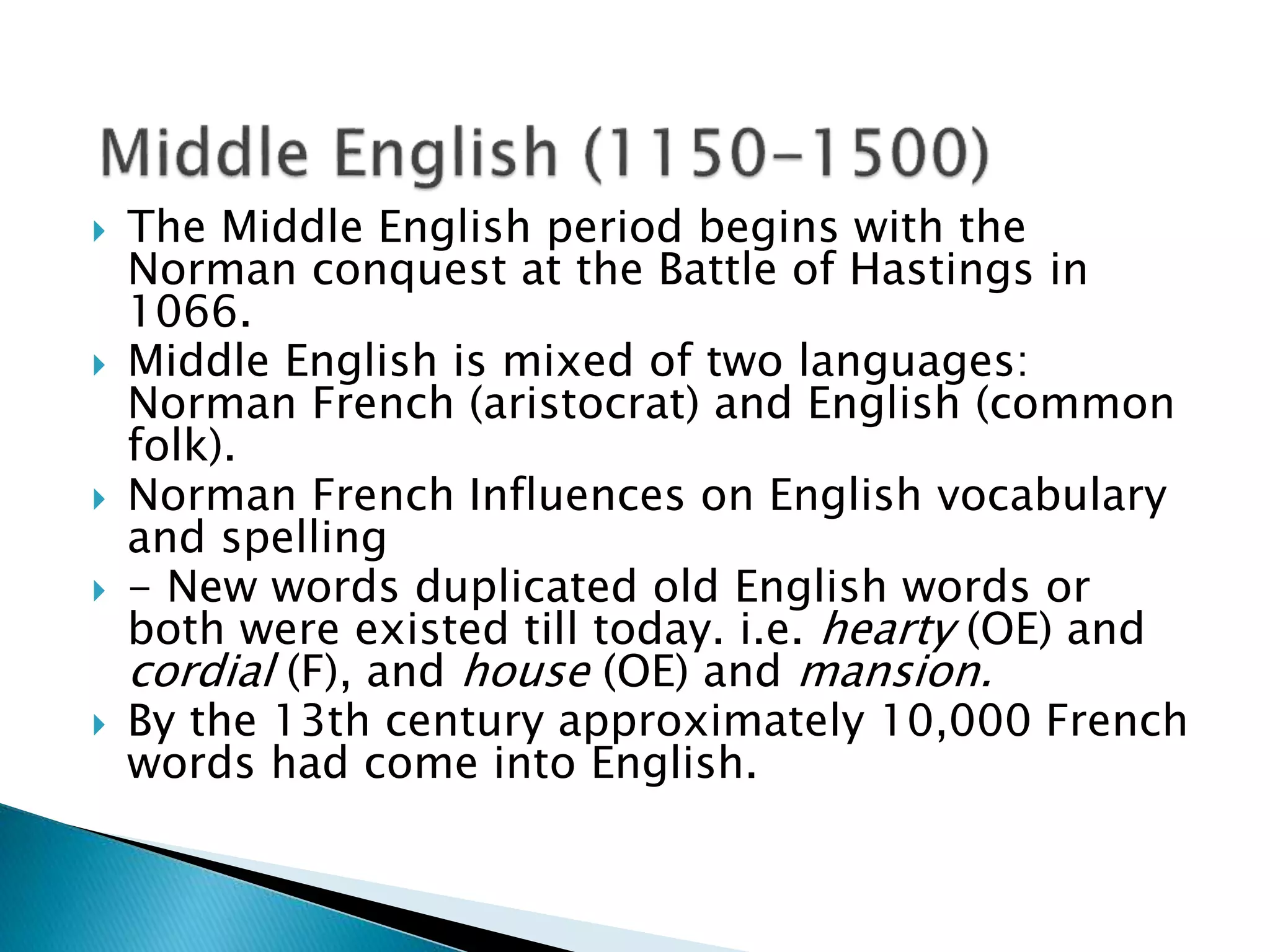
 1066 AD. William the Conqueror invades
from Normandy, France
 Brings 600 ships and 10 to 12 thousand men
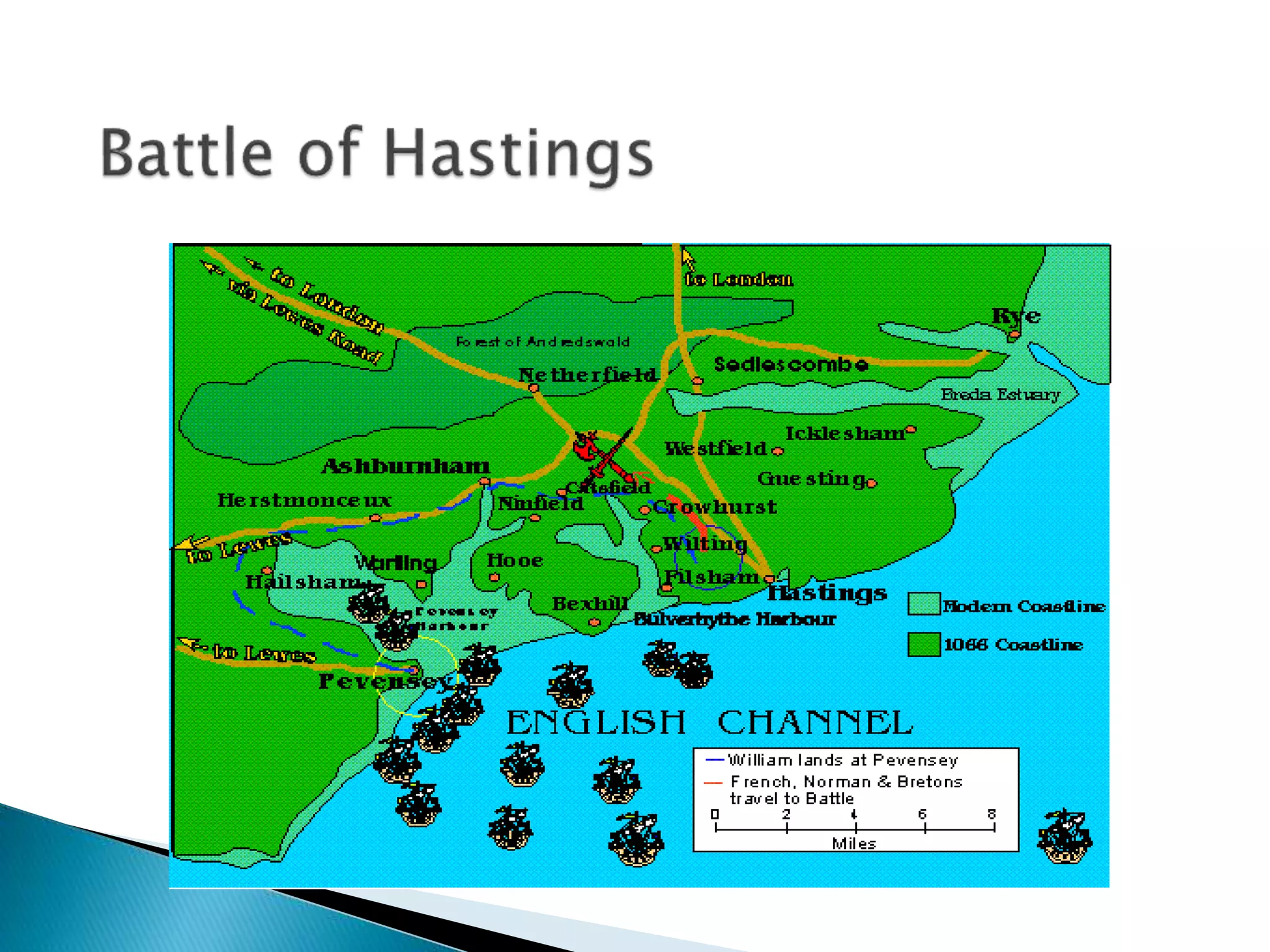
 Defeats King Harold
at the Battle of Hastings
 William the Conqueror was French
 He did not speak English
 French now becomes the language of the
government and aristocracy
 For the next 300 years all English royalty
speak only French
 Common folk speak English
 Church speaks Latin and French
 Common folk speak English, which is slowly
simplifying its form (losing tense and verb
endings, etc)
 English is also adopting many, many French
words
 Upper class folk speak French
 Church speaks French and Latin
 Latin and French are also written languages
 The Middle English period begins with the
Norman conquest at the Battle of Hastings in
1066.
 Middle English is mixed of two languages:
Norman French (aristocrat) and English (common
folk).
 Norman French Influences on English vocabulary
and spelling
 - New words duplicated old English words or
both were existed till today. i.e. hearty (OE) and
cordial (F), and house (OE) and mansion.
 By the 13th century approximately 10,000 French
words had come into English.
 French Words: action, adventure, marriage,
power, vision, beef, venison, honest, prefer,
master, court, crown
 Almost half of modern English vocabulary
comes from Latin and French
• Royalties and government officials began speaking
French
• English became language of the poor (peasants, butchers,
maids, servants)
• Also the language of poets and writers
• English kings began marrying Norman women
• More people adapted French language, causing the
decline of English usage
 In 1362AD. the Normans decided to adopt
English as their official language and,
Parliament was opened in English.
 This parliament was situated in Westminster,
London, a process of standardisation of
English had begun.
 Grammar is simplified
 Fixed word order is developed
◦ Word order dictates meaning
 Chaucer first major writer to use English
 Two major factors that influenced the
language and served to separate Middle and
Modern English were the Great Vowel Shift
and the advent of the printing press.
 The Great Vowel Shift was a change in
pronunciation that began around 1400AD.
 During the next two centuries there was a
great influx of people into the London region
and the different dialects began to affect the
pronunciation patterns of the standard.
 Modern English speakers can read Chaucer
with some difficulty, Chaucer's pronunciation
would have been completely unintelligible to
the modern ear.
 The vowel shift as a process which led to long
vowel sounds being raised and
diphthongised. Chaucer's Lyf (pronounced
/lif/), for example became the modern life.
 The last major factor in the development of
Modern English was the advent of the printing
press.
 William Caxton brought the printing press to
England in 1476.
 Books became cheaper and as a result, literacy
became more common.
 The dialect of London, where most publishing
houses were located, became the standard.
 Spelling and grammar became fixed, and the first
English dictionary was published in 1604.
• Began writing his sonnets and novels
• Created words, such as critical, leapfrog, majestic, pedant, and
dwindle
• Created clichés, such as flesh and blood, and vanish into thin
air
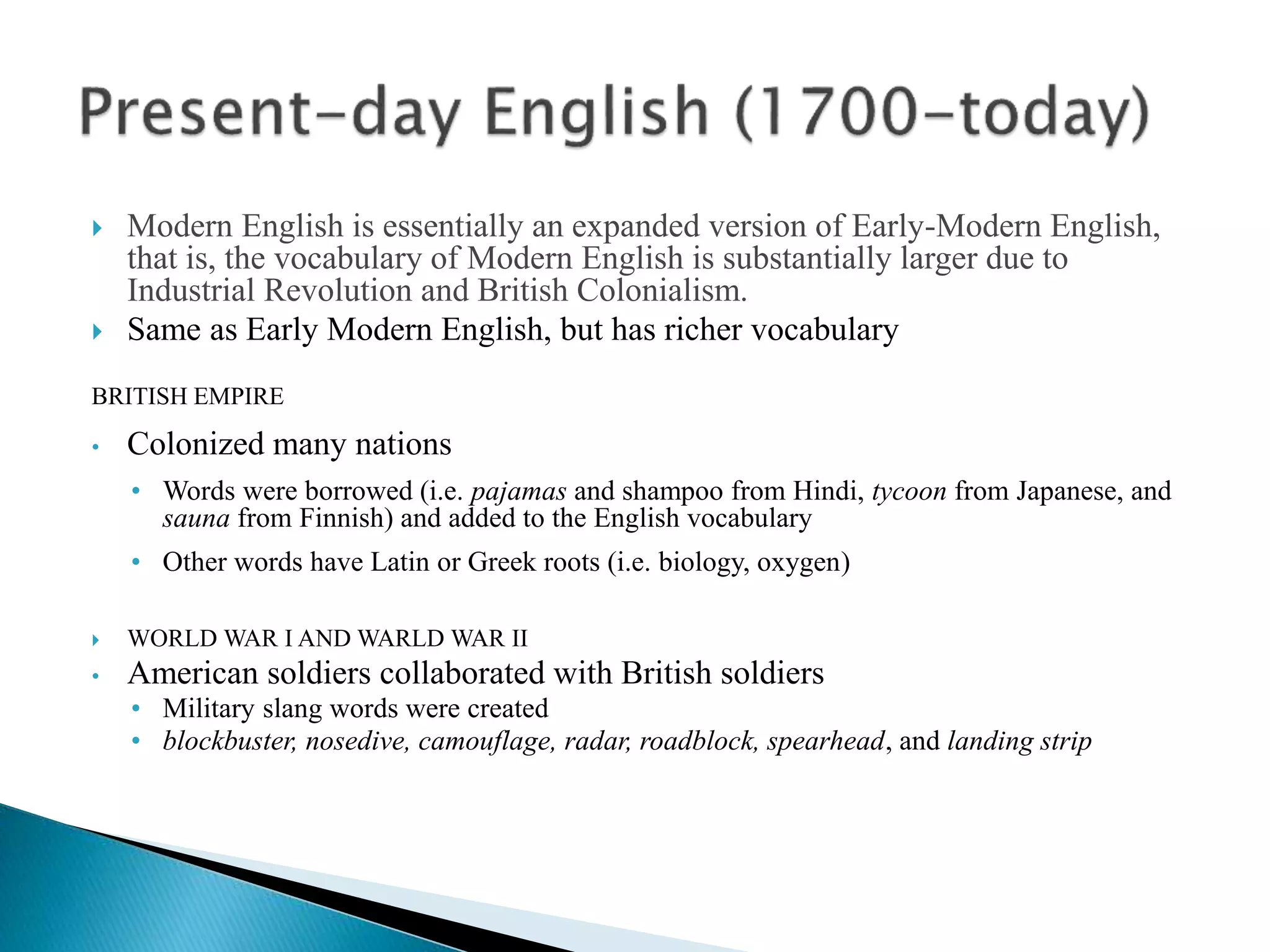
 Modern English is essentially an expanded version of Early-Modern English,
that is, the vocabulary of Modern English is substantially larger due to
Industrial Revolution and British Colonialism.
 Same as Early Modern English, but has richer vocabulary
BRITISH EMPIRE
• Colonized many nations
• Words were borrowed (i.e. pajamas and shampoo from Hindi, tycoon from Japanese, and
sauna from Finnish) and added to the English vocabulary
• Other words have Latin or Greek roots (i.e. biology, oxygen)
 WORLD WAR I AND WARLD WAR II
• American soldiers collaborated with British soldiers
• Military slang words were created
• blockbuster, nosedive, camouflage, radar, roadblock, spearhead, and landing strip
History of English Language By Moninoor Rashid

History of English Language By Moninoor Rashid

  • 2.
     England beforethe English (55 BC-450AD)  Old English  (450-1150)  Middle English  (1150-1500)  Early Modern English  (1500-1700)  Present-day English  (1700-Today)
  • 3.
     One ofthe leaves is our language, English.  The branch it has come from is West Germanic, which grows out of  Germanic, which comes from the roots of  The Indo-European family of languages.
  • 4.
     Debatable  Proto-Indo-Europeantribes (6000 years ago)  later spilt into a number of branches, including the Germanic branch  this population then expanded/migrated eastward, westward and northward and  thereby came to inhabit most of Europe and parts of Western Asia.
  • 6.
     About 500B.C. — Britain was invaded by Celtic tribes and ruled for about 500 years.  100-44 BC — Julius Caesar took several attempt to invade Britain.  43 AD.—Emperor Claudius conquers Britain except for Scotland where the Celtic Scots and non-Indo-European Picts reigned sovereign.  Occupy Britain for nearly 400 years. 100-44BC
  • 7.
     Founded cities Built walls, baths, roads, theaters  Intermarried with Celts.  Place names—Lancaster, Manchester, Winchester, London, Bath  Latin becomes the prestige language of education and social life
  • 8.
     Roman Empireis threatened by invading Germanic tribes.  410 AD—Emperor Honorius summons all Roman troops back to Rome.  Celtic tribes in Britain are left defenseless against future invasions.
  • 9.
     Celtic languages—thenative language of the people.  Latin—the language of Rome was the prestige language. ◦ Education ◦ Government ◦ Written language
  • 10.
     With theRomans gone, a power vacuum existed.  The Scots and Picts advanced southwards and the weak Celts could not keep them back.  Germanic tribes from the mainland soon began to fill that vacuum.  450 AD By this time Angles, Saxons, Jutes, and Frisians have a firm foothold in Britain.  Celts are conquered and/or driven out.  By 600A.D. the victory was complete.
  • 12.
     What weknow as English today begins with these Germanic invasions. Englaland and English was born.  England Englaland Angle land  The word English comes from Angles  Old English, or Anglo-Saxon, is an early form of German.
  • 13.
     Kent  Essex(East Saxon)  Sussex (South Saxon)  Wessex (West Saxon)  Mercia (angeles)  Northumbria (Angeles)  East Angeles
  • 14.
     Four dialectsemerge  Northumbrian  Mercian  Kentish  West Saxon
  • 15.
     Most importantOE dialect  Most OE literature is in West Saxon  Dialect of King Alfred (AD 899)  Dialect of government and church
  • 16.
     597 ADRoman Church sends St. Augustine to England  England is Christianized
  • 17.
     Latin isthe language of the church  Latin once again becomes prominent in education  Latin is the written language of the time
  • 18.
     Various dialectsof Old English  All these dialects are forms of German  These dialects also adopt some words from Celtic languages and from Latin
  • 19.
     Most powerfulpeople of their time  793 AD. Vikings invade England  Eventually, Vikings control much of England ◦ The Vikings, usually referred to as ‘Danes’ ◦ This area is called the Danelaw  Anglo-Saxons continued to control much of the south  Alfred the Great put up resistance them and eventually forced the Viking troops to surrender in 878.
  • 21.
     Various dialectsof Old English  These dialects continue to be influenced by Latin and Celtic  They are also now influenced by Scandinavian languages
  • 22.
     Anglo-Saxon words:to, and, for, in, man, wife, child, fight, love, sleep, eat, house, Tuesday, Wednesday, Thursday, Friday  Latin words: altar, monk, preach, priest, hymn, noon, candle, offer  Viking words: lift, take, give, husband, sky, dirt, skull, leg, rotten, crawl, clasp
  • 23.
     1066 AD.William the Conqueror invades from Normandy, France  Brings 600 ships and 10 to 12 thousand men  Defeats King Harold at the Battle of Hastings
  • 25.
     William theConqueror was French  He did not speak English  French now becomes the language of the government and aristocracy  For the next 300 years all English royalty speak only French  Common folk speak English  Church speaks Latin and French
  • 26.
     Common folkspeak English, which is slowly simplifying its form (losing tense and verb endings, etc)  English is also adopting many, many French words  Upper class folk speak French  Church speaks French and Latin  Latin and French are also written languages
  • 27.
     The MiddleEnglish period begins with the Norman conquest at the Battle of Hastings in 1066.  Middle English is mixed of two languages: Norman French (aristocrat) and English (common folk).  Norman French Influences on English vocabulary and spelling  - New words duplicated old English words or both were existed till today. i.e. hearty (OE) and cordial (F), and house (OE) and mansion.  By the 13th century approximately 10,000 French words had come into English.
  • 28.
     French Words:action, adventure, marriage, power, vision, beef, venison, honest, prefer, master, court, crown  Almost half of modern English vocabulary comes from Latin and French
  • 29.
    • Royalties andgovernment officials began speaking French • English became language of the poor (peasants, butchers, maids, servants) • Also the language of poets and writers • English kings began marrying Norman women • More people adapted French language, causing the decline of English usage
  • 30.
     In 1362AD.the Normans decided to adopt English as their official language and, Parliament was opened in English.  This parliament was situated in Westminster, London, a process of standardisation of English had begun.
  • 31.
     Grammar issimplified  Fixed word order is developed ◦ Word order dictates meaning  Chaucer first major writer to use English
  • 32.
     Two majorfactors that influenced the language and served to separate Middle and Modern English were the Great Vowel Shift and the advent of the printing press.
  • 33.
     The GreatVowel Shift was a change in pronunciation that began around 1400AD.  During the next two centuries there was a great influx of people into the London region and the different dialects began to affect the pronunciation patterns of the standard.  Modern English speakers can read Chaucer with some difficulty, Chaucer's pronunciation would have been completely unintelligible to the modern ear.
  • 34.
     The vowelshift as a process which led to long vowel sounds being raised and diphthongised. Chaucer's Lyf (pronounced /lif/), for example became the modern life.
  • 35.
     The lastmajor factor in the development of Modern English was the advent of the printing press.  William Caxton brought the printing press to England in 1476.  Books became cheaper and as a result, literacy became more common.  The dialect of London, where most publishing houses were located, became the standard.  Spelling and grammar became fixed, and the first English dictionary was published in 1604.
  • 36.
    • Began writinghis sonnets and novels • Created words, such as critical, leapfrog, majestic, pedant, and dwindle • Created clichés, such as flesh and blood, and vanish into thin air
  • 37.
     Modern Englishis essentially an expanded version of Early-Modern English, that is, the vocabulary of Modern English is substantially larger due to Industrial Revolution and British Colonialism.  Same as Early Modern English, but has richer vocabulary BRITISH EMPIRE • Colonized many nations • Words were borrowed (i.e. pajamas and shampoo from Hindi, tycoon from Japanese, and sauna from Finnish) and added to the English vocabulary • Other words have Latin or Greek roots (i.e. biology, oxygen)  WORLD WAR I AND WARLD WAR II • American soldiers collaborated with British soldiers • Military slang words were created • blockbuster, nosedive, camouflage, radar, roadblock, spearhead, and landing strip