THE COMMON
TONGUE
CHAPTER 1
BY GEORGE LASLUISA
ENGLISH CAME FROM:
• Germanic Warrior tribes colonizing Celtic Britons.
or
• Peaceful farmers looking for rich pastures.
• It took more than three hundred years for English to dominate as main
language.
FRISIAN LANGUAGE
• Similar to antique English. Can be identified by listening and reading
similarities.
• Laam – Lamb
• Stoarm – Storm
• Sliepe – Sleep
• Frisian came from Proto IndoEuropean.
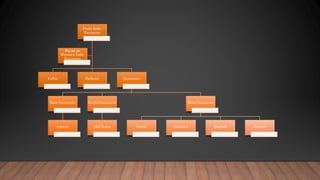
Proto Indo-
European
Celtic Hellenic Germanic
East Germanic
extinct
North Germanic
Old Norse
West Germanic
Dutch German English Frisian
Focus on
Western Indo-
European
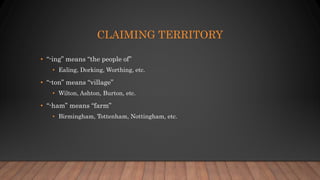
CLAIMING TERRITORY
• “-ing” means “the people of”
• Ealing, Dorking, Worthing, etc.
• “-ton” means “village”
• Wilton, Ashton, Burton, etc.
• “-ham” means “farm”
• Birmingham, Tottenham, Nottingham, etc.
LOAN WORDS
• In 635, Aidan arrived North England. Their successors fed English with
Church Latin.
• Started as pagan English, words about spiritual and religious beliefs.
• Took on Latin, Latin smuggled on Greek.
ANGLES, SAXONS AND JUTES
• The Jutes were one of the three most powerful Germanic peoples of their
time in the Nordic Iron Age.
• The Saxons were a Germanic people whose name was given in the early
Middle Ages to a large country near the North Sea coast of what is now
Germany.
• The Angles were one of the main Germanic peoples who settled in Great
Britain in the post-Roman period.
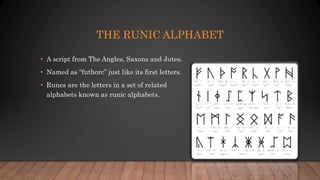
THE RUNIC ALPHABET
• A script from The Angles, Saxons and Jutes.
• Named as “futhorc” just like its first letters.
• Runes are the letters in a set of related
alphabets known as runic alphabets.
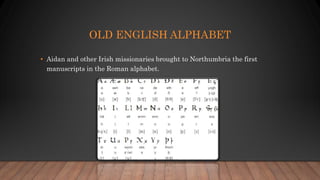
OLD ENGLISH ALPHABET
• Aidan and other Irish missionaries brought to Northumbria the first
manuscripts in the Roman alphabet.
ENGLISH IS BEING WRITTEN
• In the early 80th century was written the Lindisfarne Gospels in
Northumbria and The Ecclesiastical History of English People in Jarrow in
the monastery of St. Paul.
• During the seventh, eight century is dated The Wanderer, The Seafarer
and Beowulf.
• The Exeter Book is a tenth-century book which is an anthology of Anglo-
Saxon poetry.
THE GREAT SCAPE
CHAPTER 2
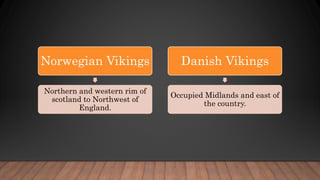
Norwegian Vikings
Northern and western rim of
scotland to Northwest of
England.
Danish Vikings
Occupied Midlands and east of
the country.
ALFRED AND THE BATTLE OF
ETHANDUNE
• Danes destroyed manuscripts and burned the great library of Jarrow.
• In 865, they settled in East Anglia and attacked south.
• In 878, they won and almost disappeared the last old kingdom.
• Alfred was the leader of the Wessex the last English army who escaped.
• Alfred used for first time the word “Englisc” to describe the language.
• He conducted an intense program to educate in English.
• In 878, Alfred joined 4000 men from Wiltshire and Somerset.
• In the last attack the Danes surrendered and their leader was baptized as Christian.
AFTER WAR
• Alfred knew the Danish will not subjugate.
• He divided the land, to the north and east for the Danelaw under Danish
rule.
• The south and west for the core of the new England.
• Crossing was not allowed, save for specific purposes or trading.
• Trade refined the language and made it more flexible.
• English had an immense capacity to absorb, to convert, to take on board
other languages.
VIKING NAMING REMAINS
• Ending “-by” means “farm or town”
• Corby, Thornby, Rugby, etc.
• Ending “-thorpe“ means “village”
• Scunthorpe, Althorp, etc.
• Ending “-thwaite“ is “a portion of land”.
• Ruthwaite, Micklethwaite, etc.
• Ending “-toft” means “homestead”
• Lowestoft, Eastoft, Sandtoft, etc.
• The word “dale” was “valley”
• Langdale, Patterdale, etc.
OLD ENGLISH STRUCTURE
• It was commonly Subject + Verb + Object, but it has not a rule.
• It was necessary to use forms to give meaning to verbs and directional to
point out the subject or the object.
• Commerce needed fast talking and high comprehension, it was the end of
word endings.
• Prepositions came in and made the order of words important.
DIALECTS
• In Britain, hybrid county dialects are disappearing due to people moving to
bigger or main cities of a language.
• Wigton Dialect: ‘I’ pronounced ‘Aah’, ‘the’ as ‘t’
• For Romany ‘horse’ was ‘grey’ or ‘book’ as ‘byeuk’
• Anglo-Saxon ‘to go’ is ‘gaan’, ‘gangan’, ‘gan’
• Old Nrose ‘Leika’ is ‘play’
• Scandinavian ‘clarty’ is ‘muddy’
BATTLE OF MALDON
• In 991, Danes attacked again and won.
• But thanks to Alfred, the language was already settled and cannot be
extinguished.
• There is a poem to describe the Battle of Maldon that was written in Old
English.
• Even Latin was thought using English as basis.
• Pupils expressed their own feelings and beliefs in English as natural.

Learning activity 1.1

  • 1.
  • 2.
    ENGLISH CAME FROM: •Germanic Warrior tribes colonizing Celtic Britons. or • Peaceful farmers looking for rich pastures. • It took more than three hundred years for English to dominate as main language.
  • 3.
    FRISIAN LANGUAGE • Similarto antique English. Can be identified by listening and reading similarities. • Laam – Lamb • Stoarm – Storm • Sliepe – Sleep • Frisian came from Proto IndoEuropean.
  • 4.
    Proto Indo- European Celtic HellenicGermanic East Germanic extinct North Germanic Old Norse West Germanic Dutch German English Frisian Focus on Western Indo- European
  • 5.
    CLAIMING TERRITORY • “-ing”means “the people of” • Ealing, Dorking, Worthing, etc. • “-ton” means “village” • Wilton, Ashton, Burton, etc. • “-ham” means “farm” • Birmingham, Tottenham, Nottingham, etc.
  • 6.
    LOAN WORDS • In635, Aidan arrived North England. Their successors fed English with Church Latin. • Started as pagan English, words about spiritual and religious beliefs. • Took on Latin, Latin smuggled on Greek.
  • 7.
    ANGLES, SAXONS ANDJUTES • The Jutes were one of the three most powerful Germanic peoples of their time in the Nordic Iron Age. • The Saxons were a Germanic people whose name was given in the early Middle Ages to a large country near the North Sea coast of what is now Germany. • The Angles were one of the main Germanic peoples who settled in Great Britain in the post-Roman period.
  • 8.
    THE RUNIC ALPHABET •A script from The Angles, Saxons and Jutes. • Named as “futhorc” just like its first letters. • Runes are the letters in a set of related alphabets known as runic alphabets.
  • 9.
    OLD ENGLISH ALPHABET •Aidan and other Irish missionaries brought to Northumbria the first manuscripts in the Roman alphabet.
  • 10.
    ENGLISH IS BEINGWRITTEN • In the early 80th century was written the Lindisfarne Gospels in Northumbria and The Ecclesiastical History of English People in Jarrow in the monastery of St. Paul. • During the seventh, eight century is dated The Wanderer, The Seafarer and Beowulf. • The Exeter Book is a tenth-century book which is an anthology of Anglo- Saxon poetry.
  • 11.
  • 12.
    Norwegian Vikings Northern andwestern rim of scotland to Northwest of England. Danish Vikings Occupied Midlands and east of the country.
  • 13.
    ALFRED AND THEBATTLE OF ETHANDUNE • Danes destroyed manuscripts and burned the great library of Jarrow. • In 865, they settled in East Anglia and attacked south. • In 878, they won and almost disappeared the last old kingdom. • Alfred was the leader of the Wessex the last English army who escaped. • Alfred used for first time the word “Englisc” to describe the language. • He conducted an intense program to educate in English. • In 878, Alfred joined 4000 men from Wiltshire and Somerset. • In the last attack the Danes surrendered and their leader was baptized as Christian.
  • 14.
    AFTER WAR • Alfredknew the Danish will not subjugate. • He divided the land, to the north and east for the Danelaw under Danish rule. • The south and west for the core of the new England. • Crossing was not allowed, save for specific purposes or trading. • Trade refined the language and made it more flexible. • English had an immense capacity to absorb, to convert, to take on board other languages.
  • 15.
    VIKING NAMING REMAINS •Ending “-by” means “farm or town” • Corby, Thornby, Rugby, etc. • Ending “-thorpe“ means “village” • Scunthorpe, Althorp, etc. • Ending “-thwaite“ is “a portion of land”. • Ruthwaite, Micklethwaite, etc. • Ending “-toft” means “homestead” • Lowestoft, Eastoft, Sandtoft, etc. • The word “dale” was “valley” • Langdale, Patterdale, etc.
  • 16.
    OLD ENGLISH STRUCTURE •It was commonly Subject + Verb + Object, but it has not a rule. • It was necessary to use forms to give meaning to verbs and directional to point out the subject or the object. • Commerce needed fast talking and high comprehension, it was the end of word endings. • Prepositions came in and made the order of words important.
  • 17.
    DIALECTS • In Britain,hybrid county dialects are disappearing due to people moving to bigger or main cities of a language. • Wigton Dialect: ‘I’ pronounced ‘Aah’, ‘the’ as ‘t’ • For Romany ‘horse’ was ‘grey’ or ‘book’ as ‘byeuk’ • Anglo-Saxon ‘to go’ is ‘gaan’, ‘gangan’, ‘gan’ • Old Nrose ‘Leika’ is ‘play’ • Scandinavian ‘clarty’ is ‘muddy’
  • 18.
    BATTLE OF MALDON •In 991, Danes attacked again and won. • But thanks to Alfred, the language was already settled and cannot be extinguished. • There is a poem to describe the Battle of Maldon that was written in Old English. • Even Latin was thought using English as basis. • Pupils expressed their own feelings and beliefs in English as natural.