The Anglo-Saxon Period
       449-1066


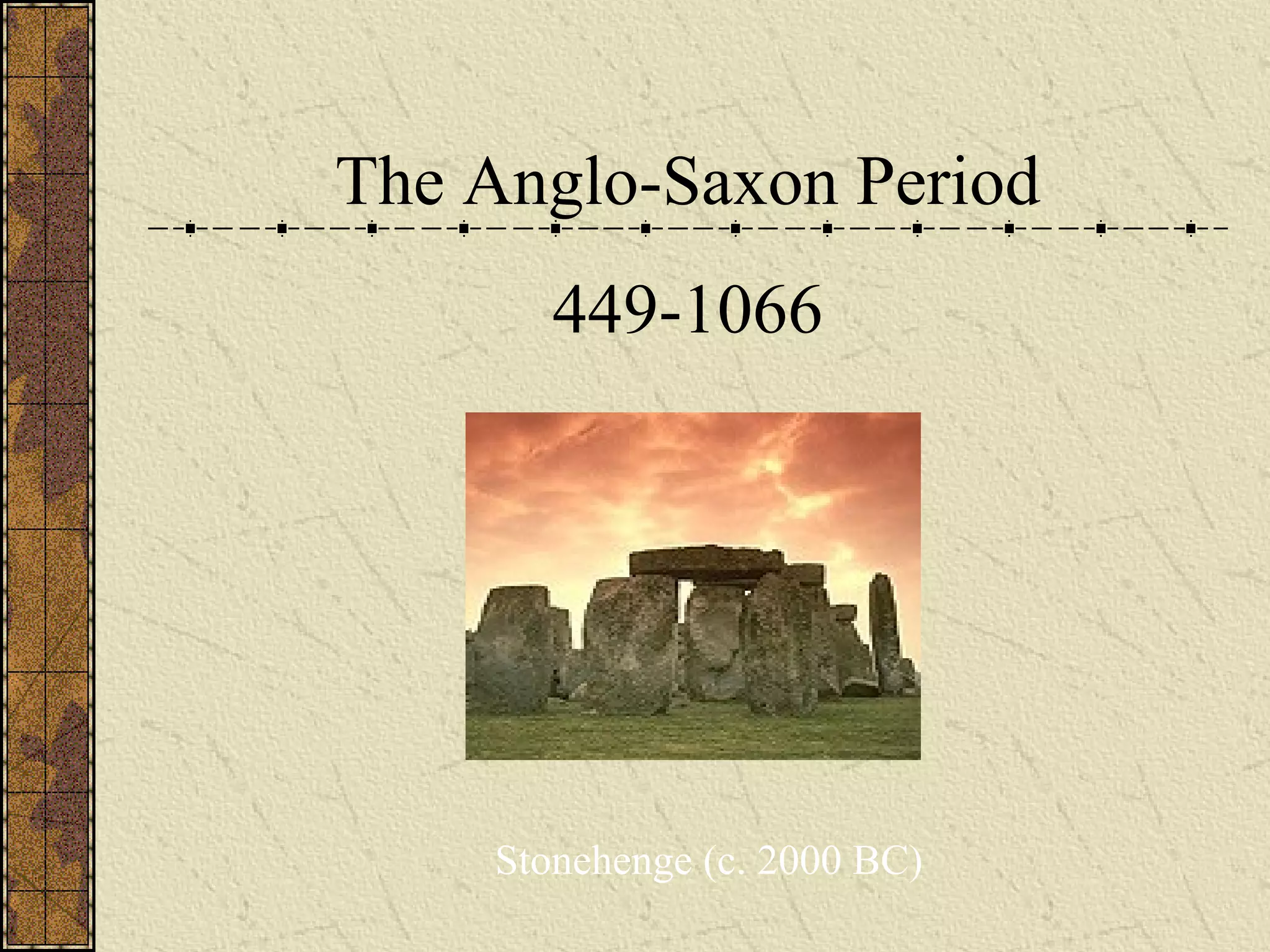
    Stonehenge (c. 2000 BC)
Celtic Invasion
Between 800 and 600 BC, two groups of
  Celts moved into the British isles:
  The Britons settled in Britain.
  The Gaels settled in Ireland.
Julius Caesar described the Celts as:
  Light-skinned, fair-haired, and blue eyed
  Shepherds, farmers, fierce fighters
  Artistic, imaginative, loved beauty
  Skilled with tin and iron
The Celts
 Farmers and hunters
 Organized into tightly knit clans
 Skilled artisans
 Introduced the use of iron to Europe
 Highly developed religion, mythology, and
 legal system that specified individual rights
The Celts (con’t)
 Disputes were settled by a class of priests
 known as Druids
 Druids presided over religious rituals
 (sacrifices and prayers)
 Druids also memorized and recited long,
 heroic poems to preserve the people’s
 history
 Celtic legends are full of strong women,
 like Queen Maeve of Connacht in Ireland.
Celtic Religion
Animism:
 From the Latin word for “spirit”
 Saw spirit everywhere: in rivers, trees,
 stones, ponds, fire, and thunder
 Spirits or gods controlled all aspects of
 existence and had to be constantly satisfied.
 Druids acted as intermediaries between the
 gods and people.
The Roman Conquest
In 55 BC and 56 BC, Julius Caesar made hasty
invasions.
True conquest, however, occurred 100 years later
under the Roman emperor Claudius in 43 AD.
Roman rule of Britain lasted for nearly 400
years, ending only when Rome was threatened in
Italy.
The last Roman legions left for Rome in 407
AD.
Roman Rule
Constructed a system of well-paved roads
and founded cities
Erected Hadrian’s Wall to protect from
Picts and Scots
Brought skills in the art of warfare
Introduced Roman law and order
Used Latin
Introduced Christianity (597 AD)
Failed to teach the Britons much about self-
defense
Roman Rule (con’t)
Roman Roads:
 5,000 miles of stone roads
 Linked tribal capitals and towns, especially
 London, York, Winchester
 Facilitated trade, the collection of taxes, and
 the movement of troops
Hadrian’s Wall:
 Linked the North Sea and the Atlantic
 Held back the Picts and Scots for 250 years
Early Anglo-Saxon Life
 The next invaders of Britain were the Anglo-
 Saxons: the Angles, Saxons, and Jutes.
 The Angles, Saxons, and Jutes came from
 Denmark, Holland, Germany, and Scandinavia.
 The Celts resisted the invaders for a number of
 years under the leadership of a great king,
 possibly the inspiration for the legendary King
 Arthur.
Dispersal of the Britons
 To flee the Anglo-Saxons, the Britons fled to other
 parts of the island:
 Cornwall
 Wales
 Some join the Gaels in Ireland and formed a
 splinter groups known as the Scots (This group
 later settled in what is now Scotland).
 In all areas, the people spoke the Celtic languages
 (Cornish, Welsh, Irish, and Scottish Gaelic). All
 but Cornish are still spoken today.
Anglo-Saxon Society
highly organized tribal units (kingdoms)
Each tribe ruled by a king chosen by a
council of elders (witan)
Thanes: the upper class, earls, or free
warriors
Thralls: slaves who did the farming and
domestic work
Freemen: small group who earned
possessions and special favors
Anglo-Saxon Society (con’t)
The Anglo-Saxons farmed, maintained local
governments, and created fine crafts, especially
metalwork.
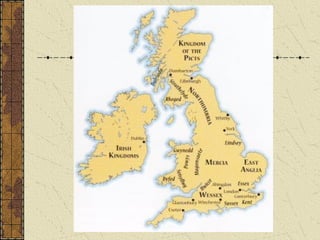
Eventually, the small kingdoms developed into seven
large ones: Northumbria, Mercia, Wessex, Sussex, Essex,
East Anglia, and Kent.
This development produced a new language: Old
English.
Lived close to their animals (to protect animals and
provide warmth)
Lived in single-family homes surrounding a communal
hall and protected by a wooden stockade fence
Characteristics of the Anglo-Saxons
 Hard fighters and bold sea warriors
 Admired physical strength, bravery, loyalty,
 fairness, and honesty
 Great love of personal freedom
 Boastful, reckless, cruel, and bloodthirsty
 Enjoyed conflict, swimming matches, horse races,
 banqueting, drinking mead, singing songs, and
 storytelling
 Also flyting, a conflict of wits between two
 warriors where each praises his own deeds and
 belittles the other’s
Role of Women
 The wife of an earl or thane supervised
 weaving and dyeing of clothes, the
 slaughter of livestock, the making of bread,
 beekeeping, and the brewing of mead
 (fermented honey).
 Women inherited and held property.
 Married women retained control over their
 property.
 With the coming of Christianity, many
 women entered religious communities, and
 some became powerful abbesses.
The Scops
 The communal hall offered shelter and a place for
 council meetings.
 The communal hall was also a place for
 storytellers or bards (scops) who shared (orally)
 the stories of the Anglo-Saxons and their gods and
 heroes.
 The Anglo-Saxons valued storytelling as equal to
 fighting, hunting, and farming.
 A line of Anglo-Saxon or Old English poetry is
 characterized by four main stresses and is
 divided in half by a pause (caesura).
Types of Anglo-Saxon Verse

 Heroic Poetry: recounts the achievements of
 warriors involved in great battles
 Elegiac Poetry: sorrowful laments that
 mourn the deaths of loved ones and the loss
 of the past
 Anglo-Saxon poets: Caedmon, Cynewulf
The Beowulf Legend
 Beowulf is an epic, a long, heroic poem, about
 a great pagan warrior renowned for his
 courage, strength, and dignity.
 Beowulf is the national epic of England,
 because it is was the first such work composed
 in the English language.
 The poem includes references to Christian
 ideas and Latin classics but also present are the
 values of a warrior society, dignity, bravery,
 and prowess in battle.
Anglo-Saxon Beliefs
 Pagan, polytheistic
 Very pessimistic view of life (due to the ever-
 present dangers of death by accident or
 warfare)
 Human life in the hands of fate (wyrd)
 Did not believe in an afterlife
 Immortality only earned through heroic
 actions
 Sharp contrast to the Christian belief in an
 individual’s free will
Anglo-Saxon Beliefs (con’t)
The early Anglo-Saxons worshipped ancient Germanic or
Norse gods:
Odin/Woden: chief of the gods, god of death, poetry, and
magic
Fria: Woden’s wife and goddess of the home
Tiu: the god of war and the sky
Thunor/Thor: god of thunder and lightening
Frijz/Frigga: queen of the heavens
The names of these gods survive today in our words Tuesday,
Wednesday, Thursday, and Friday
The dragon: personification of evil and death and the
protector of treasure (the grave mound); also associated with
the Vikings
The Coming of Christianity
In 432, the whole of Celtic Ireland was converted
by Patrick, a Romanized Briton.
In 563, a group of Irish monks led by a soldier and
abbot named Columba established a monastery on
the island of Iona off the West coast of Scotland.
Later, the Roman church began to send missionaries
throughout Europe.
In 597, Saint Augustine converted the King of
England and establish a monastery at Canterbury.
By 650, most of England was Christian in name, if
not in fact.
Christianity and Literature
 The church brought education and written
 literature to England.
 Monks established churches, monasteries, and
 libraries.
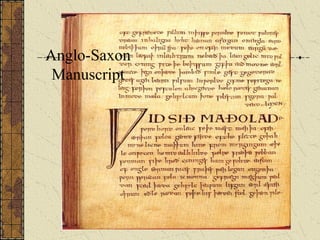
 Monks recorded and duplicated illuminated
 manuscripts, at first only written in Latin.
 Oral literature was transcribed into written
 form.
 Monks preserved not only Latin and Greek
 classics but also popular literature (Beowulf).
The Venerable Bede (673-735)
 A monk
 Considered the “father of English
 history”
 Wrote A History of the English Church
 and People: the clearest account we
 have of Anglo-Saxon times
Anglo-Saxon
 Manuscript
The Danish Invasion
 Due to rising population and limited
 farmland, many Scandinavians (the Norse
 and the Danes) took to the seas—the
 Vikings.
 In 800, Danish raiders attacked Britain.
 The Norse settled in Northumbria, Scotland,
 Wales, and Ireland.
 The Danes targeted eastern and southern
 England.
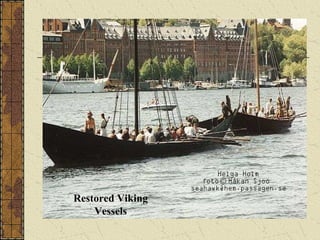
Restored Viking
    Vessels
Viking Raids: “From the Fury of the
Northmen, O Lord, Deliver Us”
 Sacked and plundered monasteries
 Stole sacred religious objects
 Burned entire communities
 Murdered villagers
 Halted the growth of learning
By the middle of the ninth century, most of
 England had fallen. The Vikings called
 their territory Danelaw.
Alfred the Great
 Only the Saxon kingdom of Wessex managed to
 fight the Danes to a standstill.
 In 871, Alfred ascended to the Wessex throne.
 Alfred resisted further Danish encroachment.
 A 886 truce formally divided England: the Danish
 ruled the east and north; the Saxons ruled the south.
 Alfred translated the Bede’s History and other
 works from Latin into English to make them more
 accessible, as well as instituted the Anglo-Saxon
 Chronicle, a history of England from the earliest
 days through 1154.
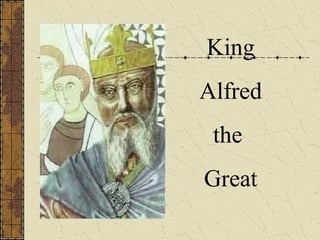
King
Alfred
 the
Great
Danish Contributions
 Built their Danelaw communities as
 military fortresses and trading centers
 Generated growth of English towns
 Expanded English vocabulary as Norse
 words crept into the language
 For example, law is Danish, and its use
 reflects the Danes’ interest in legal
 procedures.
The Norman Conquest
 Toward the end of the tenth century, the Danes increased
 attempts to recapture and widen Danelaw and eventually
 forced the witan to select a series of Danish kings.
 In 1042, the throne returned to a descendant of Alfred,
 King Edward the Confessor, a Christian.
 Edward’s association with the Normans weakened
 Saxon power.
 Upon his death in 1066, Edward was succeeded by
 Harold.
 William of Normandy challenged Harold’s right to the
 throne and defeated Harold in the Battle of Hastings.
 William was crowned King on December 25, 1066.

Anglo saxon period 09

  • 1.
    The Anglo-Saxon Period 449-1066 Stonehenge (c. 2000 BC)
  • 2.
    Celtic Invasion Between 800and 600 BC, two groups of Celts moved into the British isles: The Britons settled in Britain. The Gaels settled in Ireland. Julius Caesar described the Celts as: Light-skinned, fair-haired, and blue eyed Shepherds, farmers, fierce fighters Artistic, imaginative, loved beauty Skilled with tin and iron
  • 3.
    The Celts Farmersand hunters Organized into tightly knit clans Skilled artisans Introduced the use of iron to Europe Highly developed religion, mythology, and legal system that specified individual rights
  • 4.
    The Celts (con’t) Disputes were settled by a class of priests known as Druids Druids presided over religious rituals (sacrifices and prayers) Druids also memorized and recited long, heroic poems to preserve the people’s history Celtic legends are full of strong women, like Queen Maeve of Connacht in Ireland.
  • 5.
    Celtic Religion Animism: Fromthe Latin word for “spirit” Saw spirit everywhere: in rivers, trees, stones, ponds, fire, and thunder Spirits or gods controlled all aspects of existence and had to be constantly satisfied. Druids acted as intermediaries between the gods and people.
  • 6.
    The Roman Conquest In55 BC and 56 BC, Julius Caesar made hasty invasions. True conquest, however, occurred 100 years later under the Roman emperor Claudius in 43 AD. Roman rule of Britain lasted for nearly 400 years, ending only when Rome was threatened in Italy. The last Roman legions left for Rome in 407 AD.
  • 7.
    Roman Rule Constructed asystem of well-paved roads and founded cities Erected Hadrian’s Wall to protect from Picts and Scots Brought skills in the art of warfare Introduced Roman law and order Used Latin Introduced Christianity (597 AD) Failed to teach the Britons much about self- defense
  • 8.
    Roman Rule (con’t) RomanRoads: 5,000 miles of stone roads Linked tribal capitals and towns, especially London, York, Winchester Facilitated trade, the collection of taxes, and the movement of troops Hadrian’s Wall: Linked the North Sea and the Atlantic Held back the Picts and Scots for 250 years
  • 9.
    Early Anglo-Saxon Life The next invaders of Britain were the Anglo- Saxons: the Angles, Saxons, and Jutes. The Angles, Saxons, and Jutes came from Denmark, Holland, Germany, and Scandinavia. The Celts resisted the invaders for a number of years under the leadership of a great king, possibly the inspiration for the legendary King Arthur.
  • 10.
    Dispersal of theBritons To flee the Anglo-Saxons, the Britons fled to other parts of the island: Cornwall Wales Some join the Gaels in Ireland and formed a splinter groups known as the Scots (This group later settled in what is now Scotland). In all areas, the people spoke the Celtic languages (Cornish, Welsh, Irish, and Scottish Gaelic). All but Cornish are still spoken today.
  • 11.
    Anglo-Saxon Society highly organizedtribal units (kingdoms) Each tribe ruled by a king chosen by a council of elders (witan) Thanes: the upper class, earls, or free warriors Thralls: slaves who did the farming and domestic work Freemen: small group who earned possessions and special favors
  • 12.
    Anglo-Saxon Society (con’t) TheAnglo-Saxons farmed, maintained local governments, and created fine crafts, especially metalwork. Eventually, the small kingdoms developed into seven large ones: Northumbria, Mercia, Wessex, Sussex, Essex, East Anglia, and Kent. This development produced a new language: Old English. Lived close to their animals (to protect animals and provide warmth) Lived in single-family homes surrounding a communal hall and protected by a wooden stockade fence
  • 14.
    Characteristics of theAnglo-Saxons Hard fighters and bold sea warriors Admired physical strength, bravery, loyalty, fairness, and honesty Great love of personal freedom Boastful, reckless, cruel, and bloodthirsty Enjoyed conflict, swimming matches, horse races, banqueting, drinking mead, singing songs, and storytelling Also flyting, a conflict of wits between two warriors where each praises his own deeds and belittles the other’s
  • 15.
    Role of Women The wife of an earl or thane supervised weaving and dyeing of clothes, the slaughter of livestock, the making of bread, beekeeping, and the brewing of mead (fermented honey). Women inherited and held property. Married women retained control over their property. With the coming of Christianity, many women entered religious communities, and some became powerful abbesses.
  • 16.
    The Scops Thecommunal hall offered shelter and a place for council meetings. The communal hall was also a place for storytellers or bards (scops) who shared (orally) the stories of the Anglo-Saxons and their gods and heroes. The Anglo-Saxons valued storytelling as equal to fighting, hunting, and farming. A line of Anglo-Saxon or Old English poetry is characterized by four main stresses and is divided in half by a pause (caesura).
  • 17.
    Types of Anglo-SaxonVerse Heroic Poetry: recounts the achievements of warriors involved in great battles Elegiac Poetry: sorrowful laments that mourn the deaths of loved ones and the loss of the past Anglo-Saxon poets: Caedmon, Cynewulf
  • 18.
    The Beowulf Legend Beowulf is an epic, a long, heroic poem, about a great pagan warrior renowned for his courage, strength, and dignity. Beowulf is the national epic of England, because it is was the first such work composed in the English language. The poem includes references to Christian ideas and Latin classics but also present are the values of a warrior society, dignity, bravery, and prowess in battle.
  • 19.
    Anglo-Saxon Beliefs Pagan,polytheistic Very pessimistic view of life (due to the ever- present dangers of death by accident or warfare) Human life in the hands of fate (wyrd) Did not believe in an afterlife Immortality only earned through heroic actions Sharp contrast to the Christian belief in an individual’s free will
  • 20.
    Anglo-Saxon Beliefs (con’t) Theearly Anglo-Saxons worshipped ancient Germanic or Norse gods: Odin/Woden: chief of the gods, god of death, poetry, and magic Fria: Woden’s wife and goddess of the home Tiu: the god of war and the sky Thunor/Thor: god of thunder and lightening Frijz/Frigga: queen of the heavens The names of these gods survive today in our words Tuesday, Wednesday, Thursday, and Friday The dragon: personification of evil and death and the protector of treasure (the grave mound); also associated with the Vikings
  • 21.
    The Coming ofChristianity In 432, the whole of Celtic Ireland was converted by Patrick, a Romanized Briton. In 563, a group of Irish monks led by a soldier and abbot named Columba established a monastery on the island of Iona off the West coast of Scotland. Later, the Roman church began to send missionaries throughout Europe. In 597, Saint Augustine converted the King of England and establish a monastery at Canterbury. By 650, most of England was Christian in name, if not in fact.
  • 22.
    Christianity and Literature The church brought education and written literature to England. Monks established churches, monasteries, and libraries. Monks recorded and duplicated illuminated manuscripts, at first only written in Latin. Oral literature was transcribed into written form. Monks preserved not only Latin and Greek classics but also popular literature (Beowulf).
  • 23.
    The Venerable Bede(673-735) A monk Considered the “father of English history” Wrote A History of the English Church and People: the clearest account we have of Anglo-Saxon times
  • 24.
  • 25.
    The Danish Invasion Due to rising population and limited farmland, many Scandinavians (the Norse and the Danes) took to the seas—the Vikings. In 800, Danish raiders attacked Britain. The Norse settled in Northumbria, Scotland, Wales, and Ireland. The Danes targeted eastern and southern England.
  • 26.
  • 27.
    Viking Raids: “Fromthe Fury of the Northmen, O Lord, Deliver Us” Sacked and plundered monasteries Stole sacred religious objects Burned entire communities Murdered villagers Halted the growth of learning By the middle of the ninth century, most of England had fallen. The Vikings called their territory Danelaw.
  • 28.
    Alfred the Great Only the Saxon kingdom of Wessex managed to fight the Danes to a standstill. In 871, Alfred ascended to the Wessex throne. Alfred resisted further Danish encroachment. A 886 truce formally divided England: the Danish ruled the east and north; the Saxons ruled the south. Alfred translated the Bede’s History and other works from Latin into English to make them more accessible, as well as instituted the Anglo-Saxon Chronicle, a history of England from the earliest days through 1154.
  • 29.
  • 30.
    Danish Contributions Builttheir Danelaw communities as military fortresses and trading centers Generated growth of English towns Expanded English vocabulary as Norse words crept into the language For example, law is Danish, and its use reflects the Danes’ interest in legal procedures.
  • 31.
    The Norman Conquest Toward the end of the tenth century, the Danes increased attempts to recapture and widen Danelaw and eventually forced the witan to select a series of Danish kings. In 1042, the throne returned to a descendant of Alfred, King Edward the Confessor, a Christian. Edward’s association with the Normans weakened Saxon power. Upon his death in 1066, Edward was succeeded by Harold. William of Normandy challenged Harold’s right to the throne and defeated Harold in the Battle of Hastings. William was crowned King on December 25, 1066.