

The Dark Ages
England
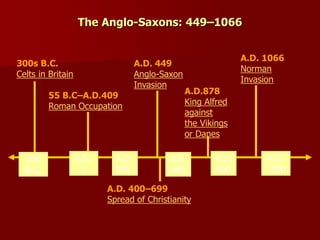
The Anglo-Saxons: 449–1066
300s B.C.
Celts in Britain
55 B.C–A.D.409
Roman Occupation
A.D. 449
Anglo-Saxon
Invasion
A.D. 400–699
Spread of Christianity
A.D. 1066
Norman
Invasion
A.D.878
King Alfred
against
the Vikings
or Danes
A.D.
600
A.D.
300
A.D.
1
300
B.C.
A.D.
900
A.D.
1200
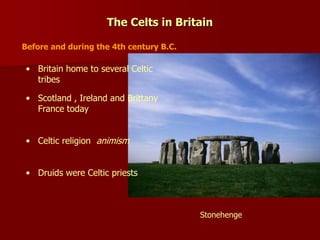
The Celts in Britain
• Celtic religion animism
Before and during the 4th century B.C.
Stonehenge
• Druids were Celtic priests
• Scotland , Ireland and Brittany
France today
• Britain home to several Celtic
tribes
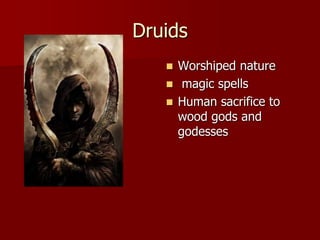
Druids
 Worshiped nature
 magic spells
 Human sacrifice to
wood gods and
godesses
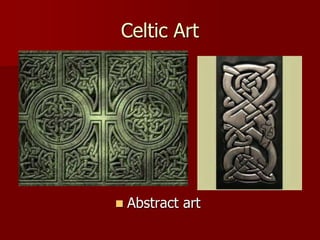
Celtic Art
 Abstract art
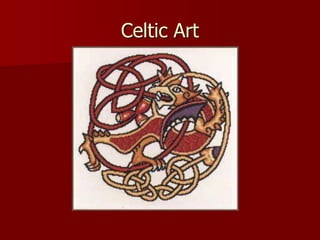
Celtic Art
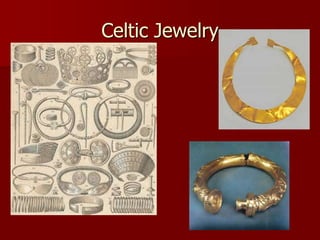
Celtic Jewelry
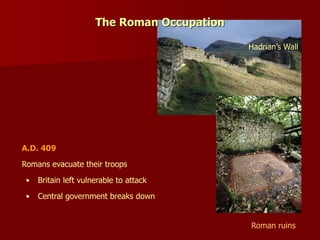
The Roman Occupation
Hadrian’s Wall
Romans evacuate their troops
• Central government breaks down
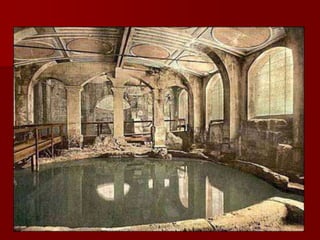
Roman ruins
• Britain left vulnerable to attack
A.D. 409
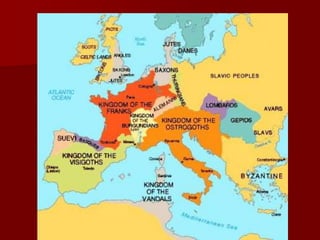
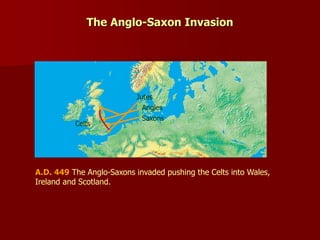
The Anglo-Saxon Invasion
A.D. 449 The Anglo-Saxons invaded pushing the Celts into Wales,
Ireland and Scotland.
Angles
Saxons
Jutes
Celts
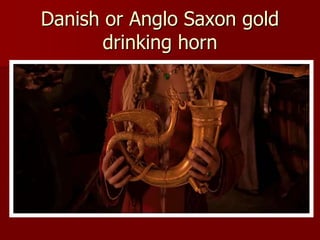
Danish or Anglo Saxon gold
drinking horn
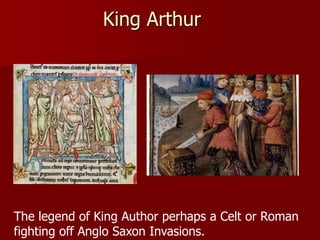
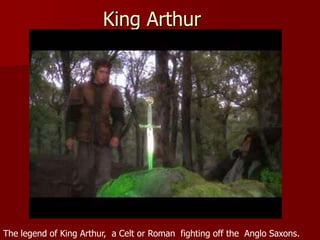
King Arthur
The legend of King Author perhaps a Celt or Roman
fighting off Anglo Saxon Invasions.
King Arthur
The legend of King Arthur, a Celt or Roman fighting off the Anglo Saxons.
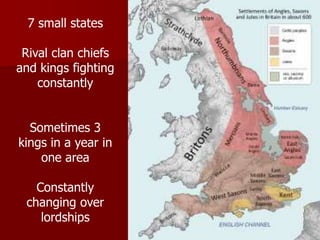
7 small states
Rival clan chiefs
and kings fighting
constantly
Sometimes 3
kings in a year in
one area
Constantly
changing over
lordships
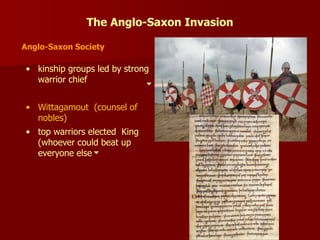
The Anglo-Saxon Invasion
Anglo-Saxon Society
• kinship groups led by strong
warrior chief
• Wittagamout (counsel of
nobles)
• top warriors elected King
(whoever could beat up
everyone else
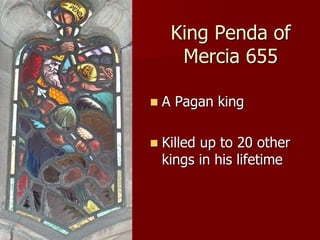
King Penda of
Mercia 655
 A Pagan king
 Killed up to 20 other
kings in his lifetime
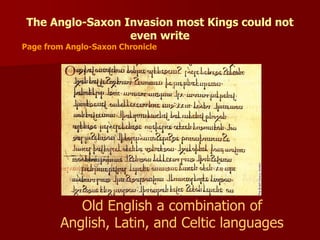
Page from Anglo-Saxon Chronicle
The Anglo-Saxon Invasion most Kings could not
even write
Old English a combination of
Anglish, Latin, and Celtic languages
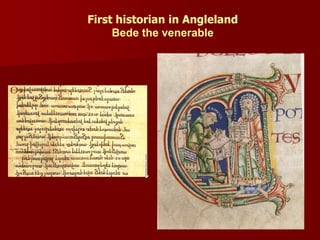
First historian in Angleland
Bede the venerable
Old English
Slaves and Serfs
 Slaves made up of conquered peoples
 Rural slaves became serfs, who worked
the land and provided labor to clan
warriors and kings for protection
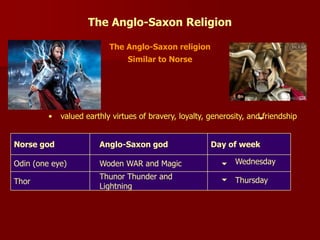
The Anglo-Saxon religion
Similar to Norse
• valued earthly virtues of bravery, loyalty, generosity, and friendship
Thunor Thunder and
Lightning
Thor
Woden WAR and MagicOdin (one eye)
Day of weekAnglo-Saxon godNorse god
Wednesday
Thursday
The Anglo-Saxon Religion
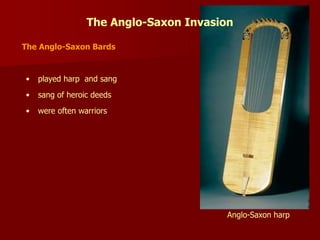
The Anglo-Saxon Bards
Anglo-Saxon harp
• played harp and sang
• sang of heroic deeds
• were often warriors
The Anglo-Saxon Invasion
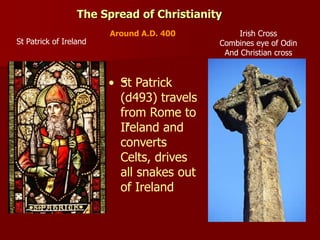
• St Patrick
(d493) travels
from Rome to
Ireland and
converts
Celts, drives
all snakes out
of Ireland
The Spread of Christianity
Around A.D. 400 Irish Cross
Combines eye of Odin
And Christian cross
St Patrick of Ireland
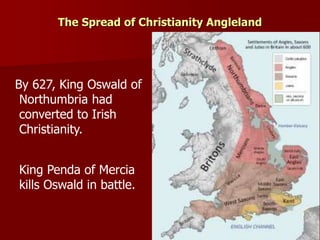
The Spread of Christianity Angleland
By 627, King Oswald of
Northumbria had
converted to Irish
Christianity.
King Penda of Mercia
kills Oswald in battle.
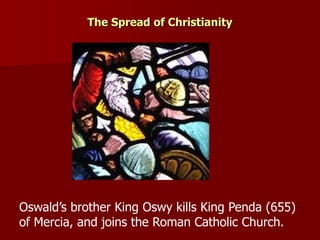
The Spread of Christianity
Oswald’s brother King Oswy kills King Penda (655)
of Mercia, and joins the Roman Catholic Church.
The Spread of Christianity Wessex
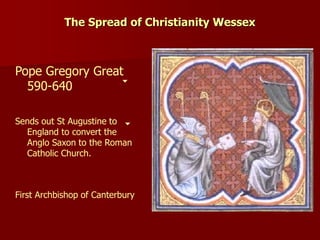
Pope Gregory Great
590-640
Sends out St Augustine to
England to convert the
Anglo Saxon to the Roman
Catholic Church.
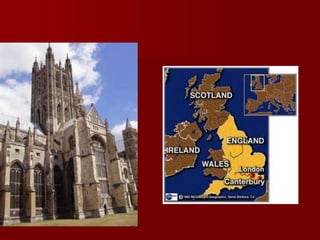
First Archbishop of Canterbury
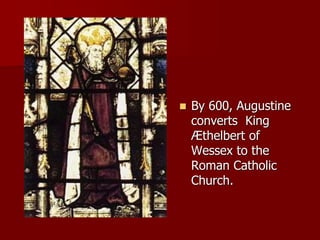
 By 600, Augustine
converts King
Æthelbert of
Wessex to the
Roman Catholic
Church.
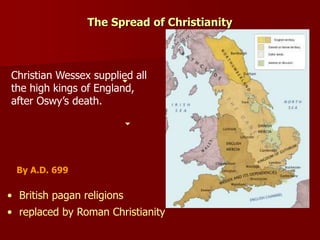
The Spread of Christianity
• British pagan religions
• replaced by Roman Christianity
By A.D. 699
Christian Wessex supplied all
the high kings of England,
after Oswy’s death.
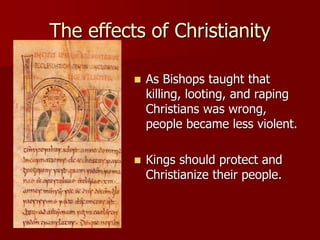
The effects of Christianity
 As Bishops taught that
killing, looting, and raping
Christians was wrong,
people became less violent.
 Kings should protect and
Christianize their people.
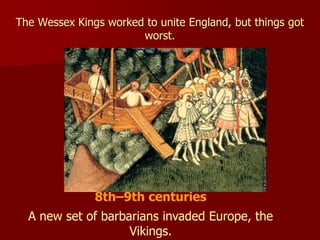
8th–9th centuries
A new set of barbarians invaded Europe, the
Vikings.
The Wessex Kings worked to unite England, but things got
worst.
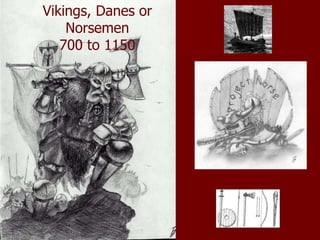
Vikings, Danes or
Norsemen
700 to 1150
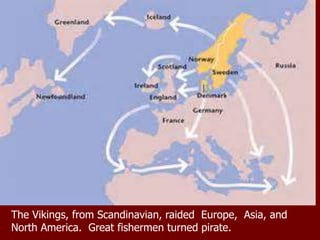
The Vikings, from Scandinavian, raided Europe, Asia, and
North America. Great fishermen turned pirate.
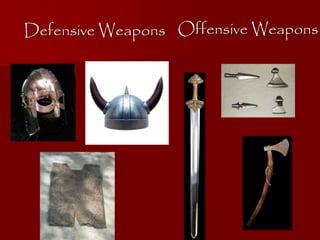
Offensive WeaponsDefensive Weapons
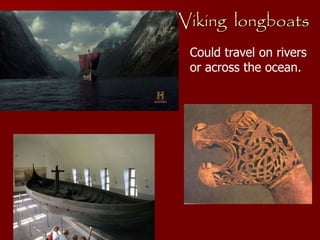
Viking longboats
Could travel on rivers
or across the ocean.
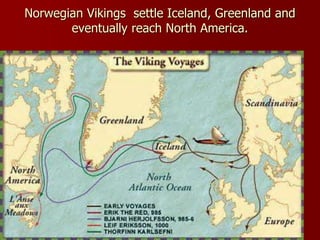
Norwegian Vikings settle Iceland, Greenland and
eventually reach North America.
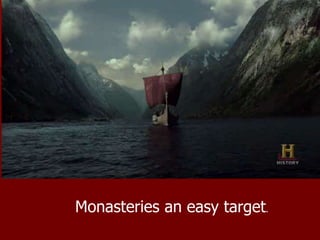
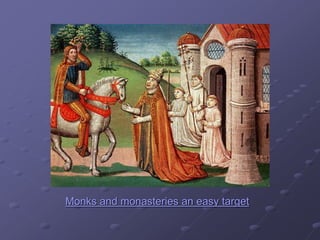
Monasteries an easy target.
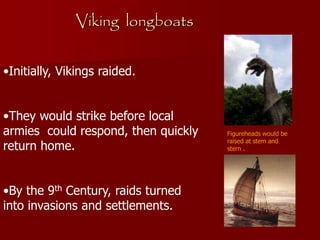
Viking longboats
•Initially, Vikings raided.
•They would strike before local
armies could respond, then quickly
return home.
•By the 9th Century, raids turned
into invasions and settlements.
Figureheads would be
raised at stem and
stern .
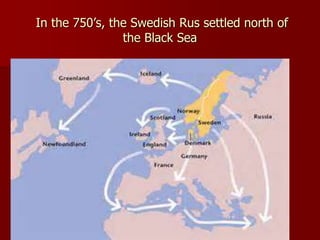
In the 750’s, the Swedish Rus settled north of
the Black Sea
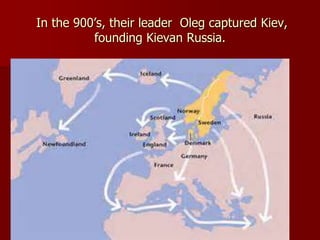
In the 900’s, their leader Oleg captured Kiev,
founding Kievan Russia.
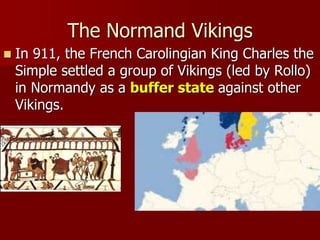
The Normand Vikings
 In 911, the French Carolingian King Charles the
Simple settled a group of Vikings (led by Rollo)
in Normandy as a buffer state against other
Vikings.
 A buffer state is a country lying between
two rival or potentially hostile greater
powers, which by its existence is thought
to prevent conflict between them.
The Normand Vikings
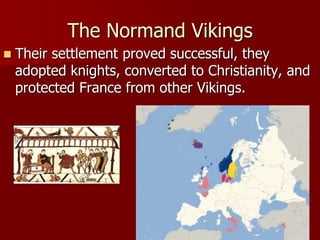
 Their settlement proved successful, they
adopted knights, converted to Christianity, and
protected France from other Vikings.
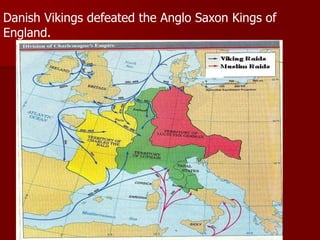
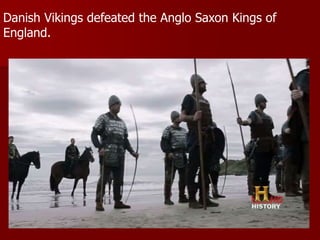
Danish Vikings defeated the Anglo Saxon Kings of
England.
Danish Vikings defeated the Anglo Saxon Kings of
England.
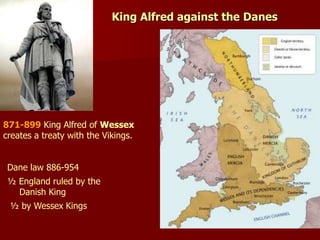
King Alfred against the Danes
871-899 King Alfred of Wessex
creates a treaty with the Vikings.
Dane law 886-954
½ England ruled by the
Danish King
½ by Wessex Kings
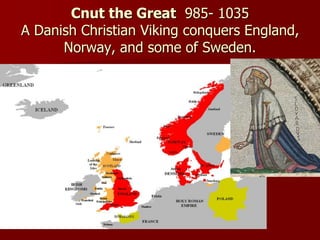
Cnut the Great 985- 1035
A Danish Christian Viking conquers England,
Norway, and some of Sweden.
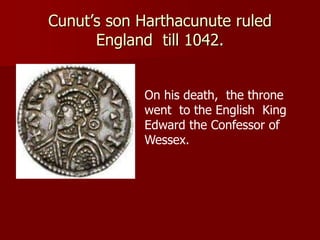
Cunut’s son Harthacunute ruled
England till 1042.
On his death, the throne
went to the English King
Edward the Confessor of
Wessex.
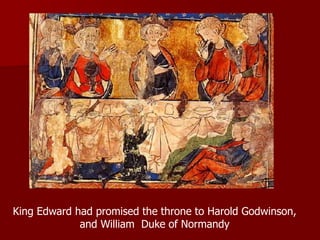
King Edward had promised the throne to Harold Godwinson,
and William Duke of Normandy
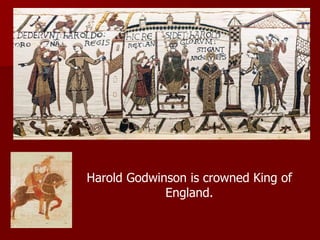
Harold Godwinson is crowned King of
England.
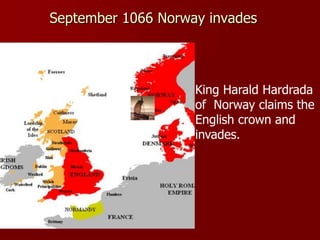
September 1066 Norway invades
King Harald Hardrada
of Norway claims the
English crown and
invades.
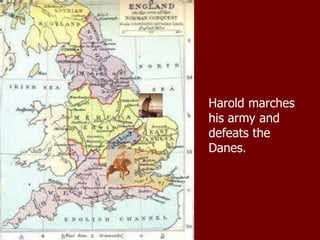
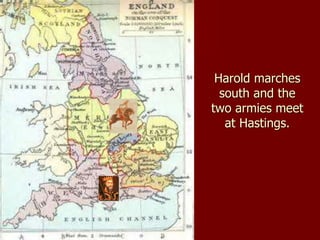
Harold marches
his army and
defeats the
Danes.
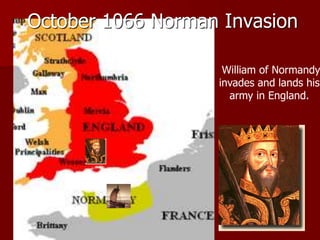
October 1066 Norman Invasion
William of Normandy
invades and lands his
army in England.
Harold marches
south and the
two armies meet
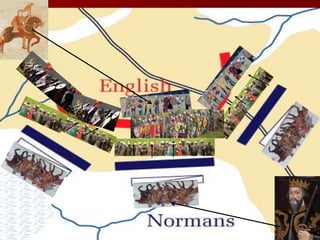
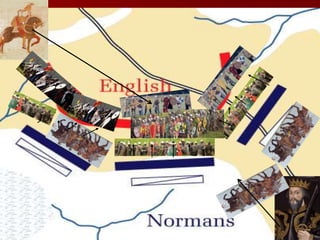
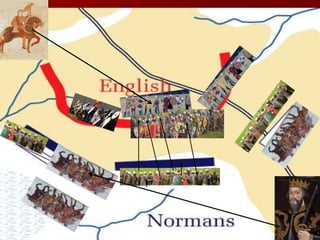
at Hastings.
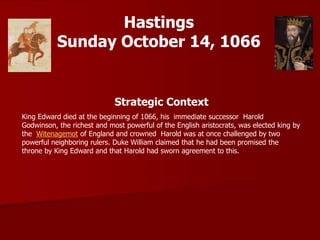
Hastings
Sunday October 14, 1066
Strategic Context
King Edward died at the beginning of 1066, his immediate successor Harold
Godwinson, the richest and most powerful of the English aristocrats, was elected king by
the Witenagemot of England and crowned Harold was at once challenged by two
powerful neighboring rulers. Duke William claimed that he had been promised the
throne by King Edward and that Harold had sworn agreement to this.
By Jonathan Webb, 2009 ©
Hastings
Sunday October 14, 1066
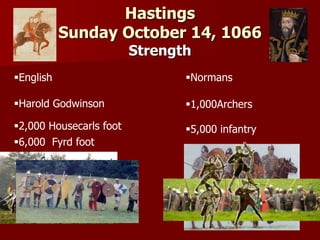
Strength
English
Well
Normans
Harold Godwinson
2,000 Housecarls foot 5,000 infantry
1,000Archers
2,000 knights
4,000 knights6,000 Fyrd foot
By Jonathan Webb, 2009 ©
Hastings
Sunday October 14, 1066
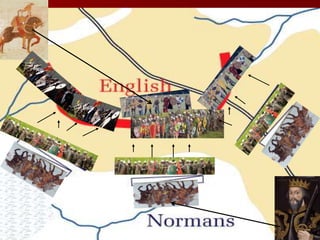
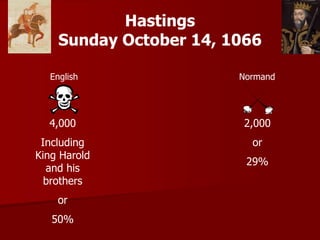
English Normand:
4,000
Including
King Harold
and his
brothers
or
50%
2,000
or
29%
By Jonathan Webb, 2009 ©
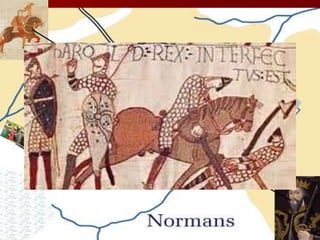
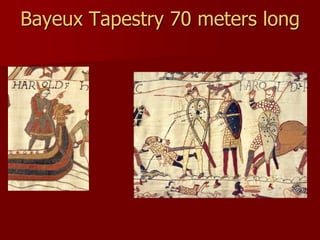
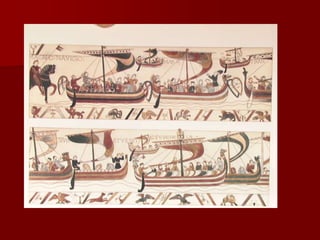
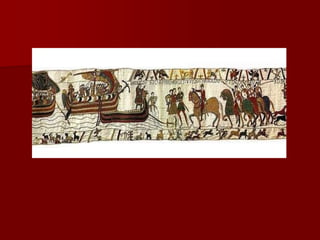
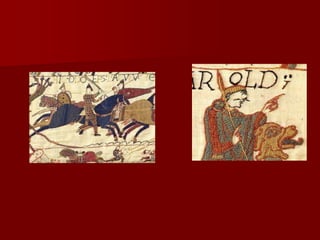
Bayeux Tapestry 70 meters long
 end
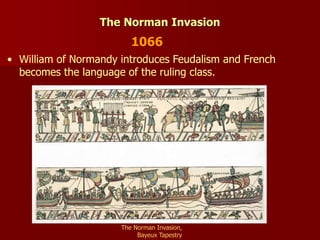
• William of Normandy introduces Feudalism and French
becomes the language of the ruling class.
The Norman Invasion
The Norman Invasion,
Bayeux Tapestry
1066
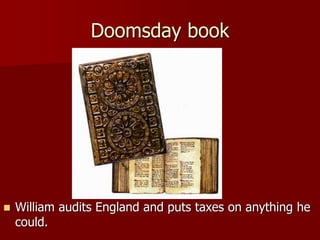
Doomsday book
 William audits England and puts taxes on anything he
could.
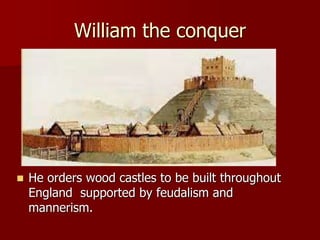
William the conquer
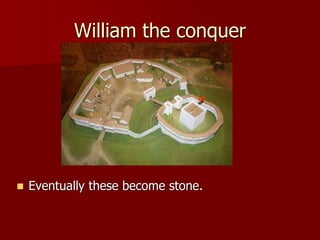
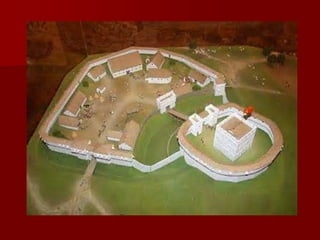
 He orders wood castles to be built throughout
England supported by feudalism and
mannerism.
William the conquer
 Eventually these become stone.
William the conquer
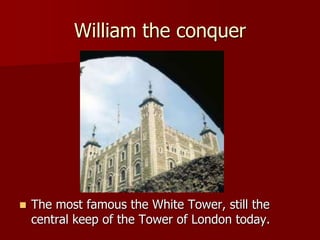
 The most famous the White Tower, still the
central keep of the Tower of London today.
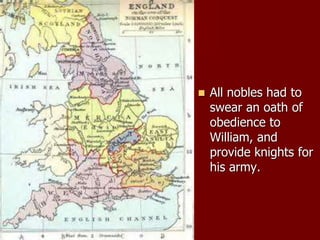
 All nobles had to
swear an oath of
obedience to
William, and
provide knights for
his army.
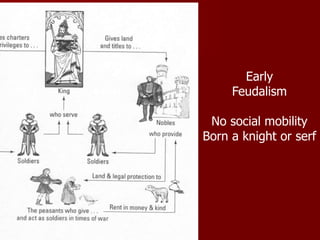
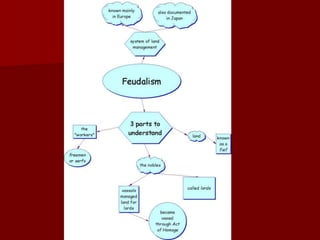
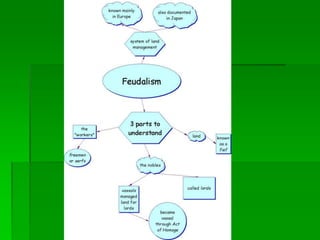
Feudalism
Feudalism
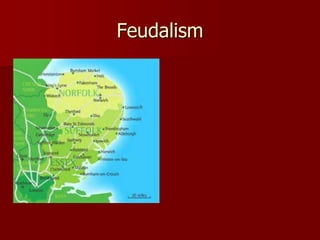
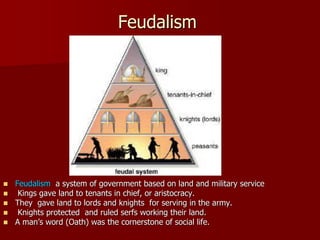
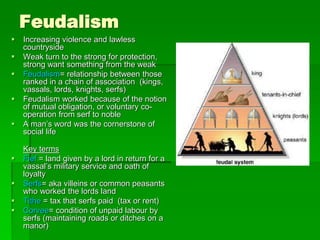
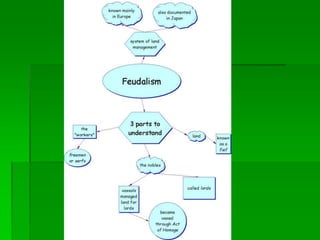
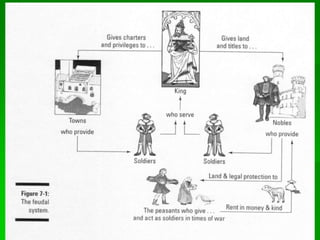
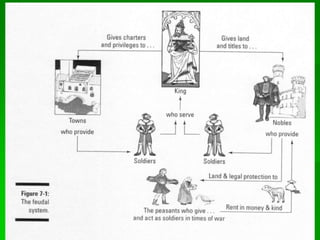
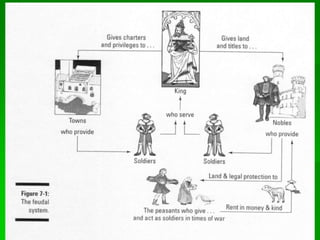
 Feudalism a system of government based on land and military service
 Kings gave land to tenants in chief, or aristocracy.
 They gave land to lords and knights for serving in the army.
 Knights protected and ruled serfs working their land.
 A man’s word (Oath) was the cornerstone of social life.
Feudalism
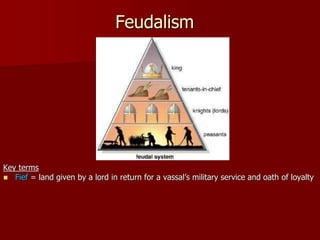
Key terms
 Fief = land given by a lord in return for a vassal’s military service and oath of loyalty
Home work
 Reading in the book
 291-296 feudalism
 317-322 mannerism
The Holy Roman Empire
 In the tenth century, the powerful dukes of the
Saxons became kings of the eastern Frankish
kingdom, which came to be known as Germany.
The Holy Roman Empire
 Otto I finished converting pagans and protected
the pope. The Pope crowned Otto I emperor
 of the Romans in 962.
The Holy Roman Empire
 Frederick I wanted to create a true empire.
 He planned to get his chief revenues from Italy.
 He considered Italy the center of a “holy empire”.
The Holy Roman Empire
 Frederick’s attempt to conquer northern Italy led
to problems with the Pope and independent city
states of Northern Italy .
The Holy Roman Empire
 An alliance of these northern Italian cities and the
pope defeated the forces of Frederick I in 1176.
The Development of Russia
 By the 8th Century, the Rus (Swedish Vikings )
dominated the Slavic tribes of the Ukraine.
The Development of Russia
 Oleg, settled in Kiev at the beginning of the
tenth century and created the Rus state known
as the principality of Kiev.
The Development of Russia
 Vladimir, married the Byzantine emperor’s sister
and officially accepted Eastern
 Orthodox Christianity
 for himself and
The Development of Russia
 However,
 civil wars and new
invasions brought an
end to the
 first Russian state in
1169.
The Development of Russia
 In the thirteenth
century, the Mongols
 conquered Russia
The Development of Russia
 Alexander Nevsky,
prince of
Novgorod,
 defeated a German
invading army in
northwestern
 Russia in 1242. The
khan, leader of the
western Mongol
 Empire, rewarded
Nevsky with the title
 end
Early
Feudalism
No social mobility
Born a knight or serf
end
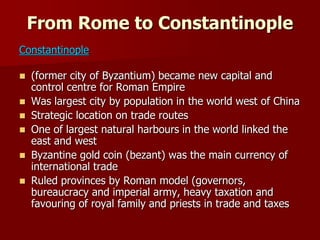
From Rome to Constantinople
Constantinople
 (former city of Byzantium) became new capital and
control centre for Roman Empire
 Was largest city by population in the world west of China
 Strategic location on trade routes
 One of largest natural harbours in the world linked the
east and west
 Byzantine gold coin (bezant) was the main currency of
international trade
 Ruled provinces by Roman model (governors,
bureaucracy and imperial army, heavy taxation and
favouring of royal family and priests in trade and taxes
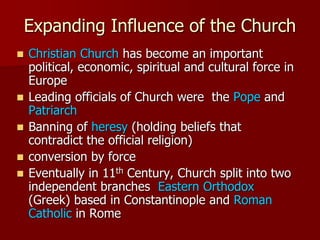
Expanding Influence of the Church
 Christian Church has become an important
political, economic, spiritual and cultural force in
Europe
 Leading officials of Church were the Pope and
Patriarch
 Banning of heresy (holding beliefs that
contradict the official religion)
 conversion by force
 Eventually in 11th Century, Church split into two
independent branches Eastern Orthodox
(Greek) based in Constantinople and Roman
Catholic in Rome
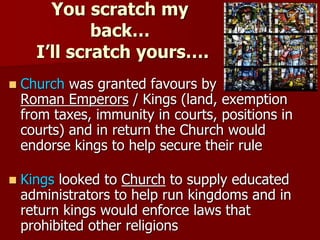
You scratch my
back…
I’ll scratch yours….
 Church was granted favours by
Roman Emperors / Kings (land, exemption
from taxes, immunity in courts, positions in
courts) and in return the Church would
endorse kings to help secure their rule
 Kings looked to Church to supply educated
administrators to help run kingdoms and in
return kings would enforce laws that
prohibited other religions
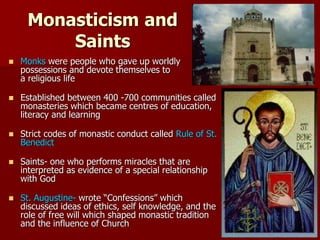
Monasticism and
Saints
 Monks were people who gave up worldly
possessions and devote themselves to
a religious life
 Established between 400 -700 communities called
monasteries which became centres of education,
literacy and learning
 Strict codes of monastic conduct called Rule of St.
Benedict
 Saints- one who performs miracles that are
interpreted as evidence of a special relationship
with God
 St. Augustine- wrote “Confessions” which
discussed ideas of ethics, self knowledge, and the
role of free will which shaped monastic tradition
and the influence of Church
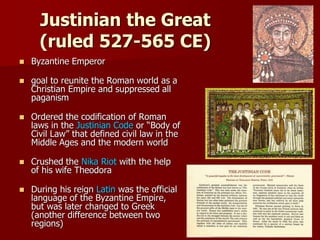
Justinian the Great
(ruled 527-565 CE)
 Byzantine Emperor
 goal to reunite the Roman world as a
Christian Empire and suppressed all
paganism
 Ordered the codification of Roman
laws in the Justinian Code or “Body of
Civil Law” that defined civil law in the
Middle Ages and the modern world
 Crushed the Nika Riot with the help
of his wife Theodora
 During his reign Latin was the official
language of the Byzantine Empire,
but was later changed to Greek
(another difference between two
regions)
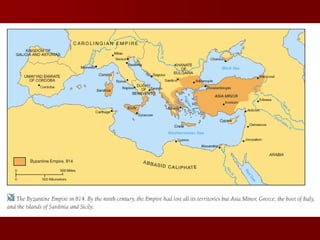
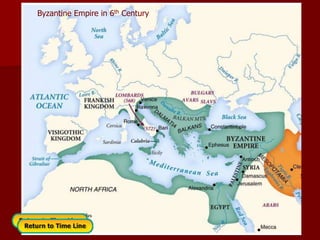
Byzantine Empire in 6th Century
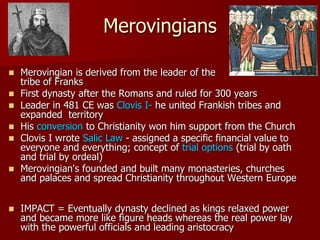
Merovingians
 Merovingian is derived from the leader of the
tribe of Franks
 First dynasty after the Romans and ruled for 300 years
 Leader in 481 CE was Clovis I- he united Frankish tribes and
expanded territory
 His conversion to Christianity won him support from the Church
 Clovis I wrote Salic Law - assigned a specific financial value to
everyone and everything; concept of trial options (trial by oath
and trial by ordeal)
 Merovingian's founded and built many monasteries, churches
and palaces and spread Christianity throughout Western Europe
 IMPACT = Eventually dynasty declined as kings relaxed power
and became more like figure heads whereas the real power lay
with the powerful officials and leading aristocracy
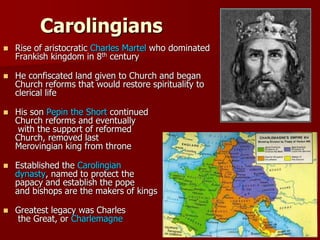
Carolingians
 Rise of aristocratic Charles Martel who dominated
Frankish kingdom in 8th century
 He confiscated land given to Church and began
Church reforms that would restore spirituality to
clerical life
 His son Pepin the Short continued
Church reforms and eventually
with the support of reformed
Church, removed last
Merovingian king from throne
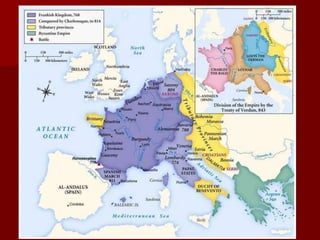
 Established the Carolingian
dynasty, named to protect the
papacy and establish the pope
and bishops are the makers of kings
 Greatest legacy was Charles
the Great, or Charlemagne
The Holy Roman Empire
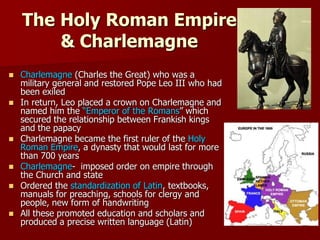
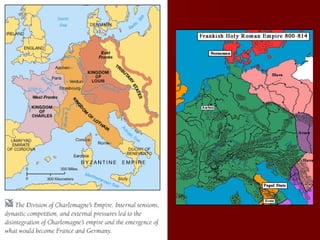
& Charlemagne
 Charlemagne (Charles the Great) who was a
military general and restored Pope Leo III who had
been exiled
 In return, Leo placed a crown on Charlemagne and
named him the “Emperor of the Romans” which
secured the relationship between Frankish kings
and the papacy
 Charlemagne became the first ruler of the Holy
Roman Empire, a dynasty that would last for more
than 700 years
 Charlemagne- imposed order on empire through
the Church and state
 Ordered the standardization of Latin, textbooks,
manuals for preaching, schools for clergy and
people, new form of handwriting
 All these promoted education and scholars and
produced a precise written language (Latin)
Birth of Modern Languages
 Development of Middle Ages
 New languages born through migration,
resettlement, conflict and changes
 Old English (Anglo Saxon) began to
incorporate words borrowed from Latin
and Old French, Old German and Old
Norse
 Roots of contemporary Spanish, Italian
and other Romance languages
High Middle Ages
 New royal dynasty called Capetians in France
 System of primogeniture= system where eldest son inherited everything
(instead of dividing land / property / wealth)
 Lords and knights however had little loyalty and began competing more
fiercely for land, power, influence and control
 Peace of God= a set of decrees issued in 989 CE that prohibited stealing
church property, assaulting clerics, peasants and women with the threat of
excommunication from Church
 were set to protect the unarmed populace by limiting warfare in countryside
 Truce of God= set in 1027 CE and outlawed all fighting from Thursday to
Monday morning, on important feast days and during religious days
 Truce encouraged idea that the only combat pleasing to God was in the
defence of Christendom (idea of the righteousness of holy war)
 1095 CE Pope Urban II referred to Truce of God when calling knights to the
first Crusade in support of Christians
Feudalism
 Increasing violence and lawless
countryside
 Weak turn to the strong for protection,
strong want something from the weak
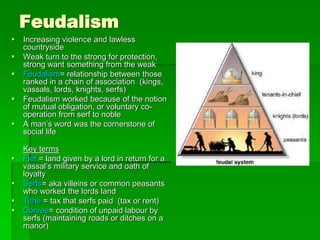
 Feudalism= relationship between those
ranked in a chain of association (kings,
vassals, lords, knights, serfs)
 Feudalism worked because of the notion
of mutual obligation, or voluntary co-
operation from serf to noble
 A man’s word was the cornerstone of
social life
Key terms
 Fief = land given by a lord in return for a
vassal’s military service and oath of
loyalty
 Serfs= aka villeins or common peasants
who worked the lords land
 Tithe = tax that serfs paid (tax or rent)
 Corvee= condition of unpaid labour by
serfs (maintaining roads or ditches on a
manor)
Feudalism
 Increasing violence and lawless
countryside
 Weak turn to the strong for protection,
strong want something from the weak
 Feudalism= relationship between those
ranked in a chain of association (kings,
vassals, lords, knights, serfs)
 Feudalism worked because of the notion
of mutual obligation, or voluntary co-
operation from serf to noble
 A man’s word was the cornerstone of
social life
Key terms
 Fief = land given by a lord in return for a
vassal’s military service and oath of
loyalty
 Serfs= aka villeins or common peasants
who worked the lords land
 Tithe = tax that serfs paid (tax or rent)
 Corvee= condition of unpaid labour by
serfs (maintaining roads or ditches on a
manor)
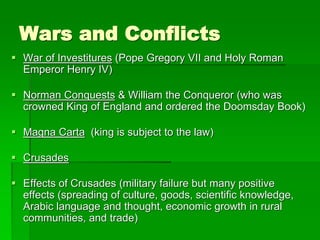
Wars and Conflicts
 War of Investitures (Pope Gregory VII and Holy Roman
Emperor Henry IV)
 Norman Conquests & William the Conqueror (who was
crowned King of England and ordered the Doomsday Book)
 Magna Carta (king is subject to the law)
 Crusades
 Effects of Crusades (military failure but many positive
effects (spreading of culture, goods, scientific knowledge,
Arabic language and thought, economic growth in rural
communities, and trade)
New Ideas and Culture
 Effects of Crusades
 Guild and communes
 Towns, cities and manors
 New thinkers (Thomas Aquinas) and writers
 Creation of universities
 New art and architecture (gothic, castles)
 Knighthood and chivalry
 Courtly entertainment (fables, playwrights)
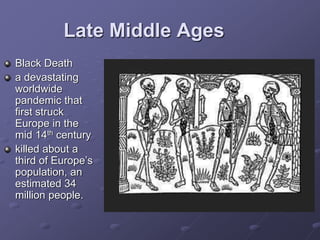
Late Middle Ages
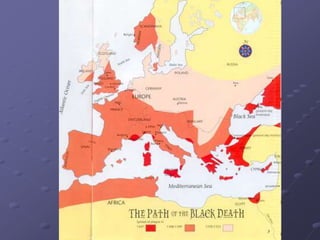
Black Death
a devastating
worldwide
pandemic that
first struck
Europe in the
mid 14th century
killed about a
third of Europe’s
population, an
estimated 34
million people.
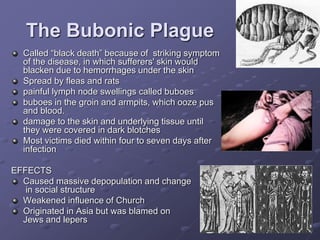
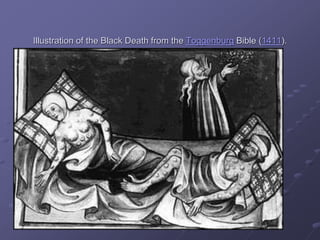
The Bubonic Plague
Called “black death” because of striking symptom
of the disease, in which sufferers' skin would
blacken due to hemorrhages under the skin
Spread by fleas and rats
painful lymph node swellings called buboes
buboes in the groin and armpits, which ooze pus
and blood.
damage to the skin and underlying tissue until
they were covered in dark blotches
Most victims died within four to seven days after
infection
EFFECTS
Caused massive depopulation and change
in social structure
Weakened influence of Church
Originated in Asia but was blamed on
Jews and lepers
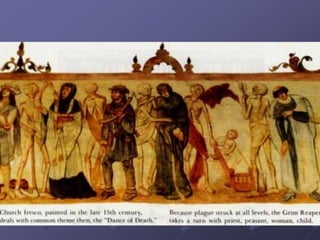
Illustration of the Black Death from the Toggenburg Bible (1411).
Ideas, Inventions and Key Figures
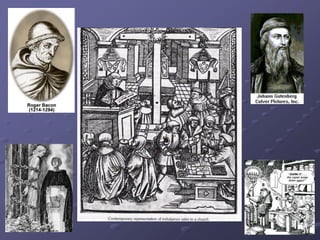
Roger Bacon (gunpowder)
Luca Pacioli (Father of Accounting)
Johannes Gutenberg (printing press)
Christine de Pisan (writer); Geoffrey Chaucer
(writer)
Joan of Arc (Hundred Year’s War)
Pope Urban II (indulgences)
Pope Innocent IV and Bernard Gui (inquisitions)
Parliamentary Government in England
Vocabulary
Decline ภาวะตกต่า
Defeated ความพ่ายแพ้
Military ทหาร
Barbarians คนหยาบคาย
Tribes พันธุ์
Clans กลุ่มคนที่สนใจในเรื่องเดียวกัน
Evacuate ถ่าย (อากาศ) ออก
Invasion การรุกราน
animalism
Legend ตานาน
Monks and monasteries an easy target

Anglo Saxons invations England

  • 1.
  • 3.
    The Anglo-Saxons: 449–1066 300sB.C. Celts in Britain 55 B.C–A.D.409 Roman Occupation A.D. 449 Anglo-Saxon Invasion A.D. 400–699 Spread of Christianity A.D. 1066 Norman Invasion A.D.878 King Alfred against the Vikings or Danes A.D. 600 A.D. 300 A.D. 1 300 B.C. A.D. 900 A.D. 1200
  • 4.
    The Celts inBritain • Celtic religion animism Before and during the 4th century B.C. Stonehenge • Druids were Celtic priests • Scotland , Ireland and Brittany France today • Britain home to several Celtic tribes
  • 5.
    Druids  Worshiped nature magic spells  Human sacrifice to wood gods and godesses
  • 6.
  • 7.
  • 8.
  • 9.
    The Roman Occupation Hadrian’sWall Romans evacuate their troops • Central government breaks down Roman ruins • Britain left vulnerable to attack A.D. 409
  • 13.
    The Anglo-Saxon Invasion A.D.449 The Anglo-Saxons invaded pushing the Celts into Wales, Ireland and Scotland. Angles Saxons Jutes Celts
  • 18.
    Danish or AngloSaxon gold drinking horn
  • 19.
    King Arthur The legendof King Author perhaps a Celt or Roman fighting off Anglo Saxon Invasions.
  • 20.
    King Arthur The legendof King Arthur, a Celt or Roman fighting off the Anglo Saxons.
  • 21.
    7 small states Rivalclan chiefs and kings fighting constantly Sometimes 3 kings in a year in one area Constantly changing over lordships
  • 22.
    The Anglo-Saxon Invasion Anglo-SaxonSociety • kinship groups led by strong warrior chief • Wittagamout (counsel of nobles) • top warriors elected King (whoever could beat up everyone else
  • 23.
    King Penda of Mercia655  A Pagan king  Killed up to 20 other kings in his lifetime
  • 24.
    Page from Anglo-SaxonChronicle The Anglo-Saxon Invasion most Kings could not even write Old English a combination of Anglish, Latin, and Celtic languages
  • 25.
    First historian inAngleland Bede the venerable Old English
  • 26.
    Slaves and Serfs Slaves made up of conquered peoples  Rural slaves became serfs, who worked the land and provided labor to clan warriors and kings for protection
  • 27.
    The Anglo-Saxon religion Similarto Norse • valued earthly virtues of bravery, loyalty, generosity, and friendship Thunor Thunder and Lightning Thor Woden WAR and MagicOdin (one eye) Day of weekAnglo-Saxon godNorse god Wednesday Thursday The Anglo-Saxon Religion
  • 28.
    The Anglo-Saxon Bards Anglo-Saxonharp • played harp and sang • sang of heroic deeds • were often warriors The Anglo-Saxon Invasion
  • 29.
    • St Patrick (d493)travels from Rome to Ireland and converts Celts, drives all snakes out of Ireland The Spread of Christianity Around A.D. 400 Irish Cross Combines eye of Odin And Christian cross St Patrick of Ireland
  • 30.
    The Spread ofChristianity Angleland By 627, King Oswald of Northumbria had converted to Irish Christianity. King Penda of Mercia kills Oswald in battle.
  • 31.
    The Spread ofChristianity Oswald’s brother King Oswy kills King Penda (655) of Mercia, and joins the Roman Catholic Church.
  • 32.
    The Spread ofChristianity Wessex Pope Gregory Great 590-640 Sends out St Augustine to England to convert the Anglo Saxon to the Roman Catholic Church. First Archbishop of Canterbury
  • 34.
     By 600,Augustine converts King Æthelbert of Wessex to the Roman Catholic Church.
  • 35.
    The Spread ofChristianity • British pagan religions • replaced by Roman Christianity By A.D. 699 Christian Wessex supplied all the high kings of England, after Oswy’s death.
  • 36.
    The effects ofChristianity  As Bishops taught that killing, looting, and raping Christians was wrong, people became less violent.  Kings should protect and Christianize their people.
  • 37.
    8th–9th centuries A newset of barbarians invaded Europe, the Vikings. The Wessex Kings worked to unite England, but things got worst.
  • 38.
  • 39.
    The Vikings, fromScandinavian, raided Europe, Asia, and North America. Great fishermen turned pirate.
  • 40.
  • 41.
    Viking longboats Could travelon rivers or across the ocean.
  • 42.
    Norwegian Vikings settleIceland, Greenland and eventually reach North America.
  • 43.
  • 44.
    Viking longboats •Initially, Vikingsraided. •They would strike before local armies could respond, then quickly return home. •By the 9th Century, raids turned into invasions and settlements. Figureheads would be raised at stem and stern .
  • 45.
    In the 750’s,the Swedish Rus settled north of the Black Sea
  • 46.
    In the 900’s,their leader Oleg captured Kiev, founding Kievan Russia.
  • 47.
    The Normand Vikings In 911, the French Carolingian King Charles the Simple settled a group of Vikings (led by Rollo) in Normandy as a buffer state against other Vikings.
  • 48.
     A bufferstate is a country lying between two rival or potentially hostile greater powers, which by its existence is thought to prevent conflict between them.
  • 49.
    The Normand Vikings Their settlement proved successful, they adopted knights, converted to Christianity, and protected France from other Vikings.
  • 50.
    Danish Vikings defeatedthe Anglo Saxon Kings of England.
  • 51.
    Danish Vikings defeatedthe Anglo Saxon Kings of England.
  • 52.
    King Alfred againstthe Danes 871-899 King Alfred of Wessex creates a treaty with the Vikings. Dane law 886-954 ½ England ruled by the Danish King ½ by Wessex Kings
  • 53.
    Cnut the Great985- 1035 A Danish Christian Viking conquers England, Norway, and some of Sweden.
  • 54.
    Cunut’s son Harthacunuteruled England till 1042. On his death, the throne went to the English King Edward the Confessor of Wessex.
  • 55.
    King Edward hadpromised the throne to Harold Godwinson, and William Duke of Normandy
  • 56.
    Harold Godwinson iscrowned King of England.
  • 57.
    September 1066 Norwayinvades King Harald Hardrada of Norway claims the English crown and invades.
  • 58.
    Harold marches his armyand defeats the Danes.
  • 59.
    October 1066 NormanInvasion William of Normandy invades and lands his army in England.
  • 60.
    Harold marches south andthe two armies meet at Hastings.
  • 61.
    Hastings Sunday October 14,1066 Strategic Context King Edward died at the beginning of 1066, his immediate successor Harold Godwinson, the richest and most powerful of the English aristocrats, was elected king by the Witenagemot of England and crowned Harold was at once challenged by two powerful neighboring rulers. Duke William claimed that he had been promised the throne by King Edward and that Harold had sworn agreement to this. By Jonathan Webb, 2009 ©
  • 62.
    Hastings Sunday October 14,1066 Strength English Well Normans Harold Godwinson 2,000 Housecarls foot 5,000 infantry 1,000Archers 2,000 knights 4,000 knights6,000 Fyrd foot By Jonathan Webb, 2009 ©
  • 68.
    Hastings Sunday October 14,1066 English Normand: 4,000 Including King Harold and his brothers or 50% 2,000 or 29% By Jonathan Webb, 2009 ©
  • 69.
    Bayeux Tapestry 70meters long
  • 70.
  • 73.
    • William ofNormandy introduces Feudalism and French becomes the language of the ruling class. The Norman Invasion The Norman Invasion, Bayeux Tapestry 1066
  • 74.
    Doomsday book  Williamaudits England and puts taxes on anything he could.
  • 75.
    William the conquer He orders wood castles to be built throughout England supported by feudalism and mannerism.
  • 76.
    William the conquer Eventually these become stone.
  • 77.
    William the conquer The most famous the White Tower, still the central keep of the Tower of London today.
  • 78.
     All nobleshad to swear an oath of obedience to William, and provide knights for his army.
  • 79.
  • 80.
    Feudalism  Feudalism asystem of government based on land and military service  Kings gave land to tenants in chief, or aristocracy.  They gave land to lords and knights for serving in the army.  Knights protected and ruled serfs working their land.  A man’s word (Oath) was the cornerstone of social life.
  • 81.
    Feudalism Key terms  Fief= land given by a lord in return for a vassal’s military service and oath of loyalty
  • 82.
    Home work  Readingin the book  291-296 feudalism  317-322 mannerism
  • 83.
    The Holy RomanEmpire  In the tenth century, the powerful dukes of the Saxons became kings of the eastern Frankish kingdom, which came to be known as Germany.
  • 84.
    The Holy RomanEmpire  Otto I finished converting pagans and protected the pope. The Pope crowned Otto I emperor  of the Romans in 962.
  • 85.
    The Holy RomanEmpire  Frederick I wanted to create a true empire.  He planned to get his chief revenues from Italy.  He considered Italy the center of a “holy empire”.
  • 86.
    The Holy RomanEmpire  Frederick’s attempt to conquer northern Italy led to problems with the Pope and independent city states of Northern Italy .
  • 87.
    The Holy RomanEmpire  An alliance of these northern Italian cities and the pope defeated the forces of Frederick I in 1176.
  • 88.
    The Development ofRussia  By the 8th Century, the Rus (Swedish Vikings ) dominated the Slavic tribes of the Ukraine.
  • 89.
    The Development ofRussia  Oleg, settled in Kiev at the beginning of the tenth century and created the Rus state known as the principality of Kiev.
  • 90.
    The Development ofRussia  Vladimir, married the Byzantine emperor’s sister and officially accepted Eastern  Orthodox Christianity  for himself and
  • 91.
    The Development ofRussia  However,  civil wars and new invasions brought an end to the  first Russian state in 1169.
  • 92.
    The Development ofRussia  In the thirteenth century, the Mongols  conquered Russia
  • 93.
    The Development ofRussia  Alexander Nevsky, prince of Novgorod,  defeated a German invading army in northwestern  Russia in 1242. The khan, leader of the western Mongol  Empire, rewarded Nevsky with the title
  • 94.
  • 95.
  • 96.
  • 98.
    From Rome toConstantinople Constantinople  (former city of Byzantium) became new capital and control centre for Roman Empire  Was largest city by population in the world west of China  Strategic location on trade routes  One of largest natural harbours in the world linked the east and west  Byzantine gold coin (bezant) was the main currency of international trade  Ruled provinces by Roman model (governors, bureaucracy and imperial army, heavy taxation and favouring of royal family and priests in trade and taxes
  • 100.
    Expanding Influence ofthe Church  Christian Church has become an important political, economic, spiritual and cultural force in Europe  Leading officials of Church were the Pope and Patriarch  Banning of heresy (holding beliefs that contradict the official religion)  conversion by force  Eventually in 11th Century, Church split into two independent branches Eastern Orthodox (Greek) based in Constantinople and Roman Catholic in Rome
  • 101.
    You scratch my back… I’llscratch yours….  Church was granted favours by Roman Emperors / Kings (land, exemption from taxes, immunity in courts, positions in courts) and in return the Church would endorse kings to help secure their rule  Kings looked to Church to supply educated administrators to help run kingdoms and in return kings would enforce laws that prohibited other religions
  • 102.
    Monasticism and Saints  Monkswere people who gave up worldly possessions and devote themselves to a religious life  Established between 400 -700 communities called monasteries which became centres of education, literacy and learning  Strict codes of monastic conduct called Rule of St. Benedict  Saints- one who performs miracles that are interpreted as evidence of a special relationship with God  St. Augustine- wrote “Confessions” which discussed ideas of ethics, self knowledge, and the role of free will which shaped monastic tradition and the influence of Church
  • 103.
    Justinian the Great (ruled527-565 CE)  Byzantine Emperor  goal to reunite the Roman world as a Christian Empire and suppressed all paganism  Ordered the codification of Roman laws in the Justinian Code or “Body of Civil Law” that defined civil law in the Middle Ages and the modern world  Crushed the Nika Riot with the help of his wife Theodora  During his reign Latin was the official language of the Byzantine Empire, but was later changed to Greek (another difference between two regions)
  • 104.
  • 105.
    Merovingians  Merovingian isderived from the leader of the tribe of Franks  First dynasty after the Romans and ruled for 300 years  Leader in 481 CE was Clovis I- he united Frankish tribes and expanded territory  His conversion to Christianity won him support from the Church  Clovis I wrote Salic Law - assigned a specific financial value to everyone and everything; concept of trial options (trial by oath and trial by ordeal)  Merovingian's founded and built many monasteries, churches and palaces and spread Christianity throughout Western Europe  IMPACT = Eventually dynasty declined as kings relaxed power and became more like figure heads whereas the real power lay with the powerful officials and leading aristocracy
  • 107.
    Carolingians  Rise ofaristocratic Charles Martel who dominated Frankish kingdom in 8th century  He confiscated land given to Church and began Church reforms that would restore spirituality to clerical life  His son Pepin the Short continued Church reforms and eventually with the support of reformed Church, removed last Merovingian king from throne  Established the Carolingian dynasty, named to protect the papacy and establish the pope and bishops are the makers of kings  Greatest legacy was Charles the Great, or Charlemagne
  • 109.
    The Holy RomanEmpire & Charlemagne  Charlemagne (Charles the Great) who was a military general and restored Pope Leo III who had been exiled  In return, Leo placed a crown on Charlemagne and named him the “Emperor of the Romans” which secured the relationship between Frankish kings and the papacy  Charlemagne became the first ruler of the Holy Roman Empire, a dynasty that would last for more than 700 years  Charlemagne- imposed order on empire through the Church and state  Ordered the standardization of Latin, textbooks, manuals for preaching, schools for clergy and people, new form of handwriting  All these promoted education and scholars and produced a precise written language (Latin)
  • 112.
    Birth of ModernLanguages  Development of Middle Ages  New languages born through migration, resettlement, conflict and changes  Old English (Anglo Saxon) began to incorporate words borrowed from Latin and Old French, Old German and Old Norse  Roots of contemporary Spanish, Italian and other Romance languages
  • 113.
    High Middle Ages New royal dynasty called Capetians in France  System of primogeniture= system where eldest son inherited everything (instead of dividing land / property / wealth)  Lords and knights however had little loyalty and began competing more fiercely for land, power, influence and control  Peace of God= a set of decrees issued in 989 CE that prohibited stealing church property, assaulting clerics, peasants and women with the threat of excommunication from Church  were set to protect the unarmed populace by limiting warfare in countryside  Truce of God= set in 1027 CE and outlawed all fighting from Thursday to Monday morning, on important feast days and during religious days  Truce encouraged idea that the only combat pleasing to God was in the defence of Christendom (idea of the righteousness of holy war)  1095 CE Pope Urban II referred to Truce of God when calling knights to the first Crusade in support of Christians
  • 114.
    Feudalism  Increasing violenceand lawless countryside  Weak turn to the strong for protection, strong want something from the weak  Feudalism= relationship between those ranked in a chain of association (kings, vassals, lords, knights, serfs)  Feudalism worked because of the notion of mutual obligation, or voluntary co- operation from serf to noble  A man’s word was the cornerstone of social life Key terms  Fief = land given by a lord in return for a vassal’s military service and oath of loyalty  Serfs= aka villeins or common peasants who worked the lords land  Tithe = tax that serfs paid (tax or rent)  Corvee= condition of unpaid labour by serfs (maintaining roads or ditches on a manor)
  • 117.
    Feudalism  Increasing violenceand lawless countryside  Weak turn to the strong for protection, strong want something from the weak  Feudalism= relationship between those ranked in a chain of association (kings, vassals, lords, knights, serfs)  Feudalism worked because of the notion of mutual obligation, or voluntary co- operation from serf to noble  A man’s word was the cornerstone of social life Key terms  Fief = land given by a lord in return for a vassal’s military service and oath of loyalty  Serfs= aka villeins or common peasants who worked the lords land  Tithe = tax that serfs paid (tax or rent)  Corvee= condition of unpaid labour by serfs (maintaining roads or ditches on a manor)
  • 121.
    Wars and Conflicts War of Investitures (Pope Gregory VII and Holy Roman Emperor Henry IV)  Norman Conquests & William the Conqueror (who was crowned King of England and ordered the Doomsday Book)  Magna Carta (king is subject to the law)  Crusades  Effects of Crusades (military failure but many positive effects (spreading of culture, goods, scientific knowledge, Arabic language and thought, economic growth in rural communities, and trade)
  • 122.
    New Ideas andCulture  Effects of Crusades  Guild and communes  Towns, cities and manors  New thinkers (Thomas Aquinas) and writers  Creation of universities  New art and architecture (gothic, castles)  Knighthood and chivalry  Courtly entertainment (fables, playwrights)
  • 123.
    Late Middle Ages BlackDeath a devastating worldwide pandemic that first struck Europe in the mid 14th century killed about a third of Europe’s population, an estimated 34 million people.
  • 124.
    The Bubonic Plague Called“black death” because of striking symptom of the disease, in which sufferers' skin would blacken due to hemorrhages under the skin Spread by fleas and rats painful lymph node swellings called buboes buboes in the groin and armpits, which ooze pus and blood. damage to the skin and underlying tissue until they were covered in dark blotches Most victims died within four to seven days after infection EFFECTS Caused massive depopulation and change in social structure Weakened influence of Church Originated in Asia but was blamed on Jews and lepers
  • 127.
    Illustration of theBlack Death from the Toggenburg Bible (1411).
  • 128.
    Ideas, Inventions andKey Figures Roger Bacon (gunpowder) Luca Pacioli (Father of Accounting) Johannes Gutenberg (printing press) Christine de Pisan (writer); Geoffrey Chaucer (writer) Joan of Arc (Hundred Year’s War) Pope Urban II (indulgences) Pope Innocent IV and Bernard Gui (inquisitions) Parliamentary Government in England
  • 130.
    Vocabulary Decline ภาวะตกต่า Defeated ความพ่ายแพ้ Militaryทหาร Barbarians คนหยาบคาย Tribes พันธุ์ Clans กลุ่มคนที่สนใจในเรื่องเดียวกัน Evacuate ถ่าย (อากาศ) ออก Invasion การรุกราน animalism Legend ตานาน
  • 131.
    Monks and monasteriesan easy target