
Anglo­Saxon England
  The Origins of Beowulf
So Who Were the Anglo­Saxons?
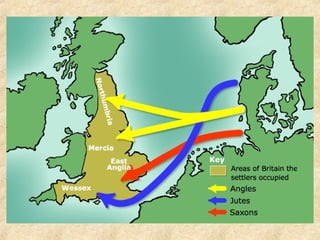
• Germanic tribes from central Europe
  – The Angles, the Saxons, and the Jutes
  – Moved east and eventually into England around 
    450 C.E.
  – Conquered by 800 C.E. through fighting process
    • Successful groups absorbed the losers
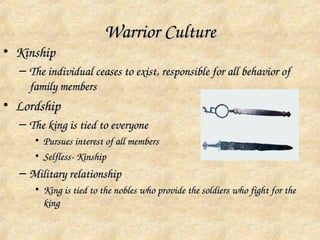
Warrior Culture
• Kinship
  – The individual ceases to exist, responsible for all behavior of 
    family members
• Lordship
  – The king is tied to everyone
     • Pursues interest of all members
     • Selfless­ Kinship
  – Military relationship
     • King is tied to the nobles who provide the soldiers who fight for the 
       king
Elements of the Warrior Culture
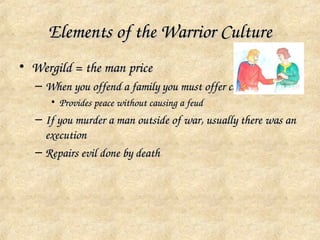
• Wergild = the man price
  – When you offend a family you must offer compensation
     • Provides peace without causing a feud
  – If you murder a man outside of war, usually there was an 
    execution
  – Repairs evil done by death
Warrior Culture Continued
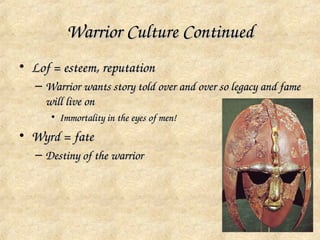
• Lof = esteem, reputation
   – Warrior wants story told over and over so legacy and fame 
     will live on
      • Immortality in the eyes of men!
• Wyrd = fate
   – Destiny of the warrior
The Epic Poem
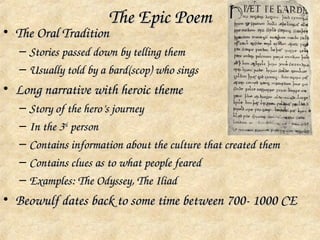
• The Oral Tradition
   – Stories passed down by telling them
   – Usually told by a bard(scop) who sings
• Long narrative with heroic theme
   – Story of the hero’s journey
   – In the 3rd person
   – Contains information about the culture that created them
   – Contains clues as to what people feared
   – Examples: The Odyssey, The Iliad
• Beowulf dates back to some time between 700­ 1000 CE
The Language of Beowulf
Old English
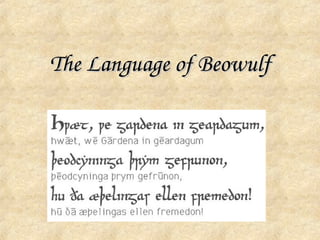
• This is the language of Beowulf, also known as 
  Anglo­Saxon
• Many people confuse Shakespearean language as Old 
  English
   – It is actually Modern English
• Shift to Modern English did not occur right away
   – Took hundreds of years
Old English Continued
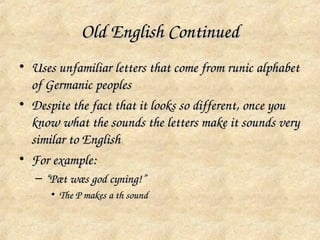
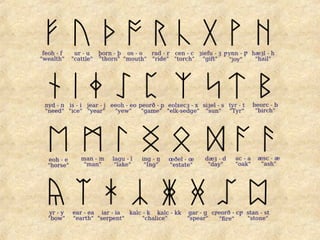
• Uses unfamiliar letters that come from runic alphabet 
  of Germanic peoples
• Despite the fact that it looks so different, once you 
  know what the sounds the letters make it sounds very 
  similar to English
• For example:
   – “Pæt wæs god cyning!”
      • The P makes a th sound
Anglo Saxon History
Anglo Saxon History

Anglo Saxon History