Old English (450-1150 A.D.)  and the  Anglo-Saxon Period  (449-1066 A.D.) The Language  and  the Literature
Three Periods  of  English Language Development Old English – 450-1150 A.D. Middle English – 1150-1500 A.D. Modern English – 1500-present
The Language English as a language first appeared about 1,500 years ago The land was inhabited between 50,000-250,000 years ago Who was there?
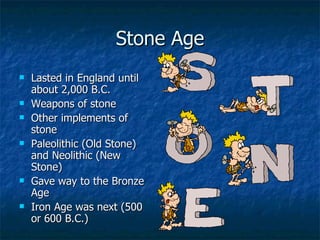
Stone Age Lasted in England until about 2,000 B.C. Weapons of stone Other implements of stone Paleolithic (Old Stone) and Neolithic (New Stone) Gave way to the Bronze Age Iron Age was next (500 or 600 B.C.)
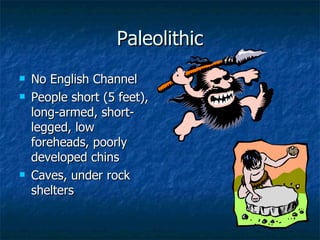
Paleolithic No English Channel People short (5 feet), long-armed, short-legged, low foreheads, poorly developed chins Caves, under rock shelters
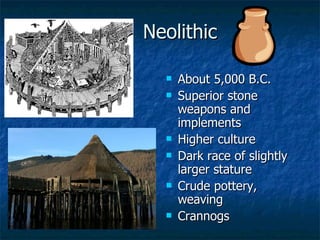
Neolithic About 5,000 B.C. Superior stone weapons and implements Higher culture Dark race of slightly larger stature Crude pottery, weaving Crannogs
The Celts Came to England during the Bronze Age Spoke Gaelic (Ireland) and Brythonic (Britain) Trivia:  In  Million Dollar Baby , Clint Eastwood’s character was reading a book about a language.  He used a term he learned to refer to Hilary Swank.  What was the language? Druids were priests who memorized and recited long heroic poems – oral tradition
Romans in England 55 B.C. – Julius Caesar invaded England -- twice Succeeded in gaining minimal control of the southeast Claudius gained control of most of the island in 43 A.D. 300 years of Roman rule
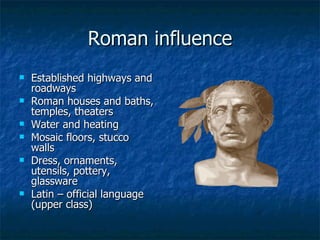
Roman influence Established highways and roadways Roman houses and baths, temples, theaters Water and heating Mosaic floors, stucco walls Dress, ornaments, utensils, pottery, glassware Latin – official language (upper class)
Germanic Conquest Invasions began around 449 A.D. Came from Denmark and Germany Bede --  Ecclesiastical History of the English People Jutes (Jutland on north Danish peninsula) Angles (Schleswig-Holstein on south Danish peninsula) Saxons (between the Elbe and Ems rivers) Frisians (along the coast from Weser to Rhine rivers)
Celtic Shut Out Britons “softened” by Roman rule Romans withdrew in 410 Made a deal with the Jutes, who took over Saxons came in 477 (Sussex) and 495 (Wessex); also Essex and Middlesex Angles came and settled the east coast; established Anglian kingdom in 547
Anglo-Saxon Civilization Some settlements peaceful with Celts Some settlements fighting occurred Roman  towns burnt and abandoned Eorls (aristocracy) Ceorls (simple freemen) Wergild (justice) Witan (council of elders) Northumbria (7 th  century) Mercia (8 th  century) East Anglia Kent Essex Sussex Wessex (9 th  century)
“ England” and “English” Celts called all Germanic invaders “Saxons” Early Latin writers referred to the people as “Saxones” and the land as “Saxonia” Anglia  began to appear with  Saxone  in reference to all West Germanic tribes Ethelbert, king of Kent, --  rex Anglorum Writers referred to the vernacular as  Englisc Angelcynn became the term for the land and people About 1,000,  Englaland  (land of the Angles) appeared
Old English Dialects Northumbrian – north of the Thames River Mercian – north of the Thames River West Saxon – West Saxon kingdom in the southwest (Almost all Old English literature is preserved in manuscripts transcribed in this region) Kentish – southeast (Jutes)
Old English example SEE HANDOUT PAGES 60-62
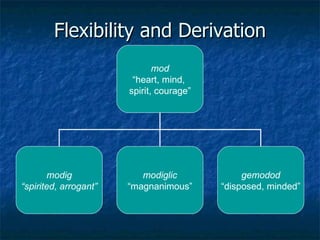
Flexibility and Derivation mod “ heart, mind,  spirit, courage” modig “ spirited, arrogant” modiglic “ magnanimous” gemodod “ disposed, minded”
Modern English  lacks  the  flexibility  of Old English.  The tendency is to borrow/assimilate rather than adapt our own words.
The Literature Some brought by the Germanic conquerors  Oral tradition Pagan Grim view of life Several gods – Woden, Fria, Tiu, Thor Wednesday, Friday, Tuesday, Thursday Fate (wyrd) Reintroduction of Christianity – 6 th  century
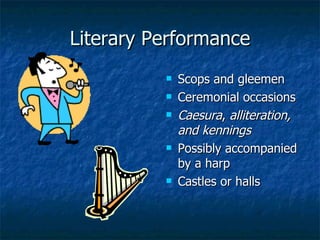
Literary Performance Scops and gleemen Ceremonial occasions Caesura ,  alliteration, and kennings Possibly accompanied by a harp Castles or halls
Christianity  King Ethelbert of Kent – converted by Saint Augustine Set up monastery in Canterbury  Mission:  Convert the kings 650 – Success Brought education and literature Bede (673-735)
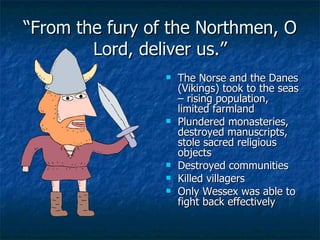
“ From the fury of the Northmen, O Lord, deliver us.” The Norse and the Danes (Vikings) took to the seas – rising population, limited farmland Plundered monasteries, destroyed manuscripts, stole sacred religious objects Destroyed communities Killed villagers Only Wessex was able to fight back effectively
Alfred the Great Wessex throne in 871 Resisted the Danes Truce:  Saxons rule the south; Danes rule the east and north ( Danelaw ) Peace -- Danish words became part of English vocabulary (i.e. law)
Norman Conquest Danes began a second invasion in 10 th  century. Edward the Confessor -- a Christian, part Norman, friend of King William of Normandy 1066 – Edward died; Norman Conquest
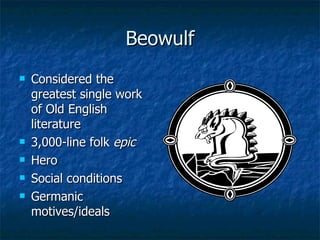
Beowulf Considered the greatest single work of Old English literature 3,000-line folk  epic Hero Social conditions Germanic motives/ideals
Beowulf as a record Physical endurance Unflinching courage Sense of duty Loyalty Honor “ Sorrow not . . . Better is it for every man that he avenge his friend than that he mourn greatly.  Each of us must abide the end of this world’s life; let him who may, work mighty deeds ere he die, for afterwards, when he lies lifeless, that is best for the warrior.”
Other Old English Literature War and exile Sea and its hardships/fascination Ruined cities Minstrel life Christian subjects “ Widsith” “ Deor” “ The Wanderer” “ The Seafarer” “ The Ruin” “ Battle of Brunanburh” “ Battle of Maldon” “ Juliana” “ Elene” “ Christ”
Verse Vs. Prose Verse is more easily remembered – oral tradition Alfred the Great (871-899) encouraged education  Had books translated from Latin to English Pastoral Care Bede’s  Ecclesiastical History of the English People The Consolation of Philosophy Sermon to the English
Let’s get started!!!

Old english power point

  • 1.
    Old English (450-1150A.D.) and the Anglo-Saxon Period (449-1066 A.D.) The Language and the Literature
  • 2.
    Three Periods of English Language Development Old English – 450-1150 A.D. Middle English – 1150-1500 A.D. Modern English – 1500-present
  • 3.
    The Language Englishas a language first appeared about 1,500 years ago The land was inhabited between 50,000-250,000 years ago Who was there?
  • 4.
    Stone Age Lastedin England until about 2,000 B.C. Weapons of stone Other implements of stone Paleolithic (Old Stone) and Neolithic (New Stone) Gave way to the Bronze Age Iron Age was next (500 or 600 B.C.)
  • 5.
    Paleolithic No EnglishChannel People short (5 feet), long-armed, short-legged, low foreheads, poorly developed chins Caves, under rock shelters
  • 6.
    Neolithic About 5,000B.C. Superior stone weapons and implements Higher culture Dark race of slightly larger stature Crude pottery, weaving Crannogs
  • 7.
    The Celts Cameto England during the Bronze Age Spoke Gaelic (Ireland) and Brythonic (Britain) Trivia: In Million Dollar Baby , Clint Eastwood’s character was reading a book about a language. He used a term he learned to refer to Hilary Swank. What was the language? Druids were priests who memorized and recited long heroic poems – oral tradition
  • 8.
    Romans in England55 B.C. – Julius Caesar invaded England -- twice Succeeded in gaining minimal control of the southeast Claudius gained control of most of the island in 43 A.D. 300 years of Roman rule
  • 9.
    Roman influence Establishedhighways and roadways Roman houses and baths, temples, theaters Water and heating Mosaic floors, stucco walls Dress, ornaments, utensils, pottery, glassware Latin – official language (upper class)
  • 10.
    Germanic Conquest Invasionsbegan around 449 A.D. Came from Denmark and Germany Bede -- Ecclesiastical History of the English People Jutes (Jutland on north Danish peninsula) Angles (Schleswig-Holstein on south Danish peninsula) Saxons (between the Elbe and Ems rivers) Frisians (along the coast from Weser to Rhine rivers)
  • 11.
    Celtic Shut OutBritons “softened” by Roman rule Romans withdrew in 410 Made a deal with the Jutes, who took over Saxons came in 477 (Sussex) and 495 (Wessex); also Essex and Middlesex Angles came and settled the east coast; established Anglian kingdom in 547
  • 12.
    Anglo-Saxon Civilization Somesettlements peaceful with Celts Some settlements fighting occurred Roman towns burnt and abandoned Eorls (aristocracy) Ceorls (simple freemen) Wergild (justice) Witan (council of elders) Northumbria (7 th century) Mercia (8 th century) East Anglia Kent Essex Sussex Wessex (9 th century)
  • 13.
    “ England” and“English” Celts called all Germanic invaders “Saxons” Early Latin writers referred to the people as “Saxones” and the land as “Saxonia” Anglia began to appear with Saxone in reference to all West Germanic tribes Ethelbert, king of Kent, -- rex Anglorum Writers referred to the vernacular as Englisc Angelcynn became the term for the land and people About 1,000, Englaland (land of the Angles) appeared
  • 14.
    Old English DialectsNorthumbrian – north of the Thames River Mercian – north of the Thames River West Saxon – West Saxon kingdom in the southwest (Almost all Old English literature is preserved in manuscripts transcribed in this region) Kentish – southeast (Jutes)
  • 15.
    Old English exampleSEE HANDOUT PAGES 60-62
  • 16.
    Flexibility and Derivationmod “ heart, mind, spirit, courage” modig “ spirited, arrogant” modiglic “ magnanimous” gemodod “ disposed, minded”
  • 17.
    Modern English lacks the flexibility of Old English. The tendency is to borrow/assimilate rather than adapt our own words.
  • 18.
    The Literature Somebrought by the Germanic conquerors Oral tradition Pagan Grim view of life Several gods – Woden, Fria, Tiu, Thor Wednesday, Friday, Tuesday, Thursday Fate (wyrd) Reintroduction of Christianity – 6 th century
  • 19.
    Literary Performance Scopsand gleemen Ceremonial occasions Caesura , alliteration, and kennings Possibly accompanied by a harp Castles or halls
  • 20.
    Christianity KingEthelbert of Kent – converted by Saint Augustine Set up monastery in Canterbury Mission: Convert the kings 650 – Success Brought education and literature Bede (673-735)
  • 21.
    “ From thefury of the Northmen, O Lord, deliver us.” The Norse and the Danes (Vikings) took to the seas – rising population, limited farmland Plundered monasteries, destroyed manuscripts, stole sacred religious objects Destroyed communities Killed villagers Only Wessex was able to fight back effectively
  • 22.
    Alfred the GreatWessex throne in 871 Resisted the Danes Truce: Saxons rule the south; Danes rule the east and north ( Danelaw ) Peace -- Danish words became part of English vocabulary (i.e. law)
  • 23.
    Norman Conquest Danesbegan a second invasion in 10 th century. Edward the Confessor -- a Christian, part Norman, friend of King William of Normandy 1066 – Edward died; Norman Conquest
  • 24.
    Beowulf Considered thegreatest single work of Old English literature 3,000-line folk epic Hero Social conditions Germanic motives/ideals
  • 25.
    Beowulf as arecord Physical endurance Unflinching courage Sense of duty Loyalty Honor “ Sorrow not . . . Better is it for every man that he avenge his friend than that he mourn greatly. Each of us must abide the end of this world’s life; let him who may, work mighty deeds ere he die, for afterwards, when he lies lifeless, that is best for the warrior.”
  • 26.
    Other Old EnglishLiterature War and exile Sea and its hardships/fascination Ruined cities Minstrel life Christian subjects “ Widsith” “ Deor” “ The Wanderer” “ The Seafarer” “ The Ruin” “ Battle of Brunanburh” “ Battle of Maldon” “ Juliana” “ Elene” “ Christ”
  • 27.
    Verse Vs. ProseVerse is more easily remembered – oral tradition Alfred the Great (871-899) encouraged education Had books translated from Latin to English Pastoral Care Bede’s Ecclesiastical History of the English People The Consolation of Philosophy Sermon to the English
  • 28.