Anesthesia Machine

History of anesthesia machine

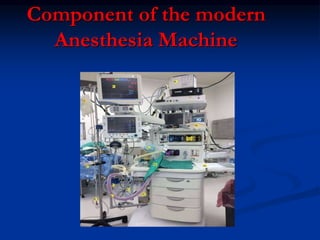
Components of modern anesthesia machine

Safety features of modern anesthesia machine

Anesthesia machine Check list
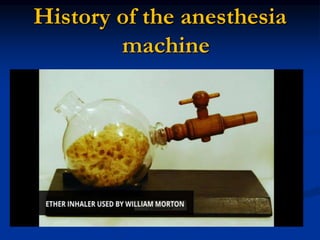
History of the anesthesia
machine
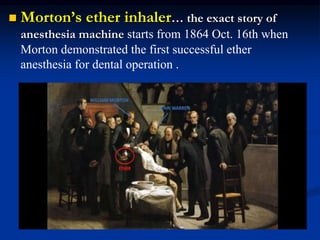
 Morton’s ether inhaler… the exact story of
anesthesia machine starts from 1864 Oct. 16th when
Morton demonstrated the first successful ether
anesthesia for dental operation .
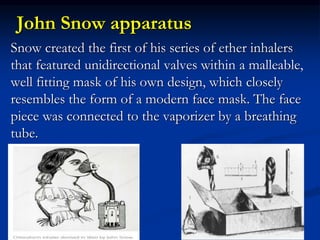
John Snow apparatus
Snow created the first of his series of ether inhalers
that featured unidirectional valves within a malleable,
well fitting mask of his own design, which closely
resembles the form of a modern face mask. The face
piece was connected to the vaporizer by a breathing
tube.
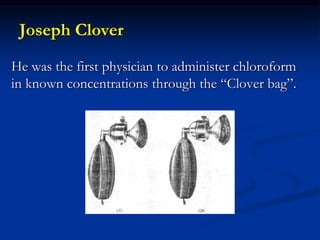
Joseph Clover
He was the first physician to administer chloroform
in known concentrations through the “Clover bag”.
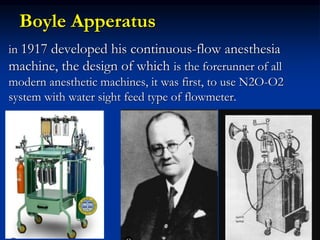
Boyle Apperatus
in 1917 developed his continuous-flow anesthesia
machine, the design of which is the forerunner of all
modern anesthetic machines, it was first, to use N2O-O2
system with water sight feed type of flowmeter.
Boyle’s machine consist of
 A high-pressure supply of gases. It housed two oxygen and
two nitrous oxide cylinders in a wooden box.
 Pressure gauges on oxygen cylinders and fine-adjustment
reducing valves. These produce a manageable breathing
system pressure. It had a spirit flame to warm these and
prevent obstruction of gas flow from ice.
 Flowmeters to control gas flow rate and adjust
proportions of gas delivered.
 A metal and glass vaporizer bottle for ether.
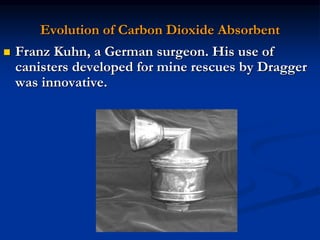
Evolution of Carbon Dioxide Absorbent
 Franz Kuhn, a German surgeon. His use of
canisters developed for mine rescues by Dragger
was innovative.
Early anesthesia vaporizers
The Junker’s inhaler (forerunner of gases under
pressure) was the first device in which an attempt
was made to increase the gas liquid interface.
The Copper Kettle was the first temperature
compensated accurate vaporizer.
The TECOTA(Temperature Compensated
Trichloroethylene Air) vaporizer appeared when
halothane was first marketed in England. It is an
effective temperature-compensated, agent specific
vaporizer.
 “Fluotec,” the first of a series of agent-specific
“tec” vaporizers for use in the operating room.
Evolution of the anesthesia
ventilator
In 1907, the first intermittent positive-pressure
device, the Dragger “Pulmotor,” was developed
to inflate the lungs during cardiothoracic
surgery.
A further boost to the development of
automatic artificial ventilators occurred in 1952,
when a catastrophic poliomyelitis epidemic
struck Denmark. There was a very high
incidence of bulbar paralysis. By using
tracheostomy and manual positive pressure
ventilation physicians overcome the catastrophe.
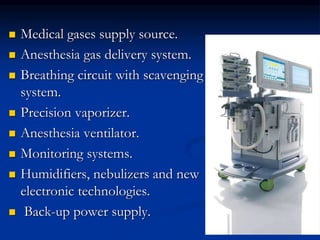
Component of the modern
Anesthesia Machine
 Medical gases supply source.
 Anesthesia gas delivery system.
 Breathing circuit with scavenging
system.
 Precision vaporizer.
 Anesthesia ventilator.
 Monitoring systems.
 Humidifiers, nebulizers and new
electronic technologies.
 Back-up power supply.
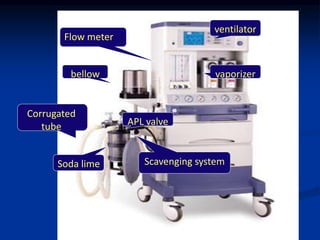
vaporizer
bellow
Corrugated
tube
Soda lime
Flow meter
ventilator
APL valve
Scavenging system
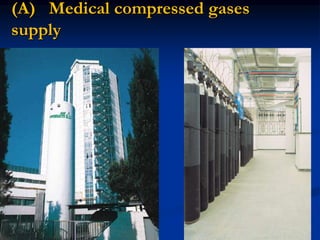
(A) Medical compressed gases
supply
Medical compressed gases supply
Gases used in the administration of anesthesia
(oxygen,nitrous oxide,air) are most often delivered to
the anesthesia machine via two sources pipline and
cylinder:
Pipeline supply source:
In the majority of modern hospitals, piped medical gases and vaccum (
PMGV ) system have been installed to distribute oxygen, nitrous oxide,
medical air and vacuum. The pipelines’ outlets act as self-closing
sockets, each specifically configured, coloured and labelled for one gas.
Oxygen, nitrous oxide and air are delivered to the anesthetic room at a
pressure (4bar, 60 pounds per square inch (psi)).

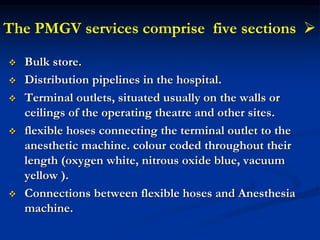
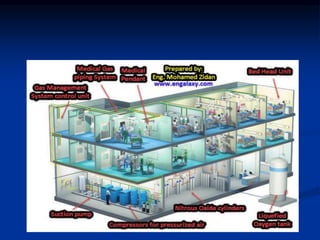
The PMGV services comprise five sections
 Bulk store.
 Distribution pipelines in the hospital.
 Terminal outlets, situated usually on the walls or
ceilings of the operating theatre and other sites.
 flexible hoses connecting the terminal outlet to the
anesthetic machine. colour coded throughout their
length (oxygen white, nitrous oxide blue, vacuum
yellow ).
 Connections between flexible hoses and Anesthesia
machine.
Bulk stores:
•Oxygen:
The standard bulk oxygen supply should consist of three
cryogenic oxygen storage tanks: a primary tank, A; a secondary
tank, B; and a reserve tank, C (Tanks A and B are physically
situated next to each other. The reserve tank (C) is located
approximately 1 block (approximately 305 m) away.
In small hospitals, oxygen may be supplied to the PMGV from
a bank of several oxygen cylinders attached to a manifold.
Oxygen cylinder manifolds consist of two groups of
large cylinders (size J). The two groups alternate in
supplying oxygen to the pipelines. In both groups, all
cylinder valves are open so that they empty
simultaneously.
All cylinders have non-return valves. The supply
automatically changes from one group to the other
when the first group of cylinders is nearly empty. The
changeover also activates an electrical signalling
system which alerts staff to change the empty
cylinders.
Nitrous oxide
Nitrous oxide , also may be supplied from banks of
cylinders connected to manifolds similar to those used
for oxygen.
Medical compressed air
Compressed air is supplied from a bank of cylinders into
the PMGV system . Air of medical quality is required as
industrial compressed air may contain fine particles of oil
.
Piped medical vaccum
Piped medical vacuum is provided by large vacuum pumps
which discharge via a filter and silencer to a suitable point ,
usually at roof level , where gases are vented to atmosphere.
Terminal outlets
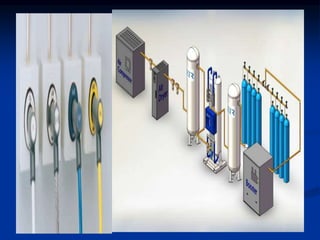
The terminal outlets are colour-coded with noninterchangeable
connections specific to each gas .
 Cylinder supply source:
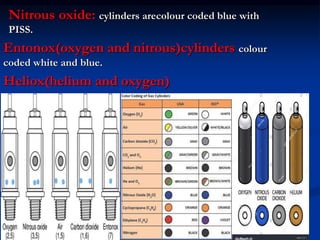
 Oxygen on anesthesia machines, the cylinder serves as a
backup supply its of E size and have an internal volume of
4.8 L. about 650 L. colour coded with PISS prevent wrong
connection.
Nitrous oxide: cylinders arecolour coded blue with
PISS.
Entonox(oxygen and nitrous)cylinders colour
coded white and blue.
Heliox(helium and oxygen)
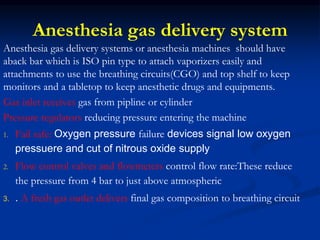
Anesthesia gas delivery system
Anesthesia gas delivery systems or anesthesia machines should have
aback bar which is ISO pin type to attach vaporizers easily and
attachments to use the breathing circuits(CGO) and top shelf to keep
monitors and a tabletop to keep anesthetic drugs and equipments.
Gas inlet receives gas from pipline or cylinder
Pressure regulators reducing pressure entering the machine
1. Fail safe: Oxygen pressure failure devices signal low oxygen
pressuere and cut of nitrous oxide supply
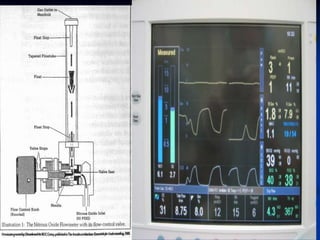
2. Flow control valves and flowmeters control flow rate:These reduce
the pressure from 4 bar to just above atmospheric
3. . A fresh gas outlet delivers final gas composition to breathing circuit
Design Limitations of Conventional
Anesthesia Machine
 Presence of many external connections subjected
to kinking, obstruction and disconnection.
 Lack of protection against barotruma.
 Lack of automated checkout.
 Lack of advanced ventilation features.
 Lack of low-flow adaptation.
 Vaporizer risks.
Complications Associated with
Anesthesia Machines and Breathing
Systems
 Hypoxic inspired gas mixture.
 Hypoventilation.
 Hypercapnia (absent/ineffective CO2 absorbent).
 Excessive airway pressure.
 Inhalation of foreign material.
 Over-dosage of the anesthetic agent.
 Inadequate anesthetic concentration.
 Fires
 Exposure to waste anesthetic gases
Safety features in modern anesthesia
machine
Poor equipment design has been identified as a major
factor in many adverse events which directly affect
patient safety. Modern anesthetic machines are
designed with many safety devices which include :
Electrical system :
Electrical power is essential to anesthesia machine as
well as monitors to function normally. Modern
anesthesia machines have a power failure alarm and
back-up battery which designed to provide temporary
power until emergency generator is on
safety feature in gas supply systems
design :
Pipeline system :
Pipeline design must provide reserve supplies and
reserve plant to ensure continuous supply, non
interchangeability between different gas services,
monitoring and alarm system and correct installation,
testing, certification of the system and correct marking.
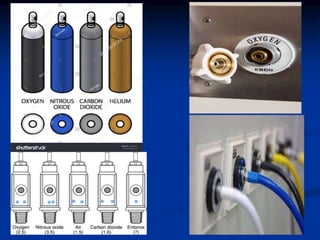
Connectors and Connections
 Diameter Index Safety System(DISS) ; which prevents
hoses being accidentally plugged into the wrong wall
socket.
 Colour coding; flexible colour-coded hoses; connect
the outlets to the anesthetic machine .The anesthetic
machine end should be permanently fixed .
 Connectors ; each has a different size and
configuration to prevent misconnection.
 Pin Index Safety System (PISS); prevent attachment of
wrong cylinders.
Pressure Regulator
providing a constant low pressure suitable for the
machine from the variable high-pressure cylinders.
Some machines use two regulators whereby the second
regulator delivers the gas to flowmeters at just above
atmospheric pressure.
Unidirectional flow valve permits gas to enter the
machine not to get out.
Oxygen Flush this switch directs a high pressure flow
of oxygen direct to the CGO from the source, either
pipeline or cylinder, bypassing all intermediate meters
and vaporizers.
Flowmeters :
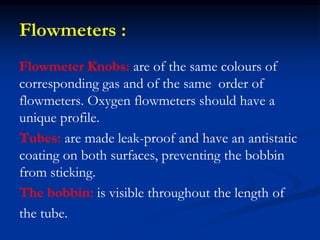
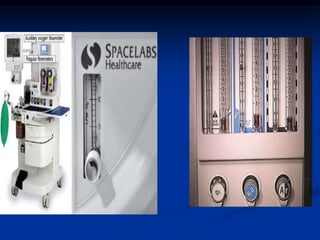
Flowmeter Knobs: are of the same colours of
corresponding gas and of the same order of
flowmeters. Oxygen flowmeters should have a
unique profile.
Tubes: are made leak-proof and have an antistatic
coating on both surfaces, preventing the bobbin
from sticking.
The bobbin: is visible throughout the length of
the tube.
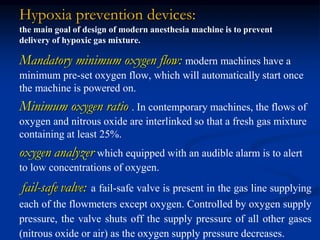
Hypoxia prevention devices:
the main goal of design of modern anesthesia machine is to prevent
delivery of hypoxic gas mixture.
Mandatory minimum oxygen flow: modern machines have a
minimum pre-set oxygen flow, which will automatically start once
the machine is powered on.
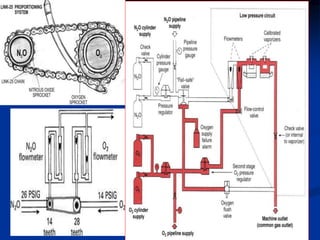
Minimum oxygen ratio . In contemporary machines, the flows of
oxygen and nitrous oxide are interlinked so that a fresh gas mixture
containing at least 25%.
oxygen analyzer which equipped with an audible alarm is to alert
to low concentrations of oxygen.
fail-safe valve: a fail-safe valve is present in the gas line supplying
each of the flowmeters except oxygen. Controlled by oxygen supply
pressure, the valve shuts off the supply pressure of all other gases
(nitrous oxide or air) as the oxygen supply pressure decreases.
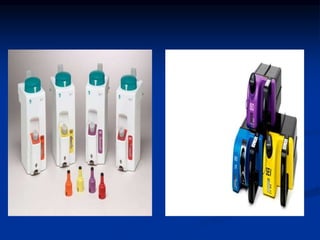
Safety features of Vaporizers
Keyed fillers :
An agent-specific colour- and shape-coded device. Low filling
port and presence of maximum filling mark prevent over filling.
Vaporizer interlock :
Interlock ensures that only one vaporizer is turned on.
Anti-spill mechanism:
The Tec 5 generation of vaporizers and later models have an
anti-spill device, which prevents volatile agents from entering the
bypass chamber.
Release button
Must be activated before dial can be turned on.
Monitoring
Oxygen analyser ; General anaesthesia should never be
administered without an oxygen analyser in the
breathing circuit.
Airway pressure monitoring
Gas volume monitoring
Disconnection monitors are an integral component of
newer anaesthesia machines.
Criteria to determine obsolescence
of anaesthesia machines
Anaesthesia machines may be considered obsolete
(to be discarded) if they do not offer the following
mandatory safety features:
Lack of certain safety features
 Minimum oxygen ratio device in a machine, which
can provide nitrous oxide as well.
 Oxygen failure safety device.
 Oxygen supply pressure failure alarm.
 Vaporizer interlock device (may be waived off if
machine is capable of accepting only one vaporizer).
 Pin index safety system and Non-interchangeable
gas connectors like DISS.
Presence of unacceptable features
 Measured flow (flow meter-controlled) vaporizers.
(e.g., Copper Kettle, Verni-trol).
 More than one flow control knob for a single gas
delivered to the CGO of the machine.
 Vaporizer with rotary concentration dials such that the
anaesthetic vapour concentration
increases when the dial is turned clockwise.
 Connection (s) in scavenging system of the same (i.e.,
15-mm or 22-mm) diameter as a breathing system
connection.
Lack of certain desirable features to be
considered
 Means to isolate the adjustable pressure-limiting valve during
mechanical ventilation.
 Oxygen flow control knob that is fluted and larger than the
other flow control knobs.
 Oxygen flush control protected from accidental
activation.
 Main on/off switch for electrical power to integral monitors
and alarms.
 Anti-disconnection device at the fresh gas outlet.
 Airway pressure alarm (for detecting sustained positive
pressure, negative pressure and high peak pressure).
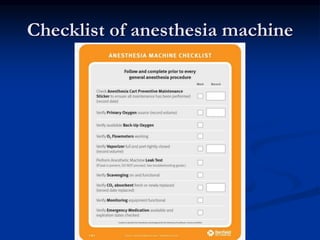
Checklist of anesthesia machine

recent advances in anesthesia machine design (2).ppt

  • 3.
    Anesthesia Machine  History ofanesthesia machine  Components of modern anesthesia machine  Safety features of modern anesthesia machine  Anesthesia machine Check list
  • 4.
    History of theanesthesia machine
  • 5.
     Morton’s etherinhaler… the exact story of anesthesia machine starts from 1864 Oct. 16th when Morton demonstrated the first successful ether anesthesia for dental operation .
  • 6.
    John Snow apparatus Snowcreated the first of his series of ether inhalers that featured unidirectional valves within a malleable, well fitting mask of his own design, which closely resembles the form of a modern face mask. The face piece was connected to the vaporizer by a breathing tube.
  • 7.
    Joseph Clover He wasthe first physician to administer chloroform in known concentrations through the “Clover bag”.
  • 8.
    Boyle Apperatus in 1917developed his continuous-flow anesthesia machine, the design of which is the forerunner of all modern anesthetic machines, it was first, to use N2O-O2 system with water sight feed type of flowmeter.
  • 9.
    Boyle’s machine consistof  A high-pressure supply of gases. It housed two oxygen and two nitrous oxide cylinders in a wooden box.  Pressure gauges on oxygen cylinders and fine-adjustment reducing valves. These produce a manageable breathing system pressure. It had a spirit flame to warm these and prevent obstruction of gas flow from ice.  Flowmeters to control gas flow rate and adjust proportions of gas delivered.  A metal and glass vaporizer bottle for ether.
  • 10.
    Evolution of CarbonDioxide Absorbent  Franz Kuhn, a German surgeon. His use of canisters developed for mine rescues by Dragger was innovative.
  • 11.
    Early anesthesia vaporizers TheJunker’s inhaler (forerunner of gases under pressure) was the first device in which an attempt was made to increase the gas liquid interface. The Copper Kettle was the first temperature compensated accurate vaporizer. The TECOTA(Temperature Compensated Trichloroethylene Air) vaporizer appeared when halothane was first marketed in England. It is an effective temperature-compensated, agent specific vaporizer.  “Fluotec,” the first of a series of agent-specific “tec” vaporizers for use in the operating room.
  • 13.
    Evolution of theanesthesia ventilator In 1907, the first intermittent positive-pressure device, the Dragger “Pulmotor,” was developed to inflate the lungs during cardiothoracic surgery. A further boost to the development of automatic artificial ventilators occurred in 1952, when a catastrophic poliomyelitis epidemic struck Denmark. There was a very high incidence of bulbar paralysis. By using tracheostomy and manual positive pressure ventilation physicians overcome the catastrophe.
  • 15.
    Component of themodern Anesthesia Machine
  • 16.
     Medical gasessupply source.  Anesthesia gas delivery system.  Breathing circuit with scavenging system.  Precision vaporizer.  Anesthesia ventilator.  Monitoring systems.  Humidifiers, nebulizers and new electronic technologies.  Back-up power supply.
  • 17.
  • 18.
  • 19.
    Medical compressed gasessupply Gases used in the administration of anesthesia (oxygen,nitrous oxide,air) are most often delivered to the anesthesia machine via two sources pipline and cylinder: Pipeline supply source: In the majority of modern hospitals, piped medical gases and vaccum ( PMGV ) system have been installed to distribute oxygen, nitrous oxide, medical air and vacuum. The pipelines’ outlets act as self-closing sockets, each specifically configured, coloured and labelled for one gas. Oxygen, nitrous oxide and air are delivered to the anesthetic room at a pressure (4bar, 60 pounds per square inch (psi)).
  • 20.
     The PMGV servicescomprise five sections  Bulk store.  Distribution pipelines in the hospital.  Terminal outlets, situated usually on the walls or ceilings of the operating theatre and other sites.  flexible hoses connecting the terminal outlet to the anesthetic machine. colour coded throughout their length (oxygen white, nitrous oxide blue, vacuum yellow ).  Connections between flexible hoses and Anesthesia machine.
  • 22.
    Bulk stores: •Oxygen: The standardbulk oxygen supply should consist of three cryogenic oxygen storage tanks: a primary tank, A; a secondary tank, B; and a reserve tank, C (Tanks A and B are physically situated next to each other. The reserve tank (C) is located approximately 1 block (approximately 305 m) away. In small hospitals, oxygen may be supplied to the PMGV from a bank of several oxygen cylinders attached to a manifold.
  • 23.
    Oxygen cylinder manifoldsconsist of two groups of large cylinders (size J). The two groups alternate in supplying oxygen to the pipelines. In both groups, all cylinder valves are open so that they empty simultaneously. All cylinders have non-return valves. The supply automatically changes from one group to the other when the first group of cylinders is nearly empty. The changeover also activates an electrical signalling system which alerts staff to change the empty cylinders.
  • 24.
    Nitrous oxide Nitrous oxide, also may be supplied from banks of cylinders connected to manifolds similar to those used for oxygen. Medical compressed air Compressed air is supplied from a bank of cylinders into the PMGV system . Air of medical quality is required as industrial compressed air may contain fine particles of oil .
  • 26.
    Piped medical vaccum Pipedmedical vacuum is provided by large vacuum pumps which discharge via a filter and silencer to a suitable point , usually at roof level , where gases are vented to atmosphere. Terminal outlets The terminal outlets are colour-coded with noninterchangeable connections specific to each gas .  Cylinder supply source:  Oxygen on anesthesia machines, the cylinder serves as a backup supply its of E size and have an internal volume of 4.8 L. about 650 L. colour coded with PISS prevent wrong connection.
  • 27.
    Nitrous oxide: cylindersarecolour coded blue with PISS. Entonox(oxygen and nitrous)cylinders colour coded white and blue. Heliox(helium and oxygen)
  • 28.
    Anesthesia gas deliverysystem Anesthesia gas delivery systems or anesthesia machines should have aback bar which is ISO pin type to attach vaporizers easily and attachments to use the breathing circuits(CGO) and top shelf to keep monitors and a tabletop to keep anesthetic drugs and equipments. Gas inlet receives gas from pipline or cylinder Pressure regulators reducing pressure entering the machine 1. Fail safe: Oxygen pressure failure devices signal low oxygen pressuere and cut of nitrous oxide supply 2. Flow control valves and flowmeters control flow rate:These reduce the pressure from 4 bar to just above atmospheric 3. . A fresh gas outlet delivers final gas composition to breathing circuit
  • 30.
    Design Limitations ofConventional Anesthesia Machine  Presence of many external connections subjected to kinking, obstruction and disconnection.  Lack of protection against barotruma.  Lack of automated checkout.  Lack of advanced ventilation features.  Lack of low-flow adaptation.  Vaporizer risks.
  • 31.
    Complications Associated with AnesthesiaMachines and Breathing Systems
  • 32.
     Hypoxic inspiredgas mixture.  Hypoventilation.  Hypercapnia (absent/ineffective CO2 absorbent).  Excessive airway pressure.  Inhalation of foreign material.  Over-dosage of the anesthetic agent.  Inadequate anesthetic concentration.  Fires  Exposure to waste anesthetic gases
  • 33.
    Safety features inmodern anesthesia machine Poor equipment design has been identified as a major factor in many adverse events which directly affect patient safety. Modern anesthetic machines are designed with many safety devices which include : Electrical system : Electrical power is essential to anesthesia machine as well as monitors to function normally. Modern anesthesia machines have a power failure alarm and back-up battery which designed to provide temporary power until emergency generator is on
  • 34.
    safety feature ingas supply systems design : Pipeline system : Pipeline design must provide reserve supplies and reserve plant to ensure continuous supply, non interchangeability between different gas services, monitoring and alarm system and correct installation, testing, certification of the system and correct marking.
  • 35.
    Connectors and Connections Diameter Index Safety System(DISS) ; which prevents hoses being accidentally plugged into the wrong wall socket.  Colour coding; flexible colour-coded hoses; connect the outlets to the anesthetic machine .The anesthetic machine end should be permanently fixed .  Connectors ; each has a different size and configuration to prevent misconnection.  Pin Index Safety System (PISS); prevent attachment of wrong cylinders.
  • 37.
    Pressure Regulator providing aconstant low pressure suitable for the machine from the variable high-pressure cylinders. Some machines use two regulators whereby the second regulator delivers the gas to flowmeters at just above atmospheric pressure. Unidirectional flow valve permits gas to enter the machine not to get out. Oxygen Flush this switch directs a high pressure flow of oxygen direct to the CGO from the source, either pipeline or cylinder, bypassing all intermediate meters and vaporizers.
  • 38.
    Flowmeters : Flowmeter Knobs:are of the same colours of corresponding gas and of the same order of flowmeters. Oxygen flowmeters should have a unique profile. Tubes: are made leak-proof and have an antistatic coating on both surfaces, preventing the bobbin from sticking. The bobbin: is visible throughout the length of the tube.
  • 40.
    Hypoxia prevention devices: themain goal of design of modern anesthesia machine is to prevent delivery of hypoxic gas mixture. Mandatory minimum oxygen flow: modern machines have a minimum pre-set oxygen flow, which will automatically start once the machine is powered on. Minimum oxygen ratio . In contemporary machines, the flows of oxygen and nitrous oxide are interlinked so that a fresh gas mixture containing at least 25%. oxygen analyzer which equipped with an audible alarm is to alert to low concentrations of oxygen. fail-safe valve: a fail-safe valve is present in the gas line supplying each of the flowmeters except oxygen. Controlled by oxygen supply pressure, the valve shuts off the supply pressure of all other gases (nitrous oxide or air) as the oxygen supply pressure decreases.
  • 42.
    Safety features ofVaporizers Keyed fillers : An agent-specific colour- and shape-coded device. Low filling port and presence of maximum filling mark prevent over filling. Vaporizer interlock : Interlock ensures that only one vaporizer is turned on. Anti-spill mechanism: The Tec 5 generation of vaporizers and later models have an anti-spill device, which prevents volatile agents from entering the bypass chamber. Release button Must be activated before dial can be turned on.
  • 44.
    Monitoring Oxygen analyser ;General anaesthesia should never be administered without an oxygen analyser in the breathing circuit. Airway pressure monitoring Gas volume monitoring Disconnection monitors are an integral component of newer anaesthesia machines.
  • 45.
    Criteria to determineobsolescence of anaesthesia machines Anaesthesia machines may be considered obsolete (to be discarded) if they do not offer the following mandatory safety features:
  • 46.
    Lack of certainsafety features  Minimum oxygen ratio device in a machine, which can provide nitrous oxide as well.  Oxygen failure safety device.  Oxygen supply pressure failure alarm.  Vaporizer interlock device (may be waived off if machine is capable of accepting only one vaporizer).  Pin index safety system and Non-interchangeable gas connectors like DISS.
  • 47.
    Presence of unacceptablefeatures  Measured flow (flow meter-controlled) vaporizers. (e.g., Copper Kettle, Verni-trol).  More than one flow control knob for a single gas delivered to the CGO of the machine.  Vaporizer with rotary concentration dials such that the anaesthetic vapour concentration increases when the dial is turned clockwise.  Connection (s) in scavenging system of the same (i.e., 15-mm or 22-mm) diameter as a breathing system connection.
  • 48.
    Lack of certaindesirable features to be considered  Means to isolate the adjustable pressure-limiting valve during mechanical ventilation.  Oxygen flow control knob that is fluted and larger than the other flow control knobs.  Oxygen flush control protected from accidental activation.  Main on/off switch for electrical power to integral monitors and alarms.  Anti-disconnection device at the fresh gas outlet.  Airway pressure alarm (for detecting sustained positive pressure, negative pressure and high peak pressure).
  • 49.