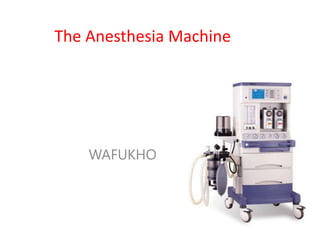
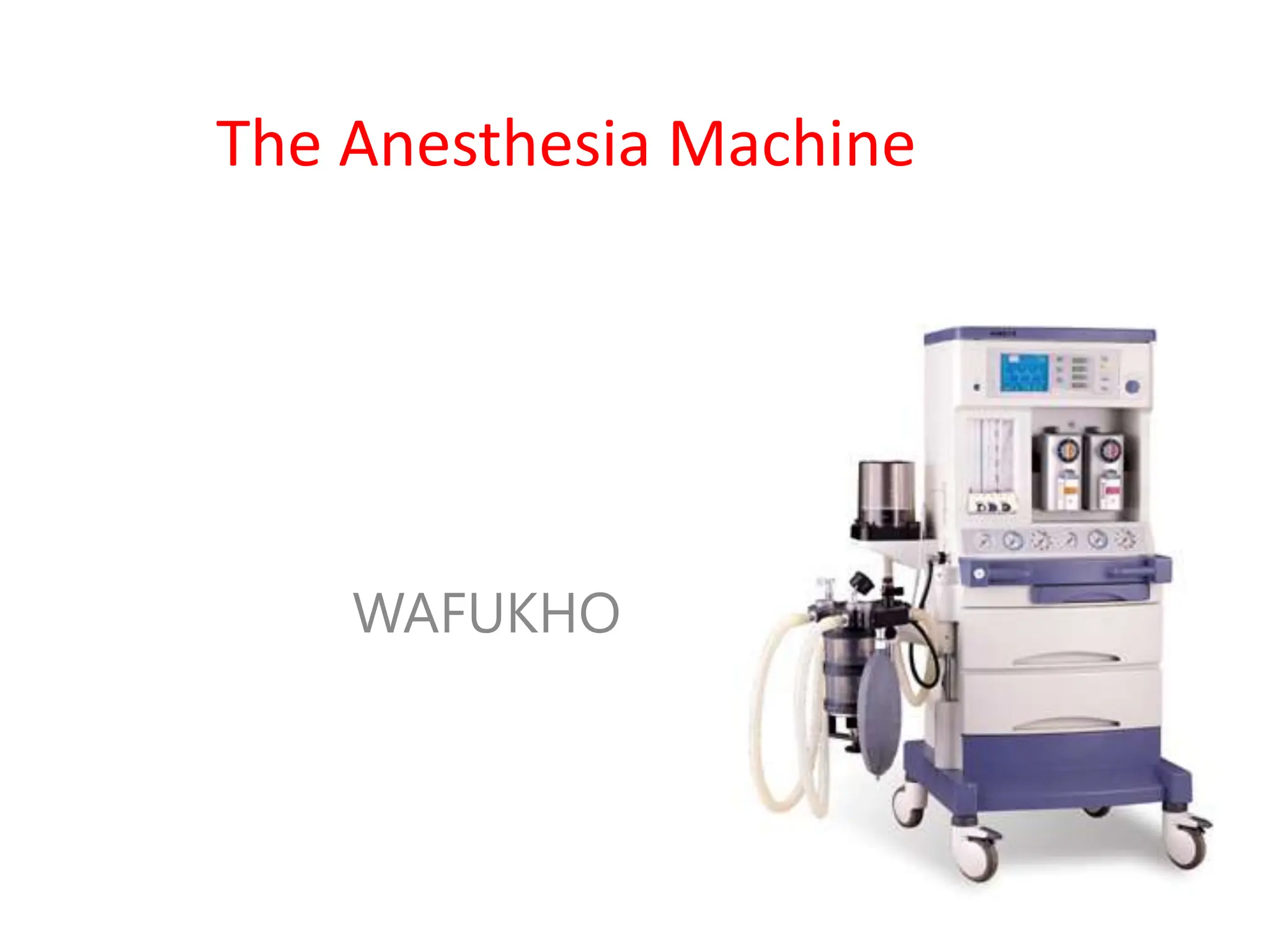
The Anesthesia Machine
WAFUKHO
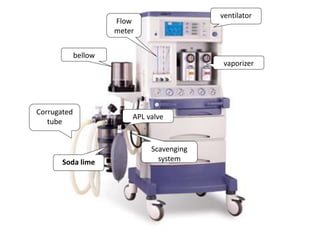
vaporizer
bellow
Corrugated
tube
Soda lime
Flow
meter
ventilator
APL valve
Scavenging
system
NE
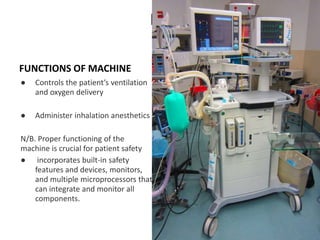
FUNCTIONS OF MACHINE
● Controls the patient’s ventilation
and oxygen delivery
● Administer inhalation anesthetics
N/B. Proper functioning of the
machine is crucial for patient safety
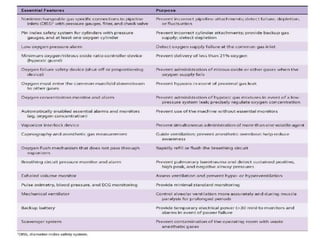
● incorporates built-in safety
features and devices, monitors,
and multiple microprocessors that
can integrate and monitor all
components.
Safety
● Misuse of gas delivery system is more likely than failure of device to
cause adverse outcomes
● Preventable mishaps can be traced to- lack of familiarity with the
equipment or failure to check machine
● Most common problems
● Breathing circuit
● Vaporizers
● Ventilators
● Oxygen supply
Describe the safety features in an
anaesthesia machine (20MKS)
1. Gas supplies: From the central
pipeline to the machine as well as
cylinders.
1. Pin index system
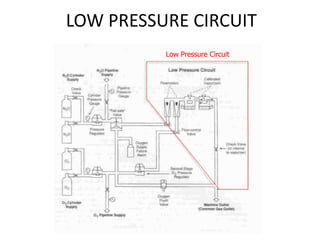
2. Cylinder colour coding
3. Pressure relief valves
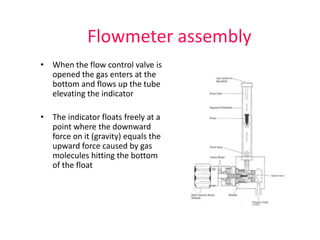
4. Pressure regulators
5. Schrader probe
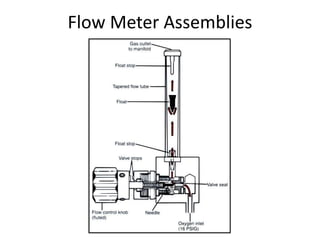
6. Flexible colour coded hose pipes
7. Diameter index safety system(DISS)
8. Non interchangeable screw thread
(NIST)
9. Pippeline pressure indicators
10. Oxygen pressure failure system
11. Oxygen flush
Describe the safety features in an
anaesthesia machine (20MKS)
1. Flow meters. 1. Providing stops at the full ON or OFF position,
so that excessive pressure may not damage
either the valve seat or get disengaged at the
full ON position so that gas escapes out of the
meters.
2. Control knob: Oxygen flow control knob is the
largest and fluted for easy identification. A
protective barrier around the control
minimises accidental changes in settings.
3. Tubes, which measure flow, have different
lengths and diameters. Some machines have a
pin-index system at each end.
4. Tubes are made leak-proof with neoprene
washers (O-rings) at both ends of the flow
meter assembly.
5. The tubes have an antistatic coating on both
surfaces, preventing the bobbin from sticking.
6. The bobbin is visible throughout the length of
the tube.
Describe the safety features in an
anaesthesia machine (20MKS)
1. Vaporizers. 1. Most vaporizers have a push (release)
button to be activated before the dial
can be turned on.
2. All modern vaporizers come equipped
with an interlock mechanism, which
prevent from more than one vaporizer
being put to use at the same time, thus
causing an accidental overdose.
3. Newer modern vaporizers have a
separate transport setting, which
prevents spillage of the liquid agent into
the bypass channel, which may cause
potential overdosing when the
vaporizers are used
4. All newer vaporizers have keyed/funnel
filling systems with unique sizing of the
fillers/funnels. Specific changes are also
made on the bottle end of the filling
adaptors.
Describe the safety features in an
anaesthesia machine (20MKS)
1. Scavenging. All connections in the scavenging system are
of 30 mm diameter, which is distinctly
different from the airway accessories
making misconnections improbable.
Transfer tubings in the system are different
by colour and configuration to that of
breathing gase.
Tubings are resistant to kinking and are
occlusion proof.
Scavenging systems also incorporate
negative and positive pressure relief valves
to make sure no dangerous pressures are
transmitted into the breathing system in the
event of malfunction of the system.
Describe the safety features in an
anaesthesia machine (20MKS)
1. Monitoring oxygen analyser in the breathing circuit. ASTM
standards do require that low oxygen alarm
level cannot be set below 21%. [5]
Gas volume monitoring is performed with
spirometers, This monitoring gives us a
measure of the tidal volume and minute
volume, as well as disconnection.
Airway pressure monitoring, The purpose of
airway pressure monitors is to prevent either
high (to prevent barotraumas) or low
pressures (leaks or disconnection).
Disconnection monitors are an integral
component of newer anaesthesia machines.
[51] They can be based on the gas flows (volume
measurements), pressure in the circuit, or gas
detection like capnography
Describe the anti-hypoxia mechanism found on the anaesthesia
machine (5marks)
Hypoxia prevention devices
.Mandatory minimum oxygen flow
Most modern machines have a minimum pre-set oxygen flow, which
will automatically start once the machine is powered on.
• Minimum oxygen ratio
Anaesthesia workstation standards require that a device be
provided that protects against a user selection of a gas mixture
with an O 2 concentration below 21%.
• Mechanical linkage
Mechanically linking the oxygen and nitrous oxide flow control
valves can ensure that at a certain set percentage of concentration
(of oxygen) both flows either increase or decrease in proportion
to the
Describe the anti-hypoxia mechanism found on the
anaesthesia machine (5marks)
• Electronic linkage
An electronic proportioning valve controls the oxygen
concentration to a pre-set minimum, depending on
the feedback it receives from a computer that
constantly calculates the maximum safe limit of other
gases that can be delivered.
Alarms
machines also activate an alarm when a user tries to
set a flow with a lower than desired O 2concentration.
Outline
• Anesthesia Machine
– High pressure system
– Intermediate pressure system
– Low pressure system
– Safety systems throughout
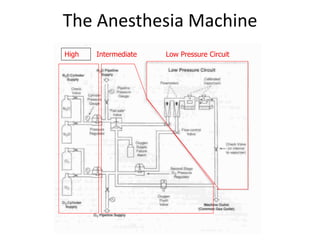
The Anesthesia Machine
High Intermediate Low Pressure Circuit
High Pressure System
• Receives gasses from the high pressure E
cylinders attached to the back of the
anesthesia machine (2000 psig for O2,
750 psig for N2O)
• Consists of:
– Hanger Yolk (reserve gas cylinder holder)
– Check valve (prevent reverse flow of gas)
– Cylinder Pressure Indicator (Gauge)
– Pressure Reducing Device (Regulator)
• Usually not used, unless pipeline gas
supply is off
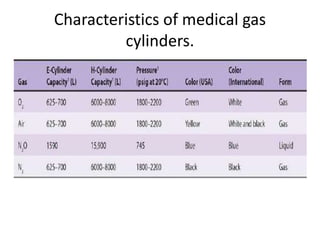
Characteristics of medical gas
cylinders.
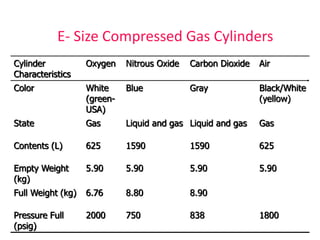
E- Size Compressed Gas Cylinders
Cylinder
Characteristics
Oxygen Nitrous Oxide Carbon Dioxide Air
Color White
(green-
USA)
Blue Gray Black/White
(yellow)
State Gas Liquid and gas Liquid and gas Gas
Contents (L) 625 1590 1590 625
Empty Weight
(kg)
5.90 5.90 5.90 5.90
Full Weight (kg) 6.76 8.80 8.90
Pressure Full
(psig)
2000 750 838 1800
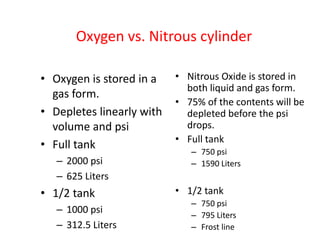
Oxygen vs. Nitrous cylinder
• Oxygen is stored in a
gas form.
• Depletes linearly with
volume and psi
• Full tank
– 2000 psi
– 625 Liters
• 1/2 tank
– 1000 psi
– 312.5 Liters
• Nitrous Oxide is stored in
both liquid and gas form.
• 75% of the contents will be
depleted before the psi
drops.
• Full tank
– 750 psi
– 1590 Liters
• 1/2 tank
– 750 psi
– 795 Liters
– Frost line
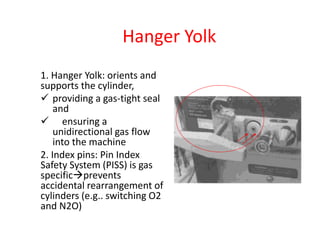
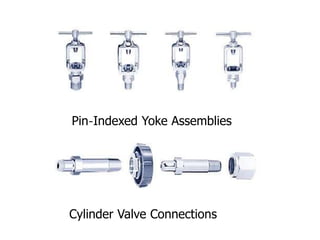
Hanger Yolk
1. Hanger Yolk: orients and
supports the cylinder,
 providing a gas-tight seal
and
 ensuring a
unidirectional gas flow
into the machine
2. Index pins: Pin Index
Safety System (PISS) is gas
specificprevents
accidental rearrangement of
cylinders (e.g.. switching O2
and N2O)
Pin-Indexed Yoke Assemblies
Cylinder Valve Connections
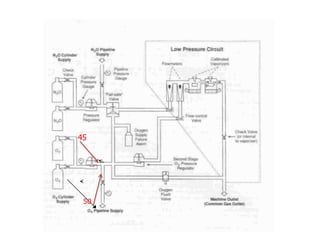
Pressure Reducing Device
Pressure Regulator
• Reduces the high and variable pressures found in a
cylinder to a lower and more constant pressure found in
the anesthesia machine (45 psig)
• Reducing devices are preset so that the machine uses only
gas from the pipeline (wall gas), when the pipeline inlet
pressure is 50 psig.
This prevents gas use from the cylinder even if the cylinder
is left open (i.e. saves the cylinder for backup if the wall
gas pipeline fails)
Pipeline pressure is just a little bit higher than the tank side
after the pressure regulator.
45
50
CT Pressure Reducing Device
• Cylinders should be kept closed.
– Otherwise, if the wall gas fails, the machine will
automatically switch to the cylinder supply
without the anesthetist being aware that the
wall supply has failed (until the cylinder is
empty too).
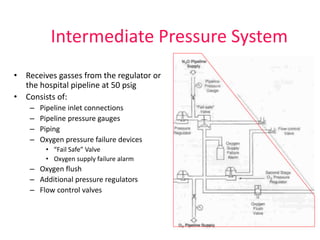
Intermediate Pressure System
• Receives gasses from the regulator or
the hospital pipeline at 50 psig
• Consists of:
– Pipeline inlet connections
– Pipeline pressure gauges
– Piping
– Oxygen pressure failure devices
• “Fail Safe” Valve
• Oxygen supply failure alarm
– Oxygen flush
– Additional pressure regulators
– Flow control valves
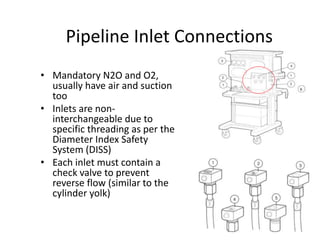
Pipeline Inlet Connections
• Mandatory N2O and O2,
usually have air and suction
too
• Inlets are non-
interchangeable due to
specific threading as per the
Diameter Index Safety
System (DISS)
• Each inlet must contain a
check valve to prevent
reverse flow (similar to the
cylinder yolk)
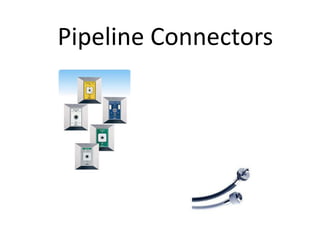
Pipeline Connectors
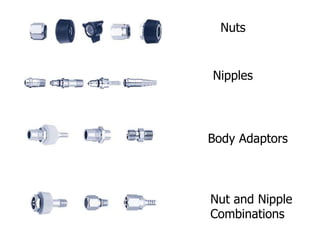
Nuts
Nipples
Body Adaptors
Nut and Nipple
Combinations
Oxygen Pressure Failure Devices
• Machine standard requires that an anesthesia machine be
designed so that whenever the oxygen supply pressure is
reduced below normal, the oxygen concentration at the
common gas outlet does not fall below 19%.
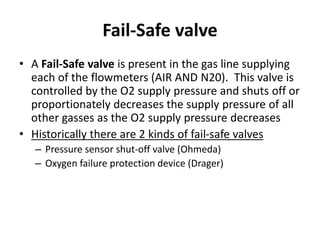
Fail-Safe valve
• A Fail-Safe valve is present in the gas line supplying
each of the flowmeters (AIR AND N20). This valve is
controlled by the O2 supply pressure and shuts off or
proportionately decreases the supply pressure of all
other gasses as the O2 supply pressure decreases
• Historically there are 2 kinds of fail-safe valves
– Pressure sensor shut-off valve (Ohmeda)
– Oxygen failure protection device (Drager)
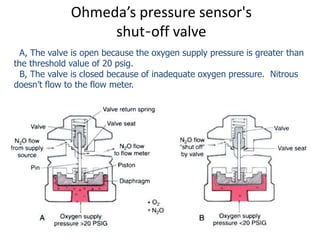
A, The valve is open because the oxygen supply pressure is greater than
the threshold value of 20 psig.
B, The valve is closed because of inadequate oxygen pressure. Nitrous
doesn’t flow to the flow meter.
Ohmeda’s pressure sensor's
shut-off valve
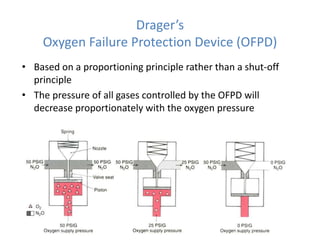
Drager’s
Oxygen Failure Protection Device (OFPD)
• Based on a proportioning principle rather than a shut-off
principle
• The pressure of all gases controlled by the OFPD will
decrease proportionately with the oxygen pressure
Oxygen Supply Failure Alarm
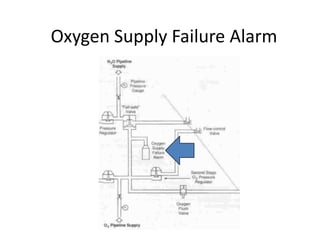
• All anesthesia machines have a standard
requirement that whenever the oxygen supply
pressure falls below a manufacturer-specified
threshold (usually 30 psig) a medium priority
alarm shall blow within 5 seconds.
Oxygen Supply Failure Alarm
Limitations of Fail-Safe Devices/Alarms
• Fail-safe valves do not prevent administration of a
hypoxic mixture because they depend on pressure
and not flow.
• These devices do not prevent hypoxia from accidents
such as pipeline crossovers or a cylinder containing
the wrong gas
Oxygen Flush Valve
Oxygen Flush Valve
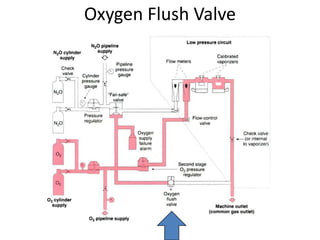
• Direct communication between the
oxygen high-pressure circuit and the
low-pressure circuit
• Delivers 100% oxygen at a rate of 35
to 75 L/min to the breathing circuit
• High pressure of 50 psig
Oxygen Flush Valve
• Several hazards
–Barotrauma
–Awareness
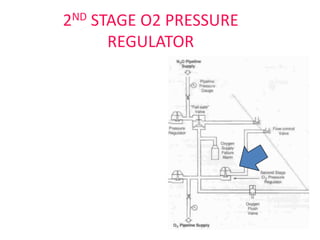
•dilutes the inhaled anesthetic
Second-Stage Reducing Device
• Located just upstream of the flow control
valves
• Receives gas from the pipeline inlet or the
cylinder reducing device and reduces it further
to 26 psig for N2O and 14 psig for O2
• Purpose is to eliminate fluctuations in
pressure supplied to the flow indicators
caused by fluctuations in pipeline pressure
2ND STAGE O2 PRESSURE
REGULATOR
Low Pressure System
• Extends from the flow control valves to the
common gas outlet
• Consists of:
– Flow meters
– Vaporizer mounting device
– Check valve
– Common gas outlet
LOW PRESSURE CIRCUIT
Low Pressure Circuit
Flowmeter assembly
• When the flow control valve is
opened the gas enters at the
bottom and flows up the tube
elevating the indicator
• The indicator floats freely at a
point where the downward
force on it (gravity) equals the
upward force caused by gas
molecules hitting the bottom
of the float
Flow Meter Assemblies
• Flow Control Valve
• Flow Meter Subassembly
–FLOW TUBES
• fine flow tube - 200 mL/min to 1 L/min
• coarse flow tube – 1 L/min to between 10
and 12 L/min
• OXYGEN SHOULD BE LAST IN LINE!
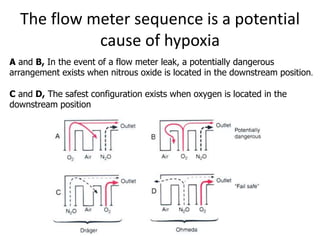
The flow meter sequence is a potential
cause of hypoxia
A and B, In the event of a flow meter leak, a potentially dangerous
arrangement exists when nitrous oxide is located in the downstream position.
C and D, The safest configuration exists when oxygen is located in the
downstream position
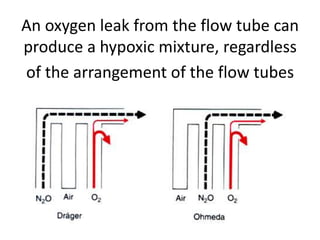
An oxygen leak from the flow tube can
produce a hypoxic mixture, regardless
of the arrangement of the flow tubes
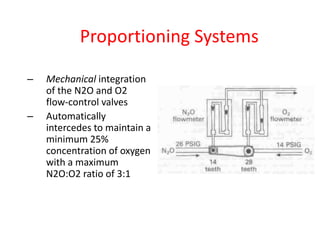
Proportioning Systems
– Mechanical integration
of the N2O and O2
flow-control valves
– Automatically
intercedes to maintain a
minimum 25%
concentration of oxygen
with a maximum
N2O:O2 ratio of 3:1
Limitations of Proportioning Systems
• Machines equipped with proportioning systems can
still deliver a hypoxic mixture under the following
conditions:
– Wrong supply gas
– Defective pneumatics (ventilator)
– Leak downstream (e.g.. Broken oxygen flow tube)
– Inert gas administration: Proportioning systems generally
link only N2O and O2
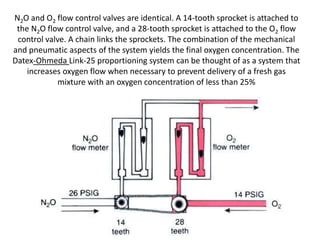
N2O and O2 flow control valves are identical. A 14-tooth sprocket is attached to
the N2O flow control valve, and a 28-tooth sprocket is attached to the O2 flow
control valve. A chain links the sprockets. The combination of the mechanical
and pneumatic aspects of the system yields the final oxygen concentration. The
Datex-Ohmeda Link-25 proportioning system can be thought of as a system that
increases oxygen flow when necessary to prevent delivery of a fresh gas
mixture with an oxygen concentration of less than 25%
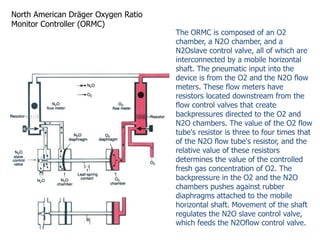
North American Dräger Oxygen Ratio
Monitor Controller (ORMC)
The ORMC is composed of an O2
chamber, a N2O chamber, and a
N2Oslave control valve, all of which are
interconnected by a mobile horizontal
shaft. The pneumatic input into the
device is from the O2 and the N2O flow
meters. These flow meters have
resistors located downstream from the
flow control valves that create
backpressures directed to the O2 and
N2O chambers. The value of the O2 flow
tube's resistor is three to four times that
of the N2O flow tube's resistor, and the
relative value of these resistors
determines the value of the controlled
fresh gas concentration of O2. The
backpressure in the O2 and the N2O
chambers pushes against rubber
diaphragms attached to the mobile
horizontal shaft. Movement of the shaft
regulates the N2O slave control valve,
which feeds the N2Oflow control valve.
Group text
• Highlight 4 differences between oxygen and
nitrous cylinders
• Color code these gases; oxygen, nitrous, air
and carbon dioxide
• Describe PISS
• Elucidate DISS
GROUP TEST
• What hazards are associated with the oxygen
flush valve?
• The oxygen flush valve delivers 100% oxygen
at a rate of 35 to 75 L/min to the breathing
circuit . TRUE OR FALSE
• Discuss Oxygen Pressure Failure Devices/ Fail-
Safe valve
WISE WORDS
if there is even a slight chance of getting
something that will make you happy, risk it. Life
is too short and happiness is too rare
WORDS OF WISDOM
references
1. Butterworth, K, et al. The Anesthesia
Machine.
2. Morgan & Mikhail's Clinical Anesthesiology,
5e, 2013.

Anesthesia MACHINE and safety measures in anesthesia machine

  • 1.
  • 2.
  • 5.
    NE FUNCTIONS OF MACHINE ●Controls the patient’s ventilation and oxygen delivery ● Administer inhalation anesthetics N/B. Proper functioning of the machine is crucial for patient safety ● incorporates built-in safety features and devices, monitors, and multiple microprocessors that can integrate and monitor all components.
  • 6.
    Safety ● Misuse ofgas delivery system is more likely than failure of device to cause adverse outcomes ● Preventable mishaps can be traced to- lack of familiarity with the equipment or failure to check machine ● Most common problems ● Breathing circuit ● Vaporizers ● Ventilators ● Oxygen supply
  • 7.
    Describe the safetyfeatures in an anaesthesia machine (20MKS) 1. Gas supplies: From the central pipeline to the machine as well as cylinders. 1. Pin index system 2. Cylinder colour coding 3. Pressure relief valves 4. Pressure regulators 5. Schrader probe 6. Flexible colour coded hose pipes 7. Diameter index safety system(DISS) 8. Non interchangeable screw thread (NIST) 9. Pippeline pressure indicators 10. Oxygen pressure failure system 11. Oxygen flush
  • 8.
    Describe the safetyfeatures in an anaesthesia machine (20MKS) 1. Flow meters. 1. Providing stops at the full ON or OFF position, so that excessive pressure may not damage either the valve seat or get disengaged at the full ON position so that gas escapes out of the meters. 2. Control knob: Oxygen flow control knob is the largest and fluted for easy identification. A protective barrier around the control minimises accidental changes in settings. 3. Tubes, which measure flow, have different lengths and diameters. Some machines have a pin-index system at each end. 4. Tubes are made leak-proof with neoprene washers (O-rings) at both ends of the flow meter assembly. 5. The tubes have an antistatic coating on both surfaces, preventing the bobbin from sticking. 6. The bobbin is visible throughout the length of the tube.
  • 9.
    Describe the safetyfeatures in an anaesthesia machine (20MKS) 1. Vaporizers. 1. Most vaporizers have a push (release) button to be activated before the dial can be turned on. 2. All modern vaporizers come equipped with an interlock mechanism, which prevent from more than one vaporizer being put to use at the same time, thus causing an accidental overdose. 3. Newer modern vaporizers have a separate transport setting, which prevents spillage of the liquid agent into the bypass channel, which may cause potential overdosing when the vaporizers are used 4. All newer vaporizers have keyed/funnel filling systems with unique sizing of the fillers/funnels. Specific changes are also made on the bottle end of the filling adaptors.
  • 10.
    Describe the safetyfeatures in an anaesthesia machine (20MKS) 1. Scavenging. All connections in the scavenging system are of 30 mm diameter, which is distinctly different from the airway accessories making misconnections improbable. Transfer tubings in the system are different by colour and configuration to that of breathing gase. Tubings are resistant to kinking and are occlusion proof. Scavenging systems also incorporate negative and positive pressure relief valves to make sure no dangerous pressures are transmitted into the breathing system in the event of malfunction of the system.
  • 11.
    Describe the safetyfeatures in an anaesthesia machine (20MKS) 1. Monitoring oxygen analyser in the breathing circuit. ASTM standards do require that low oxygen alarm level cannot be set below 21%. [5] Gas volume monitoring is performed with spirometers, This monitoring gives us a measure of the tidal volume and minute volume, as well as disconnection. Airway pressure monitoring, The purpose of airway pressure monitors is to prevent either high (to prevent barotraumas) or low pressures (leaks or disconnection). Disconnection monitors are an integral component of newer anaesthesia machines. [51] They can be based on the gas flows (volume measurements), pressure in the circuit, or gas detection like capnography
  • 12.
    Describe the anti-hypoxiamechanism found on the anaesthesia machine (5marks) Hypoxia prevention devices .Mandatory minimum oxygen flow Most modern machines have a minimum pre-set oxygen flow, which will automatically start once the machine is powered on. • Minimum oxygen ratio Anaesthesia workstation standards require that a device be provided that protects against a user selection of a gas mixture with an O 2 concentration below 21%. • Mechanical linkage Mechanically linking the oxygen and nitrous oxide flow control valves can ensure that at a certain set percentage of concentration (of oxygen) both flows either increase or decrease in proportion to the
  • 13.
    Describe the anti-hypoxiamechanism found on the anaesthesia machine (5marks) • Electronic linkage An electronic proportioning valve controls the oxygen concentration to a pre-set minimum, depending on the feedback it receives from a computer that constantly calculates the maximum safe limit of other gases that can be delivered. Alarms machines also activate an alarm when a user tries to set a flow with a lower than desired O 2concentration.
  • 14.
    Outline • Anesthesia Machine –High pressure system – Intermediate pressure system – Low pressure system – Safety systems throughout
  • 15.
    The Anesthesia Machine HighIntermediate Low Pressure Circuit
  • 16.
    High Pressure System •Receives gasses from the high pressure E cylinders attached to the back of the anesthesia machine (2000 psig for O2, 750 psig for N2O) • Consists of: – Hanger Yolk (reserve gas cylinder holder) – Check valve (prevent reverse flow of gas) – Cylinder Pressure Indicator (Gauge) – Pressure Reducing Device (Regulator) • Usually not used, unless pipeline gas supply is off
  • 17.
  • 18.
    E- Size CompressedGas Cylinders Cylinder Characteristics Oxygen Nitrous Oxide Carbon Dioxide Air Color White (green- USA) Blue Gray Black/White (yellow) State Gas Liquid and gas Liquid and gas Gas Contents (L) 625 1590 1590 625 Empty Weight (kg) 5.90 5.90 5.90 5.90 Full Weight (kg) 6.76 8.80 8.90 Pressure Full (psig) 2000 750 838 1800
  • 19.
    Oxygen vs. Nitrouscylinder • Oxygen is stored in a gas form. • Depletes linearly with volume and psi • Full tank – 2000 psi – 625 Liters • 1/2 tank – 1000 psi – 312.5 Liters • Nitrous Oxide is stored in both liquid and gas form. • 75% of the contents will be depleted before the psi drops. • Full tank – 750 psi – 1590 Liters • 1/2 tank – 750 psi – 795 Liters – Frost line
  • 20.
    Hanger Yolk 1. HangerYolk: orients and supports the cylinder,  providing a gas-tight seal and  ensuring a unidirectional gas flow into the machine 2. Index pins: Pin Index Safety System (PISS) is gas specificprevents accidental rearrangement of cylinders (e.g.. switching O2 and N2O)
  • 21.
  • 22.
    Pressure Reducing Device PressureRegulator • Reduces the high and variable pressures found in a cylinder to a lower and more constant pressure found in the anesthesia machine (45 psig) • Reducing devices are preset so that the machine uses only gas from the pipeline (wall gas), when the pipeline inlet pressure is 50 psig. This prevents gas use from the cylinder even if the cylinder is left open (i.e. saves the cylinder for backup if the wall gas pipeline fails) Pipeline pressure is just a little bit higher than the tank side after the pressure regulator.
  • 23.
  • 24.
    CT Pressure ReducingDevice • Cylinders should be kept closed. – Otherwise, if the wall gas fails, the machine will automatically switch to the cylinder supply without the anesthetist being aware that the wall supply has failed (until the cylinder is empty too).
  • 25.
    Intermediate Pressure System •Receives gasses from the regulator or the hospital pipeline at 50 psig • Consists of: – Pipeline inlet connections – Pipeline pressure gauges – Piping – Oxygen pressure failure devices • “Fail Safe” Valve • Oxygen supply failure alarm – Oxygen flush – Additional pressure regulators – Flow control valves
  • 26.
    Pipeline Inlet Connections •Mandatory N2O and O2, usually have air and suction too • Inlets are non- interchangeable due to specific threading as per the Diameter Index Safety System (DISS) • Each inlet must contain a check valve to prevent reverse flow (similar to the cylinder yolk)
  • 27.
  • 28.
  • 29.
    Oxygen Pressure FailureDevices • Machine standard requires that an anesthesia machine be designed so that whenever the oxygen supply pressure is reduced below normal, the oxygen concentration at the common gas outlet does not fall below 19%.
  • 30.
    Fail-Safe valve • AFail-Safe valve is present in the gas line supplying each of the flowmeters (AIR AND N20). This valve is controlled by the O2 supply pressure and shuts off or proportionately decreases the supply pressure of all other gasses as the O2 supply pressure decreases • Historically there are 2 kinds of fail-safe valves – Pressure sensor shut-off valve (Ohmeda) – Oxygen failure protection device (Drager)
  • 31.
    A, The valveis open because the oxygen supply pressure is greater than the threshold value of 20 psig. B, The valve is closed because of inadequate oxygen pressure. Nitrous doesn’t flow to the flow meter. Ohmeda’s pressure sensor's shut-off valve
  • 32.
    Drager’s Oxygen Failure ProtectionDevice (OFPD) • Based on a proportioning principle rather than a shut-off principle • The pressure of all gases controlled by the OFPD will decrease proportionately with the oxygen pressure
  • 33.
    Oxygen Supply FailureAlarm • All anesthesia machines have a standard requirement that whenever the oxygen supply pressure falls below a manufacturer-specified threshold (usually 30 psig) a medium priority alarm shall blow within 5 seconds.
  • 34.
  • 35.
    Limitations of Fail-SafeDevices/Alarms • Fail-safe valves do not prevent administration of a hypoxic mixture because they depend on pressure and not flow. • These devices do not prevent hypoxia from accidents such as pipeline crossovers or a cylinder containing the wrong gas
  • 36.
  • 37.
    Oxygen Flush Valve •Direct communication between the oxygen high-pressure circuit and the low-pressure circuit • Delivers 100% oxygen at a rate of 35 to 75 L/min to the breathing circuit • High pressure of 50 psig
  • 38.
    Oxygen Flush Valve •Several hazards –Barotrauma –Awareness •dilutes the inhaled anesthetic
  • 39.
    Second-Stage Reducing Device •Located just upstream of the flow control valves • Receives gas from the pipeline inlet or the cylinder reducing device and reduces it further to 26 psig for N2O and 14 psig for O2 • Purpose is to eliminate fluctuations in pressure supplied to the flow indicators caused by fluctuations in pipeline pressure
  • 40.
    2ND STAGE O2PRESSURE REGULATOR
  • 41.
    Low Pressure System •Extends from the flow control valves to the common gas outlet • Consists of: – Flow meters – Vaporizer mounting device – Check valve – Common gas outlet
  • 42.
    LOW PRESSURE CIRCUIT LowPressure Circuit
  • 43.
    Flowmeter assembly • Whenthe flow control valve is opened the gas enters at the bottom and flows up the tube elevating the indicator • The indicator floats freely at a point where the downward force on it (gravity) equals the upward force caused by gas molecules hitting the bottom of the float
  • 44.
  • 45.
    Flow Meter Assemblies •Flow Control Valve • Flow Meter Subassembly –FLOW TUBES • fine flow tube - 200 mL/min to 1 L/min • coarse flow tube – 1 L/min to between 10 and 12 L/min • OXYGEN SHOULD BE LAST IN LINE!
  • 46.
    The flow metersequence is a potential cause of hypoxia A and B, In the event of a flow meter leak, a potentially dangerous arrangement exists when nitrous oxide is located in the downstream position. C and D, The safest configuration exists when oxygen is located in the downstream position
  • 47.
    An oxygen leakfrom the flow tube can produce a hypoxic mixture, regardless of the arrangement of the flow tubes
  • 48.
    Proportioning Systems – Mechanicalintegration of the N2O and O2 flow-control valves – Automatically intercedes to maintain a minimum 25% concentration of oxygen with a maximum N2O:O2 ratio of 3:1
  • 49.
    Limitations of ProportioningSystems • Machines equipped with proportioning systems can still deliver a hypoxic mixture under the following conditions: – Wrong supply gas – Defective pneumatics (ventilator) – Leak downstream (e.g.. Broken oxygen flow tube) – Inert gas administration: Proportioning systems generally link only N2O and O2
  • 50.
    N2O and O2flow control valves are identical. A 14-tooth sprocket is attached to the N2O flow control valve, and a 28-tooth sprocket is attached to the O2 flow control valve. A chain links the sprockets. The combination of the mechanical and pneumatic aspects of the system yields the final oxygen concentration. The Datex-Ohmeda Link-25 proportioning system can be thought of as a system that increases oxygen flow when necessary to prevent delivery of a fresh gas mixture with an oxygen concentration of less than 25%
  • 51.
    North American DrägerOxygen Ratio Monitor Controller (ORMC) The ORMC is composed of an O2 chamber, a N2O chamber, and a N2Oslave control valve, all of which are interconnected by a mobile horizontal shaft. The pneumatic input into the device is from the O2 and the N2O flow meters. These flow meters have resistors located downstream from the flow control valves that create backpressures directed to the O2 and N2O chambers. The value of the O2 flow tube's resistor is three to four times that of the N2O flow tube's resistor, and the relative value of these resistors determines the value of the controlled fresh gas concentration of O2. The backpressure in the O2 and the N2O chambers pushes against rubber diaphragms attached to the mobile horizontal shaft. Movement of the shaft regulates the N2O slave control valve, which feeds the N2Oflow control valve.
  • 53.
    Group text • Highlight4 differences between oxygen and nitrous cylinders • Color code these gases; oxygen, nitrous, air and carbon dioxide • Describe PISS • Elucidate DISS
  • 54.
    GROUP TEST • Whathazards are associated with the oxygen flush valve? • The oxygen flush valve delivers 100% oxygen at a rate of 35 to 75 L/min to the breathing circuit . TRUE OR FALSE • Discuss Oxygen Pressure Failure Devices/ Fail- Safe valve
  • 55.
    WISE WORDS if thereis even a slight chance of getting something that will make you happy, risk it. Life is too short and happiness is too rare
  • 56.
  • 57.
    references 1. Butterworth, K,et al. The Anesthesia Machine. 2. Morgan & Mikhail's Clinical Anesthesiology, 5e, 2013.