The child with respiratory
distress
What is this child’s problem?
Respiratory Distress
Lung / Airway Disease
• Acute Pneumonia
• PTB
• HIV
• Stridor:
– Croup (LTB)
– Epiglottitis
Systemic Disease
• Malaria
• Severe Anaemia
• Severe dehydration
• Heart Disease
• Renal Disease
How severe is respiratory distress –
Cough or Difficult Breathing 1
Cyanosed?
Unable to drink?
Reduced level of consciousness?
Grunting (infants)?
Lower chest wall indrawing?
RR ≥ 50 aged 2 –11 months?
RR ≥ 40 aged 1 – 4 yrs?
Very Severe
Pneumonia
Severe
Pneumonia
Pneumonia
None of the above? No Pneumonia
Y
Y
Y
Y
How severe is respiratory distress –
Cough or Difficult Breathing 2
Cyanosed?
Unable to drink?
Reduced level of consciousness?
Grunting (infants)?
Very Severe
Pneumonia
Y
High Risk of Death
High Risk of Hypoxaemia = Need Oxygen
May need fluid / feeding support
Require Broad Spectrum Antibiotics
How severe is respiratory distress –
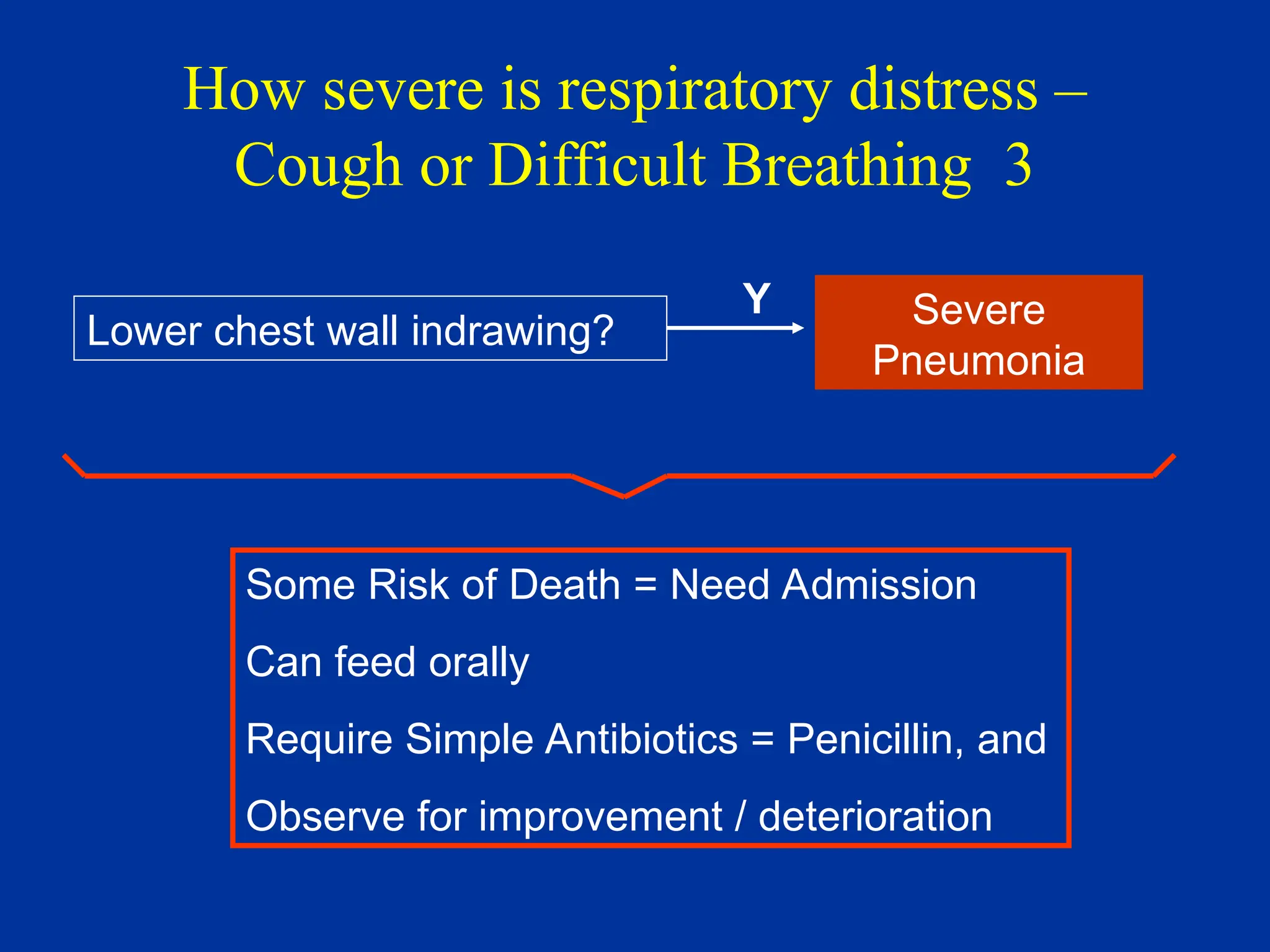
Cough or Difficult Breathing 3
Lower chest wall indrawing? Severe
Pneumonia
Y
Some Risk of Death = Need Admission
Can feed orally
Require Simple Antibiotics = Penicillin, and
Observe for improvement / deterioration
How severe is respiratory distress –
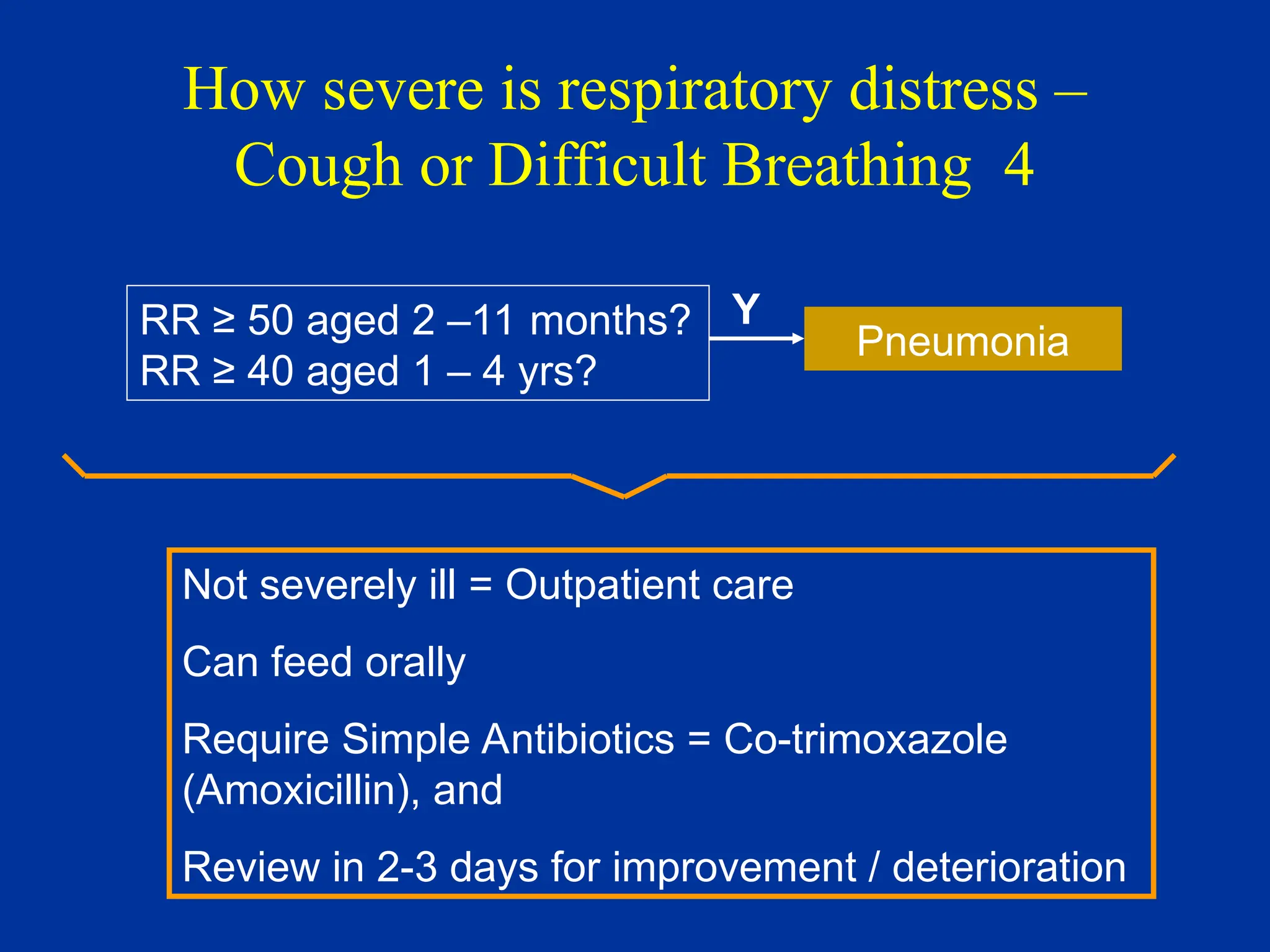
Cough or Difficult Breathing 4
RR ≥ 50 aged 2 –11 months?
RR ≥ 40 aged 1 – 4 yrs?
Pneumonia
Y
Not severely ill = Outpatient care
Can feed orally
Require Simple Antibiotics = Co-trimoxazole
(Amoxicillin), and
Review in 2-3 days for improvement / deterioration
Respiratory distress – Cough or Difficult
Breathing Critical Clinical Signs
Cyanosed?
Unable to drink?
Reduced level of consciousness?
Grunting (infants)?
Lower chest wall indrawing?
RR ≥ 50 aged 2 –11 months?
RR ≥ 40 aged 1 – 4 yrs?
Very Severe
Pneumonia
Severe
Pneumonia
Pneumonia
None of the above? No Pneumonia
Y
Y
Y
Y
Cause of Respiratory Distress 1?
12 months
Difficult
Breathing,
AVPU = P
RR = 43/min
Indrawing
+ve Blood Slide
Cause of Respiratory Distress 2?
12 months
Difficult
Breathing,
AVPU = P
RR = 43/min
Indrawing
+ve Blood Slide
Very Severe
Pneumonia
Difficult
breathing and
AVPU = P
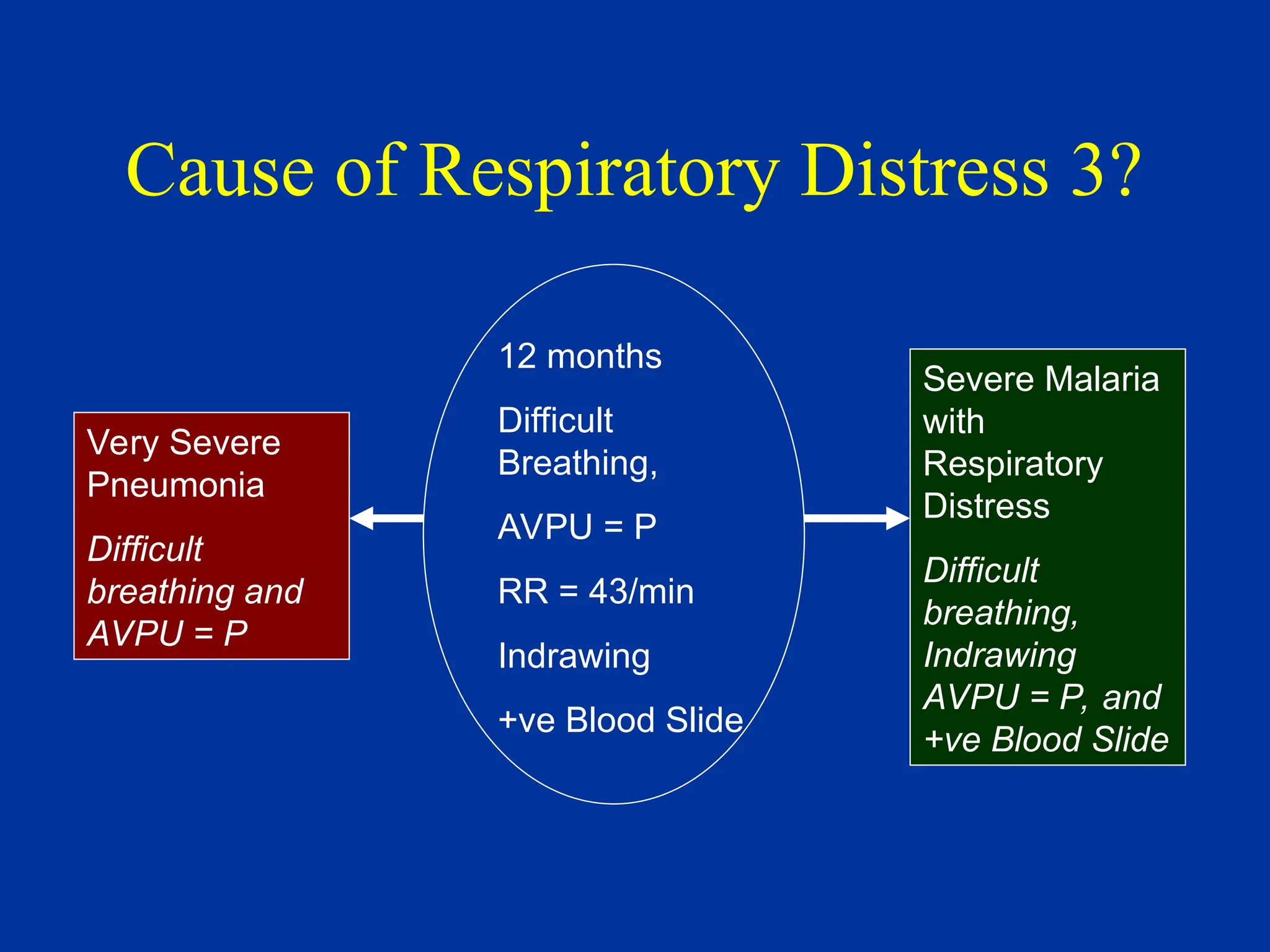
Cause of Respiratory Distress 3?
12 months
Difficult
Breathing,
AVPU = P
RR = 43/min
Indrawing
+ve Blood Slide
Very Severe
Pneumonia
Difficult
breathing and
AVPU = P
Severe Malaria
with
Respiratory
Distress
Difficult
breathing,
Indrawing
AVPU = P, and
+ve Blood Slide
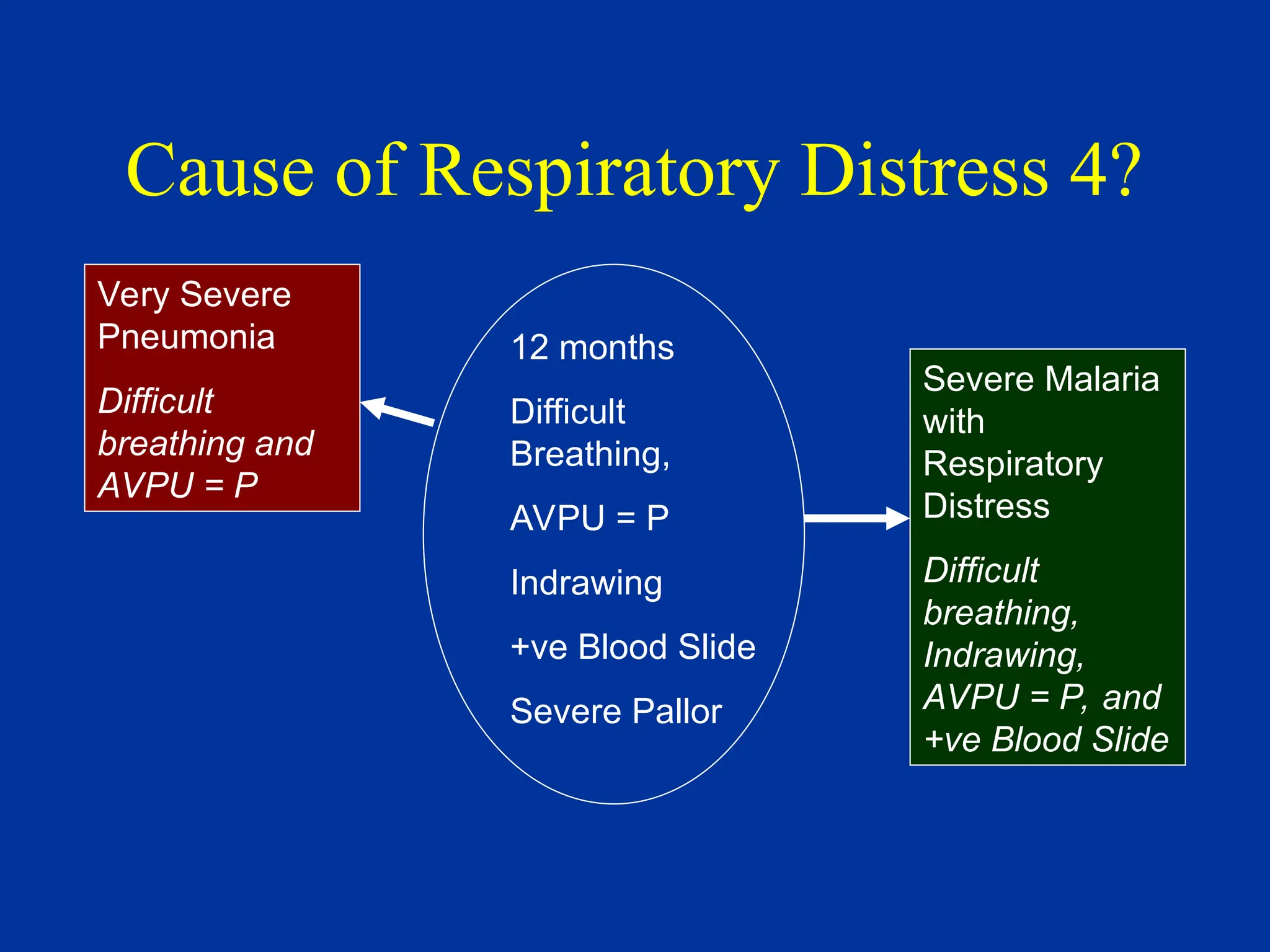
Cause of Respiratory Distress 4?
12 months
Difficult
Breathing,
AVPU = P
Indrawing
+ve Blood Slide
Severe Pallor
Very Severe
Pneumonia
Difficult
breathing and
AVPU = P
Severe Malaria
with
Respiratory
Distress
Difficult
breathing,
Indrawing,
AVPU = P, and
+ve Blood Slide
Cause of Respiratory Distress 4?
12 months
Difficult
Breathing,
AVPU = P
Indrawing
+ve Blood Slide
Severe Pallor
Very Severe
Pneumonia
Difficult
breathing and
AVPU = P
Severe Malaria
with
Respiratory
Distress
Difficult
breathing,
Indrawing,
AVPU = P, and
+ve Blood Slide
Severe
Anaemia
Respiratory
distress plus
severe pallor
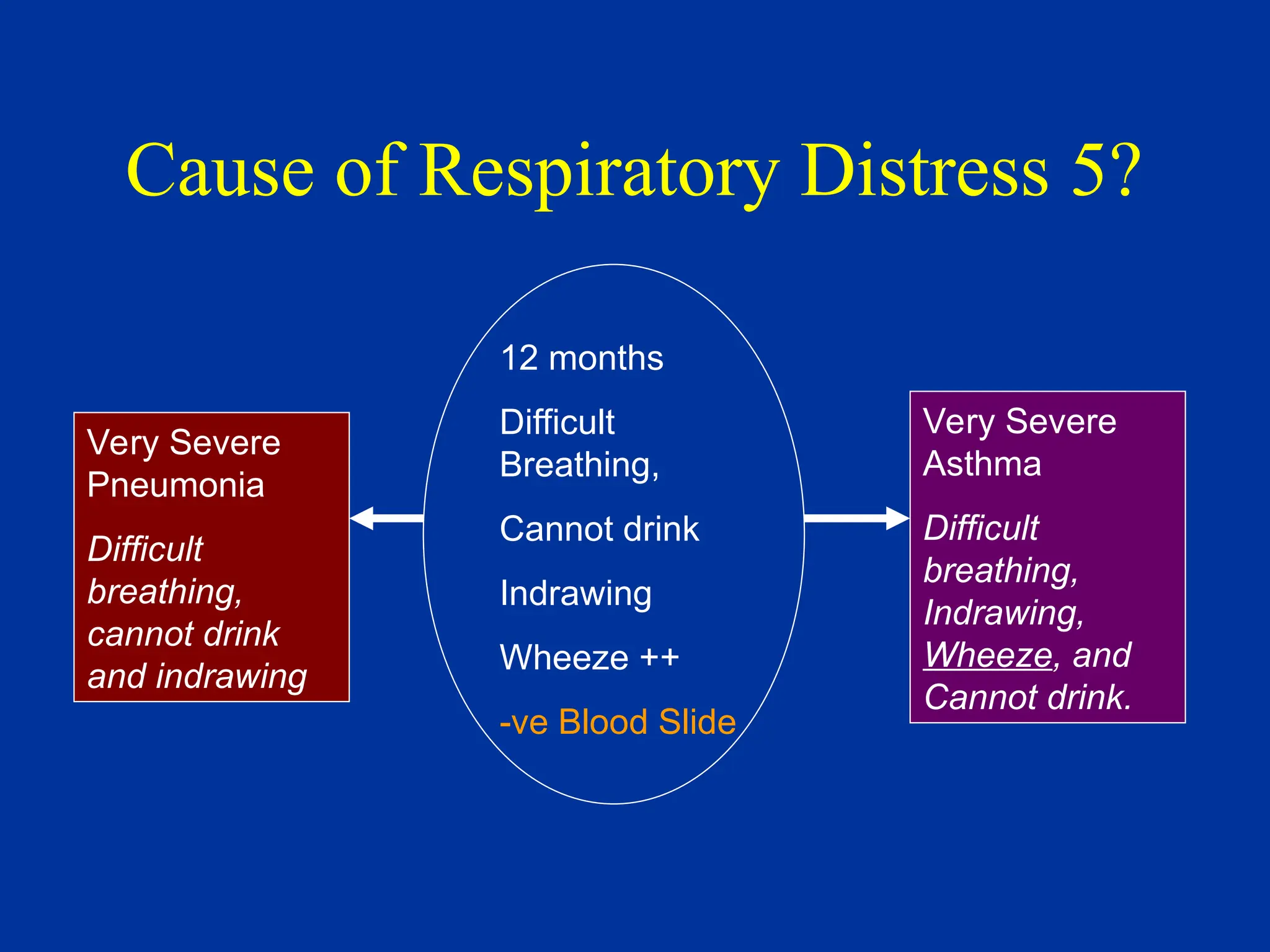
Cause of Respiratory Distress 5?
12 months
Difficult
Breathing,
Cannot drink
Indrawing
Wheeze ++
-ve Blood Slide
Very Severe
Pneumonia
Difficult
breathing,
cannot drink
and indrawing
Cause of Respiratory Distress 5?
12 months
Difficult
Breathing,
Cannot drink
Indrawing
Wheeze ++
-ve Blood Slide
Very Severe
Pneumonia
Difficult
breathing,
cannot drink
and indrawing
Very Severe
Asthma
Difficult
breathing,
Indrawing,
Wheeze, and
Cannot drink.
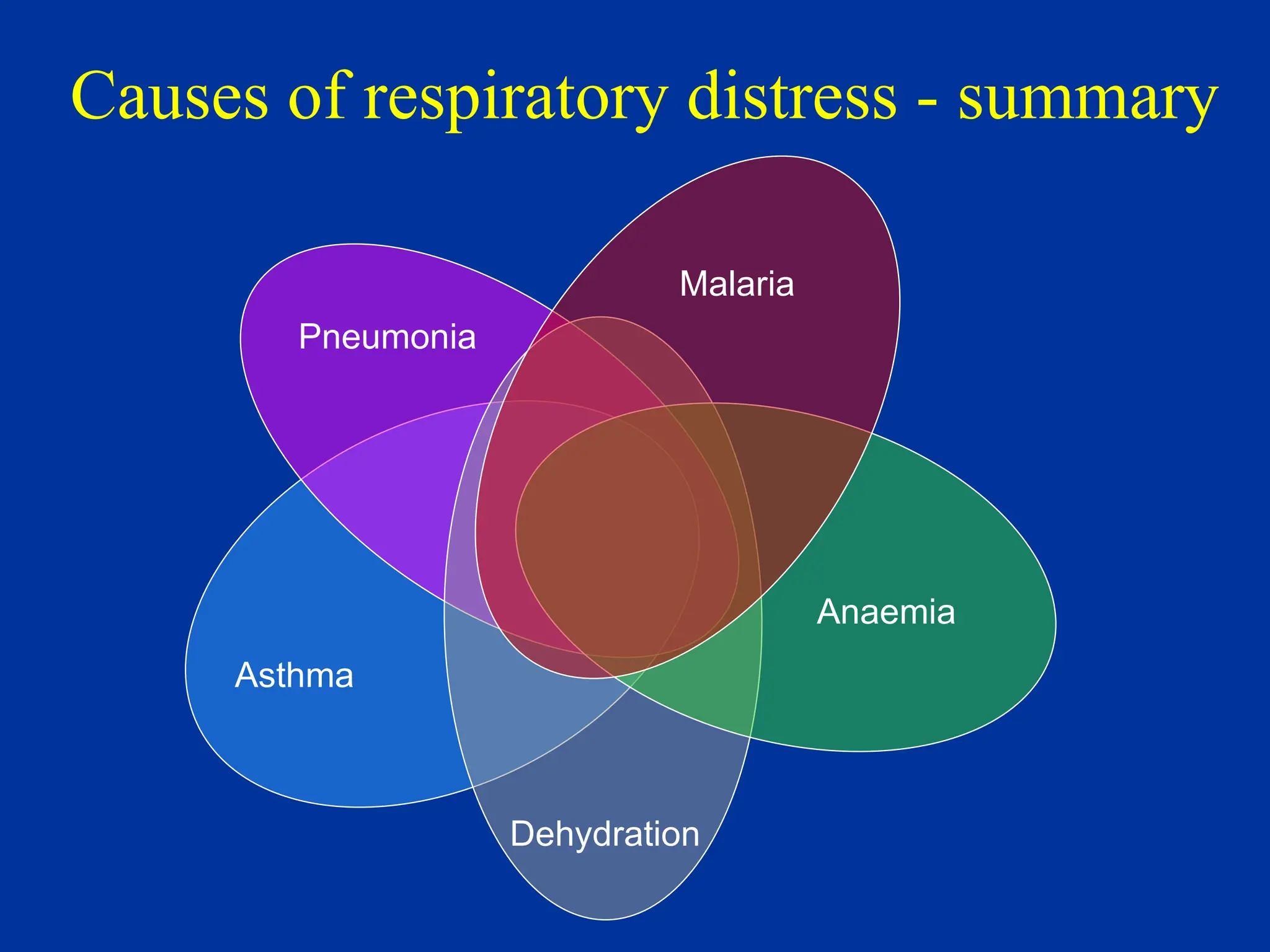
Causes of respiratory distress - summary
Pneumonia
Malaria
Anaemia
Asthma
Dehydration
Causes of respiratory distress
Pneumonia
Malaria
Anaemia
Asthma
Dehydration
Acidosis
Blood Film
Pallor / Hb
Acidosis
Sunken Eyes,
Skin Turgor,
Acidosis
Wheeze
Crackles
Causes of respiratory distress
Pneumonia
Malaria
Anaemia
Asthma
Dehydration
Acidosis
Blood Film
Pallor / Hb
Acidosis
Sunken Eyes,
Skin Turogor,
Acidosis
Wheeze
Crackles
Difficulty
Breathing
Indrawing
Tachypneoa
Consciousness?
How severe is respiratory distress –
Cough or Difficulty Breathing
Cyanosed?
Unable to drink?
Reduced level of consciousness?
Grunting (infants)?
Lower chest wall indrawing?
RR ≥ 50 aged 2 –11 months?
RR ≥ 40 aged 1 – 4 yrs?
Very Severe
Pneumonia
Severe
Pneumonia
Pneumonia
None of the above? No Pneumonia
Y
Y
Y
Y
Wheeze – how severe is the asthma?
Cyanosed?
Unable to drink?
Reduced level of consciousness?
Grunting (infants)?
Lower chest wall indrawing?
RR ≥ 50 aged 2 –11 months?
RR ≥ 40 aged 1 – 4 yrs?
Very Severe
Asthma
Severe Asthma
Mild Asthma
Y
Y
Y
Respiratory distress & Malaria
Conscious level OK
Deep / acidotic breathing
Indrawing / Deep acidotic
breathing PLUS severe pallor or
Hb <5g/dl?
Severe Malaria
Life threatening
anaemia plus
malaria
Y
Y
Key Respiratory Symptoms and Signs
• Cough or Difficulty Breathing
• Respiratory Rate
• Indrawing
• Grunting (infants)
• Wheeze
• Acidotic / Deep Breathing
• Cyanosis
• Ability to drink / conscious level (AVPU)
• Severe pallor
Additional Respiratory Symptoms and Signs
• Duration of Cough - > 3 weeks?
• Recurrence of Pneumonia?
• Stridor
• Sunken Eyes / Skin turgor
Questions?
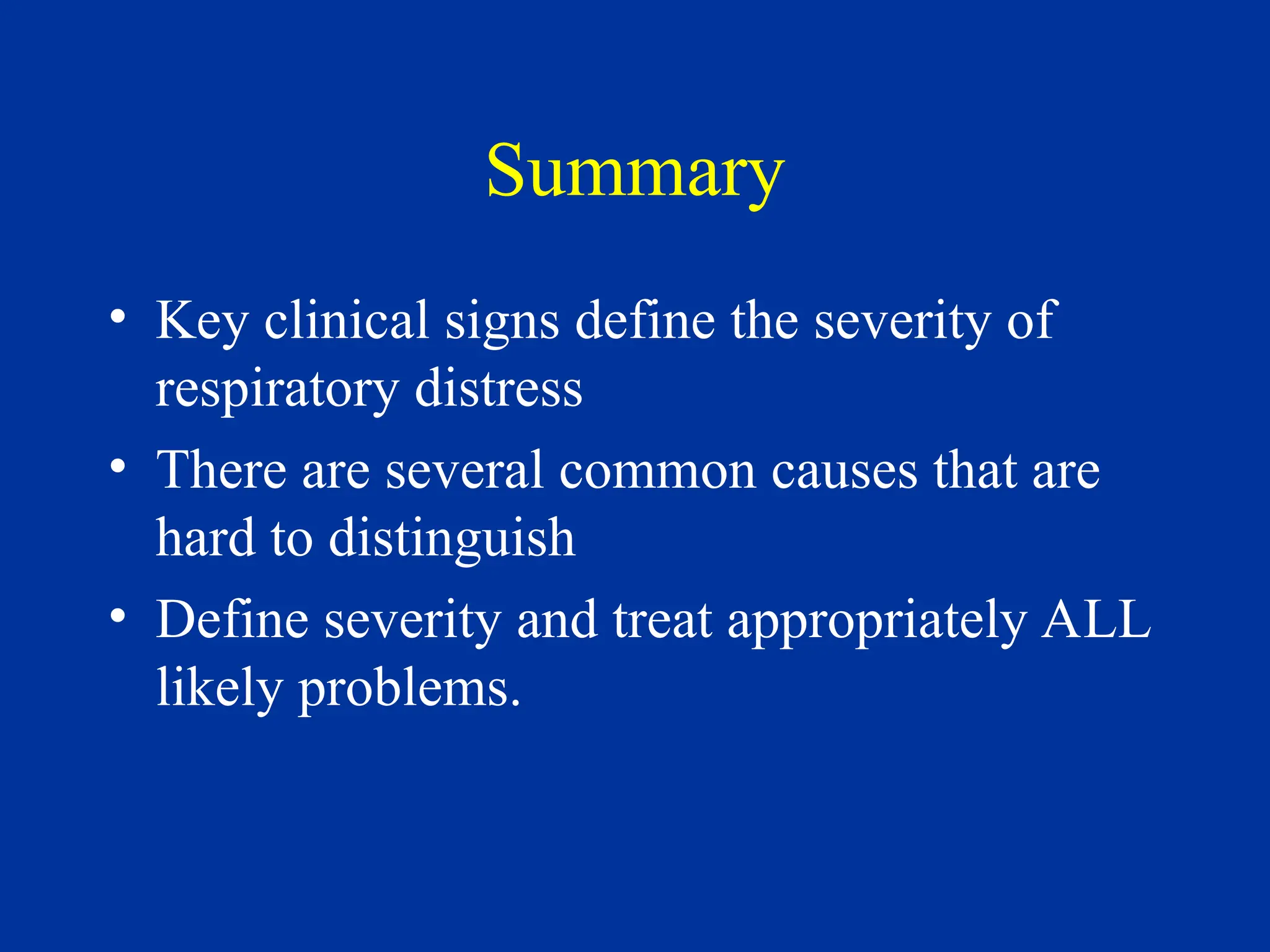
Summary
• Key clinical signs define the severity of
respiratory distress
• There are several common causes that are
hard to distinguish
• Define severity and treat appropriately ALL
likely problems.

The child with respiratory distress under aesthesia

  • 1.
    The child withrespiratory distress
  • 2.
    What is thischild’s problem?
  • 3.
    Respiratory Distress Lung /Airway Disease • Acute Pneumonia • PTB • HIV • Stridor: – Croup (LTB) – Epiglottitis Systemic Disease • Malaria • Severe Anaemia • Severe dehydration • Heart Disease • Renal Disease
  • 4.
    How severe isrespiratory distress – Cough or Difficult Breathing 1 Cyanosed? Unable to drink? Reduced level of consciousness? Grunting (infants)? Lower chest wall indrawing? RR ≥ 50 aged 2 –11 months? RR ≥ 40 aged 1 – 4 yrs? Very Severe Pneumonia Severe Pneumonia Pneumonia None of the above? No Pneumonia Y Y Y Y
  • 5.
    How severe isrespiratory distress – Cough or Difficult Breathing 2 Cyanosed? Unable to drink? Reduced level of consciousness? Grunting (infants)? Very Severe Pneumonia Y High Risk of Death High Risk of Hypoxaemia = Need Oxygen May need fluid / feeding support Require Broad Spectrum Antibiotics
  • 6.
    How severe isrespiratory distress – Cough or Difficult Breathing 3 Lower chest wall indrawing? Severe Pneumonia Y Some Risk of Death = Need Admission Can feed orally Require Simple Antibiotics = Penicillin, and Observe for improvement / deterioration
  • 7.
    How severe isrespiratory distress – Cough or Difficult Breathing 4 RR ≥ 50 aged 2 –11 months? RR ≥ 40 aged 1 – 4 yrs? Pneumonia Y Not severely ill = Outpatient care Can feed orally Require Simple Antibiotics = Co-trimoxazole (Amoxicillin), and Review in 2-3 days for improvement / deterioration
  • 8.
    Respiratory distress –Cough or Difficult Breathing Critical Clinical Signs Cyanosed? Unable to drink? Reduced level of consciousness? Grunting (infants)? Lower chest wall indrawing? RR ≥ 50 aged 2 –11 months? RR ≥ 40 aged 1 – 4 yrs? Very Severe Pneumonia Severe Pneumonia Pneumonia None of the above? No Pneumonia Y Y Y Y
  • 9.
    Cause of RespiratoryDistress 1? 12 months Difficult Breathing, AVPU = P RR = 43/min Indrawing +ve Blood Slide
  • 10.
    Cause of RespiratoryDistress 2? 12 months Difficult Breathing, AVPU = P RR = 43/min Indrawing +ve Blood Slide Very Severe Pneumonia Difficult breathing and AVPU = P
  • 11.
    Cause of RespiratoryDistress 3? 12 months Difficult Breathing, AVPU = P RR = 43/min Indrawing +ve Blood Slide Very Severe Pneumonia Difficult breathing and AVPU = P Severe Malaria with Respiratory Distress Difficult breathing, Indrawing AVPU = P, and +ve Blood Slide
  • 12.
    Cause of RespiratoryDistress 4? 12 months Difficult Breathing, AVPU = P Indrawing +ve Blood Slide Severe Pallor Very Severe Pneumonia Difficult breathing and AVPU = P Severe Malaria with Respiratory Distress Difficult breathing, Indrawing, AVPU = P, and +ve Blood Slide
  • 13.
    Cause of RespiratoryDistress 4? 12 months Difficult Breathing, AVPU = P Indrawing +ve Blood Slide Severe Pallor Very Severe Pneumonia Difficult breathing and AVPU = P Severe Malaria with Respiratory Distress Difficult breathing, Indrawing, AVPU = P, and +ve Blood Slide Severe Anaemia Respiratory distress plus severe pallor
  • 14.
    Cause of RespiratoryDistress 5? 12 months Difficult Breathing, Cannot drink Indrawing Wheeze ++ -ve Blood Slide Very Severe Pneumonia Difficult breathing, cannot drink and indrawing
  • 15.
    Cause of RespiratoryDistress 5? 12 months Difficult Breathing, Cannot drink Indrawing Wheeze ++ -ve Blood Slide Very Severe Pneumonia Difficult breathing, cannot drink and indrawing Very Severe Asthma Difficult breathing, Indrawing, Wheeze, and Cannot drink.
  • 16.
    Causes of respiratorydistress - summary Pneumonia Malaria Anaemia Asthma Dehydration
  • 17.
    Causes of respiratorydistress Pneumonia Malaria Anaemia Asthma Dehydration Acidosis Blood Film Pallor / Hb Acidosis Sunken Eyes, Skin Turgor, Acidosis Wheeze Crackles
  • 18.
    Causes of respiratorydistress Pneumonia Malaria Anaemia Asthma Dehydration Acidosis Blood Film Pallor / Hb Acidosis Sunken Eyes, Skin Turogor, Acidosis Wheeze Crackles Difficulty Breathing Indrawing Tachypneoa Consciousness?
  • 19.
    How severe isrespiratory distress – Cough or Difficulty Breathing Cyanosed? Unable to drink? Reduced level of consciousness? Grunting (infants)? Lower chest wall indrawing? RR ≥ 50 aged 2 –11 months? RR ≥ 40 aged 1 – 4 yrs? Very Severe Pneumonia Severe Pneumonia Pneumonia None of the above? No Pneumonia Y Y Y Y
  • 20.
    Wheeze – howsevere is the asthma? Cyanosed? Unable to drink? Reduced level of consciousness? Grunting (infants)? Lower chest wall indrawing? RR ≥ 50 aged 2 –11 months? RR ≥ 40 aged 1 – 4 yrs? Very Severe Asthma Severe Asthma Mild Asthma Y Y Y
  • 21.
    Respiratory distress &Malaria Conscious level OK Deep / acidotic breathing Indrawing / Deep acidotic breathing PLUS severe pallor or Hb <5g/dl? Severe Malaria Life threatening anaemia plus malaria Y Y
  • 22.
    Key Respiratory Symptomsand Signs • Cough or Difficulty Breathing • Respiratory Rate • Indrawing • Grunting (infants) • Wheeze • Acidotic / Deep Breathing • Cyanosis • Ability to drink / conscious level (AVPU) • Severe pallor
  • 23.
    Additional Respiratory Symptomsand Signs • Duration of Cough - > 3 weeks? • Recurrence of Pneumonia? • Stridor • Sunken Eyes / Skin turgor
  • 24.
  • 25.
    Summary • Key clinicalsigns define the severity of respiratory distress • There are several common causes that are hard to distinguish • Define severity and treat appropriately ALL likely problems.

Editor's Notes

  • #2 1) The point of showing this video is to get people to think about the possible different causes of respiratory distress and that it is hard to be sure….we need a good clinical examination for a starting point….
  • #3 1) This is a non-exhaustive list of possible causes of respiratory distress, clearly divided into respiratory tract problems and others.
  • #4 As a result of this research the WHO proposes a classification of pneumonia based on key signs – this is part of the IMCI (and previously the ARI) programme. Working from the severe end downwards one can check for only a few signs in a child with cough and difficulty breathing and classify into one of four categories that provide a measure of the severity of the child’s disease. Once the severity is classified it becomes easier to decide who should be in hospital – only those with severe or very severe pneumonia. There is evidence that this classification works to identify those at greatest risk of death and thus most in need of hospital care (see pneumonia severity of disease summary).
  • #5 As a result of this research the WHO proposes a classification of pneumonia based on key signs – this is part of the IMCI (and previously the ARI) programme. Working from the severe end downwards one can check for only a few signs in a child with cough and difficulty breathing and classify into one of four categories that provide a measure of the severity of the child’s disease. Once the severity is classified it becomes easier to decide who should be in hospital – only those with severe or very severe pneumonia. There is evidence that this classification works to identify those at greatest risk of death and thus most in need of hospital care (see pneumonia severity of disease summary).
  • #6 As a result of this research the WHO proposes a classification of pneumonia based on key signs – this is part of the IMCI (and previously the ARI) programme. Working from the severe end downwards one can check for only a few signs in a child with cough and difficulty breathing and classify into one of four categories that provide a measure of the severity of the child’s disease. Once the severity is classified it becomes easier to decide who should be in hospital – only those with severe or very severe pneumonia. There is evidence that this classification works to identify those at greatest risk of death and thus most in need of hospital care (see pneumonia severity of disease summary).
  • #7 As a result of this research the WHO proposes a classification of pneumonia based on key signs – this is part of the IMCI (and previously the ARI) programme. Working from the severe end downwards one can check for only a few signs in a child with cough and difficulty breathing and classify into one of four categories that provide a measure of the severity of the child’s disease. Once the severity is classified it becomes easier to decide who should be in hospital – only those with severe or very severe pneumonia. There is evidence that this classification works to identify those at greatest risk of death and thus most in need of hospital care (see pneumonia severity of disease summary).
  • #8 As a result of this research the WHO proposes a classification of pneumonia based on key signs – this is part of the IMCI (and previously the ARI) programme. Working from the severe end downwards one can check for only a few signs in a child with cough and difficulty breathing and classify into one of four categories that provide a measure of the severity of the child’s disease. Once the severity is classified it becomes easier to decide who should be in hospital – only those with severe or very severe pneumonia. There is evidence that this classification works to identify those at greatest risk of death and thus most in need of hospital care (see pneumonia severity of disease summary).
  • #16 1) This serves to re-emphasise that there are many possible causes of respiratory distress and we need to think about them all.
  • #17 1) Some signs are more associated with one diagnosis than others eg. wheeze.
  • #18 1) Many key signs are common to all causes of respiratory distress and are certainly not specific for pneumonia.
  • #19 The point of putting this slide up again is that whatever the cause of respiratory distress we must consider how severe it is….and the same pneumonia signs are a very good basis for this.
  • #20 So in a wheezing child we can classify the level of respiratory distress in the same way Note, we may not be able to confirm the diagnosis of asthma but we will probably have to treat a severely ill wheezing child as though they have asthma. For those with more experience and perhaps if you know the patient it would be reasonable to treat the wheeze / asthma first and then see if the child improves what the classification is and whether additional treatment for pneumonia is required.
  • #21 If a child with malaria has deep / acidotic type breathing even if they are alert then they have severe malaria and need quinine. Their chance of dying is high. If a child with malaria and severe anaemia has indrawing or deep breathing then they need IMMEDIATE transfusion. The risk of death without treatment is very high.
  • #22 1) There are not too many signs we have to look for when deciding on treatment for a child with respiratory distress but we cannot classify severity or consider the common causes without looking for all of them.
  • #23 1) These signs may make us think of specific diseases, eg recurrent pneumonia and HIV