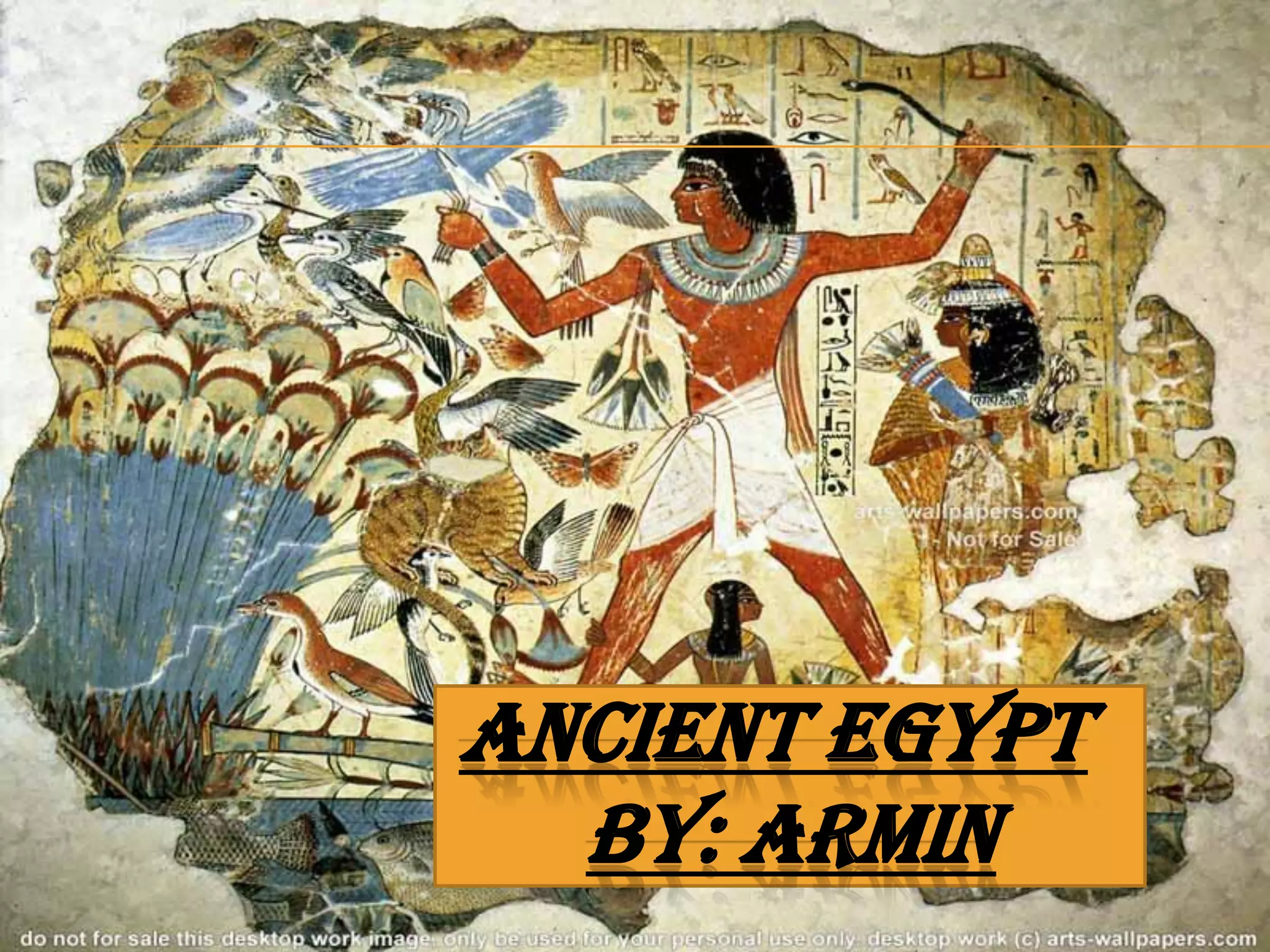
ANCIENT EGYPT
  BY: ARMIN
TABLE OF CONTESTS
   Map
   Background
   Social structure
   Housing
   Food
   Family life
   Marriage
   Childhood
   Education
   Religion
   Clothing
   Art, Music
   Cunclision
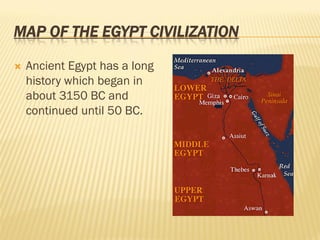
MAP OF THE EGYPT CIVILIZATION

   Ancient Egypt has a long
    history which began in
    about 3150 BC and
    continued until 50 BC.
BACKGROUND
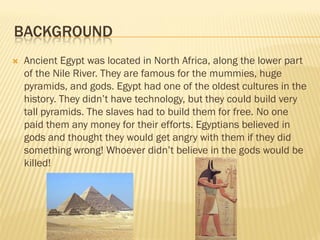
   Ancient Egypt was located in North Africa, along the lower part
    of the Nile River. They are famous for the mummies, huge
    pyramids, and gods. Egypt had one of the oldest cultures in the
    history. They didn’t have technology, but they could build very
    tall pyramids. The slaves had to build them for free. No one
    paid them any money for their efforts. Egyptians believed in
    gods and thought they would get angry with them if they did
    something wrong! Whoever didn’t believe in the gods would be
    killed!
SOCIAL STRUCTURE
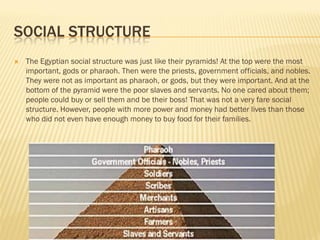
   The Egyptian social structure was just like their pyramids! At the top were the most
    important, gods or pharaoh. Then were the priests, government officials, and nobles.
    They were not as important as pharaoh, or gods, but they were important. And at the
    bottom of the pyramid were the poor slaves and servants. No one cared about them;
    people could buy or sell them and be their boss! That was not a very fare social
    structure. However, people with more power and money had better lives than those
    who did not even have enough money to buy food for their families.
HOUSING
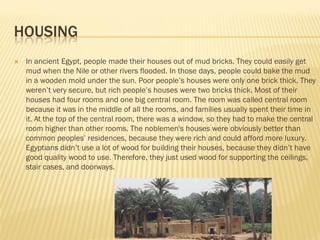
   In ancient Egypt, people made their houses out of mud bricks. They could easily get
    mud when the Nile or other rivers flooded. In those days, people could bake the mud
    in a wooden mold under the sun. Poor people’s houses were only one brick thick. They
    weren’t very secure, but rich people’s houses were two bricks thick. Most of their
    houses had four rooms and one big central room. The room was called central room
    because it was in the middle of all the rooms, and families usually spent their time in
    it. At the top of the central room, there was a window, so they had to make the central
    room higher than other rooms. The noblemen's houses were obviously better than
    common peoples’ residences, because they were rich and could afford more luxury.
    Egyptians didn’t use a lot of wood for building their houses, because they didn’t have
    good quality wood to use. Therefore, they just used wood for supporting the ceilings,
    stair cases, and doorways.
FOOD
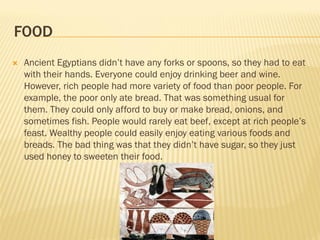
   Ancient Egyptians didn’t have any forks or spoons, so they had to eat
    with their hands. Everyone could enjoy drinking beer and wine.
    However, rich people had more variety of food than poor people. For
    example, the poor only ate bread. That was something usual for
    them. They could only afford to buy or make bread, onions, and
    sometimes fish. People would rarely eat beef, except at rich people’s
    feast. Wealthy people could easily enjoy eating various foods and
    breads. The bad thing was that they didn’t have sugar, so they just
    used honey to sweeten their food.
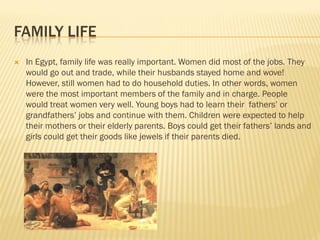
FAMILY LIFE
   In Egypt, family life was really important. Women did most of the jobs. They
    would go out and trade, while their husbands stayed home and wove!
    However, still women had to do household duties. In other words, women
    were the most important members of the family and in charge. People
    would treat women very well. Young boys had to learn their fathers’ or
    grandfathers’ jobs and continue with them. Children were expected to help
    their mothers or their elderly parents. Boys could get their fathers’ lands and
    girls could get their goods like jewels if their parents died.
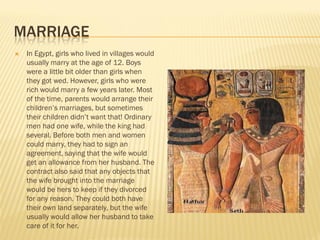
MARRIAGE
   In Egypt, girls who lived in villages would
    usually marry at the age of 12. Boys
    were a little bit older than girls when
    they got wed. However, girls who were
    rich would marry a few years later. Most
    of the time, parents would arrange their
    children’s marriages, but sometimes
    their children didn’t want that! Ordinary
    men had one wife, while the king had
    several. Before both men and women
    could marry, they had to sign an
    agreement, saying that the wife would
    get an allowance from her husband. The
    contract also said that any objects that
    the wife brought into the marriage
    would be hers to keep if they divorced
    for any reason. They could both have
    their own land separately, but the wife
    usually would allow her husband to take
    care of it for her.
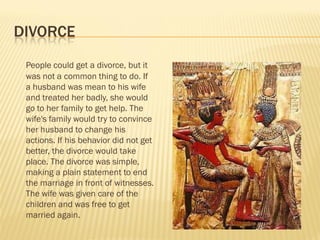
DIVORCE
 People could get a divorce, but it
 was not a common thing to do. If
 a husband was mean to his wife
 and treated her badly, she would
 go to her family to get help. The
 wife's family would try to convince
 her husband to change his
 actions. If his behavior did not get
 better, the divorce would take
 place. The divorce was simple,
 making a plain statement to end
 the marriage in front of witnesses.
 The wife was given care of the
 children and was free to get
 married again.
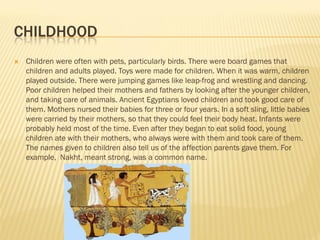
CHILDHOOD
   Children were often with pets, particularly birds. There were board games that
    children and adults played. Toys were made for children. When it was warm, children
    played outside. There were jumping games like leap-frog and wrestling and dancing.
    Poor children helped their mothers and fathers by looking after the younger children,
    and taking care of animals. Ancient Egyptians loved children and took good care of
    them. Mothers nursed their babies for three or four years. In a soft sling, little babies
    were carried by their mothers, so that they could feel their body heat. Infants were
    probably held most of the time. Even after they began to eat solid food, young
    children ate with their mothers, who always were with them and took care of them.
    The names given to children also tell us of the affection parents gave them. For
    example, Nakht, meant strong, was a common name.
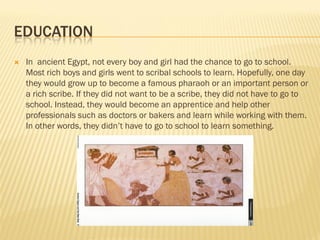
EDUCATION
   In ancient Egypt, not every boy and girl had the chance to go to school.
    Most rich boys and girls went to scribal schools to learn. Hopefully, one day
    they would grow up to become a famous pharaoh or an important person or
    a rich scribe. If they did not want to be a scribe, they did not have to go to
    school. Instead, they would become an apprentice and help other
    professionals such as doctors or bakers and learn while working with them.
    In other words, they didn’t have to go to school to learn something.
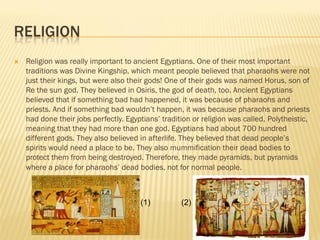
RELIGION
   Religion was really important to ancient Egyptians. One of their most important
    traditions was Divine Kingship, which meant people believed that pharaohs were not
    just their kings, but were also their gods! One of their gods was named Horus, son of
    Re the sun god. They believed in Osiris, the god of death, too. Ancient Egyptians
    believed that if something bad had happened, it was because of pharaohs and
    priests. And if something bad wouldn’t happen, it was because pharaohs and priests
    had done their jobs perfectly. Egyptians’ tradition or religion was called, Polytheistic,
    meaning that they had more than one god. Egyptians had about 700 hundred
    different gods. They also believed in afterlife. They believed that dead people’s
    spirits would need a place to be. They also mummification their dead bodies to
    protect them from being destroyed. Therefore, they made pyramids, but pyramids
    where a place for pharaohs’ dead bodies, not for normal people.


                                       (1)          (2)
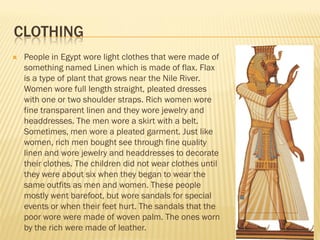
CLOTHING
   People in Egypt wore light clothes that were made of
    something named Linen which is made of flax. Flax
    is a type of plant that grows near the Nile River.
    Women wore full length straight, pleated dresses
    with one or two shoulder straps. Rich women wore
    fine transparent linen and they wore jewelry and
    headdresses. The men wore a skirt with a belt.
    Sometimes, men wore a pleated garment. Just like
    women, rich men bought see through fine quality
    linen and wore jewelry and headdresses to decorate
    their clothes. The children did not wear clothes until
    they were about six when they began to wear the
    same outfits as men and women. These people
    mostly went barefoot, but wore sandals for special
    events or when their feet hurt. The sandals that the
    poor wore were made of woven palm. The ones worn
    by the rich were made of leather.
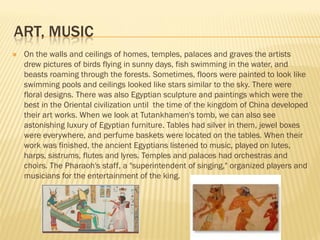
ART, MUSIC
   On the walls and ceilings of homes, temples, palaces and graves the artists
    drew pictures of birds flying in sunny days, fish swimming in the water, and
    beasts roaming through the forests. Sometimes, floors were painted to look like
    swimming pools and ceilings looked like stars similar to the sky. There were
    floral designs. There was also Egyptian sculpture and paintings which were the
    best in the Oriental civilization until the time of the kingdom of China developed
    their art works. When we look at Tutankhamen's tomb, we can also see
    astonishing luxury of Egyptian furniture. Tables had silver in them, jewel boxes
    were everywhere, and perfume baskets were located on the tables. When their
    work was finished, the ancient Egyptians listened to music, played on lutes,
    harps, sistrums, flutes and lyres. Temples and palaces had orchestras and
    choirs. The Pharaoh's staff, a "superintendent of singing," organized players and
    musicians for the entertainment of the king.
CONCLUSION
   In conclusion, ancient Egypt had a successful and completed civilization.
    They also had a the longest recorded history between all other civilizations.
    They had very strange and different traditions than we have now. They had
    multiple gods and goddesses which were really weird. Egyptian even had a
    very different type of life style than we do now! They didn’t have the
    technology to make cool things, but we now see that they have made a lot of
    things that we wouldn’t be able to do if they hadn’t done it. For example, we
    didn’t now how to mummification an animal. We didn’t even know what it
    was, until we read the walls of the tombs of Egyptians. Ancient Egypt is a
    well known place because of its mummies, huge pyramids, strange gods
    and goddesses. By now, I’m pretty sure that every one knows a little bit
    about ancient Egypt!
INFORMATION BIBLIOGRAPHY
   Ancient Egyptian Education - http://library.thinkquest.org/J002046F/education.htm education
   Ancient Egypt, Tourism - http://egypthistorytourism.blogspot.com/2010/10/ancient-egypt.html facts about
    Egypt
   Brewer, Douglas J., and Emily Teeter. “Egypt and the Egyptians” (couldn’t find it!) Cambridge University Press 1995.
   Egypt: Daily Life - http://www2.sptimes.com/Egypt/EgyptCredit.4.2.html family life and marriage
   Factual Information About Egypt - http://library.thinkquest.org/CR0210200/ancient_egypt/facts.htm Some basic and factual
    information
   Food in Ancient Egypt - http://historylink101.net/egypt_1/a-food.htm food
   Housing in Ancient Egypt http://historylink101.net/egypt_1/a-housing.htm housing
   Morley, Jacqueline. “How Would You Survive as an Ancient Egyptian?” New York. Franklin Watts, 1995.(book from
    classroom)
   Online Activities, Childhood - http://www.rom.on.ca/programs/activities/egypt/learn/childhood.php childhood
   Painting in Ancient Egypt - http://www.love-egypt.com/painting.html Art, music
   Religion of ancient Egypt - http://historylink101.net/egypt_1/religion.htm religion
   The Egyptians – clothing - http://www.historyonthenet.com/Egyptians/clothing.htm clothing
PICTURES BIBLIOGRAPHY
   http://scoilchaitrionajnrmsflaherty.blogspot.com/ Title page
   http://carlos.emory.edu/ODYSSEY/EGYPT/nilemap.html map of Egypt
   http://jeremylent.wordpress.com/category/ascendancy-to-power-agriculture/ Table of contests
   http://www.places-to-visit.us/games/Alexandria,_Egypt.html background pyramids
   http://professortravel-egypt.com/ancientreligions2.html Background (2) god
   http://historylink101.net/egypt_1/a-housing.htm housing
   http://www.educationaladventures.co.uk/history/ancient-egyptian-introduction.html food
   http://www.ancient-egypt-online.com/daily-life-in-ancient-egypt.html family life
   http://www.awakening-healing.com/Egyptian_Gods_&_Goddesses.htm marriage
   http://preterhuman.net/texts/other/crystalinks/divorce.html divorce
   http://www.woodlands-junior.kent.sch.uk/Homework/egypt/clothes.htm children
   http://ancientegyptmoberly.pbworks.com/w/page/12830354/bibliography education
   http://egypthistorytourism.blogspot.com/2010/10/ancient-egypt.html religion (1)
   http://www.egypttourinfo.com/ancient-egypt-religion.html religion (2)
   http://www.love-egypt.com/clothing.html clothing
   http://www.zazzle.com/ancient+egyptian+art+gifts music
   http://www.love-egypt.com/life-in-ancient-egypt.html art

Armin socials

  • 1.
    ANCIENT EGYPT BY: ARMIN
  • 2.
    TABLE OF CONTESTS  Map  Background  Social structure  Housing  Food  Family life  Marriage  Childhood  Education  Religion  Clothing  Art, Music  Cunclision
  • 3.
    MAP OF THEEGYPT CIVILIZATION  Ancient Egypt has a long history which began in about 3150 BC and continued until 50 BC.
  • 4.
    BACKGROUND  Ancient Egypt was located in North Africa, along the lower part of the Nile River. They are famous for the mummies, huge pyramids, and gods. Egypt had one of the oldest cultures in the history. They didn’t have technology, but they could build very tall pyramids. The slaves had to build them for free. No one paid them any money for their efforts. Egyptians believed in gods and thought they would get angry with them if they did something wrong! Whoever didn’t believe in the gods would be killed!
  • 5.
    SOCIAL STRUCTURE  The Egyptian social structure was just like their pyramids! At the top were the most important, gods or pharaoh. Then were the priests, government officials, and nobles. They were not as important as pharaoh, or gods, but they were important. And at the bottom of the pyramid were the poor slaves and servants. No one cared about them; people could buy or sell them and be their boss! That was not a very fare social structure. However, people with more power and money had better lives than those who did not even have enough money to buy food for their families.
  • 6.
    HOUSING  In ancient Egypt, people made their houses out of mud bricks. They could easily get mud when the Nile or other rivers flooded. In those days, people could bake the mud in a wooden mold under the sun. Poor people’s houses were only one brick thick. They weren’t very secure, but rich people’s houses were two bricks thick. Most of their houses had four rooms and one big central room. The room was called central room because it was in the middle of all the rooms, and families usually spent their time in it. At the top of the central room, there was a window, so they had to make the central room higher than other rooms. The noblemen's houses were obviously better than common peoples’ residences, because they were rich and could afford more luxury. Egyptians didn’t use a lot of wood for building their houses, because they didn’t have good quality wood to use. Therefore, they just used wood for supporting the ceilings, stair cases, and doorways.
  • 7.
    FOOD  Ancient Egyptians didn’t have any forks or spoons, so they had to eat with their hands. Everyone could enjoy drinking beer and wine. However, rich people had more variety of food than poor people. For example, the poor only ate bread. That was something usual for them. They could only afford to buy or make bread, onions, and sometimes fish. People would rarely eat beef, except at rich people’s feast. Wealthy people could easily enjoy eating various foods and breads. The bad thing was that they didn’t have sugar, so they just used honey to sweeten their food.
  • 8.
    FAMILY LIFE  In Egypt, family life was really important. Women did most of the jobs. They would go out and trade, while their husbands stayed home and wove! However, still women had to do household duties. In other words, women were the most important members of the family and in charge. People would treat women very well. Young boys had to learn their fathers’ or grandfathers’ jobs and continue with them. Children were expected to help their mothers or their elderly parents. Boys could get their fathers’ lands and girls could get their goods like jewels if their parents died.
  • 9.
    MARRIAGE  In Egypt, girls who lived in villages would usually marry at the age of 12. Boys were a little bit older than girls when they got wed. However, girls who were rich would marry a few years later. Most of the time, parents would arrange their children’s marriages, but sometimes their children didn’t want that! Ordinary men had one wife, while the king had several. Before both men and women could marry, they had to sign an agreement, saying that the wife would get an allowance from her husband. The contract also said that any objects that the wife brought into the marriage would be hers to keep if they divorced for any reason. They could both have their own land separately, but the wife usually would allow her husband to take care of it for her.
  • 10.
    DIVORCE People couldget a divorce, but it was not a common thing to do. If a husband was mean to his wife and treated her badly, she would go to her family to get help. The wife's family would try to convince her husband to change his actions. If his behavior did not get better, the divorce would take place. The divorce was simple, making a plain statement to end the marriage in front of witnesses. The wife was given care of the children and was free to get married again.
  • 11.
    CHILDHOOD  Children were often with pets, particularly birds. There were board games that children and adults played. Toys were made for children. When it was warm, children played outside. There were jumping games like leap-frog and wrestling and dancing. Poor children helped their mothers and fathers by looking after the younger children, and taking care of animals. Ancient Egyptians loved children and took good care of them. Mothers nursed their babies for three or four years. In a soft sling, little babies were carried by their mothers, so that they could feel their body heat. Infants were probably held most of the time. Even after they began to eat solid food, young children ate with their mothers, who always were with them and took care of them. The names given to children also tell us of the affection parents gave them. For example, Nakht, meant strong, was a common name.
  • 12.
    EDUCATION  In ancient Egypt, not every boy and girl had the chance to go to school. Most rich boys and girls went to scribal schools to learn. Hopefully, one day they would grow up to become a famous pharaoh or an important person or a rich scribe. If they did not want to be a scribe, they did not have to go to school. Instead, they would become an apprentice and help other professionals such as doctors or bakers and learn while working with them. In other words, they didn’t have to go to school to learn something.
  • 13.
    RELIGION  Religion was really important to ancient Egyptians. One of their most important traditions was Divine Kingship, which meant people believed that pharaohs were not just their kings, but were also their gods! One of their gods was named Horus, son of Re the sun god. They believed in Osiris, the god of death, too. Ancient Egyptians believed that if something bad had happened, it was because of pharaohs and priests. And if something bad wouldn’t happen, it was because pharaohs and priests had done their jobs perfectly. Egyptians’ tradition or religion was called, Polytheistic, meaning that they had more than one god. Egyptians had about 700 hundred different gods. They also believed in afterlife. They believed that dead people’s spirits would need a place to be. They also mummification their dead bodies to protect them from being destroyed. Therefore, they made pyramids, but pyramids where a place for pharaohs’ dead bodies, not for normal people. (1) (2)
  • 14.
    CLOTHING  People in Egypt wore light clothes that were made of something named Linen which is made of flax. Flax is a type of plant that grows near the Nile River. Women wore full length straight, pleated dresses with one or two shoulder straps. Rich women wore fine transparent linen and they wore jewelry and headdresses. The men wore a skirt with a belt. Sometimes, men wore a pleated garment. Just like women, rich men bought see through fine quality linen and wore jewelry and headdresses to decorate their clothes. The children did not wear clothes until they were about six when they began to wear the same outfits as men and women. These people mostly went barefoot, but wore sandals for special events or when their feet hurt. The sandals that the poor wore were made of woven palm. The ones worn by the rich were made of leather.
  • 15.
    ART, MUSIC  On the walls and ceilings of homes, temples, palaces and graves the artists drew pictures of birds flying in sunny days, fish swimming in the water, and beasts roaming through the forests. Sometimes, floors were painted to look like swimming pools and ceilings looked like stars similar to the sky. There were floral designs. There was also Egyptian sculpture and paintings which were the best in the Oriental civilization until the time of the kingdom of China developed their art works. When we look at Tutankhamen's tomb, we can also see astonishing luxury of Egyptian furniture. Tables had silver in them, jewel boxes were everywhere, and perfume baskets were located on the tables. When their work was finished, the ancient Egyptians listened to music, played on lutes, harps, sistrums, flutes and lyres. Temples and palaces had orchestras and choirs. The Pharaoh's staff, a "superintendent of singing," organized players and musicians for the entertainment of the king.
  • 16.
    CONCLUSION  In conclusion, ancient Egypt had a successful and completed civilization. They also had a the longest recorded history between all other civilizations. They had very strange and different traditions than we have now. They had multiple gods and goddesses which were really weird. Egyptian even had a very different type of life style than we do now! They didn’t have the technology to make cool things, but we now see that they have made a lot of things that we wouldn’t be able to do if they hadn’t done it. For example, we didn’t now how to mummification an animal. We didn’t even know what it was, until we read the walls of the tombs of Egyptians. Ancient Egypt is a well known place because of its mummies, huge pyramids, strange gods and goddesses. By now, I’m pretty sure that every one knows a little bit about ancient Egypt!
  • 17.
    INFORMATION BIBLIOGRAPHY  Ancient Egyptian Education - http://library.thinkquest.org/J002046F/education.htm education  Ancient Egypt, Tourism - http://egypthistorytourism.blogspot.com/2010/10/ancient-egypt.html facts about Egypt  Brewer, Douglas J., and Emily Teeter. “Egypt and the Egyptians” (couldn’t find it!) Cambridge University Press 1995.  Egypt: Daily Life - http://www2.sptimes.com/Egypt/EgyptCredit.4.2.html family life and marriage  Factual Information About Egypt - http://library.thinkquest.org/CR0210200/ancient_egypt/facts.htm Some basic and factual information  Food in Ancient Egypt - http://historylink101.net/egypt_1/a-food.htm food  Housing in Ancient Egypt http://historylink101.net/egypt_1/a-housing.htm housing  Morley, Jacqueline. “How Would You Survive as an Ancient Egyptian?” New York. Franklin Watts, 1995.(book from classroom)  Online Activities, Childhood - http://www.rom.on.ca/programs/activities/egypt/learn/childhood.php childhood  Painting in Ancient Egypt - http://www.love-egypt.com/painting.html Art, music  Religion of ancient Egypt - http://historylink101.net/egypt_1/religion.htm religion  The Egyptians – clothing - http://www.historyonthenet.com/Egyptians/clothing.htm clothing
  • 18.
    PICTURES BIBLIOGRAPHY  http://scoilchaitrionajnrmsflaherty.blogspot.com/ Title page  http://carlos.emory.edu/ODYSSEY/EGYPT/nilemap.html map of Egypt  http://jeremylent.wordpress.com/category/ascendancy-to-power-agriculture/ Table of contests  http://www.places-to-visit.us/games/Alexandria,_Egypt.html background pyramids  http://professortravel-egypt.com/ancientreligions2.html Background (2) god  http://historylink101.net/egypt_1/a-housing.htm housing  http://www.educationaladventures.co.uk/history/ancient-egyptian-introduction.html food  http://www.ancient-egypt-online.com/daily-life-in-ancient-egypt.html family life  http://www.awakening-healing.com/Egyptian_Gods_&_Goddesses.htm marriage  http://preterhuman.net/texts/other/crystalinks/divorce.html divorce  http://www.woodlands-junior.kent.sch.uk/Homework/egypt/clothes.htm children  http://ancientegyptmoberly.pbworks.com/w/page/12830354/bibliography education  http://egypthistorytourism.blogspot.com/2010/10/ancient-egypt.html religion (1)  http://www.egypttourinfo.com/ancient-egypt-religion.html religion (2)  http://www.love-egypt.com/clothing.html clothing  http://www.zazzle.com/ancient+egyptian+art+gifts music  http://www.love-egypt.com/life-in-ancient-egypt.html art