Please click anywhere to begin presentation and to move through slides.
Ancient Egyptian  9th Grade History ACIC School 2009 Ancient Egyptian
Geography Located in the Nile river valley Civilization developed by about 3,000 BC
Geography Protected from invaders by: Mountains and falls to the south vast deserts on both sides Mediterranean Sea to the north
Geography This location kept Egypt separate from the rest of the world, so the Egyptians had a unique and enduring style of life and art for about 3,000 years.
People Communities were made up of: Hunters and fishermen Soldiers Slaves Priests Scribes Artists and craftsmen Farmers and herdsmen   Fishing Scene Tomb of Kenamun About 1430 BC
People Artists, craftsmen and scribes were honored and admired. A  scribe  is a scholar who could read and write. Scribes wrote on papyrus. Papyrus  is a reed pounded to make a heavy type of paper. Seated Scribe Painted Limestone About 2500 BC
People The leader was called a  pharaoh . The  pharaoh  was believed to be half man, half god. The afterlife of the pharaoh is an important theme in ancient Egyptian art.   Tutankhamun Sarcophagus About 1340 BC
Contributions The ancient Egyptians: Made bricks Used sails on the water Used wheels on land Harnessed animals for  work Trained donkeys to carry people Combined copper and tin to make bronze Forged tools from copper. Egyptian Boat
Contributions They also used  hieroglyphics . Hieroglyphics  are an early form of picture writing.
Architecture The greatest architectural achievements of the Ancient Egyptians were the pyramids. Pyramids were built as tombs for the pharaohs. They contained the items that the Egyptians believed that the Pharaoh would need in the afterlife. Much of the art that remains was preserved in the pyramids.
Architecture The first pyramid was built for King Zoser. It was a “step pyramid”. It was designed and built by an artist and architect named  Imhotep . Imhotep is the first artist whose name is recorded in history. This pyramid was built about 2600 BC.
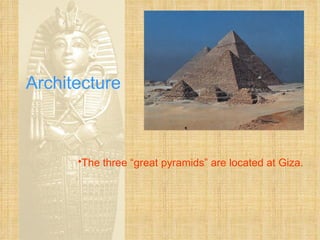
Architecture The three “great pyramids” are located at Giza.
Architecture They are guarded by the Great Sphinx. The sphinx is carved from a rocky ledge. It was damaged by Muslim vandalism and sand and wind.
Architecture The ancient Egyptians also built beautiful temples. This is the Temple of Re The post and lintel system was used to build this temple.
Mummies The pyramids and tombs contained the mummified remains of the pharaohs. The ancient Egyptians believed that the soul (called the Ka) would need to use the body in the afterlife, so the bodies were carefully preserved. Many items in the tombs were left there to be used by the Ka in the afterlife.
Mummies
Mummies These are the mummified remains of a pharaoh named Ramses II.
Mummies After embalming, mummies were carefully wrapped in yards of linen bandages.
Mummies The ancient Egyptians even mummified animals.
Sculpture Painted relief sculpture lined the walls of pyramids. This is called a  stele . A  stele  is a carved upright stone slab used as a monument.
Sculpture This stele shows Ramses II slaying his enemies.
Sculpture Notice that the sculptures are  stiff ,  formal , and  stylized .
Sculpture Faces face forward, and the left foot is slightly ahead of the right. There are no open spaces in the stone that the figures are carved from.
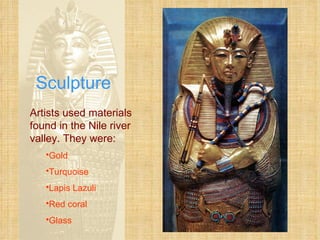
Sculpture Artists used materials found in the Nile river valley. They were: Gold Turquoise Lapis Lazuli Red coral Glass
Sculpture
Sculpture This gold mask rested on the head of the mummy of King Tutankhaman.
Sculpture Notice how Ramses II faces forward. He appears to be very rigid. This is typical of ancient Egyptian sculpture.
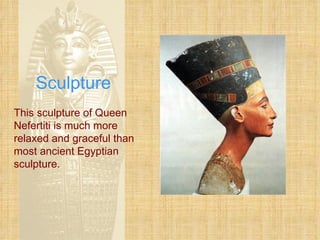
Sculpture This sculpture of Queen Nefertiti is much more relaxed and graceful than most ancient Egyptian sculpture.
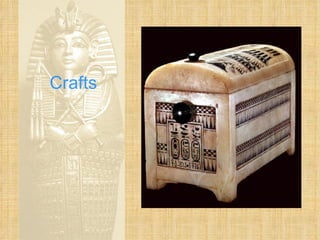
Crafts Craftsmen made furniture, jewelry, pottery, and other useful items.
Crafts
Crafts
Crafts
Crafts
Crafts
Crafts
Crafts
Painting Ancient Egyptians followed a very strict set of rules in their art. One of these rules was to show the human body from the most familiar or visible angle.
Painting Again, the figures appear to be rigid and stylized. Notice the left foot and body posture.
Painting Paintings tell us about the daily lives of the ancient Egyptians.
Painting This painting is somewhat unusual. Can you spot the reason why?
Painting The gods are often depicted in the tomb paintings.
Objectives Now that you have watched this presentation, can you Describe life in Ancient Egypt? Tell what kinds of art were created in ancient Egypt?
Can you define these terms? Hieroglyphic Stele Pharaoh Papyrus Scribe What did the artist Imhotep do?
The Egyptians used hieroglyphics and various patterns to decorate the pharaohs’ coffins.  You will use pattern and symbols that represent things that are important in your life to make a life-sized mummy case that that resembles those of the ancient Egyptians. What symbols will you use?  Assignment
Then you will see the life   of The Old Kingdom.
The old kingdom The old kingdom is a period of time when egypt was ruled by The Third Dynasty through the Sixth dynasty (2686 BC – 2134 BC).
Menes Menes is the most important person in Egyptian history. He is the man who united Egypt into 1 country
A statue of Menes  The state of the crown after the uniting.
The rest of the pharaohs in the 1 st  dynasty are: Aha  Djer  Djet  Den  Anedjib  Semerkhet  Qaa
The second dynasty   The second dynasty was not important in so important in history even not effective.
The pharaohs in the 2 nd  dynasty are: Raneb  Nynetjer  Peribsen  Khasekhem
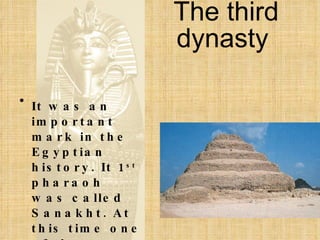
The third dynasty   It was an important mark in the Egyptian history. It 1 st  pharaoh  was called Sanakht. At this time one of the most important mounumental builidngs was built.
This building as built by the 2 nd  pharaoh in this dynasty he was called zoser. And the pyramid was called sakara pyramyd.
The rest of the pharaohs in the 3 rd  dynasty are: Sekhemkhet  Huni
The fourth dynasty It the most important dynasty in the old kingdom. Its 1 st  pharaoh was Senfru. And the most important kings are Cheops , Chephren and Menkaura.
This dynasty is considered the most important because the most important symbols of the pharaohs was built in this dynasty and they are:
The pyramids   The pyramids.they are one of the Seven Wonders of the world. The biggest is for Cheops then Chephren and at the end Menkaura.
The Great Sphinx They are guarded by the Great Sphinx. The sphinx is carved from a rocky ledge. It was damaged by Muslim vandalism and sand and wind.
The fifth dynasty   As the 2 nd  dynasty it was not so effective in the Egyptian history. It had some small pyramids and some nice artifacts. Its 1 st  king was Userkaf the son of Khentkaues, who was a member of the fourth dynasty.
The rest of the pharaohs in the 5 th  dynasty are: Sahura  Neferirkara Kakai  Shepseskara Isi  Raneferef  Nyuserra  Menkauhor Akauhor  Djedkara Isesi  Unas
The sixth dynasty  The last powerful dynasties of the old kingdom. One of the remarkable pharohs of this dynasty was Pepi the second.
The pyramid of Pepi II at southern Saqqara is the last major monument of the Old Kingdom .  None of the names of kings of the short - lived seventh dynasty are known and the eighth dynasty shows signs of and political decay .
The rest of the pharaohs in the 6 th  dynasty are: Teti  Userkara  Pepy I  Merenra
The end

ancient egypt

  • 1.
    Please click anywhereto begin presentation and to move through slides.
  • 2.
    Ancient Egyptian 9th Grade History ACIC School 2009 Ancient Egyptian
  • 3.
    Geography Located inthe Nile river valley Civilization developed by about 3,000 BC
  • 4.
    Geography Protected frominvaders by: Mountains and falls to the south vast deserts on both sides Mediterranean Sea to the north
  • 5.
    Geography This locationkept Egypt separate from the rest of the world, so the Egyptians had a unique and enduring style of life and art for about 3,000 years.
  • 6.
    People Communities weremade up of: Hunters and fishermen Soldiers Slaves Priests Scribes Artists and craftsmen Farmers and herdsmen Fishing Scene Tomb of Kenamun About 1430 BC
  • 7.
    People Artists, craftsmenand scribes were honored and admired. A scribe is a scholar who could read and write. Scribes wrote on papyrus. Papyrus is a reed pounded to make a heavy type of paper. Seated Scribe Painted Limestone About 2500 BC
  • 8.
    People The leaderwas called a pharaoh . The pharaoh was believed to be half man, half god. The afterlife of the pharaoh is an important theme in ancient Egyptian art. Tutankhamun Sarcophagus About 1340 BC
  • 9.
    Contributions The ancientEgyptians: Made bricks Used sails on the water Used wheels on land Harnessed animals for work Trained donkeys to carry people Combined copper and tin to make bronze Forged tools from copper. Egyptian Boat
  • 10.
    Contributions They alsoused hieroglyphics . Hieroglyphics are an early form of picture writing.
  • 11.
    Architecture The greatestarchitectural achievements of the Ancient Egyptians were the pyramids. Pyramids were built as tombs for the pharaohs. They contained the items that the Egyptians believed that the Pharaoh would need in the afterlife. Much of the art that remains was preserved in the pyramids.
  • 12.
    Architecture The firstpyramid was built for King Zoser. It was a “step pyramid”. It was designed and built by an artist and architect named Imhotep . Imhotep is the first artist whose name is recorded in history. This pyramid was built about 2600 BC.
  • 13.
    Architecture The three“great pyramids” are located at Giza.
  • 14.
    Architecture They areguarded by the Great Sphinx. The sphinx is carved from a rocky ledge. It was damaged by Muslim vandalism and sand and wind.
  • 15.
    Architecture The ancientEgyptians also built beautiful temples. This is the Temple of Re The post and lintel system was used to build this temple.
  • 16.
    Mummies The pyramidsand tombs contained the mummified remains of the pharaohs. The ancient Egyptians believed that the soul (called the Ka) would need to use the body in the afterlife, so the bodies were carefully preserved. Many items in the tombs were left there to be used by the Ka in the afterlife.
  • 17.
  • 18.
    Mummies These arethe mummified remains of a pharaoh named Ramses II.
  • 19.
    Mummies After embalming,mummies were carefully wrapped in yards of linen bandages.
  • 20.
    Mummies The ancientEgyptians even mummified animals.
  • 21.
    Sculpture Painted reliefsculpture lined the walls of pyramids. This is called a stele . A stele is a carved upright stone slab used as a monument.
  • 22.
    Sculpture This steleshows Ramses II slaying his enemies.
  • 23.
    Sculpture Notice thatthe sculptures are stiff , formal , and stylized .
  • 24.
    Sculpture Faces faceforward, and the left foot is slightly ahead of the right. There are no open spaces in the stone that the figures are carved from.
  • 25.
    Sculpture Artists usedmaterials found in the Nile river valley. They were: Gold Turquoise Lapis Lazuli Red coral Glass
  • 26.
  • 27.
    Sculpture This goldmask rested on the head of the mummy of King Tutankhaman.
  • 28.
    Sculpture Notice howRamses II faces forward. He appears to be very rigid. This is typical of ancient Egyptian sculpture.
  • 29.
    Sculpture This sculptureof Queen Nefertiti is much more relaxed and graceful than most ancient Egyptian sculpture.
  • 30.
    Crafts Craftsmen madefurniture, jewelry, pottery, and other useful items.
  • 31.
  • 32.
  • 33.
  • 34.
  • 35.
  • 36.
  • 37.
  • 38.
    Painting Ancient Egyptiansfollowed a very strict set of rules in their art. One of these rules was to show the human body from the most familiar or visible angle.
  • 39.
    Painting Again, thefigures appear to be rigid and stylized. Notice the left foot and body posture.
  • 40.
    Painting Paintings tellus about the daily lives of the ancient Egyptians.
  • 41.
    Painting This paintingis somewhat unusual. Can you spot the reason why?
  • 42.
    Painting The godsare often depicted in the tomb paintings.
  • 43.
    Objectives Now thatyou have watched this presentation, can you Describe life in Ancient Egypt? Tell what kinds of art were created in ancient Egypt?
  • 44.
    Can you definethese terms? Hieroglyphic Stele Pharaoh Papyrus Scribe What did the artist Imhotep do?
  • 45.
    The Egyptians usedhieroglyphics and various patterns to decorate the pharaohs’ coffins. You will use pattern and symbols that represent things that are important in your life to make a life-sized mummy case that that resembles those of the ancient Egyptians. What symbols will you use? Assignment
  • 46.
    Then you willsee the life of The Old Kingdom.
  • 47.
    The old kingdomThe old kingdom is a period of time when egypt was ruled by The Third Dynasty through the Sixth dynasty (2686 BC – 2134 BC).
  • 48.
    Menes Menes isthe most important person in Egyptian history. He is the man who united Egypt into 1 country
  • 49.
    A statue ofMenes The state of the crown after the uniting.
  • 50.
    The rest ofthe pharaohs in the 1 st dynasty are: Aha Djer Djet Den Anedjib Semerkhet Qaa
  • 51.
    The second dynasty The second dynasty was not important in so important in history even not effective.
  • 52.
    The pharaohs inthe 2 nd dynasty are: Raneb Nynetjer Peribsen Khasekhem
  • 53.
    The third dynasty It was an important mark in the Egyptian history. It 1 st pharaoh was called Sanakht. At this time one of the most important mounumental builidngs was built.
  • 54.
    This building asbuilt by the 2 nd pharaoh in this dynasty he was called zoser. And the pyramid was called sakara pyramyd.
  • 55.
    The rest ofthe pharaohs in the 3 rd dynasty are: Sekhemkhet Huni
  • 56.
    The fourth dynastyIt the most important dynasty in the old kingdom. Its 1 st pharaoh was Senfru. And the most important kings are Cheops , Chephren and Menkaura.
  • 57.
    This dynasty isconsidered the most important because the most important symbols of the pharaohs was built in this dynasty and they are:
  • 58.
    The pyramids The pyramids.they are one of the Seven Wonders of the world. The biggest is for Cheops then Chephren and at the end Menkaura.
  • 59.
    The Great SphinxThey are guarded by the Great Sphinx. The sphinx is carved from a rocky ledge. It was damaged by Muslim vandalism and sand and wind.
  • 60.
    The fifth dynasty As the 2 nd dynasty it was not so effective in the Egyptian history. It had some small pyramids and some nice artifacts. Its 1 st king was Userkaf the son of Khentkaues, who was a member of the fourth dynasty.
  • 61.
    The rest ofthe pharaohs in the 5 th dynasty are: Sahura Neferirkara Kakai Shepseskara Isi Raneferef Nyuserra Menkauhor Akauhor Djedkara Isesi Unas
  • 62.
    The sixth dynasty The last powerful dynasties of the old kingdom. One of the remarkable pharohs of this dynasty was Pepi the second.
  • 63.
    The pyramid ofPepi II at southern Saqqara is the last major monument of the Old Kingdom . None of the names of kings of the short - lived seventh dynasty are known and the eighth dynasty shows signs of and political decay .
  • 64.
    The rest ofthe pharaohs in the 6 th dynasty are: Teti Userkara Pepy I Merenra
  • 65.