Art of
Ancient Egypt
Ancient Egyptian Periods (3100 – 30 BCE)
Early Dynastic
Old Kingdom
First Intermediate Period
Middle Kingdom
Second Intermediate Period
New Kingdom
Third Intermediate Period
Late Period
Ptolemaic Period
The Afterlife
Egyptians built tombs for their Kings and Queens –
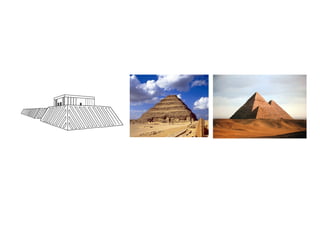
styles vary from a flat “mastaba” to a “stepped
pyramid” to the “pyramid” form
Tombs contained the mummified body of the King
or Queen, their pets, and many objects for their
next life
Egyptians believed in Eternal Life (Life After Death)
- “Ka” or spirit lives on after death of body
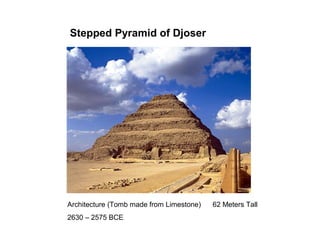
Stepped Pyramid of Djoser
Architecture (Tomb made from Limestone) 62 Meters Tall
2630 – 2575 BCE
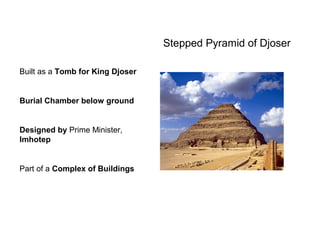
Stepped Pyramid of Djoser
Built as a Tomb for King Djoser
Burial Chamber below ground
Designed by Prime Minister,
Imhotep
Part of a Complex of Buildings
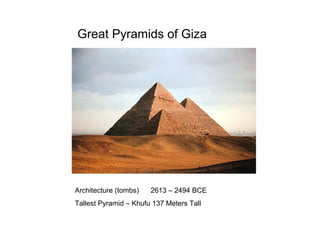
Great Pyramids of Giza
Architecture (tombs) 2613 – 2494 BCE
Tallest Pyramid – Khufu 137 Meters Tall
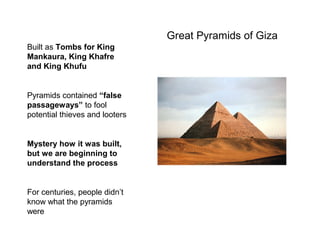
Great Pyramids of Giza
Built as Tombs for King
Mankaura, King Khafre
and King Khufu
Pyramids contained “false
passageways” to fool
potential thieves and looters
Mystery how it was built,
but we are beginning to
understand the process
For centuries, people didn’t
know what the pyramids
were
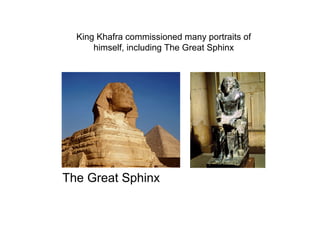
The Great Sphinx
King Khafra commissioned many portraits of
himself, including The Great Sphinx
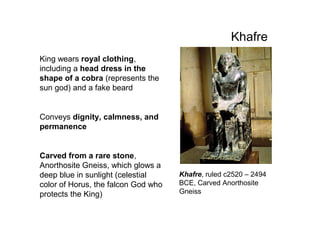
Khafre
King wears royal clothing,
including a head dress in the
shape of a cobra (represents the
sun god) and a fake beard
Conveys dignity, calmness, and
permanence
Carved from a rare stone,
Anorthosite Gneiss, which glows a
deep blue in sunlight (celestial
color of Horus, the falcon God who
protects the King)
Khafre, ruled c2520 – 2494
BCE, Carved Anorthosite
Gneiss
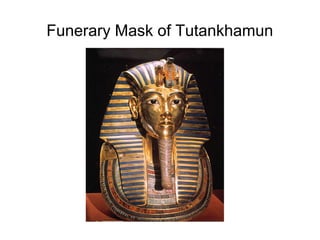
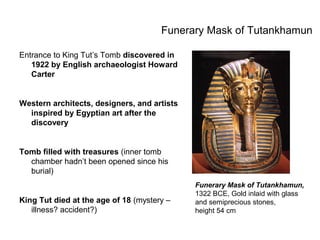
Funerary Mask of Tutankhamun
Entrance to King Tut’s Tomb discovered in
1922 by English archaeologist Howard
Carter
Western architects, designers, and artists
inspired by Egyptian art after the
discovery
Tomb filled with treasures (inner tomb
chamber hadn’t been opened since his
burial)
King Tut died at the age of 18 (mystery –
illness? accident?)
Funerary Mask of Tutankhamun,
1322 BCE, Gold inlaid with glass
and semiprecious stones,
height 54 cm
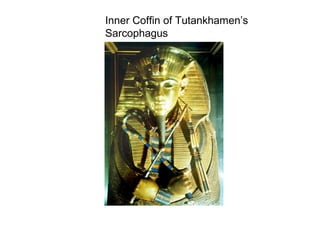
Inner Coffin of Tutankhamen’s
Sarcophagus
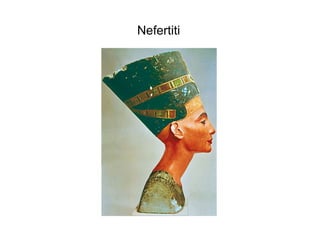
Nefertiti
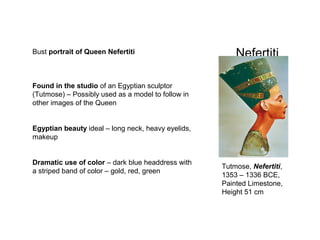
NefertitiBust portrait of Queen Nefertiti
Found in the studio of an Egyptian sculptor
(Tutmose) – Possibly used as a model to follow in
other images of the Queen
Egyptian beauty ideal – long neck, heavy eyelids,
makeup
Dramatic use of color – dark blue headdress with
a striped band of color – gold, red, green
Tutmose, Nefertiti,
1353 – 1336 BCE,
Painted Limestone,
Height 51 cm
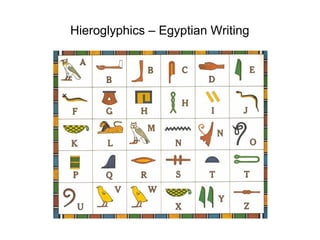
Hieroglyphics – Egyptian Writing
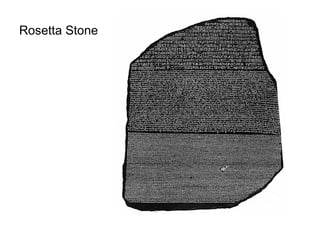
Rosetta Stone
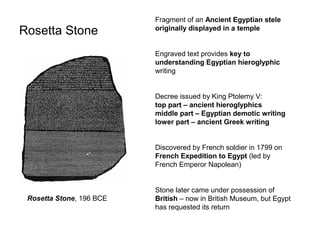
Rosetta Stone
Fragment of an Ancient Egyptian stele
originally displayed in a temple
Engraved text provides key to
understanding Egyptian hieroglyphic
writing
Decree issued by King Ptolemy V:
top part – ancient hieroglyphics
middle part – Egyptian demotic writing
lower part – ancient Greek writing
Discovered by French soldier in 1799 on
French Expedition to Egypt (led by
French Emperor Napolean)
Stone later came under possession of
British – now in British Museum, but Egypt
has requested its return
Rosetta Stone, 196 BCE
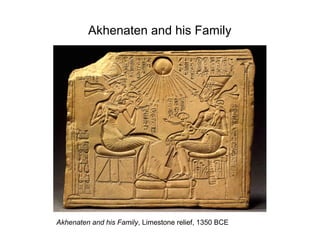
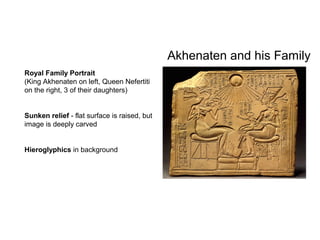
Akhenaten and his Family
Akhenaten and his Family, Limestone relief, 1350 BCE
Akhenaten and his Family
Royal Family Portrait
(King Akhenaten on left, Queen Nefertiti
on the right, 3 of their daughters)
Sunken relief - flat surface is raised, but
image is deeply carved
Hieroglyphics in background
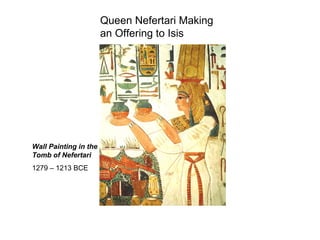
Queen Nefertari Making
an Offering to Isis
Wall Painting in the
Tomb of Nefertari
1279 – 1213 BCE
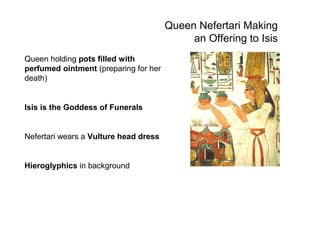
Queen Nefertari Making
an Offering to Isis
Queen holding pots filled with
perfumed ointment (preparing for her
death)
Isis is the Goddess of Funerals
Nefertari wears a Vulture head dress
Hieroglyphics in background
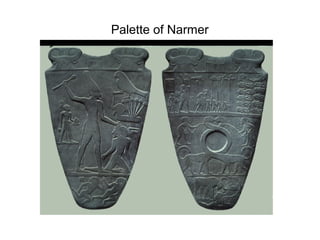
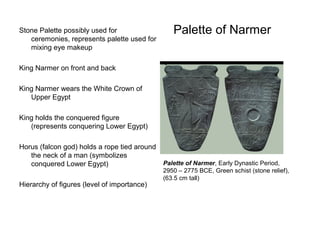
Palette of Narmer
Palette of NarmerStone Palette possibly used for
ceremonies, represents palette used for
mixing eye makeup
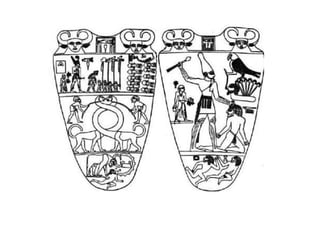
King Narmer on front and back
King Narmer wears the White Crown of
Upper Egypt
King holds the conquered figure
(represents conquering Lower Egypt)
Horus (falcon god) holds a rope tied around
the neck of a man (symbolizes
conquered Lower Egypt)
Hierarchy of figures (level of importance)
Palette of Narmer, Early Dynastic Period,
2950 – 2775 BCE, Green schist (stone relief),
(63.5 cm tall)
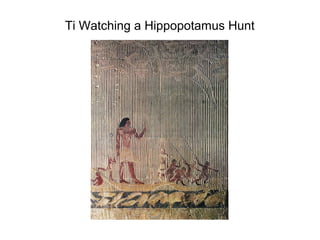
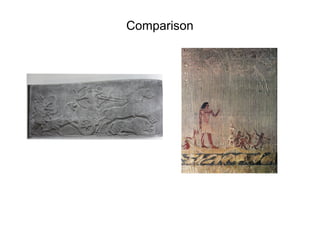
Ti Watching a Hippopotamus Hunt
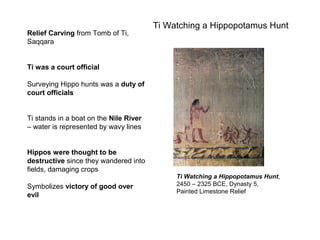
Relief Carving from Tomb of Ti,
Saqqara
Ti was a court official
Surveying Hippo hunts was a duty of
court officials
Ti stands in a boat on the Nile River
– water is represented by wavy lines
Hippos were thought to be
destructive since they wandered into
fields, damaging crops
Symbolizes victory of good over
evil
Ti Watching a Hippopotamus Hunt,
2450 – 2325 BCE, Dynasty 5,
Painted Limestone Relief
Comparison

Ancient Egypt

  • 1.
  • 3.
    Ancient Egyptian Periods(3100 – 30 BCE) Early Dynastic Old Kingdom First Intermediate Period Middle Kingdom Second Intermediate Period New Kingdom Third Intermediate Period Late Period Ptolemaic Period
  • 4.
    The Afterlife Egyptians builttombs for their Kings and Queens – styles vary from a flat “mastaba” to a “stepped pyramid” to the “pyramid” form Tombs contained the mummified body of the King or Queen, their pets, and many objects for their next life Egyptians believed in Eternal Life (Life After Death) - “Ka” or spirit lives on after death of body
  • 5.
    Stepped Pyramid ofDjoser Architecture (Tomb made from Limestone) 62 Meters Tall 2630 – 2575 BCE
  • 6.
    Stepped Pyramid ofDjoser Built as a Tomb for King Djoser Burial Chamber below ground Designed by Prime Minister, Imhotep Part of a Complex of Buildings
  • 7.
    Great Pyramids ofGiza Architecture (tombs) 2613 – 2494 BCE Tallest Pyramid – Khufu 137 Meters Tall
  • 8.
    Great Pyramids ofGiza Built as Tombs for King Mankaura, King Khafre and King Khufu Pyramids contained “false passageways” to fool potential thieves and looters Mystery how it was built, but we are beginning to understand the process For centuries, people didn’t know what the pyramids were
  • 10.
    The Great Sphinx KingKhafra commissioned many portraits of himself, including The Great Sphinx
  • 11.
    Khafre King wears royalclothing, including a head dress in the shape of a cobra (represents the sun god) and a fake beard Conveys dignity, calmness, and permanence Carved from a rare stone, Anorthosite Gneiss, which glows a deep blue in sunlight (celestial color of Horus, the falcon God who protects the King) Khafre, ruled c2520 – 2494 BCE, Carved Anorthosite Gneiss
  • 12.
    Funerary Mask ofTutankhamun
  • 13.
    Funerary Mask ofTutankhamun Entrance to King Tut’s Tomb discovered in 1922 by English archaeologist Howard Carter Western architects, designers, and artists inspired by Egyptian art after the discovery Tomb filled with treasures (inner tomb chamber hadn’t been opened since his burial) King Tut died at the age of 18 (mystery – illness? accident?) Funerary Mask of Tutankhamun, 1322 BCE, Gold inlaid with glass and semiprecious stones, height 54 cm
  • 14.
    Inner Coffin ofTutankhamen’s Sarcophagus
  • 15.
  • 16.
    NefertitiBust portrait ofQueen Nefertiti Found in the studio of an Egyptian sculptor (Tutmose) – Possibly used as a model to follow in other images of the Queen Egyptian beauty ideal – long neck, heavy eyelids, makeup Dramatic use of color – dark blue headdress with a striped band of color – gold, red, green Tutmose, Nefertiti, 1353 – 1336 BCE, Painted Limestone, Height 51 cm
  • 17.
  • 18.
  • 19.
    Rosetta Stone Fragment ofan Ancient Egyptian stele originally displayed in a temple Engraved text provides key to understanding Egyptian hieroglyphic writing Decree issued by King Ptolemy V: top part – ancient hieroglyphics middle part – Egyptian demotic writing lower part – ancient Greek writing Discovered by French soldier in 1799 on French Expedition to Egypt (led by French Emperor Napolean) Stone later came under possession of British – now in British Museum, but Egypt has requested its return Rosetta Stone, 196 BCE
  • 20.
    Akhenaten and hisFamily Akhenaten and his Family, Limestone relief, 1350 BCE
  • 21.
    Akhenaten and hisFamily Royal Family Portrait (King Akhenaten on left, Queen Nefertiti on the right, 3 of their daughters) Sunken relief - flat surface is raised, but image is deeply carved Hieroglyphics in background
  • 22.
    Queen Nefertari Making anOffering to Isis Wall Painting in the Tomb of Nefertari 1279 – 1213 BCE
  • 23.
    Queen Nefertari Making anOffering to Isis Queen holding pots filled with perfumed ointment (preparing for her death) Isis is the Goddess of Funerals Nefertari wears a Vulture head dress Hieroglyphics in background
  • 24.
  • 25.
    Palette of NarmerStonePalette possibly used for ceremonies, represents palette used for mixing eye makeup King Narmer on front and back King Narmer wears the White Crown of Upper Egypt King holds the conquered figure (represents conquering Lower Egypt) Horus (falcon god) holds a rope tied around the neck of a man (symbolizes conquered Lower Egypt) Hierarchy of figures (level of importance) Palette of Narmer, Early Dynastic Period, 2950 – 2775 BCE, Green schist (stone relief), (63.5 cm tall)
  • 27.
    Ti Watching aHippopotamus Hunt
  • 28.
    Ti Watching aHippopotamus Hunt Relief Carving from Tomb of Ti, Saqqara Ti was a court official Surveying Hippo hunts was a duty of court officials Ti stands in a boat on the Nile River – water is represented by wavy lines Hippos were thought to be destructive since they wandered into fields, damaging crops Symbolizes victory of good over evil Ti Watching a Hippopotamus Hunt, 2450 – 2325 BCE, Dynasty 5, Painted Limestone Relief
  • 29.