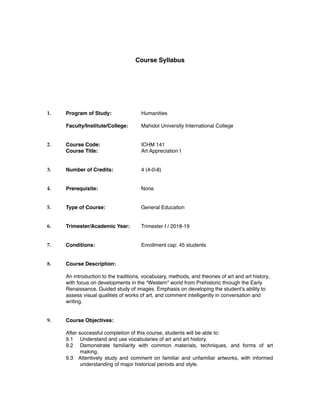
Course Syllabus
1. Program of Study: Humanities
Faculty/Institute/College: Mahidol University International College
2. Course Code: ICHM 141
Course Title: Art Appreciation I
3. Number of Credits: 4 (4-0-8)
4. Prerequisite: None
5. Type of Course: General Education
6. Trimester/Academic Year: Trimester I / 2018-19
7. Conditions: Enrollment cap: 45 students
8. Course Description:
An introduction to the traditions, vocabulary, methods, and theories of art and art history,
with focus on developments in the “Western” world from Prehistoric through the Early
Renaissance. Guided study of images. Emphasis on developing the student’s ability to
assess visual qualities of works of art, and comment intelligently in conversation and
writing.
9. Course Objectives:
After successful completion of this course, students will be able to:
9.1 Understand and use vocabularies of art and art history.
9.2 Demonstrate familiarity with common materials, techniques, and forms of art
making.
9.3 Attentively study and comment on familiar and unfamiliar artworks, with informed
understanding of major historical periods and style.
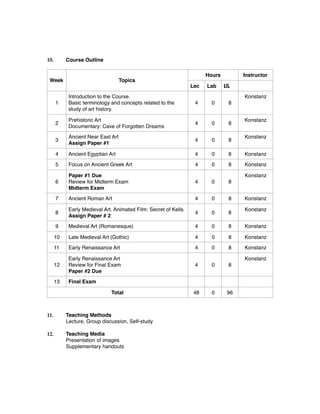
10. Course Outline
11. Teaching Methods
Lecture, Group discussion, Self-study
12. Teaching Media
Presentation of images
Supplementary handouts
Week Topics
Hours Instructor
Lec Lab I.S.
1
Introduction to the Course.
Basic terminology and concepts related to the
study of art history.
4 0 8
Konstanz
2
Prehistoric Art
Documentary: Cave of Forgotten Dreams
4 0 8
Konstanz
3
Ancient Near East Art
Assign Paper #1
4 0 8
Konstanz
4 Ancient Egyptian Art 4 0 8 Konstanz
5 Focus on Ancient Greek Art 4 0 8 Konstanz
6
Paper #1 Due
Review for Midterm Exam
Midterm Exam
4 0 8
Konstanz
7 Ancient Roman Art 4 0 8 Konstanz
8
Early Medieval Art. Animated Film: Secret of Kells.
Assign Paper # 2
4 0 8
Konstanz
9 Medieval Art (Romanesque) 4 0 8 Konstanz
10 Late Medieval Art (Gothic) 4 0 8 Konstanz
11 Early Renaissance Art 4 0 8 Konstanz
12
Early Renaissance Art
Review for Final Exam
Paper #2 Due
4 0 8
Konstanz
13 Final Exam
Total 48 0 96
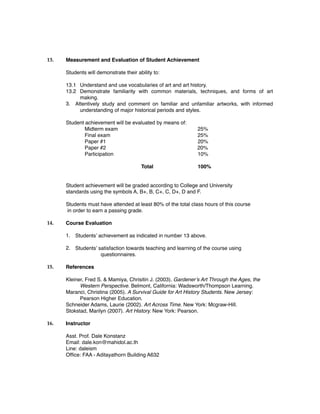
13. Measurement and Evaluation of Student Achievement
Students will demonstrate their ability to:
13.1 Understand and use vocabularies of art and art history.
13.2 Demonstrate familiarity with common materials, techniques, and forms of art
making.
3. Attentively study and comment on familiar and unfamiliar artworks, with informed
understanding of major historical periods and styles.
Student achievement will be evaluated by means of:
Midterm exam 25%
Final exam 25%
Paper #1 20%
Paper #2 20%
Participation 10%
Total 100%
Student achievement will be graded according to College and University
standards using the symbols A, B+, B, C+, C, D+, D and F.
Students must have attended at least 80% of the total class hours of this course
in order to earn a passing grade.
14. Course Evaluation
1. Students’ achievement as indicated in number 13 above.
2. Students’ satisfaction towards teaching and learning of the course using
questionnaires.
15. References
Kleiner, Fred S. & Mamiya, Chrisitin J. (2003). Gardener’s Art Through the Ages, the
Western Perspective. Belmont, California: Wadsworth/Thompson Learning.
Maranci, Christina (2005). A Survival Guide for Art History Students. New Jersey:
Pearson Higher Education.
Schneider Adams, Laurie (2002). Art Across Time. New York: Mcgraw-Hill.
Stokstad, Marilyn (2007). Art History. New York: Pearson.
16. Instructor
Asst. Prof. Dale Konstanz
Email: dale.kon@mahidol.ac.th
Line: daleism
Office: FAA - Aditayathorn Building A632
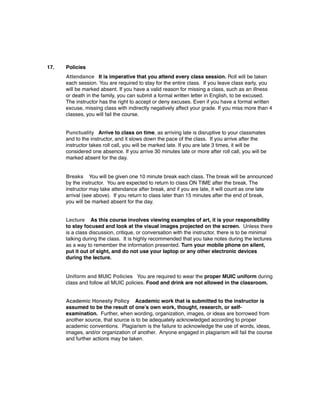
17. Policies
Attendance   It is imperative that you attend every class session. Roll will be taken
each session. You are required to stay for the entire class.  If you leave class early, you
will be marked absent. If you have a valid reason for missing a class, such as an illness
or death in the family, you can submit a formal written letter in English, to be excused. 
The instructor has the right to accept or deny excuses. Even if you have a formal written
excuse, missing class with indirectly negatively affect your grade. If you miss more than 4
classes, you will fail the course.
Punctuality Arrive to class on time, as arriving late is disruptive to your classmates
and to the instructor, and it slows down the pace of the class.  If you arrive after the
instructor takes roll call, you will be marked late. If you are late 3 times, it will be
considered one absence. If you arrive 30 minutes late or more after roll call, you will be
marked absent for the day.
Breaks You will be given one 10 minute break each class. The break will be announced
by the instructor.  You are expected to return to class ON TIME after the break. The
instructor may take attendance after break, and if you are late, it will count as one late
arrival (see above).  If you return to class later than 15 minutes after the end of break,
you will be marked absent for the day.
Lecture As this course involves viewing examples of art, it is your responsibility
to stay focused and look at the visual images projected on the screen.  Unless there
is a class discussion, critique, or conversation with the instructor, there is to be minimal
talking during the class.  It is highly recommended that you take notes during the lectures
as a way to remember the information presented. Turn your mobile phone on silent,
put it out of sight, and do not use your laptop or any other electronic devices
during the lecture.
Uniform and MUIC Policies You are required to wear the proper MUIC uniform during
class and follow all MUIC policies. Food and drink are not allowed in the classroom.
Academic Honesty Policy Academic work that is submitted to the instructor is
assumed to be the result of one’s own work, thought, research, or self-
examination. Further, when wording, organization, images, or ideas are borrowed from
another source, that source is to be adequately acknowledged according to proper
academic conventions. Plagiarism is the failure to acknowledge the use of words, ideas,
images, and/or organization of another. Anyone engaged in plagiarism will fail the course
and further actions may be taken.

Course Outline

  • 1.
    Course Syllabus 1. Programof Study: Humanities Faculty/Institute/College: Mahidol University International College 2. Course Code: ICHM 141 Course Title: Art Appreciation I 3. Number of Credits: 4 (4-0-8) 4. Prerequisite: None 5. Type of Course: General Education 6. Trimester/Academic Year: Trimester I / 2018-19 7. Conditions: Enrollment cap: 45 students 8. Course Description: An introduction to the traditions, vocabulary, methods, and theories of art and art history, with focus on developments in the “Western” world from Prehistoric through the Early Renaissance. Guided study of images. Emphasis on developing the student’s ability to assess visual qualities of works of art, and comment intelligently in conversation and writing. 9. Course Objectives: After successful completion of this course, students will be able to: 9.1 Understand and use vocabularies of art and art history. 9.2 Demonstrate familiarity with common materials, techniques, and forms of art making. 9.3 Attentively study and comment on familiar and unfamiliar artworks, with informed understanding of major historical periods and style.
  • 2.
    10. Course Outline 11.Teaching Methods Lecture, Group discussion, Self-study 12. Teaching Media Presentation of images Supplementary handouts Week Topics Hours Instructor Lec Lab I.S. 1 Introduction to the Course. Basic terminology and concepts related to the study of art history. 4 0 8 Konstanz 2 Prehistoric Art Documentary: Cave of Forgotten Dreams 4 0 8 Konstanz 3 Ancient Near East Art Assign Paper #1 4 0 8 Konstanz 4 Ancient Egyptian Art 4 0 8 Konstanz 5 Focus on Ancient Greek Art 4 0 8 Konstanz 6 Paper #1 Due Review for Midterm Exam Midterm Exam 4 0 8 Konstanz 7 Ancient Roman Art 4 0 8 Konstanz 8 Early Medieval Art. Animated Film: Secret of Kells. Assign Paper # 2 4 0 8 Konstanz 9 Medieval Art (Romanesque) 4 0 8 Konstanz 10 Late Medieval Art (Gothic) 4 0 8 Konstanz 11 Early Renaissance Art 4 0 8 Konstanz 12 Early Renaissance Art Review for Final Exam Paper #2 Due 4 0 8 Konstanz 13 Final Exam Total 48 0 96
  • 3.
    13. Measurement andEvaluation of Student Achievement Students will demonstrate their ability to: 13.1 Understand and use vocabularies of art and art history. 13.2 Demonstrate familiarity with common materials, techniques, and forms of art making. 3. Attentively study and comment on familiar and unfamiliar artworks, with informed understanding of major historical periods and styles. Student achievement will be evaluated by means of: Midterm exam 25% Final exam 25% Paper #1 20% Paper #2 20% Participation 10% Total 100% Student achievement will be graded according to College and University standards using the symbols A, B+, B, C+, C, D+, D and F. Students must have attended at least 80% of the total class hours of this course in order to earn a passing grade. 14. Course Evaluation 1. Students’ achievement as indicated in number 13 above. 2. Students’ satisfaction towards teaching and learning of the course using questionnaires. 15. References Kleiner, Fred S. & Mamiya, Chrisitin J. (2003). Gardener’s Art Through the Ages, the Western Perspective. Belmont, California: Wadsworth/Thompson Learning. Maranci, Christina (2005). A Survival Guide for Art History Students. New Jersey: Pearson Higher Education. Schneider Adams, Laurie (2002). Art Across Time. New York: Mcgraw-Hill. Stokstad, Marilyn (2007). Art History. New York: Pearson. 16. Instructor Asst. Prof. Dale Konstanz Email: dale.kon@mahidol.ac.th Line: daleism Office: FAA - Aditayathorn Building A632
  • 4.
    17. Policies Attendance  It is imperative that you attend every class session. Roll will be taken each session. You are required to stay for the entire class.  If you leave class early, you will be marked absent. If you have a valid reason for missing a class, such as an illness or death in the family, you can submit a formal written letter in English, to be excused.  The instructor has the right to accept or deny excuses. Even if you have a formal written excuse, missing class with indirectly negatively affect your grade. If you miss more than 4 classes, you will fail the course. Punctuality Arrive to class on time, as arriving late is disruptive to your classmates and to the instructor, and it slows down the pace of the class.  If you arrive after the instructor takes roll call, you will be marked late. If you are late 3 times, it will be considered one absence. If you arrive 30 minutes late or more after roll call, you will be marked absent for the day. Breaks You will be given one 10 minute break each class. The break will be announced by the instructor.  You are expected to return to class ON TIME after the break. The instructor may take attendance after break, and if you are late, it will count as one late arrival (see above).  If you return to class later than 15 minutes after the end of break, you will be marked absent for the day. Lecture As this course involves viewing examples of art, it is your responsibility to stay focused and look at the visual images projected on the screen.  Unless there is a class discussion, critique, or conversation with the instructor, there is to be minimal talking during the class.  It is highly recommended that you take notes during the lectures as a way to remember the information presented. Turn your mobile phone on silent, put it out of sight, and do not use your laptop or any other electronic devices during the lecture. Uniform and MUIC Policies You are required to wear the proper MUIC uniform during class and follow all MUIC policies. Food and drink are not allowed in the classroom. Academic Honesty Policy Academic work that is submitted to the instructor is assumed to be the result of one’s own work, thought, research, or self- examination. Further, when wording, organization, images, or ideas are borrowed from another source, that source is to be adequately acknowledged according to proper academic conventions. Plagiarism is the failure to acknowledge the use of words, ideas, images, and/or organization of another. Anyone engaged in plagiarism will fail the course and further actions may be taken.