Chapter 3
Ancient Egypt
How is the context of hierarchy expressed in the design of New Kingdom temples?
Why is there very little change of style in Egyptian art and architecture?
Why did the Egyptians follow a strict canon of proportions and strict conventions
in painting human forms?
Explain how context determines function and how function determines style in Egyptian
tomb sculpture, painting, and architecture.
Why did Egyptian painters concentrate on conceptual reality rather than optical reality?
eath mask of Tutankhamen, from the innermost coffin in his tomb at Thebes, Egypt, 18th
Dynasty, ca. 1323 BCE. Gold with inlay of semiprecious stones, 1’9 ¼” hieath mask of Tutankhamen, from the innermost coffin in his tomb at Thebes, Egypt, 18th
Dynasty, ca. 1323 BCE. Gold with inlay of semiprecious stones, 1’9 ¼” hi
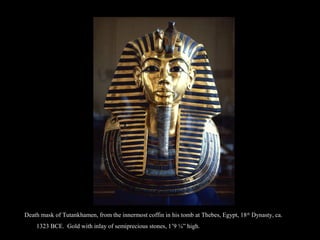
Death mask of Tutankhamen, from the innermost coffin in his tomb at Thebes, Egypt, 18th
Dynasty, ca.
1323 BCE. Gold with inlay of semiprecious stones, 1’9 ¼” high.
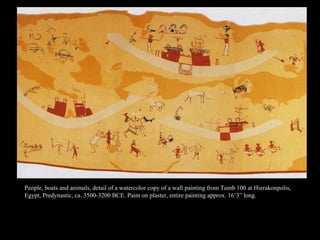
People, boats and animals, detail of a watercolor copy of a wall painting from Tomb 100 at Hierakonpolis,
Egypt, Predynastic, ca. 3500-3200 BCE. Paint on plaster, entire painting approx. 16’3” long.
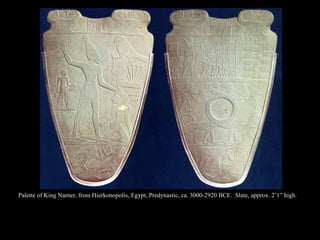
Palette of King Narner, from Hierkonopolis, Egypt, Predynastic, ca. 3000-2920 BCE. Slate, approx. 2’1” high.
Virtual Visit
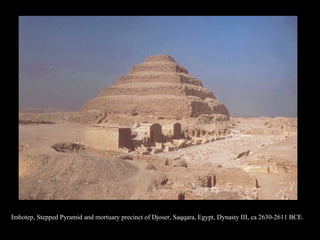
Imhotep, Stepped Pyramid and mortuary precinct of Djoser, Saqqara, Egypt, Dynasty III, ca 2630-2611 BCE.
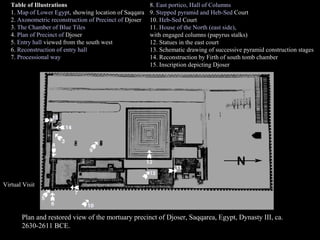
Table of Illustrations
1. Map of Lower Egypt, showing location of Saqqara
2. Axonometric reconstruction of Precinct of Djoser
3. The Chamber of Blue Tiles
4. Plan of Precinct of Djoser
5. Entry hall viewed from the south west
6. Reconstruction of entry hall
7. Processional way
8. East portico, Hall of Columns
9. Stepped pyramid and Heb-Sed Court
10. Heb-Sed Court
11. House of the North (east side),
with engaged columns (papyrus stalks)
12. Statues in the east court
13. Schematic drawing of successive pyramid construction stages
14. Reconstruction by Firth of south tomb chamber
15. Inscription depicting Djoser
Virtual Visit
Plan and restored view of the mortuary precinct of Djoser, Saqqarea, Egypt, Dynasty III, ca.
2630-2611 BCE.
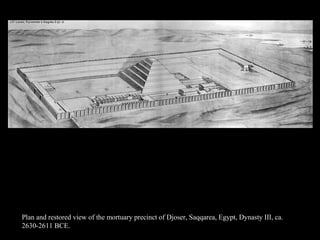
Plan and restored view of the mortuary precinct of Djoser, Saqqarea, Egypt, Dynasty III, ca.
2630-2611 BCE.
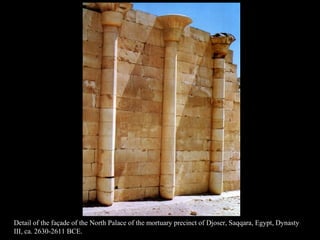
Detail of the façade of the North Palace of the mortuary precinct of Djoser, Saqqara, Egypt, Dynasty
III, ca. 2630-2611 BCE.
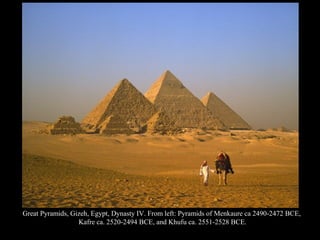
Great Pyramids, Gizeh, Egypt, Dynasty IV. From left: Pyramids of Menkaure ca 2490-2472 BCE,
Kafre ca. 2520-2494 BCE, and Khufu ca. 2551-2528 BCE.
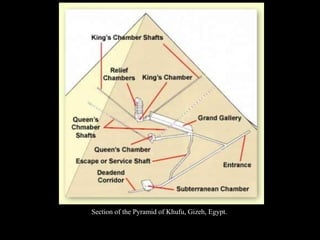
Section of the Pyramid of Khufu, Gizeh, Egypt.
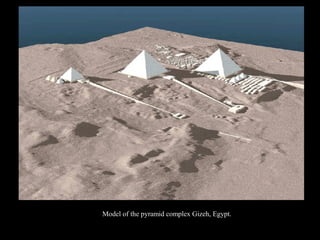
Model of the pyramid complex Gizeh, Egypt.
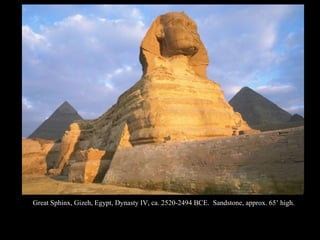
Great Sphinx, Gizeh, Egypt, Dynasty IV, ca. 2520-2494 BCE. Sandstone, approx. 65’ high.
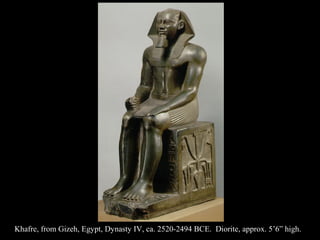
Khafre, from Gizeh, Egypt, Dynasty IV, ca. 2520-2494 BCE. Diorite, approx. 5’6” high.
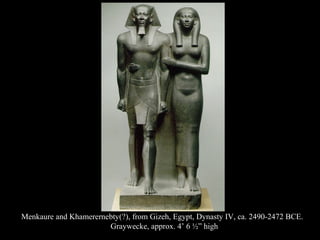
Menkaure and Khamerernebty(?), from Gizeh, Egypt, Dynasty IV, ca. 2490-2472 BCE.
Graywecke, approx. 4’ 6 ½” high
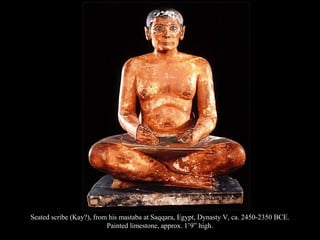
Seated scribe (Kay?), from his mastaba at Saqqara, Egypt, Dynasty V, ca. 2450-2350 BCE.
Painted limestone, approx. 1’9” high.
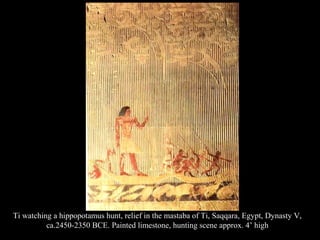
Ti watching a hippopotamus hunt, relief in the mastaba of Ti, Saqqara, Egypt, Dynasty V,
ca.2450-2350 BCE. Painted limestone, hunting scene approx. 4’ high
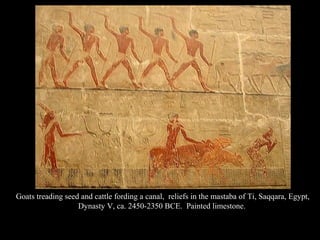
Goats treading seed and cattle fording a canal, reliefs in the mastaba of Ti, Saqqara, Egypt,
Dynasty V, ca. 2450-2350 BCE. Painted limestone.
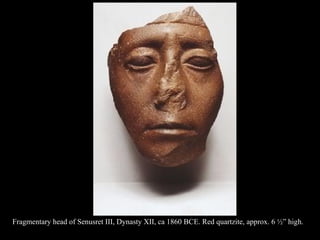
Fragmentary head of Senusret III, Dynasty XII, ca 1860 BCE. Red quartzite, approx. 6 ½” high.
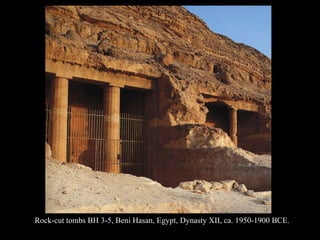
Rock-cut tombs BH 3-5, Beni Hasan, Egypt, Dynasty XII, ca. 1950-1900 BCE.
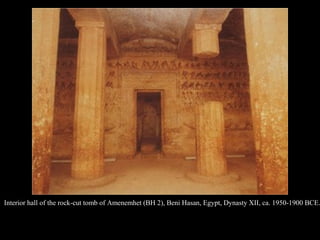
Interior hall of the rock-cut tomb of Amenemhet (BH 2), Beni Hasan, Egypt, Dynasty XII, ca. 1950-1900 BCE.
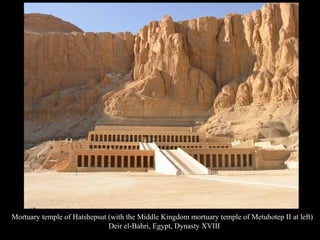
Mortuary temple of Hatshepsut (with the Middle Kingdom mortuary temple of Metuhotep II at left)
Deir el-Bahri, Egypt, Dynasty XVIII
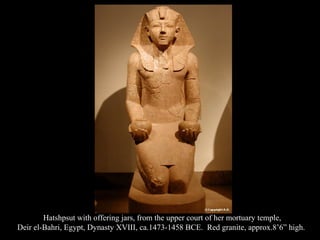
Hatshpsut with offering jars, from the upper court of her mortuary temple,
Deir el-Bahri, Egypt, Dynasty XVIII, ca.1473-1458 BCE. Red granite, approx.8’6” high.
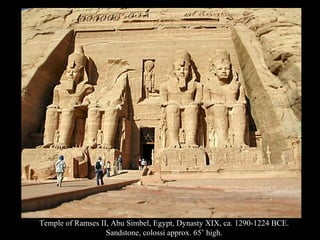
Temple of Ramses II, Abu Simbel, Egypt, Dynasty XIX, ca. 1290-1224 BCE.
Sandstone, colossi approx. 65’ high.
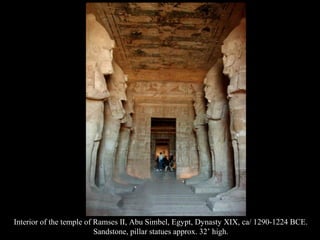
Interior of the temple of Ramses II, Abu Simbel, Egypt, Dynasty XIX, ca/ 1290-1224 BCE.
Sandstone, pillar statues approx. 32’ high.
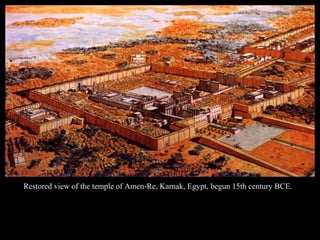
Restored view of the temple of Amen-Re, Karnak, Egypt, begun 15th century BCE.
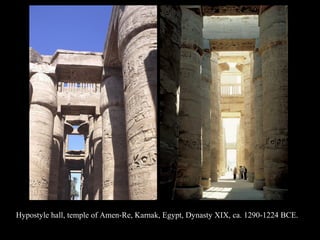
Hypostyle hall, temple of Amen-Re, Karnak, Egypt, Dynasty XIX, ca. 1290-1224 BCE.
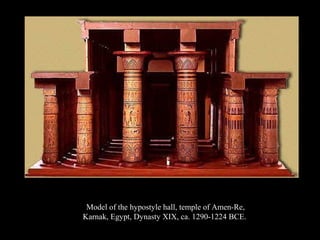
Model of the hypostyle hall, temple of Amen-Re,
Karnak, Egypt, Dynasty XIX, ca. 1290-1224 BCE.
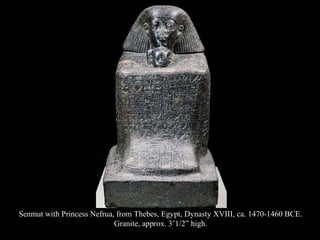
Senmut with Princess Nefrua, from Thebes, Egypt, Dynasty XVIII, ca. 1470-1460 BCE.
Granite, approx. 3’1/2” high.
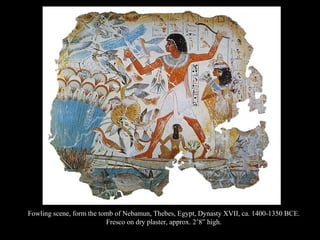
Fowling scene, form the tomb of Nebamun, Thebes, Egypt, Dynasty XVII, ca. 1400-1350 BCE.
Fresco on dry plaster, approx. 2’8” high.
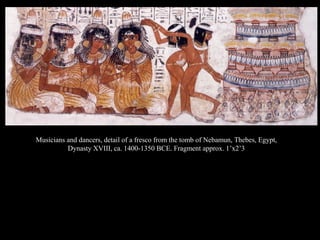
Musicians and dancers, detail of a fresco from the tomb of Nebamun, Thebes, Egypt,
Dynasty XVIII, ca. 1400-1350 BCE. Fragment approx. 1’x2’3
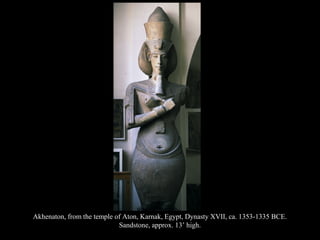
Akhenaton, from the temple of Aton, Karnak, Egypt, Dynasty XVII, ca. 1353-1335 BCE.
Sandstone, approx. 13’ high.
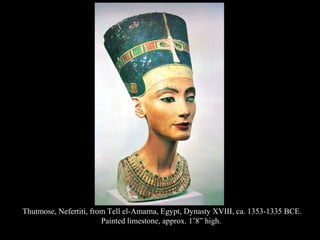
Thutmose, Nefertiti, from Tell el-Amarna, Egypt, Dynasty XVIII, ca. 1353-1335 BCE.
Painted limestone, approx. 1’8” high.
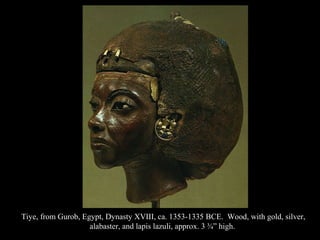
Tiye, from Gurob, Egypt, Dynasty XVIII, ca. 1353-1335 BCE. Wood, with gold, silver,
alabaster, and lapis lazuli, approx. 3 ¾” high.
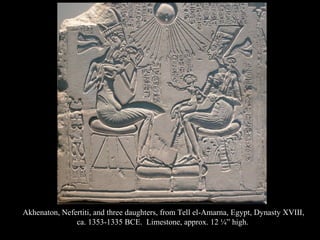
Akhenaton, Nefertiti, and three daughters, from Tell el-Amarna, Egypt, Dynasty XVIII,
ca. 1353-1335 BCE. Limestone, approx. 12 ¼” high.
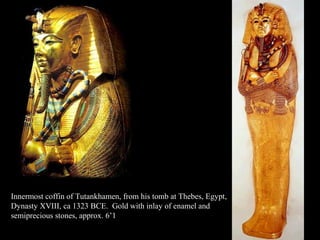
Innermost coffin of Tutankhamen, from his tomb at Thebes, Egypt,
Dynasty XVIII, ca 1323 BCE. Gold with inlay of enamel and
semiprecious stones, approx. 6’1
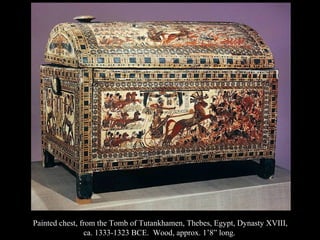
Painted chest, from the Tomb of Tutankhamen, Thebes, Egypt, Dynasty XVIII,
ca. 1333-1323 BCE. Wood, approx. 1’8” long.
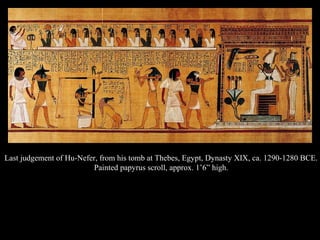
Last judgement of Hu-Nefer, from his tomb at Thebes, Egypt, Dynasty XIX, ca. 1290-1280 BCE.
Painted papyrus scroll, approx. 1’6” high.
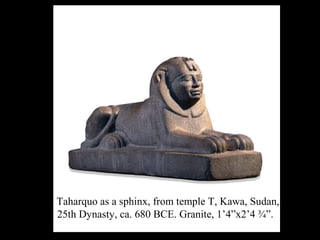
Taharquo as a sphinx, from temple T, Kawa, Sudan,
25th Dynasty, ca. 680 BCE. Granite, 1’4”x2’4 ¾”.
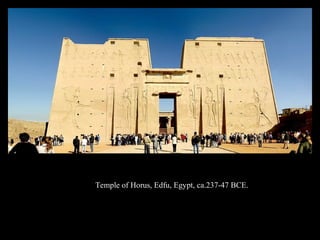
Temple of Horus, Edfu, Egypt, ca.237-47 BCE.

APAH Ch 3 egypt

  • 1.
  • 2.
    How is thecontext of hierarchy expressed in the design of New Kingdom temples? Why is there very little change of style in Egyptian art and architecture? Why did the Egyptians follow a strict canon of proportions and strict conventions in painting human forms? Explain how context determines function and how function determines style in Egyptian tomb sculpture, painting, and architecture. Why did Egyptian painters concentrate on conceptual reality rather than optical reality?
  • 5.
    eath mask ofTutankhamen, from the innermost coffin in his tomb at Thebes, Egypt, 18th Dynasty, ca. 1323 BCE. Gold with inlay of semiprecious stones, 1’9 ¼” hieath mask of Tutankhamen, from the innermost coffin in his tomb at Thebes, Egypt, 18th Dynasty, ca. 1323 BCE. Gold with inlay of semiprecious stones, 1’9 ¼” hi Death mask of Tutankhamen, from the innermost coffin in his tomb at Thebes, Egypt, 18th Dynasty, ca. 1323 BCE. Gold with inlay of semiprecious stones, 1’9 ¼” high.
  • 6.
    People, boats andanimals, detail of a watercolor copy of a wall painting from Tomb 100 at Hierakonpolis, Egypt, Predynastic, ca. 3500-3200 BCE. Paint on plaster, entire painting approx. 16’3” long.
  • 8.
    Palette of KingNarner, from Hierkonopolis, Egypt, Predynastic, ca. 3000-2920 BCE. Slate, approx. 2’1” high.
  • 9.
  • 10.
    Imhotep, Stepped Pyramidand mortuary precinct of Djoser, Saqqara, Egypt, Dynasty III, ca 2630-2611 BCE.
  • 11.
    Table of Illustrations 1.Map of Lower Egypt, showing location of Saqqara 2. Axonometric reconstruction of Precinct of Djoser 3. The Chamber of Blue Tiles 4. Plan of Precinct of Djoser 5. Entry hall viewed from the south west 6. Reconstruction of entry hall 7. Processional way 8. East portico, Hall of Columns 9. Stepped pyramid and Heb-Sed Court 10. Heb-Sed Court 11. House of the North (east side), with engaged columns (papyrus stalks) 12. Statues in the east court 13. Schematic drawing of successive pyramid construction stages 14. Reconstruction by Firth of south tomb chamber 15. Inscription depicting Djoser Virtual Visit Plan and restored view of the mortuary precinct of Djoser, Saqqarea, Egypt, Dynasty III, ca. 2630-2611 BCE.
  • 12.
    Plan and restoredview of the mortuary precinct of Djoser, Saqqarea, Egypt, Dynasty III, ca. 2630-2611 BCE.
  • 13.
    Detail of thefaçade of the North Palace of the mortuary precinct of Djoser, Saqqara, Egypt, Dynasty III, ca. 2630-2611 BCE.
  • 14.
    Great Pyramids, Gizeh,Egypt, Dynasty IV. From left: Pyramids of Menkaure ca 2490-2472 BCE, Kafre ca. 2520-2494 BCE, and Khufu ca. 2551-2528 BCE.
  • 15.
    Section of thePyramid of Khufu, Gizeh, Egypt.
  • 16.
    Model of thepyramid complex Gizeh, Egypt.
  • 17.
    Great Sphinx, Gizeh,Egypt, Dynasty IV, ca. 2520-2494 BCE. Sandstone, approx. 65’ high.
  • 18.
    Khafre, from Gizeh,Egypt, Dynasty IV, ca. 2520-2494 BCE. Diorite, approx. 5’6” high.
  • 19.
    Menkaure and Khamerernebty(?),from Gizeh, Egypt, Dynasty IV, ca. 2490-2472 BCE. Graywecke, approx. 4’ 6 ½” high
  • 20.
    Seated scribe (Kay?),from his mastaba at Saqqara, Egypt, Dynasty V, ca. 2450-2350 BCE. Painted limestone, approx. 1’9” high.
  • 21.
    Ti watching ahippopotamus hunt, relief in the mastaba of Ti, Saqqara, Egypt, Dynasty V, ca.2450-2350 BCE. Painted limestone, hunting scene approx. 4’ high
  • 22.
    Goats treading seedand cattle fording a canal, reliefs in the mastaba of Ti, Saqqara, Egypt, Dynasty V, ca. 2450-2350 BCE. Painted limestone.
  • 23.
    Fragmentary head ofSenusret III, Dynasty XII, ca 1860 BCE. Red quartzite, approx. 6 ½” high.
  • 24.
    Rock-cut tombs BH3-5, Beni Hasan, Egypt, Dynasty XII, ca. 1950-1900 BCE.
  • 25.
    Interior hall ofthe rock-cut tomb of Amenemhet (BH 2), Beni Hasan, Egypt, Dynasty XII, ca. 1950-1900 BCE.
  • 26.
    Mortuary temple ofHatshepsut (with the Middle Kingdom mortuary temple of Metuhotep II at left) Deir el-Bahri, Egypt, Dynasty XVIII
  • 27.
    Hatshpsut with offeringjars, from the upper court of her mortuary temple, Deir el-Bahri, Egypt, Dynasty XVIII, ca.1473-1458 BCE. Red granite, approx.8’6” high.
  • 28.
    Temple of RamsesII, Abu Simbel, Egypt, Dynasty XIX, ca. 1290-1224 BCE. Sandstone, colossi approx. 65’ high.
  • 29.
    Interior of thetemple of Ramses II, Abu Simbel, Egypt, Dynasty XIX, ca/ 1290-1224 BCE. Sandstone, pillar statues approx. 32’ high.
  • 30.
    Restored view ofthe temple of Amen-Re, Karnak, Egypt, begun 15th century BCE.
  • 31.
    Hypostyle hall, templeof Amen-Re, Karnak, Egypt, Dynasty XIX, ca. 1290-1224 BCE.
  • 32.
    Model of thehypostyle hall, temple of Amen-Re, Karnak, Egypt, Dynasty XIX, ca. 1290-1224 BCE.
  • 33.
    Senmut with PrincessNefrua, from Thebes, Egypt, Dynasty XVIII, ca. 1470-1460 BCE. Granite, approx. 3’1/2” high.
  • 34.
    Fowling scene, formthe tomb of Nebamun, Thebes, Egypt, Dynasty XVII, ca. 1400-1350 BCE. Fresco on dry plaster, approx. 2’8” high.
  • 35.
    Musicians and dancers,detail of a fresco from the tomb of Nebamun, Thebes, Egypt, Dynasty XVIII, ca. 1400-1350 BCE. Fragment approx. 1’x2’3
  • 36.
    Akhenaton, from thetemple of Aton, Karnak, Egypt, Dynasty XVII, ca. 1353-1335 BCE. Sandstone, approx. 13’ high.
  • 37.
    Thutmose, Nefertiti, fromTell el-Amarna, Egypt, Dynasty XVIII, ca. 1353-1335 BCE. Painted limestone, approx. 1’8” high.
  • 38.
    Tiye, from Gurob,Egypt, Dynasty XVIII, ca. 1353-1335 BCE. Wood, with gold, silver, alabaster, and lapis lazuli, approx. 3 ¾” high.
  • 39.
    Akhenaton, Nefertiti, andthree daughters, from Tell el-Amarna, Egypt, Dynasty XVIII, ca. 1353-1335 BCE. Limestone, approx. 12 ¼” high.
  • 40.
    Innermost coffin ofTutankhamen, from his tomb at Thebes, Egypt, Dynasty XVIII, ca 1323 BCE. Gold with inlay of enamel and semiprecious stones, approx. 6’1
  • 41.
    Painted chest, fromthe Tomb of Tutankhamen, Thebes, Egypt, Dynasty XVIII, ca. 1333-1323 BCE. Wood, approx. 1’8” long.
  • 42.
    Last judgement ofHu-Nefer, from his tomb at Thebes, Egypt, Dynasty XIX, ca. 1290-1280 BCE. Painted papyrus scroll, approx. 1’6” high.
  • 43.
    Taharquo as asphinx, from temple T, Kawa, Sudan, 25th Dynasty, ca. 680 BCE. Granite, 1’4”x2’4 ¾”.
  • 44.
    Temple of Horus,Edfu, Egypt, ca.237-47 BCE.