Lymphatic system
Consists of
• Lymphatic vessels
• Lymphoid tissues and organs
• Lymphatic vessels
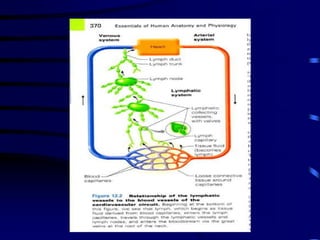
–Return excess fluid from the tissue
back to the blood stream, about three
liters per day
–One way flow towards the heart
–Proteins and bacteria, cell debris too
big to enter the capillaries return by
lymphatic vessels
–Lymph flow to lymph nodes first
Lacteals
• are specialized lymph capillaries in the villi of
the small intestine; they absorb the fat-soluble
end products of digestion, such as fatty acids
and vitamins A, D, E, and K.
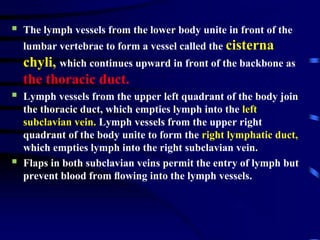
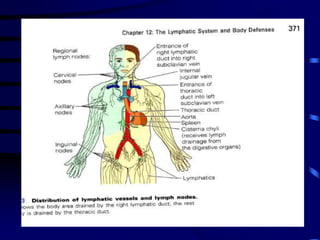
 The lymph vessels from the lower body unite in front of the
lumbar vertebrae to form a vessel called the cisterna
chyli, which continues upward in front of the backbone as
the thoracic duct.
 Lymph vessels from the upper left quadrant of the body join
the thoracic duct, which empties lymph into the left
subclavian vein. Lymph vessels from the upper right
quadrant of the body unite to form the right lymphatic duct,
which empties lymph into the right subclavian vein.
 Flaps in both subclavian veins permit the entry of lymph but
prevent blood from flowing into the lymph vessels.
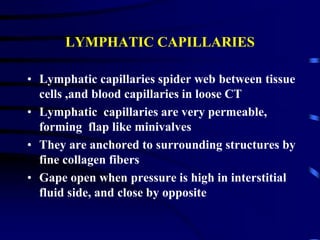
LYMPHATIC CAPILLARIES
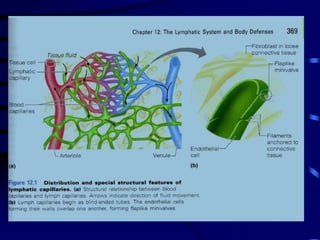
• Lymphatic capillaries spider web between tissue
cells ,and blood capillaries in loose CT
• Lymphatic capillaries are very permeable,
forming flap like minivalves
• They are anchored to surrounding structures by
fine collagen fibers
• Gape open when pressure is high in interstitial
fluid side, and close by opposite
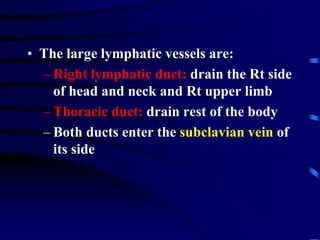
• The large lymphatic vessels are:
– Right lymphatic duct: drain the Rt side
of head and neck and Rt upper limb
– Thoracic duct: drain rest of the body
– Both ducts enter the subclavian vein of
its side
–Lymphatic vessels are thin walled
–Lymph vessels have one way valve
towards the heart
–Respiratory movements and muscle
contraction act like a pump helps in
lymph return
–Smooth muscle contraction in their
wall help in its return
Lymph nodes
Produce lymphocytes which remove bacteria and
tumor cells from body
Thousands of LN are scattered through
lymphatic vessels, filtering lymph before it is
returned to venous blood
•
Structure of lymph node
• LN vary in size and shape ,usually kidney
shaped, less than 1 inch long ,buried in
surrounding CT.
• Each node is surrounded by fibrous capsule
• Trabeculae extend inward from cortex dividing
node into compartments.
• Outer part of the LN is cortex, containing
collection of lymphocytes called follicles
• Germinal center are dark stained when B
lymphocytes are forming plasma cells which
release antibodies
• Rest of cortical cells are lymphocytes in transit
forming surveillance role, between blood,
lymph Nodes and lymphatic stream.
• Phagocytic macrophages are located in central
medulla.
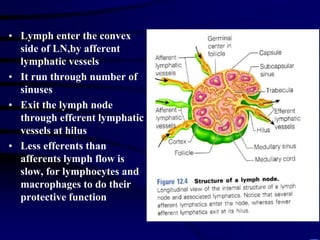
• Lymph enter the convex
side of LN,by afferent
lymphatic vessels
• It run through number of
sinuses
• Exit the lymph node
through efferent lymphatic
vessels at hilus
• Less efferents than
afferents lymph flow is
slow, for lymphocytes and
macrophages to do their
protective function
Groups of lymph nodes
• Cervical group: neck
• Axillary group: axilla
• Inguinal group: upper thigh
• Thoracic group: around lung hilum
• Aortic group: around abdominal aorta
Other lymphoid organ
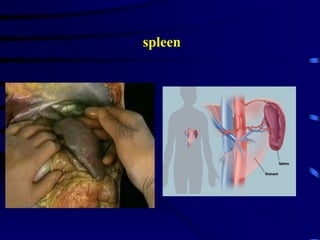
Spleen
• Is reddish and largest single mass of lymphoid
tissue
• Blood rich organ that filter the blood
• Fist size,4 inches long, protected by rib cage
• 150 Gm in weight
• Lie in left hypochondrium, look like a shoe
• Between fundus of stomach and diaphragm
• Lie behind 9th,10th,11th rib.
SPLEEN
• It has anterior end reach the midclavicular
line, passes downward and forward
• Posterior end is rounded rest on the upper pole
of left kidney
• Spleen has two borders superior is notched
near its anterior end
• Has two surfaces diaphragmatic is smooth and
convex,visceral surface is irregular and concave
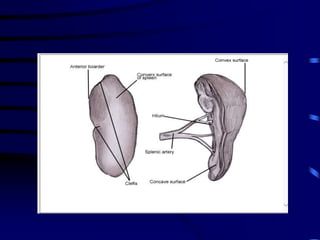
spleen
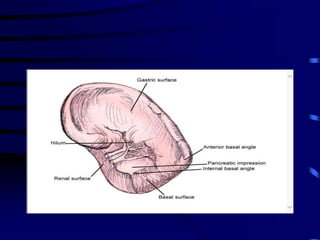
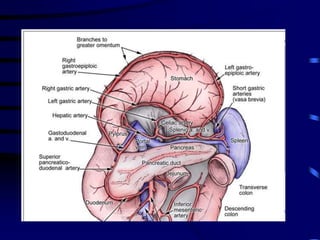
Relation of spleen
• Gastric impression for fundus of stomach
• Renal impression for left kidney
• Colic impression for splenic flexure of colon
• Pancreatic impression for the tail of pancreas
between hilum and colic impression
• Hilum is found in inferior medial part of
gastric impression
• Hilum transmit splenic vessels and provide
attachments for ligaments
Function of spleen
• Immune resopnces,B,T lymphocytes
• Phagocytosis
• Hematopoiesis,RBCS in fetal life ,lymphopoiesis
through adult life
• Storage of red blood cells,8% of RBCs are stored in
spleen
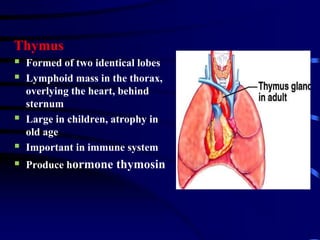
Thymus
 Formed of two identical lobes
 Lymphoid mass in the thorax,
overlying the heart, behind
sternum
 Large in children, atrophy in
old age
 Important in immune system
 Produce hormone thymosin
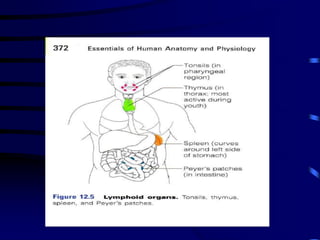
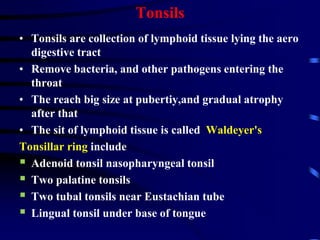
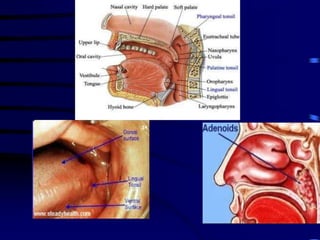
Tonsils
• Tonsils are collection of lymphoid tissue lying the aero
digestive tract
• Remove bacteria, and other pathogens entering the
throat
• The reach big size at pubertiy,and gradual atrophy
after that
• The sit of lymphoid tissue is called Waldeyer's
Tonsillar ring include
 Adenoid tonsil nasopharyngeal tonsil
 Two palatine tonsils
 Two tubal tonsils near Eustachian tube
 Lingual tonsil under base of tongue
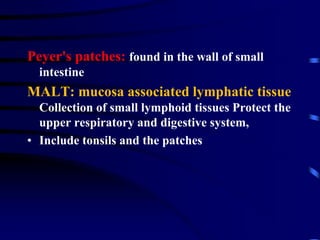
Peyer's patches: found in the wall of small
intestine
MALT: mucosa associated lymphatic tissue
Collection of small lymphoid tissues Protect the
upper respiratory and digestive system,
• Include tonsils and the patches
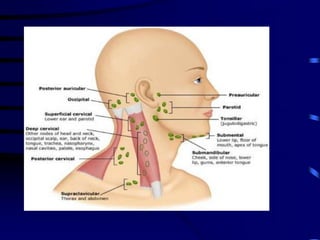
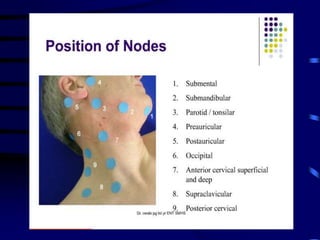
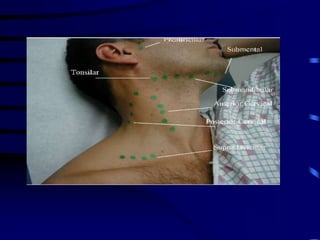
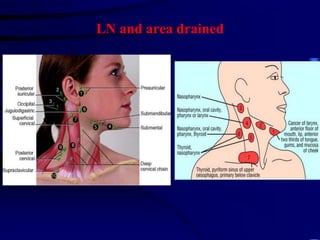
Lymph nodes in the neck
• Horizontal group level I
• Submental tip of tongue floor of mouth, incisor
teeth,gum,central part of lower lip
• Submandibular front of scalp,upper,lower
lip,sinuses,upper,lower teeth, anterior two thirds of
tongue, floor of mouth,vestibule,gum.
• Parotid scalp,ear,eyelid
• Pre auricular ear
• Post auricular scalp, ear
• Occipital back of scalp
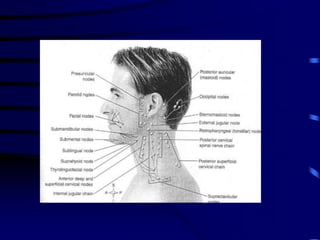
Cervical lymph nodes
• Vertical group
• Anterior cervical,skin,superficial tissue of front of neck
• Superficial cervical skin of mandible,parotid,ear lobule
• Posterior cervical posterior triangle
• Laryngeal, and tracheal nodes, larynx pre,para
tracheal nodes from trachea, thyroid
• Deep cervical from skull, root of neck Upper, middle
lower jugular
• Jugulodigastric tonsil,tongue,jugulo-omohyoid tongue
• trachea nasopharynx, tongue
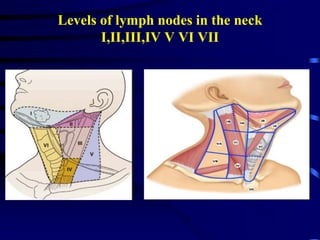
Levels of lymph nodes in the neck
I,II,III,IV V VI VII
LN and area drained
Lymphatic system[1]
Lymphatic system[1]
Lymphatic system[1]
Lymphatic system[1]
Lymphatic system[1]

Lymphatic system[1]

  • 1.
  • 2.
    Consists of • Lymphaticvessels • Lymphoid tissues and organs
  • 3.
    • Lymphatic vessels –Returnexcess fluid from the tissue back to the blood stream, about three liters per day –One way flow towards the heart –Proteins and bacteria, cell debris too big to enter the capillaries return by lymphatic vessels –Lymph flow to lymph nodes first
  • 4.
    Lacteals • are specializedlymph capillaries in the villi of the small intestine; they absorb the fat-soluble end products of digestion, such as fatty acids and vitamins A, D, E, and K.
  • 5.
     The lymphvessels from the lower body unite in front of the lumbar vertebrae to form a vessel called the cisterna chyli, which continues upward in front of the backbone as the thoracic duct.  Lymph vessels from the upper left quadrant of the body join the thoracic duct, which empties lymph into the left subclavian vein. Lymph vessels from the upper right quadrant of the body unite to form the right lymphatic duct, which empties lymph into the right subclavian vein.  Flaps in both subclavian veins permit the entry of lymph but prevent blood from flowing into the lymph vessels.
  • 7.
    LYMPHATIC CAPILLARIES • Lymphaticcapillaries spider web between tissue cells ,and blood capillaries in loose CT • Lymphatic capillaries are very permeable, forming flap like minivalves • They are anchored to surrounding structures by fine collagen fibers • Gape open when pressure is high in interstitial fluid side, and close by opposite
  • 9.
    • The largelymphatic vessels are: – Right lymphatic duct: drain the Rt side of head and neck and Rt upper limb – Thoracic duct: drain rest of the body – Both ducts enter the subclavian vein of its side
  • 11.
    –Lymphatic vessels arethin walled –Lymph vessels have one way valve towards the heart –Respiratory movements and muscle contraction act like a pump helps in lymph return –Smooth muscle contraction in their wall help in its return
  • 12.
    Lymph nodes Produce lymphocyteswhich remove bacteria and tumor cells from body Thousands of LN are scattered through lymphatic vessels, filtering lymph before it is returned to venous blood •
  • 13.
    Structure of lymphnode • LN vary in size and shape ,usually kidney shaped, less than 1 inch long ,buried in surrounding CT. • Each node is surrounded by fibrous capsule • Trabeculae extend inward from cortex dividing node into compartments. • Outer part of the LN is cortex, containing collection of lymphocytes called follicles
  • 14.
    • Germinal centerare dark stained when B lymphocytes are forming plasma cells which release antibodies • Rest of cortical cells are lymphocytes in transit forming surveillance role, between blood, lymph Nodes and lymphatic stream. • Phagocytic macrophages are located in central medulla.
  • 15.
    • Lymph enterthe convex side of LN,by afferent lymphatic vessels • It run through number of sinuses • Exit the lymph node through efferent lymphatic vessels at hilus • Less efferents than afferents lymph flow is slow, for lymphocytes and macrophages to do their protective function
  • 16.
    Groups of lymphnodes • Cervical group: neck • Axillary group: axilla • Inguinal group: upper thigh • Thoracic group: around lung hilum • Aortic group: around abdominal aorta
  • 17.
    Other lymphoid organ Spleen •Is reddish and largest single mass of lymphoid tissue • Blood rich organ that filter the blood • Fist size,4 inches long, protected by rib cage • 150 Gm in weight • Lie in left hypochondrium, look like a shoe • Between fundus of stomach and diaphragm • Lie behind 9th,10th,11th rib.
  • 19.
    SPLEEN • It hasanterior end reach the midclavicular line, passes downward and forward • Posterior end is rounded rest on the upper pole of left kidney • Spleen has two borders superior is notched near its anterior end • Has two surfaces diaphragmatic is smooth and convex,visceral surface is irregular and concave
  • 21.
  • 22.
    Relation of spleen •Gastric impression for fundus of stomach • Renal impression for left kidney • Colic impression for splenic flexure of colon • Pancreatic impression for the tail of pancreas between hilum and colic impression • Hilum is found in inferior medial part of gastric impression • Hilum transmit splenic vessels and provide attachments for ligaments
  • 24.
    Function of spleen •Immune resopnces,B,T lymphocytes • Phagocytosis • Hematopoiesis,RBCS in fetal life ,lymphopoiesis through adult life • Storage of red blood cells,8% of RBCs are stored in spleen
  • 25.
    Thymus  Formed oftwo identical lobes  Lymphoid mass in the thorax, overlying the heart, behind sternum  Large in children, atrophy in old age  Important in immune system  Produce hormone thymosin
  • 27.
    Tonsils • Tonsils arecollection of lymphoid tissue lying the aero digestive tract • Remove bacteria, and other pathogens entering the throat • The reach big size at pubertiy,and gradual atrophy after that • The sit of lymphoid tissue is called Waldeyer's Tonsillar ring include  Adenoid tonsil nasopharyngeal tonsil  Two palatine tonsils  Two tubal tonsils near Eustachian tube  Lingual tonsil under base of tongue
  • 28.
    Peyer's patches: foundin the wall of small intestine MALT: mucosa associated lymphatic tissue Collection of small lymphoid tissues Protect the upper respiratory and digestive system, • Include tonsils and the patches
  • 30.
    Lymph nodes inthe neck • Horizontal group level I • Submental tip of tongue floor of mouth, incisor teeth,gum,central part of lower lip • Submandibular front of scalp,upper,lower lip,sinuses,upper,lower teeth, anterior two thirds of tongue, floor of mouth,vestibule,gum. • Parotid scalp,ear,eyelid • Pre auricular ear • Post auricular scalp, ear • Occipital back of scalp
  • 31.
    Cervical lymph nodes •Vertical group • Anterior cervical,skin,superficial tissue of front of neck • Superficial cervical skin of mandible,parotid,ear lobule • Posterior cervical posterior triangle • Laryngeal, and tracheal nodes, larynx pre,para tracheal nodes from trachea, thyroid • Deep cervical from skull, root of neck Upper, middle lower jugular • Jugulodigastric tonsil,tongue,jugulo-omohyoid tongue • trachea nasopharynx, tongue
  • 33.
    Levels of lymphnodes in the neck I,II,III,IV V VI VII
  • 37.
    LN and areadrained

Editor's Notes

  • #25 Phagocytosis of old ,deformed rbcs,other blood cells ,debris micro organisms,as it is part of reticuloendothelial system