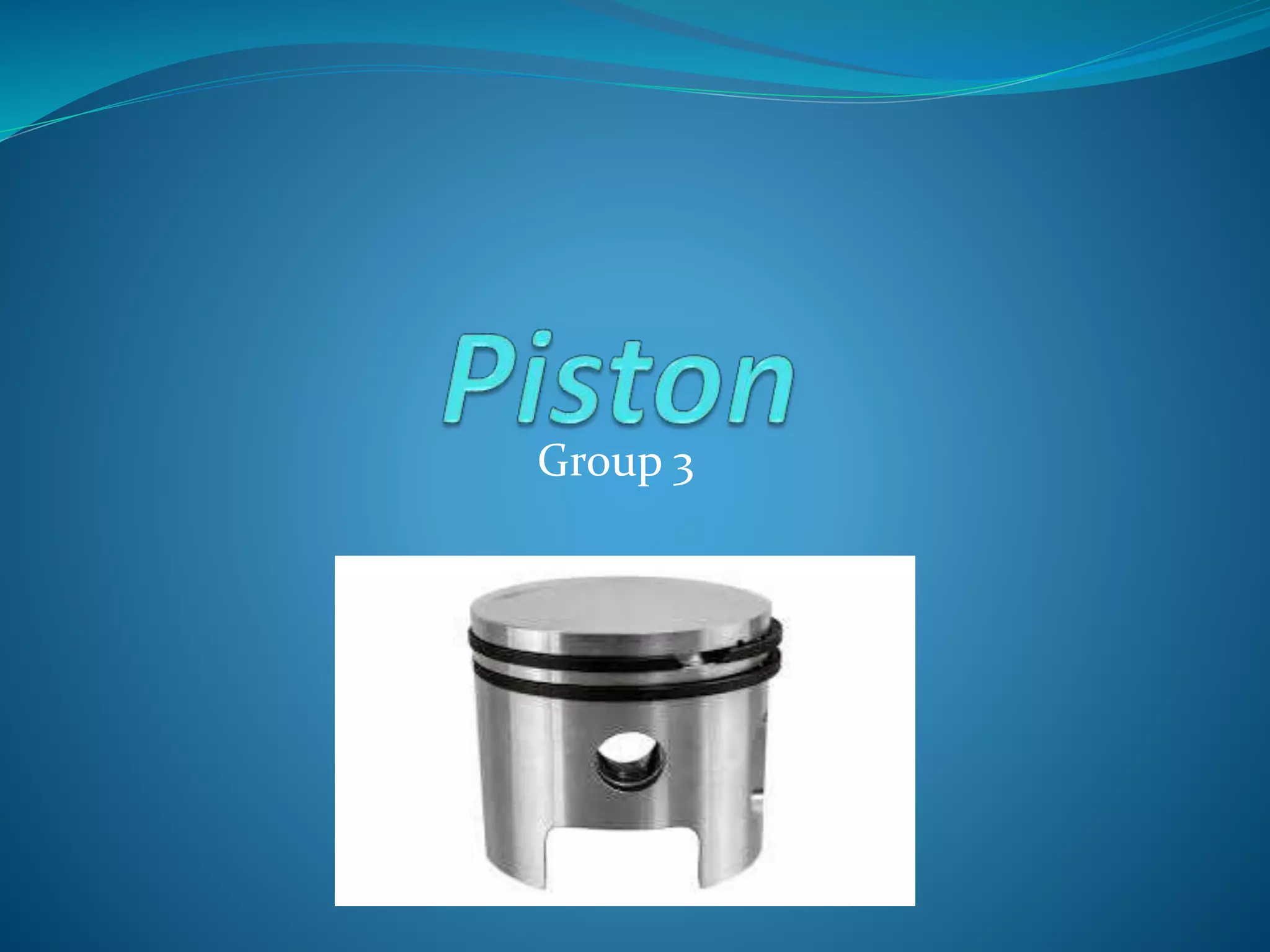
Group 3
Content:
 Duties and working condition of the piston
 Classification
 Piston rings
 Cooling the piston
Duties
Transmit the Pressure and Heat
Working condition
Mechaniacal Load
Thermal Load
Wear
Classification
Trunk Piston
Crosshead
Piston
Piston Crown
 Made of materials that is capable of resisting high
temperature and pressure ( Chrome, nickel alloy steel,
…)
 The top maybe flat, convex or hollow form.
Piston Crown
 Annular Grooves to fit compression rings( normally
plated with Chrome to reinforce ability of resistance to
wear)
 Heating distribute groove
 Special groove with stronger and more durable
material
Piston Skirt
 Function: to guide for movement of the piston,
transmit a part of heat from the combustion chamber
to the cooling water through the liner wall
 Generally made of cast iron
 Perpendicular bored to the center line of the piston to
fit piston pin ( by 1 bold and 1 key)
 There are grooves to fit the oil rings.
Crosshead Piston
 Is applied low-speed large engines.
 Piston moves only in the vertical direction
-> reduce machannical friction, avoid the wear of
cylinder liner.
Crosshead Piston
 The Crosshead Piston of return flow scavenging
2-stroke has long skirt to separate the scavenging and
exhaust ports when the piston is at TDC.
 In the Uni-flow scavenging 2-stroke engines, the
piston has no skirt
=> need more compression rings to transmit the heat.
Duties of Piston Ring
Sealing the
compressor
Conducting the
heat
Scrape the
lubricating oil
Working condition of Piston Rings
 High Pressure and temperature
 Be subjected to striking when the piston changes the
moving direction
 Be subjected to wear due to friction in bad lubricating
condition
 Withstand the corrosion due to action of combustion
products
Compression rings
 The main function: To prevent the leakage of
compressed air to the crankcase and to transmit the
heat from the piston crown to the cooling water
 Closely contact to the liner surface by the elastic
property and due to pressure of combustion gases.
Compression Rings
• 3-4 pieces for high-speed
engines
• 5-7 pieces for low-speed
engines
Number
• Contacting face
• Ring Gap
• Ring width
• Ring thickness
Construction
Compression Rings
Oil Rings
Duty
• Scrape the
remaining
lubricating oil
Number
• 1-3 oil rings
each piston
• Normally 1 for
high-speed
engines
Type
• 1 edge( doesn’t
have hold)
• 2 edges
( needs holds)
Cooling the piston
 In small piston engines, the piston is not cooled.
 In large piston engines, the piston is cooled by
lubricating oil that is supplied from drill hold in the
small end of the connecting rod to the back of the
piston crown
Piston Rings Clearances
Ring end clearance
• Is the distance between 2 ends
• Not too small and not too big either
Ring side clearance
• Is the distance from the top of the ring to the bottom
• Must be in permitted limits
Ring Back clearance
• Not necessary to measure but need to check
• The thickness mush be less than the groove depth
Assembly the piston rings
Check ring clearances
Put the piston rings in correct
direction
Install the rings in correct order ( the
cutting edges must not be coincided)
Piston

Piston

  • 2.
  • 3.
    Content:  Duties andworking condition of the piston  Classification  Piston rings  Cooling the piston
  • 4.
  • 5.
  • 6.
  • 7.
    Piston Crown  Madeof materials that is capable of resisting high temperature and pressure ( Chrome, nickel alloy steel, …)  The top maybe flat, convex or hollow form.
  • 8.
    Piston Crown  AnnularGrooves to fit compression rings( normally plated with Chrome to reinforce ability of resistance to wear)  Heating distribute groove  Special groove with stronger and more durable material
  • 9.
    Piston Skirt  Function:to guide for movement of the piston, transmit a part of heat from the combustion chamber to the cooling water through the liner wall  Generally made of cast iron  Perpendicular bored to the center line of the piston to fit piston pin ( by 1 bold and 1 key)  There are grooves to fit the oil rings.
  • 10.
    Crosshead Piston  Isapplied low-speed large engines.  Piston moves only in the vertical direction -> reduce machannical friction, avoid the wear of cylinder liner.
  • 11.
    Crosshead Piston  TheCrosshead Piston of return flow scavenging 2-stroke has long skirt to separate the scavenging and exhaust ports when the piston is at TDC.  In the Uni-flow scavenging 2-stroke engines, the piston has no skirt => need more compression rings to transmit the heat.
  • 12.
    Duties of PistonRing Sealing the compressor Conducting the heat Scrape the lubricating oil
  • 13.
    Working condition ofPiston Rings  High Pressure and temperature  Be subjected to striking when the piston changes the moving direction  Be subjected to wear due to friction in bad lubricating condition  Withstand the corrosion due to action of combustion products
  • 14.
    Compression rings  Themain function: To prevent the leakage of compressed air to the crankcase and to transmit the heat from the piston crown to the cooling water  Closely contact to the liner surface by the elastic property and due to pressure of combustion gases.
  • 15.
    Compression Rings • 3-4pieces for high-speed engines • 5-7 pieces for low-speed engines Number • Contacting face • Ring Gap • Ring width • Ring thickness Construction
  • 16.
  • 17.
    Oil Rings Duty • Scrapethe remaining lubricating oil Number • 1-3 oil rings each piston • Normally 1 for high-speed engines Type • 1 edge( doesn’t have hold) • 2 edges ( needs holds)
  • 19.
    Cooling the piston In small piston engines, the piston is not cooled.  In large piston engines, the piston is cooled by lubricating oil that is supplied from drill hold in the small end of the connecting rod to the back of the piston crown
  • 20.
    Piston Rings Clearances Ringend clearance • Is the distance between 2 ends • Not too small and not too big either Ring side clearance • Is the distance from the top of the ring to the bottom • Must be in permitted limits Ring Back clearance • Not necessary to measure but need to check • The thickness mush be less than the groove depth
  • 21.
    Assembly the pistonrings Check ring clearances Put the piston rings in correct direction Install the rings in correct order ( the cutting edges must not be coincided)