Internal expanding shoebreak
(drumbrake)
* Twin Leading Shoebrake
By: Kalola Meet M. and Jaimin Joshi
This system was used popularly in front wheels because
itis very effective at braking in forward direction.
Twin leading shoe drum brake system use two single
piston wheel cylinders –one near the topof the backing
plate and one near thebottom.
Eachwheel cylinder activates one of the brake shoes.
By: Kalola Meet M. and Jaimin Joshi
It is called twin leading shoe brake because both the shoes are
arranged in a leading shoe configuration inthe forward direction.
When applied in the reverse direction, the breaking force is very
less and hence it is usually accompanied by one of the other
types of brakes on rear wheels to be used as parkingbrakes.
This type is well suited for motorcycles they are driven mostly
in the forward direction and rarely inreverse.
By: Kalola Meet M. and Jaimin Joshi
Assumptions
(i)The intensity of normal pressure between the friction
lining and the brake drum at any point is proportional to its
vertical distance from thepivot.
(ii) The brake drum and the shoe arerigid.
(iii)The centrifugal force acting on theshoe is
negligible.
(iv) The coefficient of friction isconstant.
By: Kalola Meet M. and Jaimin Joshi
calculation
By: Kalola Meet M. and Jaimin Joshi
Brake Drum
Assuming diameter to be 250mm.
P = 1500N
By: Kalola Meet M. and Jaimin Joshi
SHOE
θ1= 30o
θ2 =1200
By: Kalola Meet M. and Jaimin Joshi
• For curvedbeams,
• The maximum stress occurs
either at the inner fibreor at
the outer fibre.
• Stress at outerfibre:
• Stress atinner fibre:
Ro = radius of outer fibre (mm)
Ri = radius of inner fibre (mm)
R = radius of centroidal axis (mm)
RN = radius of neutral axis (mm)
hi = distance of inner fibre from neutral axis
(mm)
ho = distance of outer fibre from neutral axis
(mm)
Mb = bending moment with respect to
centroidal axis (N-mm)
A = area of the cross-section (mm2) The
eccentricity ebetween centroidal and
neutral axes is givenby,
By: Kalola Meet M. and Jaimin Joshi
Spring
By: Kalola Meet M. and Jaimin Joshi
1
2
3
• D =5d
• K =1.31
• τ = (1.31x 8 x 1500 x 5x d) /( 3.14 xd3
)
= 25031.87/d2
By: Kalola Meet M. and Jaimin Joshi
Taking different values ofd
1) d= 7mm
τ = 510.68N/mm2
Using table, Sut = 1260N/mm2
τ =0.4Sut
= 500N/mm2
τ >τper
2)d =8mm
τ =391.12
Using table, Sut = 1220N/mm2
τ =0.4Sut
= 488N/mm2
τ <τper
Thus d = 8mm isoptimum
D= 5d = 40mm
By: Kalola Meet M. and Jaimin Joshi
• k = 1500 /6
= 250N/mm
• 250 = (81370x 84
) /(8 x 403
xN)
• N= 2.6 or 3
4
5
By: Kalola Meet M. and Jaimin Joshi
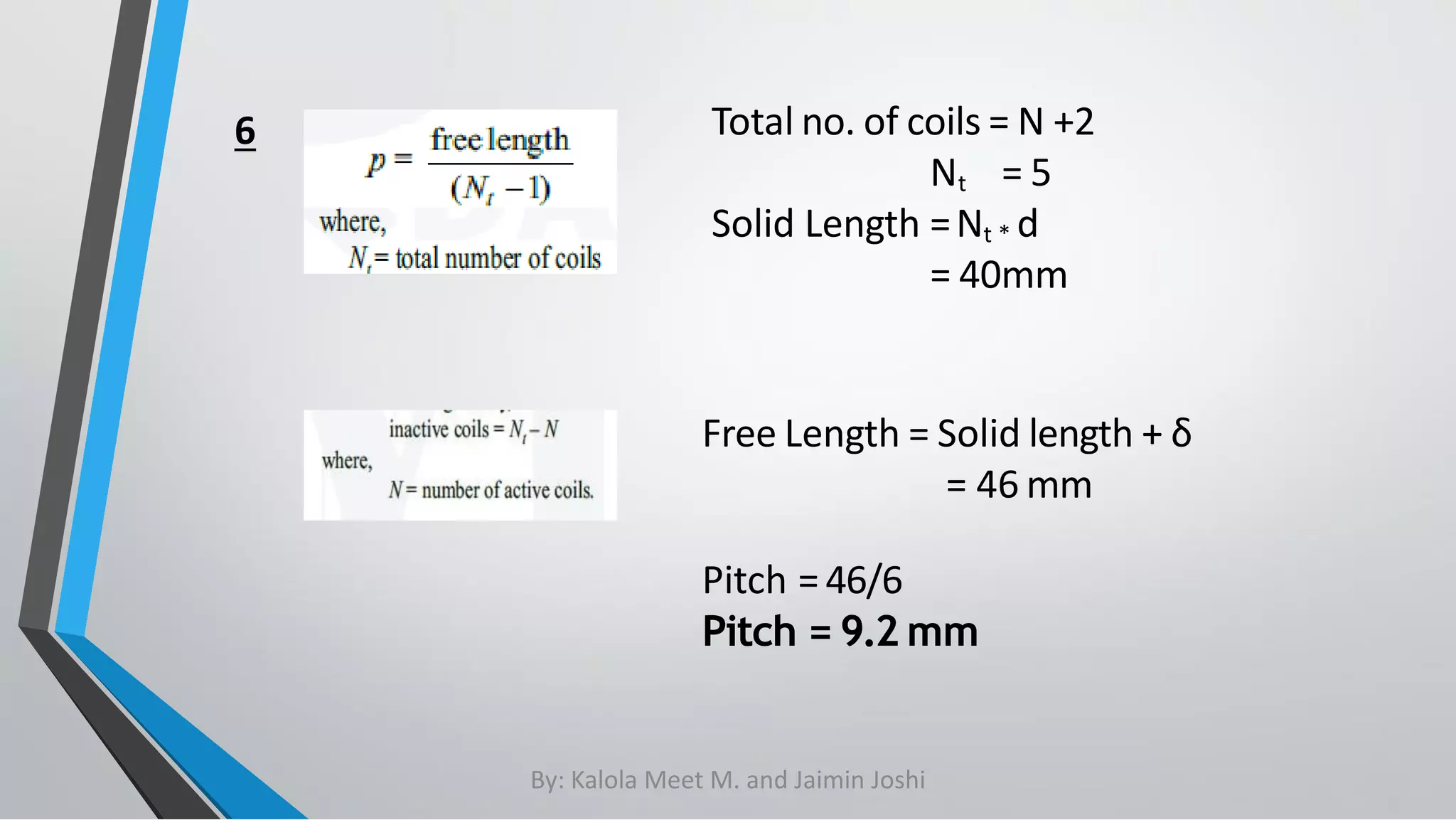
Total no. of coils = N +2
Nt = 5
Solid Length =Nt * d
= 40mm
6
Free Length = Solid length + δ
= 46 mm
Pitch = 46/6
Pitch = 9.2 mm
By: Kalola Meet M. and Jaimin Joshi
Pin
•
By: Kalola Meet M. and Jaimin Joshi
Friction LiningMaterial
By: Kalola Meet M. and Jaimin Joshi
Friction LiningMaterial
μ = 0.4
Maximum intensity of pressure= 2.06 N/mm2
Taking w = b = 20mm
thickness = 3mm
θ1= 30o
θ2 =1200
By: Kalola Meet M. and Jaimin Joshi
Braking Torque
• We can use the following equation tocompare the required braking
torque with generated brakingtorque.
Generated Braking Torque = 351.74Nm Required
braking torque = 250Nm
By: Kalola Meet M. and Jaimin Joshi
Mn = 552183.75 Nmm
Mf = 306429.68 Nmm
P = (Mn – Mf )/C = 245754.07 /187.5
= 1310.68N
Checking forforce
By: Kalola Meet M. and Jaimin Joshi
MODEL in Solidworks
By: Kalola Meet M. and Jaimin Joshi
SHOE
By: Kalola Meet M. and Jaimin Joshi
Pin
By: Kalola Meet M. and Jaimin Joshi
Assembly
By: Kalola Meet M. and Jaimin Joshi
Assembly Drawing
By: Kalola Meet M. and Jaimin Joshi
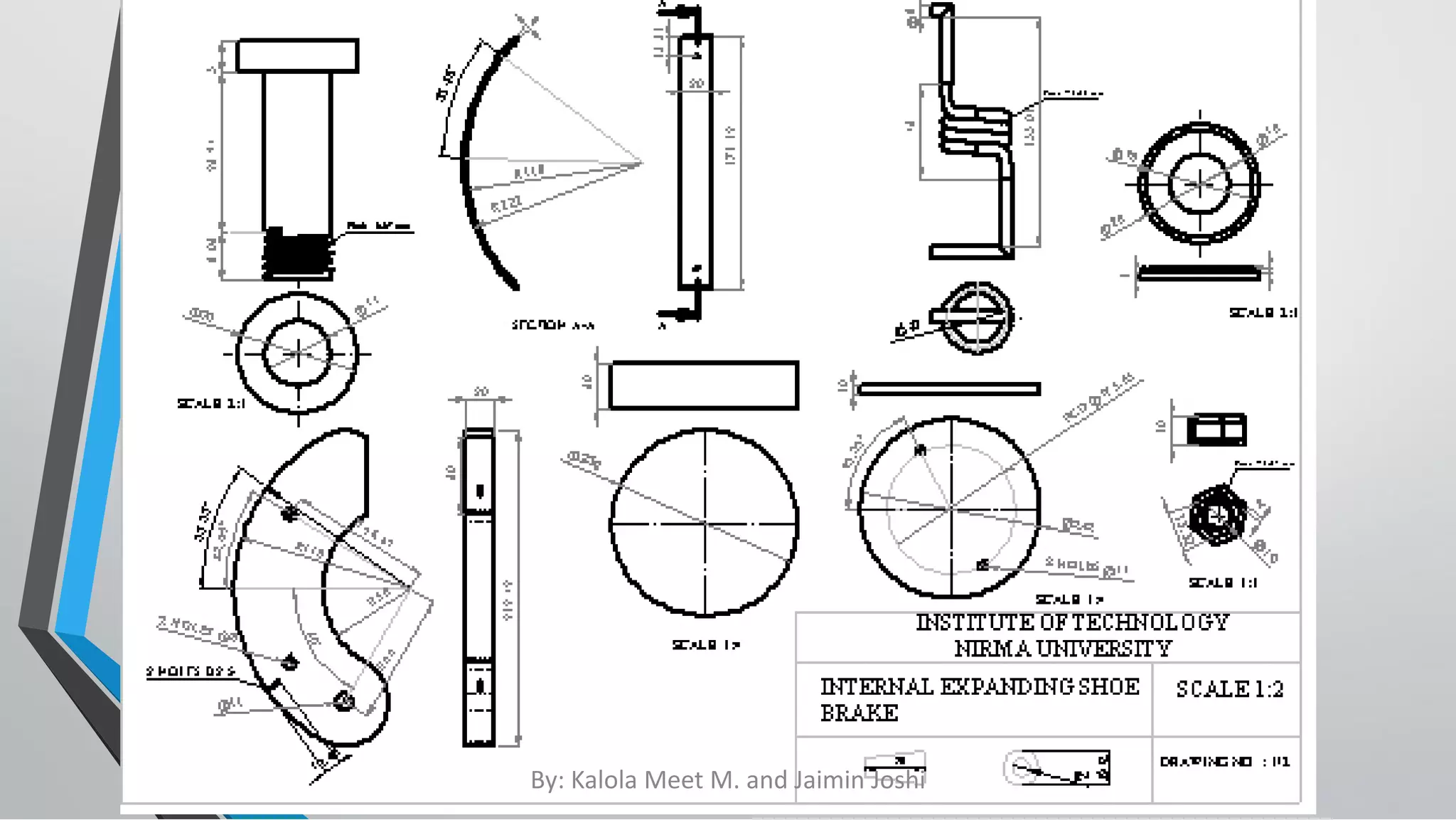
Detailed Drawings
By: Kalola Meet M. and Jaimin Joshi
SHOE
By: Kalola Meet M. and Jaimin Joshi
Pin
By: Kalola Meet M. and Jaimin Joshi
Spring
By: Kalola Meet M. and Jaimin Joshi
FrictionLining
By: Kalola Meet M. and Jaimin Joshi
Backplate
By: Kalola Meet M. and Jaimin Joshi
Drum
By: Kalola Meet M. and Jaimin Joshi
Washer
By: Kalola Meet M. and Jaimin Joshi
Nut
By: Kalola Meet M. and Jaimin Joshi
Construction
• Drum brakes are a brake system with brake drums (rotor)
which rotate with the wheels. Inside each drum are brake shoes
fitted with brake linings (friction material). Pistons (pressure
mechanism) press against the drums from the inside to
generate braking force, thus making is possible to decelerate
and stop the vehicle.
By: Kalola Meet M. and Jaimin Joshi
References
• Friction lining material -
http://www.stillchampion.com/aft-132.html
• Book - Elements of machine design by V.B.Bhandari
• http://www.stillchampion.com/aft-132.html
• Spring - https://steelpurchase.com/1045-s45c-c45-
steel/
By: Kalola Meet M. and Jaimin Joshi

Internal Expanding shoe brake.pdf

  • 1.
    Internal expanding shoebreak (drumbrake) *Twin Leading Shoebrake By: Kalola Meet M. and Jaimin Joshi
  • 2.
    This system wasused popularly in front wheels because itis very effective at braking in forward direction. Twin leading shoe drum brake system use two single piston wheel cylinders –one near the topof the backing plate and one near thebottom. Eachwheel cylinder activates one of the brake shoes. By: Kalola Meet M. and Jaimin Joshi
  • 3.
    It is calledtwin leading shoe brake because both the shoes are arranged in a leading shoe configuration inthe forward direction. When applied in the reverse direction, the breaking force is very less and hence it is usually accompanied by one of the other types of brakes on rear wheels to be used as parkingbrakes. This type is well suited for motorcycles they are driven mostly in the forward direction and rarely inreverse. By: Kalola Meet M. and Jaimin Joshi
  • 4.
    Assumptions (i)The intensity ofnormal pressure between the friction lining and the brake drum at any point is proportional to its vertical distance from thepivot. (ii) The brake drum and the shoe arerigid. (iii)The centrifugal force acting on theshoe is negligible. (iv) The coefficient of friction isconstant. By: Kalola Meet M. and Jaimin Joshi
  • 5.
    calculation By: Kalola MeetM. and Jaimin Joshi
  • 6.
    By: Kalola MeetM. and Jaimin Joshi
  • 7.
    Brake Drum Assuming diameterto be 250mm. P = 1500N By: Kalola Meet M. and Jaimin Joshi
  • 8.
    SHOE θ1= 30o θ2 =1200 By:Kalola Meet M. and Jaimin Joshi
  • 9.
    • For curvedbeams, •The maximum stress occurs either at the inner fibreor at the outer fibre. • Stress at outerfibre: • Stress atinner fibre: Ro = radius of outer fibre (mm) Ri = radius of inner fibre (mm) R = radius of centroidal axis (mm) RN = radius of neutral axis (mm) hi = distance of inner fibre from neutral axis (mm) ho = distance of outer fibre from neutral axis (mm) Mb = bending moment with respect to centroidal axis (N-mm) A = area of the cross-section (mm2) The eccentricity ebetween centroidal and neutral axes is givenby, By: Kalola Meet M. and Jaimin Joshi
  • 10.
    By: Kalola MeetM. and Jaimin Joshi
  • 11.
    Spring By: Kalola MeetM. and Jaimin Joshi
  • 12.
    1 2 3 • D =5d •K =1.31 • τ = (1.31x 8 x 1500 x 5x d) /( 3.14 xd3 ) = 25031.87/d2 By: Kalola Meet M. and Jaimin Joshi
  • 13.
    Taking different valuesofd 1) d= 7mm τ = 510.68N/mm2 Using table, Sut = 1260N/mm2 τ =0.4Sut = 500N/mm2 τ >τper 2)d =8mm τ =391.12 Using table, Sut = 1220N/mm2 τ =0.4Sut = 488N/mm2 τ <τper Thus d = 8mm isoptimum D= 5d = 40mm By: Kalola Meet M. and Jaimin Joshi
  • 14.
    • k =1500 /6 = 250N/mm • 250 = (81370x 84 ) /(8 x 403 xN) • N= 2.6 or 3 4 5 By: Kalola Meet M. and Jaimin Joshi
  • 15.
    Total no. ofcoils = N +2 Nt = 5 Solid Length =Nt * d = 40mm 6 Free Length = Solid length + δ = 46 mm Pitch = 46/6 Pitch = 9.2 mm By: Kalola Meet M. and Jaimin Joshi
  • 16.
    Pin • By: Kalola MeetM. and Jaimin Joshi
  • 17.
    By: Kalola MeetM. and Jaimin Joshi
  • 18.
    By: Kalola MeetM. and Jaimin Joshi
  • 19.
    Friction LiningMaterial By: KalolaMeet M. and Jaimin Joshi
  • 20.
    By: Kalola MeetM. and Jaimin Joshi
  • 21.
    Friction LiningMaterial μ =0.4 Maximum intensity of pressure= 2.06 N/mm2 Taking w = b = 20mm thickness = 3mm θ1= 30o θ2 =1200 By: Kalola Meet M. and Jaimin Joshi
  • 22.
    Braking Torque • Wecan use the following equation tocompare the required braking torque with generated brakingtorque. Generated Braking Torque = 351.74Nm Required braking torque = 250Nm By: Kalola Meet M. and Jaimin Joshi
  • 23.
    Mn = 552183.75Nmm Mf = 306429.68 Nmm P = (Mn – Mf )/C = 245754.07 /187.5 = 1310.68N Checking forforce By: Kalola Meet M. and Jaimin Joshi
  • 24.
    MODEL in Solidworks By:Kalola Meet M. and Jaimin Joshi
  • 25.
    SHOE By: Kalola MeetM. and Jaimin Joshi
  • 26.
    Pin By: Kalola MeetM. and Jaimin Joshi
  • 27.
    Assembly By: Kalola MeetM. and Jaimin Joshi
  • 28.
    By: Kalola MeetM. and Jaimin Joshi
  • 29.
    Assembly Drawing By: KalolaMeet M. and Jaimin Joshi
  • 30.
    By: Kalola MeetM. and Jaimin Joshi
  • 31.
    Detailed Drawings By: KalolaMeet M. and Jaimin Joshi
  • 32.
    SHOE By: Kalola MeetM. and Jaimin Joshi
  • 33.
    Pin By: Kalola MeetM. and Jaimin Joshi
  • 34.
    Spring By: Kalola MeetM. and Jaimin Joshi
  • 35.
    FrictionLining By: Kalola MeetM. and Jaimin Joshi
  • 36.
    Backplate By: Kalola MeetM. and Jaimin Joshi
  • 37.
    Drum By: Kalola MeetM. and Jaimin Joshi
  • 38.
    Washer By: Kalola MeetM. and Jaimin Joshi
  • 39.
    Nut By: Kalola MeetM. and Jaimin Joshi
  • 40.
    By: Kalola MeetM. and Jaimin Joshi
  • 41.
    By: Kalola MeetM. and Jaimin Joshi
  • 42.
    Construction • Drum brakesare a brake system with brake drums (rotor) which rotate with the wheels. Inside each drum are brake shoes fitted with brake linings (friction material). Pistons (pressure mechanism) press against the drums from the inside to generate braking force, thus making is possible to decelerate and stop the vehicle. By: Kalola Meet M. and Jaimin Joshi
  • 43.
    By: Kalola MeetM. and Jaimin Joshi
  • 44.
    References • Friction liningmaterial - http://www.stillchampion.com/aft-132.html • Book - Elements of machine design by V.B.Bhandari • http://www.stillchampion.com/aft-132.html • Spring - https://steelpurchase.com/1045-s45c-c45- steel/ By: Kalola Meet M. and Jaimin Joshi