International Journal of Trend in Scientific Research and Development (IJTSRD)
Volume: 3 | Issue: 3 | Mar-Apr 2019 Available Online: www.ijtsrd.com e-ISSN: 2456 - 6470
@ IJTSRD | Unique Paper ID – IJTSRD22789 | Volume – 3 | Issue – 3 | Mar-Apr 2019 Page: 267
Analysis of Energy in Wireless Sensor Networks: An Assessment
Anupam Jain1, Prof. Madhuvan Dixit2
1PG Scholar, 2Assistant Professor
1,2Department of CSE, MIT, Bhopal, Madhya Pradesh, India
How to cite this paper: Anupam Jain |
Prof. Madhuvan Dixit "Analysis of
Energy in WirelessSensorNetworks:An
Assessment" Published in International
Journal of Trend in Scientific Research
and Development
(ijtsrd), ISSN: 2456-
6470, Volume-3 |
Issue-3, April 2019,
pp.267-271, URL:
http://www.ijtsrd.co
m/papers/ijtsrd227
89.pdf
Copyright © 2019 by author(s) and
International Journal of Trend in
Scientific Research and Development
Journal. This is an Open Access article
distributed under
the terms of the
Creative Commons
Attribution License (CC BY 4.0)
(http://creativecommons.org/licenses/
by/4.0)
ABSTRACT
In the past decades, Wireless Sensor Network (WSN) has become a wide area of
research. In WSN, numerous sensor nodes are randomly setup with different
energy level. Energy acts as power source and is available to eachsensor nodein
limited quantity. The limiting factor is that sensor nodes are energy constrained
and recharging or replacing battery is costly and complex process. This paper
explores the different energy consumption factors which effect the lifetime and
performance of the WSN’s. The main factors which effect the energy
consumption in WSN’s are scalability, loadbalancing, reliability,communication,
collision, over-hearing, ideal listing and latency. Researchers have proved that
the node near to sink node discharge very fastly. Apart from these, most of the
energy is consumed during the transfer of data from sender to receiver. In this
paper effort is made to analyze the effect of different factors on energy
consumption in WSN’s.
Keywords: Wireless SensorNetworks,Energyefficiency, Scalability, Load balancing,
Reliability, Over-hearing, Latency
I. INTRODUCTION
Wireless Sensor Networks(WSN’s) is a networkconsistingof
numerous sensor nodes. A sensor node(SN) is a
multifunctional, low-power andlow-costtinysizedevice.SNs
are randomly deployed over a zone to measure various
phenomena like humidity, moisture, vibrations and many
more. By enhancing the capabilities of sensor nodes,
realization of WSNs based on the collaborative effort of
sensor nodes is easy[1]. SN has four basic components
Sensing unit, Processing unit, Transceiver unit and Power
unit are shown in Figure 1.SNsare broadly classified as
normal nodes, advanced nodes and supernodes. Apparently,
the normal nodes have the least energy level, the advanced
nodes have more energy than the normal nodes and the
super nodes have the highest level of energy[2].The major
advantages of SNs in comparison to the normal nodes are
their ability to operate in harsh environment in which
contemporary monitoringisriskyandsometimenotfeasible.
SN’s are established randomly in field of interest by
uncontrolled means like dropped by a helicopter etc. The
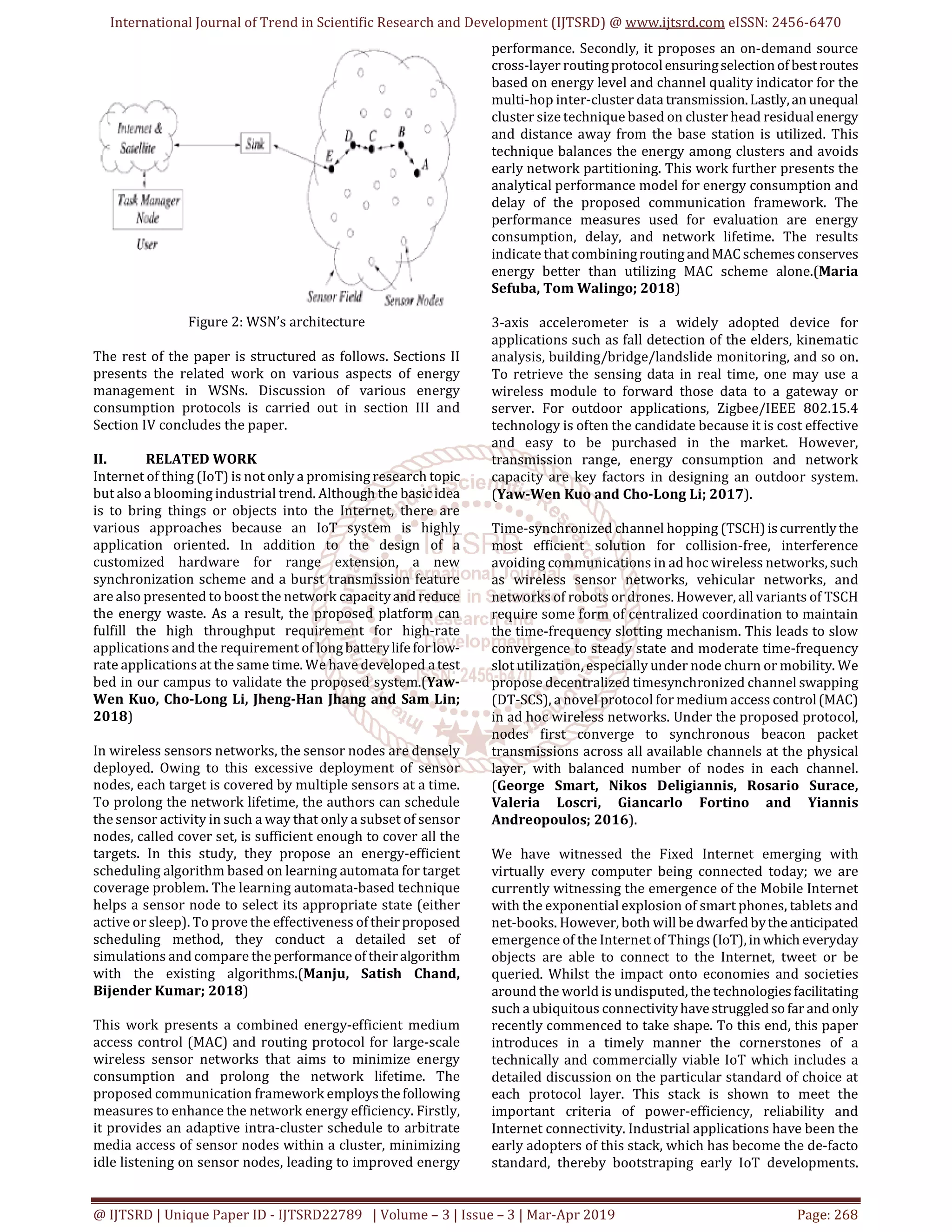
general architecture of WSN’s is shown in Figure 2. SNs
collect data and transmit to the base station or sink node[3].
Therefore data collection can besinglehopormulti-hop.Sink
node is an intermediate node which receives the data from
the sensor field and transmits over the internet. In WSN’s,
SNs are randomlysetup in a geographical region. This region
is divided into sub-regions calledclusters.Ineachcluster,one
of thenode is selected as clusterhead(CH)andtheremaining
nodes are cluster members[4]. CH is chosen on the basis of
weighted probability. The node having highest weight
probability has more chance to become a CH. Weight
probability is the ratio of residualenergyofnodeandaverage
energy of wireless sensor network.
Figure 1: Components of sensor node
IJTSRD22789
International Journal of Trend in Scientific Research and Development (IJTSRD) @ www.ijtsrd.com eISSN: 2456-6470
@ IJTSRD | Unique Paper ID - IJTSRD22789 | Volume – 3 | Issue – 3 | Mar-Apr 2019 Page: 268
Figure 2: WSN’s architecture
The rest of the paper is structured as follows. Sections II
presents the related work on various aspects of energy
management in WSNs. Discussion of various energy
consumption protocols is carried out in section III and
Section IV concludes the paper.
II. RELATED WORK
Internet of thing (IoT) is not only a promising research topic
but also a blooming industrial trend. Although the basicidea
is to bring things or objects into the Internet, there are
various approaches because an IoT system is highly
application oriented. In addition to the design of a
customized hardware for range extension, a new
synchronization scheme and a burst transmission feature
are also presented to boost the network capacityand reduce
the energy waste. As a result, the proposed platform can
fulfill the high throughput requirement for high-rate
applications and the requirement of longbatterylifeforlow-
rate applications at the same time. We have developed atest
bed in our campus to validate the proposed system.(Yaw-
Wen Kuo, Cho-Long Li, Jheng-Han Jhang and Sam Lin;
2018)
In wireless sensors networks, the sensor nodes are densely
deployed. Owing to this excessive deployment of sensor
nodes, each target is covered by multiple sensors at a time.
To prolong the network lifetime, the authors can schedule
the sensor activity in such a way that only a subset of sensor
nodes, called cover set, is sufficient enough to cover all the
targets. In this study, they propose an energy-efficient
scheduling algorithm based on learning automata for target
coverage problem. The learning automata-based technique
helps a sensor node to select its appropriate state (either
active or sleep). To prove the effectiveness oftheirproposed
scheduling method, they conduct a detailed set of
simulations and compare theperformanceof theiralgorithm
with the existing algorithms.(Manju, Satish Chand,
Bijender Kumar; 2018)
This work presents a combined energy-efficient medium
access control (MAC) and routing protocol for large-scale
wireless sensor networks that aims to minimize energy
consumption and prolong the network lifetime. The
proposed communication framework employsthefollowing
measures to enhance the network energy efficiency. Firstly,
it provides an adaptive intra-cluster schedule to arbitrate
media access of sensor nodes within a cluster, minimizing
idle listening on sensor nodes, leading to improved energy
performance. Secondly, it proposes an on-demand source
cross-layer routingprotocolensuringselectionofbestroutes
based on energy level and channel quality indicator for the
multi-hop inter-cluster data transmission.Lastly,anunequal
cluster size technique based on cluster head residualenergy
and distance away from the base station is utilized. This
technique balances the energy among clusters and avoids
early network partitioning. This work further presents the
analytical performance model for energy consumption and
delay of the proposed communication framework. The
performance measures used for evaluation are energy
consumption, delay, and network lifetime. The results
indicate that combiningroutingandMAC schemes conserves
energy better than utilizing MAC scheme alone.(Maria
Sefuba, Tom Walingo; 2018)
3-axis accelerometer is a widely adopted device for
applications such as fall detection of the elders, kinematic
analysis, building/bridge/landslide monitoring, and so on.
To retrieve the sensing data in real time, one may use a
wireless module to forward those data to a gateway or
server. For outdoor applications, Zigbee/IEEE 802.15.4
technology is often the candidate because it is cost effective
and easy to be purchased in the market. However,
transmission range, energy consumption and network
capacity are key factors in designing an outdoor system.
(Yaw-Wen Kuo and Cho-Long Li; 2017).
Time-synchronized channel hopping (TSCH)iscurrently the
most efficient solution for collision-free, interference
avoiding communications in ad hoc wireless networks, such
as wireless sensor networks, vehicular networks, and
networks of robots or drones. However, all variants of TSCH
require some form of centralized coordination to maintain
the time-frequency slotting mechanism. This leads to slow
convergence to steady state and moderate time-frequency
slot utilization, especially under node churn or mobility. We
propose decentralized timesynchronized channel swapping
(DT-SCS), a novel protocol for medium access control(MAC)
in ad hoc wireless networks. Under the proposed protocol,
nodes first converge to synchronous beacon packet
transmissions across all available channels at the physical
layer, with balanced number of nodes in each channel.
(George Smart, Nikos Deligiannis, Rosario Surace,
Valeria Loscri, Giancarlo Fortino and Yiannis
Andreopoulos; 2016).
We have witnessed the Fixed Internet emerging with
virtually every computer being connected today; we are
currently witnessing the emergence of the Mobile Internet
with the exponential explosion of smart phones, tablets and
net-books. However, both will be dwarfed bythe anticipated
emergence of the Internet of Things(IoT),inwhich everyday
objects are able to connect to the Internet, tweet or be
queried. Whilst the impact onto economies and societies
around the world is undisputed, the technologies facilitating
such a ubiquitous connectivityhavestruggledsofar and only
recently commenced to take shape. To this end, this paper
introduces in a timely manner the cornerstones of a
technically and commercially viable IoT which includes a
detailed discussion on the particular standard of choice at
each protocol layer. This stack is shown to meet the
important criteria of power-efficiency, reliability and
Internet connectivity. Industrial applications have been the
early adopters of this stack, which has become the de-facto
standard, thereby bootstraping early IoT developments.
International Journal of Trend in Scientific Research and Development (IJTSRD) @ www.ijtsrd.com eISSN: 2456-6470
@ IJTSRD | Unique Paper ID - IJTSRD22789 | Volume – 3 | Issue – 3 | Mar-Apr 2019 Page: 269
Corroborated throughout this paper and by emerging
industry alliances, we believe that a standardized approach,
using latest developments in the IEEE 802.15.4 and IETF
working groups, is the only way forward. (Maria Rita
Palattella, Nicola Accettura, Xavier Vilajosana, Thomas
Watteyne, Luigi Alfredo Grieco, Gennaro Boggia and
Mischa Dohler; 2016)
The main concern in Wireless Sensor Networks is how to
handle with their limitedenergyresources. Theperformance
of Wireless Sensor Networks strongly depends on their
lifetime. As a result, Dynamic Power Management
approaches with the purpose of reduction of energy
consumption in sensor nodes, after deployment and
designing of the network. Recently, there have beenastrong
interest to use intelligenttoolsespeciallyNeural Networksin
energy efficient approaches of Wireless Sensor Networks,
due to their simple parallel distributed computation,
distributed storage, data robustness, auto classification of
sensor nodes and sensor reading. This paper presentsanew
centralized adaptive Energy Based Clustering protocol
through the application of Self organizing map neural
networks (called EBC-S) which can cluster sensor nodes,
based on multi parameters; energy level and coordinates of
sensor nodes. We applied some maximum energy nodes as
weights of SOM map units; so that the nodes with higher
energy attract the nearest nodes with lower energy levels.
Therefore, formed clusters may not necessarily contain
adjacent nodes. The new algorithm enables us to form
energy balanced clusters and equally distribute energy
consumption. Simulation results and comparison with
previous protocols( LEACH and LEA2C) prove that our new
algorithm is able to extend the lifetime of the
network.(Mohammad Ali Azimi kashani and Hassan
Ziafat; 2016)
The increasing complexity of Wireless Sensor Networks
(WSNs) is leading towards the deployment of complex
networked systems and the optimal design of WSNscan bea
very difficult task because several constraints and
requirements must be considered, among all the power
consumption. This paper proposes a novel fuzzy logic based
mechanism that according to the battery level and to the
ratio of Throughput to Workload determines the sleeping
time of sensor devices in a Wireless Sensor Network for
environmental monitoring based on the IEEE 802.15.4
protocol. The main aim here is to find an effective solution
that achieves the target while avoiding complex and
computationally expensive solutions, which would not be
appropriate for the problem at hand and would impair the
practical applicability of the approach in real scenarios. The
results of several real test-bed scenarios show that the
proposed system outperforms other solutions, significantly
reducing the whole power consumption while maintaining
good performance in terms of the ratio of throughput to
workload.An implementationonoff-the-shelf devicesproves
that the proposed controller does not require powerful
hardware and can be easily implemented on a low-cost
device, thus paving the way for extensive usage in
practice.(Giovanni Pau, “Power Consumption Reduction
for Wireless Sensor Networks Using A Fuzzy Approach”,
International Journal of Engineering and Technology
Innovation, vol. 6, no. 1, 2016)
Energy management in WirelessSensorNetworks(WSNs) is
of paramount importance for the remotely deployed energy
stringent sensor nodes. These nodes are typically powered
by attached batteries. Several battery-driven energy
conservation schemes are proposed to ensure energy
efficient network operation. The constraints associated to
the limited battery capacity shifted the research trend
towards finding alternate sources by harvesting ambient
energy. This survey presentsahigh leveltaxonomyof energy
management in WSNs. We analyze different battery-driven
energy consumption based schemes and energy harvesting
based energy provision schemes. We also highlight the
recent breakthrough of wireless energy transference to a
sensor node as an alternative to typical batteries. We
recommend take into account recent energy provisioning
advancements in parallel with the traditional energy
conservation approaches for a sensor network while
designing energy efficient schemes.(Junaid Ahmed Khan,
Hassaan Khaliq Qureshi and Adnan Iqbal, “Energy
management in Wireless Sensor Networks: A survey”,
https://hal.archives-ouvertes.fr/hal-01283728, 2015)
III. DISCUSSION
Various protocols discussed in section II are analyzed and
their outcomes/methodology are presented in tabular form
as shown in table I. WSN approaches discussed in section-II
have been categorized into three main catagories: data-
centric routing protocol, hierarchical protocols and
aggregation based protocols. In the field of WSN’s, LEACH
protocol solves the problem of energy consumption due
rotation of cluster heads in setup phase of cluster
formation[4]. In LEACH, data gathering problem developed
does not reach an optimal solution. PEGASIS protocol was
developed for solving data gathering problem. The key point
of PEGASIS is to make chain to nearest sensor node so that
each node can receive and transmit data to closest SN[5].
PEGASIS gives better performance in comparison to LEACH.
In both LEACH and PEGASIS network simulators are used to
measure the efficiency of WSN’s. LEACH doesn’t have the
data-centric routing capability. A new protocol called REEP
was developed for reliable and energy efficient data-centric
routing[6]. In data-centric routing, the BS sends queries to
certain regions and waits for data from deployed sensors,
hence data is collected through queries. EEHCA was
developedtoovercometheproblemofloadbalancing.EEHCA
is a hierarchical and data aggregation based WSN protocol.
EEHCA increased the WSN’s lifetime with the help of backup
cluster heads. In EEHCA if theprimary CH is depletedofallits
energy then secondary CH manages the load. EEHC was
developed for energy efficiency maximization on the basis of
weighted electionprobabilityoftheirresidualenergy.Tofulfil
the objective of energy efficient and load balancingscheme,a
approach called S-EECP and M-EECP was developed. In S-
EECP the single hop communication is established inside the
clusters between non-CHs and CHs whereas multi-hop
communication is established between CHs and BS by M-
EECP[10]. The latest protocol for achieving the mobility and
decreasing thedelayin transmission of dataisVELCT.VELCT
construct theDCT based on clusterheadlocationwhichhelps
in reducing the end to end delay of network.
International Journal of Trend in Scientific Research and Development (IJTSRD) @ www.ijtsrd.com eISSN: 2456-6470
@ IJTSRD | Unique Paper ID - IJTSRD22789 | Volume – 3 | Issue – 3 | Mar-Apr 2019 Page: 270
Table 1: Comparative analysis of different algorithms and protocol
Further in depth analyzation the effect of different parameter such as load balancing, reliability, ideal listening and latency in
data transmission. The first factor, load balancing is the distribution of energy load throughout the WSN’s for maximizing the
network lifetime. The primary objective of protocol listed in Table 2 is balancing the energy load and providing a reliable
communication between SNs[9]. Reliability means protocol is working according to their functionalityor specificationwithout
any failure. Ideal-listening occurs when a node is not receiving any message but still in an active state for incoming messages,
hence the energy is consumed. In order to reduce the energy consumption due toidle-listening in WSNa protocol called Sparse
Topology and Energy Management (STEM) has been developed. STEM efficiently wakes up nodes from a sleep state to active
state when there is any message to receive. However the nodes don’t suffer from idle-listening. Latency means delay in packet
transmission; hence more energy is consumed if packet takes a long route. REEP, S-EECP, M-EECP and VLECT protocol suffer
with problem of ideal-listening.
Table 2: Effect of various techniques over selected parameters
International Journal of Trend in Scientific Research and Development (IJTSRD) @ www.ijtsrd.com eISSN: 2456-6470
@ IJTSRD | Unique Paper ID - IJTSRD22789 | Volume – 3 | Issue – 3 | Mar-Apr 2019 Page: 271
On analyzation of WSN protocols we have found some
research gapes. In EEHCA the data transmission capability
and inter cluster communication can beimproved.TheREEP
protocol has been designed for static nodes only so it can
also be design for mobile nodewhich willhelpfulfortracking
moving devices. In REEP lots of energy is waste when the
node in active mode so it’s also design for sleep or active
mode operation for saving energy and lifetime of WSN is
increases.
Another interestingissuein energy consumption protocolsis
the selection of cluster head amongavailablesensornodes. A
cluster head perform data aggregation and transmition to
BS. Many researchers have been done in WSNs to build
optimized clusters with efficient and reliable data collection
techniques, but still there are research gaps in cluster
formation and CH selection. Most of the protocol assumes
that sink node is stationary. However there are some
situations where the sink node is mobile like a battlefield
where the information of enemy and battleships current
location are frequently transmitted to the control rooms
hence the sensors energy drains rapidly. So new protocols
are needed for handling the changes in topology and
mobility overhead.
IV. CONCLUSION AND FUTURE WORKS
At present, WSNs is an emerging research area. In this paper
we have summarized the WSNs protocols and proposed a
comparative study based on the data-centric routing,
hierarchical and aggregation based protocol. Furthermore,
the protocol is classified based on the energy consumption
factors like latency, load balancing and energy efficiency.
Although many ofWSNprotocollookpromisingbutstillthere
are many challenges that needs to be solved in WSNs. We
highlightthose challengesandpointingoutfutureresearchin
the direction to solve energy consumption problem to be
solved in WSNs. We highlight those challenges and pointing
out future research in the direction to solve energy
consumption problem.
REFERENCES
[1] Yaw-Wen Kuo, Cho-Long Li, Jheng-Han Jhang and Sam
Lin, “Design of a wireless sensor network based IoT
platform for wide area and heterogeneous
applications”, IEEE Sensors Journal, 2018.
[2] Manju, Satish Chand,Bijender Kumar, “Targetcoverage
heuristic based on learning automata in wireless
sensor networks”, IET Wirel. Sens. Syst., 2018.
[3] Maria Sefuba, Tom Walingo, “Energy-efficient medium
access control and routing protocol for multihop
wireless sensor networks”, IET Wireless Sensor
Systems, 2018.
[4] Yaw-Wen Kuo and Cho-Long Li, “Design ofalongrange
wireless 3-axis accelerometer module for
environmental monitoring”, IEEE Journal of WSN,
2017.
[5] Arvind Kumar, Damanpreet Singh, “Importance of
Energy in Wireless Sensor Networks: A Survey”, An
International Journal of Engineering Sciences, Vol. 17,
2016.
[6] George Smart, Nikos Deligiannis, Rosario Surace,
Valeria Loscri, Giancarlo Fortino and Yiannis
Andreopoulos, “Decentralized Time-Synchronized
Channel Swapping for Ad Hoc Wireless Networks”,
IEEE Transaction of Wireless Network, 2016.
[7] Maria Rita Palattella, Nicola Accettura, Xavier
Vilajosana, Thomas Watteyne, Luigi Alfredo Grieco,
Gennaro Boggia and Mischa Dohler, “Standardized
Protocol Stack ForTheInternetOf (Important)Things”,
IEEE Conference of IoT, 2016.
[8] Mohammad Ali Azimi kashani and Hassan Ziafat, “A
method for Reduction of Energy Consumption in
Wireless SensorNetwork withusingNeural Networks”,
IEEE Conference of Wireless Sensor Network, 2016.
[9] Giovanni Pau, “Power Consumption Reduction for
Wireless Sensor Networks Using A Fuzzy Approach”,
International Journal of Engineering and Technology
Innovation, vol. 6, no. 1, 2016.
[10] Junaid Ahmed Khan, Hassaan Khaliq Qureshi and
Adnan Iqbal “Energy management in Wireless Sensor
Networks: A survey”, https://hal.archives-
ouvertes.fr/hal-01283728, 2015.
[11] Keshav Sood, Shui Yu and Yong Xiang, “Software
Defined Wireless Networking Opportunities and
Challenges for Internet of Things: A Review”, IEEE
internet of things journal, 2015.
[12] Ala Al-Fuqaha, Mohsen Guizani, Mehdi Mohammadi,
Mohammed Aledhari and Moussa Ayyash, “Internet of
Things: A Survey on Enabling Technologies, Protocols,
and Applications”, IEEE communication surveys &
tutorials, vol. 17, no. 4, fourth quarter 2015.
[13] Antonio Guerrieri, Giancarlo Fortino andWilma Russo,
“An Evaluation Framework for Buildings-oriented
Wireless Sensor Networks”, 14th IEEE/ACM
International Symposium on Cluster, Cloud and Grid
Computing, 2014.
[14] B. Molina, C.E. Palau, G. Fortino, A. Guerrieri, C.
Savaglio, “Empowering smart cities through
interoperable Sensor Network Enablers”, IEEE
International Conference on Systems, Man, and
Cybernetics, 2014.
[15] Mihai T. Lazarescu, “Design of a WSN Platform for
Long-Term Environmental Monitoring for IoT
Applications”, IEEE journal on emerging and selected
topics in circuits and systems, vol. 3, no.1,march2013.

Analysis of Energy in Wireless Sensor Networks An Assessment

  • 1.
    International Journal ofTrend in Scientific Research and Development (IJTSRD) Volume: 3 | Issue: 3 | Mar-Apr 2019 Available Online: www.ijtsrd.com e-ISSN: 2456 - 6470 @ IJTSRD | Unique Paper ID – IJTSRD22789 | Volume – 3 | Issue – 3 | Mar-Apr 2019 Page: 267 Analysis of Energy in Wireless Sensor Networks: An Assessment Anupam Jain1, Prof. Madhuvan Dixit2 1PG Scholar, 2Assistant Professor 1,2Department of CSE, MIT, Bhopal, Madhya Pradesh, India How to cite this paper: Anupam Jain | Prof. Madhuvan Dixit "Analysis of Energy in WirelessSensorNetworks:An Assessment" Published in International Journal of Trend in Scientific Research and Development (ijtsrd), ISSN: 2456- 6470, Volume-3 | Issue-3, April 2019, pp.267-271, URL: http://www.ijtsrd.co m/papers/ijtsrd227 89.pdf Copyright © 2019 by author(s) and International Journal of Trend in Scientific Research and Development Journal. This is an Open Access article distributed under the terms of the Creative Commons Attribution License (CC BY 4.0) (http://creativecommons.org/licenses/ by/4.0) ABSTRACT In the past decades, Wireless Sensor Network (WSN) has become a wide area of research. In WSN, numerous sensor nodes are randomly setup with different energy level. Energy acts as power source and is available to eachsensor nodein limited quantity. The limiting factor is that sensor nodes are energy constrained and recharging or replacing battery is costly and complex process. This paper explores the different energy consumption factors which effect the lifetime and performance of the WSN’s. The main factors which effect the energy consumption in WSN’s are scalability, loadbalancing, reliability,communication, collision, over-hearing, ideal listing and latency. Researchers have proved that the node near to sink node discharge very fastly. Apart from these, most of the energy is consumed during the transfer of data from sender to receiver. In this paper effort is made to analyze the effect of different factors on energy consumption in WSN’s. Keywords: Wireless SensorNetworks,Energyefficiency, Scalability, Load balancing, Reliability, Over-hearing, Latency I. INTRODUCTION Wireless Sensor Networks(WSN’s) is a networkconsistingof numerous sensor nodes. A sensor node(SN) is a multifunctional, low-power andlow-costtinysizedevice.SNs are randomly deployed over a zone to measure various phenomena like humidity, moisture, vibrations and many more. By enhancing the capabilities of sensor nodes, realization of WSNs based on the collaborative effort of sensor nodes is easy[1]. SN has four basic components Sensing unit, Processing unit, Transceiver unit and Power unit are shown in Figure 1.SNsare broadly classified as normal nodes, advanced nodes and supernodes. Apparently, the normal nodes have the least energy level, the advanced nodes have more energy than the normal nodes and the super nodes have the highest level of energy[2].The major advantages of SNs in comparison to the normal nodes are their ability to operate in harsh environment in which contemporary monitoringisriskyandsometimenotfeasible. SN’s are established randomly in field of interest by uncontrolled means like dropped by a helicopter etc. The general architecture of WSN’s is shown in Figure 2. SNs collect data and transmit to the base station or sink node[3]. Therefore data collection can besinglehopormulti-hop.Sink node is an intermediate node which receives the data from the sensor field and transmits over the internet. In WSN’s, SNs are randomlysetup in a geographical region. This region is divided into sub-regions calledclusters.Ineachcluster,one of thenode is selected as clusterhead(CH)andtheremaining nodes are cluster members[4]. CH is chosen on the basis of weighted probability. The node having highest weight probability has more chance to become a CH. Weight probability is the ratio of residualenergyofnodeandaverage energy of wireless sensor network. Figure 1: Components of sensor node IJTSRD22789
  • 2.
    International Journal ofTrend in Scientific Research and Development (IJTSRD) @ www.ijtsrd.com eISSN: 2456-6470 @ IJTSRD | Unique Paper ID - IJTSRD22789 | Volume – 3 | Issue – 3 | Mar-Apr 2019 Page: 268 Figure 2: WSN’s architecture The rest of the paper is structured as follows. Sections II presents the related work on various aspects of energy management in WSNs. Discussion of various energy consumption protocols is carried out in section III and Section IV concludes the paper. II. RELATED WORK Internet of thing (IoT) is not only a promising research topic but also a blooming industrial trend. Although the basicidea is to bring things or objects into the Internet, there are various approaches because an IoT system is highly application oriented. In addition to the design of a customized hardware for range extension, a new synchronization scheme and a burst transmission feature are also presented to boost the network capacityand reduce the energy waste. As a result, the proposed platform can fulfill the high throughput requirement for high-rate applications and the requirement of longbatterylifeforlow- rate applications at the same time. We have developed atest bed in our campus to validate the proposed system.(Yaw- Wen Kuo, Cho-Long Li, Jheng-Han Jhang and Sam Lin; 2018) In wireless sensors networks, the sensor nodes are densely deployed. Owing to this excessive deployment of sensor nodes, each target is covered by multiple sensors at a time. To prolong the network lifetime, the authors can schedule the sensor activity in such a way that only a subset of sensor nodes, called cover set, is sufficient enough to cover all the targets. In this study, they propose an energy-efficient scheduling algorithm based on learning automata for target coverage problem. The learning automata-based technique helps a sensor node to select its appropriate state (either active or sleep). To prove the effectiveness oftheirproposed scheduling method, they conduct a detailed set of simulations and compare theperformanceof theiralgorithm with the existing algorithms.(Manju, Satish Chand, Bijender Kumar; 2018) This work presents a combined energy-efficient medium access control (MAC) and routing protocol for large-scale wireless sensor networks that aims to minimize energy consumption and prolong the network lifetime. The proposed communication framework employsthefollowing measures to enhance the network energy efficiency. Firstly, it provides an adaptive intra-cluster schedule to arbitrate media access of sensor nodes within a cluster, minimizing idle listening on sensor nodes, leading to improved energy performance. Secondly, it proposes an on-demand source cross-layer routingprotocolensuringselectionofbestroutes based on energy level and channel quality indicator for the multi-hop inter-cluster data transmission.Lastly,anunequal cluster size technique based on cluster head residualenergy and distance away from the base station is utilized. This technique balances the energy among clusters and avoids early network partitioning. This work further presents the analytical performance model for energy consumption and delay of the proposed communication framework. The performance measures used for evaluation are energy consumption, delay, and network lifetime. The results indicate that combiningroutingandMAC schemes conserves energy better than utilizing MAC scheme alone.(Maria Sefuba, Tom Walingo; 2018) 3-axis accelerometer is a widely adopted device for applications such as fall detection of the elders, kinematic analysis, building/bridge/landslide monitoring, and so on. To retrieve the sensing data in real time, one may use a wireless module to forward those data to a gateway or server. For outdoor applications, Zigbee/IEEE 802.15.4 technology is often the candidate because it is cost effective and easy to be purchased in the market. However, transmission range, energy consumption and network capacity are key factors in designing an outdoor system. (Yaw-Wen Kuo and Cho-Long Li; 2017). Time-synchronized channel hopping (TSCH)iscurrently the most efficient solution for collision-free, interference avoiding communications in ad hoc wireless networks, such as wireless sensor networks, vehicular networks, and networks of robots or drones. However, all variants of TSCH require some form of centralized coordination to maintain the time-frequency slotting mechanism. This leads to slow convergence to steady state and moderate time-frequency slot utilization, especially under node churn or mobility. We propose decentralized timesynchronized channel swapping (DT-SCS), a novel protocol for medium access control(MAC) in ad hoc wireless networks. Under the proposed protocol, nodes first converge to synchronous beacon packet transmissions across all available channels at the physical layer, with balanced number of nodes in each channel. (George Smart, Nikos Deligiannis, Rosario Surace, Valeria Loscri, Giancarlo Fortino and Yiannis Andreopoulos; 2016). We have witnessed the Fixed Internet emerging with virtually every computer being connected today; we are currently witnessing the emergence of the Mobile Internet with the exponential explosion of smart phones, tablets and net-books. However, both will be dwarfed bythe anticipated emergence of the Internet of Things(IoT),inwhich everyday objects are able to connect to the Internet, tweet or be queried. Whilst the impact onto economies and societies around the world is undisputed, the technologies facilitating such a ubiquitous connectivityhavestruggledsofar and only recently commenced to take shape. To this end, this paper introduces in a timely manner the cornerstones of a technically and commercially viable IoT which includes a detailed discussion on the particular standard of choice at each protocol layer. This stack is shown to meet the important criteria of power-efficiency, reliability and Internet connectivity. Industrial applications have been the early adopters of this stack, which has become the de-facto standard, thereby bootstraping early IoT developments.
  • 3.
    International Journal ofTrend in Scientific Research and Development (IJTSRD) @ www.ijtsrd.com eISSN: 2456-6470 @ IJTSRD | Unique Paper ID - IJTSRD22789 | Volume – 3 | Issue – 3 | Mar-Apr 2019 Page: 269 Corroborated throughout this paper and by emerging industry alliances, we believe that a standardized approach, using latest developments in the IEEE 802.15.4 and IETF working groups, is the only way forward. (Maria Rita Palattella, Nicola Accettura, Xavier Vilajosana, Thomas Watteyne, Luigi Alfredo Grieco, Gennaro Boggia and Mischa Dohler; 2016) The main concern in Wireless Sensor Networks is how to handle with their limitedenergyresources. Theperformance of Wireless Sensor Networks strongly depends on their lifetime. As a result, Dynamic Power Management approaches with the purpose of reduction of energy consumption in sensor nodes, after deployment and designing of the network. Recently, there have beenastrong interest to use intelligenttoolsespeciallyNeural Networksin energy efficient approaches of Wireless Sensor Networks, due to their simple parallel distributed computation, distributed storage, data robustness, auto classification of sensor nodes and sensor reading. This paper presentsanew centralized adaptive Energy Based Clustering protocol through the application of Self organizing map neural networks (called EBC-S) which can cluster sensor nodes, based on multi parameters; energy level and coordinates of sensor nodes. We applied some maximum energy nodes as weights of SOM map units; so that the nodes with higher energy attract the nearest nodes with lower energy levels. Therefore, formed clusters may not necessarily contain adjacent nodes. The new algorithm enables us to form energy balanced clusters and equally distribute energy consumption. Simulation results and comparison with previous protocols( LEACH and LEA2C) prove that our new algorithm is able to extend the lifetime of the network.(Mohammad Ali Azimi kashani and Hassan Ziafat; 2016) The increasing complexity of Wireless Sensor Networks (WSNs) is leading towards the deployment of complex networked systems and the optimal design of WSNscan bea very difficult task because several constraints and requirements must be considered, among all the power consumption. This paper proposes a novel fuzzy logic based mechanism that according to the battery level and to the ratio of Throughput to Workload determines the sleeping time of sensor devices in a Wireless Sensor Network for environmental monitoring based on the IEEE 802.15.4 protocol. The main aim here is to find an effective solution that achieves the target while avoiding complex and computationally expensive solutions, which would not be appropriate for the problem at hand and would impair the practical applicability of the approach in real scenarios. The results of several real test-bed scenarios show that the proposed system outperforms other solutions, significantly reducing the whole power consumption while maintaining good performance in terms of the ratio of throughput to workload.An implementationonoff-the-shelf devicesproves that the proposed controller does not require powerful hardware and can be easily implemented on a low-cost device, thus paving the way for extensive usage in practice.(Giovanni Pau, “Power Consumption Reduction for Wireless Sensor Networks Using A Fuzzy Approach”, International Journal of Engineering and Technology Innovation, vol. 6, no. 1, 2016) Energy management in WirelessSensorNetworks(WSNs) is of paramount importance for the remotely deployed energy stringent sensor nodes. These nodes are typically powered by attached batteries. Several battery-driven energy conservation schemes are proposed to ensure energy efficient network operation. The constraints associated to the limited battery capacity shifted the research trend towards finding alternate sources by harvesting ambient energy. This survey presentsahigh leveltaxonomyof energy management in WSNs. We analyze different battery-driven energy consumption based schemes and energy harvesting based energy provision schemes. We also highlight the recent breakthrough of wireless energy transference to a sensor node as an alternative to typical batteries. We recommend take into account recent energy provisioning advancements in parallel with the traditional energy conservation approaches for a sensor network while designing energy efficient schemes.(Junaid Ahmed Khan, Hassaan Khaliq Qureshi and Adnan Iqbal, “Energy management in Wireless Sensor Networks: A survey”, https://hal.archives-ouvertes.fr/hal-01283728, 2015) III. DISCUSSION Various protocols discussed in section II are analyzed and their outcomes/methodology are presented in tabular form as shown in table I. WSN approaches discussed in section-II have been categorized into three main catagories: data- centric routing protocol, hierarchical protocols and aggregation based protocols. In the field of WSN’s, LEACH protocol solves the problem of energy consumption due rotation of cluster heads in setup phase of cluster formation[4]. In LEACH, data gathering problem developed does not reach an optimal solution. PEGASIS protocol was developed for solving data gathering problem. The key point of PEGASIS is to make chain to nearest sensor node so that each node can receive and transmit data to closest SN[5]. PEGASIS gives better performance in comparison to LEACH. In both LEACH and PEGASIS network simulators are used to measure the efficiency of WSN’s. LEACH doesn’t have the data-centric routing capability. A new protocol called REEP was developed for reliable and energy efficient data-centric routing[6]. In data-centric routing, the BS sends queries to certain regions and waits for data from deployed sensors, hence data is collected through queries. EEHCA was developedtoovercometheproblemofloadbalancing.EEHCA is a hierarchical and data aggregation based WSN protocol. EEHCA increased the WSN’s lifetime with the help of backup cluster heads. In EEHCA if theprimary CH is depletedofallits energy then secondary CH manages the load. EEHC was developed for energy efficiency maximization on the basis of weighted electionprobabilityoftheirresidualenergy.Tofulfil the objective of energy efficient and load balancingscheme,a approach called S-EECP and M-EECP was developed. In S- EECP the single hop communication is established inside the clusters between non-CHs and CHs whereas multi-hop communication is established between CHs and BS by M- EECP[10]. The latest protocol for achieving the mobility and decreasing thedelayin transmission of dataisVELCT.VELCT construct theDCT based on clusterheadlocationwhichhelps in reducing the end to end delay of network.
  • 4.
    International Journal ofTrend in Scientific Research and Development (IJTSRD) @ www.ijtsrd.com eISSN: 2456-6470 @ IJTSRD | Unique Paper ID - IJTSRD22789 | Volume – 3 | Issue – 3 | Mar-Apr 2019 Page: 270 Table 1: Comparative analysis of different algorithms and protocol Further in depth analyzation the effect of different parameter such as load balancing, reliability, ideal listening and latency in data transmission. The first factor, load balancing is the distribution of energy load throughout the WSN’s for maximizing the network lifetime. The primary objective of protocol listed in Table 2 is balancing the energy load and providing a reliable communication between SNs[9]. Reliability means protocol is working according to their functionalityor specificationwithout any failure. Ideal-listening occurs when a node is not receiving any message but still in an active state for incoming messages, hence the energy is consumed. In order to reduce the energy consumption due toidle-listening in WSNa protocol called Sparse Topology and Energy Management (STEM) has been developed. STEM efficiently wakes up nodes from a sleep state to active state when there is any message to receive. However the nodes don’t suffer from idle-listening. Latency means delay in packet transmission; hence more energy is consumed if packet takes a long route. REEP, S-EECP, M-EECP and VLECT protocol suffer with problem of ideal-listening. Table 2: Effect of various techniques over selected parameters
  • 5.
    International Journal ofTrend in Scientific Research and Development (IJTSRD) @ www.ijtsrd.com eISSN: 2456-6470 @ IJTSRD | Unique Paper ID - IJTSRD22789 | Volume – 3 | Issue – 3 | Mar-Apr 2019 Page: 271 On analyzation of WSN protocols we have found some research gapes. In EEHCA the data transmission capability and inter cluster communication can beimproved.TheREEP protocol has been designed for static nodes only so it can also be design for mobile nodewhich willhelpfulfortracking moving devices. In REEP lots of energy is waste when the node in active mode so it’s also design for sleep or active mode operation for saving energy and lifetime of WSN is increases. Another interestingissuein energy consumption protocolsis the selection of cluster head amongavailablesensornodes. A cluster head perform data aggregation and transmition to BS. Many researchers have been done in WSNs to build optimized clusters with efficient and reliable data collection techniques, but still there are research gaps in cluster formation and CH selection. Most of the protocol assumes that sink node is stationary. However there are some situations where the sink node is mobile like a battlefield where the information of enemy and battleships current location are frequently transmitted to the control rooms hence the sensors energy drains rapidly. So new protocols are needed for handling the changes in topology and mobility overhead. IV. CONCLUSION AND FUTURE WORKS At present, WSNs is an emerging research area. In this paper we have summarized the WSNs protocols and proposed a comparative study based on the data-centric routing, hierarchical and aggregation based protocol. Furthermore, the protocol is classified based on the energy consumption factors like latency, load balancing and energy efficiency. Although many ofWSNprotocollookpromisingbutstillthere are many challenges that needs to be solved in WSNs. We highlightthose challengesandpointingoutfutureresearchin the direction to solve energy consumption problem to be solved in WSNs. We highlight those challenges and pointing out future research in the direction to solve energy consumption problem. REFERENCES [1] Yaw-Wen Kuo, Cho-Long Li, Jheng-Han Jhang and Sam Lin, “Design of a wireless sensor network based IoT platform for wide area and heterogeneous applications”, IEEE Sensors Journal, 2018. [2] Manju, Satish Chand,Bijender Kumar, “Targetcoverage heuristic based on learning automata in wireless sensor networks”, IET Wirel. Sens. Syst., 2018. [3] Maria Sefuba, Tom Walingo, “Energy-efficient medium access control and routing protocol for multihop wireless sensor networks”, IET Wireless Sensor Systems, 2018. [4] Yaw-Wen Kuo and Cho-Long Li, “Design ofalongrange wireless 3-axis accelerometer module for environmental monitoring”, IEEE Journal of WSN, 2017. [5] Arvind Kumar, Damanpreet Singh, “Importance of Energy in Wireless Sensor Networks: A Survey”, An International Journal of Engineering Sciences, Vol. 17, 2016. [6] George Smart, Nikos Deligiannis, Rosario Surace, Valeria Loscri, Giancarlo Fortino and Yiannis Andreopoulos, “Decentralized Time-Synchronized Channel Swapping for Ad Hoc Wireless Networks”, IEEE Transaction of Wireless Network, 2016. [7] Maria Rita Palattella, Nicola Accettura, Xavier Vilajosana, Thomas Watteyne, Luigi Alfredo Grieco, Gennaro Boggia and Mischa Dohler, “Standardized Protocol Stack ForTheInternetOf (Important)Things”, IEEE Conference of IoT, 2016. [8] Mohammad Ali Azimi kashani and Hassan Ziafat, “A method for Reduction of Energy Consumption in Wireless SensorNetwork withusingNeural Networks”, IEEE Conference of Wireless Sensor Network, 2016. [9] Giovanni Pau, “Power Consumption Reduction for Wireless Sensor Networks Using A Fuzzy Approach”, International Journal of Engineering and Technology Innovation, vol. 6, no. 1, 2016. [10] Junaid Ahmed Khan, Hassaan Khaliq Qureshi and Adnan Iqbal “Energy management in Wireless Sensor Networks: A survey”, https://hal.archives- ouvertes.fr/hal-01283728, 2015. [11] Keshav Sood, Shui Yu and Yong Xiang, “Software Defined Wireless Networking Opportunities and Challenges for Internet of Things: A Review”, IEEE internet of things journal, 2015. [12] Ala Al-Fuqaha, Mohsen Guizani, Mehdi Mohammadi, Mohammed Aledhari and Moussa Ayyash, “Internet of Things: A Survey on Enabling Technologies, Protocols, and Applications”, IEEE communication surveys & tutorials, vol. 17, no. 4, fourth quarter 2015. [13] Antonio Guerrieri, Giancarlo Fortino andWilma Russo, “An Evaluation Framework for Buildings-oriented Wireless Sensor Networks”, 14th IEEE/ACM International Symposium on Cluster, Cloud and Grid Computing, 2014. [14] B. Molina, C.E. Palau, G. Fortino, A. Guerrieri, C. Savaglio, “Empowering smart cities through interoperable Sensor Network Enablers”, IEEE International Conference on Systems, Man, and Cybernetics, 2014. [15] Mihai T. Lazarescu, “Design of a WSN Platform for Long-Term Environmental Monitoring for IoT Applications”, IEEE journal on emerging and selected topics in circuits and systems, vol. 3, no.1,march2013.