Analog Video
Broadcast
Yossi Cohen
VDroid
Agenda
Introduction to Color Spaces
Connectors
Video Broadcast Standards
  NTSC
  PAL
Audio Standards
  NICAM
  BTSC
  EIAJ
  A2
Transmission Path
Reception Path
INTRO TO ANALOG TV

Color Spaces
Connectors
Broadcast Standards
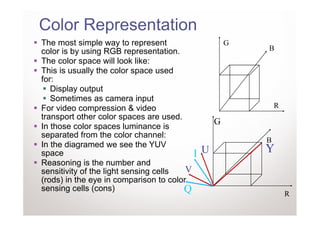
Color Representation
The most simple way to represent                      G
color is by using RGB representation.                     B
The color space will look like:
This is usually the color space used
for:
   Display output
   Sometimes as camera input
For video compression & video                                 R
transport other color spaces are used.
                                                  G
In those color spaces luminance is
separated from the color channel:
                                                          B
In the diagramed we see the YUV
space                                     I   U           Y
Reasoning is the number and
sensitivity of the light sensing cells  V
(rods) in the eye in comparison to color
sensing cells (cons)                   Q                          R
Color Models in Video
In Europe, video broadcast uses PAL or SECAM coding,
uses the YUV color model.
A matrix transform YIQ is used to transmit TV signals in
North America and Japan. (NTSC) This coding also
makes its way into VHS video tape coding in these
countries since video tape technologies also use YIQ.
Digital video uses a matrix transform called YCbCr that is
closely related to YUV.
Recently NV12 format has gained popularity
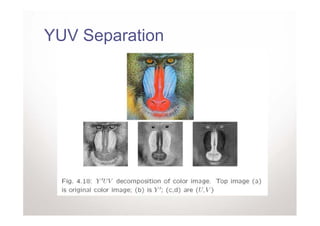
YUV Separation
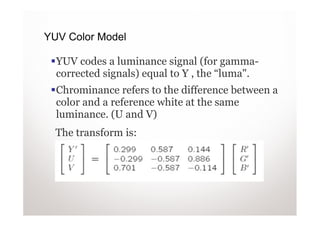
YUV Color Model

  YUV codes a luminance signal (for gamma-
  corrected signals) equal to Y , the “luma".
  Chrominance refers to the difference between a
  color and a reference white at the same
  luminance. (U and V)
  The transform is:
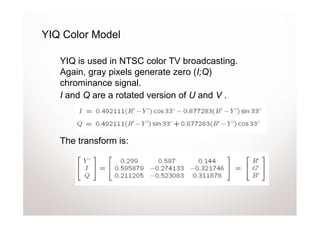
YIQ Color Model

   YIQ is used in NTSC color TV broadcasting.
   Again, gray pixels generate zero (I;Q)
   chrominance signal.
   I and Q are a rotated version of U and V .


   The transform is:
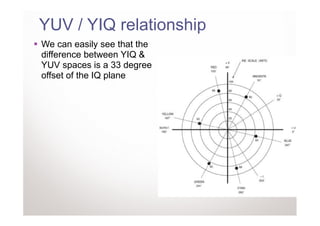
YUV / YIQ relationship
We can easily see that the
difference between YIQ &
YUV spaces is a 33 degree
offset of the IQ plane
Analog TV Connectors

 Analog TV connectors have a tradeoff between
   Number of Pins & wires
   Quality of video
 Using one wire to deliver luminance and color leads to
 interferences between the luminance and color
 components while using three wires or more just for the
 video is not convenient.
 Those problems are solved in new digital video connection
 standards like:
   DVI (obsolete)
   HDMI 1.4
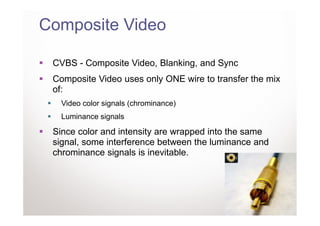
Composite Video

 CVBS - Composite Video, Blanking, and Sync
 Composite Video uses only ONE wire to transfer the mix
 of:
   Video color signals (chrominance)
   Luminance signals

 Since color and intensity are wrapped into the same
 signal, some interference between the luminance and
 chrominance signals is inevitable.
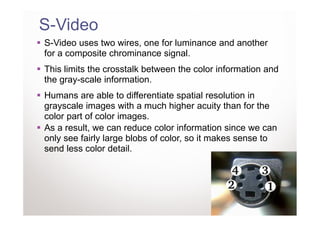
S-Video
S-Video uses two wires, one for luminance and another
for a composite chrominance signal.
This limits the crosstalk between the color information and
the gray-scale information.
Humans are able to differentiate spatial resolution in
grayscale images with a much higher acuity than for the
color part of color images.
As a result, we can reduce color information since we can
only see fairly large blobs of color, so it makes sense to
send less color detail.
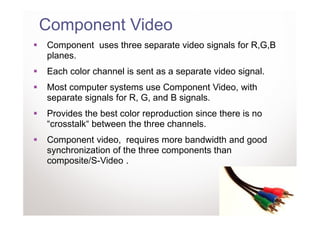
Component Video
Component uses three separate video signals for R,G,B
planes.
Each color channel is sent as a separate video signal.
Most computer systems use Component Video, with
separate signals for R, G, and B signals.
Provides the best color reproduction since there is no
“crosstalk“ between the three channels.
Component video, requires more bandwidth and good
synchronization of the three components than
composite/S-Video .
ANALOG BROADCAST
STANDARDS
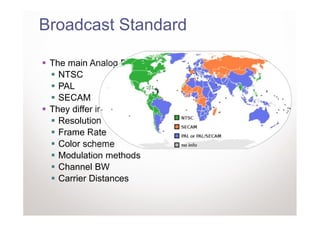
Broadcast Standard

 The main Analog Broadcasting standards are:
   NTSC
   PAL
   SECAM
 They differ in:
   Resolution
   Frame Rate
   Color scheme
   Modulation methods
   Channel BW
   Carrier Distances
NTSC
• NTSC (National Television System Committee) TV standard
  is mostly used in North America and Japan.
  ▫ 4:3 aspect ratio
  ▫ 525 scan lines
  ▫ 30 frames per second (fps)

• NTSC follows the interlaced scanning system, and each
  frame is divided into two fields, with 262.5 lines/field.
• The horizontal sweep frequency is 525 X 29.97 = 15,734
  lines/sec,
• Line swept cycle is 63.6u second.
• The horizontal retrace takes 10.9 u sec, this leaves 52.7 sec
  for the active line signal during which image data is displayed
NTSC
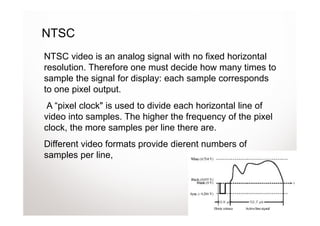
NTSC video is an analog signal with no fixed horizontal
resolution. Therefore one must decide how many times to
sample the signal for display: each sample corresponds
to one pixel output.
 A “pixel clock" is used to divide each horizontal line of
video into samples. The higher the frequency of the pixel
clock, the more samples per line there are.
Different video formats provide dierent numbers of
samples per line,
NTSC Color Modulation

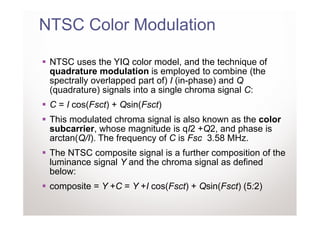
 NTSC uses the YIQ color model, and the technique of
 quadrature modulation is employed to combine (the
 spectrally overlapped part of) I (in-phase) and Q
 (quadrature) signals into a single chroma signal C:
 C = I cos(Fsct) + Qsin(Fsct)
 This modulated chroma signal is also known as the color
 subcarrier, whose magnitude is qI2 +Q2, and phase is
 arctan(Q/I). The frequency of C is Fsc 3.58 MHz.
 The NTSC composite signal is a further composition of the
 luminance signal Y and the chroma signal as defined
 below:
 composite = Y +C = Y +I cos(Fsct) + Qsin(Fsct) (5:2)
PAL

 PAL (Phase Alternating Line) is a TV standard widely
 used in Western Europe, China, India, and many other
 parts of the world.
   4:3 Aspect Ratio
   625 scan lines
   25 frames/second
   YUV Color space
   8 MHz channel
     5.5 MHz to Y
     1.8 MHz each to U and V.
   Color subcarrier frequency is fsc 4.43 MHz.
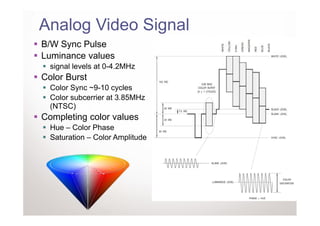
Analog Video Signal
B/W Sync Pulse
Luminance values
  signal levels at 0-4.2MHz
Color Burst
  Color Sync ~9-10 cycles
  Color subcerrier at 3.85MHz
  (NTSC)
Completing color values
  Hue – Color Phase
  Saturation – Color Amplitude
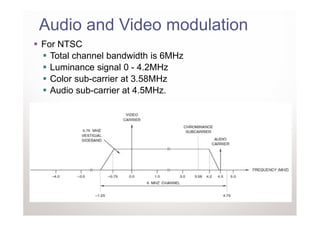
Audio and Video modulation
For NTSC
  Total channel bandwidth is 6MHz
  Luminance signal 0 - 4.2MHz
  Color sub-carrier at 3.58MHz
  Audio sub-carrier at 4.5MHz.
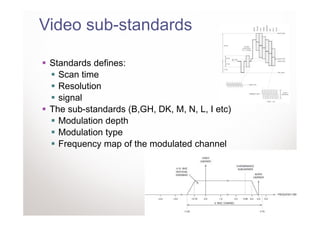
Video sub-standards

 Standards defines:
   Scan time
   Resolution
   signal
 The sub-standards (B,GH, DK, M, N, L, I etc)
   Modulation depth
   Modulation type
   Frequency map of the modulated channel
Audio Modulation Methods

 Mono AM
 BTSC / MTS
 EIA-J
 A2 / Zweikanalton
 NICAM
Overview

 Legacy TV only has monaural sound capabilities which
 receives a single L+R channel
 Later audio system delivered stereo capabilities while
 supporting the legacy TVs:
   Must provide the legacy mono channel
   Add Stereo of L-R using new technique & Bandwidth
BTSC
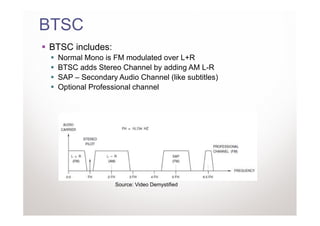
BTSC includes:
 Normal Mono is FM modulated over L+R
 BTSC adds Stereo Channel by adding AM L-R
 SAP – Secondary Audio Channel (like subtitles)
 Optional Professional channel


                 Source: Video Demystified
EIAJ
 Stereo Broadcast standard in Japan
 Used in conjunction with NTSC-J, similar to BTSC
 Uses FM instead of AM for the L-R Modulation
 Differentiate between dual mono and single stereo using a
 3.5FH subcarrier AM modulated (for 1/0)
A2

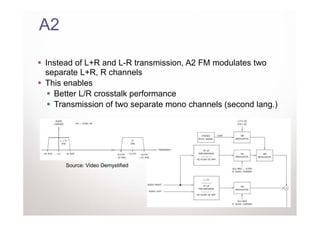
Instead of L+R and L-R transmission, A2 FM modulates two
separate L+R, R channels
This enables
  Better L/R crosstalk performance
  Transmission of two separate mono channels (second lang.)


     Source: Video Demystified
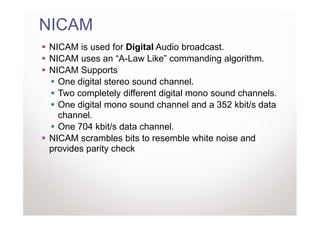
NICAM
NICAM is used for Digital Audio broadcast.
NICAM uses an “A-Law Like” commanding algorithm.
NICAM Supports
  One digital stereo sound channel.
  Two completely different digital mono sound channels.
  One digital mono sound channel and a 352 kbit/s data
  channel.
  One 704 kbit/s data channel.
NICAM scrambles bits to resemble white noise and
provides parity check
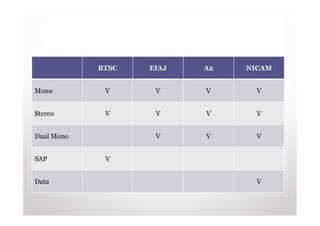
BTSC   EIAJ   A2   NICAM


Mono         V      V     V      V


Stereo       V      V     V      V


Dual Mono           V     V      V


SAP          V


Data                             V
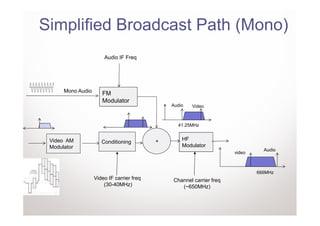
Simplified Broadcast Path (Mono)
                       Audio IF Freq


      Mono Audio      FM
                      Modulator
                                               Audio   Video


                                                 41.25MHz


 Video AM                                  +       HF
                      Conditioning
 Modulator                                         Modulator
                                                                                Audio
                                                                      video


                                                                              666MHz
                   Video IF carrier freq       Channel carrier freq
                       (30-40MHz)                 (~650MHz)
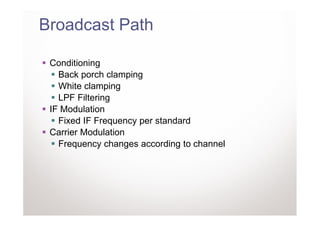
Broadcast Path

 Conditioning
   Back porch clamping
   White clamping
   LPF Filtering
 IF Modulation
   Fixed IF Frequency per standard
 Carrier Modulation
   Frequency changes according to channel
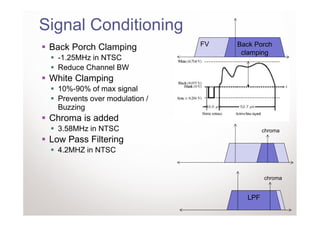
Signal Conditioning
                                FV    Back Porch
 Back Porch Clamping
                                       clamping
   -1.25MHz in NTSC
   Reduce Channel BW
 White Clamping
   10%-90% of max signal
   Prevents over modulation /
   Buzzing
 Chroma is added
   3.58MHz in NTSC                           chroma
 Low Pass Filtering
   4.2MHZ in NTSC


                                             chroma


                                     BackLPF
                                          Porch
                                     clamping
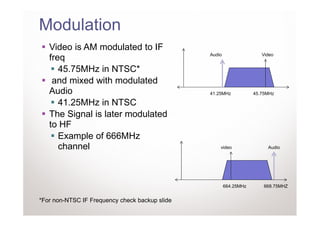
Modulation
   Video is AM modulated to IF
                                                Audio                  Video
   freq
      45.75MHz in NTSC*
    and mixed with modulated
   Audio                                        41.25MHz            45.75MHz

      41.25MHz in NTSC
   The Signal is later modulated
   to HF
      Example of 666MHz
      channel                                       video                Audio


                                                        664.25MHz       668.75MHZ


*For non-NTSC IF Frequency check backup slide
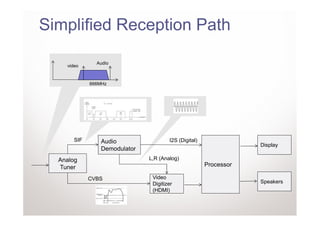
Simplified Reception Path

               Audio
    video


             666MHz


       SIF       Audio                 I2S (Digital)
                                                                   Display
                 Demodulator
  Analog                       L,R (Analog)
  Tuner                                                Processor

             CVBS               Video
                                Digitizer                          Speakers
                                (HDMI)
Thank you!
More About me:
• Video Expert
                                  Yossi Cohen
• Lectures on Video / Android /
  VoIP
                                  yossicohen19@gmail.com
                                  +972-545-313092
• Android Native Developer

Analog Video

  • 1.
  • 2.
    Agenda Introduction to ColorSpaces Connectors Video Broadcast Standards NTSC PAL Audio Standards NICAM BTSC EIAJ A2 Transmission Path Reception Path
  • 3.
    INTRO TO ANALOGTV Color Spaces Connectors Broadcast Standards
  • 4.
    Color Representation The mostsimple way to represent G color is by using RGB representation. B The color space will look like: This is usually the color space used for: Display output Sometimes as camera input For video compression & video R transport other color spaces are used. G In those color spaces luminance is separated from the color channel: B In the diagramed we see the YUV space I U Y Reasoning is the number and sensitivity of the light sensing cells V (rods) in the eye in comparison to color sensing cells (cons) Q R
  • 5.
    Color Models inVideo In Europe, video broadcast uses PAL or SECAM coding, uses the YUV color model. A matrix transform YIQ is used to transmit TV signals in North America and Japan. (NTSC) This coding also makes its way into VHS video tape coding in these countries since video tape technologies also use YIQ. Digital video uses a matrix transform called YCbCr that is closely related to YUV. Recently NV12 format has gained popularity
  • 6.
  • 7.
    YUV Color Model YUV codes a luminance signal (for gamma- corrected signals) equal to Y , the “luma". Chrominance refers to the difference between a color and a reference white at the same luminance. (U and V) The transform is:
  • 8.
    YIQ Color Model YIQ is used in NTSC color TV broadcasting. Again, gray pixels generate zero (I;Q) chrominance signal. I and Q are a rotated version of U and V . The transform is:
  • 9.
    YUV / YIQrelationship We can easily see that the difference between YIQ & YUV spaces is a 33 degree offset of the IQ plane
  • 10.
    Analog TV Connectors Analog TV connectors have a tradeoff between Number of Pins & wires Quality of video Using one wire to deliver luminance and color leads to interferences between the luminance and color components while using three wires or more just for the video is not convenient. Those problems are solved in new digital video connection standards like: DVI (obsolete) HDMI 1.4
  • 11.
    Composite Video CVBS- Composite Video, Blanking, and Sync Composite Video uses only ONE wire to transfer the mix of: Video color signals (chrominance) Luminance signals Since color and intensity are wrapped into the same signal, some interference between the luminance and chrominance signals is inevitable.
  • 12.
    S-Video S-Video uses twowires, one for luminance and another for a composite chrominance signal. This limits the crosstalk between the color information and the gray-scale information. Humans are able to differentiate spatial resolution in grayscale images with a much higher acuity than for the color part of color images. As a result, we can reduce color information since we can only see fairly large blobs of color, so it makes sense to send less color detail.
  • 13.
    Component Video Component usesthree separate video signals for R,G,B planes. Each color channel is sent as a separate video signal. Most computer systems use Component Video, with separate signals for R, G, and B signals. Provides the best color reproduction since there is no “crosstalk“ between the three channels. Component video, requires more bandwidth and good synchronization of the three components than composite/S-Video .
  • 14.
  • 15.
    Broadcast Standard Themain Analog Broadcasting standards are: NTSC PAL SECAM They differ in: Resolution Frame Rate Color scheme Modulation methods Channel BW Carrier Distances
  • 16.
    NTSC • NTSC (NationalTelevision System Committee) TV standard is mostly used in North America and Japan. ▫ 4:3 aspect ratio ▫ 525 scan lines ▫ 30 frames per second (fps) • NTSC follows the interlaced scanning system, and each frame is divided into two fields, with 262.5 lines/field. • The horizontal sweep frequency is 525 X 29.97 = 15,734 lines/sec, • Line swept cycle is 63.6u second. • The horizontal retrace takes 10.9 u sec, this leaves 52.7 sec for the active line signal during which image data is displayed
  • 17.
    NTSC NTSC video isan analog signal with no fixed horizontal resolution. Therefore one must decide how many times to sample the signal for display: each sample corresponds to one pixel output. A “pixel clock" is used to divide each horizontal line of video into samples. The higher the frequency of the pixel clock, the more samples per line there are. Different video formats provide dierent numbers of samples per line,
  • 18.
    NTSC Color Modulation NTSC uses the YIQ color model, and the technique of quadrature modulation is employed to combine (the spectrally overlapped part of) I (in-phase) and Q (quadrature) signals into a single chroma signal C: C = I cos(Fsct) + Qsin(Fsct) This modulated chroma signal is also known as the color subcarrier, whose magnitude is qI2 +Q2, and phase is arctan(Q/I). The frequency of C is Fsc 3.58 MHz. The NTSC composite signal is a further composition of the luminance signal Y and the chroma signal as defined below: composite = Y +C = Y +I cos(Fsct) + Qsin(Fsct) (5:2)
  • 19.
    PAL PAL (PhaseAlternating Line) is a TV standard widely used in Western Europe, China, India, and many other parts of the world. 4:3 Aspect Ratio 625 scan lines 25 frames/second YUV Color space 8 MHz channel 5.5 MHz to Y 1.8 MHz each to U and V. Color subcarrier frequency is fsc 4.43 MHz.
  • 20.
    Analog Video Signal B/WSync Pulse Luminance values signal levels at 0-4.2MHz Color Burst Color Sync ~9-10 cycles Color subcerrier at 3.85MHz (NTSC) Completing color values Hue – Color Phase Saturation – Color Amplitude
  • 21.
    Audio and Videomodulation For NTSC Total channel bandwidth is 6MHz Luminance signal 0 - 4.2MHz Color sub-carrier at 3.58MHz Audio sub-carrier at 4.5MHz.
  • 22.
    Video sub-standards Standardsdefines: Scan time Resolution signal The sub-standards (B,GH, DK, M, N, L, I etc) Modulation depth Modulation type Frequency map of the modulated channel
  • 23.
    Audio Modulation Methods Mono AM BTSC / MTS EIA-J A2 / Zweikanalton NICAM
  • 24.
    Overview Legacy TVonly has monaural sound capabilities which receives a single L+R channel Later audio system delivered stereo capabilities while supporting the legacy TVs: Must provide the legacy mono channel Add Stereo of L-R using new technique & Bandwidth
  • 25.
    BTSC BTSC includes: NormalMono is FM modulated over L+R BTSC adds Stereo Channel by adding AM L-R SAP – Secondary Audio Channel (like subtitles) Optional Professional channel Source: Video Demystified
  • 26.
    EIAJ Stereo Broadcaststandard in Japan Used in conjunction with NTSC-J, similar to BTSC Uses FM instead of AM for the L-R Modulation Differentiate between dual mono and single stereo using a 3.5FH subcarrier AM modulated (for 1/0)
  • 27.
    A2 Instead of L+Rand L-R transmission, A2 FM modulates two separate L+R, R channels This enables Better L/R crosstalk performance Transmission of two separate mono channels (second lang.) Source: Video Demystified
  • 28.
    NICAM NICAM is usedfor Digital Audio broadcast. NICAM uses an “A-Law Like” commanding algorithm. NICAM Supports One digital stereo sound channel. Two completely different digital mono sound channels. One digital mono sound channel and a 352 kbit/s data channel. One 704 kbit/s data channel. NICAM scrambles bits to resemble white noise and provides parity check
  • 29.
    BTSC EIAJ A2 NICAM Mono V V V V Stereo V V V V Dual Mono V V V SAP V Data V
  • 30.
    Simplified Broadcast Path(Mono) Audio IF Freq Mono Audio FM Modulator Audio Video 41.25MHz Video AM + HF Conditioning Modulator Modulator Audio video 666MHz Video IF carrier freq Channel carrier freq (30-40MHz) (~650MHz)
  • 31.
    Broadcast Path Conditioning Back porch clamping White clamping LPF Filtering IF Modulation Fixed IF Frequency per standard Carrier Modulation Frequency changes according to channel
  • 32.
    Signal Conditioning FV Back Porch Back Porch Clamping clamping -1.25MHz in NTSC Reduce Channel BW White Clamping 10%-90% of max signal Prevents over modulation / Buzzing Chroma is added 3.58MHz in NTSC chroma Low Pass Filtering 4.2MHZ in NTSC chroma BackLPF Porch clamping
  • 33.
    Modulation Video is AM modulated to IF Audio Video freq 45.75MHz in NTSC* and mixed with modulated Audio 41.25MHz 45.75MHz 41.25MHz in NTSC The Signal is later modulated to HF Example of 666MHz channel video Audio 664.25MHz 668.75MHZ *For non-NTSC IF Frequency check backup slide
  • 34.
    Simplified Reception Path Audio video 666MHz SIF Audio I2S (Digital) Display Demodulator Analog L,R (Analog) Tuner Processor CVBS Video Digitizer Speakers (HDMI)
  • 35.
    Thank you! More Aboutme: • Video Expert Yossi Cohen • Lectures on Video / Android / VoIP yossicohen19@gmail.com +972-545-313092 • Android Native Developer