1
Deep Learning
From black magic to
structured
programming
2
Agenda
▪Introduction
▪Tools / Model Types
▪Classifiers to instance segmentors
▪Process
▪Program? Train?
▪Data
▪Where to get it?
▪Platforms
▪Optimization
▪Video Analytics
3
Introduction
What is Deep Learning?
4
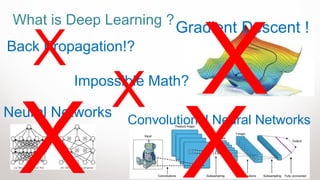
What is Deep Learning?
▪Deep Learning is not “Black Magic”
▪Deep Learning is using common statistics tools
▪Deep Learning is using iterative convergence process to
find a local minimum point which minimize the loss (“best
local solution”)
5
What is Deep Learning ?
Gradient Descent !
Neural Networks Convolutional Neural Networks
Back Propagation!?
X Impossible Math?
X
6
Deep Learning for system eng. & Architects
▪Set of Tools
▪Simple library
▪Development process
▪Non-standard programming
7
Deep Learning Tools
8
The tools
▪Most common tools:
▪Classifier
▪Detector (Box Detectors)
▪Segmentor
▪Instance Segmentor
▪Time series networks
9
Classifiers - 2
▪Answer on the existence of X (in image?)
▪Number classifier 0-9 (first CNN)
▪Common objects (Car, Chair, Cat…)
▪Cancer / No Cancer
▪Gun shot / broken glass
▪Most classifiers use some form of CNNs
10
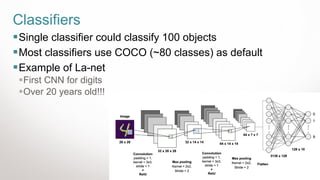
Classifiers
▪Single classifier could classify 100 objects
▪Most classifiers use COCO (~80 classes) as default
▪Example of La-net
▪First CNN for digits
▪Over 20 years old!!!
11
BOX Detectors
▪Box detectors detects the location of the object
▪Used to detect:
▪People, face, corona mask
▪car, road signs
▪cats
12
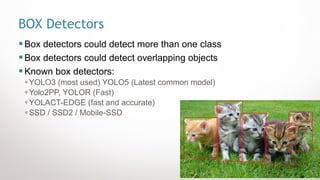
BOX Detectors
▪Box detectors could detect more than one class
▪Box detectors could detect overlapping objects
▪Known box detectors:
▪YOLO3 (most used) YOLO5 (Latest common model)
▪Yolo2PP, YOLOR (Fast)
▪YOLACT-EDGE (fast and accurate)
▪SSD / SSD2 / Mobile-SSD
13
Segmentor and Multi-Instance Segmentor
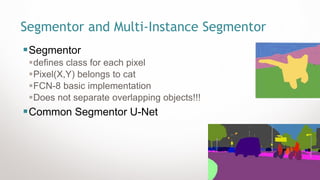
▪Segmentor
▪defines class for each pixel
▪Pixel(X,Y) belongs to cat
▪FCN-8 basic implementation
▪Does not separate overlapping objects!!!
▪Common Segmentor U-Net
14
Multi-Instance Segmentor
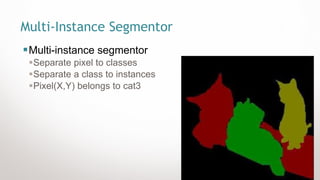
▪Multi-instance segmentor
▪Separate pixel to classes
▪Separate a class to instances
▪Pixel(X,Y) belongs to cat3
15
Multi-Instance Segmentor - Implementation
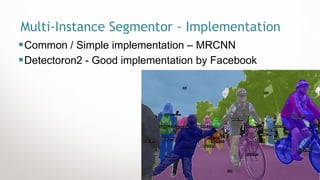
▪Common / Simple implementation – MRCNN
▪Detectoron2 - Good implementation by Facebook
16
(Time) series network
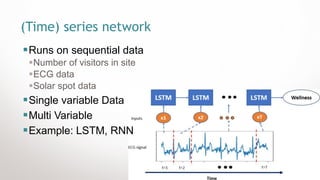
▪Runs on sequential data
▪Number of visitors in site
▪ECG data
▪Solar spot data
▪Single variable Data
▪Multi Variable
▪Example: LSTM, RNN
17
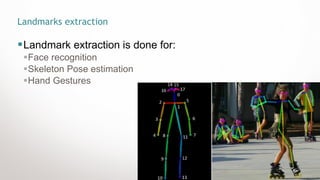
Landmarks extraction
▪Landmark extraction is done for:
▪Face recognition
▪Skeleton Pose estimation
▪Hand Gestures
18
Deep Learning
Process
19
Process
▪Train
▪Infer (Run)?
▪That’s all???????
20
Data
▪Data gathering (Initial)
▪Cameras / datasets
▪Data generation
▪Graphic engine (Unity / Omnviverse)
▪GAN
▪Data exploration
▪Anomaly detection
▪Class bias
▪Errored data
▪Data cleaning
▪Setting data pipes
21
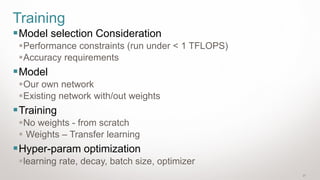
Training
▪Model selection Consideration
▪Performance constraints (run under < 1 TFLOPS)
▪Accuracy requirements
▪Model
▪Our own network
▪Existing network with/out weights
▪Training
▪No weights - from scratch
▪ Weights – Transfer learning
▪Hyper-param optimization
▪learning rate, decay, batch size, optimizer
22
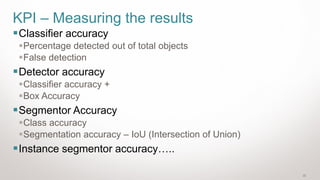
KPI – Measuring the results
▪Classifier accuracy
▪Percentage detected out of total objects
▪False detection
▪Detector accuracy
▪Classifier accuracy +
▪Box Accuracy
▪Segmentor Accuracy
▪Class accuracy
▪Segmentation accuracy – IoU (Intersection of Union)
▪Instance segmentor accuracy…..
23
Model Optimization
▪For which platform? CPU, GPU, TPU?
▪What type of GPU/TPU?
▪How many cores?
▪What type of cores (FP32, FP16, Int 16, Int8)
▪What batch to use?
24
Deployment and Automation
▪How to install the environment?
▪Python
▪Libraries
▪SDKs?
▪In Docker ?
▪How to automate the training and deployment platforms?
25
Deep Learning Data
26
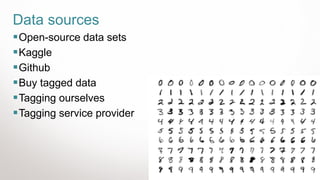
Data sources
▪Open-source data sets
▪Kaggle
▪Github
▪Buy tagged data
▪Tagging ourselves
▪Tagging service provider
27
Dataset Challenges
▪Existence – does the data exists somewhere
▪Faces, numbers, clothing, animals, cars, fonts
▪Can we use the data to train freely?
▪Datasets Has license like code
▪Does it fit my needs?
▪Data is RGB we need IR
▪Data is from close range we need distant range
▪Good plants we need sick plants
▪Cancer non-cancer image ration is 1:4.3*10^5
▪Data fine but too little
28
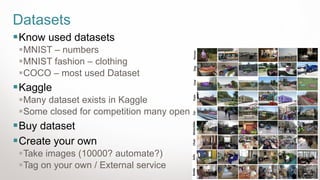
Datasets
▪Know used datasets
▪MNIST – numbers
▪MNIST fashion – clothing
▪COCO – most used Dataset
▪Kaggle
▪Many dataset exists in Kaggle
▪Some closed for competition many open
▪Buy dataset
▪Create your own
▪Take images (10000? automate?)
▪Tag on your own / External service
29
Deep Learning platforms
30
Deployment and Automation
▪For code we have Git and Git lab for CI/CD
▪Can we use it for Deep Learning
▪Requirements
▪Manage data gathering
▪Store data versioning
▪Create and store model versioning
▪Automatic training + KPI Measurements
▪Automatic deployment
31
Deep Learning Automation - 2
▪MLOP Platforms
▪ClearML (Allegro)
▪Converge.IO (Intel)
▪Igazio
▪Neptune
▪SageMaker
32
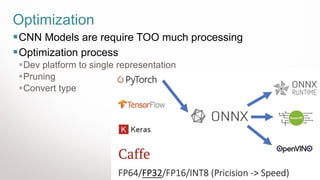
Optimization
▪CNN Models are require TOO much processing
▪Optimization process
▪Dev platform to single representation
▪Pruning
▪Convert type
33
Accelerator software platforms
▪Model porting and optimization
▪Nvidia TensorRT
▪Intel OpenVino
▪XILINX tools
▪Video processing and analytics platforms
▪NVIDIA DeepStream
▪Intel OpenVino
▪XILINX
▪All video analytics SDKs are based on GStreamer
▪Robotics
▪NVIDIA ISAAC (ROS / GEMS integration)
34
Yossi Cohen
0545313092
info@dsp-ip.com
Thank you

Deep Learning - system view

  • 1.
    1 Deep Learning From blackmagic to structured programming
  • 2.
    2 Agenda ▪Introduction ▪Tools / ModelTypes ▪Classifiers to instance segmentors ▪Process ▪Program? Train? ▪Data ▪Where to get it? ▪Platforms ▪Optimization ▪Video Analytics
  • 3.
  • 4.
    4 What is DeepLearning? ▪Deep Learning is not “Black Magic” ▪Deep Learning is using common statistics tools ▪Deep Learning is using iterative convergence process to find a local minimum point which minimize the loss (“best local solution”)
  • 5.
    5 What is DeepLearning ? Gradient Descent ! Neural Networks Convolutional Neural Networks Back Propagation!? X Impossible Math? X
  • 6.
    6 Deep Learning forsystem eng. & Architects ▪Set of Tools ▪Simple library ▪Development process ▪Non-standard programming
  • 7.
  • 8.
    8 The tools ▪Most commontools: ▪Classifier ▪Detector (Box Detectors) ▪Segmentor ▪Instance Segmentor ▪Time series networks
  • 9.
    9 Classifiers - 2 ▪Answeron the existence of X (in image?) ▪Number classifier 0-9 (first CNN) ▪Common objects (Car, Chair, Cat…) ▪Cancer / No Cancer ▪Gun shot / broken glass ▪Most classifiers use some form of CNNs
  • 10.
    10 Classifiers ▪Single classifier couldclassify 100 objects ▪Most classifiers use COCO (~80 classes) as default ▪Example of La-net ▪First CNN for digits ▪Over 20 years old!!!
  • 11.
    11 BOX Detectors ▪Box detectorsdetects the location of the object ▪Used to detect: ▪People, face, corona mask ▪car, road signs ▪cats
  • 12.
    12 BOX Detectors ▪Box detectorscould detect more than one class ▪Box detectors could detect overlapping objects ▪Known box detectors: ▪YOLO3 (most used) YOLO5 (Latest common model) ▪Yolo2PP, YOLOR (Fast) ▪YOLACT-EDGE (fast and accurate) ▪SSD / SSD2 / Mobile-SSD
  • 13.
    13 Segmentor and Multi-InstanceSegmentor ▪Segmentor ▪defines class for each pixel ▪Pixel(X,Y) belongs to cat ▪FCN-8 basic implementation ▪Does not separate overlapping objects!!! ▪Common Segmentor U-Net
  • 14.
    14 Multi-Instance Segmentor ▪Multi-instance segmentor ▪Separatepixel to classes ▪Separate a class to instances ▪Pixel(X,Y) belongs to cat3
  • 15.
    15 Multi-Instance Segmentor -Implementation ▪Common / Simple implementation – MRCNN ▪Detectoron2 - Good implementation by Facebook
  • 16.
    16 (Time) series network ▪Runson sequential data ▪Number of visitors in site ▪ECG data ▪Solar spot data ▪Single variable Data ▪Multi Variable ▪Example: LSTM, RNN
  • 17.
    17 Landmarks extraction ▪Landmark extractionis done for: ▪Face recognition ▪Skeleton Pose estimation ▪Hand Gestures
  • 18.
  • 19.
  • 20.
    20 Data ▪Data gathering (Initial) ▪Cameras/ datasets ▪Data generation ▪Graphic engine (Unity / Omnviverse) ▪GAN ▪Data exploration ▪Anomaly detection ▪Class bias ▪Errored data ▪Data cleaning ▪Setting data pipes
  • 21.
    21 Training ▪Model selection Consideration ▪Performanceconstraints (run under < 1 TFLOPS) ▪Accuracy requirements ▪Model ▪Our own network ▪Existing network with/out weights ▪Training ▪No weights - from scratch ▪ Weights – Transfer learning ▪Hyper-param optimization ▪learning rate, decay, batch size, optimizer
  • 22.
    22 KPI – Measuringthe results ▪Classifier accuracy ▪Percentage detected out of total objects ▪False detection ▪Detector accuracy ▪Classifier accuracy + ▪Box Accuracy ▪Segmentor Accuracy ▪Class accuracy ▪Segmentation accuracy – IoU (Intersection of Union) ▪Instance segmentor accuracy…..
  • 23.
    23 Model Optimization ▪For whichplatform? CPU, GPU, TPU? ▪What type of GPU/TPU? ▪How many cores? ▪What type of cores (FP32, FP16, Int 16, Int8) ▪What batch to use?
  • 24.
    24 Deployment and Automation ▪Howto install the environment? ▪Python ▪Libraries ▪SDKs? ▪In Docker ? ▪How to automate the training and deployment platforms?
  • 25.
  • 26.
    26 Data sources ▪Open-source datasets ▪Kaggle ▪Github ▪Buy tagged data ▪Tagging ourselves ▪Tagging service provider
  • 27.
    27 Dataset Challenges ▪Existence –does the data exists somewhere ▪Faces, numbers, clothing, animals, cars, fonts ▪Can we use the data to train freely? ▪Datasets Has license like code ▪Does it fit my needs? ▪Data is RGB we need IR ▪Data is from close range we need distant range ▪Good plants we need sick plants ▪Cancer non-cancer image ration is 1:4.3*10^5 ▪Data fine but too little
  • 28.
    28 Datasets ▪Know used datasets ▪MNIST– numbers ▪MNIST fashion – clothing ▪COCO – most used Dataset ▪Kaggle ▪Many dataset exists in Kaggle ▪Some closed for competition many open ▪Buy dataset ▪Create your own ▪Take images (10000? automate?) ▪Tag on your own / External service
  • 29.
  • 30.
    30 Deployment and Automation ▪Forcode we have Git and Git lab for CI/CD ▪Can we use it for Deep Learning ▪Requirements ▪Manage data gathering ▪Store data versioning ▪Create and store model versioning ▪Automatic training + KPI Measurements ▪Automatic deployment
  • 31.
    31 Deep Learning Automation- 2 ▪MLOP Platforms ▪ClearML (Allegro) ▪Converge.IO (Intel) ▪Igazio ▪Neptune ▪SageMaker
  • 32.
    32 Optimization ▪CNN Models arerequire TOO much processing ▪Optimization process ▪Dev platform to single representation ▪Pruning ▪Convert type
  • 33.
    33 Accelerator software platforms ▪Modelporting and optimization ▪Nvidia TensorRT ▪Intel OpenVino ▪XILINX tools ▪Video processing and analytics platforms ▪NVIDIA DeepStream ▪Intel OpenVino ▪XILINX ▪All video analytics SDKs are based on GStreamer ▪Robotics ▪NVIDIA ISAAC (ROS / GEMS integration)
  • 34.