TRAINING REPORT
Dept. Of ECE, VJCET 1
CHAPTER 1
INTRODUCTION
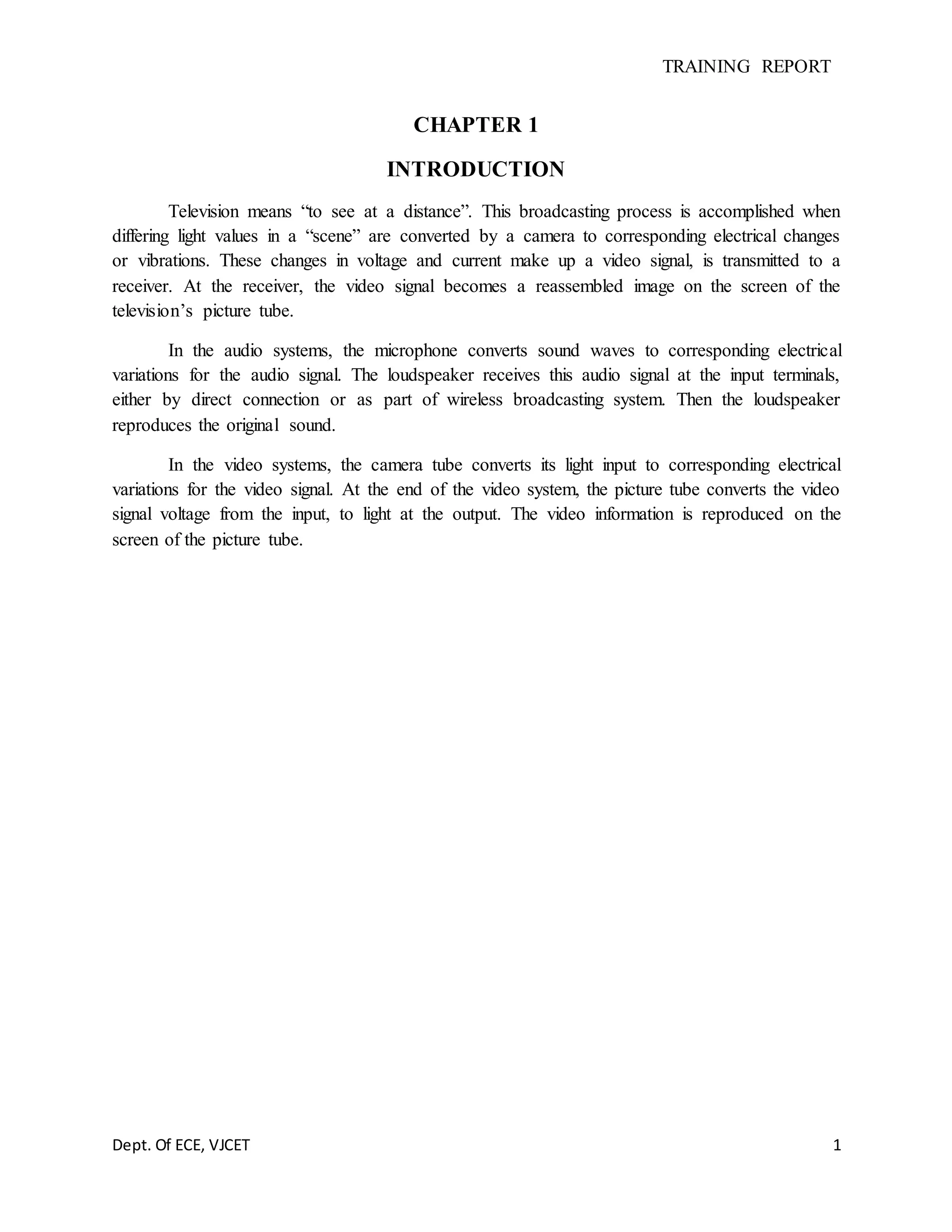
Television means “to see at a distance”. This broadcasting process is accomplished when
differing light values in a “scene” are converted by a camera to corresponding electrical changes
or vibrations. These changes in voltage and current make up a video signal, is transmitted to a
receiver. At the receiver, the video signal becomes a reassembled image on the screen of the
television’s picture tube.
In the audio systems, the microphone converts sound waves to corresponding electrical
variations for the audio signal. The loudspeaker receives this audio signal at the input terminals,
either by direct connection or as part of wireless broadcasting system. Then the loudspeaker
reproduces the original sound.
In the video systems, the camera tube converts its light input to corresponding electrical
variations for the video signal. At the end of the video system, the picture tube converts the video
signal voltage from the input, to light at the output. The video information is reproduced on the
screen of the picture tube.
TRAINING REPORT
Dept. Of ECE, VJCET 2
CHAPTER 2
TELEVISION BROADCASTING
In television broadcasting, amplitude modulation is used for the picture signal and
frequency modulation for the associated sound signal.
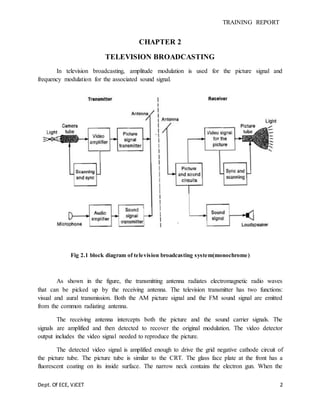
Fig 2.1 block diagram of television broadcasting system(monochrome)
As shown in the figure, the transmitting antenna radiates electromagnetic radio waves
that can be picked up by the receiving antenna. The television transmitter has two functions:
visual and aural transmission. Both the AM picture signal and the FM sound signal are emitted
from the common radiating antenna.
The receiving antenna intercepts both the picture and the sound carrier signals. The
signals are amplified and then detected to recover the original modulation. The video detector
output includes the video signal needed to reproduce the picture.
The detected video signal is amplified enough to drive the grid negative cathode circuit of
the picture tube. The picture tube is similar to the CRT. The glass face plate at the front has a
fluorescent coating on its inside surface. The narrow neck contains the electron gun. When the
TRAINING REPORT
Dept. Of ECE, VJCET 3
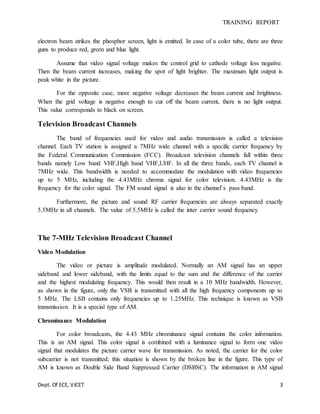
electron beam strikes the phosphor screen, light is emitted. In case of a color tube, there are three
guns to produce red, green and blue light.
Assume that video signal voltage makes the control grid to cathode voltage less negative.
Then the beam current increases, making the spot of light brighter. The maximum light output is
peak white in the picture.
For the opposite case, more negative voltage decreases the beam current and brightness.
When the grid voltage is negative enough to cut off the beam current, there is no light output.
This value corresponds to black on screen.
Television Broadcast Channels
The band of frequencies used for video and audio transmission is called a television
channel. Each TV station is assigned a 7MHz wide channel with a specific carrier frequency by
the Federal Communication Commission (FCC). Broadcast television channels fall within three
bands namely Low band VHF,High band VHF,UHF. In all the three bands, each TV channel is
7MHz wide. This bandwidth is needed to accommodate the modulation with video frequencies
up to 5 MHz, including the 4.43MHz chroma signal for color television. 4.43MHz is the
frequency for the color signal. The FM sound signal is also in the channel’s pass band.
Furthermore, the picture and sound RF carrier frequencies are always separated exactly
5.5MHz in all channels. The value of 5.5MHz is called the inter carrier sound frequency.
The 7-MHz Television Broadcast Channel
Video Modulation
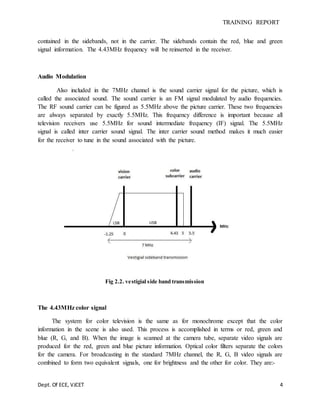
The video or picture is amplitude modulated. Normally an AM signal has an upper
sideband and lower sideband, with the limits equal to the sum and the difference of the carrier
and the highest modulating frequency. This would then result in a 10 MHz bandwidth. However,
as shown in the figure, only the VSB is transmitted with all the high frequency components up to
5 MHz. The LSB contains only frequencies up to 1.25MHz. This technique is known as VSB
transmission. It is a special type of AM.
Chrominance Modulation
For color broadcasts, the 4.43 MHz chrominance signal contains the color information.
This is an AM signal. This color signal is combined with a luminance signal to form one video
signal that modulates the picture carrier wave for transmission. As noted, the carrier for the color
subcarrier is not transmitted; this situation is shown by the broken line in the figure. This type of
AM is known as Double Side Band Suppressed Carrier (DSBSC). The information in AM signal
TRAINING REPORT
Dept. Of ECE, VJCET 4
contained in the sidebands, not in the carrier. The sidebands contain the red, blue and green
signal information. The 4.43MHz frequency will be reinserted in the receiver.
Audio Modulation
Also included in the 7MHz channel is the sound carrier signal for the picture, which is
called the associated sound. The sound carrier is an FM signal modulated by audio frequencies.
The RF sound carrier can be figured as 5.5MHz above the picture carrier. These two frequencies
are always separated by exactly 5.5MHz. This frequency difference is important because all
television receivers use 5.5MHz for sound intermediate frequency (IF) signal. The 5.5MHz
signal is called inter carrier sound signal. The inter carrier sound method makes it much easier
for the receiver to tune in the sound associated with the picture.
Fig 2.2. vestigial side band transmission
The 4.43MHz color signal
The system for color television is the same as for monochrome except that the color
information in the scene is also used. This process is accomplished in terms or red, green and
blue (R, G, and B). When the image is scanned at the camera tube, separate video signals are
produced for the red, green and blue picture information. Optical color filters separate the colors
for the camera. For broadcasting in the standard 7MHz channel, the R, G, B video signals are
combined to form two equivalent signals, one for brightness and the other for color. They are:-
TRAINING REPORT
Dept. Of ECE, VJCET 5
1. Luminance Signal
It contains only brightness variations of the picture information, including fine details. It
is used to reproduce the picture in black and white or monochrome.
2. Chrominance signal
It contains the color information. 4.43MHz is the color frequency. The subcarrier is an
AM DSBSC signal.
In a color television receiver, the color signal is combined with luminance signal to
recover the original red, green and blue signals. Then these are used to reproduce the picture in
color on the screen of a color picture tube.
Since we are using AM for video signals, we can’t send Y carrier and C carrier in VSB. C
carrier is not sent. Only a sample of carrier (C) is sent. The 4.43MHz carrier is generated at the
receiver. This can be done with the help of PLL.
CHAPTER 3
COLOR TV SIGNALS
The present day television systems are fundamentally based on the work of the National
Television Systems Committee (NTSC) in the USA in the year 1951-53. The Committee formed
by the leading research laboratories had the aim of evolving a color television system that would
be compatible with the existing black & white television system. This required that the additional
color information sent in the color TV system be accommodated in the same channel bandwidth
carrying the black & white information, maintaining the same carrier and scanning frequency
standards.
For monochrome compatibility in the NTSC system, three primary colors R, G & B from
the luminance signal and chrominance signal I and Q derived from color difference signals (R-Y)
and (B-Y). The two are sended on a single subcarrier by Quadrature Amplitude Modulation
(QAM). The magnitude of the resultant subcarrier by vector C represents the saturation of color
while its phase represents the hue
The color subcarrier has to convey chrominance information by two color difference
signals R-Y and B-Y in PAL and SECAM system, or their derivatives I and Q signals in the
NTSC system. The two signals are sent simultaneously on one subcarrier by Quadrature
Amplitude Modulation in the NTSC and PAL systems, while the R-Y and B-Y signals are sent
on the alternate lines in the sequence, on a frequency modulated subcarrier in the SECAM
system. For Quadrature Amplitude Modulation in NTSC or PAL, the two sub carrier are derived
TRAINING REPORT
Dept. Of ECE, VJCET 6
from the same source but phased 90 degree apart to carry independent information without
affecting each other.
Color TV transmission using NTSC system was found to be rather sensitive to phrase
errors introduced in the subcarrier, in the transmission path and due to equipments like tape
records, giving frequent changes in colors reproduced. A sequential technique for transmitting
the color difference signals alternatively, and combining them through a delay line switching,
under the name SECAM was developed in France, while in Germany the PAL system was
developed, in which phase errors are cancelled by alternating the phase of the color vector
alternate lines.
Pal system
This system of Phase Alternation by Line (PAL), was put forward by Prof. Walter Bruch
of Telefonken in Germany, is very similar to the NTSC, except that simple color difference
signals R-Y and B-y called V and U after weighting, are used as chroma signals and the color
subcarrier phase is reversed on every other line. These modifications make the PAL system less
sensitive to differential phase errors that can occur at a number of places in the studio chain and
the transmission path.
In the PAL system, the U and V signals are transmitted as a simultaneous pairs of chrominance
components in the form of amplitude modulated sidebands of a pair of suppressed subcarriers in
quadrature, as in the NTSC system. The phase of V signal is, however, reversed on alternating
lines. Phase errors that may be present in one line are counteracted by equal and opposite errors
produced in next line. These opposite phase errors in color subcarrier vectors for every alternate
line tend to cancel out the effect of color shift on human eye.
TRAINING REPORT
Dept. Of ECE, VJCET 7
CHAPTER 4
SCANNING
The scene is scanned rapidly both in the horizontal & vertical directions simultaneously to
provide sufficient number of complete pictures or frames per second to give the illusion of
continuous motion. Frame repetition rate is 25 per second in most TV systems.
Horizontal Scanning:
The linear rise of current in the horizontal deflection coils deflects the beam across the screen
with a continuous uniform motion for the trace from left to right. Then reverse direction and
decreases rapidly to its initial value called as retrace.
Vertical Scanning:
The saw tooth current in the vertical deflection coils moves the e – beam from top to bottom of
the raster at a uniform speed. While the e – beam is being deflected horizontally. Thus the beam
produces complete horizontal lines one below the other.
Flicker:
Although the rate of 24 picture per second in motion pictures and that of scanning of 25 frames per
second in TV is enough to cause an illusion of continuity, they are not rapid enough to blend
pictures smoothly into the next. This results in a definite flicker of lightthat is very annoying to
the observer. The problem is solved in motion pictures by showing each picture twice, i.e., 48
views of scene per second.
Interlaced Scanning:
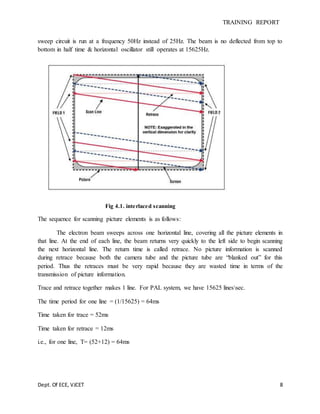
In TV pictures, an effective rate of 50 vertical scans per second is utilized to reduce
flicker. This is accomplished by increasing the downward rate of travel of the scanning e-beam ,
so that every alternative lines get scanned instead of every successive lines. Then when the beam
reaches the bottom of picture frame, it quickly reaches the top to scan those lines that were
missed in the previous scanning. Thus total number of lines is divided into 2 groups called
‘fields’. Each field is scanned alternatively. This method of scanning is called Interlaced
Scanning. It reduces flicker to an acceptable level since the area of screen is covered at twice the
rate. In the 625 line monochrome system, for successful interlaced scanning, the 625 lines of
each frame or picture are divided into sets of 312.5 lines and each set is scanned alternatively to
cover the entire picture area. To achieve this, the horizontal sweep oscillator is made to work at a
frequency of 15625Hz (312.5x50) to scan the same number of lines per frame, but the vertical
TRAINING REPORT
Dept. Of ECE, VJCET 8
sweep circuit is run at a frequency 50Hz instead of 25Hz. The beam is no deflected from top to
bottom in half time & horizontal oscillator still operates at 15625Hz.
Fig 4.1. interlaced scanning
The sequence for scanning picture elements is as follows:
The electron beam sweeps across one horizontal line, covering all the picture elements in
that line. At the end of each line, the beam returns very quickly to the left side to begin scanning
the next horizontal line. The return time is called retrace. No picture information is scanned
during retrace because both the camera tube and the picture tube are “blanked out” for this
period. Thus the retraces must be very rapid because they are wasted time in terms of the
transmission of picture information.
Trace and retrace together makes 1 line. For PAL system, we have 15625 linessec.
The time period for one line = (1/15625) = 64ms
Time taken for trace = 52ms
Time taken for retrace = 12ms
i.e., for one line, T= (52+12) = 64ms
TRAINING REPORT
Dept. Of ECE, VJCET 9
CHAPTER 5
VIDEO SIGNAL ANALYSIS
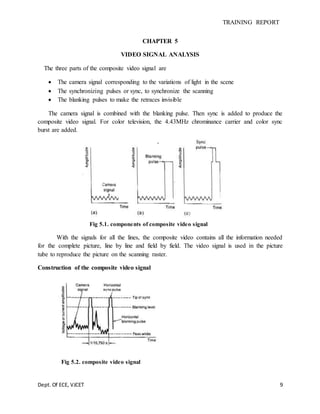
The three parts of the composite video signal are
 The camera signal corresponding to the variations of light in the scene
 The synchronizing pulses or sync, to synchronize the scanning
 The blanking pulses to make the retraces invisible
The camera signal is combined with the blanking pulse. Then sync is added to produce the
composite video signal. For color television, the 4.43MHz chrominance carrier and color sync
burst are added.
Fig 5.1. components of composite video signal
With the signals for all the lines, the composite video contains all the information needed
for the complete picture, line by line and field by field. The video signal is used in the picture
tube to reproduce the picture on the scanning raster.
Construction of the composite video signal
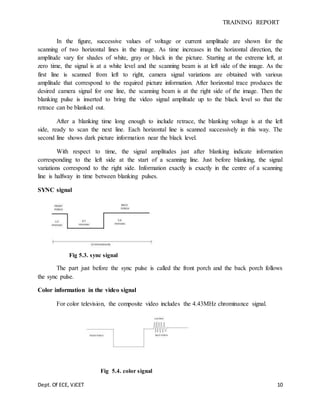
Fig 5.2. composite video signal
TRAINING REPORT
Dept. Of ECE, VJCET 10
In the figure, successive values of voltage or current amplitude are shown for the
scanning of two horizontal lines in the image. As time increases in the horizontal direction, the
amplitude vary for shades of white, gray or black in the picture. Starting at the extreme left, at
zero time, the signal is at a white level and the scanning beam is at left side of the image. As the
first line is scanned from left to right, camera signal variations are obtained with various
amplitude that correspond to the required picture information. After horizontal trace produces the
desired camera signal for one line, the scanning beam is at the right side of the image. Then the
blanking pulse is inserted to bring the video signal amplitude up to the black level so that the
retrace can be blanked out.
After a blanking time long enough to include retrace, the blanking voltage is at the left
side, ready to scan the next line. Each horizontal line is scanned successively in this way. The
second line shows dark picture information near the black level.
With respect to time, the signal amplitudes just after blanking indicate information
corresponding to the left side at the start of a scanning line. Just before blanking, the signal
variations correspond to the right side. Information exactly is exactly in the centre of a scanning
line is halfway in time between blanking pulses.
SYNC signal
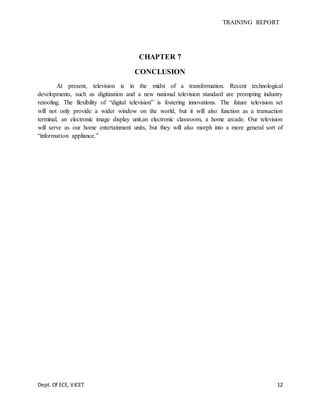
Fig 5.3. sync signal
The part just before the sync pulse is called the front porch and the back porch follows
the sync pulse.
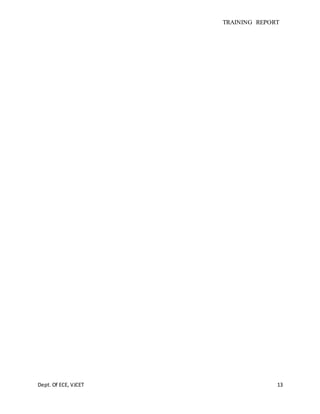
Color information in the video signal
For color television, the composite video includes the 4.43MHz chrominance signal.
Fig 5.4. color signal
TRAINING REPORT
Dept. Of ECE, VJCET 11
Composite video signal
The standard composite video input or output signal has negative pulses and a level of 1
volt peak to peak [0.7V video + 0.3V sync]
Fig 5.5 composite video signal
CHAPTER 6
DIGITAL COMPRESSION
Digital television broadcasting has to happen, because service providers can no longer
afford the limitations of traditional analog transmission. The broadcaster has to find a more
spectrum efficient technology. One of the fundamentals of efficient use of spectrum is
compression is a way of expressing digital audio & video by using less data. Compression theory
suggests that the more effective the reduction in bandwidth has to be, the more complex signal
processing at lower cost than for broadcasting using the analog techniques.
The active region of a digital television frame, sampled according to CCIR
recommendation 601, is 702 pixels by 576 lines for a frame rate of 25 HZ using, 8 bit for
luminance & for chrominance component, and the compressed bit rates become in 4:2:2.
Using the various compression techniques these can be being down to 3-15 M bits. For
digital broadcasting of standard definition video, a bit rate of around 6 M bits is thought to be
good compromise between picture quality and transmission bandwidth efficiency. At the lower
bit rates in this range, the impairments introduced by coding and decoding process become
increasingly objectionable.
TRAINING REPORT
Dept. Of ECE, VJCET 12
CHAPTER 7
CONCLUSION
At present, television is in the midst of a transformation. Recent technological
developments, such as digitization and a new national television standard are prompting industry
retooling. The flexibility of “digital television” is fostering innovations. The future television set
will not only provide a wider window on the world, but it will also function as a transaction
terminal, an electronic image display unit,an electronic classroom, a home arcade. Our television
will serve as our home entertainment units, but they will also morph into a more general sort of
“information appliance.”
TRAINING REPORT
Dept. Of ECE, VJCET 13
TRAINING REPORT
Dept. Of ECE, VJCET 14

TRAINING REPORT

  • 1.
    TRAINING REPORT Dept. OfECE, VJCET 1 CHAPTER 1 INTRODUCTION Television means “to see at a distance”. This broadcasting process is accomplished when differing light values in a “scene” are converted by a camera to corresponding electrical changes or vibrations. These changes in voltage and current make up a video signal, is transmitted to a receiver. At the receiver, the video signal becomes a reassembled image on the screen of the television’s picture tube. In the audio systems, the microphone converts sound waves to corresponding electrical variations for the audio signal. The loudspeaker receives this audio signal at the input terminals, either by direct connection or as part of wireless broadcasting system. Then the loudspeaker reproduces the original sound. In the video systems, the camera tube converts its light input to corresponding electrical variations for the video signal. At the end of the video system, the picture tube converts the video signal voltage from the input, to light at the output. The video information is reproduced on the screen of the picture tube.
  • 2.
    TRAINING REPORT Dept. OfECE, VJCET 2 CHAPTER 2 TELEVISION BROADCASTING In television broadcasting, amplitude modulation is used for the picture signal and frequency modulation for the associated sound signal. Fig 2.1 block diagram of television broadcasting system(monochrome) As shown in the figure, the transmitting antenna radiates electromagnetic radio waves that can be picked up by the receiving antenna. The television transmitter has two functions: visual and aural transmission. Both the AM picture signal and the FM sound signal are emitted from the common radiating antenna. The receiving antenna intercepts both the picture and the sound carrier signals. The signals are amplified and then detected to recover the original modulation. The video detector output includes the video signal needed to reproduce the picture. The detected video signal is amplified enough to drive the grid negative cathode circuit of the picture tube. The picture tube is similar to the CRT. The glass face plate at the front has a fluorescent coating on its inside surface. The narrow neck contains the electron gun. When the
  • 3.
    TRAINING REPORT Dept. OfECE, VJCET 3 electron beam strikes the phosphor screen, light is emitted. In case of a color tube, there are three guns to produce red, green and blue light. Assume that video signal voltage makes the control grid to cathode voltage less negative. Then the beam current increases, making the spot of light brighter. The maximum light output is peak white in the picture. For the opposite case, more negative voltage decreases the beam current and brightness. When the grid voltage is negative enough to cut off the beam current, there is no light output. This value corresponds to black on screen. Television Broadcast Channels The band of frequencies used for video and audio transmission is called a television channel. Each TV station is assigned a 7MHz wide channel with a specific carrier frequency by the Federal Communication Commission (FCC). Broadcast television channels fall within three bands namely Low band VHF,High band VHF,UHF. In all the three bands, each TV channel is 7MHz wide. This bandwidth is needed to accommodate the modulation with video frequencies up to 5 MHz, including the 4.43MHz chroma signal for color television. 4.43MHz is the frequency for the color signal. The FM sound signal is also in the channel’s pass band. Furthermore, the picture and sound RF carrier frequencies are always separated exactly 5.5MHz in all channels. The value of 5.5MHz is called the inter carrier sound frequency. The 7-MHz Television Broadcast Channel Video Modulation The video or picture is amplitude modulated. Normally an AM signal has an upper sideband and lower sideband, with the limits equal to the sum and the difference of the carrier and the highest modulating frequency. This would then result in a 10 MHz bandwidth. However, as shown in the figure, only the VSB is transmitted with all the high frequency components up to 5 MHz. The LSB contains only frequencies up to 1.25MHz. This technique is known as VSB transmission. It is a special type of AM. Chrominance Modulation For color broadcasts, the 4.43 MHz chrominance signal contains the color information. This is an AM signal. This color signal is combined with a luminance signal to form one video signal that modulates the picture carrier wave for transmission. As noted, the carrier for the color subcarrier is not transmitted; this situation is shown by the broken line in the figure. This type of AM is known as Double Side Band Suppressed Carrier (DSBSC). The information in AM signal
  • 4.
    TRAINING REPORT Dept. OfECE, VJCET 4 contained in the sidebands, not in the carrier. The sidebands contain the red, blue and green signal information. The 4.43MHz frequency will be reinserted in the receiver. Audio Modulation Also included in the 7MHz channel is the sound carrier signal for the picture, which is called the associated sound. The sound carrier is an FM signal modulated by audio frequencies. The RF sound carrier can be figured as 5.5MHz above the picture carrier. These two frequencies are always separated by exactly 5.5MHz. This frequency difference is important because all television receivers use 5.5MHz for sound intermediate frequency (IF) signal. The 5.5MHz signal is called inter carrier sound signal. The inter carrier sound method makes it much easier for the receiver to tune in the sound associated with the picture. Fig 2.2. vestigial side band transmission The 4.43MHz color signal The system for color television is the same as for monochrome except that the color information in the scene is also used. This process is accomplished in terms or red, green and blue (R, G, and B). When the image is scanned at the camera tube, separate video signals are produced for the red, green and blue picture information. Optical color filters separate the colors for the camera. For broadcasting in the standard 7MHz channel, the R, G, B video signals are combined to form two equivalent signals, one for brightness and the other for color. They are:-
  • 5.
    TRAINING REPORT Dept. OfECE, VJCET 5 1. Luminance Signal It contains only brightness variations of the picture information, including fine details. It is used to reproduce the picture in black and white or monochrome. 2. Chrominance signal It contains the color information. 4.43MHz is the color frequency. The subcarrier is an AM DSBSC signal. In a color television receiver, the color signal is combined with luminance signal to recover the original red, green and blue signals. Then these are used to reproduce the picture in color on the screen of a color picture tube. Since we are using AM for video signals, we can’t send Y carrier and C carrier in VSB. C carrier is not sent. Only a sample of carrier (C) is sent. The 4.43MHz carrier is generated at the receiver. This can be done with the help of PLL. CHAPTER 3 COLOR TV SIGNALS The present day television systems are fundamentally based on the work of the National Television Systems Committee (NTSC) in the USA in the year 1951-53. The Committee formed by the leading research laboratories had the aim of evolving a color television system that would be compatible with the existing black & white television system. This required that the additional color information sent in the color TV system be accommodated in the same channel bandwidth carrying the black & white information, maintaining the same carrier and scanning frequency standards. For monochrome compatibility in the NTSC system, three primary colors R, G & B from the luminance signal and chrominance signal I and Q derived from color difference signals (R-Y) and (B-Y). The two are sended on a single subcarrier by Quadrature Amplitude Modulation (QAM). The magnitude of the resultant subcarrier by vector C represents the saturation of color while its phase represents the hue The color subcarrier has to convey chrominance information by two color difference signals R-Y and B-Y in PAL and SECAM system, or their derivatives I and Q signals in the NTSC system. The two signals are sent simultaneously on one subcarrier by Quadrature Amplitude Modulation in the NTSC and PAL systems, while the R-Y and B-Y signals are sent on the alternate lines in the sequence, on a frequency modulated subcarrier in the SECAM system. For Quadrature Amplitude Modulation in NTSC or PAL, the two sub carrier are derived
  • 6.
    TRAINING REPORT Dept. OfECE, VJCET 6 from the same source but phased 90 degree apart to carry independent information without affecting each other. Color TV transmission using NTSC system was found to be rather sensitive to phrase errors introduced in the subcarrier, in the transmission path and due to equipments like tape records, giving frequent changes in colors reproduced. A sequential technique for transmitting the color difference signals alternatively, and combining them through a delay line switching, under the name SECAM was developed in France, while in Germany the PAL system was developed, in which phase errors are cancelled by alternating the phase of the color vector alternate lines. Pal system This system of Phase Alternation by Line (PAL), was put forward by Prof. Walter Bruch of Telefonken in Germany, is very similar to the NTSC, except that simple color difference signals R-Y and B-y called V and U after weighting, are used as chroma signals and the color subcarrier phase is reversed on every other line. These modifications make the PAL system less sensitive to differential phase errors that can occur at a number of places in the studio chain and the transmission path. In the PAL system, the U and V signals are transmitted as a simultaneous pairs of chrominance components in the form of amplitude modulated sidebands of a pair of suppressed subcarriers in quadrature, as in the NTSC system. The phase of V signal is, however, reversed on alternating lines. Phase errors that may be present in one line are counteracted by equal and opposite errors produced in next line. These opposite phase errors in color subcarrier vectors for every alternate line tend to cancel out the effect of color shift on human eye.
  • 7.
    TRAINING REPORT Dept. OfECE, VJCET 7 CHAPTER 4 SCANNING The scene is scanned rapidly both in the horizontal & vertical directions simultaneously to provide sufficient number of complete pictures or frames per second to give the illusion of continuous motion. Frame repetition rate is 25 per second in most TV systems. Horizontal Scanning: The linear rise of current in the horizontal deflection coils deflects the beam across the screen with a continuous uniform motion for the trace from left to right. Then reverse direction and decreases rapidly to its initial value called as retrace. Vertical Scanning: The saw tooth current in the vertical deflection coils moves the e – beam from top to bottom of the raster at a uniform speed. While the e – beam is being deflected horizontally. Thus the beam produces complete horizontal lines one below the other. Flicker: Although the rate of 24 picture per second in motion pictures and that of scanning of 25 frames per second in TV is enough to cause an illusion of continuity, they are not rapid enough to blend pictures smoothly into the next. This results in a definite flicker of lightthat is very annoying to the observer. The problem is solved in motion pictures by showing each picture twice, i.e., 48 views of scene per second. Interlaced Scanning: In TV pictures, an effective rate of 50 vertical scans per second is utilized to reduce flicker. This is accomplished by increasing the downward rate of travel of the scanning e-beam , so that every alternative lines get scanned instead of every successive lines. Then when the beam reaches the bottom of picture frame, it quickly reaches the top to scan those lines that were missed in the previous scanning. Thus total number of lines is divided into 2 groups called ‘fields’. Each field is scanned alternatively. This method of scanning is called Interlaced Scanning. It reduces flicker to an acceptable level since the area of screen is covered at twice the rate. In the 625 line monochrome system, for successful interlaced scanning, the 625 lines of each frame or picture are divided into sets of 312.5 lines and each set is scanned alternatively to cover the entire picture area. To achieve this, the horizontal sweep oscillator is made to work at a frequency of 15625Hz (312.5x50) to scan the same number of lines per frame, but the vertical
  • 8.
    TRAINING REPORT Dept. OfECE, VJCET 8 sweep circuit is run at a frequency 50Hz instead of 25Hz. The beam is no deflected from top to bottom in half time & horizontal oscillator still operates at 15625Hz. Fig 4.1. interlaced scanning The sequence for scanning picture elements is as follows: The electron beam sweeps across one horizontal line, covering all the picture elements in that line. At the end of each line, the beam returns very quickly to the left side to begin scanning the next horizontal line. The return time is called retrace. No picture information is scanned during retrace because both the camera tube and the picture tube are “blanked out” for this period. Thus the retraces must be very rapid because they are wasted time in terms of the transmission of picture information. Trace and retrace together makes 1 line. For PAL system, we have 15625 linessec. The time period for one line = (1/15625) = 64ms Time taken for trace = 52ms Time taken for retrace = 12ms i.e., for one line, T= (52+12) = 64ms
  • 9.
    TRAINING REPORT Dept. OfECE, VJCET 9 CHAPTER 5 VIDEO SIGNAL ANALYSIS The three parts of the composite video signal are  The camera signal corresponding to the variations of light in the scene  The synchronizing pulses or sync, to synchronize the scanning  The blanking pulses to make the retraces invisible The camera signal is combined with the blanking pulse. Then sync is added to produce the composite video signal. For color television, the 4.43MHz chrominance carrier and color sync burst are added. Fig 5.1. components of composite video signal With the signals for all the lines, the composite video contains all the information needed for the complete picture, line by line and field by field. The video signal is used in the picture tube to reproduce the picture on the scanning raster. Construction of the composite video signal Fig 5.2. composite video signal
  • 10.
    TRAINING REPORT Dept. OfECE, VJCET 10 In the figure, successive values of voltage or current amplitude are shown for the scanning of two horizontal lines in the image. As time increases in the horizontal direction, the amplitude vary for shades of white, gray or black in the picture. Starting at the extreme left, at zero time, the signal is at a white level and the scanning beam is at left side of the image. As the first line is scanned from left to right, camera signal variations are obtained with various amplitude that correspond to the required picture information. After horizontal trace produces the desired camera signal for one line, the scanning beam is at the right side of the image. Then the blanking pulse is inserted to bring the video signal amplitude up to the black level so that the retrace can be blanked out. After a blanking time long enough to include retrace, the blanking voltage is at the left side, ready to scan the next line. Each horizontal line is scanned successively in this way. The second line shows dark picture information near the black level. With respect to time, the signal amplitudes just after blanking indicate information corresponding to the left side at the start of a scanning line. Just before blanking, the signal variations correspond to the right side. Information exactly is exactly in the centre of a scanning line is halfway in time between blanking pulses. SYNC signal Fig 5.3. sync signal The part just before the sync pulse is called the front porch and the back porch follows the sync pulse. Color information in the video signal For color television, the composite video includes the 4.43MHz chrominance signal. Fig 5.4. color signal
  • 11.
    TRAINING REPORT Dept. OfECE, VJCET 11 Composite video signal The standard composite video input or output signal has negative pulses and a level of 1 volt peak to peak [0.7V video + 0.3V sync] Fig 5.5 composite video signal CHAPTER 6 DIGITAL COMPRESSION Digital television broadcasting has to happen, because service providers can no longer afford the limitations of traditional analog transmission. The broadcaster has to find a more spectrum efficient technology. One of the fundamentals of efficient use of spectrum is compression is a way of expressing digital audio & video by using less data. Compression theory suggests that the more effective the reduction in bandwidth has to be, the more complex signal processing at lower cost than for broadcasting using the analog techniques. The active region of a digital television frame, sampled according to CCIR recommendation 601, is 702 pixels by 576 lines for a frame rate of 25 HZ using, 8 bit for luminance & for chrominance component, and the compressed bit rates become in 4:2:2. Using the various compression techniques these can be being down to 3-15 M bits. For digital broadcasting of standard definition video, a bit rate of around 6 M bits is thought to be good compromise between picture quality and transmission bandwidth efficiency. At the lower bit rates in this range, the impairments introduced by coding and decoding process become increasingly objectionable.
  • 12.
    TRAINING REPORT Dept. OfECE, VJCET 12 CHAPTER 7 CONCLUSION At present, television is in the midst of a transformation. Recent technological developments, such as digitization and a new national television standard are prompting industry retooling. The flexibility of “digital television” is fostering innovations. The future television set will not only provide a wider window on the world, but it will also function as a transaction terminal, an electronic image display unit,an electronic classroom, a home arcade. Our television will serve as our home entertainment units, but they will also morph into a more general sort of “information appliance.”
  • 13.
  • 14.