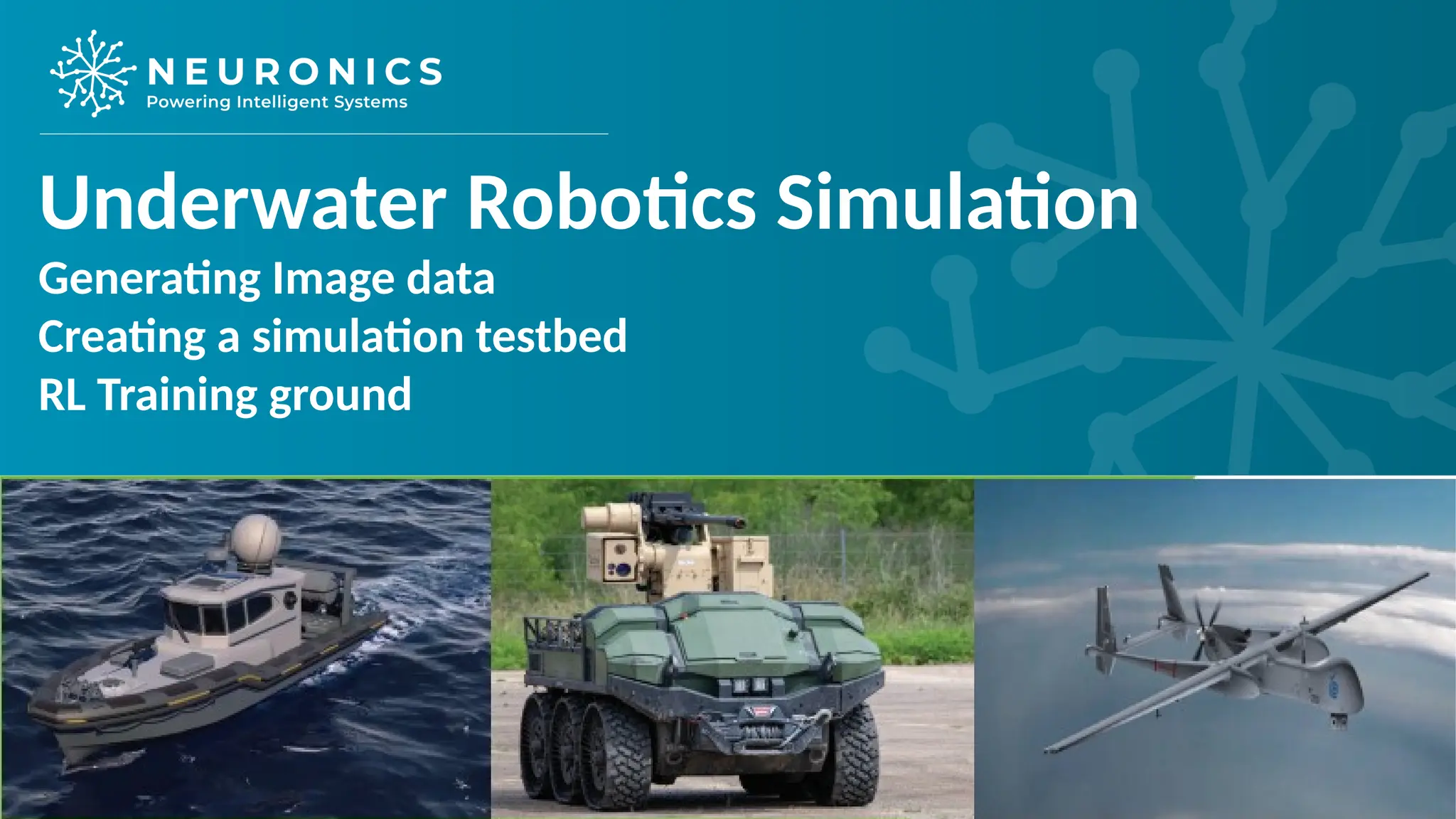
Underwater Robotics Simulation
Generating Image data
Creating a simulation testbed
RL Training ground
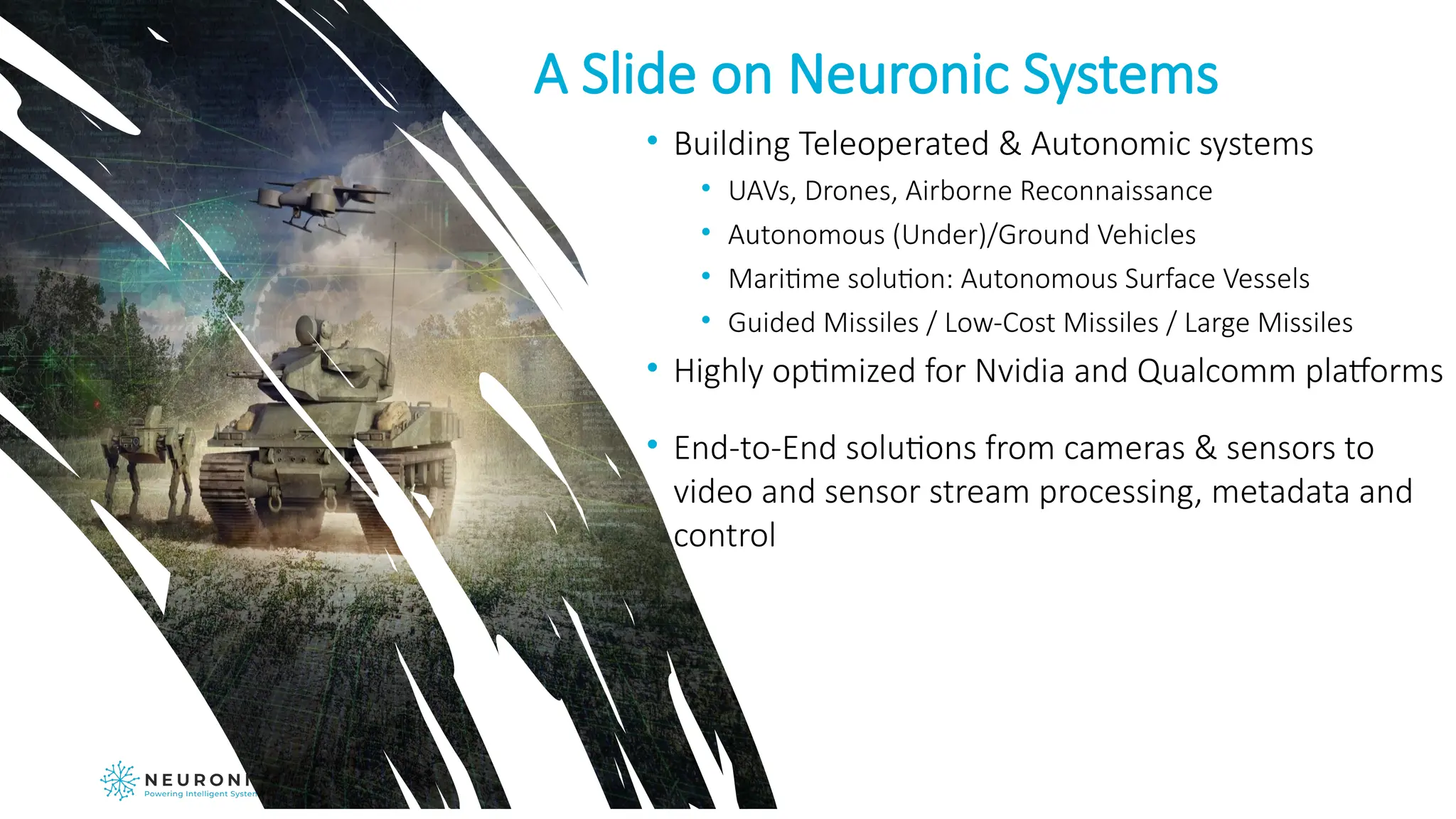
A Slide on Neuronic Systems
• Building Teleoperated & Autonomic systems
• UAVs, Drones, Airborne Reconnaissance
• Autonomous (Under)/Ground Vehicles
• Maritime solution: Autonomous Surface Vessels
• Guided Missiles / Low-Cost Missiles / Large Missiles
• Highly optimized for Nvidia and Qualcomm platforms
• End-to-End solutions from cameras & sensors to
video and sensor stream processing, metadata and
control
Motivation & Applications
Growing need for
ROVs/AUVs in
underwater
inspection,
mapping, research,
warfare
1
High cost & risk of
real underwater
testing
2
Simulation reduces
development time,
enhances safety,
tests very rare
events
(“Legendary”)
3
Reinforcement
learning accelerates
autonomy
development
4
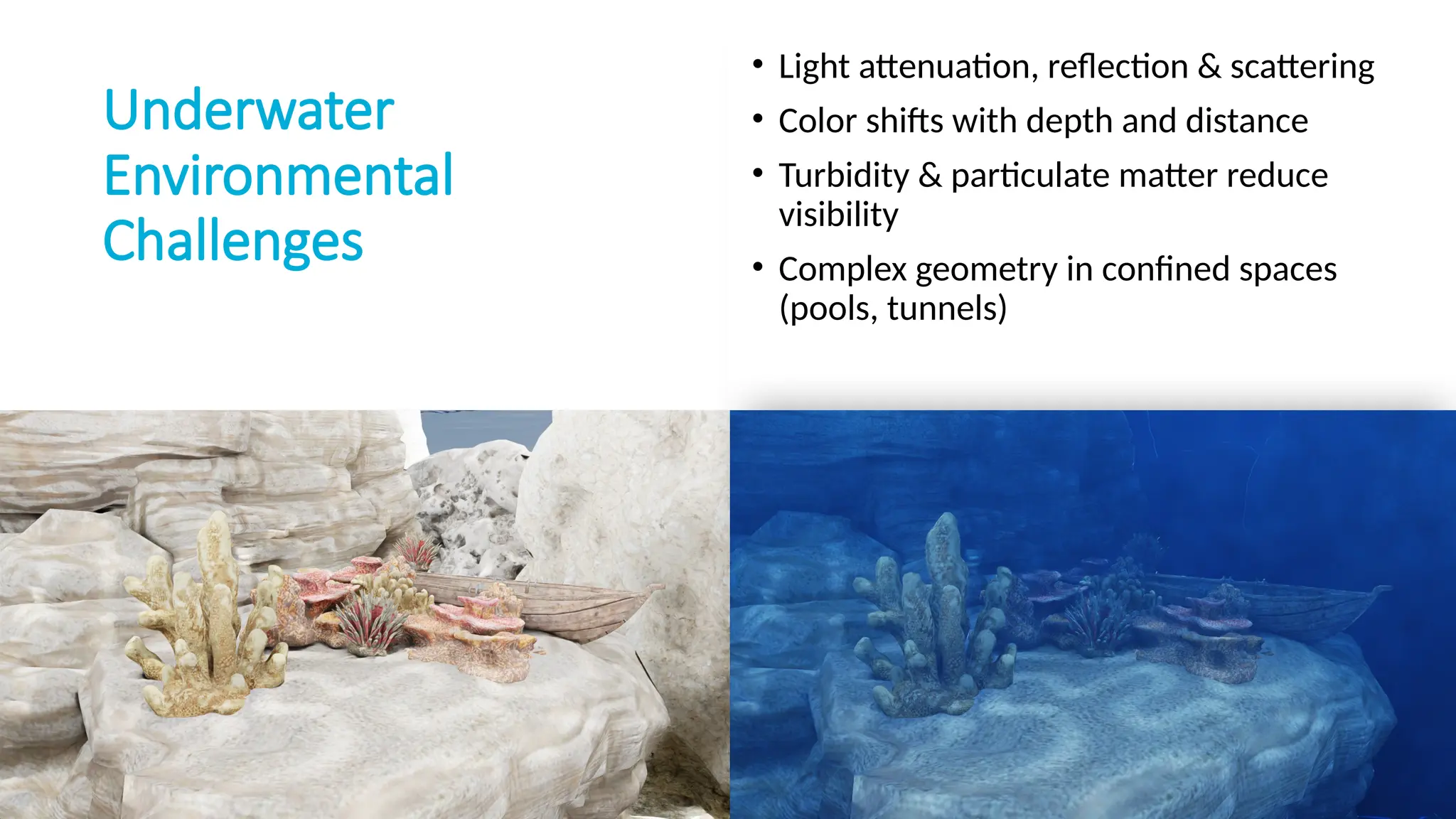
Underwater
Environmental
Challenges
• Light attenuation, reflection & scattering
• Color shifts with depth and distance
• Turbidity & particulate matter reduce
visibility
• Complex geometry in confined spaces
(pools, tunnels)
Effects of Light & Color • Shorter wavelengths (blue/green)
penetrate deeper than red
• Objects appear more
monochromatic or bluish with
depth
• Dynamic lighting conditions (sun
angles, artificial lights)
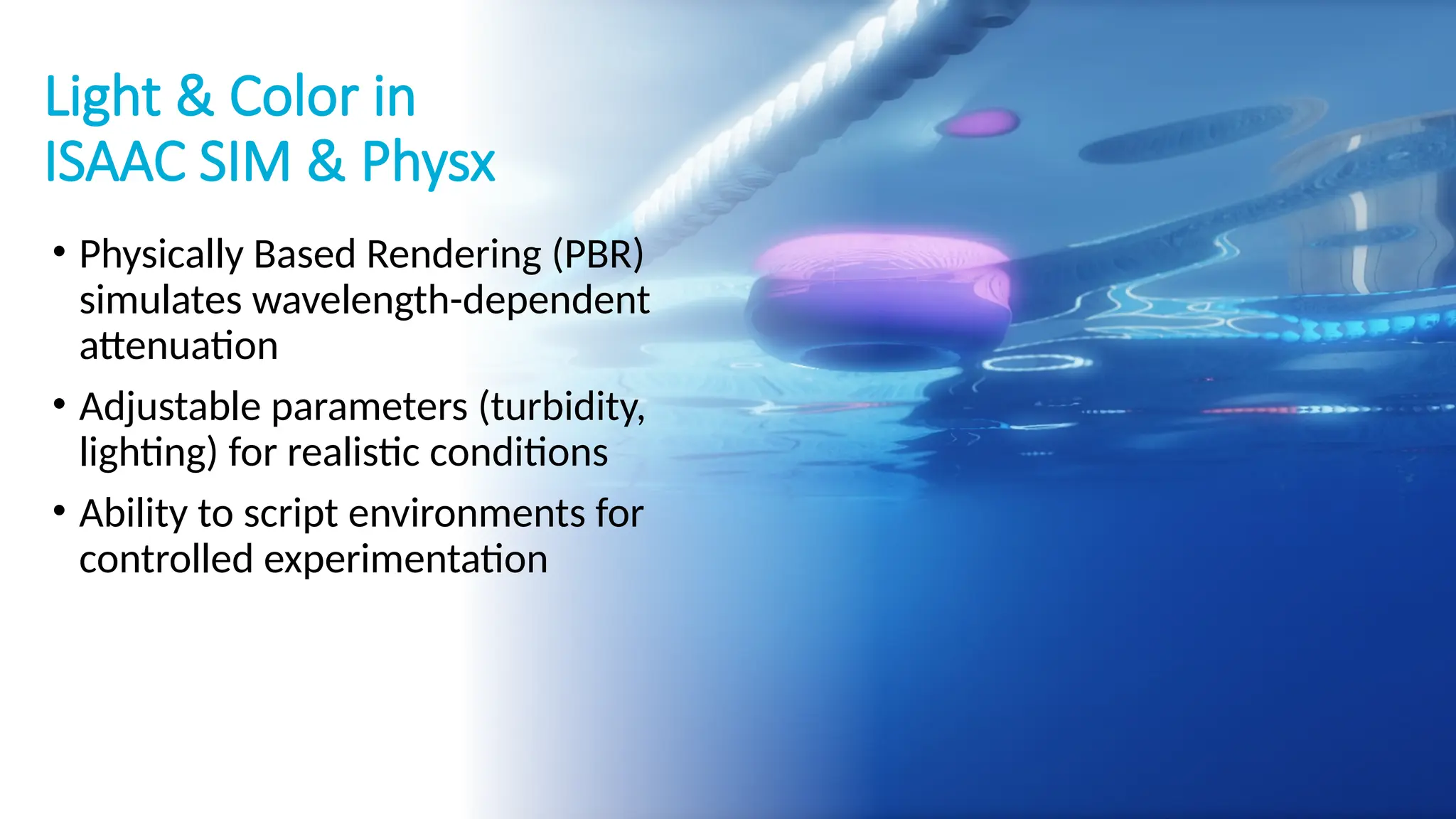
Light & Color in
ISAAC SIM & Physx
• Physically Based Rendering (PBR)
simulates wavelength-dependent
attenuation
• Adjustable parameters (turbidity,
lighting) for realistic conditions
• Ability to script environments for
controlled experimentation
Neural Network
Post-Processing
• NN-based color correction &
enhancement for synthetic images
• GANs in the past or Transformer
today improve fidelity to real
underwater imagery
• Better synthetic-to-real domain
adaptation for perception
algorithms
ROS Integration with ISAAC
ROS: Standardized messaging, SLAM & navigation packages,
quick prototyping
ISAAC Sim: High-fidelity environment & sensor modeling, GPU-
accelerated, Omniverse integration, Ray-Tracing for High fidelity
Combined stack for rapid iteration and smooth sim-to-real
transitions
Underwater
Robot
Sensor Suite
Sensor Use in SLAM &
Mapping
Underwater
Considerations
Camera (RGB/Mono) Visual features Limited by turbidity & lighting
shifts
Depth Camera Dense mapping Reduced effective range
underwater
Sonar Acoustic structure mapping Reliable in low visibility, complex
modeling needed
DVL Velocity estimation Stabilizes drift in known-floor
settings
IMU Inertial data fusion
Unaffected by visibility, needs
correction
Depth/Pressure Vertical position (Z-axis) Stable altitude reference
Underwater SLAM Challenges
- OPTICAL DEGRADATION
REDUCES RELIABLE VISUAL
FEATURES
- CONFINED SPACES
(TUNNELS, POOLS) DEMAND
ROBUST SENSOR FUSION
- HEAVY RELIANCE ON
ACOUSTIC SENSORS (SONAR,
DVL) + IMU TO MAINTAIN
STABLE POSE ESTIMATES
Sonar Simulation
Approaches
No native sonar
“Gem” in ISAAC Sim
Approximate via
raycasts + custom
signal processing
Integrate external
acoustic models via
ROS for realism
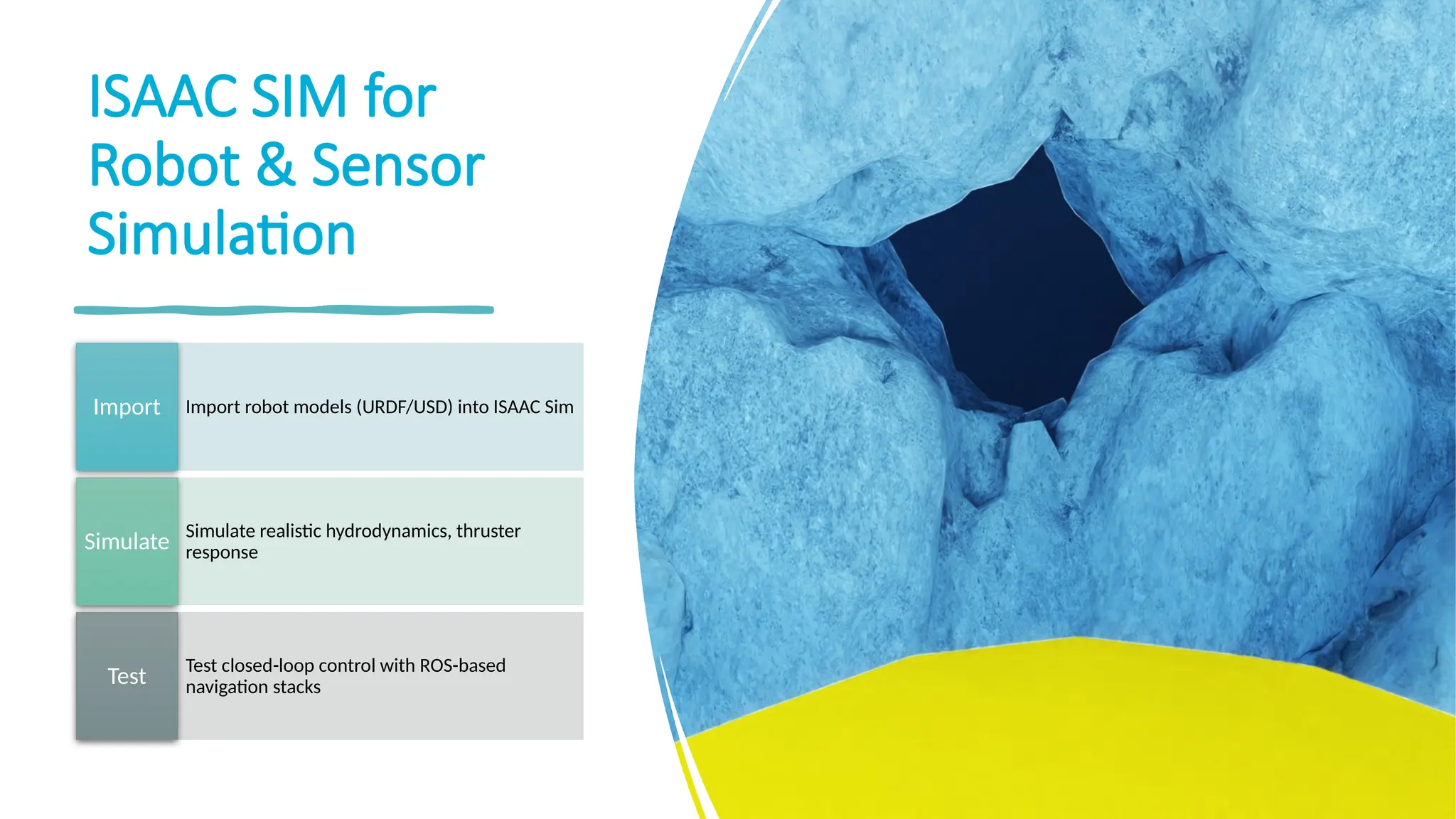
ISAAC SIM for
Robot & Sensor
Simulation
Import robot models (URDF/USD) into ISAAC Sim
Import
Simulate realistic hydrodynamics, thruster
response
Simulate
Test closed-loop control with ROS-based
navigation stacks
Test
Real-Time Control
& Navigation
Testing
• Validate path planning, obstacle avoidance
• Train and refine SLAM algorithms with repetitive, consistent
scenarios
• Reinforcement learning accelerates training by leveraging synthetic
environments
Real-Time Control
& Navigation
Testing
Benefits of a Virtual Testbed
• Cost-effective and safe environment for early R&D
• Repeatable conditions to refine algorithms
• Seamless integration of complex sensor suites &
novel SLAM approaches
• GPU-accelerated RL for fast autonomy development
Future Directions
Advanced scattering,
bioluminescence
modeling
Better acoustic
simulations integrated
directly in ISAAC Sim
Cloud-based simulation
for collaboration & large-
scale experiments
Enhanced reinforcement
learning frameworks for
underwater robotics
Conclusion
&
Q&A
Integrated ROS & ISAAC Sim
accelerate underwater robot
development
Advanced lighting, acoustic
modeling, and RL improve SLAM
fidelity
Ready for questions and further
discussion
Tal Rotholz, Sales Director
Tal@neuronicode.com
+972-52-8925915
Yossi Cohen, CTO
Yossi@neuronicode.com
+972-54-5313092
www.neuronicode.com
Thank You

Underwater robotics simulation with isaac sim

  • 1.
    Underwater Robotics Simulation GeneratingImage data Creating a simulation testbed RL Training ground
  • 2.
    A Slide onNeuronic Systems • Building Teleoperated & Autonomic systems • UAVs, Drones, Airborne Reconnaissance • Autonomous (Under)/Ground Vehicles • Maritime solution: Autonomous Surface Vessels • Guided Missiles / Low-Cost Missiles / Large Missiles • Highly optimized for Nvidia and Qualcomm platforms • End-to-End solutions from cameras & sensors to video and sensor stream processing, metadata and control
  • 3.
    Motivation & Applications Growingneed for ROVs/AUVs in underwater inspection, mapping, research, warfare 1 High cost & risk of real underwater testing 2 Simulation reduces development time, enhances safety, tests very rare events (“Legendary”) 3 Reinforcement learning accelerates autonomy development 4
  • 4.
    Underwater Environmental Challenges • Light attenuation,reflection & scattering • Color shifts with depth and distance • Turbidity & particulate matter reduce visibility • Complex geometry in confined spaces (pools, tunnels)
  • 5.
    Effects of Light& Color • Shorter wavelengths (blue/green) penetrate deeper than red • Objects appear more monochromatic or bluish with depth • Dynamic lighting conditions (sun angles, artificial lights)
  • 6.
    Light & Colorin ISAAC SIM & Physx • Physically Based Rendering (PBR) simulates wavelength-dependent attenuation • Adjustable parameters (turbidity, lighting) for realistic conditions • Ability to script environments for controlled experimentation
  • 7.
    Neural Network Post-Processing • NN-basedcolor correction & enhancement for synthetic images • GANs in the past or Transformer today improve fidelity to real underwater imagery • Better synthetic-to-real domain adaptation for perception algorithms
  • 8.
    ROS Integration withISAAC ROS: Standardized messaging, SLAM & navigation packages, quick prototyping ISAAC Sim: High-fidelity environment & sensor modeling, GPU- accelerated, Omniverse integration, Ray-Tracing for High fidelity Combined stack for rapid iteration and smooth sim-to-real transitions
  • 9.
    Underwater Robot Sensor Suite Sensor Usein SLAM & Mapping Underwater Considerations Camera (RGB/Mono) Visual features Limited by turbidity & lighting shifts Depth Camera Dense mapping Reduced effective range underwater Sonar Acoustic structure mapping Reliable in low visibility, complex modeling needed DVL Velocity estimation Stabilizes drift in known-floor settings IMU Inertial data fusion Unaffected by visibility, needs correction Depth/Pressure Vertical position (Z-axis) Stable altitude reference
  • 10.
    Underwater SLAM Challenges -OPTICAL DEGRADATION REDUCES RELIABLE VISUAL FEATURES - CONFINED SPACES (TUNNELS, POOLS) DEMAND ROBUST SENSOR FUSION - HEAVY RELIANCE ON ACOUSTIC SENSORS (SONAR, DVL) + IMU TO MAINTAIN STABLE POSE ESTIMATES
  • 11.
    Sonar Simulation Approaches No nativesonar “Gem” in ISAAC Sim Approximate via raycasts + custom signal processing Integrate external acoustic models via ROS for realism
  • 12.
    ISAAC SIM for Robot& Sensor Simulation Import robot models (URDF/USD) into ISAAC Sim Import Simulate realistic hydrodynamics, thruster response Simulate Test closed-loop control with ROS-based navigation stacks Test
  • 13.
    Real-Time Control & Navigation Testing •Validate path planning, obstacle avoidance • Train and refine SLAM algorithms with repetitive, consistent scenarios • Reinforcement learning accelerates training by leveraging synthetic environments
  • 14.
  • 15.
    Benefits of aVirtual Testbed • Cost-effective and safe environment for early R&D • Repeatable conditions to refine algorithms • Seamless integration of complex sensor suites & novel SLAM approaches • GPU-accelerated RL for fast autonomy development
  • 16.
    Future Directions Advanced scattering, bioluminescence modeling Betteracoustic simulations integrated directly in ISAAC Sim Cloud-based simulation for collaboration & large- scale experiments Enhanced reinforcement learning frameworks for underwater robotics
  • 17.
    Conclusion & Q&A Integrated ROS &ISAAC Sim accelerate underwater robot development Advanced lighting, acoustic modeling, and RL improve SLAM fidelity Ready for questions and further discussion
  • 18.
    Tal Rotholz, SalesDirector Tal@neuronicode.com +972-52-8925915 Yossi Cohen, CTO Yossi@neuronicode.com +972-54-5313092 www.neuronicode.com Thank You

Editor's Notes

  • #3 ROV – Teleoperated Robotics AUV – Autonomic Vehicle
  • #8 ROS – Robotic Operation System