Analog and digital Electronics
Mr. Vishal L. Tathe
ZES's ZCOER,Pune
ZEAL EDUCATION SOCIETY’S
ZEAL COLLEGE OF ENGINEERING AND RESEARCH,
NARHE │PUNE - 41 │ INDIA
Electrical Engineering Department
ANALOG/DIGITAL SYSTEMS
I Real world systems and processes
Mostly continuous (at the macroscopic level): time, acceleration,
chemical reactions
Sometimes discrete: quantum states, mass (# of atoms)
Mathematics to represent physical systems is continuous (calculus)
Mathematics for number theory, counting, approximating physical
systems can be discrete
ZES's ZCOER, Pune
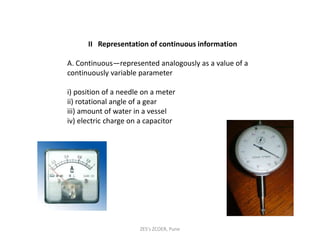
II Representation of continuous information
A. Continuous—represented analogously as a value of a
continuously variable parameter
i) position of a needle on a meter
ii) rotational angle of a gear
iii) amount of water in a vessel
iv) electric charge on a capacitor
ZES's ZCOER, Pune
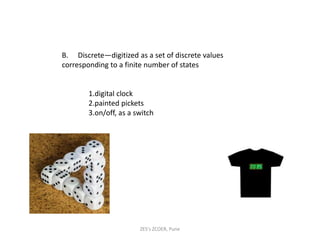
B. Discrete—digitized as a set of discrete values
corresponding to a finite number of states
1.digital clock
2.painted pickets
3.on/off, as a switch
ZES's ZCOER, Pune
III Representation of continuous processes
A. Analogous to the process itself
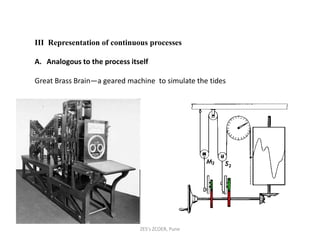
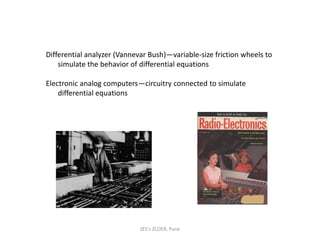
Great Brass Brain—a geared machine to simulate the tides
ZES's ZCOER, Pune
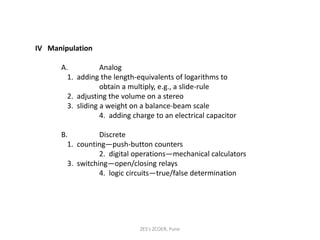
Differential analyzer (Vannevar Bush)—variable-size friction wheels to
simulate the behavior of differential equations
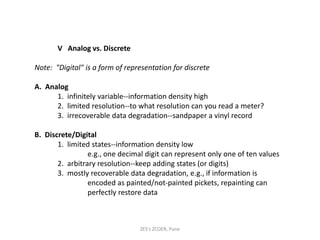
Electronic analog computers—circuitry connected to simulate
differential equations
ZES's ZCOER, Pune
Phonograph record—wiggles in grooves to represent sound oscillations
Slide rule—an instrument which does multiplication by adding lengths
which correspond to the logarithms of numbers.
Electric clocks
Mercury thermometers
ZES's ZCOER, Pune
B. Discretized to represent the process
Finite difference formulations
Digital clocks
Music CD’s
ZES's ZCOER, Pune
IV Manipulation
A. Analog
1. adding the length-equivalents of logarithms to
obtain a multiply, e.g., a slide-rule
2. adjusting the volume on a stereo
3. sliding a weight on a balance-beam scale
4. adding charge to an electrical capacitor
B. Discrete
1. counting—push-button counters
2. digital operations—mechanical calculators
3. switching—open/closing relays
4. logic circuits—true/false determination
ZES's ZCOER, Pune
V Analog vs. Discrete
Note: "Digital" is a form of representation for discrete
A. Analog
1. infinitely variable--information density high
2. limited resolution--to what resolution can you read a meter?
3. irrecoverable data degradation--sandpaper a vinyl record
B. Discrete/Digital
1. limited states--information density low
e.g., one decimal digit can represent only one of ten values
2. arbitrary resolution--keep adding states (or digits)
3. mostly recoverable data degradation, e.g., if information is
encoded as painted/not-painted pickets, repainting can
perfectly restore data
ZES's ZCOER, Pune
VI Digital systems
A. decimal--not so good, because there are few 10-state devices that
could be used to store information (fingers. . .?)
B. binary--excellent for hardware; lots of 2-state devices:
switches, lights, magnetics
--poor for communication: 2-state devices require many
digits to represent values with reasonable resolution
--excellent for logic systems whose states are true and false
C. octal --base 8: used to conveniently represent binary data;
almost as efficient as decimal
D. hexadecimal--base 16: more efficient than decimal; more practical
than octal because of binary digit groupings in computers
ZES's ZCOER, Pune
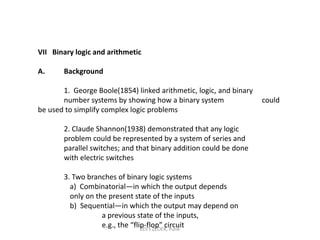
VII Binary logic and arithmetic
A. Background
1. George Boole(1854) linked arithmetic, logic, and binary
number systems by showing how a binary system could
be used to simplify complex logic problems
2. Claude Shannon(1938) demonstrated that any logic
problem could be represented by a system of series and
parallel switches; and that binary addition could be done
with electric switches
3. Two branches of binary logic systems
a) Combinatorial—in which the output depends
only on the present state of the inputs
b) Sequential—in which the output may depend on
a previous state of the inputs,
e.g., the “flip-flop” circuit
ZES's ZCOER, Pune
C
A
B
A B C
0 0 0
1 0 0
0 1 0
1 1 1
AND gate
ZES's ZCOER, Pune
C
A
B
A B C
0 0 0
1 0 0
0 1 0
1 1 1
AND gate
Simple “AND” Circuit
Battery
A B
C
ZES's ZCOER, Pune
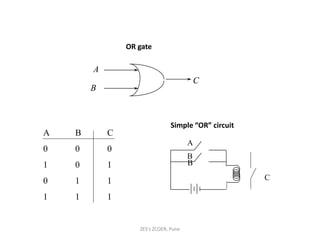
OR gate
C
A
B
A B C
0 0 0
1 0 1
0 1 1
1 1 1
ZES's ZCOER, Pune
OR gate
C
A
B
A B C
0 0 0
1 0 1
0 1 1
1 1 1
A
Simple “OR” circuit
B
B
C
ZES's ZCOER, Pune
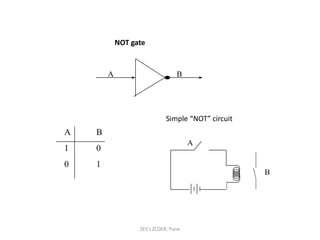
A B
NOT gate
A B
1 0
0 1
ZES's ZCOER, Pune
A B
NOT gate
A B
1 0
0 1
A
B
Simple “NOT” circuit
ZES's ZCOER, Pune
C
A
B
A B C
0 0 1
1 0 1
0 1 1
1 1 0
NAND gate
ZES's ZCOER, Pune
C
A
B
A B C
0 0 1
1 0 1
0 1 1
1 1 0
NAND gate
Simple “NAND” Circuit
Battery
A B
C
ZES's ZCOER, Pune
3. Control systems: e.g., car will start only if doors are
locked, seat belts are on, key is turned
D S K I
0 0 0 0
0 0 1 0
0 1 0 0
0 1 1 0
1 0 0 0
1 0 1 0
1 1 0 0
1 1 1 1
ZES's ZCOER, Pune
3. Control systems: e.g., car will start only if doors are
locked, seat belts are on, key is turned
D S K I
0 0 0 0
0 0 1 0
0 1 0 0
0 1 1 0
1 0 0 0
1 0 1 0
1 1 0 0
1 1 1 1
I = D AND S AND K
D
S
K
I
ZES's ZCOER, Pune
Binary arithmetic: e.g., adding two binary digits
A B R C
0 0 0 0
0 1 1 0
1 0 1 0
1 1 0 1
ZES's ZCOER, Pune
Binary arithmetic: e.g., adding two binary digits
A B R C
0 0 0 0
0 1 1 0
1 0 1 0
1 1 0 1
A
B
R
C
R = (A OR B) AND NOT (A AND B)
C = A AND B
ZES's ZCOER, Pune
AND rules OR rules
A*A = A A +A = A
A*A' = 0 A +A' = 1
0*A = 0 0+A = A
1*A = A 1 +A = 1
A*B = B*A A + B = B+A
A*(B*C) = (A*B)*C A+(B+C) = (A+B)+C
A(B+C) = A*B+B*C A+B*C = (A+B)*(A+C)
A'*B' = (A+B)' A'+B' = (A*B)‘ (DeMorgan’s theorem)
Notation: * = AND + = OR ‘ = NOT
Boolean algebra properties
ZES's ZCOER, Pune
Design and construct a logic circuit to control a light-seeking car
using only NAND gates
Right Center Left Right Left
Sensor Sensor Sensor Wheel Wheel
0 0 0 ? ?
0 0 1 1 0
0 1 0 1 1
0 1 1 1 ?
1 0 0 0 1
1 0 1 ? ?
1 1 0 ? 1
1 1 1 ? ?
ZES's ZCOER, Pune
7400 chip and its
“pinout”
Protoboard and
ribbon cable connector
ZES's ZCOER, Pune
Example circuit wired into the light-seeking car
ZES's ZCOER, Pune

Analog and digital Electronics.pptx

  • 1.
    Analog and digitalElectronics Mr. Vishal L. Tathe ZES's ZCOER,Pune ZEAL EDUCATION SOCIETY’S ZEAL COLLEGE OF ENGINEERING AND RESEARCH, NARHE │PUNE - 41 │ INDIA Electrical Engineering Department
  • 2.
    ANALOG/DIGITAL SYSTEMS I Realworld systems and processes Mostly continuous (at the macroscopic level): time, acceleration, chemical reactions Sometimes discrete: quantum states, mass (# of atoms) Mathematics to represent physical systems is continuous (calculus) Mathematics for number theory, counting, approximating physical systems can be discrete ZES's ZCOER, Pune
  • 3.
    II Representation ofcontinuous information A. Continuous—represented analogously as a value of a continuously variable parameter i) position of a needle on a meter ii) rotational angle of a gear iii) amount of water in a vessel iv) electric charge on a capacitor ZES's ZCOER, Pune
  • 4.
    B. Discrete—digitized asa set of discrete values corresponding to a finite number of states 1.digital clock 2.painted pickets 3.on/off, as a switch ZES's ZCOER, Pune
  • 5.
    III Representation ofcontinuous processes A. Analogous to the process itself Great Brass Brain—a geared machine to simulate the tides ZES's ZCOER, Pune
  • 6.
    Differential analyzer (VannevarBush)—variable-size friction wheels to simulate the behavior of differential equations Electronic analog computers—circuitry connected to simulate differential equations ZES's ZCOER, Pune
  • 7.
    Phonograph record—wiggles ingrooves to represent sound oscillations Slide rule—an instrument which does multiplication by adding lengths which correspond to the logarithms of numbers. Electric clocks Mercury thermometers ZES's ZCOER, Pune
  • 8.
    B. Discretized torepresent the process Finite difference formulations Digital clocks Music CD’s ZES's ZCOER, Pune
  • 9.
    IV Manipulation A. Analog 1.adding the length-equivalents of logarithms to obtain a multiply, e.g., a slide-rule 2. adjusting the volume on a stereo 3. sliding a weight on a balance-beam scale 4. adding charge to an electrical capacitor B. Discrete 1. counting—push-button counters 2. digital operations—mechanical calculators 3. switching—open/closing relays 4. logic circuits—true/false determination ZES's ZCOER, Pune
  • 10.
    V Analog vs.Discrete Note: "Digital" is a form of representation for discrete A. Analog 1. infinitely variable--information density high 2. limited resolution--to what resolution can you read a meter? 3. irrecoverable data degradation--sandpaper a vinyl record B. Discrete/Digital 1. limited states--information density low e.g., one decimal digit can represent only one of ten values 2. arbitrary resolution--keep adding states (or digits) 3. mostly recoverable data degradation, e.g., if information is encoded as painted/not-painted pickets, repainting can perfectly restore data ZES's ZCOER, Pune
  • 11.
    VI Digital systems A.decimal--not so good, because there are few 10-state devices that could be used to store information (fingers. . .?) B. binary--excellent for hardware; lots of 2-state devices: switches, lights, magnetics --poor for communication: 2-state devices require many digits to represent values with reasonable resolution --excellent for logic systems whose states are true and false C. octal --base 8: used to conveniently represent binary data; almost as efficient as decimal D. hexadecimal--base 16: more efficient than decimal; more practical than octal because of binary digit groupings in computers ZES's ZCOER, Pune
  • 12.
    VII Binary logicand arithmetic A. Background 1. George Boole(1854) linked arithmetic, logic, and binary number systems by showing how a binary system could be used to simplify complex logic problems 2. Claude Shannon(1938) demonstrated that any logic problem could be represented by a system of series and parallel switches; and that binary addition could be done with electric switches 3. Two branches of binary logic systems a) Combinatorial—in which the output depends only on the present state of the inputs b) Sequential—in which the output may depend on a previous state of the inputs, e.g., the “flip-flop” circuit ZES's ZCOER, Pune
  • 13.
    C A B A B C 00 0 1 0 0 0 1 0 1 1 1 AND gate ZES's ZCOER, Pune
  • 14.
    C A B A B C 00 0 1 0 0 0 1 0 1 1 1 AND gate Simple “AND” Circuit Battery A B C ZES's ZCOER, Pune
  • 15.
    OR gate C A B A BC 0 0 0 1 0 1 0 1 1 1 1 1 ZES's ZCOER, Pune
  • 16.
    OR gate C A B A BC 0 0 0 1 0 1 0 1 1 1 1 1 A Simple “OR” circuit B B C ZES's ZCOER, Pune
  • 17.
    A B NOT gate AB 1 0 0 1 ZES's ZCOER, Pune
  • 18.
    A B NOT gate AB 1 0 0 1 A B Simple “NOT” circuit ZES's ZCOER, Pune
  • 19.
    C A B A B C 00 1 1 0 1 0 1 1 1 1 0 NAND gate ZES's ZCOER, Pune
  • 20.
    C A B A B C 00 1 1 0 1 0 1 1 1 1 0 NAND gate Simple “NAND” Circuit Battery A B C ZES's ZCOER, Pune
  • 21.
    3. Control systems:e.g., car will start only if doors are locked, seat belts are on, key is turned D S K I 0 0 0 0 0 0 1 0 0 1 0 0 0 1 1 0 1 0 0 0 1 0 1 0 1 1 0 0 1 1 1 1 ZES's ZCOER, Pune
  • 22.
    3. Control systems:e.g., car will start only if doors are locked, seat belts are on, key is turned D S K I 0 0 0 0 0 0 1 0 0 1 0 0 0 1 1 0 1 0 0 0 1 0 1 0 1 1 0 0 1 1 1 1 I = D AND S AND K D S K I ZES's ZCOER, Pune
  • 23.
    Binary arithmetic: e.g.,adding two binary digits A B R C 0 0 0 0 0 1 1 0 1 0 1 0 1 1 0 1 ZES's ZCOER, Pune
  • 24.
    Binary arithmetic: e.g.,adding two binary digits A B R C 0 0 0 0 0 1 1 0 1 0 1 0 1 1 0 1 A B R C R = (A OR B) AND NOT (A AND B) C = A AND B ZES's ZCOER, Pune
  • 25.
    AND rules ORrules A*A = A A +A = A A*A' = 0 A +A' = 1 0*A = 0 0+A = A 1*A = A 1 +A = 1 A*B = B*A A + B = B+A A*(B*C) = (A*B)*C A+(B+C) = (A+B)+C A(B+C) = A*B+B*C A+B*C = (A+B)*(A+C) A'*B' = (A+B)' A'+B' = (A*B)‘ (DeMorgan’s theorem) Notation: * = AND + = OR ‘ = NOT Boolean algebra properties ZES's ZCOER, Pune
  • 26.
    Design and constructa logic circuit to control a light-seeking car using only NAND gates Right Center Left Right Left Sensor Sensor Sensor Wheel Wheel 0 0 0 ? ? 0 0 1 1 0 0 1 0 1 1 0 1 1 1 ? 1 0 0 0 1 1 0 1 ? ? 1 1 0 ? 1 1 1 1 ? ? ZES's ZCOER, Pune
  • 27.
    7400 chip andits “pinout” Protoboard and ribbon cable connector ZES's ZCOER, Pune
  • 28.
    Example circuit wiredinto the light-seeking car ZES's ZCOER, Pune