UNIT2
LOGIC GATES AND CIRCUITS
OBJECTIVES
• Understand the relationship between Boolean logic and digital computer circuits.
• Learn how to design simple logic circuits.
• Understand how digital circuits work together to form complex computer systems.
INTRODUCTION
• In the latter part of the nineteenth century, George Boole incensed philosophers and
mathematicians alike when he suggested that logical thought could be represented through
mathematical equations.
• How dare anyone suggest that human thought could be encapsulated and
manipulated like an algebraic formula?
• Computers, as we know them today, are implementations of Boole’s Laws of Thought.
• John Atanasoff and Claude Shannon were among the first to see this connection.
• In the middle of the twentieth century, computers were commonly known as “thinking
machines” and “electronic brains.”
• Many people were fearful of them.
• Nowadays, we rarely ponder the relationship between electronic digital computers and
human logic. Computers are accepted as part of our lives.
• Many people, however, are still fearful of them.
• In this chapter, you will learn the simplicity that constitutes the essence of the machine.
BOOLEAN ALGEBRA
• Boolean algebra is a mathematical system for the manipulation of variables that can have
one of two values.
• In formal logic, these values are “true” and “false.”
• In digital systems, these values are “on” and “off,” 1 and 0, or “high” and “low.”
• Boolean expressions are created by performing operations on Boolean variables.
• Common Boolean operators include AND, OR, and NOT.
AND, OR OPERATION
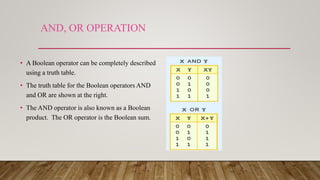
• A Boolean operator can be completely described
using a truth table.
• The truth table for the Boolean operators AND
and OR are shown at the right.
• The AND operator is also known as a Boolean
product. The OR operator is the Boolean sum.
NOT OPERATION
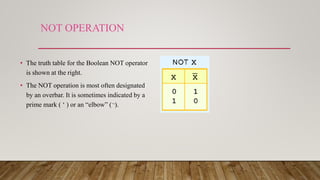
• The truth table for the Boolean NOT operator
is shown at the right.
• The NOT operation is most often designated
by an overbar. It is sometimes indicated by a
prime mark ( ‘ ) or an “elbow” ().
FUNDAMENTAL LAWS
•Associative laws
•(A + B)+ C = A+ (B + C)
•(AB)C = A (BC)
• Distributive laws
•A (B + C) = AB + AC
•Related identities
•(A + AB)= A
•(A + B)= A+ B
•(A+B)• (A+C) =(A+BC)
•Commutative Law
•A + B = B + A
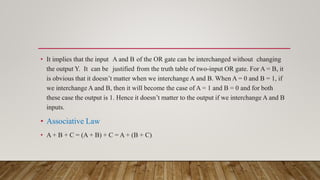
• It implies that the input A and B of the OR gate can be interchanged without changing
the output Y. It can be justified from the truth table of two-input OR gate. For A = B, it
is obvious that it doesn’t matter when we interchange A and B. When A = 0 and B = 1, if
we interchange A and B, then it will become the case of A = 1 and B = 0 and for both
these case the output is 1. Hence it doesn’t matter to the output if we interchange A and B
inputs.
• Associative Law
• A + B + C = (A + B) + C = A + (B + C)
BOOLEAN FUNCTION
• A Boolean function has:
• At least one Boolean variable,
• At least one Boolean operator, and
• At least one input from the set {0,1}.
• It produces an output that is also a member of the set {0,1}.
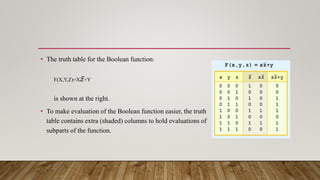
• The truth table for the Boolean function:
F(X,Y,Z)=X 𝑧+Y
is shown at the right.
• To make evaluation of the Boolean function easier, the truth
table contains extra (shaded) columns to hold evaluations of
subparts of the function.
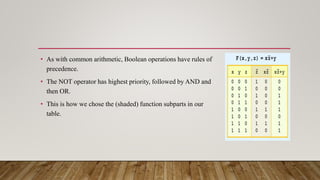
• As with common arithmetic, Boolean operations have rules of
precedence.
• The NOT operator has highest priority, followed by AND and
then OR.
• This is how we chose the (shaded) function subparts in our
table.
• Digital computers contain circuits that implement Boolean functions.
• The simpler that we can make a Boolean function, the smaller the circuit that will result.
• Simpler circuits are cheaper to build, consume less power, and run faster than
complex circuits.
• With this in mind, we always want to reduce our Boolean functions to their simplest form.
• There are a number of Boolean identities that help us to do this.
DE MORGAN'S THEOREM
• Sometimes it is more economical to build a circuit using the complement of a function
(and complementing its result) than it is to implement the function directly.
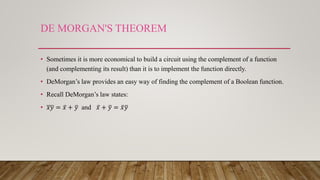
• DeMorgan’s law provides an easy way of finding the complement of a Boolean function.
• Recall DeMorgan’s law states:
• 𝑥𝑦 = 𝑥 + 𝑦 and 𝑥 + 𝑦 = 𝑥 𝑦
• DeMorgan’s law can be extended to any number of variables.
• Replace each variable by its complement and change all ANDs to ORs and all ORs to
ANDs.
• Thus, we find the the complement of:
𝐹 𝑋, 𝑌, 𝑍 = (𝑋𝑌)+( 𝑥𝑍) + 𝑌 𝑧)
𝐹 𝑋, 𝑌, 𝑍 = 𝑥𝑦 + 𝑥𝑧 + 𝑦 𝑧
= 𝑥𝑦 𝑥𝑧 𝑦 𝑧
= 𝑥 + 𝑦 𝑥 + 𝑍 𝑦 + 𝑧
LOGIC GATES
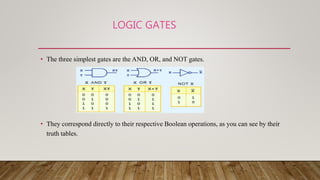
• The three simplest gates are the AND, OR, and NOT gates.
• They correspond directly to their respective Boolean operations, as you can see by their
truth tables.
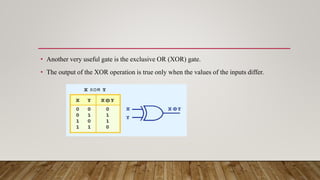
• Another very useful gate is the exclusive OR (XOR) gate.
• The output of the XOR operation is true only when the values of the inputs differ.
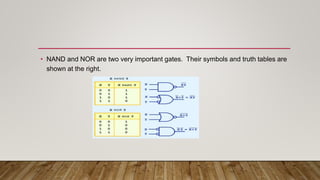
• NAND and NOR are two very important gates. Their symbols and truth tables are
shown at the right.
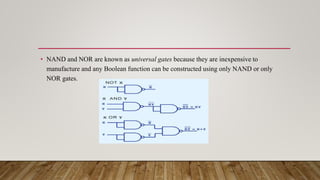
• NAND and NOR are known as universal gates because they are inexpensive to
manufacture and any Boolean function can be constructed using only NAND or only
NOR gates.
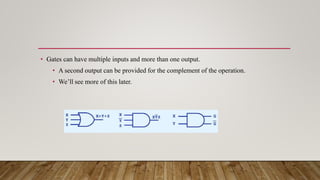
• Gates can have multiple inputs and more than one output.
• A second output can be provided for the complement of the operation.
• We’ll see more of this later.
CHARACTERISTICS OF LOGIC FAMILIES
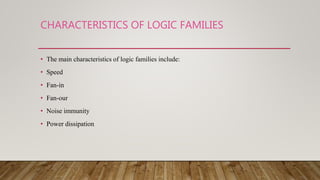
• The main characteristics of logic families include:
• Speed
• Fan-in
• Fan-our
• Noise immunity
• Power dissipation
• Speed:speed of a logic circuits is determined by the time between the application of input
and change in the output of the circuits.
• Fan-in:It determines the number of inputs the logic gate can handle.
• Fan-out:Determines the number of circuits that a gate can drive.
• Noisy immunity:Maximum noise that a circuit can withstand without affecting the output.
• Power:When a circuit switches from one state to other ,power dissipates.
BIPOLAR FAMILIES
• Bipolar transistors are fabricated on a chip in digital integrated circuits.
• Bipolar technology is preferred for SSI[Small scale integrated]and MS[Medium scale
integration]because it is faster.
• TYPES OF BIPOLAR FAMILIES:
• Diode Logic(DL)
• Register Transistor Logic(RTL)
• Diode Transistor Logic
• Transistor-Transistor Logic
DIODE LOGIC
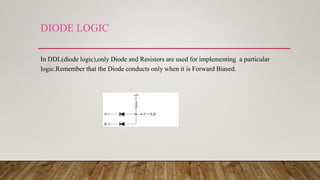
In DDL(diode logic),only Diode and Resistors are used for implementing a particular
logic.Remember that the Diode conducts only when it is Forward Biased.
• DISADVANTAGES OF DIODE LOGIC:
• Diode Logic suffers from voltage degradation from one stage to the next.
• Diode Logic only permits OR and AND functions.
RESISTOR TRANSISTOR LOGIC
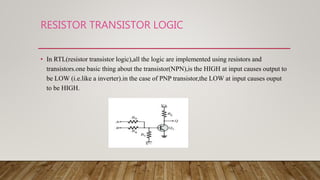
• In RTL(resistor transistor logic),all the logic are implemented using resistors and
transistors.one basic thing about the transistor(NPN),is the HIGH at input causes output to
be LOW (i.e.like a inverter).in the case of PNP transistor,the LOW at input causes ouput
to be HIGH.
• ADVANTAGE:
• Less number of transistors
• DISADVANTAGES:
• High power dissipation
• Low fan in
DIODE TRANSISTOR LOGIC
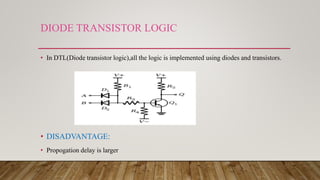
• In DTL(Diode transistor logic),all the logic is implemented using diodes and transistors.
• DISADVANTAGE:
• Propogation delay is larger
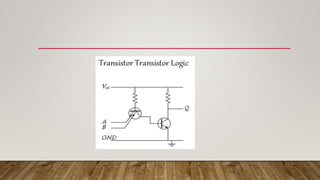
TRANSISTOR TRANSISTOR LOGIC
• The first transistor-transistor logic family of integrated circuits was introduced by
Sylvania as Sylvania universal high-level logic(SUHL)in 1963 Texas instruments
introduced 7400 series TTL family in 1964.
• Transistor –transistor logic uses bipolar transistor to form its integrated circuits.
• TTL has changed significantly over the years,with newer versions replacing the old types.
INTEGRATED CIRCUITS
• When integrated circuits are used,one or more complete gates or other circuits are
packaged in a single integrated –circuits(IC)container.
• The IC containers provide input and output pins or connections,which or then
interconnected by plated strips on circuit boards,wires,or other means.to form complete
computing devices.
• There are two basic techniques for manufacturing ICs-bipolar and metal-oxide
semiconductor(MOS).
THANK YOU

Logic gates and circuits

  • 1.
  • 2.
    OBJECTIVES • Understand therelationship between Boolean logic and digital computer circuits. • Learn how to design simple logic circuits. • Understand how digital circuits work together to form complex computer systems.
  • 3.
    INTRODUCTION • In thelatter part of the nineteenth century, George Boole incensed philosophers and mathematicians alike when he suggested that logical thought could be represented through mathematical equations. • How dare anyone suggest that human thought could be encapsulated and manipulated like an algebraic formula? • Computers, as we know them today, are implementations of Boole’s Laws of Thought. • John Atanasoff and Claude Shannon were among the first to see this connection.
  • 4.
    • In themiddle of the twentieth century, computers were commonly known as “thinking machines” and “electronic brains.” • Many people were fearful of them. • Nowadays, we rarely ponder the relationship between electronic digital computers and human logic. Computers are accepted as part of our lives. • Many people, however, are still fearful of them. • In this chapter, you will learn the simplicity that constitutes the essence of the machine.
  • 5.
    BOOLEAN ALGEBRA • Booleanalgebra is a mathematical system for the manipulation of variables that can have one of two values. • In formal logic, these values are “true” and “false.” • In digital systems, these values are “on” and “off,” 1 and 0, or “high” and “low.” • Boolean expressions are created by performing operations on Boolean variables. • Common Boolean operators include AND, OR, and NOT.
  • 6.
    AND, OR OPERATION •A Boolean operator can be completely described using a truth table. • The truth table for the Boolean operators AND and OR are shown at the right. • The AND operator is also known as a Boolean product. The OR operator is the Boolean sum.
  • 7.
    NOT OPERATION • Thetruth table for the Boolean NOT operator is shown at the right. • The NOT operation is most often designated by an overbar. It is sometimes indicated by a prime mark ( ‘ ) or an “elbow” ().
  • 8.
    FUNDAMENTAL LAWS •Associative laws •(A+ B)+ C = A+ (B + C) •(AB)C = A (BC) • Distributive laws •A (B + C) = AB + AC
  • 9.
    •Related identities •(A +AB)= A •(A + B)= A+ B •(A+B)• (A+C) =(A+BC) •Commutative Law •A + B = B + A
  • 10.
    • It impliesthat the input A and B of the OR gate can be interchanged without changing the output Y. It can be justified from the truth table of two-input OR gate. For A = B, it is obvious that it doesn’t matter when we interchange A and B. When A = 0 and B = 1, if we interchange A and B, then it will become the case of A = 1 and B = 0 and for both these case the output is 1. Hence it doesn’t matter to the output if we interchange A and B inputs. • Associative Law • A + B + C = (A + B) + C = A + (B + C)
  • 11.
    BOOLEAN FUNCTION • ABoolean function has: • At least one Boolean variable, • At least one Boolean operator, and • At least one input from the set {0,1}. • It produces an output that is also a member of the set {0,1}.
  • 12.
    • The truthtable for the Boolean function: F(X,Y,Z)=X 𝑧+Y is shown at the right. • To make evaluation of the Boolean function easier, the truth table contains extra (shaded) columns to hold evaluations of subparts of the function.
  • 13.
    • As withcommon arithmetic, Boolean operations have rules of precedence. • The NOT operator has highest priority, followed by AND and then OR. • This is how we chose the (shaded) function subparts in our table.
  • 14.
    • Digital computerscontain circuits that implement Boolean functions. • The simpler that we can make a Boolean function, the smaller the circuit that will result. • Simpler circuits are cheaper to build, consume less power, and run faster than complex circuits. • With this in mind, we always want to reduce our Boolean functions to their simplest form. • There are a number of Boolean identities that help us to do this.
  • 15.
    DE MORGAN'S THEOREM •Sometimes it is more economical to build a circuit using the complement of a function (and complementing its result) than it is to implement the function directly. • DeMorgan’s law provides an easy way of finding the complement of a Boolean function. • Recall DeMorgan’s law states: • 𝑥𝑦 = 𝑥 + 𝑦 and 𝑥 + 𝑦 = 𝑥 𝑦
  • 16.
    • DeMorgan’s lawcan be extended to any number of variables. • Replace each variable by its complement and change all ANDs to ORs and all ORs to ANDs. • Thus, we find the the complement of: 𝐹 𝑋, 𝑌, 𝑍 = (𝑋𝑌)+( 𝑥𝑍) + 𝑌 𝑧) 𝐹 𝑋, 𝑌, 𝑍 = 𝑥𝑦 + 𝑥𝑧 + 𝑦 𝑧 = 𝑥𝑦 𝑥𝑧 𝑦 𝑧 = 𝑥 + 𝑦 𝑥 + 𝑍 𝑦 + 𝑧
  • 17.
    LOGIC GATES • Thethree simplest gates are the AND, OR, and NOT gates. • They correspond directly to their respective Boolean operations, as you can see by their truth tables.
  • 18.
    • Another veryuseful gate is the exclusive OR (XOR) gate. • The output of the XOR operation is true only when the values of the inputs differ.
  • 19.
    • NAND andNOR are two very important gates. Their symbols and truth tables are shown at the right.
  • 20.
    • NAND andNOR are known as universal gates because they are inexpensive to manufacture and any Boolean function can be constructed using only NAND or only NOR gates.
  • 21.
    • Gates canhave multiple inputs and more than one output. • A second output can be provided for the complement of the operation. • We’ll see more of this later.
  • 22.
    CHARACTERISTICS OF LOGICFAMILIES • The main characteristics of logic families include: • Speed • Fan-in • Fan-our • Noise immunity • Power dissipation
  • 23.
    • Speed:speed ofa logic circuits is determined by the time between the application of input and change in the output of the circuits. • Fan-in:It determines the number of inputs the logic gate can handle. • Fan-out:Determines the number of circuits that a gate can drive. • Noisy immunity:Maximum noise that a circuit can withstand without affecting the output. • Power:When a circuit switches from one state to other ,power dissipates.
  • 24.
    BIPOLAR FAMILIES • Bipolartransistors are fabricated on a chip in digital integrated circuits. • Bipolar technology is preferred for SSI[Small scale integrated]and MS[Medium scale integration]because it is faster. • TYPES OF BIPOLAR FAMILIES: • Diode Logic(DL) • Register Transistor Logic(RTL) • Diode Transistor Logic • Transistor-Transistor Logic
  • 25.
    DIODE LOGIC In DDL(diodelogic),only Diode and Resistors are used for implementing a particular logic.Remember that the Diode conducts only when it is Forward Biased.
  • 26.
    • DISADVANTAGES OFDIODE LOGIC: • Diode Logic suffers from voltage degradation from one stage to the next. • Diode Logic only permits OR and AND functions.
  • 27.
    RESISTOR TRANSISTOR LOGIC •In RTL(resistor transistor logic),all the logic are implemented using resistors and transistors.one basic thing about the transistor(NPN),is the HIGH at input causes output to be LOW (i.e.like a inverter).in the case of PNP transistor,the LOW at input causes ouput to be HIGH.
  • 28.
    • ADVANTAGE: • Lessnumber of transistors • DISADVANTAGES: • High power dissipation • Low fan in
  • 29.
    DIODE TRANSISTOR LOGIC •In DTL(Diode transistor logic),all the logic is implemented using diodes and transistors. • DISADVANTAGE: • Propogation delay is larger
  • 30.
    TRANSISTOR TRANSISTOR LOGIC •The first transistor-transistor logic family of integrated circuits was introduced by Sylvania as Sylvania universal high-level logic(SUHL)in 1963 Texas instruments introduced 7400 series TTL family in 1964. • Transistor –transistor logic uses bipolar transistor to form its integrated circuits. • TTL has changed significantly over the years,with newer versions replacing the old types.
  • 32.
    INTEGRATED CIRCUITS • Whenintegrated circuits are used,one or more complete gates or other circuits are packaged in a single integrated –circuits(IC)container. • The IC containers provide input and output pins or connections,which or then interconnected by plated strips on circuit boards,wires,or other means.to form complete computing devices. • There are two basic techniques for manufacturing ICs-bipolar and metal-oxide semiconductor(MOS).
  • 33.