Download to read offline
![International Journal of Scientific Research and Engineering Development-– Volume 2 Issue 5, Sep – Oct 2019
Available at www.ijsred.com
ISSN : 2581-7175 ©IJSRED:All Rights are Reserved Page 918
An Approach for Engineering Tuning of PID Controller with a
Highly Oscillating Second Order Process
Georgi Petrov Terziyski
*(Department of Automation, Information and Control Engineering, University of Food Technologies – Plovdiv, Bulgaria
Email: georgi_terziyski@abv.bg)
----------------------------------------************************----------------------------------
Abstract:
An approach is proposed for engineering tuning of PID controller with a highly oscillating second order process. A proposal is
made to solve the problem by solving the characteristic equation of the closed system process-controller. As a result of the high
order system analysis, the PID controller tuning parameters were calculated. The obtained values of the tuning parameters
completely satisfy the set quality requirements of the high order system. A 0% overshoot value is obtained, which is the quality
requirement. From the obtained transient processes of the closed system of process-controller by default and by interference
confirm the set quality requirement, namely 0% overshoot. Therefore, the proposed tuning for a PID controller with a highly
oscillating second order process is suitable for use in the analysis of high order dynamic systems.
Keywords —PID controller, tuning, dynamic system, highly oscillating, second order process
----------------------------------------************************----------------------------------
I. INTRODUCTION
In many industrial processes there are high
fluctuations that are undesirable and a good tuning
of the controller should eliminate this problem.
Hassaan (2013) uses a PIDF controller to solve this
problem, as high fluctuations are largely eliminated.
The transient of the control process it uses has an
overshoot of over 85 %, this value being reduced by
the use of a PIDF controller. It adjusts the controller
by minimizing the amount of absolute error of the
control system [1]. Hassaan (2014) argues that the
use of a PID controller eliminates problems with
highly oscillatory processes, but with less efficiency
than other types of PID controllers [2]. Hassaan
(2014) proposes tuning up a PD controller with
second order processes, many of the control
processes being approximated to second order
models. Here, the attenuation coefficient varies
from 0.05 to 10, as the tuning is to minimize the
square error integral [3]. Raut et al. (2014) presents
the rules for tuning a PID controller for a higher
order system [4]. Ray et al. (2017) presents an
engineering approach to reduce oscillations in a
high order system [5]. Sudha et al. (2016) presents a
classic PID controller for process control in aircraft
systems. Here the PID controller is developed based
on the dynamic and mathematical modeling of the
flying system. Various tuning methods have been
used and simulation of the flight system has been
carried out [6]. Lorenzini et al. (2018) propose the
setting of a PID controller based on forced
oscillations for objects without finite frequency [7].
High order dynamic systems can be obtained in
the following cases [8,9,10]:
process two aperiodic links operating with I-
controller;
process two aperiodic links working with PI-
controller;
process two aperiodic links, working with PID-
controller with perfect differentiation;
process three aperiodic links operating with a P-
controller;
process three aperiodic links, working with a PD-
controller with perfect differentiation;
process oscillating link operating with PD-
controller with perfect differentiation;
process oscillating link operating with a real-time
differentiation first-order PD-controller;
RESEARCH ARTICLE OPEN ACCESS](https://image.slidesharecdn.com/ijsred-v2i5p87-200209151258/85/An-Approach-for-Engineering-Tuning-of-PID-Controller-with-a-Highly-Oscillating-Second-Order-Process-1-320.jpg)
![International Journal of Scientific Research and Engineering Development-– Volume 2 Issue 5, Sep – Oct 2019
Available at www.ijsred.com
ISSN : 2581-7175 ©IJSRED:All Rights are Reserved Page 918
An Approach for Engineering Tuning of PID Controller with a
Highly Oscillating Second Order Process
Georgi Petrov Terziyski
*(Department of Automation, Information and Control Engineering, University of Food Technologies – Plovdiv, Bulgaria
Email: georgi_terziyski@abv.bg)
----------------------------------------************************----------------------------------
Abstract:
An approach is proposed for engineering tuning of PID controller with a highly oscillating second order process. A proposal is
made to solve the problem by solving the characteristic equation of the closed system process-controller. As a result of the high
order system analysis, the PID controller tuning parameters were calculated. The obtained values of the tuning parameters
completely satisfy the set quality requirements of the high order system. A 0% overshoot value is obtained, which is the quality
requirement. From the obtained transient processes of the closed system of process-controller by default and by interference
confirm the set quality requirement, namely 0% overshoot. Therefore, the proposed tuning for a PID controller with a highly
oscillating second order process is suitable for use in the analysis of high order dynamic systems.
Keywords —PID controller, tuning, dynamic system, highly oscillating, second order process
----------------------------------------************************----------------------------------
I. INTRODUCTION
In many industrial processes there are high
fluctuations that are undesirable and a good tuning
of the controller should eliminate this problem.
Hassaan (2013) uses a PIDF controller to solve this
problem, as high fluctuations are largely eliminated.
The transient of the control process it uses has an
overshoot of over 85 %, this value being reduced by
the use of a PIDF controller. It adjusts the controller
by minimizing the amount of absolute error of the
control system [1]. Hassaan (2014) argues that the
use of a PID controller eliminates problems with
highly oscillatory processes, but with less efficiency
than other types of PID controllers [2]. Hassaan
(2014) proposes tuning up a PD controller with
second order processes, many of the control
processes being approximated to second order
models. Here, the attenuation coefficient varies
from 0.05 to 10, as the tuning is to minimize the
square error integral [3]. Raut et al. (2014) presents
the rules for tuning a PID controller for a higher
order system [4]. Ray et al. (2017) presents an
engineering approach to reduce oscillations in a
high order system [5]. Sudha et al. (2016) presents a
classic PID controller for process control in aircraft
systems. Here the PID controller is developed based
on the dynamic and mathematical modeling of the
flying system. Various tuning methods have been
used and simulation of the flight system has been
carried out [6]. Lorenzini et al. (2018) propose the
setting of a PID controller based on forced
oscillations for objects without finite frequency [7].
High order dynamic systems can be obtained in
the following cases [8,9,10]:
process two aperiodic links operating with I-
controller;
process two aperiodic links working with PI-
controller;
process two aperiodic links, working with PID-
controller with perfect differentiation;
process three aperiodic links operating with a P-
controller;
process three aperiodic links, working with a PD-
controller with perfect differentiation;
process oscillating link operating with PD-
controller with perfect differentiation;
process oscillating link operating with a real-time
differentiation first-order PD-controller;
RESEARCH ARTICLE OPEN ACCESS](https://image.slidesharecdn.com/ijsred-v2i5p87-200209151258/75/An-Approach-for-Engineering-Tuning-of-PID-Controller-with-a-Highly-Oscillating-Second-Order-Process-1-2048.jpg)
![International Journal of Scientific Research and Engineering Development-– Volume 2 Issue 5, Sep – Oct 2019
Available at www.ijsred.com
ISSN : 2581-7175 ©IJSRED: All Rights are Reserved Page 919
process oscillating link operating with PID-
controller with ideal differentiation.
PROBLEMS WITH THE TUNING OF
CONTROLLERS IN HIGH ORDER
SYSTEMS
Higher order dynamic systems are often used in
industrial automation systems for a variety of
production processes, but due to their complexity,
few authors have attempted to do theoretical
research on them [1-9]. The complexity is that the
roots of the characteristic equation of the closed
ACS ( automatic control system) is three, and it is
not clear how the third real root influences the
stability of the system, and hence the indicators of
quality of the transitional processes.
POSSIBLE OPTIONS FOR SOLUTION OF
THE ASSIGNED TASK
In analyzing high order dynamic systems, the
determination of dependencies between quality
indicators and system parameters is considerably
more complicated. One of the possible options for
solving the task is through the use of
Prof.Vishnegradski's diagram [8].
Other possible options for solving this task are by
using Ziegler &Nicols first method, Koppelovich's
nomograms andnomograms given in [10]. These are
methods for determining the parameters for
adjusting the controllers by known data for the
transitional characteristic of the control process
[8,9,10].
The purpose of this paper is to offer an
engineering tuning of a proportional-integral-
differential PID-controller with a highly oscillating
second order process by solving the characteristic
equation of the closed system (process-controller).
PROPOSAL FOR SOLVING THE PROBLEM
BY SOLVING THE CHARACTERISTIC
EQUATION
Figure 1 shows the structural diagram of a ACS
comprising a oscillating second order process and a
PID-controller.
++= sT
sT
ksW pp d
i
1
1)(
12
)( 22
++
=
sTsT
k
sW
обоб
об
ζ
об
Fig. 1. A system with a oscillating second order
process and a PID-controller
The transfer function of the closed system (fig.1)
regarding the assignment is the type
( )
( )
( ) ( ) )1(.
1
12
1
1
12
1
12
)()(1
)().(
)(
)(
)(
23
2
2
2
2
2
2
+
+
+
+
+
++
=
=
++
⋅
++
++
⋅
++
=
=
⋅+
==
s
kk
Tkk
s
kk
TTkkT
s
kk
TT
sTsTT
sT
sTsTT
k
sTs
k
sT
sTsTT
k
sTs
k
sWsW
sWsW
sY
sY
sW
p
p
p
idpоб
p
iоб
id
id
p
об
об
id
p
об
об
p
p
зад
об
об
об
об
об
об
об
зад
i
i
i
i
2
об
i
i
2
об
T
+1
T
ζ
ζ
ζ
The transfer function of the closed system (fig.1)
regarding the disturbance is the type
( )
( )
( ) ( ) )2(.
1
12
1
12
12
)()(1
)(
)(
)(
)(
23
2
2
2
2
+
+
+
+
+
=
=
++
⋅
++
++
=
=
⋅+
==
s
kk
Tkk
s
kk
TTkkT
s
kk
TT
s
k
T
sT
sTsTT
k
sTs
k
sTs
k
sWsW
sW
sY
sY
sW
p
p
p
idpоб
p
iобp
i
id
p
об
об
об
об
pзад
об
об
об
об
об
об
об
зад
i
i
i
2
об
2
об
T
+1
T
ζ
ζ
ζ
I propose that the analysis of high order dynamic
system be carried out with a successively connected
oscillating and aperiodic link, i.](https://image.slidesharecdn.com/ijsred-v2i5p87-200209151258/85/An-Approach-for-Engineering-Tuning-of-PID-Controller-with-a-Highly-Oscillating-Second-Order-Process-2-320.jpg)
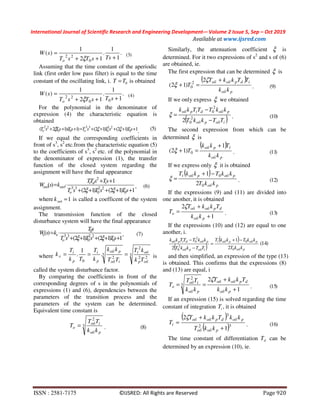
![International Journal of Scientific Research and Engineering Development-– Volume 2 Issue 5, Sep – Oct 2019
Available at www.ijsred.com
ISSN : 2581-7175 ©IJSRED: All Rights are Reserved Page 921
( )
ip
piобp
d
Tkk
kkTTTkkT
T
об
обоб
2
0
2
02 +−
=
ξ
)17(
The proportionality coefficient of the controller
pk can be determined by an expression (11), ie.
( )[ ]i
i
p
TTk
T
k
−+
=
012ξоб
)18(
The transitional process is given with a highly
oscillating second order process. The following
algorithm performs the following:
Take the transitional process of the control
process that is smooth and normalizing.
After identification (fig.2), it is determined:
4,0=обk , 5.19=обT sec and 05,0=ζ . The transfer
function of the control process is :
( )
144,05,19
4,0
2
++
=
ss
sWоб .
Fig. 2.Transitional process of the control process
By the expressions (16), (17) and (18), the tuning
parameters of the PID-controller are calculated
using the next procedure.
First, calculate the value of oT , at a set value of
обT and обk , where iT and pk are arbitrary values, ie
71,4
2,2.4,0
7,4.42,43
2
3
2
===
p
iоб
o
kk
TT
T
об
sec.
It is then calculated pk at the same setpointof iT ,
ie
( )[ ]
43,24
7,471,4.105,0.2.4,0
7,4
=
−+
=pk .
Then calculate the value of dT again at the same
set value of iT
( ) 15,5
7,4.43,24.4,0
43,24.4,0.71,47,4.42,443,24.4,0.71,405,0.2 22
=
+−
=dT
sec.
Finally iT is calculated
( )
( )
36,52
143,24.4,0.42,4
43,24.4,0.15,5.43,24.4,042,4.05,0.2
32
3
=
+
+
=iT
sec.
Fig. 3.Transitional processes by assignment and
by disturbance.
CONCLUSIONS](https://image.slidesharecdn.com/ijsred-v2i5p87-200209151258/85/An-Approach-for-Engineering-Tuning-of-PID-Controller-with-a-Highly-Oscillating-Second-Order-Process-4-320.jpg)
![International Journal of Scientific Research and Engineering Development-– Volume 2 Issue 5, Sep – Oct 2019
Available at www.ijsred.com
ISSN : 2581-7175 ©IJSRED: All Rights are Reserved Page 922
An approach is proposed for engineering tuning
of PID controller with a highly oscillating second
order process. A proposal is made to solve the
problem by solving the characteristic equation of
the closed system process-controller. As a result of
the high order system analysis, the PID controller
tuning parameters were calculated. The obtained
values of the tuning parameters completely satisfy
the set quality requirements of the high order
system. A 0% overshoot value is obtained, which is
the quality requirement. From the obtained transient
processes of the closed system of process-controller
by default and by interference confirm the set
quality requirement, namely 0% overshoot.
Therefore, the proposed tuning for a PID controller
with a highly oscillating second order process is
suitable for use in the analysis of high order
dynamic systems.
REFERENCES
[1] G. Hassaan and A. Mohammed, M. Lashin, Tuning of a PIDF
Controller Used With a Highly Oscillating Second Order Process,
International Journal of Emerging Technology and Advanced
Engineering, Volume 3, Issue 3, pp. 943-945, 2013.
[2] G. Hassaan, Tuning Of A PID With First-Order-Lag Controller Used
With A Highly Oscillating Second-Order Process, International Journal
of Scientific & Technology Reesearch, Volume 3, Issue 9, pp. 314-317,
2014.
[3] G. Hassaan, Tuning of a PD-controller used with Second Order
Processes, International Journal of Engineering and Technical
Research, Volume 2, Issue 7, pp. 120-122, 2014.
[4] K. Raut and S. Vaishnav, Performance Analysis of PID Tuning
Techniques based on Time Response specification, International
Journal of Innovative Research in Electrical, Electronics,
Instrumentation and Control Engineering, Volume 2, Issue 1, pp. 616-
619, 2014.
[5] S. Ray and Md. Rahman and Md. Ahmed, Tuning of PI and PID
Controller with STATCOM, SSSC and UPFC for Minimizing
Damping of Oscillation, IOSR Journal of Electrical and Electronics
Engineering, Volume 12, Issue 1, pp. 30-44, 2017.
[6] G. Sudha and S. Deepa, Optimization for PID Control Parameters on
Pitch Control of Aircraft Dynamics Based on Tuning Methods,
International Journal of Applied Mathematics & Information Sciences,
Volume 10, Issue 1, pp. 343-350, 2016.
[7] C. Lorenzini and A. Bazanella, L. Pereira, PID Tuning Based on
Forced Oscillation for Plants Without Ultimate Frequency, IFAC
Conference, Volume 51, Issue 4, pp. 131-136, 2018.
[8] N. Naplatanov, Theory of Automatic Control - Volume 1, Linear
Systems, "Technika", Sofia, pp. 226-229, 1976 (in Bulgarian).
[9] H. Hinov and S. Tsonkov et al. Automation of production - part 2.
Automation of technological processes, "Technika", Sofia, pp. 170-173,
1978 (in Bulgarian).
[10] I. Dragotinov and I. Ganchev, Automation of technological processes,
UFT, Plovdiv, pp. 182-192, 2003 (in Bulgarian).
[11] H. Patel and S. Chaphekar, Developments in PID Controllers:
Literature Survey, International Journal of Engineering Innovation &
Research, Volume 1, Issue 5, pp. 425-430, 2012.
[12] J. Rana and R. Prasad, R. Agarwal, Designing of a Controller by Using
Model Order Reduction Techniques, International Journal of
Engineering Innovation & Research, Volume 5, Issue 3, pp. 220-223,
2016.](https://image.slidesharecdn.com/ijsred-v2i5p87-200209151258/85/An-Approach-for-Engineering-Tuning-of-PID-Controller-with-a-Highly-Oscillating-Second-Order-Process-5-320.jpg)

This document proposes an engineering approach to tune a PID controller for a highly oscillating second order process. The approach involves solving the characteristic equation of the closed loop system (process-controller) to determine the PID tuning parameters. The analysis results in expressions to calculate the time constant of integration, time constant of differentiation, and proportional gain of the PID controller. These tuning parameters completely satisfy the quality requirement of 0% overshoot for the high order system.


![[IJET-V1I3P18] Authors :Galal Ali Hassaan.](https://cdn.slidesharecdn.com/ss_thumbnails/ijet-v1i3p18-150629060030-lva1-app6892-thumbnail.jpg?width=640&height=640&fit=bounds)


