International Journal of Scientific Research and Engineering Development-– Volume 3 - Issue 5, Sep - Oct 2020
Available at www.ijsred.com
ISSN : 2581-7175 ©IJSRED: All Rights are Reserved Page 175
Quantitative and Qualitative Analysis of Plant Leaf Disease
Sugantha. H*, Dr.D.Jeyakumari**, R.Kannan***
*(PG Student, Dept. of ECE, RVS College of Engineering & Technology, Coimbatore, India)
** (Professor, Dept. of ECE, RVS College of Engineering & Technology, Coimbatore, India)
*** (Assistant Professor, Dept. of ECE, RVS College of Engineering & Technology, Coimbatore, India)
----------------------------------------************************----------------------------------
Abstract:
Plant disease detection is very important because agriculture is the backbone of the country like India.
Crops and plantations get destroyed mainly due to two major reasons, first reason is destruction by natural
calamities and second reason is the destruction by the pathogens such as viral, bacterial and fungal.
Through naked eye farmers could not detect the type of plant disease. To overcome this a technique is
developed in which plant disease is detected using image processing technique. Disease detection begins
with image acquisition. The input image is then converted into gray image by the library function. This is
followed by filtering where median filter is used to remove the noise and smoothening of the image. The
next process is feature extraction done with GLCM. K-means clustering and GLCM algorithm would
generate the features from the images. This is proceeded with enhancement. Here adaptive histogram
equalization is involved. Then segmentation is performed based on some common properties of the objects
present in an image like color, texture and, shape etc. Finally, the disease and area of the affected region in
the leaf is found.
Keywords —Leaf disease identification, SVM, GLCM, Quality Analysis, Segmentation
----------------------------------------************************----------------------------------
I. INTRODUCTION
In several parts of the world, a great challenge
to plant growth and crop production is plant
diseases which affect the plants by interfering with
several processes such as plant growth, flower &
fruit development, absorbance and translocation of
water and nutrients, photosynthesis, and cell
division and enlargement. Plant diseases can be
caused by different types of fungi, bacteria,
phytoplasma, viruses and other agents. The severity
of diseases caused by these pathogens varies from
mild symptoms to decline of the infected plants,
depending on the aggressiveness of the pathogen,
host resistance, environmental conditions, duration
of infection and other factors. Plant disease
symptoms vary with the infecting pathogen and the
infected part and can include leaf spots, leaf blights,
root rots, fruit rots, fruit spots, wilt, dieback and
decline.
The scientific study of plant diseases which are
caused by pathogens and other environmental
conditions is termed as Plant pathology. Pathogens
include fungi, oomycetes, bacteria, viruses, viroids,
phytoplasmas, protozoa, nematodes and parasitic
plants. The various steps of Plant pathology include
the study of pathogen identification, disease
etiology, disease cycles, economic impact, plant
disease epidemiology, plant disease resistance, how
plant diseases affect humans and animals.
The important methods used in this project are
K-means clustering, GLCM algorithm and
segmentation using SVM.
RESEARCH ARTICLE OPEN ACCESS
International Journal of Scientific Research and Engineering Development-– Volume X Issue X, Year
Available at www.ijsred.com
ISSN : 2581-7175 ©IJSRED: All Rights are Reserved Page 176
II. PLANT LEAF DISEASES
Organisms that cause infectious disease include
fungi, oomycetes, bacteria, viruses, viroids, virus-
like organisms, phytoplasmas, protozoa, nematodes
and parasitic plants. Symptoms differ based on the
internal and external expression of the disease.
General classification includes local (within a
limited area of host tissue), systemic (reaction of a
greater part or all of the plant), primary (pathogen
activity on invaded tissues), secondary
(physiological effects of disease on distant tissues
and uninvaded organs), microscopic (disease in cell
structure or cell arrangement) or macroscopic
(abnormal effects on host cells, tissues, and organs).
Few diseases with their symptoms and
characteristics are explained below;
A. Alternaria Alternata
It is a fungus that causes leaf spots, rots, blights
and other diseases on over 380 host species of plant.
It can also cause upper respiratory tract infections
and asthma in humans.
Fig. 1. Example of Alternaria Alternata
B. Anthracnose
It is a fungus that causes leaf spots, rots, blights
and other diseases on over 380 host species of plant.
It can also cause upper respiratory tract infections
and asthma in humans.
Fig. 2. Example of Anthracnose
C. Bacterial blight
It is a disease caused by the bacterial pathogen
Xanthomonas campestris which is characterized by
small, pale green spots or streaks which soon
appear water-soaked. Infections are spread by
splashing of bacterial ooze by rain drops, plant to
plant contact and insects. This develops on the
upper leaves during cold and wet weather.
Fig. 3. Example of Bacterial blight
D. Cercospora Leaf Spot
It is a common disease in beetroot, capsicum,
carrot, avocado and coffee crops. It causes small,
brown flecks develop with a reddish border, round
water-soaked lesions on leaves, petioles and stems.
This tissue also becomes thin and brittle.
Fig. 4. Example of Cercospora Leaf Spot
International Journal of Scientific Research and Engineering Development-– Volume X Issue X, Year
Available at www.ijsred.com
ISSN : 2581-7175 ©IJSRED: All Rights are Reserved Page 177
III. EXISTING SYSTEM
An automatic soft computing approach
BRBFNN for identification and classification of
disease from plant leaves. The proposed method
uses Bacterial Foraging Optimization (BFO) to
assign optimal weight to Radial Basis Function
Neural Network (RBFNN) and to find the optimal
region for the different disease present on the plant
leaves. The efficiency of the Radial Basis Function
Neural Network is further enhanced by using region
growing method searching for seed points and
grouping them having similar attributes that help in
feature extraction process.[1]
Fig. 5. Methodology for the existing work
IV. PROPOSED SYSTEM
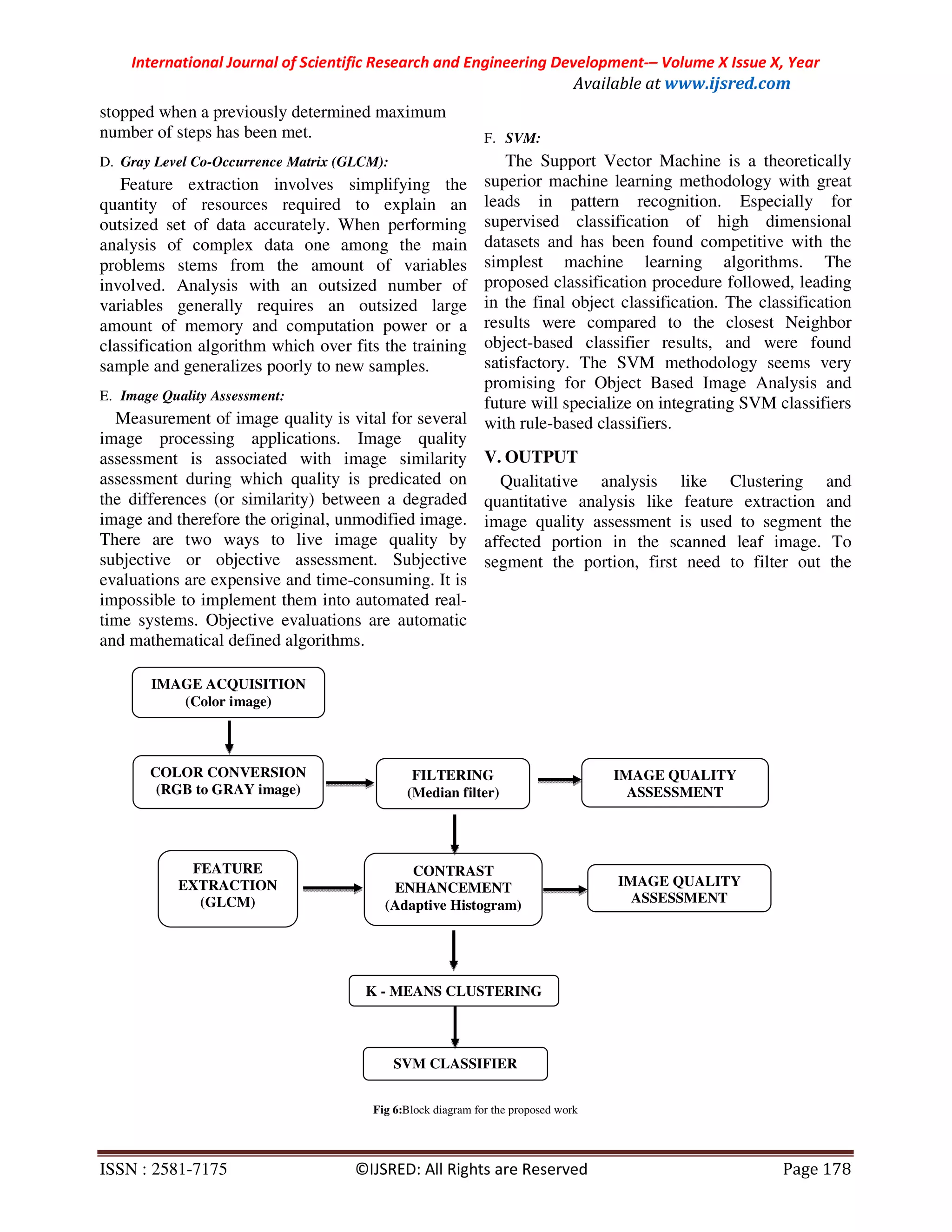
The proposed method includes various
techniques such as changing image size, filtering of
noise, image conversion, enhancing image. K-means
clustering method partitions the images into clusters
in such a way that at least one part of cluster
contains an image with major area of affected part.
GLCM has been used extensively in the field of
image processing. It has been for texture analysis in
gray scale as well as color texture recognition. The
different methods implemented in this project within
MATLAB are been explained below.
A. Median filter
The input image is pre-processed by the median
filter for better results. The main idea of the median
filter is to run through the signal entry by entry,
replacing each entry with the median of
neighboring entries referred as window pattern.
B. Adaptive Histogram Equalization
AHE improves the local contrast and
enhances the definitions of edge in each region of
an image. AHE features a tendency to overamplify
noise in relatively homogeneous regions of an
image. A variant of adaptive histogram equalization
called contrast limited adaptive histogram
equalization (CLAHE) prevents this by limiting the
amplification. Each pixel is transformed supported
on the histogram of a square surrounding the pixel.
The transformation function is proportional to the
cumulative distribution function (CDF) of pixel
values in within the neighbourhood.
C. K Means Clustering:
K-Means starts by randomly defining k centroids.
From there, it works in iterative (repetitive) steps to
perform two tasks:
1. Assign each data point to the closest
corresponding centroid, using the standard
Euclidean distance. In layman’s terms: the
straight-line distance between the data point
and the centroid.
2. For each centroid, calculate the mean of the
values of all the points belonging to it. The
mean value becomes the new value of the
centroid.
Once step 2 is complete, all of the centroids
have new values that correspond to the means of all
of their corresponding points. These new points are
put through steps one and two producing yet one
more set of centroid values. This process is repeated
over and over until there is no change with in the
centroid values, meaning that they need been
accurately grouped. Or, the method are often
International Journal of Scientific Research and Engineering Development-– Volume X Issue X, Year
Available at www.ijsred.com
ISSN : 2581-7175 ©IJSRED: All Rights are Reserved Page 178
stopped when a previously determined maximum
number of steps has been met.
D. Gray Level Co-Occurrence Matrix (GLCM):
Feature extraction involves simplifying the
quantity of resources required to explain an
outsized set of data accurately. When performing
analysis of complex data one among the main
problems stems from the amount of variables
involved. Analysis with an outsized number of
variables generally requires an outsized large
amount of memory and computation power or a
classification algorithm which over fits the training
sample and generalizes poorly to new samples.
E. Image Quality Assessment:
Measurement of image quality is vital for several
image processing applications. Image quality
assessment is associated with image similarity
assessment during which quality is predicated on
the differences (or similarity) between a degraded
image and therefore the original, unmodified image.
There are two ways to live image quality by
subjective or objective assessment. Subjective
evaluations are expensive and time-consuming. It is
impossible to implement them into automated real-
time systems. Objective evaluations are automatic
and mathematical defined algorithms.
F. SVM:
The Support Vector Machine is a theoretically
superior machine learning methodology with great
leads in pattern recognition. Especially for
supervised classification of high dimensional
datasets and has been found competitive with the
simplest machine learning algorithms. The
proposed classification procedure followed, leading
in the final object classification. The classification
results were compared to the closest Neighbor
object-based classifier results, and were found
satisfactory. The SVM methodology seems very
promising for Object Based Image Analysis and
future will specialize on integrating SVM classifiers
with rule-based classifiers.
V. OUTPUT
Qualitative analysis like Clustering and
quantitative analysis like feature extraction and
image quality assessment is used to segment the
affected portion in the scanned leaf image. To
segment the portion, first need to filter out the
Fig 6:Block diagram for the proposed work
IMAGE ACQUISITION
(Color image)
FEATURE
EXTRACTION
(GLCM)
COLOR CONVERSION
(RGB to GRAY image)
FILTERING
(Median filter)
IMAGE QUALITY
ASSESSMENT
CONTRAST
ENHANCEMENT
(Adaptive Histogram)
IMAGE QUALITY
ASSESSMENT
K - MEANS CLUSTERING
SVM CLASSIFIER
International Journal of Scientific Research and Engineering Development-– Volume X Issue X, Year
Available at www.ijsred.com
ISSN : 2581-7175 ©IJSRED: All Rights are Reserved Page 179
acquired image based upon masking methodology.
The clustering function are to be applied throughout
the filtered image. By the tactic of morphological
bounding, box will be drawn over the affected
portion. Then the region enclosed by bounding box
will be segregated separately. After filtering and
contrast enhancement, image quality assessment is
calculated to match other techniques. Then the
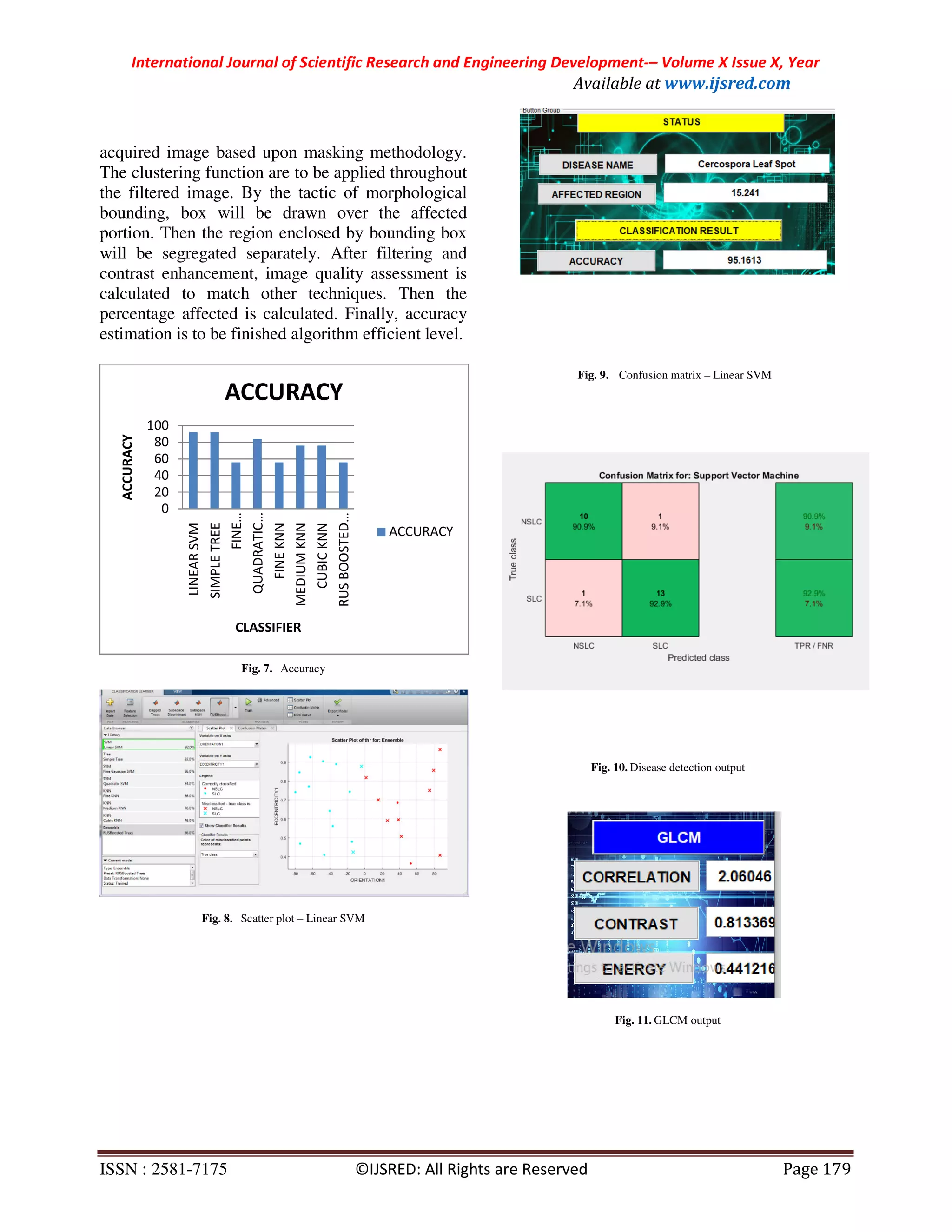
percentage affected is calculated. Finally, accuracy
estimation is to be finished algorithm efficient level.
Fig. 7. Accuracy
Fig. 8. Scatter plot – Linear SVM
Fig. 9. Confusion matrix – Linear SVM
Fig. 10. Disease detection output
Fig. 11. GLCM output
0
20
40
60
80
100
LINEARSVM
SIMPLETREE
FINE…
QUADRATIC…
FINEKNN
MEDIUMKNN
CUBICKNN
RUSBOOSTED…
ACCURACY
CLASSIFIER
ACCURACY
ACCURACY
International Journal of Scientific Research and Engineering Development-– Volume X Issue X, Year
Available at www.ijsred.com
ISSN : 2581-7175 ©IJSRED: All Rights are Reserved Page 180
Fig. 12. Image quality assessment results
VI. CONCLUSION
In this paper, the detection and classification
of plant leaf disease is made by means if KNN
techniques, segmentation and detection by means of
intensity computation, thresholding and features
extraction. The diseases are classified with the help
of SVM and were able to distinguish between four
different types of grading level with an average
accuracy of 94.17%. As an extension of our work, it
is suggested to identify and classify various stages
of plant diseases and different diseases caused by
bacteria and virus.
REFERENCES
[1] Siddharth Singh Chouhan, Uday Pratap Singh, Sanjeev Jain. (2018),
“Bacterial foraging optimization based Radial Basis Function Neural
Network (BRBFNN) for identification and classification of plant leaf
diseases: An automatic approach towards Plant Pathology”, IEEE, Vol.
06, pp 8852 – 8863.
[2] Arivazhagan, S., R. Newlin Shebiah, S. Ananthi, and S. Vishnu Varthin.
“Detection of unhealthy region of plant leaves and classification of plant
leaf diseases using texture features.” Agriculture Engineering
International: CIGR Journal 15, No.1 (2013): 211–217.
[3] Xihai zhang, Yue qiao, Fanfeng meng.(2018), “Identification Of Maize
AND Leaf Diseases Using Convolutional Neural Network”, IEEE, Vol.
06, pp 30370 – 30377.
[4] Sushil R. Kamlapurkar. (2016), “Detection of Plant Leaf Disease Using
Image Processing Approach”, IJSRP, Vol. 6, No. 02, pp 73 – 76.
[5] Ayesha .L Tilwani , Prof. Devang G. Jani.(2017), “Disease Detection in
Leaves using Image Processing Techniques”, IRJET, Vol 04, pp 1639 –
1642.
[6] Mr. Sanjay Mirchandani, Mihir Pendse, Prathamesh Rane, Ashwini
Vedula.(2018), “Plant disease detection and classification using image
processing and artificial neural networks”, IRJET, Vol. 05, No.06.
[7] Dr. S. K. Jayanthi, C.Lalitha. (2017), “Betel Leaf Disease Detection
Using Histogram of Oriented Gradients and Multiclass SVM”, IRJET,
Vol. 05, No.08.
[8] N.Neelaveni, S. Rajeswari. (2016), “Paddy Leaf Disease Detection
Classification and Remedy Finder Using K means Clustering and Image
Mining”, Vol. 04 No 12.
[9] Shweta.S. Kothawale, S.R.Barbade, Pradnya .P.Mirajkar. (2018),
“Grape Leaf Disease Detection Using SVM Classifie”, IRJET, Vol. 06,
No.04.
[10] Nikhil Govinda Dhakad, Umesh Shyamkant Yewale, Tejal Yuvraj Patil,
Gayatri Avinash Deore, (2018), “Leaf disease detection using Image
Processing”, IRJET, Vol.05, No.12.

Quantitative and Qualitative Analysis of Plant Leaf Disease

  • 1.
    International Journal ofScientific Research and Engineering Development-– Volume 3 - Issue 5, Sep - Oct 2020 Available at www.ijsred.com ISSN : 2581-7175 ©IJSRED: All Rights are Reserved Page 175 Quantitative and Qualitative Analysis of Plant Leaf Disease Sugantha. H*, Dr.D.Jeyakumari**, R.Kannan*** *(PG Student, Dept. of ECE, RVS College of Engineering & Technology, Coimbatore, India) ** (Professor, Dept. of ECE, RVS College of Engineering & Technology, Coimbatore, India) *** (Assistant Professor, Dept. of ECE, RVS College of Engineering & Technology, Coimbatore, India) ----------------------------------------************************---------------------------------- Abstract: Plant disease detection is very important because agriculture is the backbone of the country like India. Crops and plantations get destroyed mainly due to two major reasons, first reason is destruction by natural calamities and second reason is the destruction by the pathogens such as viral, bacterial and fungal. Through naked eye farmers could not detect the type of plant disease. To overcome this a technique is developed in which plant disease is detected using image processing technique. Disease detection begins with image acquisition. The input image is then converted into gray image by the library function. This is followed by filtering where median filter is used to remove the noise and smoothening of the image. The next process is feature extraction done with GLCM. K-means clustering and GLCM algorithm would generate the features from the images. This is proceeded with enhancement. Here adaptive histogram equalization is involved. Then segmentation is performed based on some common properties of the objects present in an image like color, texture and, shape etc. Finally, the disease and area of the affected region in the leaf is found. Keywords —Leaf disease identification, SVM, GLCM, Quality Analysis, Segmentation ----------------------------------------************************---------------------------------- I. INTRODUCTION In several parts of the world, a great challenge to plant growth and crop production is plant diseases which affect the plants by interfering with several processes such as plant growth, flower & fruit development, absorbance and translocation of water and nutrients, photosynthesis, and cell division and enlargement. Plant diseases can be caused by different types of fungi, bacteria, phytoplasma, viruses and other agents. The severity of diseases caused by these pathogens varies from mild symptoms to decline of the infected plants, depending on the aggressiveness of the pathogen, host resistance, environmental conditions, duration of infection and other factors. Plant disease symptoms vary with the infecting pathogen and the infected part and can include leaf spots, leaf blights, root rots, fruit rots, fruit spots, wilt, dieback and decline. The scientific study of plant diseases which are caused by pathogens and other environmental conditions is termed as Plant pathology. Pathogens include fungi, oomycetes, bacteria, viruses, viroids, phytoplasmas, protozoa, nematodes and parasitic plants. The various steps of Plant pathology include the study of pathogen identification, disease etiology, disease cycles, economic impact, plant disease epidemiology, plant disease resistance, how plant diseases affect humans and animals. The important methods used in this project are K-means clustering, GLCM algorithm and segmentation using SVM. RESEARCH ARTICLE OPEN ACCESS
  • 2.
    International Journal ofScientific Research and Engineering Development-– Volume X Issue X, Year Available at www.ijsred.com ISSN : 2581-7175 ©IJSRED: All Rights are Reserved Page 176 II. PLANT LEAF DISEASES Organisms that cause infectious disease include fungi, oomycetes, bacteria, viruses, viroids, virus- like organisms, phytoplasmas, protozoa, nematodes and parasitic plants. Symptoms differ based on the internal and external expression of the disease. General classification includes local (within a limited area of host tissue), systemic (reaction of a greater part or all of the plant), primary (pathogen activity on invaded tissues), secondary (physiological effects of disease on distant tissues and uninvaded organs), microscopic (disease in cell structure or cell arrangement) or macroscopic (abnormal effects on host cells, tissues, and organs). Few diseases with their symptoms and characteristics are explained below; A. Alternaria Alternata It is a fungus that causes leaf spots, rots, blights and other diseases on over 380 host species of plant. It can also cause upper respiratory tract infections and asthma in humans. Fig. 1. Example of Alternaria Alternata B. Anthracnose It is a fungus that causes leaf spots, rots, blights and other diseases on over 380 host species of plant. It can also cause upper respiratory tract infections and asthma in humans. Fig. 2. Example of Anthracnose C. Bacterial blight It is a disease caused by the bacterial pathogen Xanthomonas campestris which is characterized by small, pale green spots or streaks which soon appear water-soaked. Infections are spread by splashing of bacterial ooze by rain drops, plant to plant contact and insects. This develops on the upper leaves during cold and wet weather. Fig. 3. Example of Bacterial blight D. Cercospora Leaf Spot It is a common disease in beetroot, capsicum, carrot, avocado and coffee crops. It causes small, brown flecks develop with a reddish border, round water-soaked lesions on leaves, petioles and stems. This tissue also becomes thin and brittle. Fig. 4. Example of Cercospora Leaf Spot
  • 3.
    International Journal ofScientific Research and Engineering Development-– Volume X Issue X, Year Available at www.ijsred.com ISSN : 2581-7175 ©IJSRED: All Rights are Reserved Page 177 III. EXISTING SYSTEM An automatic soft computing approach BRBFNN for identification and classification of disease from plant leaves. The proposed method uses Bacterial Foraging Optimization (BFO) to assign optimal weight to Radial Basis Function Neural Network (RBFNN) and to find the optimal region for the different disease present on the plant leaves. The efficiency of the Radial Basis Function Neural Network is further enhanced by using region growing method searching for seed points and grouping them having similar attributes that help in feature extraction process.[1] Fig. 5. Methodology for the existing work IV. PROPOSED SYSTEM The proposed method includes various techniques such as changing image size, filtering of noise, image conversion, enhancing image. K-means clustering method partitions the images into clusters in such a way that at least one part of cluster contains an image with major area of affected part. GLCM has been used extensively in the field of image processing. It has been for texture analysis in gray scale as well as color texture recognition. The different methods implemented in this project within MATLAB are been explained below. A. Median filter The input image is pre-processed by the median filter for better results. The main idea of the median filter is to run through the signal entry by entry, replacing each entry with the median of neighboring entries referred as window pattern. B. Adaptive Histogram Equalization AHE improves the local contrast and enhances the definitions of edge in each region of an image. AHE features a tendency to overamplify noise in relatively homogeneous regions of an image. A variant of adaptive histogram equalization called contrast limited adaptive histogram equalization (CLAHE) prevents this by limiting the amplification. Each pixel is transformed supported on the histogram of a square surrounding the pixel. The transformation function is proportional to the cumulative distribution function (CDF) of pixel values in within the neighbourhood. C. K Means Clustering: K-Means starts by randomly defining k centroids. From there, it works in iterative (repetitive) steps to perform two tasks: 1. Assign each data point to the closest corresponding centroid, using the standard Euclidean distance. In layman’s terms: the straight-line distance between the data point and the centroid. 2. For each centroid, calculate the mean of the values of all the points belonging to it. The mean value becomes the new value of the centroid. Once step 2 is complete, all of the centroids have new values that correspond to the means of all of their corresponding points. These new points are put through steps one and two producing yet one more set of centroid values. This process is repeated over and over until there is no change with in the centroid values, meaning that they need been accurately grouped. Or, the method are often
  • 4.
    International Journal ofScientific Research and Engineering Development-– Volume X Issue X, Year Available at www.ijsred.com ISSN : 2581-7175 ©IJSRED: All Rights are Reserved Page 178 stopped when a previously determined maximum number of steps has been met. D. Gray Level Co-Occurrence Matrix (GLCM): Feature extraction involves simplifying the quantity of resources required to explain an outsized set of data accurately. When performing analysis of complex data one among the main problems stems from the amount of variables involved. Analysis with an outsized number of variables generally requires an outsized large amount of memory and computation power or a classification algorithm which over fits the training sample and generalizes poorly to new samples. E. Image Quality Assessment: Measurement of image quality is vital for several image processing applications. Image quality assessment is associated with image similarity assessment during which quality is predicated on the differences (or similarity) between a degraded image and therefore the original, unmodified image. There are two ways to live image quality by subjective or objective assessment. Subjective evaluations are expensive and time-consuming. It is impossible to implement them into automated real- time systems. Objective evaluations are automatic and mathematical defined algorithms. F. SVM: The Support Vector Machine is a theoretically superior machine learning methodology with great leads in pattern recognition. Especially for supervised classification of high dimensional datasets and has been found competitive with the simplest machine learning algorithms. The proposed classification procedure followed, leading in the final object classification. The classification results were compared to the closest Neighbor object-based classifier results, and were found satisfactory. The SVM methodology seems very promising for Object Based Image Analysis and future will specialize on integrating SVM classifiers with rule-based classifiers. V. OUTPUT Qualitative analysis like Clustering and quantitative analysis like feature extraction and image quality assessment is used to segment the affected portion in the scanned leaf image. To segment the portion, first need to filter out the Fig 6:Block diagram for the proposed work IMAGE ACQUISITION (Color image) FEATURE EXTRACTION (GLCM) COLOR CONVERSION (RGB to GRAY image) FILTERING (Median filter) IMAGE QUALITY ASSESSMENT CONTRAST ENHANCEMENT (Adaptive Histogram) IMAGE QUALITY ASSESSMENT K - MEANS CLUSTERING SVM CLASSIFIER
  • 5.
    International Journal ofScientific Research and Engineering Development-– Volume X Issue X, Year Available at www.ijsred.com ISSN : 2581-7175 ©IJSRED: All Rights are Reserved Page 179 acquired image based upon masking methodology. The clustering function are to be applied throughout the filtered image. By the tactic of morphological bounding, box will be drawn over the affected portion. Then the region enclosed by bounding box will be segregated separately. After filtering and contrast enhancement, image quality assessment is calculated to match other techniques. Then the percentage affected is calculated. Finally, accuracy estimation is to be finished algorithm efficient level. Fig. 7. Accuracy Fig. 8. Scatter plot – Linear SVM Fig. 9. Confusion matrix – Linear SVM Fig. 10. Disease detection output Fig. 11. GLCM output 0 20 40 60 80 100 LINEARSVM SIMPLETREE FINE… QUADRATIC… FINEKNN MEDIUMKNN CUBICKNN RUSBOOSTED… ACCURACY CLASSIFIER ACCURACY ACCURACY
  • 6.
    International Journal ofScientific Research and Engineering Development-– Volume X Issue X, Year Available at www.ijsred.com ISSN : 2581-7175 ©IJSRED: All Rights are Reserved Page 180 Fig. 12. Image quality assessment results VI. CONCLUSION In this paper, the detection and classification of plant leaf disease is made by means if KNN techniques, segmentation and detection by means of intensity computation, thresholding and features extraction. The diseases are classified with the help of SVM and were able to distinguish between four different types of grading level with an average accuracy of 94.17%. As an extension of our work, it is suggested to identify and classify various stages of plant diseases and different diseases caused by bacteria and virus. REFERENCES [1] Siddharth Singh Chouhan, Uday Pratap Singh, Sanjeev Jain. (2018), “Bacterial foraging optimization based Radial Basis Function Neural Network (BRBFNN) for identification and classification of plant leaf diseases: An automatic approach towards Plant Pathology”, IEEE, Vol. 06, pp 8852 – 8863. [2] Arivazhagan, S., R. Newlin Shebiah, S. Ananthi, and S. Vishnu Varthin. “Detection of unhealthy region of plant leaves and classification of plant leaf diseases using texture features.” Agriculture Engineering International: CIGR Journal 15, No.1 (2013): 211–217. [3] Xihai zhang, Yue qiao, Fanfeng meng.(2018), “Identification Of Maize AND Leaf Diseases Using Convolutional Neural Network”, IEEE, Vol. 06, pp 30370 – 30377. [4] Sushil R. Kamlapurkar. (2016), “Detection of Plant Leaf Disease Using Image Processing Approach”, IJSRP, Vol. 6, No. 02, pp 73 – 76. [5] Ayesha .L Tilwani , Prof. Devang G. Jani.(2017), “Disease Detection in Leaves using Image Processing Techniques”, IRJET, Vol 04, pp 1639 – 1642. [6] Mr. Sanjay Mirchandani, Mihir Pendse, Prathamesh Rane, Ashwini Vedula.(2018), “Plant disease detection and classification using image processing and artificial neural networks”, IRJET, Vol. 05, No.06. [7] Dr. S. K. Jayanthi, C.Lalitha. (2017), “Betel Leaf Disease Detection Using Histogram of Oriented Gradients and Multiclass SVM”, IRJET, Vol. 05, No.08. [8] N.Neelaveni, S. Rajeswari. (2016), “Paddy Leaf Disease Detection Classification and Remedy Finder Using K means Clustering and Image Mining”, Vol. 04 No 12. [9] Shweta.S. Kothawale, S.R.Barbade, Pradnya .P.Mirajkar. (2018), “Grape Leaf Disease Detection Using SVM Classifie”, IRJET, Vol. 06, No.04. [10] Nikhil Govinda Dhakad, Umesh Shyamkant Yewale, Tejal Yuvraj Patil, Gayatri Avinash Deore, (2018), “Leaf disease detection using Image Processing”, IRJET, Vol.05, No.12.