Page 1
SCHOOL BUS TRACKING AND SECURITY
SYSTEM
Mr. B. Muthukrishna Vinayagam, M.E.,
(Assistant Professor CSE, Kamaraj college of engineering and technology, Virudhunagar, Tamilnadu, India )
Arunachalam M, Saanmuga kumaar K, Karkuvelayyanar T
(CSE, Kamaraj college of engineering and technology, Virudhunagar, Tamilnadu, India
Email : 16ucse025@kamarajengg.edu.in, 16ucse010@kamarajengg.edu.in, 16ucse005@kamarajengg.edu.in )
----------------------------------------************************----------------------------------
Abstract:
It is important for every school to have a trustworthy and secure transportation service to ensure the safety
of the students. The proposed system provides real time information about various parameters of the
vehicle like the location, the route. In this system, we make use of face recognition and GPS technologies.
GPS module is used to find the current geographic coordinates of the vehicle's location. Camera identifies
each student as they board or alight the vehicle. The information can be accessed by the parents through a
mobile application and school administration this helps them track their wards effectively.
----------------------------------------************************----------------------------------
I. INTRODUCTION
Children security has always been a priority
problem whose solution must constantly be
improved. Children safety is importance to their
parents. Despite the best safety measures, children,
due to their lack of skills to protect them. School
bus plays an essential role in carrying most of
children everyday all over the world. Millions of
children needs to be moved a from home to school
and vice versa every day. For parents, obtaining a
safe transport for their children is a crucial issue.
The commute of students from home to
school and back has always been a source of
concern for parents. Students often get on the
wrong buses and get off at the wrong stops. Bus
drivers may not be able to identify all the students
and will not know in time if a student is missing.
Parents have no way of knowing if their ward is
safe until the evening when the bus returns. The
proposed system describes a low cost
comprehensive school bus monitoring device that
tracks the location.
Real time tracking of the bus allows the
children to have more time for activities instead of
waiting for a delayed bus and the notification
system ensures the individual safety of each student.
The tracking is achieved by reading the geographic
coordinates of the bus from the GPS module and
uploading in to a database. This information can
then be accessed by a user base that includes the
parents, bus drivers and school administration
through a mobile application which takes the
location from the database and plots it on a map.
The notification system alerts the parent when the
face recognition from their child’s face is read by
camera.
II. ARDUINO
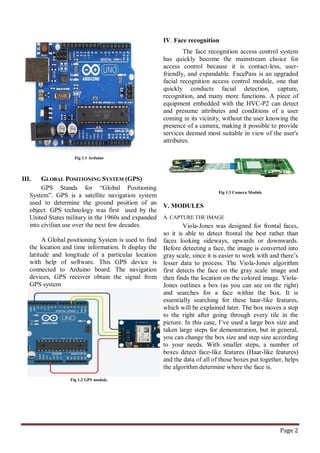
Arduino is an open-source platform which is
used to build electronics related projects. It consists
of a microcontroller and software. This Integrated
Development runs on computer which is used to
Write and upload computer code to the physical
board.
Page 2
Fig 1.1 Arduino
III. GLOBAL POSITIONING SYSTEM (GPS)
GPS Stands for “Global Positioning
System”. GPS is a satellite navigation system
used to determine the ground position of an
object. GPS technology was first used by the
United States military in the 1960s and expanded
into civilian use over the next few decades.
A Global positioning System is used to find
the location and time information. It display the
latitude and longitude of a particular location
with help of software. This GPS device is
connected to Arduino board. The navigation
devices, GPS receiver obtain the signal from
GPS system
Fig 1.2 GPS module.
IV. Face recognition
The face recognition access control system
has quickly become the mainstream choice for
access control because it is contact-less, user-
friendly, and expandable. FacePass is an upgraded
facial recognition access control module, one that
quickly conducts facial detection, capture,
recognition, and many more functions. A piece of
equipment embedded with the HVC-P2 can detect
and presume attributes and conditions of a user
coming in its vicinity, without the user knowing the
presence of a camera, making it possible to provide
services deemed most suitable in view of the user's
attributes.
Fig 1.3 Camera Module
V. MODULES
A. CAPTURE THE IMAGE
Viola-Jones was designed for frontal faces,
so it is able to detect frontal the best rather than
faces looking sideways, upwards or downwards.
Before detecting a face, the image is converted into
gray scale, since it is easier to work with and there’s
lesser data to process. The Viola-Jones algorithm
first detects the face on the gray scale image and
then finds the location on the colored image. Viola-
Jones outlines a box (as you can see on the right)
and searches for a face within the box. It is
essentially searching for these haar-like features,
which will be explained later. The box moves a step
to the right after going through every tile in the
picture. In this case, I’ve used a large box size and
taken large steps for demonstration, but in general,
you can change the box size and step size according
to your needs. With smaller steps, a number of
boxes detect face-like features (Haar-like features)
and the data of all of those boxes put together, helps
the algorithm determine where the face is.
Page 3
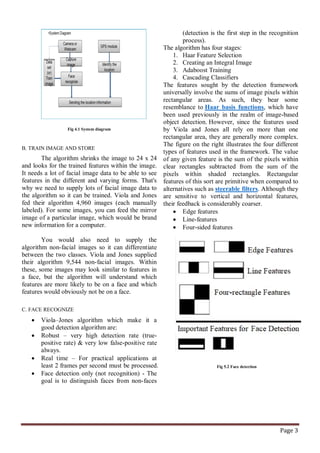
Fig 4.1 System diagram
B. TRAIN IMAGE AND STORE
The algorithm shrinks the image to 24 x 24
and looks for the trained features within the image.
It needs a lot of facial image data to be able to see
features in the different and varying forms. That's
why we need to supply lots of facial image data to
the algorithm so it can be trained. Viola and Jones
fed their algorithm 4,960 images (each manually
labeled). For some images, you can feed the mirror
image of a particular image, which would be brand
new information for a computer.
You would also need to supply the
algorithm non-facial images so it can differentiate
between the two classes. Viola and Jones supplied
their algorithm 9,544 non-facial images. Within
these, some images may look similar to features in
a face, but the algorithm will understand which
features are more likely to be on a face and which
features would obviously not be on a face.
C. FACE RECOGNIZE
 Viola–Jones algorithm which make it a
good detection algorithm are:
 Robust – very high detection rate (true-
positive rate) & very low false-positive rate
always.
 Real time – For practical applications at
least 2 frames per second must be processed.
 Face detection only (not recognition) - The
goal is to distinguish faces from non-faces
(detection is the first step in the recognition
process).
The algorithm has four stages:
1. Haar Feature Selection
2. Creating an Integral Image
3. Adaboost Training
4. Cascading Classifiers
The features sought by the detection framework
universally involve the sums of image pixels within
rectangular areas. As such, they bear some
resemblance to Haar basis functions, which have
been used previously in the realm of image-based
object detection. However, since the features used
by Viola and Jones all rely on more than one
rectangular area, they are generally more complex.
The figure on the right illustrates the four different
types of features used in the framework. The value
of any given feature is the sum of the pixels within
clear rectangles subtracted from the sum of the
pixels within shaded rectangles. Rectangular
features of this sort are primitive when compared to
alternatives such as steerable filters. Although they
are sensitive to vertical and horizontal features,
their feedback is considerably coarser.
 Edge features
 Line-features
 Four-sided features
Fig 5.2 Face detection
Page 4
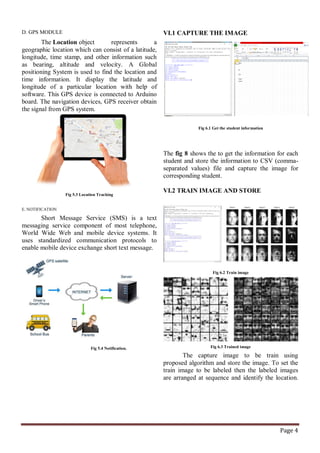
D. GPS MODULE
The Location object represents a
geographic location which can consist of a latitude,
longitude, time stamp, and other information such
as bearing, altitude and velocity. A Global
positioning System is used to find the location and
time information. It display the latitude and
longitude of a particular location with help of
software. This GPS device is connected to Arduino
board. The navigation devices, GPS receiver obtain
the signal from GPS system.
Fig 5.3 Location Tracking
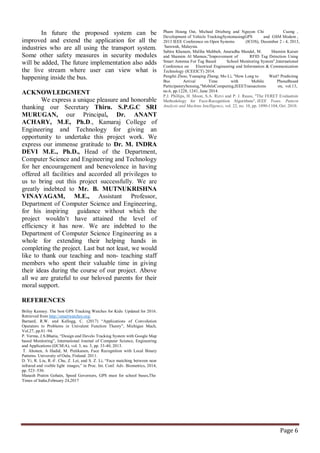
E. NOTIFICATION
Short Message Service (SMS) is a text
messaging service component of most telephone,
World Wide Web and mobile device systems. It
uses standardized communication protocols to
enable mobile device exchange short text message.
Fig 5.4 Notification.
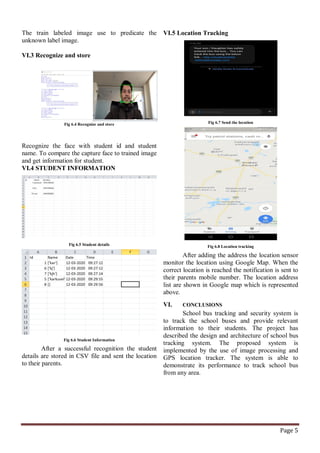
VI.1 CAPTURE THE IMAGE
Fig 6.1 Get the student information
The fig 8 shows the to get the information for each
student and store the information to CSV (comma-
separated values) file and capture the image for
corresponding student.
VI.2 TRAIN IMAGE AND STORE
Fig 6.2 Train image
Fig 6.3 Trained image
The capture image to be train using
proposed algorithm and store the image. To set the
train image to be labeled then the labeled images
are arranged at sequence and identify the location.
Page 5
The train labeled image use to predicate the
unknown label image.
VI.3 Recognize and store
Fig 6.4 Recognize and store
Recognize the face with student id and student
name. To compare the capture face to trained image
and get information for student.
VI.4 STUDENT INFORMATION
Fig 6.5 Student details
Fig 6.6 Student Information
After a successful recognition the student
details are stored in CSV file and sent the location
to their parents.
VI.5 Location Tracking
Fig 6.7 Send the location
Fig 6.8 Location tracking
After adding the address the location sensor
monitor the location using Google Map. When the
correct location is reached the notification is sent to
their parents mobile number. The location address
list are shown in Google map which is represented
above.
VI. CONCLUSIONS
School bus tracking and security system is
to track the school buses and provide relevant
information to their students. The project has
described the design and architecture of school bus
tracking system. The proposed system is
implemented by the use of image processing and
GPS location tracker. The system is able to
demonstrate its performance to track school bus
from any area.
Page 6
In future the proposed system can be
improved and extend the application for all the
industries who are all using the transport system.
Some other safety measures in security modules
will be added, The future implementation also adds
the live stream where user can view what is
happening inside the bus.
ACKNOWLEDGMENT
We express a unique pleasure and honorable
thanking our Secretary Thiru. S.P.G.C SRI
MURUGAN, our Principal, Dr. ANANT
ACHARY, M.E, Ph.D., Kamaraj College of
Engineering and Technology for giving an
opportunity to undertake this project work. We
express our immense gratitude to Dr. M. INDRA
DEVI M.E., Ph.D., Head of the Department,
Computer Science and Engineering and Technology
for her encouragement and benevolence in having
offered all facilities and accorded all privileges to
us to bring out this project successfully. We are
greatly indebted to Mr. B. MUTNUKRISHNA
VINAYAGAM, M.E., Assistant Professor,
Department of Computer Science and Engineering,
for his inspiring guidance without which the
project wouldn’t have attained the level of
efficiency it has now. We are indebted to the
Department of Computer Science Engineering as a
whole for extending their helping hands in
completing the project. Last but not least, we would
like to thank our teaching and non- teaching staff
members who spent their valuable time in giving
their ideas during the course of our project. Above
all we are grateful to our beloved parents for their
moral support.
REFERENCES
Briley Kenney. The best GPS Tracking Watches for Kids: Updated for 2016.
Retrieved from http://smartwatches.org/
Barnard, R.W. and Kellogg, C. (2017) “Applications of Convolution
Operators to Problems in Univalent Function Theory”, Michigan Mach,
Vol.27, pp.81–94.
P. Verma, J.S.Bhatia, “Design and Develo Tracking System with Google Map
based Monitoring”, International Journal of Computer Science, Engineering
and Applications (IJCSEA), vol. 3, no. 3, pp. 33-40, 2013.
T. Ahonen, A Hadid, M. Pietikanen, Face Recognition with Local Binary
Patterns. University of Oulu, Finland. 2011.
D. Yi, R. Liu, R.-F. Chu, Z. Lei, and S. Z. Li, “Face matching between near
infrared and visible light images,” in Proc. Int. Conf. Adv. Biometrics, 2014,
pp. 523–530.
Manash Pratim Gohain, Speed Governors, GPS must for school buses,The
Times of India,February 24,2017
Pham Hoang Oat, Micheal Drieberg and Nguyen Chi Cuong ,
Development of Vehicle TrackingSystemusingGPS and GSM Modem ,
2013 IEEE Conference on Open Systems (ICOS), December 2 - 4, 2013,
Sarawak, Malaysia.
Sabira Khanam, Maliha Mahbub, Anuradha Mandal, M. Shamim Kaiser
and Shamim Al Mamun,”Improvement of RFID Tag Detection Using
Smart Antenna For Tag Based School Monitoring System”,International
Conference on Electrical Engineering and Information & Communication
Technology (ICEEICT) 2014.
Pengfei Zhou; Yuanqing Zheng; Mo Li, "How Long to Wait? Predicting
Bus Arrival Time with Mobile PhoneBased
ParticipatorySensing,"MobileComputing,IEEETransactions on, vol.13,
no.6, pp.1228, 1241, June 2014.
P.J. Phillips, H. Moon, S.A. Rizvi and P. J. Rauss, "The FERET Evaluation
Methodology for Face-Recognition Algorithms", IEEE Trans. Pattern
Analysis and Machine Intelligence, vol. 22, no. 10, pp. 1090-1104, Oct. 2010.

School Bus Tracking and Security System

  • 1.
    Page 1 SCHOOL BUSTRACKING AND SECURITY SYSTEM Mr. B. Muthukrishna Vinayagam, M.E., (Assistant Professor CSE, Kamaraj college of engineering and technology, Virudhunagar, Tamilnadu, India ) Arunachalam M, Saanmuga kumaar K, Karkuvelayyanar T (CSE, Kamaraj college of engineering and technology, Virudhunagar, Tamilnadu, India Email : 16ucse025@kamarajengg.edu.in, 16ucse010@kamarajengg.edu.in, 16ucse005@kamarajengg.edu.in ) ----------------------------------------************************---------------------------------- Abstract: It is important for every school to have a trustworthy and secure transportation service to ensure the safety of the students. The proposed system provides real time information about various parameters of the vehicle like the location, the route. In this system, we make use of face recognition and GPS technologies. GPS module is used to find the current geographic coordinates of the vehicle's location. Camera identifies each student as they board or alight the vehicle. The information can be accessed by the parents through a mobile application and school administration this helps them track their wards effectively. ----------------------------------------************************---------------------------------- I. INTRODUCTION Children security has always been a priority problem whose solution must constantly be improved. Children safety is importance to their parents. Despite the best safety measures, children, due to their lack of skills to protect them. School bus plays an essential role in carrying most of children everyday all over the world. Millions of children needs to be moved a from home to school and vice versa every day. For parents, obtaining a safe transport for their children is a crucial issue. The commute of students from home to school and back has always been a source of concern for parents. Students often get on the wrong buses and get off at the wrong stops. Bus drivers may not be able to identify all the students and will not know in time if a student is missing. Parents have no way of knowing if their ward is safe until the evening when the bus returns. The proposed system describes a low cost comprehensive school bus monitoring device that tracks the location. Real time tracking of the bus allows the children to have more time for activities instead of waiting for a delayed bus and the notification system ensures the individual safety of each student. The tracking is achieved by reading the geographic coordinates of the bus from the GPS module and uploading in to a database. This information can then be accessed by a user base that includes the parents, bus drivers and school administration through a mobile application which takes the location from the database and plots it on a map. The notification system alerts the parent when the face recognition from their child’s face is read by camera. II. ARDUINO Arduino is an open-source platform which is used to build electronics related projects. It consists of a microcontroller and software. This Integrated Development runs on computer which is used to Write and upload computer code to the physical board.
  • 2.
    Page 2 Fig 1.1Arduino III. GLOBAL POSITIONING SYSTEM (GPS) GPS Stands for “Global Positioning System”. GPS is a satellite navigation system used to determine the ground position of an object. GPS technology was first used by the United States military in the 1960s and expanded into civilian use over the next few decades. A Global positioning System is used to find the location and time information. It display the latitude and longitude of a particular location with help of software. This GPS device is connected to Arduino board. The navigation devices, GPS receiver obtain the signal from GPS system Fig 1.2 GPS module. IV. Face recognition The face recognition access control system has quickly become the mainstream choice for access control because it is contact-less, user- friendly, and expandable. FacePass is an upgraded facial recognition access control module, one that quickly conducts facial detection, capture, recognition, and many more functions. A piece of equipment embedded with the HVC-P2 can detect and presume attributes and conditions of a user coming in its vicinity, without the user knowing the presence of a camera, making it possible to provide services deemed most suitable in view of the user's attributes. Fig 1.3 Camera Module V. MODULES A. CAPTURE THE IMAGE Viola-Jones was designed for frontal faces, so it is able to detect frontal the best rather than faces looking sideways, upwards or downwards. Before detecting a face, the image is converted into gray scale, since it is easier to work with and there’s lesser data to process. The Viola-Jones algorithm first detects the face on the gray scale image and then finds the location on the colored image. Viola- Jones outlines a box (as you can see on the right) and searches for a face within the box. It is essentially searching for these haar-like features, which will be explained later. The box moves a step to the right after going through every tile in the picture. In this case, I’ve used a large box size and taken large steps for demonstration, but in general, you can change the box size and step size according to your needs. With smaller steps, a number of boxes detect face-like features (Haar-like features) and the data of all of those boxes put together, helps the algorithm determine where the face is.
  • 3.
    Page 3 Fig 4.1System diagram B. TRAIN IMAGE AND STORE The algorithm shrinks the image to 24 x 24 and looks for the trained features within the image. It needs a lot of facial image data to be able to see features in the different and varying forms. That's why we need to supply lots of facial image data to the algorithm so it can be trained. Viola and Jones fed their algorithm 4,960 images (each manually labeled). For some images, you can feed the mirror image of a particular image, which would be brand new information for a computer. You would also need to supply the algorithm non-facial images so it can differentiate between the two classes. Viola and Jones supplied their algorithm 9,544 non-facial images. Within these, some images may look similar to features in a face, but the algorithm will understand which features are more likely to be on a face and which features would obviously not be on a face. C. FACE RECOGNIZE  Viola–Jones algorithm which make it a good detection algorithm are:  Robust – very high detection rate (true- positive rate) & very low false-positive rate always.  Real time – For practical applications at least 2 frames per second must be processed.  Face detection only (not recognition) - The goal is to distinguish faces from non-faces (detection is the first step in the recognition process). The algorithm has four stages: 1. Haar Feature Selection 2. Creating an Integral Image 3. Adaboost Training 4. Cascading Classifiers The features sought by the detection framework universally involve the sums of image pixels within rectangular areas. As such, they bear some resemblance to Haar basis functions, which have been used previously in the realm of image-based object detection. However, since the features used by Viola and Jones all rely on more than one rectangular area, they are generally more complex. The figure on the right illustrates the four different types of features used in the framework. The value of any given feature is the sum of the pixels within clear rectangles subtracted from the sum of the pixels within shaded rectangles. Rectangular features of this sort are primitive when compared to alternatives such as steerable filters. Although they are sensitive to vertical and horizontal features, their feedback is considerably coarser.  Edge features  Line-features  Four-sided features Fig 5.2 Face detection
  • 4.
    Page 4 D. GPSMODULE The Location object represents a geographic location which can consist of a latitude, longitude, time stamp, and other information such as bearing, altitude and velocity. A Global positioning System is used to find the location and time information. It display the latitude and longitude of a particular location with help of software. This GPS device is connected to Arduino board. The navigation devices, GPS receiver obtain the signal from GPS system. Fig 5.3 Location Tracking E. NOTIFICATION Short Message Service (SMS) is a text messaging service component of most telephone, World Wide Web and mobile device systems. It uses standardized communication protocols to enable mobile device exchange short text message. Fig 5.4 Notification. VI.1 CAPTURE THE IMAGE Fig 6.1 Get the student information The fig 8 shows the to get the information for each student and store the information to CSV (comma- separated values) file and capture the image for corresponding student. VI.2 TRAIN IMAGE AND STORE Fig 6.2 Train image Fig 6.3 Trained image The capture image to be train using proposed algorithm and store the image. To set the train image to be labeled then the labeled images are arranged at sequence and identify the location.
  • 5.
    Page 5 The trainlabeled image use to predicate the unknown label image. VI.3 Recognize and store Fig 6.4 Recognize and store Recognize the face with student id and student name. To compare the capture face to trained image and get information for student. VI.4 STUDENT INFORMATION Fig 6.5 Student details Fig 6.6 Student Information After a successful recognition the student details are stored in CSV file and sent the location to their parents. VI.5 Location Tracking Fig 6.7 Send the location Fig 6.8 Location tracking After adding the address the location sensor monitor the location using Google Map. When the correct location is reached the notification is sent to their parents mobile number. The location address list are shown in Google map which is represented above. VI. CONCLUSIONS School bus tracking and security system is to track the school buses and provide relevant information to their students. The project has described the design and architecture of school bus tracking system. The proposed system is implemented by the use of image processing and GPS location tracker. The system is able to demonstrate its performance to track school bus from any area.
  • 6.
    Page 6 In futurethe proposed system can be improved and extend the application for all the industries who are all using the transport system. Some other safety measures in security modules will be added, The future implementation also adds the live stream where user can view what is happening inside the bus. ACKNOWLEDGMENT We express a unique pleasure and honorable thanking our Secretary Thiru. S.P.G.C SRI MURUGAN, our Principal, Dr. ANANT ACHARY, M.E, Ph.D., Kamaraj College of Engineering and Technology for giving an opportunity to undertake this project work. We express our immense gratitude to Dr. M. INDRA DEVI M.E., Ph.D., Head of the Department, Computer Science and Engineering and Technology for her encouragement and benevolence in having offered all facilities and accorded all privileges to us to bring out this project successfully. We are greatly indebted to Mr. B. MUTNUKRISHNA VINAYAGAM, M.E., Assistant Professor, Department of Computer Science and Engineering, for his inspiring guidance without which the project wouldn’t have attained the level of efficiency it has now. We are indebted to the Department of Computer Science Engineering as a whole for extending their helping hands in completing the project. Last but not least, we would like to thank our teaching and non- teaching staff members who spent their valuable time in giving their ideas during the course of our project. Above all we are grateful to our beloved parents for their moral support. REFERENCES Briley Kenney. The best GPS Tracking Watches for Kids: Updated for 2016. Retrieved from http://smartwatches.org/ Barnard, R.W. and Kellogg, C. (2017) “Applications of Convolution Operators to Problems in Univalent Function Theory”, Michigan Mach, Vol.27, pp.81–94. P. Verma, J.S.Bhatia, “Design and Develo Tracking System with Google Map based Monitoring”, International Journal of Computer Science, Engineering and Applications (IJCSEA), vol. 3, no. 3, pp. 33-40, 2013. T. Ahonen, A Hadid, M. Pietikanen, Face Recognition with Local Binary Patterns. University of Oulu, Finland. 2011. D. Yi, R. Liu, R.-F. Chu, Z. Lei, and S. Z. Li, “Face matching between near infrared and visible light images,” in Proc. Int. Conf. Adv. Biometrics, 2014, pp. 523–530. Manash Pratim Gohain, Speed Governors, GPS must for school buses,The Times of India,February 24,2017 Pham Hoang Oat, Micheal Drieberg and Nguyen Chi Cuong , Development of Vehicle TrackingSystemusingGPS and GSM Modem , 2013 IEEE Conference on Open Systems (ICOS), December 2 - 4, 2013, Sarawak, Malaysia. Sabira Khanam, Maliha Mahbub, Anuradha Mandal, M. Shamim Kaiser and Shamim Al Mamun,”Improvement of RFID Tag Detection Using Smart Antenna For Tag Based School Monitoring System”,International Conference on Electrical Engineering and Information & Communication Technology (ICEEICT) 2014. Pengfei Zhou; Yuanqing Zheng; Mo Li, "How Long to Wait? Predicting Bus Arrival Time with Mobile PhoneBased ParticipatorySensing,"MobileComputing,IEEETransactions on, vol.13, no.6, pp.1228, 1241, June 2014. P.J. Phillips, H. Moon, S.A. Rizvi and P. J. Rauss, "The FERET Evaluation Methodology for Face-Recognition Algorithms", IEEE Trans. Pattern Analysis and Machine Intelligence, vol. 22, no. 10, pp. 1090-1104, Oct. 2010.