SMART CANTEEN
MANAGEMENT SYSTEM
J. Mohammed Afrose, A. Kamatchi Kumaran, V. Nandha Kishore
Department of Computer Science and Engineering
Kamaraj College of Engineering and Technology, K.vellakulam, Madurai District,
vtmuser@gmail.com
Abstract- “Smart Canteen System” enables the end users to register online, read and select the food
that the user wants to have using web application. It reduces the rush in the canteen and avoids wastage
of food. The user will have a username and a password, by using which they can login into the system.
The manual system involves paperwork in the form of maintaining various files and manuals. So this
software helps them to save time rather than waiting for a long time to receive their food.
Keywords: Smart canteen, cashless, Barcode reader.
I.INTRODUCTION
A smart canteen management system is
being developed to reduce time and
increase efficiency in monitoring the
stock. This reduces the work of human
since everything is automized. It is
important to provide a method to
efficiently monitor the process.A web
application is proposed for ordering the
food using “PHP”, with the help of barcode
scanner the student identification is done.
A barcode reader (or barcode
scanner) is an optical scanner that can
read printed barcodes, decode the data
contained in the barcode and send the
data to a computer. It consists of a light
source, a lens and a light sensor
translating for optical impulses into
electrical signals. Additionally, nearly all
barcode readers contain decoder circuitry
that can analyze the barcode's image
data provided by the sensor and sending
the barcode's content to the scanner's
output port. With the help of the thermal
printer the bill generated is printed in the
thermal paper. Thermal
printing (or direct thermal printing) is
a digital printing process which produces
a printed image by selectively heating
coated thermochromic paper, or thermal
paper as it is commonly known, when the
paper passes over the thermal print
head. The coating turns black in the
areas where it is heated, producing an
image. Two-color direct thermal printers
can print both black and an
additional color (often red) by
applying heat at two
different temperatures. QR code is
generated after the order is placed
through the mobile application which
should be shown to the person in-charge
at the food counter.
II. LITREATURE SURVEY
A. Sustainable consumption and
production(SCP) in the food
supply chain:
The paper presented the change and the
increase in the importance of SCP with a
focus on the food industry. One important
part of SCP is to decrease the food
wastage.
B. Cost-optimization modelling for
fresh food quality and
transportation:
Taking into account the degradation in
quality of food products through
temperature and transport time, the
model seeks to optimize total cost by
maintaining the quality of food products
above an acceptable level during the
transportation. The transportation cost,
cooling cost and devalued cost of food
products due to reduced quality.
C. Food safety and sustainability in
Wal-Mart's honduran produce
supply chains:
Public‐private partnerships between
supermarket retailers and development
agencies help small‐scale producers reach
growing domestic markets in developing
countries. The responsibility and costs
for incentivizing growers to change their
practices is shifted to nongovernmental
organizations.
III. PROPOSED SYSTEM
A smart canteen management system is
being developed to reduce time and
increase efficiency in monitoring the
stock. This reduces the work of human
since everything is automized. It is
important to provide a method to
efficiently monitor the process.
IV. BLOCK DIAGRAM
Fig 1: System diagram
The main purpose of the Smart canteen
System is to make students to have
their lunch even when cash is not
available. Then to monitor the stocks
daily and to avoid the wastage of foods.
Fig 2: Thermal printer
Thermal printing (or direct thermal
printing) is a digital printing process
which produces a printed image by
selectively heating coated thermochromic
paper, or thermal paper as it is
commonly known, when the paper passes
over the thermal print head. A thermal
printer comprises these key components:
Thermal head: generates heat; prints on
paper. Platen: a rubber roller that feeds
paper. Spring: applies pressure to the
thermal head, causing it to contact the
thermosensitive paper. In order to print,
thermo-sensitive paper is inserted
between the thermal head and the platen.
The printer sends an electric current to
the heating elements of the thermal
head, which generate heat. The heat
activates the thermo-sensitive coloring
layer of the thermosensitive paper, which
changes color where heated. Such a
printing mechanism is known as
a thermal system or direct system. The
heating elements are usually arranged as
a line of small closely spaced dots.
Fig 3: Barcode Scanner
A barcode reader (or barcode
scanner) is an optical
scanner that can read
printed barcodes, decode the data
contained in the barcode and send
the data to a computer. Like
a flatbed scanner, it consists of a
light source, a lens and a light
sensor translating for optical
impulses into electrical signals.
Additionally, nearly all barcode
readers contain decoder circuitry
that can analyze the barcode's
image data provided by the sensor
and sending the barcode's content
to the scanner's output port. Laser
scanners work the same way as
pen-type readers except that they
use a laser beam as the light
source and typically employ either
a reciprocating mirror or a rotating
prism to scan the laser beam back
and forth across the barcode. As
with the pen-type reader, a photo-
diode is used to measure the
intensity of the light reflected back
from the barcode. In both pen
readers and laser scanners, the
light emitted by the reader is
rapidly varied in brightness with a
data pattern and the photo-diode
receive circuitry is designed to
detect only signals with the
same modulated pattern.
VI. CONCLUSION
By this Smart Canteen System the
canteen management gets relief
from two things, one the crowd at
the bill and food counter will be
controlled and reduced, the
second is they get the detailed
sales report of a particular day.
This helps in the control of the
food wastage. The student can
purchase anything during that
time.
VII. RESULT
Fig 4: Home Page
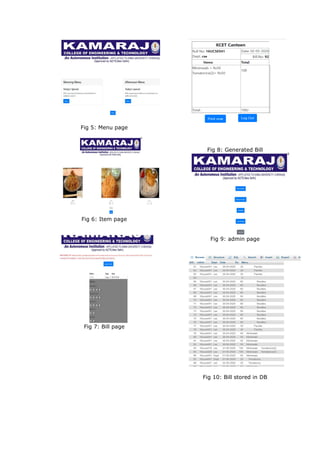
Fig 5: Menu page
Fig 6: Item page
Fig 7: Bill page
Fig 8: Generated Bill
Fig 9: admin page
Fig 10: Bill stored in DB
Fig 11: Recharge page
VIII. REFERENCES
[1] (2015). World Health Organization.
Accessed: Mar. 15, 2019. [Online].
Available:
http://www.who.int/campaigns/world-
health-day/2015/en/
[2] J. Trienekens and P. Zuurbieri,
``Quality and safety standards in the
food
industry, developments and challenges,''
Int. J. Prod. Econ., vol. 113, no. 1,
pp. 107_122, 2008.
[3] D. Li, X. J. Wang, H. K. Chan, and R.
Manzini, ``Sustainable food supply
chain management,'' Int. J. Prod. Econ.,
vol. 152, pp. 1_8, Jun. 2014.
[4] V. León-Bravo, F. Caniato, M. Caridi,
and T. Johnsen, ``Collaboration
for sustainability in the food supply
chain: A multi-stage study in italy,''
Sustainability, vol. 9, no. 7, p. 1253,
2017.
[5] K. Govindan, ``Sustainable
consumption and production in the food
supply chain: A conceptual framework,''
Int. J. Prod. Econ., vol. 195,
pp. 419_431, Jan. 2018.
[6] R. Accorsi, S. Cholette, R. Manzini,
and A. Tufano, ``A hierarchical data
architecture for sustainable food supply
chain management and planning,''
J. Clean Prod., vol. 203, pp. 1039_1054,
Dec. 2018.
[7] T. Bányai, B. Illés, and A. Bányai,
``Smart scheduling: An integrated _rst
mile and last mile supply approach,''
Complexity, vol. 2018, pp. 1_15,
Jul. 2018, Art. no. 5180156. doi:
10.1155/2018/5180156.
[8] D. Nakandala, H. Lau, and J. J.
Zhang, ``Cost-optimization modelling
for
fresh food quality and transportation,''
Ind. Manage. Data Syst., vol. 116,
no. 3, pp. 564_583, 2016.
[9] P. Amorim, H.-O. Günther, and B.
Almada-Lobo, ``Multi-objective
integrated
production and distribution planning of
perishable products,'' Int.
J. Prod. Econ., vol. 138, no. 1, pp.
89_101, 2012.
[10] Y. M. Wang and H. L. Yin, ``Cost-
optimization problem with a soft
time window based on an improved
fuzzy genetic algorithm for fresh
food distribution,'' Math. Problems Eng.,
vol. 2018, pp. 1_16, Aug. 2018,
Art. no. 5743287. doi:
10.1155/2018/5743287.
[11] Kantar Worldpanel Taiwan. (2014).
2014 Blended Oil Scandal
Report. Accessed: Mar. 14, 2019.
[Online]. Available: http://www.
kantarworldpanel.com/tw
[12] K. G. Grunert, ``Food quality and
safety: Consumer perception and
demand,'' Eur. Rev. Agricult.
Econ., vol. 32, no. 3, pp.
369_391, 2005.

Smart Canteen Management

  • 1.
    SMART CANTEEN MANAGEMENT SYSTEM J.Mohammed Afrose, A. Kamatchi Kumaran, V. Nandha Kishore Department of Computer Science and Engineering Kamaraj College of Engineering and Technology, K.vellakulam, Madurai District, vtmuser@gmail.com Abstract- “Smart Canteen System” enables the end users to register online, read and select the food that the user wants to have using web application. It reduces the rush in the canteen and avoids wastage of food. The user will have a username and a password, by using which they can login into the system. The manual system involves paperwork in the form of maintaining various files and manuals. So this software helps them to save time rather than waiting for a long time to receive their food. Keywords: Smart canteen, cashless, Barcode reader. I.INTRODUCTION A smart canteen management system is being developed to reduce time and increase efficiency in monitoring the stock. This reduces the work of human since everything is automized. It is important to provide a method to efficiently monitor the process.A web application is proposed for ordering the food using “PHP”, with the help of barcode scanner the student identification is done. A barcode reader (or barcode scanner) is an optical scanner that can read printed barcodes, decode the data contained in the barcode and send the data to a computer. It consists of a light source, a lens and a light sensor translating for optical impulses into electrical signals. Additionally, nearly all barcode readers contain decoder circuitry that can analyze the barcode's image data provided by the sensor and sending the barcode's content to the scanner's output port. With the help of the thermal printer the bill generated is printed in the thermal paper. Thermal printing (or direct thermal printing) is a digital printing process which produces a printed image by selectively heating coated thermochromic paper, or thermal paper as it is commonly known, when the paper passes over the thermal print head. The coating turns black in the areas where it is heated, producing an image. Two-color direct thermal printers can print both black and an additional color (often red) by applying heat at two different temperatures. QR code is generated after the order is placed through the mobile application which should be shown to the person in-charge at the food counter. II. LITREATURE SURVEY A. Sustainable consumption and production(SCP) in the food supply chain:
  • 2.
    The paper presentedthe change and the increase in the importance of SCP with a focus on the food industry. One important part of SCP is to decrease the food wastage. B. Cost-optimization modelling for fresh food quality and transportation: Taking into account the degradation in quality of food products through temperature and transport time, the model seeks to optimize total cost by maintaining the quality of food products above an acceptable level during the transportation. The transportation cost, cooling cost and devalued cost of food products due to reduced quality. C. Food safety and sustainability in Wal-Mart's honduran produce supply chains: Public‐private partnerships between supermarket retailers and development agencies help small‐scale producers reach growing domestic markets in developing countries. The responsibility and costs for incentivizing growers to change their practices is shifted to nongovernmental organizations. III. PROPOSED SYSTEM A smart canteen management system is being developed to reduce time and increase efficiency in monitoring the stock. This reduces the work of human since everything is automized. It is important to provide a method to efficiently monitor the process. IV. BLOCK DIAGRAM Fig 1: System diagram The main purpose of the Smart canteen System is to make students to have their lunch even when cash is not available. Then to monitor the stocks daily and to avoid the wastage of foods. Fig 2: Thermal printer Thermal printing (or direct thermal printing) is a digital printing process which produces a printed image by selectively heating coated thermochromic paper, or thermal paper as it is commonly known, when the paper passes over the thermal print head. A thermal printer comprises these key components: Thermal head: generates heat; prints on paper. Platen: a rubber roller that feeds paper. Spring: applies pressure to the thermal head, causing it to contact the thermosensitive paper. In order to print, thermo-sensitive paper is inserted between the thermal head and the platen.
  • 3.
    The printer sendsan electric current to the heating elements of the thermal head, which generate heat. The heat activates the thermo-sensitive coloring layer of the thermosensitive paper, which changes color where heated. Such a printing mechanism is known as a thermal system or direct system. The heating elements are usually arranged as a line of small closely spaced dots. Fig 3: Barcode Scanner A barcode reader (or barcode scanner) is an optical scanner that can read printed barcodes, decode the data contained in the barcode and send the data to a computer. Like a flatbed scanner, it consists of a light source, a lens and a light sensor translating for optical impulses into electrical signals. Additionally, nearly all barcode readers contain decoder circuitry that can analyze the barcode's image data provided by the sensor and sending the barcode's content to the scanner's output port. Laser scanners work the same way as pen-type readers except that they use a laser beam as the light source and typically employ either a reciprocating mirror or a rotating prism to scan the laser beam back and forth across the barcode. As with the pen-type reader, a photo- diode is used to measure the intensity of the light reflected back from the barcode. In both pen readers and laser scanners, the light emitted by the reader is rapidly varied in brightness with a data pattern and the photo-diode receive circuitry is designed to detect only signals with the same modulated pattern. VI. CONCLUSION By this Smart Canteen System the canteen management gets relief from two things, one the crowd at the bill and food counter will be controlled and reduced, the second is they get the detailed sales report of a particular day. This helps in the control of the food wastage. The student can purchase anything during that time. VII. RESULT Fig 4: Home Page
  • 4.
    Fig 5: Menupage Fig 6: Item page Fig 7: Bill page Fig 8: Generated Bill Fig 9: admin page Fig 10: Bill stored in DB
  • 5.
    Fig 11: Rechargepage VIII. REFERENCES [1] (2015). World Health Organization. Accessed: Mar. 15, 2019. [Online]. Available: http://www.who.int/campaigns/world- health-day/2015/en/ [2] J. Trienekens and P. Zuurbieri, ``Quality and safety standards in the food industry, developments and challenges,'' Int. J. Prod. Econ., vol. 113, no. 1, pp. 107_122, 2008. [3] D. Li, X. J. Wang, H. K. Chan, and R. Manzini, ``Sustainable food supply chain management,'' Int. J. Prod. Econ., vol. 152, pp. 1_8, Jun. 2014. [4] V. León-Bravo, F. Caniato, M. Caridi, and T. Johnsen, ``Collaboration for sustainability in the food supply chain: A multi-stage study in italy,'' Sustainability, vol. 9, no. 7, p. 1253, 2017. [5] K. Govindan, ``Sustainable consumption and production in the food supply chain: A conceptual framework,'' Int. J. Prod. Econ., vol. 195, pp. 419_431, Jan. 2018. [6] R. Accorsi, S. Cholette, R. Manzini, and A. Tufano, ``A hierarchical data architecture for sustainable food supply chain management and planning,'' J. Clean Prod., vol. 203, pp. 1039_1054, Dec. 2018. [7] T. Bányai, B. Illés, and A. Bányai, ``Smart scheduling: An integrated _rst mile and last mile supply approach,'' Complexity, vol. 2018, pp. 1_15, Jul. 2018, Art. no. 5180156. doi: 10.1155/2018/5180156. [8] D. Nakandala, H. Lau, and J. J. Zhang, ``Cost-optimization modelling for fresh food quality and transportation,'' Ind. Manage. Data Syst., vol. 116, no. 3, pp. 564_583, 2016. [9] P. Amorim, H.-O. Günther, and B. Almada-Lobo, ``Multi-objective integrated production and distribution planning of perishable products,'' Int. J. Prod. Econ., vol. 138, no. 1, pp. 89_101, 2012. [10] Y. M. Wang and H. L. Yin, ``Cost- optimization problem with a soft time window based on an improved fuzzy genetic algorithm for fresh food distribution,'' Math. Problems Eng., vol. 2018, pp. 1_16, Aug. 2018, Art. no. 5743287. doi: 10.1155/2018/5743287. [11] Kantar Worldpanel Taiwan. (2014). 2014 Blended Oil Scandal Report. Accessed: Mar. 14, 2019. [Online]. Available: http://www. kantarworldpanel.com/tw [12] K. G. Grunert, ``Food quality and safety: Consumer perception and demand,'' Eur. Rev. Agricult. Econ., vol. 32, no. 3, pp. 369_391, 2005.