Download to read offline
![IJRET: International Journal of Research in Engineering and Technology eISSN: 2319-1163 | pISSN: 2321-7308
__________________________________________________________________________________________
Volume: 02 Issue: 09 | Sep-2013, Available @ http://www.ijret.org 62
AN INTELLIGENT HYBRID CONTROL FOR PAPER MACHINE
SYSTEM
G.Suribabu1
, T.Chiranjeevi2
, T.Gurubhavan3
, K. Ramesh kumar4
1, 2
Assistant Professor, EEE Department, Vishnu Institute of Technology, A.P, India,
3
Assistant Professor, EEE Department, Audisankara college of Engineering, A.P, India,
4
Project officer, EEE Department, IIT Hyderabad, A.P, India,
surigolla@yahoo.com, chirupci479@gmail.com, bhavaneee_217@yahoomail.com, ramesh@iith.ac.in
Abstract
The aim of this paper is to present an intelligent hybrid controller for a paper machine system with ash content and dry weight as
outputs and filler valve and thick stock valve as inputs. Simulation studies have been carried out to check the robust performance
(10% increase in each process gain, 10% increase in each time delay, and 10% decrease in each time constant) of the system. The
improvement in the performance of proposed hybrid controller is compared with the Adaptive-neuro- fuzzy controller and Dahlin
controller and evaluated in terms of ISE.
Index Terms: Dahlin, Neuro-fuzzy, Hybrid and Robust
-----------------------------------------------------------------------***-----------------------------------------------------------------------
1. INTRODUCTION
Control system for paper machines is very complex as the
overall system is complicated and is at least unknown. New
control techniques for paper machines is usually evaluated in
terms of its contribution to fibre efficiency, energy efficiency,
reduced downtime and breaks increased product quality and
increased machine capacity. In order to achieve these
efficiency determinants of the paper machine system, ash
content control plays a vital role [1].
An increased complexity is that ash content is also heavily
coupled with another important variable, basis weight. Many
control strategies have therefore been developed and applied
to some production machines. However, most of these control
algorithms [4] have assumed the linearity of the process,
which is unlikely true for paper machines where frequent
grade changes take place. It is therefore necessary to
investigate the use of nonlinear control laws for such systems.
Since neuro-fuzzy modeling techniques have been shown to
be able to model the unknown nonlinear process to a pre-
specified accuracy, these control algorithms are well suited for
the paper machine system. The later will then be combined
with the dahlin controller to form an intelligent hybrid
controller which outperforms the rest.
Fig 1.Paper Machine Unit
2. PROCESS REPRESENTATION
By denoting ash content in (%) and basis weight (gm/m2) as
the outputs, filler flow rate and the thick stock rate as the
inputs, the multivariable system of paper machine [2] is
modeled as
)(22)(21
)(12)(11)(
sGsG
sGsG
sG
(1)
Where
sacT
e
sac
acK
G
111
sdwT
e
sdw
daK
G
112
sacT
e
sac
adK
G
121
sdwT
e
sdw
dwK
G
122 ](https://image.slidesharecdn.com/anintelligenthybridcontrolforpapermachinesystem-160802115206/85/An-intelligent-hybrid-control-for-paper-machine-system-1-320.jpg)
![IJRET: International Journal of Research in Engineering and Technology eISSN: 2319-1163 | pISSN: 2321-7308
__________________________________________________________________________________________
Volume: 02 Issue: 09 | Sep-2013, Available @ http://www.ijret.org 62
AN INTELLIGENT HYBRID CONTROL FOR PAPER MACHINE
SYSTEM
G.Suribabu1
, T.Chiranjeevi2
, T.Gurubhavan3
, K. Ramesh kumar4
1, 2
Assistant Professor, EEE Department, Vishnu Institute of Technology, A.P, India,
3
Assistant Professor, EEE Department, Audisankara college of Engineering, A.P, India,
4
Project officer, EEE Department, IIT Hyderabad, A.P, India,
surigolla@yahoo.com, chirupci479@gmail.com, bhavaneee_217@yahoomail.com, ramesh@iith.ac.in
Abstract
The aim of this paper is to present an intelligent hybrid controller for a paper machine system with ash content and dry weight as
outputs and filler valve and thick stock valve as inputs. Simulation studies have been carried out to check the robust performance
(10% increase in each process gain, 10% increase in each time delay, and 10% decrease in each time constant) of the system. The
improvement in the performance of proposed hybrid controller is compared with the Adaptive-neuro- fuzzy controller and Dahlin
controller and evaluated in terms of ISE.
Index Terms: Dahlin, Neuro-fuzzy, Hybrid and Robust
-----------------------------------------------------------------------***-----------------------------------------------------------------------
1. INTRODUCTION
Control system for paper machines is very complex as the
overall system is complicated and is at least unknown. New
control techniques for paper machines is usually evaluated in
terms of its contribution to fibre efficiency, energy efficiency,
reduced downtime and breaks increased product quality and
increased machine capacity. In order to achieve these
efficiency determinants of the paper machine system, ash
content control plays a vital role [1].
An increased complexity is that ash content is also heavily
coupled with another important variable, basis weight. Many
control strategies have therefore been developed and applied
to some production machines. However, most of these control
algorithms [4] have assumed the linearity of the process,
which is unlikely true for paper machines where frequent
grade changes take place. It is therefore necessary to
investigate the use of nonlinear control laws for such systems.
Since neuro-fuzzy modeling techniques have been shown to
be able to model the unknown nonlinear process to a pre-
specified accuracy, these control algorithms are well suited for
the paper machine system. The later will then be combined
with the dahlin controller to form an intelligent hybrid
controller which outperforms the rest.
Fig 1.Paper Machine Unit
2. PROCESS REPRESENTATION
By denoting ash content in (%) and basis weight (gm/m2) as
the outputs, filler flow rate and the thick stock rate as the
inputs, the multivariable system of paper machine [2] is
modeled as
)(22)(21
)(12)(11)(
sGsG
sGsG
sG
(1)
Where
sacT
e
sac
acK
G
111
sdwT
e
sdw
daK
G
112
sacT
e
sac
adK
G
121
sdwT
e
sdw
dwK
G
122 ](https://image.slidesharecdn.com/anintelligenthybridcontrolforpapermachinesystem-160802115206/75/An-intelligent-hybrid-control-for-paper-machine-system-1-2048.jpg)
![IJRET: International Journal of Research in Engineering and Technology eISSN: 2319-1163 | pISSN: 2321-7308
__________________________________________________________________________________________
Volume: 02 Issue: 09 | Sep-2013, Available @ http://www.ijret.org 63
Where
214.0acK ,
125ac ,
93.0dwK ,
17dw
68 dwac TT ,
153.0adK ,
192.0daK
Which results the multivariable process as?
se
s
se
s
se
s
se
s
sG
68
117
93.068
1125
153.0
68
117
192.068
1125
214.0
)(
(2)
This model is used in analysis of hybrid, neuro-fuzzy and
conventional controller algorithms to track the desired basis
weight and ash content properties in this paper.
2.1 IMPLEMENTATION OF CONTROLLERS
With the presence of strong interactions in the MIMO paper
machine system ,the controller performance deteriorates and it
is necessary to design a proper decoupler[3] in order to nullify
the effect of interactions over the performance of controllers.
Two important advantages of decoupling which were
eliminated the interactions in paper machine system as
follows:
1) Control loop interactions of ash content and basis
weight were eliminated.
2) A set point change for ash content controlled variable
not have any effect with basis weight controlled
variable.
Fig 2.Decoupling Structure
If the transfer function elements of G are known and having
specified the diagonal elements of Gc*,then the appropriate
off-diagonal elements of Gc* to achieve decoupling control
can be calculated by using equations
11
*
2212*
12 G
cGG
c
G
(3)
22
*
1121*
21 G
cGG
c
G
(4)
2.1.1 Dahlin and Adaptive Neuro-fuzzy controller
A decoupler D(s) is included in the controller such that
)(220
0)(11)()(
sG
sG
sGsD
(5)
The choice of lambda as twice the original time constant [2]is
a typical rule-of-thumb used in the paper mills while designing
the Dahlin controller. In this paper the forward path
controllers are replaced with neuro fuzzy controller to obtain
better response.
As Fuzzy systems [5] lack the ability to learn and cannot
adjust themselves to a new environment, the merger of a
neural network with a fuzzy system into one integrated
system, therefore, offers a promising approach in building
intelligent systems. Integrated systems can combine the
parallel computation and learning abilities of neural networks,
with the human- knowledge representation and explanation
abilities of fuzzy systems [6], [7].
Fig3. Structure of the neuro-fuzzy control system
The Objective function to be minimized is
2
)(
2
1
)(
k
rykykE
(6)
The learning rule could be expressed as
)(
)(
)()1(
ku
kE
kuku
ij
bijij
(7)](https://image.slidesharecdn.com/anintelligenthybridcontrolforpapermachinesystem-160802115206/85/An-intelligent-hybrid-control-for-paper-machine-system-2-320.jpg)
![IJRET: International Journal of Research in Engineering and Technology eISSN: 2319-1163 | pISSN: 2321-7308
__________________________________________________________________________________________
Volume: 02 Issue: 09 | Sep-2013, Available @ http://www.ijret.org 64
The gradient
1
1
21
21
)(),(
)(),(
)(
)(
n
i
i
i
ij
kxkx
kxkx
ku
kE
(8)
Where
k jAijij
jAij
ik
kxku
kx
kykwkeJ
)()(
)(1
)()()(1
(9)
iju
= controller output of jth input used in ith rule.
b Learning coefficient.
)(kxjAij
= Degree of membership function .
)(kwi = Output of the ith rule
kJ = Jacobian of the plant
e(k)= Error at the kth instant = y(k)-yr
The summation
k is for off-line learning that uses the
summation of measurements at the discrete instances after the
end of a control cycle. No summation
k is required in the
above equations for on-line learning. In simulations, sgn of a
discrete linearized Jacobian were used .Discrete linearized
Jacobian is defined as
)1()(
)1()(
kuku
kyky
Jk
(10)
Its sgn defined by
otherwise0
,01
)sgn(
k
k
J
J
3. HYBRID CONTROLLER
In this paper, a design methodology is introduced that blends
the Dahlin and the fuzzy controllers in an intelligent way and
thus a new intelligent hybrid controller[10],[11],[12] has been
achieved. Basically, in this design methodology, the Dahlin
and neuro-fuzzy controller have been combined by a blending
mechanism that depends on a certain function of actuating
error. Moreover, an intelligent switching scheme is induced on
the blending mechanism that makes a decision upon the
priority of the two controller parts. A switching & blending
mechanism firstly decides the dominant one of the two
controller structures. The outputs of the neuro-fuzzy
controller and the Dahlin controller are then multiplied by
either one of the functions 1-f(e) and f(e).
Fig 4: Structure of the hybrid control system
1-f(e) and f(e) are the weighing factors of the blending part of
the mechanism. They quantify the level of the activity of the
contributing controller and help us to achieve a reasonable
tradeoff between the actions generated by the individual
controllers. Since the function f(e) has to be positive valued, it
has been selected as f(e)=e2. Consequently the hybrid
controller‟s output becomes either
UHYBRID = f (e).UD + (1− f (e)).UNFS (11)
Or
UHYBRID = (1− f (e)).UPID + f (e).UNFS (12)
It is obvious that when the error is large the controller output
multiplied by f(e) is activated more than the other controller
part[13],[14]. For this reason, at the early stages of the control
action, the controller output which gives the faster response
must be multiplied by f(e).
The switching part of the mechanism tries to catch the bigger
one of the control efforts of the two main controller parts. The
idea behind this is that higher control effort should produce
faster system response. The simulations done on proposed
system using the new hybrid fuzzy PID controller provides
„better‟ system responses in terms of transient and steady-state
Performances when compared to the Dahlin and the neuro
fuzzy controller.
4. SIMULATION RESULTS
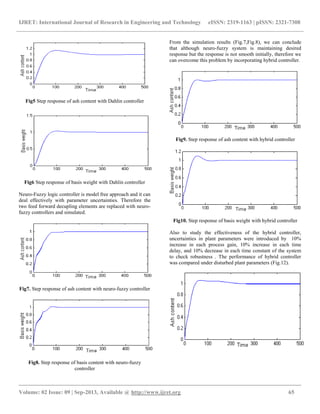
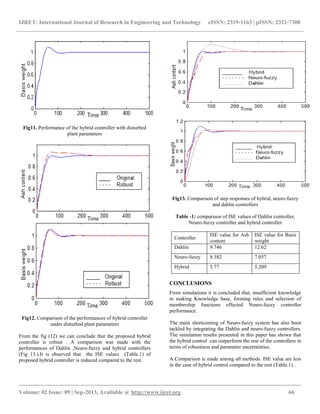
Different intelligent control techniques were developed for
paper machine control and simulated under Matlab 7.0
package to verify the performance of various control schemes
with proposed hybrid controller. The feed forward decoupling
elements replaced by PID controllers ,designed using Dahlin
method and the designed values for
*
11c
G
is kp=4.521, ,ki=0.1,
kd=1 and for
*
22c
G
kp=0.1415, ,ki=0.05, kd=0.2.](https://image.slidesharecdn.com/anintelligenthybridcontrolforpapermachinesystem-160802115206/85/An-intelligent-hybrid-control-for-paper-machine-system-3-320.jpg)
![IJRET: International Journal of Research in Engineering and Technology eISSN: 2319-1163 | pISSN: 2321-7308
__________________________________________________________________________________________
Volume: 02 Issue: 09 | Sep-2013, Available @ http://www.ijret.org 67
REFERENCES
[1]. Bergeron, M., Boulay, R., Drouin, B.,Gagnon, R.,
"Simultaneous Moisture and Basis Weight Measurement" ,
Pulp and Paper Canada, Vol. 89, No. 12 pp. 173-176, 1988.
[2]Isaksson, A.J., L.E. Johnsson and M. Hagberg (1995). “
Benchmarking for Paper Machine MD-Control. Simulation
Results”, Extended Version. Technical Report TRITA-REG-
9502. Department of Signals, Sensors and Systems, Royal
Institute of Technology. Stockholm, Sweden.
[3]M.T. Tham, “Multivariable Control an Introduction To
Decoupling Control” , Dept. of Chemical and Process
Engineering , University of Newcastle upon Tyne An
introduction to Decoupling Control/MTT/July 1999.
[4] K.L. Tang and R.J. Mulholland, “Comparing fuzzy logic
with classical controller designs”, 1EEE Trans. Systems Man
Cybernet. 17 (1987) 1085- 1087.
[5] Verbruggen, H.B. and Brujin, P.M.“Fuzzy Control and
Conventional Control – What is the real contributionof Fuzzy
Systems”Fuzzy Sets and Systems 1997 (151-160).
[6]Braae, M., Rutherford, D.A., "Selection of Parameters for a
Fuzzy Logic Controller", FuzzySets and Systems, Vol. 2, pp.
185-199, 1979.
[7] T. Takagi and M. Sugeno, “ Fuzzy identification of
systems and its applications to modeling and control,” IEEE
Trans. Sys ., man, Cybern, vol.SMC-15, pp. 116-132, 1985.
[8]Lee, C.C., "Fuzzy Logic in Control Systems: Fuzzy Logic
Controller, part I", IEEE Transactions on Systems, Man and
Cybernetics, Vol 20, Part I: pp. 404-418, Part II: pp. 419-435,
1990.
[9]C.C.Lee, “Fuzzy logic in control systems: fuzzy logic
controller, Part II”, IEEE Trans. Syst., man, Cybern, vol.SMC-
20. pp. 419-435, 1990.
[10] Brehm, T., Rattan, K.S., 1993. “Hybrid fuzzy logic PID
controller.” Proceeding of the IEEE National Aerospace and
Electronics Conference, Vol:2, 807-813.
[11]Er, M. J., Sun, Y.L., 2001. “Hybrid fuzzy proportional
integral plus conventional derivative control of linear and
nonlinear systems.” IEEE Trans.On Industrial Electronics
48(6),1109-1117.
[12] Li, W. 1998. “Design of hybrid fuzzy logic proportional
plus conventional integral-derivative controller.” IEEE Trans.
Fuzzy Systems 6(4), 449-463.
[13] Li, W., Chang, X.G., Wahl, F.M., Tso, S.K., 1999.
Hybrid fuzzy P+ID control of manipulators under
uncertainty.” Mechatronics (9), 301-315.](https://image.slidesharecdn.com/anintelligenthybridcontrolforpapermachinesystem-160802115206/85/An-intelligent-hybrid-control-for-paper-machine-system-6-320.jpg)

The paper presents an intelligent hybrid controller for paper machine systems, addressing the complexities of controlling ash content and basis weight. The proposed controller combines Dahlin and neuro-fuzzy techniques, demonstrating improved robustness and performance compared to traditional controllers. Simulation results show that the hybrid controller outperforms other methods, particularly under varying operational conditions.


