❓
Amyotropic lateral
sclerosis
Ayesha Yousaf
Rimsha
CONTENTS
1 Introduction
2
Biochemistry
3
Medication
Introduction
W h a t i s A L S .
01
W h a t i s A L S
Amyotrophic lateral sclerosis (ALS), also known as motor
neurone disease (MND) or Lou Gehrig's disease, is a
disease that causes the death of neurons controlling
voluntary muscles
A-myo-trophic comes from the Greek language.
"A" means no. "Myo" refers to muscle, and "Trophic"
means nourishment – "No muscle nourishment."
"Lateral" identifies the areas in a person's spinal cord
where portions of the nerve cells that signal and control
the muscles are located.
As this area degenerates, it leads to scarring or hardening
("sclerosis") in the region.
H i s t o r y
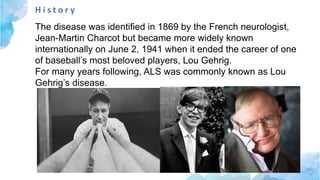
The disease was identified in 1869 by the French neurologist,
Jean-Martin Charcot but became more widely known
internationally on June 2, 1941 when it ended the career of one
of baseball’s most beloved players, Lou Gehrig.
For many years following, ALS was commonly known as Lou
Gehrig’s disease.
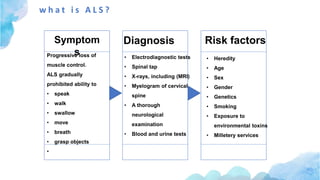
Symptom
s
Diagnosis Risk factors
w h a t i s A L S ?
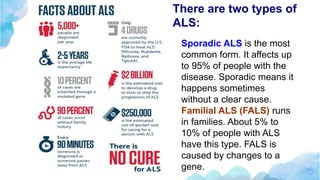
There are two types of
ALS:
Sporadic ALS is the most
common form. It affects up
to 95% of people with the
disease. Sporadic means it
happens sometimes
without a clear cause.
Familial ALS (FALS) runs
in families. About 5% to
10% of people with ALS
have this type. FALS is
caused by changes to a
gene.
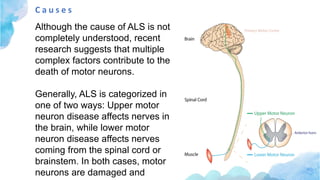
C a u s e s
Although the cause of ALS is not
completely understood, recent
research suggests that multiple
complex factors contribute to the
death of motor neurons.
Generally, ALS is categorized in
one of two ways: Upper motor
neuron disease affects nerves in
the brain, while lower motor
neuron disease affects nerves
coming from the spinal cord or
brainstem. In both cases, motor
neurons are damaged and
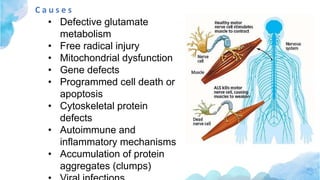
C a u s e s
• Defective glutamate
metabolism
• Free radical injury
• Mitochondrial dysfunction
• Gene defects
• Programmed cell death or
apoptosis
• Cytoskeletal protein
defects
• Autoimmune and
inflammatory mechanisms
• Accumulation of protein
aggregates (clumps)
Motor neurons
degeneration
02
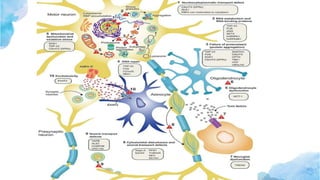
M u l t i p l e R o u t e s o f M o t o r N e u r o n
D e g e n e r a t i o n i n A L S
The genes known to be involved in ALS can be grouped
into three general categories based on their normal
function: protein degradation, the cytoskeleton, and RNA
processing.
The etiology of most ALS cases remains unknown, but
mutations of ALS-linked Cu/Zn superoxide dismutase 1
(SOD1) are the most common causes of fALS and are
responsible for its neurotoxicity and disease propagation
due to the acquired toxic gain-of-function.
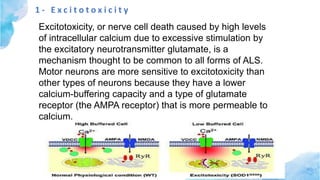
1 - E x c i t o t o x i c i t y
Excitotoxicity, or nerve cell death caused by high levels
of intracellular calcium due to excessive stimulation by
the excitatory neurotransmitter glutamate, is a
mechanism thought to be common to all forms of ALS.
Motor neurons are more sensitive to excitotoxicity than
other types of neurons because they have a lower
calcium-buffering capacity and a type of glutamate
receptor (the AMPA receptor) that is more permeable to
calcium.
2 - A p o p t o s i s
Apoptosis is probably correlated with the demise of motor
neurons in ALS.
Degenerating motor neurons in the spinal cord and the motor
cortex are illustrated by the dark and shrunken cytoplasm and
nuclei, chromatin condensation, and apoptotic bodies in the
cells.
Various pro-apoptosis proteins are activated in the ALS-injured
area, and protein synthesis
inhibitors attenuate ALS-related neuronal death.
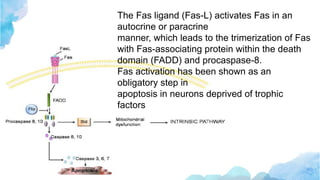
Death receptor Fas : The death receptor Fas (CD95 or APO-
1) belongs to the tumor necrosis factor (TNF) receptor
superfamily and functions as a key determinant of cell fate
under physiological and patho‐
logical conditions.
The Fas ligand (Fas-L) activates Fas in an
autocrine or paracrine
manner, which leads to the trimerization of Fas
with Fas-associating protein within the death
domain (FADD) and procaspase-8.
Fas activation has been shown as an
obligatory step in
apoptosis in neurons deprived of trophic
factors
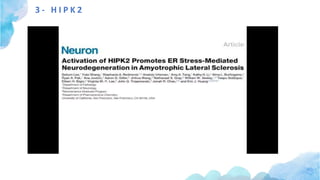
3 - H I P K 2
03 Medication
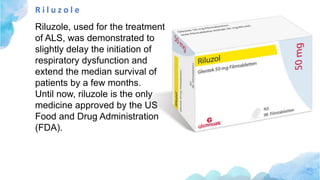
R i l u z o l e
Riluzole, used for the treatment
of ALS, was demonstrated to
slightly delay the initiation of
respiratory dysfunction and
extend the median survival of
patients by a few months.
Until now, riluzole is the only
medicine approved by the US
Food and Drug Administration
(FDA).
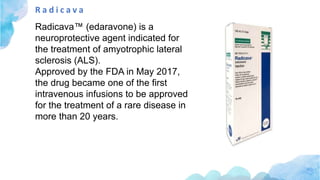
R a d i c a v a
Radicava™ (edaravone) is a
neuroprotective agent indicated for
the treatment of amyotrophic lateral
sclerosis (ALS).
Approved by the FDA in May 2017,
the drug became one of the first
intravenous infusions to be approved
for the treatment of a rare disease in
more than 20 years.
M e c h a n i s m
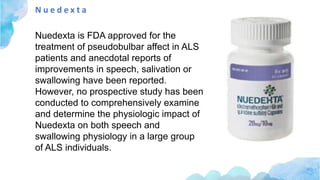
N u e d e x t a
Nuedexta is FDA approved for the
treatment of pseudobulbar affect in ALS
patients and anecdotal reports of
improvements in speech, salivation or
swallowing have been reported.
However, no prospective study has been
conducted to comprehensively examine
and determine the physiologic impact of
Nuedexta on both speech and
swallowing physiology in a large group
of ALS individuals.
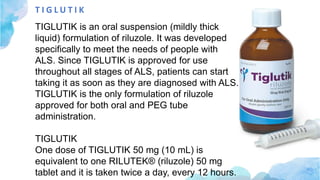
T I G L U T I K
TIGLUTIK is an oral suspension (mildly thick
liquid) formulation of riluzole. It was developed
specifically to meet the needs of people with
ALS. Since TIGLUTIK is approved for use
throughout all stages of ALS, patients can start
taking it as soon as they are diagnosed with ALS.
TIGLUTIK is the only formulation of riluzole
approved for both oral and PEG tube
administration.
TIGLUTIK
One dose of TIGLUTIK 50 mg (10 mL) is
equivalent to one RILUTEK® (riluzole) 50 mg
tablet and it is taken twice a day, every 12 hours.
Any Question🤔
THANK YOU

Aymotropic lateral sclerosis & Cell signaling

  • 1.
  • 2.
  • 3.
  • 4.
    Introduction W h at i s A L S . 01
  • 5.
    W h at i s A L S Amyotrophic lateral sclerosis (ALS), also known as motor neurone disease (MND) or Lou Gehrig's disease, is a disease that causes the death of neurons controlling voluntary muscles A-myo-trophic comes from the Greek language. "A" means no. "Myo" refers to muscle, and "Trophic" means nourishment – "No muscle nourishment." "Lateral" identifies the areas in a person's spinal cord where portions of the nerve cells that signal and control the muscles are located. As this area degenerates, it leads to scarring or hardening ("sclerosis") in the region.
  • 6.
    H i st o r y The disease was identified in 1869 by the French neurologist, Jean-Martin Charcot but became more widely known internationally on June 2, 1941 when it ended the career of one of baseball’s most beloved players, Lou Gehrig. For many years following, ALS was commonly known as Lou Gehrig’s disease.
  • 7.
  • 8.
    There are twotypes of ALS: Sporadic ALS is the most common form. It affects up to 95% of people with the disease. Sporadic means it happens sometimes without a clear cause. Familial ALS (FALS) runs in families. About 5% to 10% of people with ALS have this type. FALS is caused by changes to a gene.
  • 9.
    C a us e s Although the cause of ALS is not completely understood, recent research suggests that multiple complex factors contribute to the death of motor neurons. Generally, ALS is categorized in one of two ways: Upper motor neuron disease affects nerves in the brain, while lower motor neuron disease affects nerves coming from the spinal cord or brainstem. In both cases, motor neurons are damaged and
  • 10.
    C a us e s • Defective glutamate metabolism • Free radical injury • Mitochondrial dysfunction • Gene defects • Programmed cell death or apoptosis • Cytoskeletal protein defects • Autoimmune and inflammatory mechanisms • Accumulation of protein aggregates (clumps)
  • 11.
  • 12.
    M u lt i p l e R o u t e s o f M o t o r N e u r o n D e g e n e r a t i o n i n A L S The genes known to be involved in ALS can be grouped into three general categories based on their normal function: protein degradation, the cytoskeleton, and RNA processing. The etiology of most ALS cases remains unknown, but mutations of ALS-linked Cu/Zn superoxide dismutase 1 (SOD1) are the most common causes of fALS and are responsible for its neurotoxicity and disease propagation due to the acquired toxic gain-of-function.
  • 13.
    1 - Ex c i t o t o x i c i t y Excitotoxicity, or nerve cell death caused by high levels of intracellular calcium due to excessive stimulation by the excitatory neurotransmitter glutamate, is a mechanism thought to be common to all forms of ALS. Motor neurons are more sensitive to excitotoxicity than other types of neurons because they have a lower calcium-buffering capacity and a type of glutamate receptor (the AMPA receptor) that is more permeable to calcium.
  • 14.
    2 - Ap o p t o s i s Apoptosis is probably correlated with the demise of motor neurons in ALS. Degenerating motor neurons in the spinal cord and the motor cortex are illustrated by the dark and shrunken cytoplasm and nuclei, chromatin condensation, and apoptotic bodies in the cells. Various pro-apoptosis proteins are activated in the ALS-injured area, and protein synthesis inhibitors attenuate ALS-related neuronal death. Death receptor Fas : The death receptor Fas (CD95 or APO- 1) belongs to the tumor necrosis factor (TNF) receptor superfamily and functions as a key determinant of cell fate under physiological and patho‐ logical conditions.
  • 15.
    The Fas ligand(Fas-L) activates Fas in an autocrine or paracrine manner, which leads to the trimerization of Fas with Fas-associating protein within the death domain (FADD) and procaspase-8. Fas activation has been shown as an obligatory step in apoptosis in neurons deprived of trophic factors
  • 17.
    3 - HI P K 2
  • 18.
  • 19.
    R i lu z o l e Riluzole, used for the treatment of ALS, was demonstrated to slightly delay the initiation of respiratory dysfunction and extend the median survival of patients by a few months. Until now, riluzole is the only medicine approved by the US Food and Drug Administration (FDA).
  • 20.
    R a di c a v a Radicava™ (edaravone) is a neuroprotective agent indicated for the treatment of amyotrophic lateral sclerosis (ALS). Approved by the FDA in May 2017, the drug became one of the first intravenous infusions to be approved for the treatment of a rare disease in more than 20 years.
  • 21.
    M e ch a n i s m
  • 22.
    N u ed e x t a Nuedexta is FDA approved for the treatment of pseudobulbar affect in ALS patients and anecdotal reports of improvements in speech, salivation or swallowing have been reported. However, no prospective study has been conducted to comprehensively examine and determine the physiologic impact of Nuedexta on both speech and swallowing physiology in a large group of ALS individuals.
  • 23.
    T I GL U T I K TIGLUTIK is an oral suspension (mildly thick liquid) formulation of riluzole. It was developed specifically to meet the needs of people with ALS. Since TIGLUTIK is approved for use throughout all stages of ALS, patients can start taking it as soon as they are diagnosed with ALS. TIGLUTIK is the only formulation of riluzole approved for both oral and PEG tube administration. TIGLUTIK One dose of TIGLUTIK 50 mg (10 mL) is equivalent to one RILUTEK® (riluzole) 50 mg tablet and it is taken twice a day, every 12 hours.
  • 24.
  • 25.