Chapter 12- Nervous System Suffixes and ALS Jenny Trace
Suffixes -paresis: weakness -taxia: muscle coordination For this presentation I’m going to report on  Amyotrophic lateral sclerosis (ALS) and how those suffixes are used to describe this disease.
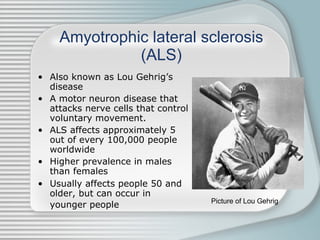
Amyotrophic lateral sclerosis (ALS) Also known as Lou Gehrig’s disease A motor neuron disease that attacks nerve cells that control voluntary movement. ALS affects approximately 5 out of every 100,000 people worldwide Higher prevalence in males than females Usually affects people 50 and older, but can occur in younger people   Picture of Lou Gehrig
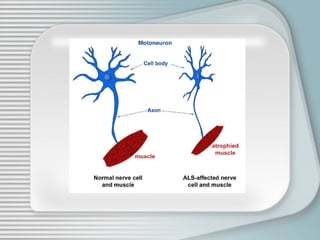
How Does ALS Work? Motor neurons are communication unit between brain, brain stem, and spinal cord and voluntary muscles Both upper motor neurons (brain) and lower motor neurons (spinal cord) are affected With ALS, motor neurons degenerate and die and are not able to send messages to muscles This causes loss of function and the muscles weaken and waste away As the disease progresses, the brain loses all capacity to control voluntary muscles When the muscles control of the diaphragm is lost , then the patient is no longer to breath on his/her own Patients usually die within 3-5 years from respiratory failure.
 
Early Symptoms Usually mild and go unnoticed by doctor Twitching, cramping or stiffness of muscles Usually arm or leg Slurred or nasal speech  Difficulty chewing or swallowing
Symptoms As symptoms persist, then diagnosis for ALS is usually given Difficulty breathing (dysphagia)  Difficulty speaking or forming words Muscle atrophy Exaggerated reflexes Overactive gag reflex Difficulty swallowing Paralysis
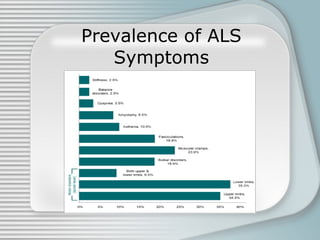
Prevalence of ALS Symptoms
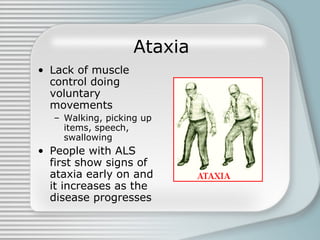
Ataxia Lack of muscle control doing voluntary movements Walking, picking up items, speech, swallowing People with ALS first show signs of ataxia early on and it increases as the disease progresses
Quadriparesis   Muscle weakness affecting all four limbs Depending on how the ALS is progressing, a patient may first experience paraparesis (weakness of lower limbs) or weakness of all limbs This will eventually result in paralysis and the patient can become a quadriplegic
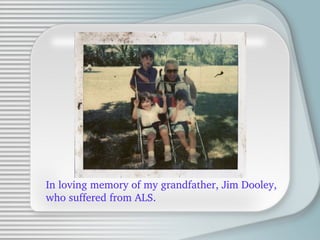
In loving memory of my grandfather, Jim Dooley, who suffered from ALS.

Chapter 12

  • 1.
    Chapter 12- NervousSystem Suffixes and ALS Jenny Trace
  • 2.
    Suffixes -paresis: weakness-taxia: muscle coordination For this presentation I’m going to report on Amyotrophic lateral sclerosis (ALS) and how those suffixes are used to describe this disease.
  • 3.
    Amyotrophic lateral sclerosis(ALS) Also known as Lou Gehrig’s disease A motor neuron disease that attacks nerve cells that control voluntary movement. ALS affects approximately 5 out of every 100,000 people worldwide Higher prevalence in males than females Usually affects people 50 and older, but can occur in younger people Picture of Lou Gehrig
  • 4.
    How Does ALSWork? Motor neurons are communication unit between brain, brain stem, and spinal cord and voluntary muscles Both upper motor neurons (brain) and lower motor neurons (spinal cord) are affected With ALS, motor neurons degenerate and die and are not able to send messages to muscles This causes loss of function and the muscles weaken and waste away As the disease progresses, the brain loses all capacity to control voluntary muscles When the muscles control of the diaphragm is lost , then the patient is no longer to breath on his/her own Patients usually die within 3-5 years from respiratory failure.
  • 5.
  • 6.
    Early Symptoms Usuallymild and go unnoticed by doctor Twitching, cramping or stiffness of muscles Usually arm or leg Slurred or nasal speech Difficulty chewing or swallowing
  • 7.
    Symptoms As symptomspersist, then diagnosis for ALS is usually given Difficulty breathing (dysphagia) Difficulty speaking or forming words Muscle atrophy Exaggerated reflexes Overactive gag reflex Difficulty swallowing Paralysis
  • 8.
  • 9.
    Ataxia Lack ofmuscle control doing voluntary movements Walking, picking up items, speech, swallowing People with ALS first show signs of ataxia early on and it increases as the disease progresses
  • 10.
    Quadriparesis Muscle weakness affecting all four limbs Depending on how the ALS is progressing, a patient may first experience paraparesis (weakness of lower limbs) or weakness of all limbs This will eventually result in paralysis and the patient can become a quadriplegic
  • 11.
    In loving memoryof my grandfather, Jim Dooley, who suffered from ALS.