GASTROINTESTINAL INTUBATION
PRESENTED BY :
V.RAMYA,
TUTOR.
DEFINITION
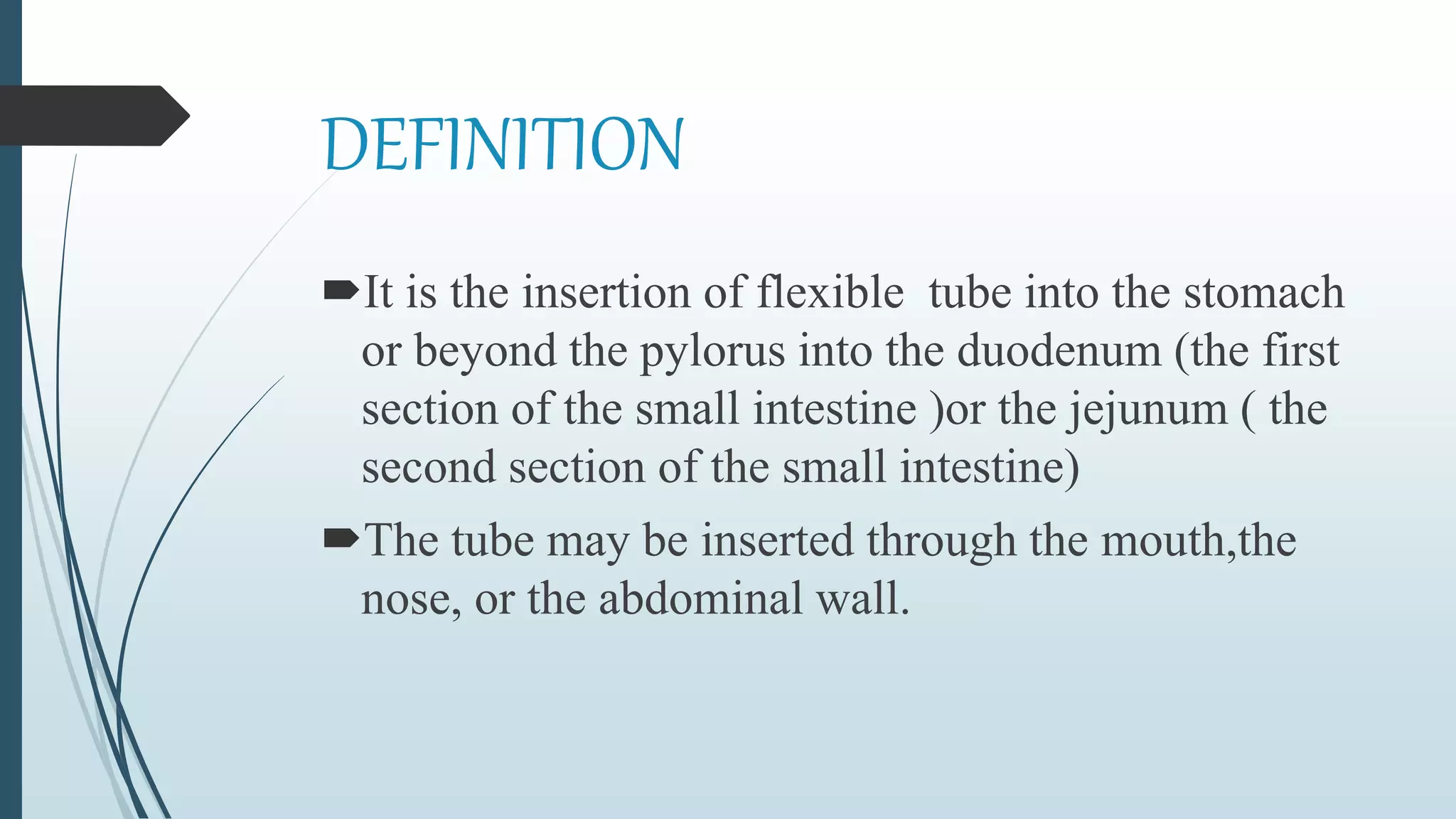
It is the insertion of flexible tube into the stomach
or beyond the pylorus into the duodenum (the first
section of the small intestine )or the jejunum ( the
second section of the small intestine)
The tube may be inserted through the mouth,the
nose, or the abdominal wall.
PURPOSE
 Decompress the stomach
 Lavage the stomach
 Diagnose GI disorders
 Administer medications and tube feedings and fluids
 Treat an obstruction
 Compress a bleeding site
 Aspirate GI contents for analysis
TYPES OF TUBES
Gastric tubes
Levin
Sump
Enteric tubes
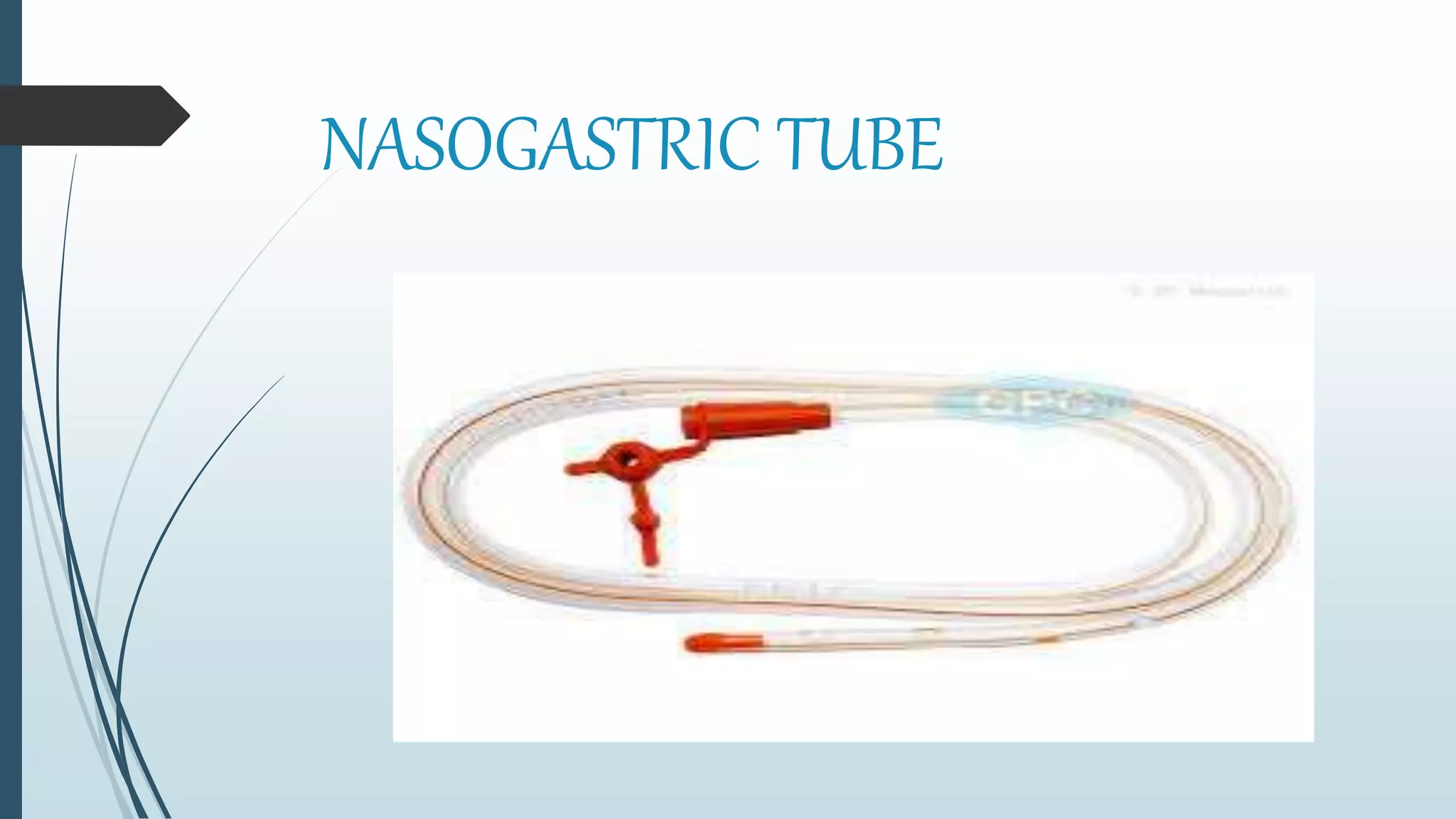
NASOGASTRIC TUBE
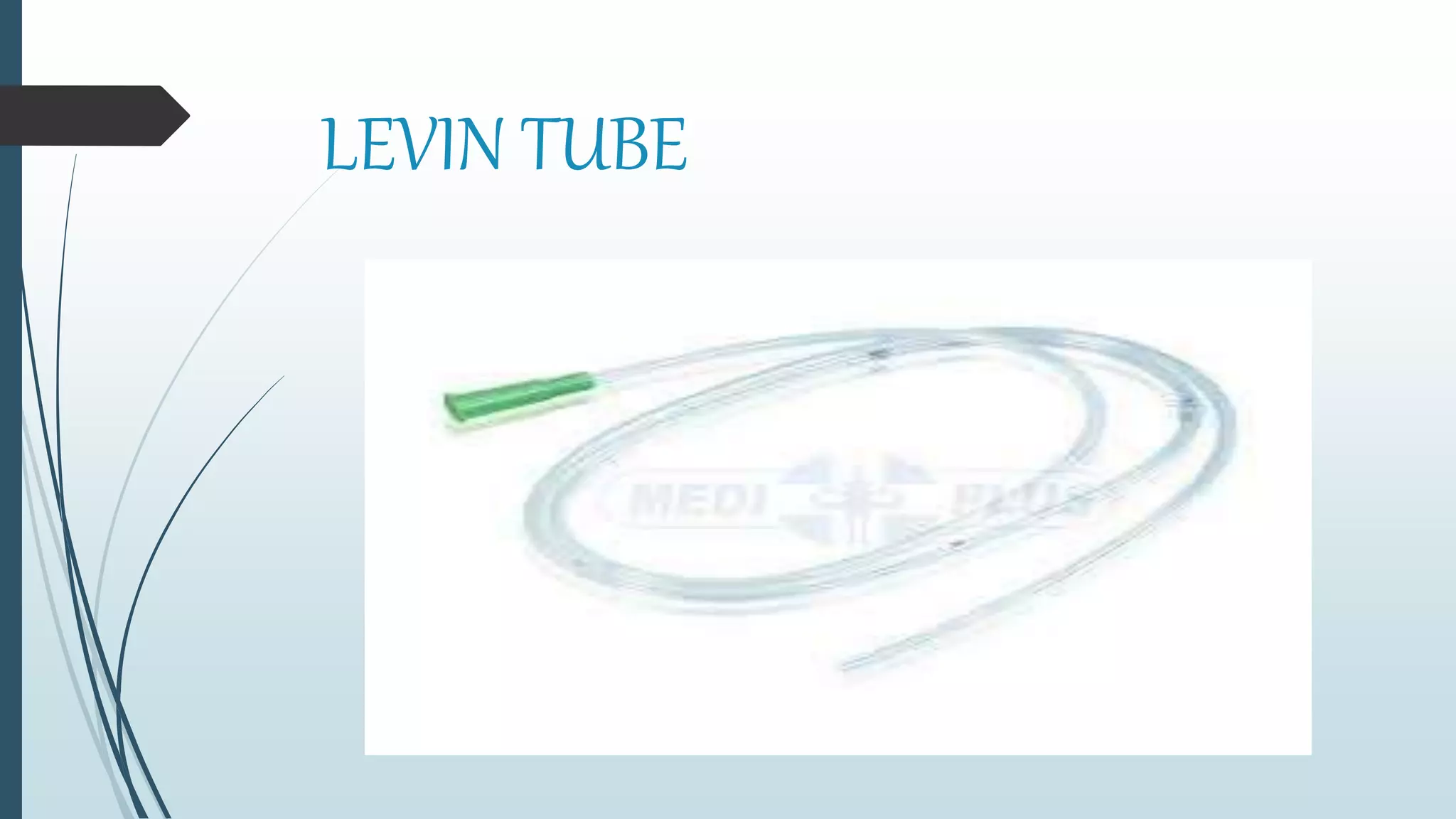
LEVIN TUBE
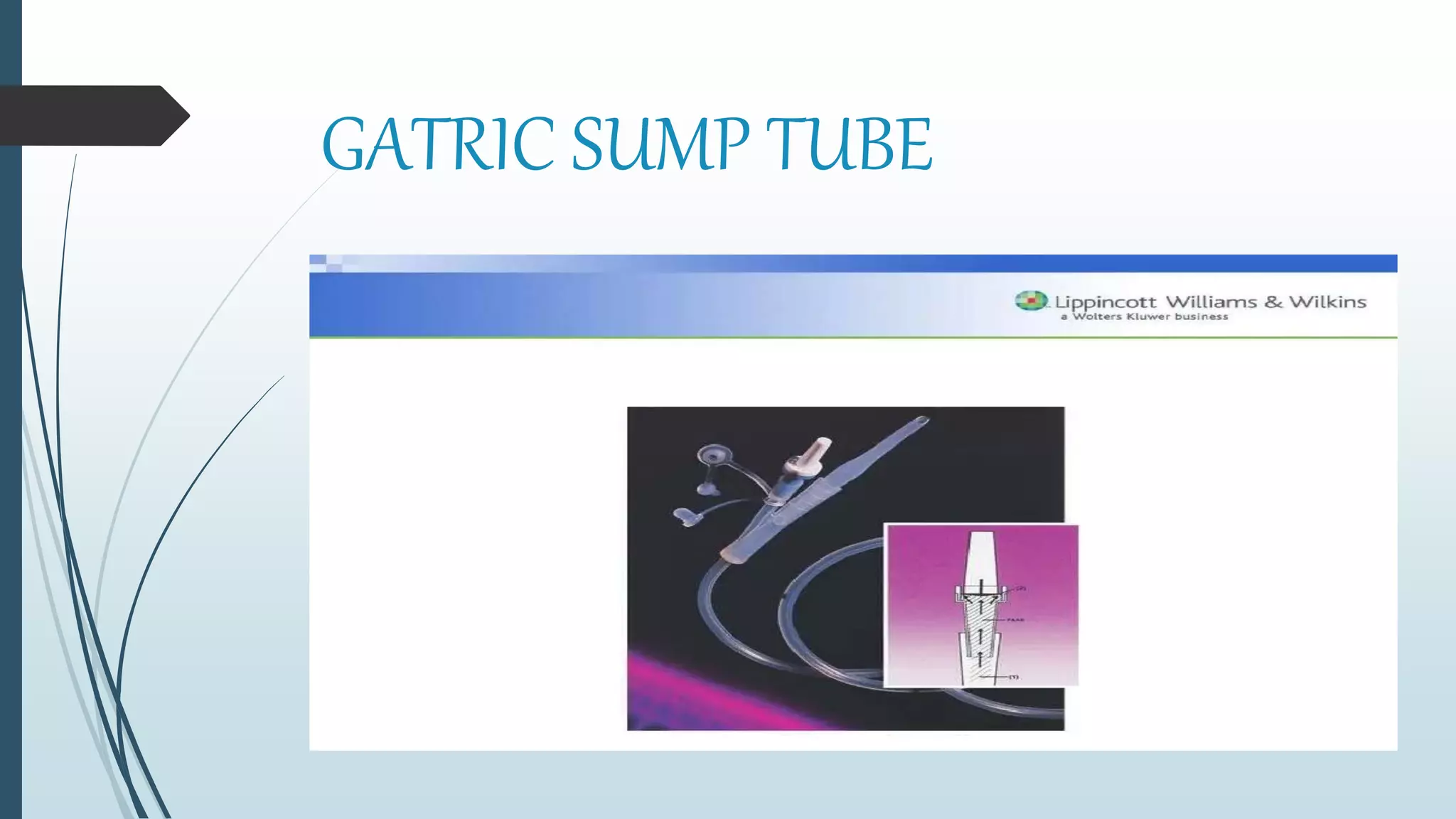
GATRIC SUMP TUBE
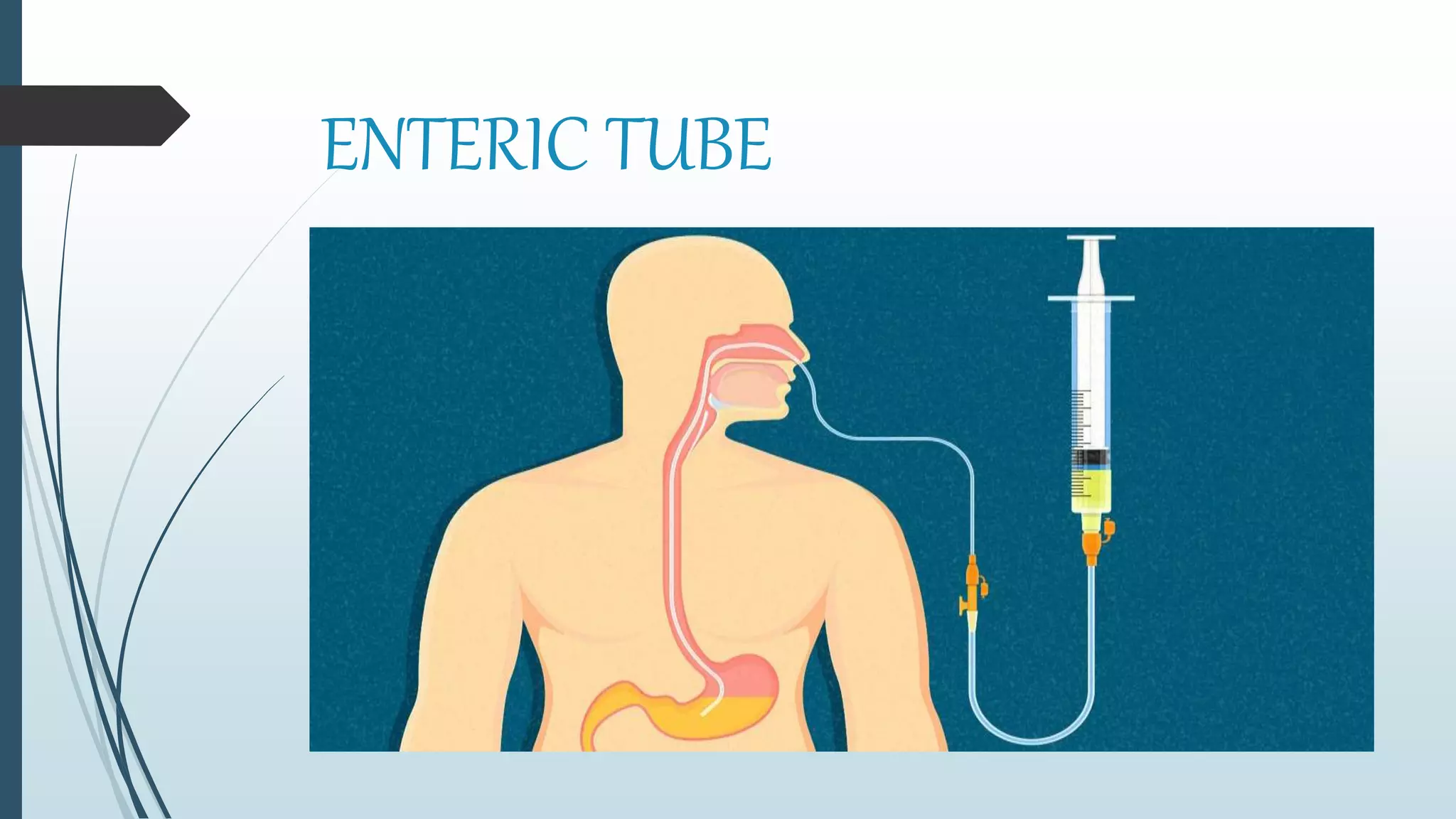
ENTERIC TUBE
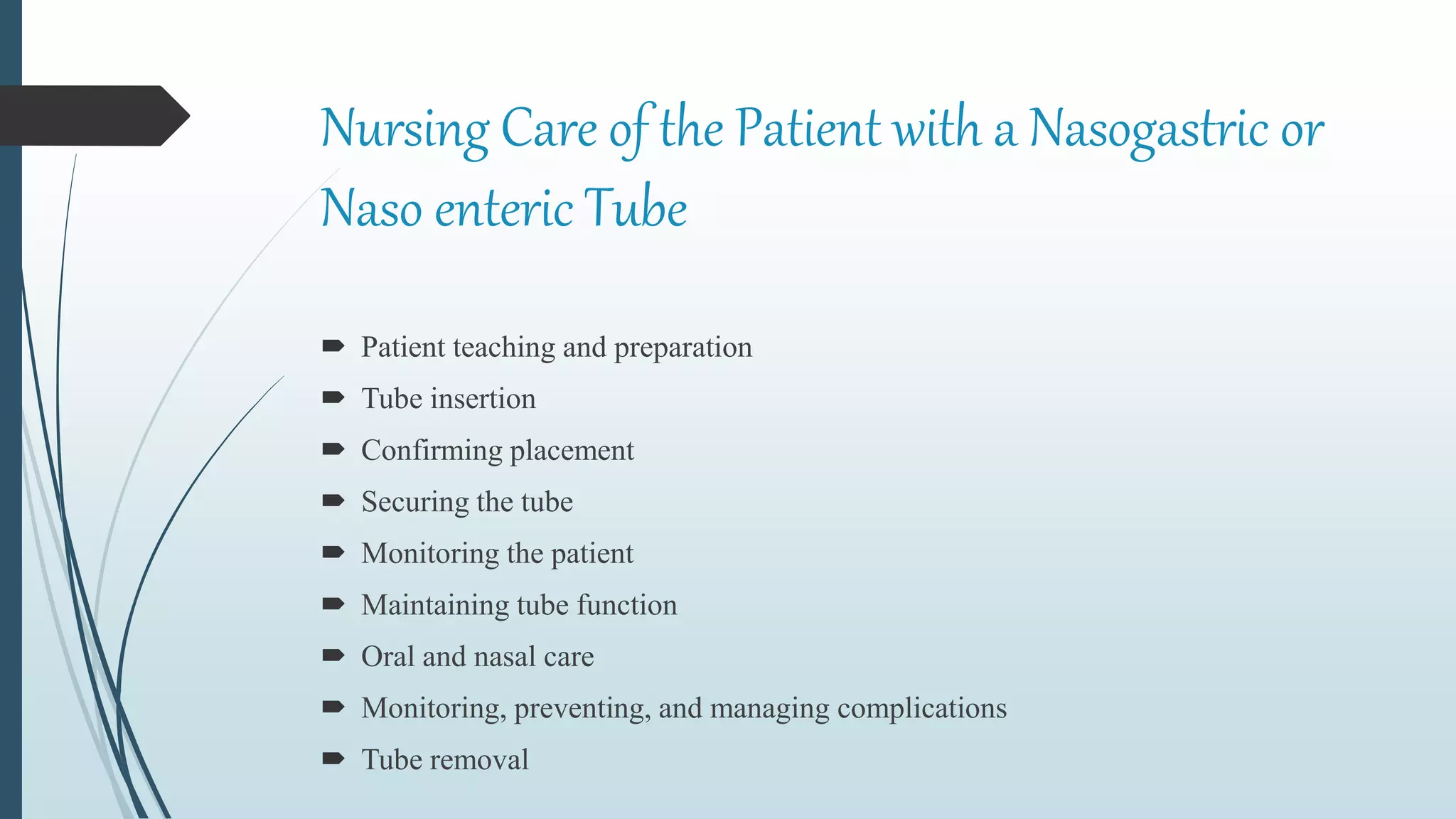
Nursing Care of the Patient with a Nasogastric or
Naso enteric Tube
 Patient teaching and preparation
 Tube insertion
 Confirming placement
 Securing the tube
 Monitoring the patient
 Maintaining tube function
 Oral and nasal care
 Monitoring, preventing, and managing complications
 Tube removal
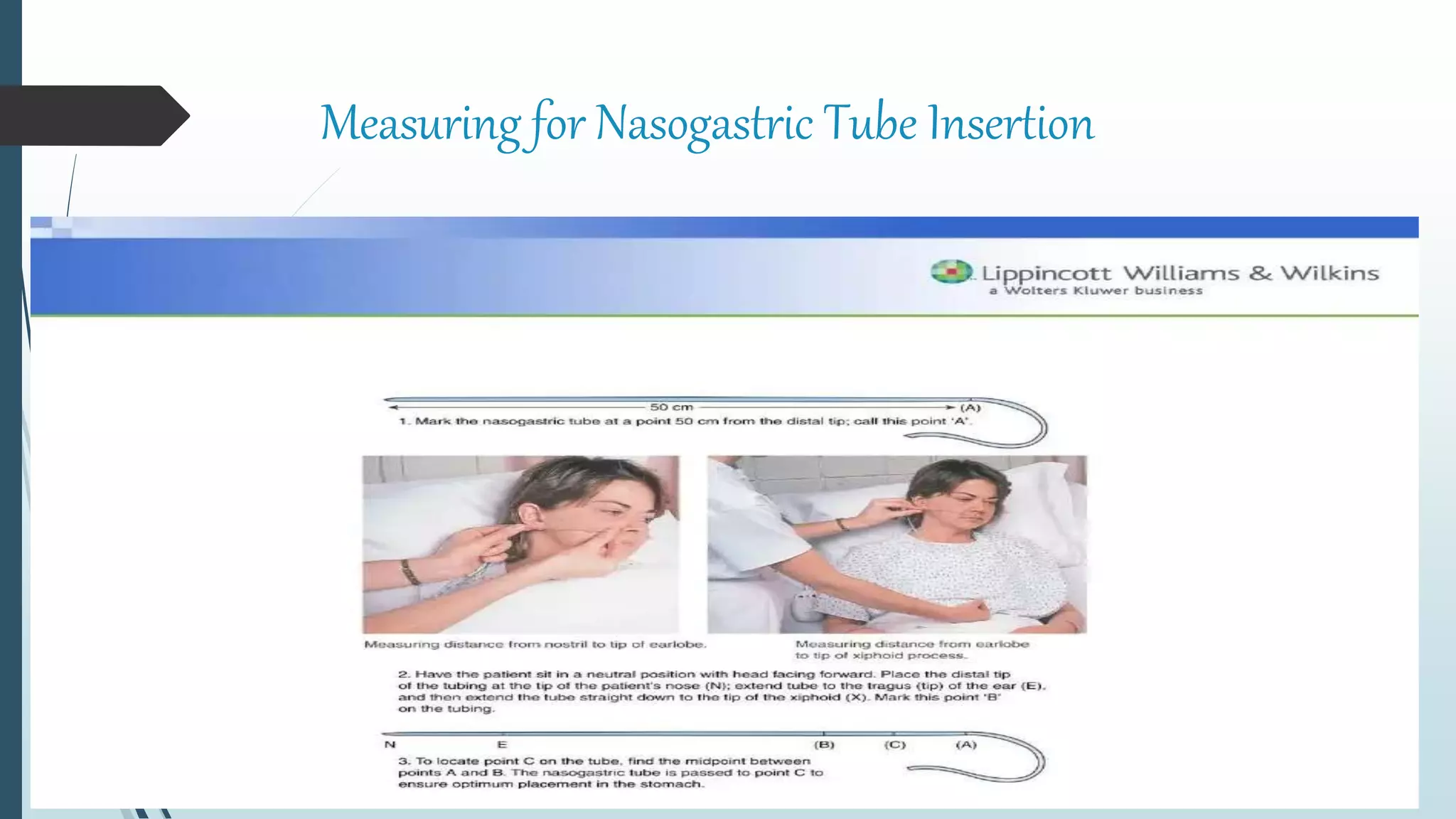
Measuring for Nasogastric Tube Insertion
Securing the NG Tube
Purposes and Advantages of Enteral Feeding
 Meets nutritional requirements when oral intake is in adequate or
not possible, and the GI tract is functioning
 Advantages:–
 Safe and cost-effective
 Preserves GI integrity
 Preserves the normal sequence of intestinal and hepatic metabolism
 Maintains fat metabolism and lipoprotein synthesis
 Maintains normal insulin and glucagon ratios
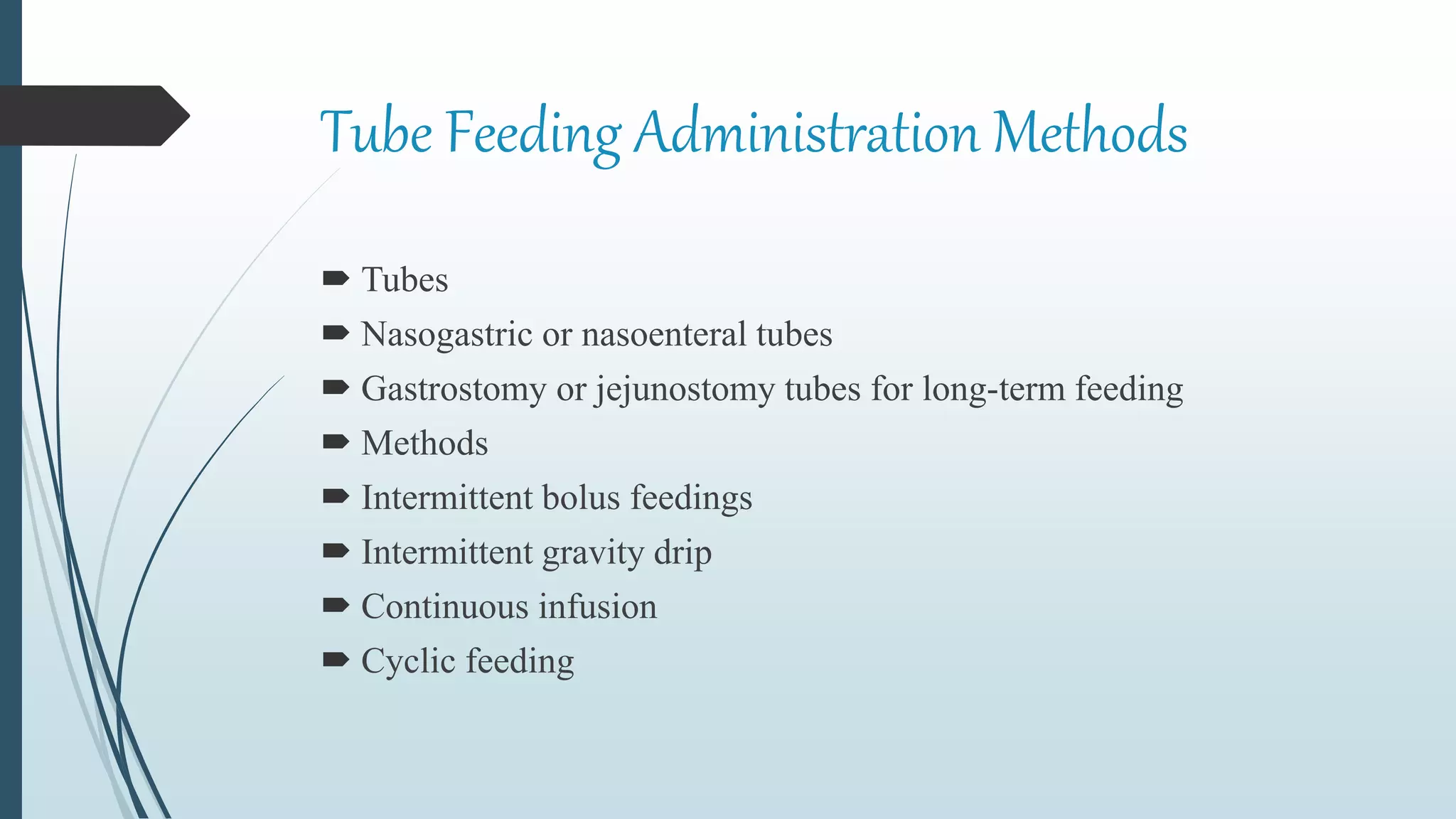
Tube Feeding Administration Methods
 Tubes
 Nasogastric or nasoenteral tubes
 Gastrostomy or jejunostomy tubes for long-term feeding
 Methods
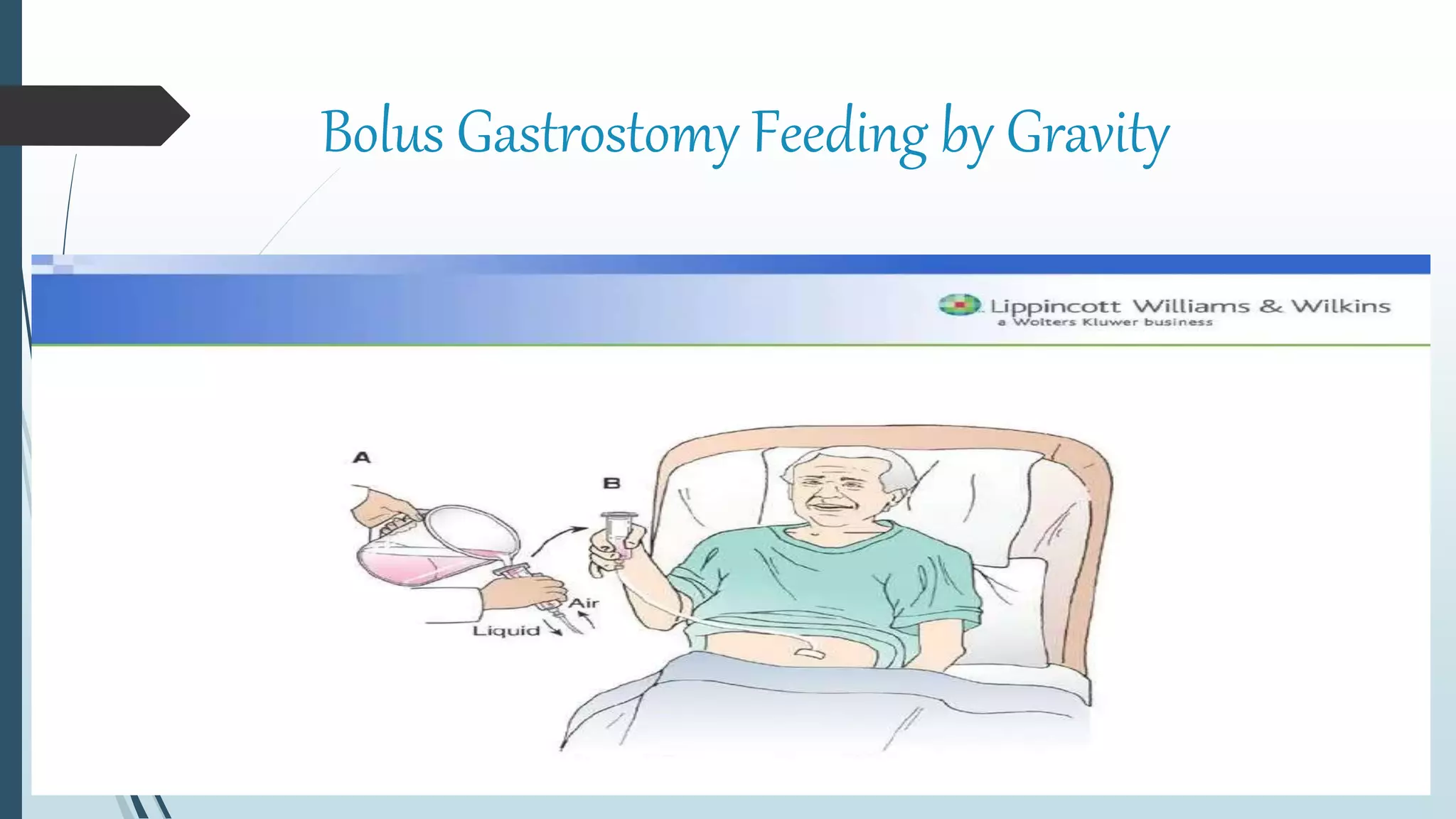
 Intermittent bolus feedings
 Intermittent gravity drip
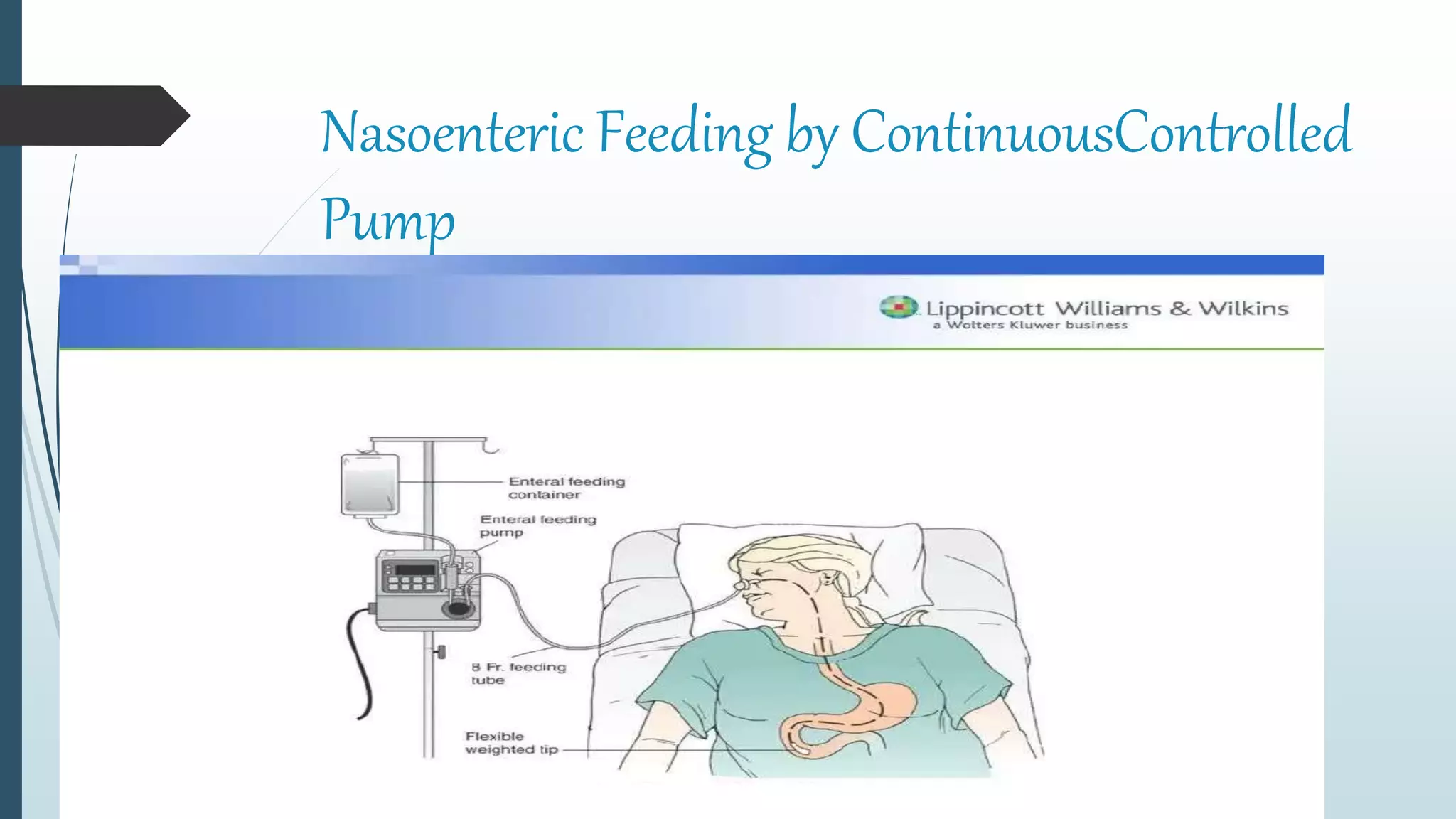
 Continuous infusion
 Cyclic feeding
Bolus Gastrostomy Feeding by Gravity
Nasoenteric Feeding by ContinuousControlled
Pump
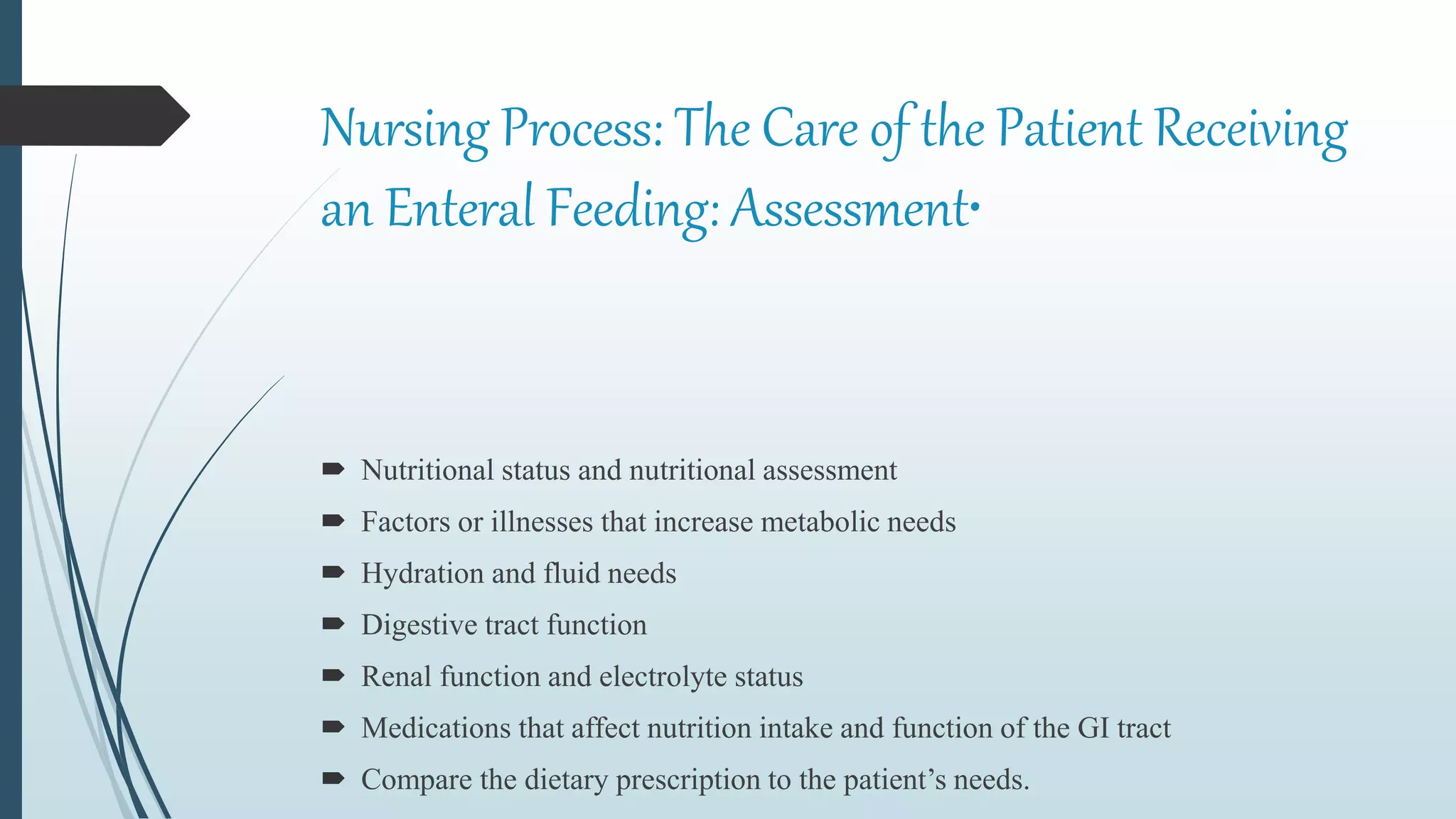
Nursing Process: The Care of the Patient Receiving
an Enteral Feeding: Assessment•
 Nutritional status and nutritional assessment
 Factors or illnesses that increase metabolic needs
 Hydration and fluid needs
 Digestive tract function
 Renal function and electrolyte status
 Medications that affect nutrition intake and function of the GI tract
 Compare the dietary prescription to the patient’s needs.
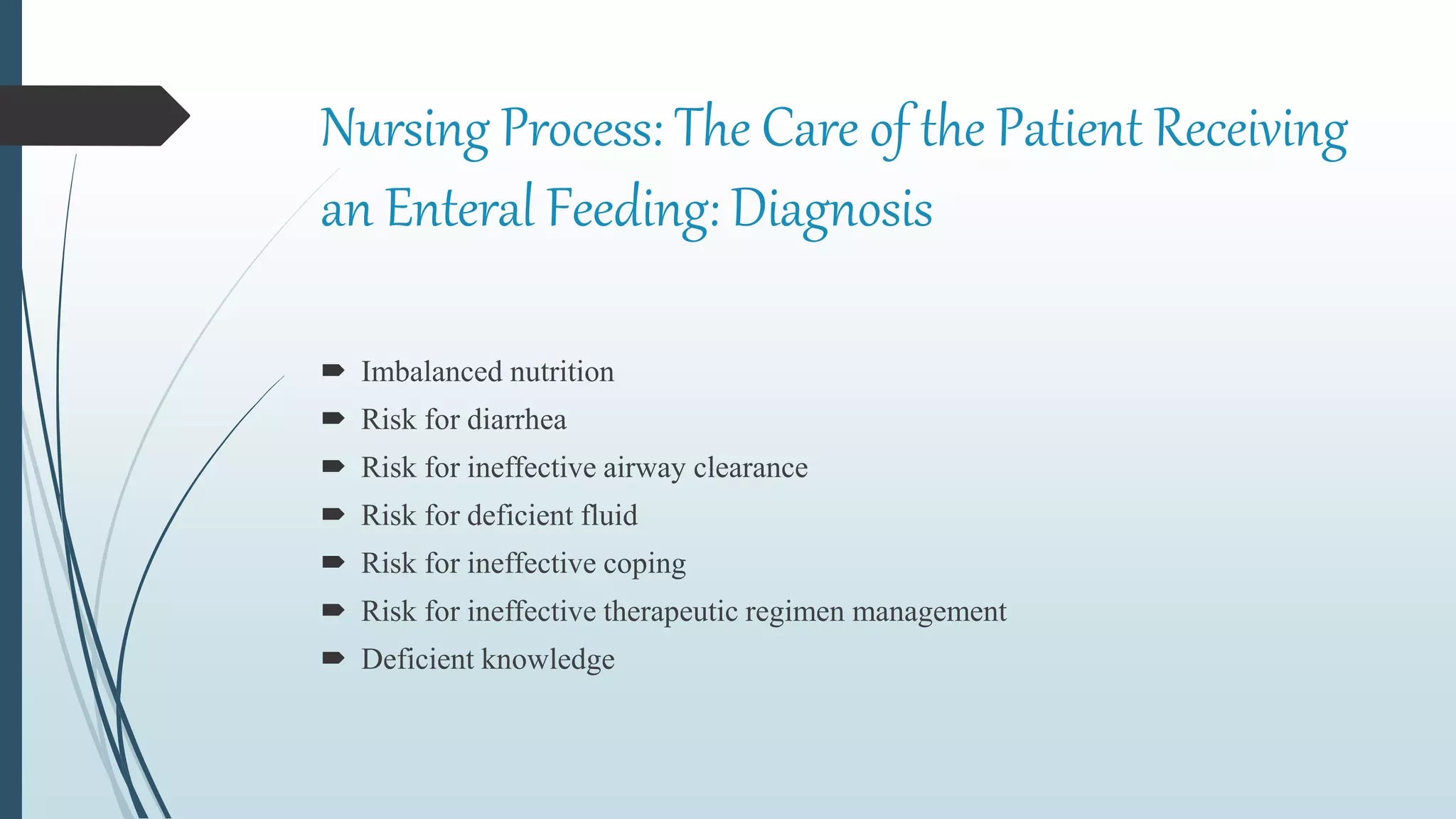
Nursing Process: The Care of the Patient Receiving
an Enteral Feeding: Diagnosis
 Imbalanced nutrition
 Risk for diarrhea
 Risk for ineffective airway clearance
 Risk for deficient fluid
 Risk for ineffective coping
 Risk for ineffective therapeutic regimen management
 Deficient knowledge
Collaborative Problems/Potential Complications
 Diarrhea
 Nausea and vomiting
 Gas/bloating/cramping
 Dumping syndrome
 Aspiration pneumonia
 Tube displacement
 Tube obstruction
 Nasopharyngeal irritation
 Hyperglycemia
 Dehydration and azotemia
Nursing Process: The Care of the Patient Receiving
an Enteral Feeding: Planning
 Major goals may include nutritional balance,
 Normal bowel elimination pattern,
 Reduced risk of aspiration,
 Adequate hydration,
 Individual coping,
 Knowledge of and skill in self-care,
 And prevention of complications.
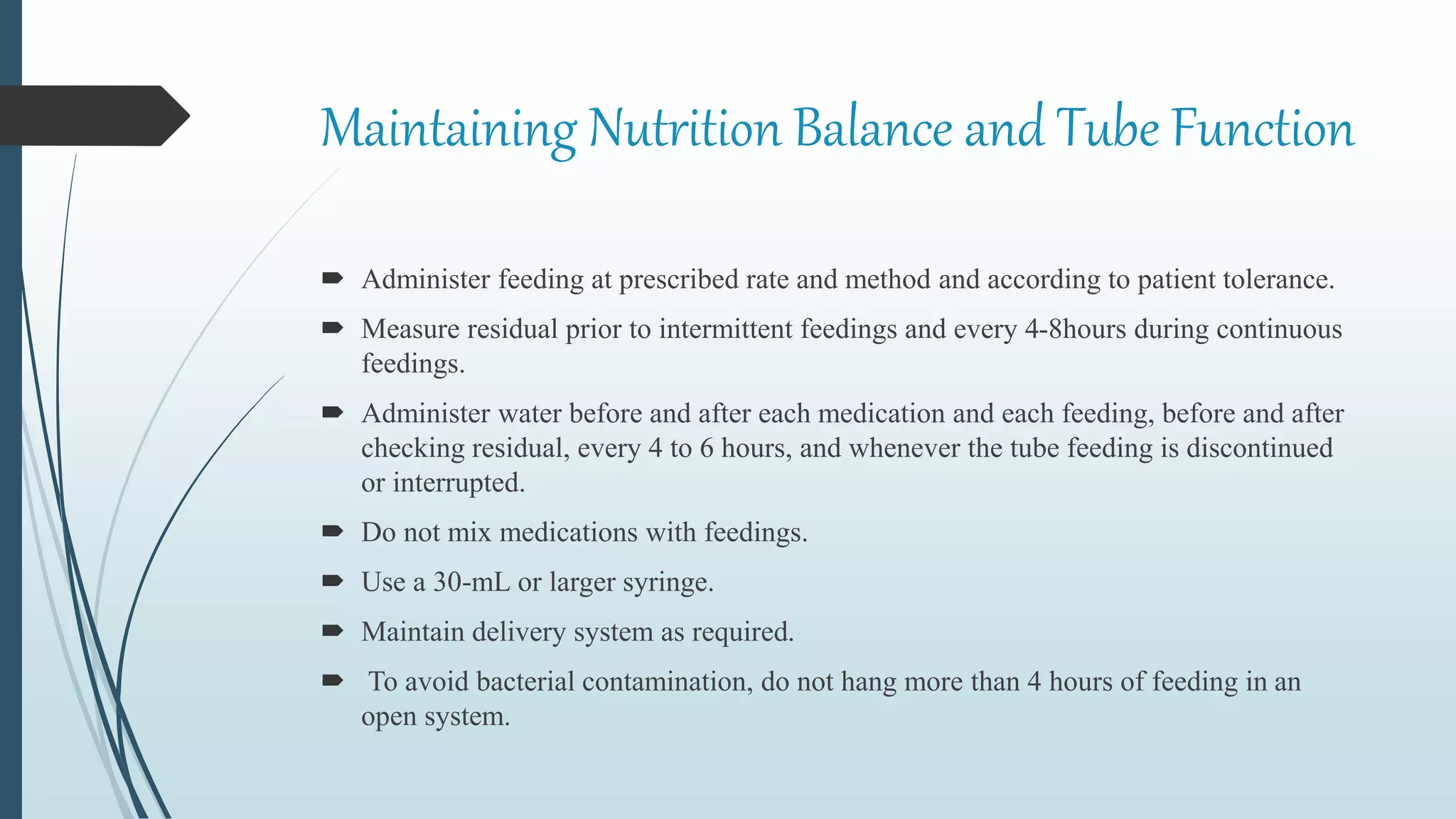
Maintaining Nutrition Balance and Tube Function
 Administer feeding at prescribed rate and method and according to patient tolerance.
 Measure residual prior to intermittent feedings and every 4-8hours during continuous
feedings.
 Administer water before and after each medication and each feeding, before and after
checking residual, every 4 to 6 hours, and whenever the tube feeding is discontinued
or interrupted.
 Do not mix medications with feedings.
 Use a 30-mL or larger syringe.
 Maintain delivery system as required.
 To avoid bacterial contamination, do not hang more than 4 hours of feeding in an
open system.
Maintaining Normal Bowel Elimination
 Selection of Tube Feeding formula:
 consider fiber, osmolality, and fluid content
 Prevent contamination of Tube Feeding:
 maintain closed system, do not hang more than 4 hours of Tube
Feeding in an open system.
 Maintain proper nutritional intake.
 Assess for reason for diarrhea and obtain treatment as needed.
 Administer Tube Feeding slowly to prevent dumping syndrome
 Avoid cold Tube Feeding.
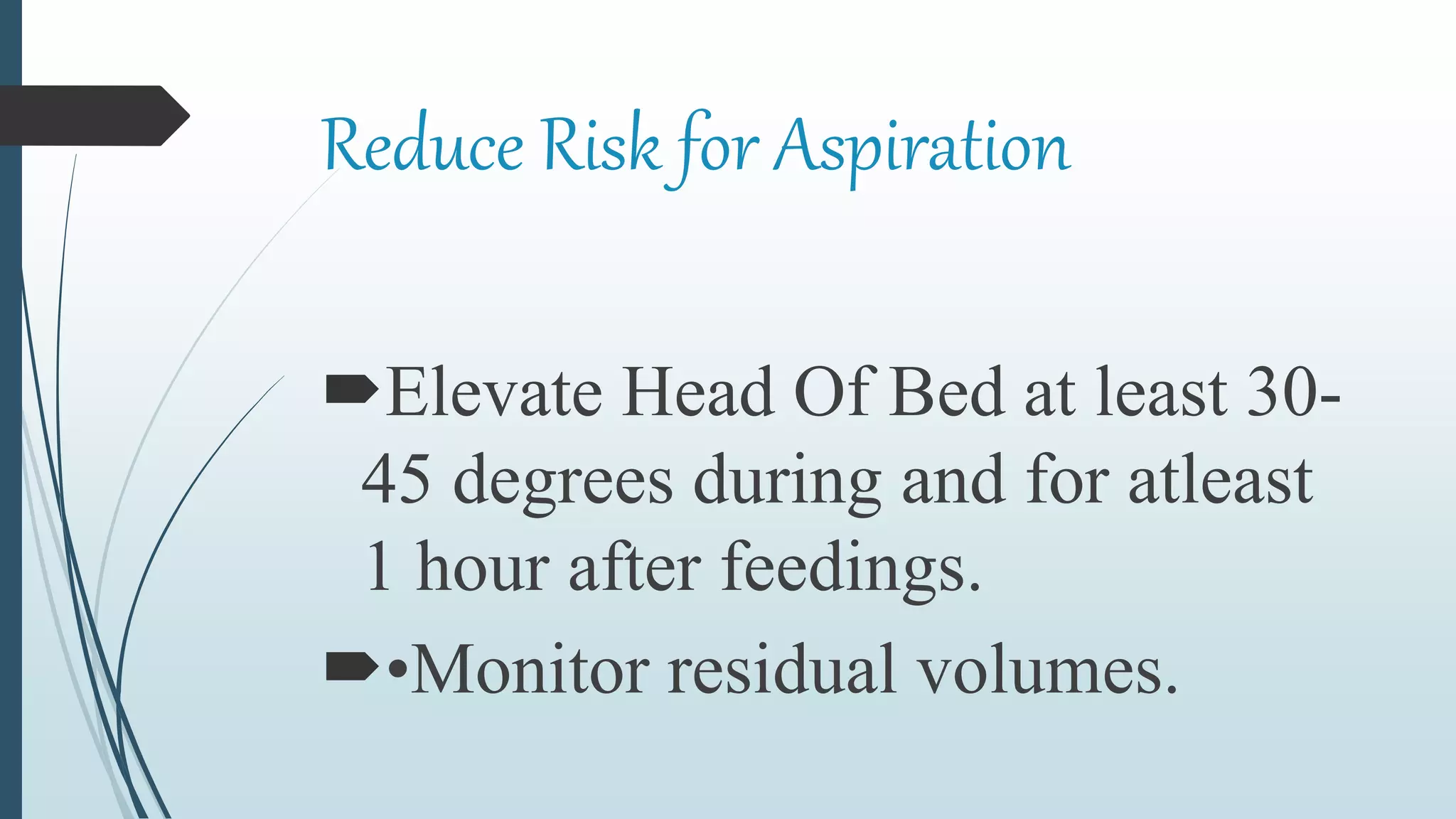
Reduce Risk for Aspiration
Elevate Head Of Bed at least 30-
45 degrees during and for atleast
1 hour after feedings.
•Monitor residual volumes.
Other Interventions
Maintain hydration by supplying additional
water and assessing for signs of dehydration.
Promote coping by support and
encouragement;
Encourage self-care and activities.
Patient teaching
Gastrostomy Tubes
Types of tubes:–
Stamm
Janeway
PEG
Low-profile gastrostomy device (LPGD)
Insertion of the PEG tube
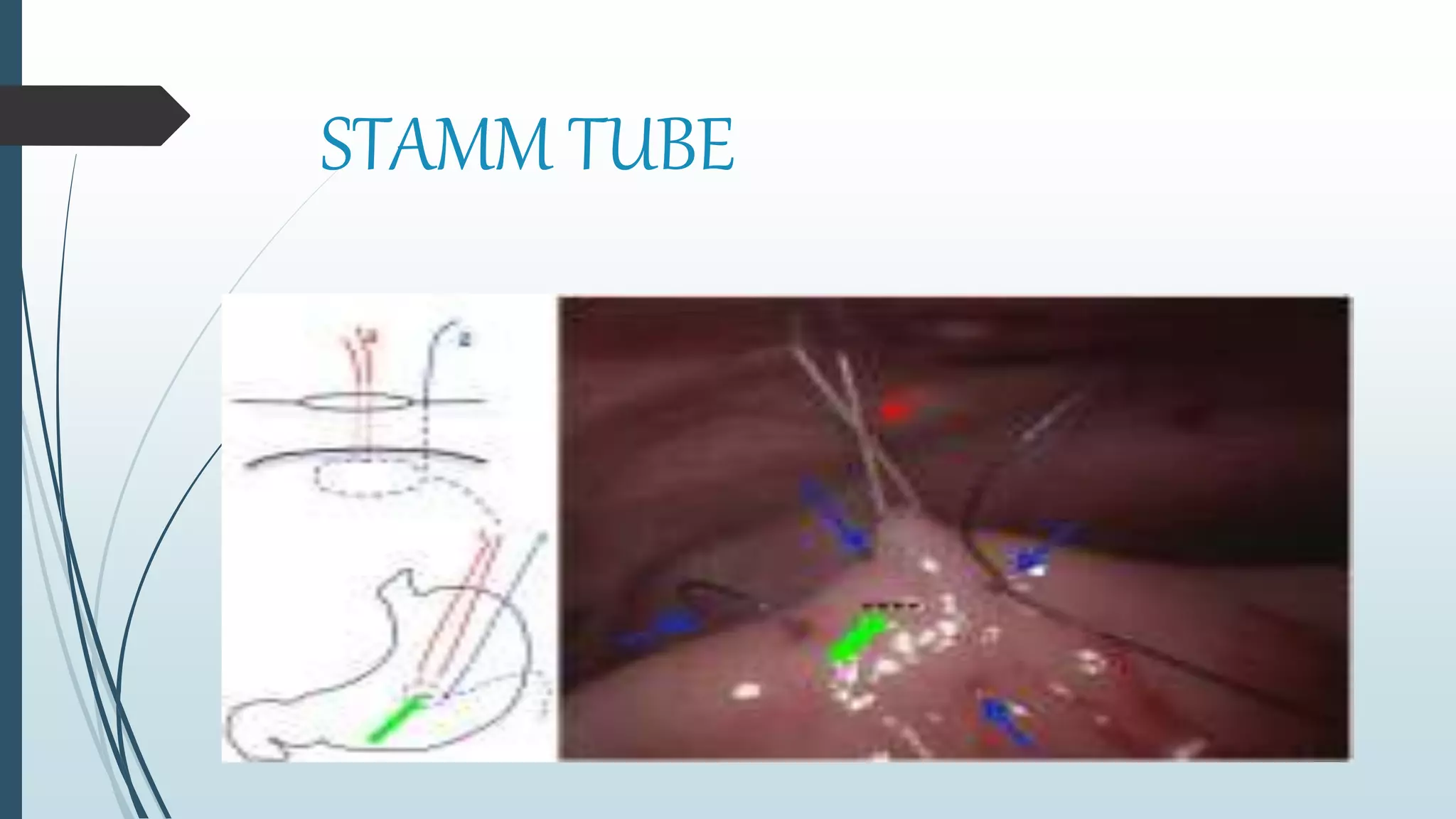
STAMM TUBE
Gastrostomy (PEG) Tubes
Nursing Process: The Care of the Patient With a
Gastrostomy: Assessment
Patient knowledge and ability to learn
Self-care ability and support
Skin condition
Nutrition and fluid status
Nursing Process: The Care of the Patient With a
Gastrostomy: Diagnosis
Imbalanced nutrition
Risk of infection
Risk for impaired skin integrity
Ineffective coping
Disturbed body image
Risk for ineffective therapeutic regimen management
Collaborative Problems/Potential
Complications
Wound infection
GI bleeding
Premature removal of tube
Aspiration
Constipation
Diarrhea
Nursing Process: The Care of the Patient With a
Gastrostomy: Planning
Major goals include attaining an optimal level of nutrition,
Preventing infection,
 Maintaining skin integrity,
Enhancing coping skills,
Adjusting to changes in body image,
Acquiring knowledge of and skill in self-care,
And preventing complications.
Tube Care and Preventing Infection
Proper use of dressing
Skin care around the tube
Manipulation of the stabilizing disk
to prevent skin breakdown
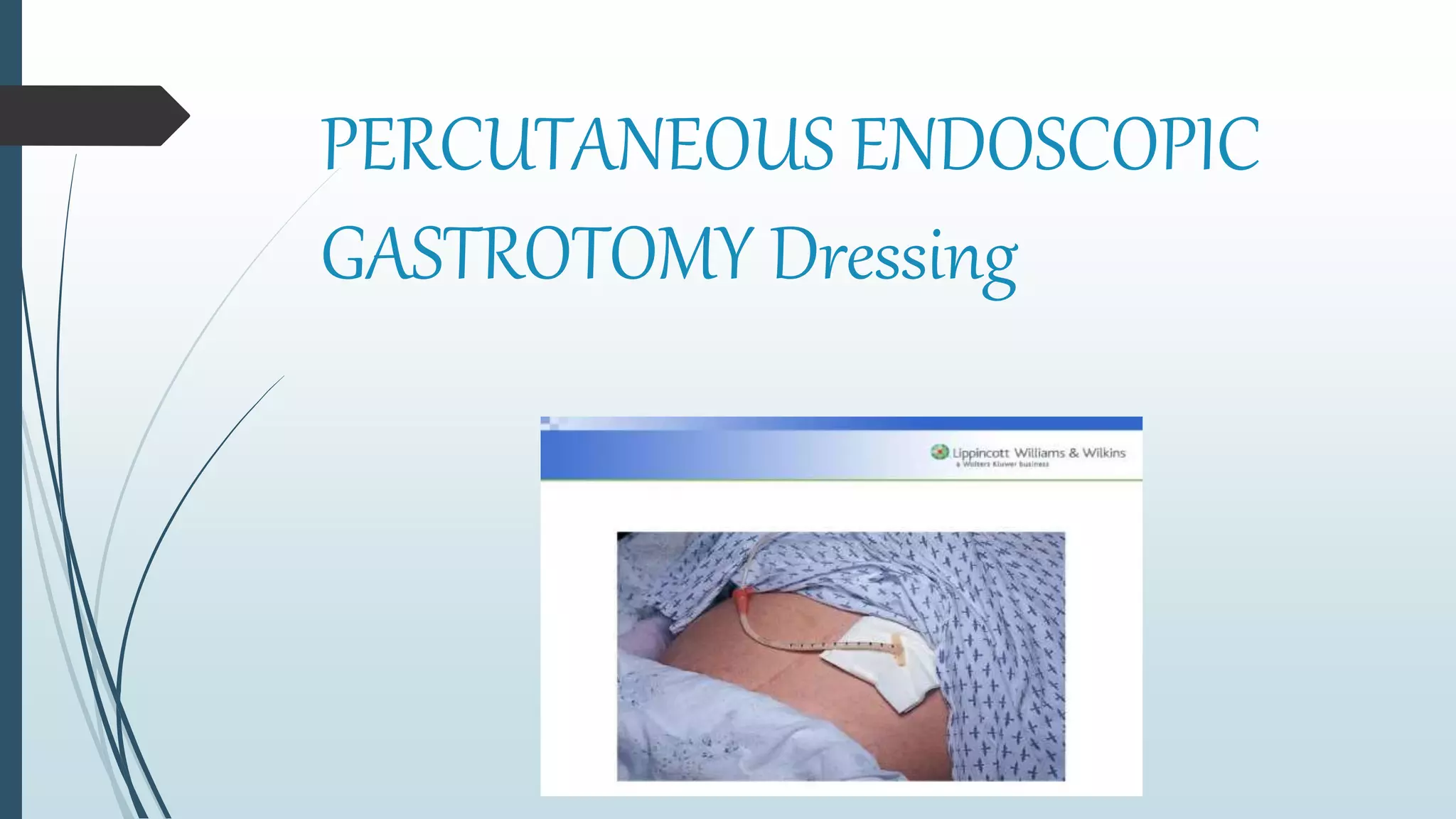
PERCUTANEOUS ENDOSCOPIC
GASTROTOMY Dressing
Indications for Parenteral Nutrition
A method to provide nutrients to the body by an IV route
A complex mixture containing proteins, carbohydrates ,
fats, electrolytes, vitamins, trace minerals, and sterile
water is administered in a single container.
The goals of parenteral nutrition are to improve nutritional
status and to attain a positive nitrogen status.
Nursing Process: The Care of the Patient Receiving
Parenteral Nutrition : Assessment
 Assist in identifying patients who are candidates for Parenteral
Nutrition
 Nutrition status
 Hydration status
 Electrolytes
 Signs and symptoms of hypoglycaemia / hyperglycemia
 Monitor blood glucose levels.
 Assess for potential complications
 Including temperature every 4 hours or by protocol
Nursing Process: The Care of the Patient
Receiving Parenteral Nutrition: Diagnosis
 Imbalanced nutrition
 Risk for infection
 Risk for excess or deficient fluid
 Risk for immobility
 Risk of ineffective therapeutic regimen
Collaborative Problems and Potential
Complications
 Pneumothorax
 Clotted or displaced catheter
 Sepsis
 Hyperglycemia
 Rebound hypoglycaemia
 Fluid overload
Nursing Process: The Care of the Patient Receiving
Parenteral Nutrition: Planning
Major goals may include attaining an optimal level of
nutrition,
Absence of infection,
Adequate fluid volume,
Optimal level of activity,
Knowledge of self-care, and
Absence of complications.
Prevention of Infection
Appropriate catheter and IV site care
Strict sterile technique for dressing changes
Wear mask when changing the dressing.
Assess insertion site.
Assess for indicators of infection.
Proper IV and tubing care
Maintaining Fluid Balance
Use infusion pump.
Flow rate should not be increased or decreased rapidly.
If fluid runs out, hang 10% dextrose solution.
Monitor indicators of fluid balance and electrolyte levels.
I&O
Weights
Monitor blood glucose levels.
Patient Teaching
Goals and purpose
Components of Parenteral Nutrition
Emergency contact numbers
Demonstrate use of equipment and how to handle and
hang the IV.
Demonstrate dressing changes.
Demonstrate how to flush or heparinize the catheter.
Potential complications and actions to take
BIBLIOGRAPHY
 Brunner and Suddarth’s Textbook of Medical- Surgical Nursing ,South Asian
 Edition , Volume 1 , Published by Wolters Kluwer . Page reffered to 817-838.
 Ansari and Kaur, Textbook of Medical – Surgical Nursing 1 , Published by Pee
 Vee 2011 Edition, Page reffered to 810 – 822.
 https://www.slideshare.net/arifasudheer/nasogastric-intubation-151445458
Gastrointestinal intubation.pptx

Gastrointestinal intubation.pptx

  • 1.
  • 2.
    DEFINITION It is theinsertion of flexible tube into the stomach or beyond the pylorus into the duodenum (the first section of the small intestine )or the jejunum ( the second section of the small intestine) The tube may be inserted through the mouth,the nose, or the abdominal wall.
  • 3.
    PURPOSE  Decompress thestomach  Lavage the stomach  Diagnose GI disorders  Administer medications and tube feedings and fluids  Treat an obstruction  Compress a bleeding site  Aspirate GI contents for analysis
  • 4.
    TYPES OF TUBES Gastrictubes Levin Sump Enteric tubes
  • 5.
  • 6.
  • 7.
  • 8.
  • 9.
    Nursing Care ofthe Patient with a Nasogastric or Naso enteric Tube  Patient teaching and preparation  Tube insertion  Confirming placement  Securing the tube  Monitoring the patient  Maintaining tube function  Oral and nasal care  Monitoring, preventing, and managing complications  Tube removal
  • 10.
  • 11.
  • 12.
    Purposes and Advantagesof Enteral Feeding  Meets nutritional requirements when oral intake is in adequate or not possible, and the GI tract is functioning  Advantages:–  Safe and cost-effective  Preserves GI integrity  Preserves the normal sequence of intestinal and hepatic metabolism  Maintains fat metabolism and lipoprotein synthesis  Maintains normal insulin and glucagon ratios
  • 13.
    Tube Feeding AdministrationMethods  Tubes  Nasogastric or nasoenteral tubes  Gastrostomy or jejunostomy tubes for long-term feeding  Methods  Intermittent bolus feedings  Intermittent gravity drip  Continuous infusion  Cyclic feeding
  • 14.
  • 15.
    Nasoenteric Feeding byContinuousControlled Pump
  • 16.
    Nursing Process: TheCare of the Patient Receiving an Enteral Feeding: Assessment•  Nutritional status and nutritional assessment  Factors or illnesses that increase metabolic needs  Hydration and fluid needs  Digestive tract function  Renal function and electrolyte status  Medications that affect nutrition intake and function of the GI tract  Compare the dietary prescription to the patient’s needs.
  • 17.
    Nursing Process: TheCare of the Patient Receiving an Enteral Feeding: Diagnosis  Imbalanced nutrition  Risk for diarrhea  Risk for ineffective airway clearance  Risk for deficient fluid  Risk for ineffective coping  Risk for ineffective therapeutic regimen management  Deficient knowledge
  • 18.
    Collaborative Problems/Potential Complications Diarrhea  Nausea and vomiting  Gas/bloating/cramping  Dumping syndrome  Aspiration pneumonia  Tube displacement  Tube obstruction  Nasopharyngeal irritation  Hyperglycemia  Dehydration and azotemia
  • 19.
    Nursing Process: TheCare of the Patient Receiving an Enteral Feeding: Planning  Major goals may include nutritional balance,  Normal bowel elimination pattern,  Reduced risk of aspiration,  Adequate hydration,  Individual coping,  Knowledge of and skill in self-care,  And prevention of complications.
  • 20.
    Maintaining Nutrition Balanceand Tube Function  Administer feeding at prescribed rate and method and according to patient tolerance.  Measure residual prior to intermittent feedings and every 4-8hours during continuous feedings.  Administer water before and after each medication and each feeding, before and after checking residual, every 4 to 6 hours, and whenever the tube feeding is discontinued or interrupted.  Do not mix medications with feedings.  Use a 30-mL or larger syringe.  Maintain delivery system as required.  To avoid bacterial contamination, do not hang more than 4 hours of feeding in an open system.
  • 21.
    Maintaining Normal BowelElimination  Selection of Tube Feeding formula:  consider fiber, osmolality, and fluid content  Prevent contamination of Tube Feeding:  maintain closed system, do not hang more than 4 hours of Tube Feeding in an open system.  Maintain proper nutritional intake.  Assess for reason for diarrhea and obtain treatment as needed.  Administer Tube Feeding slowly to prevent dumping syndrome  Avoid cold Tube Feeding.
  • 22.
    Reduce Risk forAspiration Elevate Head Of Bed at least 30- 45 degrees during and for atleast 1 hour after feedings. •Monitor residual volumes.
  • 23.
    Other Interventions Maintain hydrationby supplying additional water and assessing for signs of dehydration. Promote coping by support and encouragement; Encourage self-care and activities. Patient teaching
  • 24.
    Gastrostomy Tubes Types oftubes:– Stamm Janeway PEG Low-profile gastrostomy device (LPGD) Insertion of the PEG tube
  • 25.
  • 26.
  • 27.
    Nursing Process: TheCare of the Patient With a Gastrostomy: Assessment Patient knowledge and ability to learn Self-care ability and support Skin condition Nutrition and fluid status
  • 28.
    Nursing Process: TheCare of the Patient With a Gastrostomy: Diagnosis Imbalanced nutrition Risk of infection Risk for impaired skin integrity Ineffective coping Disturbed body image Risk for ineffective therapeutic regimen management
  • 29.
    Collaborative Problems/Potential Complications Wound infection GIbleeding Premature removal of tube Aspiration Constipation Diarrhea
  • 30.
    Nursing Process: TheCare of the Patient With a Gastrostomy: Planning Major goals include attaining an optimal level of nutrition, Preventing infection,  Maintaining skin integrity, Enhancing coping skills, Adjusting to changes in body image, Acquiring knowledge of and skill in self-care, And preventing complications.
  • 31.
    Tube Care andPreventing Infection Proper use of dressing Skin care around the tube Manipulation of the stabilizing disk to prevent skin breakdown
  • 32.
  • 33.
    Indications for ParenteralNutrition A method to provide nutrients to the body by an IV route A complex mixture containing proteins, carbohydrates , fats, electrolytes, vitamins, trace minerals, and sterile water is administered in a single container. The goals of parenteral nutrition are to improve nutritional status and to attain a positive nitrogen status.
  • 34.
    Nursing Process: TheCare of the Patient Receiving Parenteral Nutrition : Assessment  Assist in identifying patients who are candidates for Parenteral Nutrition  Nutrition status  Hydration status  Electrolytes  Signs and symptoms of hypoglycaemia / hyperglycemia  Monitor blood glucose levels.  Assess for potential complications  Including temperature every 4 hours or by protocol
  • 35.
    Nursing Process: TheCare of the Patient Receiving Parenteral Nutrition: Diagnosis  Imbalanced nutrition  Risk for infection  Risk for excess or deficient fluid  Risk for immobility  Risk of ineffective therapeutic regimen
  • 36.
    Collaborative Problems andPotential Complications  Pneumothorax  Clotted or displaced catheter  Sepsis  Hyperglycemia  Rebound hypoglycaemia  Fluid overload
  • 37.
    Nursing Process: TheCare of the Patient Receiving Parenteral Nutrition: Planning Major goals may include attaining an optimal level of nutrition, Absence of infection, Adequate fluid volume, Optimal level of activity, Knowledge of self-care, and Absence of complications.
  • 38.
    Prevention of Infection Appropriatecatheter and IV site care Strict sterile technique for dressing changes Wear mask when changing the dressing. Assess insertion site. Assess for indicators of infection. Proper IV and tubing care
  • 39.
    Maintaining Fluid Balance Useinfusion pump. Flow rate should not be increased or decreased rapidly. If fluid runs out, hang 10% dextrose solution. Monitor indicators of fluid balance and electrolyte levels. I&O Weights Monitor blood glucose levels.
  • 40.
    Patient Teaching Goals andpurpose Components of Parenteral Nutrition Emergency contact numbers Demonstrate use of equipment and how to handle and hang the IV. Demonstrate dressing changes. Demonstrate how to flush or heparinize the catheter. Potential complications and actions to take
  • 41.
    BIBLIOGRAPHY  Brunner andSuddarth’s Textbook of Medical- Surgical Nursing ,South Asian  Edition , Volume 1 , Published by Wolters Kluwer . Page reffered to 817-838.  Ansari and Kaur, Textbook of Medical – Surgical Nursing 1 , Published by Pee  Vee 2011 Edition, Page reffered to 810 – 822.  https://www.slideshare.net/arifasudheer/nasogastric-intubation-151445458