(Active Matrix Organic Light Emitting Diode)
AMOLED
PresentedBy:-
NITIN GUPTA
ROLL NO.-1516431133
SECTION - EC-III-B
1
2/22/2018
nitingupta1054@gmail.com
CONTENT
Introduction
Principle
AMOLEDComponents
Working
Manufacturing of AMOLED
Comparison
Applications
Advantages
Disadvantages
Future Prospects
Conclusion
2
2/22/2018
INTRODUCTION
 Active-Matrix OLED (Active-matrix organic
light-emitting diode or AMOLED) is a display
technology .
 AMOLED is type of OLED .
 OLED describes specific type of thin display
technology and Active-Matrix refers to the
technology behind the addressing of pixels.
 An OLED is any LED whose emissive
electroluminescent layer comprises a film of
organic compounds
3
 They are deposited in rows and columns onto a
flat carrier by a simple printing process.
 The resulting matrix of pixels can emit light of
different colors.
 AMOLEDs have full layers of cathode, organic
molecules and anode, but the anode layer overlays
a thin film transistor (TFT) array that forms a
matrix. The TFT array itself is the circuitry that
determines which pixels get turned on to form an
image.
 The active matrix technology is invented by
Bernard Lechner in 1975
4
PRINCIPLE
 Electroluminescence (EL) is
an optical phenomenon and electrical
phenomenon in which a material
emits light in response to an electric
current passed through it, or to a
strong electric field
5
2/22/2018
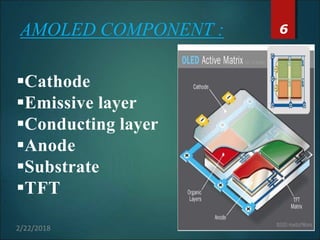
AMOLED COMPONENT :
Cathode
Emissive layer
Conducting layer
Anode
Substrate
TFT
6
2/22/2018
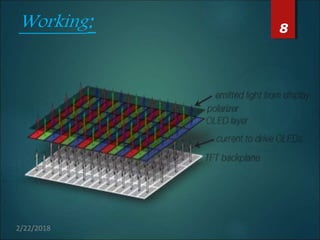
The AMOLED display consists of a matrix of
OLED pixels, each having an anode, cathode and
a layer of organic material between them.
These pixels are activated by a thin film transistor
array which controls the current to each pixel,
enabling it to be activated and when current flows
through it, light is generated.
Typically two transistors are used for each pixel -
one to turn the charge to the pixel on and off, and
a second to provide the constant current.
This eliminates the need for the very high currents
required for passive matrix OLED operation
7Working
Working: 8
2/22/2018
Manufacturing Of
AMOLED
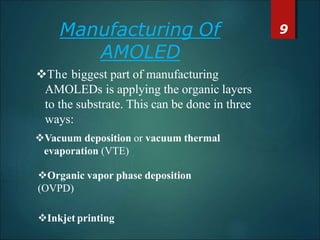
The biggest part of manufacturing
AMOLEDs is applying the organic layers
to the substrate. This can be done in three
ways:
Vacuum deposition or vacuum thermal
evaporation (VTE)
Organic vapor phase deposition
(OVPD)
Inkjet printing
9
AMOLED LCD PLASMA
 Medium cost. Potentially the lowest cost.
 Consumes lowest power  Lower Power consumption
than plasma
 Requires backlight. Self emissive.
 Displays wider color range.  Color range not good.
 No screen burn potential
 Highest cost
 Highest power
consumption
 Requires backlight.
 Displays a very deep
black.
 Screen burn potential No screen burn potential
 Shorter overall lifetime  Backlight bulb typically
requires replace at around 30 k
hours
 Half life ~60k hours
Comparison: 10
2/22/2018
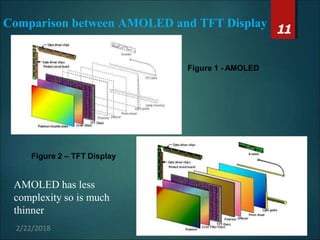
Comparison between AMOLED and TFT Display
Figure 2 – TFT Display
AMOLED has less
complexity so is much
thinner
11
Figure 1 - AMOLED
2/22/2018
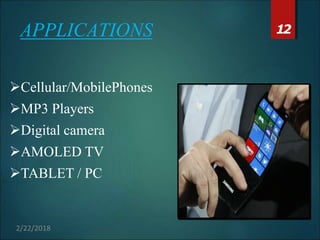
APPLICATIONS
Cellular/MobilePhones
MP3 Players
Digital camera
AMOLED TV
TABLET / PC
12
2/22/2018
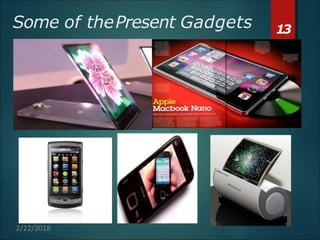
Some of thePresent Gadgets 13
2/22/2018
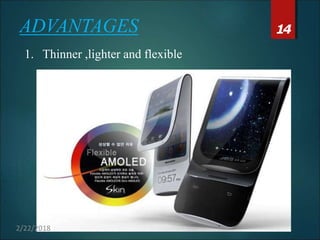
ADVANTAGES
1. Thinner ,lighter and flexible
14
2/22/2018
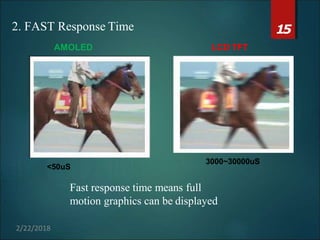
AMOLED LCD TFT
<50uS
3000~30000uS
Fast response time means full
motion graphics can be displayed
152. FAST Response Time
2/22/2018
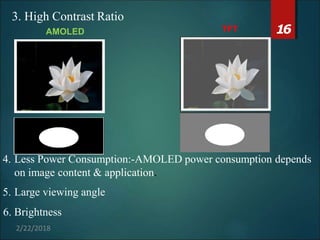
TFT 16
3. High Contrast Ratio
AMOLED
4. Less Power Consumption:-AMOLED power consumption depends
on image content & application.
5. Large viewing angle
6. Brightness
2/22/2018
DISADVANTAGES
•Limited Lifetime
•Expensive manufacturing process
•Easily damaged by Water
•Fabrication of substrate is complex
17
2/22/2018
FUTURE PROSPECTS
 Curved AMOLED
displays
 Wearable AMOLEDs
 Transparent
AMOLEDs embedded
in windows
 AMOLEDs in car
windshields
 Realizing Concept
models of various
mobile devices
18
19
FUTURE USE OF AMOLED
2/22/2018
CONCLUSION
 Limited use caused by degradation
of materials.
 AMOLED will replace current LED
and LCD technologies
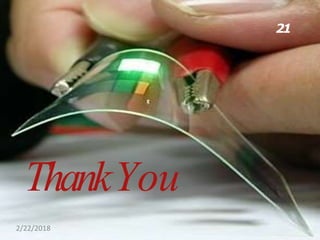
 Flexibility and thinness will enable
many applications
20
2/22/2018
THANK YOU 21
ThankYou
2/22/2018

AMOLED [Active Matrix Organic LED] by NITIN GUPTA

  • 1.
    (Active Matrix OrganicLight Emitting Diode) AMOLED PresentedBy:- NITIN GUPTA ROLL NO.-1516431133 SECTION - EC-III-B 1 2/22/2018 nitingupta1054@gmail.com
  • 2.
  • 3.
    INTRODUCTION  Active-Matrix OLED(Active-matrix organic light-emitting diode or AMOLED) is a display technology .  AMOLED is type of OLED .  OLED describes specific type of thin display technology and Active-Matrix refers to the technology behind the addressing of pixels.  An OLED is any LED whose emissive electroluminescent layer comprises a film of organic compounds 3
  • 4.
     They aredeposited in rows and columns onto a flat carrier by a simple printing process.  The resulting matrix of pixels can emit light of different colors.  AMOLEDs have full layers of cathode, organic molecules and anode, but the anode layer overlays a thin film transistor (TFT) array that forms a matrix. The TFT array itself is the circuitry that determines which pixels get turned on to form an image.  The active matrix technology is invented by Bernard Lechner in 1975 4
  • 5.
    PRINCIPLE  Electroluminescence (EL)is an optical phenomenon and electrical phenomenon in which a material emits light in response to an electric current passed through it, or to a strong electric field 5 2/22/2018
  • 6.
    AMOLED COMPONENT : Cathode Emissivelayer Conducting layer Anode Substrate TFT 6 2/22/2018
  • 7.
    The AMOLED displayconsists of a matrix of OLED pixels, each having an anode, cathode and a layer of organic material between them. These pixels are activated by a thin film transistor array which controls the current to each pixel, enabling it to be activated and when current flows through it, light is generated. Typically two transistors are used for each pixel - one to turn the charge to the pixel on and off, and a second to provide the constant current. This eliminates the need for the very high currents required for passive matrix OLED operation 7Working
  • 8.
  • 9.
    Manufacturing Of AMOLED The biggestpart of manufacturing AMOLEDs is applying the organic layers to the substrate. This can be done in three ways: Vacuum deposition or vacuum thermal evaporation (VTE) Organic vapor phase deposition (OVPD) Inkjet printing 9
  • 10.
    AMOLED LCD PLASMA Medium cost. Potentially the lowest cost.  Consumes lowest power  Lower Power consumption than plasma  Requires backlight. Self emissive.  Displays wider color range.  Color range not good.  No screen burn potential  Highest cost  Highest power consumption  Requires backlight.  Displays a very deep black.  Screen burn potential No screen burn potential  Shorter overall lifetime  Backlight bulb typically requires replace at around 30 k hours  Half life ~60k hours Comparison: 10 2/22/2018
  • 11.
    Comparison between AMOLEDand TFT Display Figure 2 – TFT Display AMOLED has less complexity so is much thinner 11 Figure 1 - AMOLED 2/22/2018
  • 12.
  • 13.
    Some of thePresentGadgets 13 2/22/2018
  • 14.
    ADVANTAGES 1. Thinner ,lighterand flexible 14 2/22/2018
  • 15.
    AMOLED LCD TFT <50uS 3000~30000uS Fastresponse time means full motion graphics can be displayed 152. FAST Response Time 2/22/2018
  • 16.
    TFT 16 3. HighContrast Ratio AMOLED 4. Less Power Consumption:-AMOLED power consumption depends on image content & application. 5. Large viewing angle 6. Brightness 2/22/2018
  • 17.
    DISADVANTAGES •Limited Lifetime •Expensive manufacturingprocess •Easily damaged by Water •Fabrication of substrate is complex 17 2/22/2018
  • 18.
    FUTURE PROSPECTS  CurvedAMOLED displays  Wearable AMOLEDs  Transparent AMOLEDs embedded in windows  AMOLEDs in car windshields  Realizing Concept models of various mobile devices 18
  • 19.
    19 FUTURE USE OFAMOLED 2/22/2018
  • 20.
    CONCLUSION  Limited usecaused by degradation of materials.  AMOLED will replace current LED and LCD technologies  Flexibility and thinness will enable many applications 20 2/22/2018
  • 21.