OLEDOLED
TECHNOLOGYTECHNOLOGY
CONTENTSCONTENTS……
 What is an OLED?What is an OLED?
 How It Works?How It Works?
 Types of OLEDsTypes of OLEDs
 OLEDOLED vsvs. Plasma/LCD. Plasma/LCD
 Advantages of OLEDAdvantages of OLED
 AMOLEDAMOLED
 AMOLEDAMOLED typestypes
 AMOLEDAMOLED devices/applicationsdevices/applications
What is an OLED?What is an OLED?
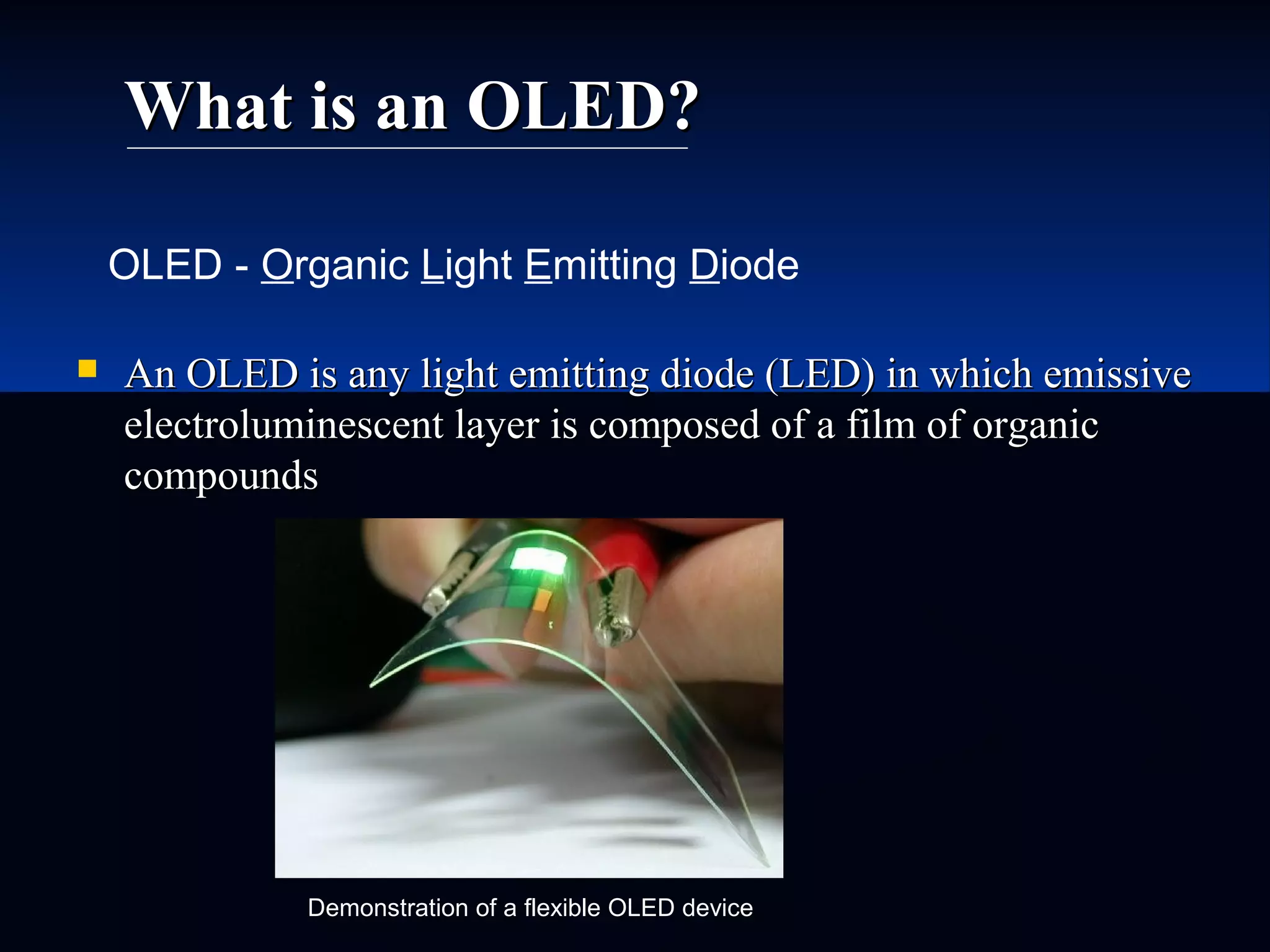
 An OLED is any light emitting diode (LED) in which emissiveAn OLED is any light emitting diode (LED) in which emissive
electroluminescent layer is composed of a film of organicelectroluminescent layer is composed of a film of organic
compoundscompounds
OLED - Organic Light Emitting Diode
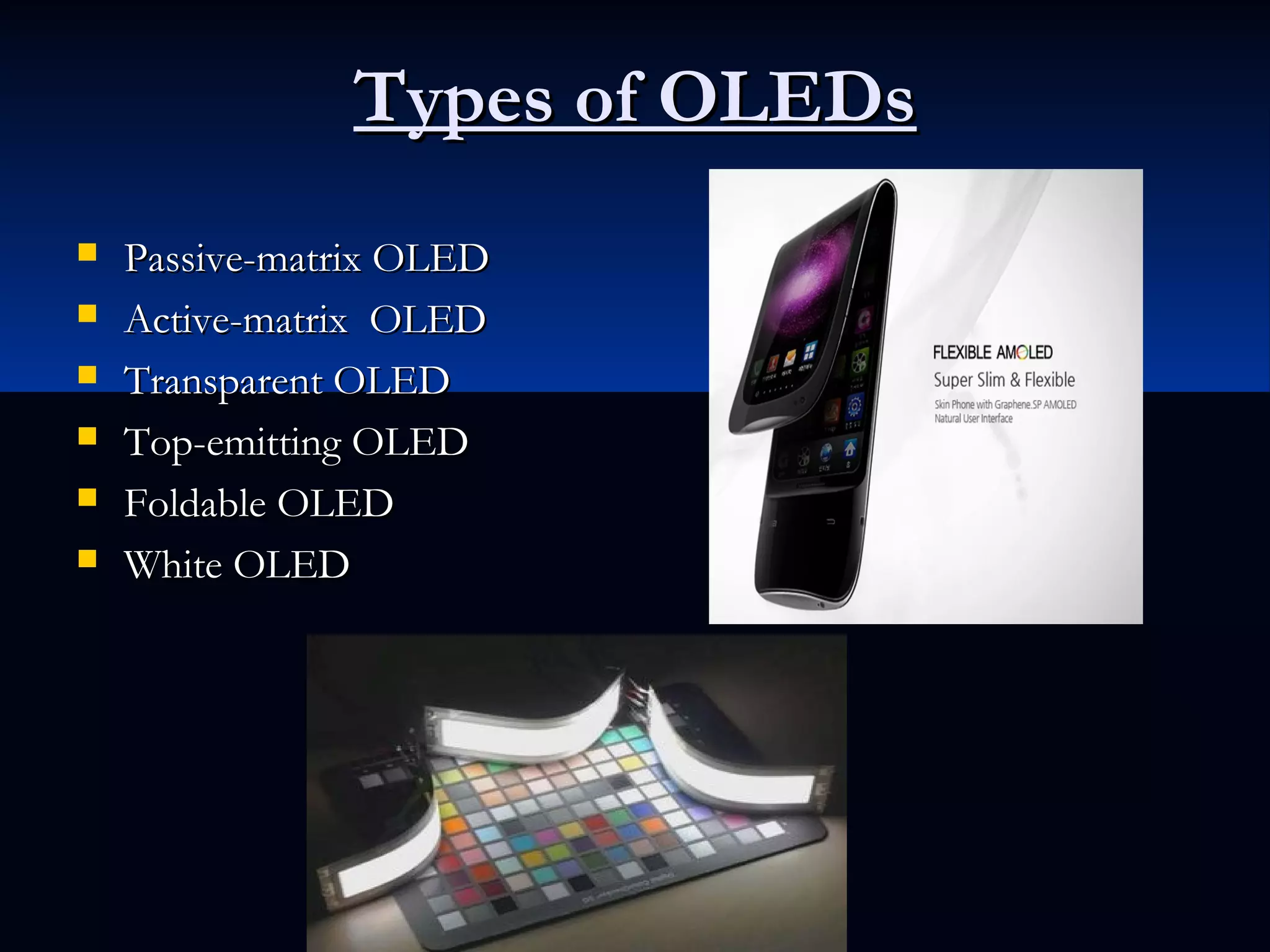
Demonstration of a flexible OLED device
How It Works?How It Works?
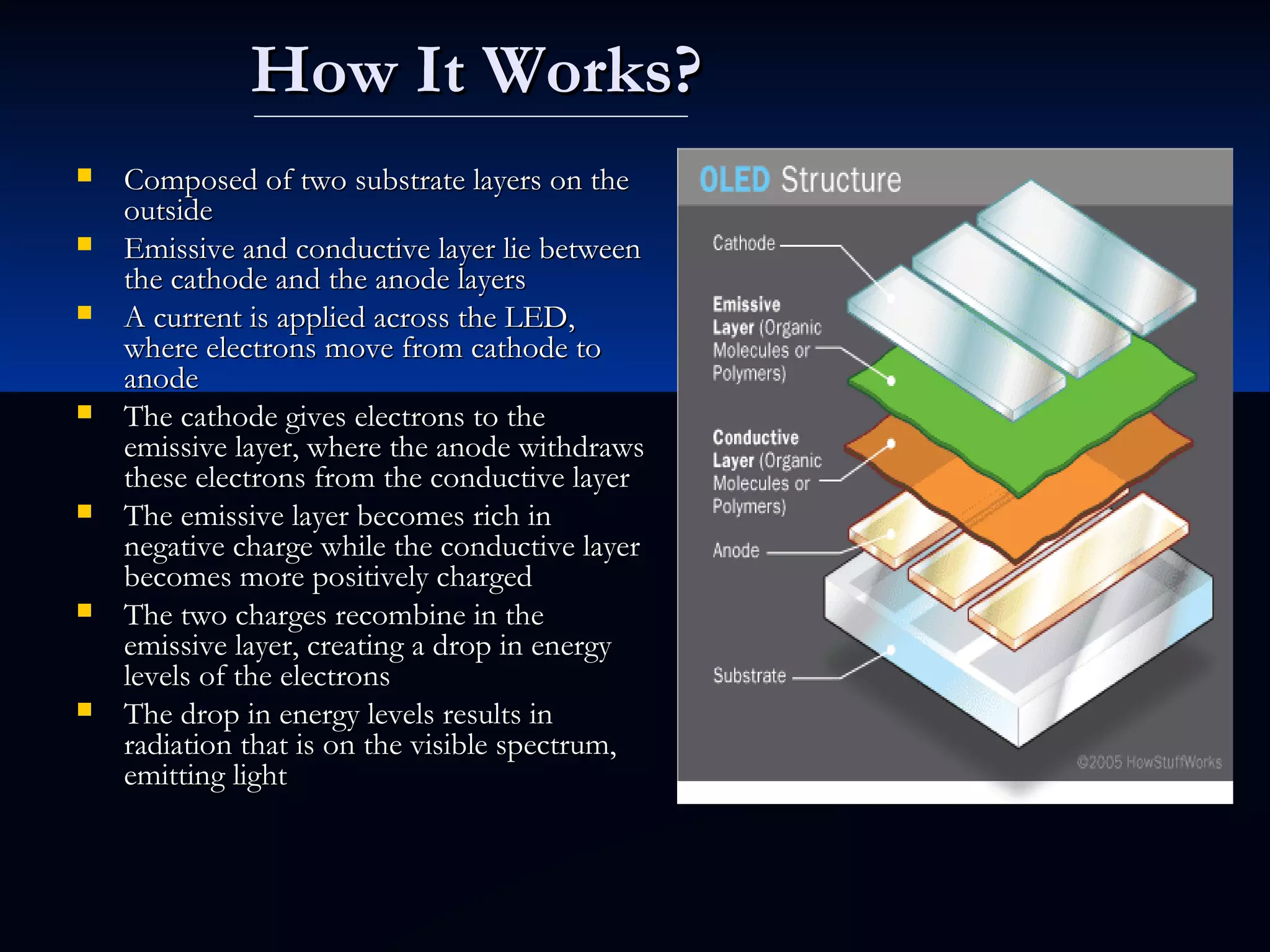
 Composed of two substrate layers on theComposed of two substrate layers on the
outsideoutside
 Emissive and conductive layer lie betweenEmissive and conductive layer lie between
the cathode and the anode layersthe cathode and the anode layers
 A current is applied across the LED,A current is applied across the LED,
where electrons move from cathode towhere electrons move from cathode to
anodeanode
 The cathode gives electrons to theThe cathode gives electrons to the
emissive layer, where the anode withdrawsemissive layer, where the anode withdraws
these electrons from the conductive layerthese electrons from the conductive layer
 The emissive layer becomes rich inThe emissive layer becomes rich in
negative charge while the conductive layernegative charge while the conductive layer
becomes more positively chargedbecomes more positively charged
 The two charges recombine in theThe two charges recombine in the
emissive layer, creating a drop in energyemissive layer, creating a drop in energy
levels of the electronslevels of the electrons
 The drop in energy levels results inThe drop in energy levels results in
radiation that is on the visible spectrum,radiation that is on the visible spectrum,
emitting lightemitting light
Types of OLEDsTypes of OLEDs
 Passive-matrix OLEDPassive-matrix OLED
 Active-matrix OLEDActive-matrix OLED
 Transparent OLEDTransparent OLED
 Top-emitting OLEDTop-emitting OLED
 Foldable OLEDFoldable OLED
 White OLEDWhite OLED
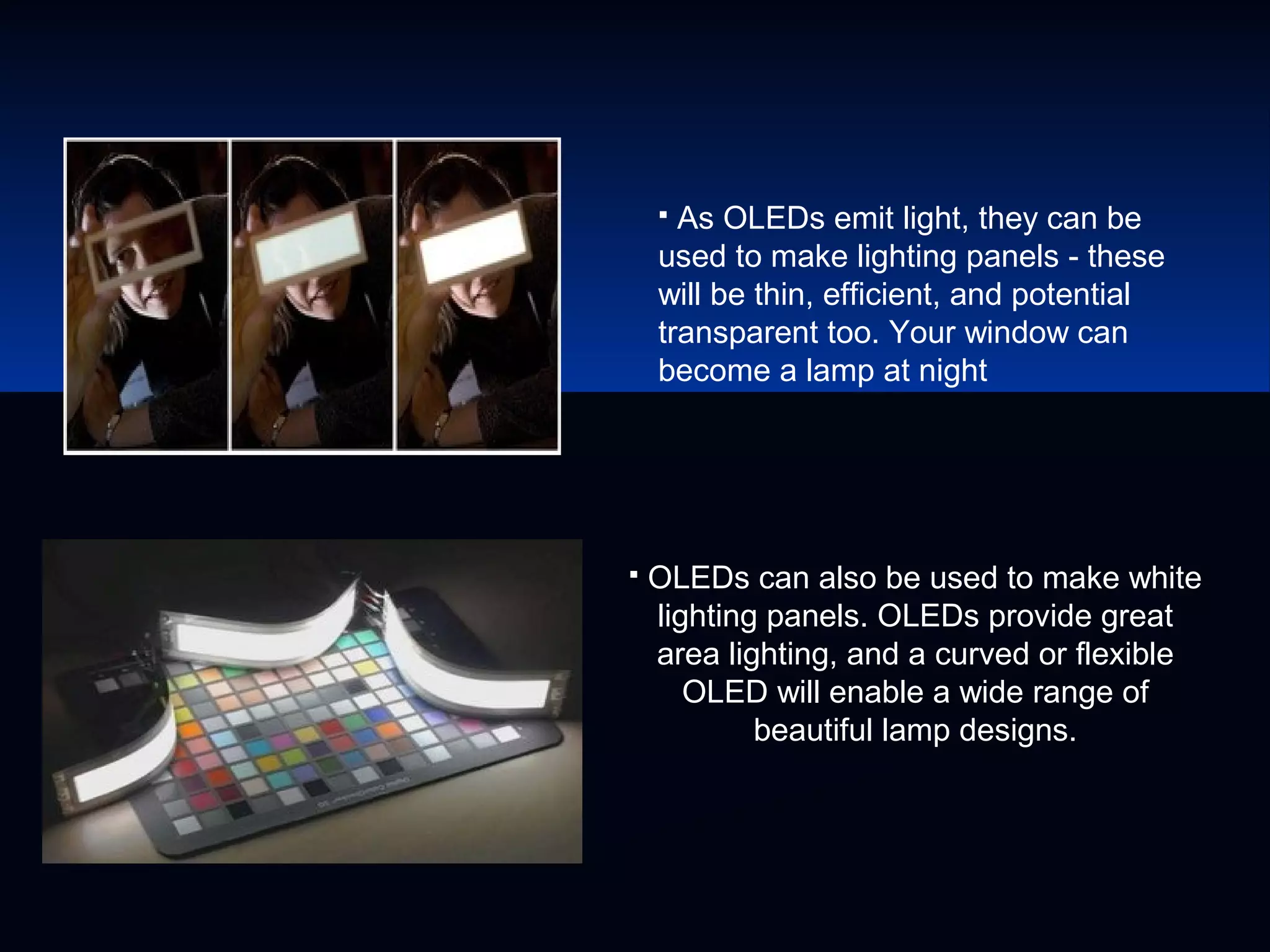
 As OLEDs emit light, they can be
used to make lighting panels - these
will be thin, efficient, and potential
transparent too. Your window can
become a lamp at night
 OLEDs can also be used to make white
lighting panels. OLEDs provide great
area lighting, and a curved or flexible
OLED will enable a wide range of
beautiful lamp designs.
Types of OLED’STypes of OLED’S
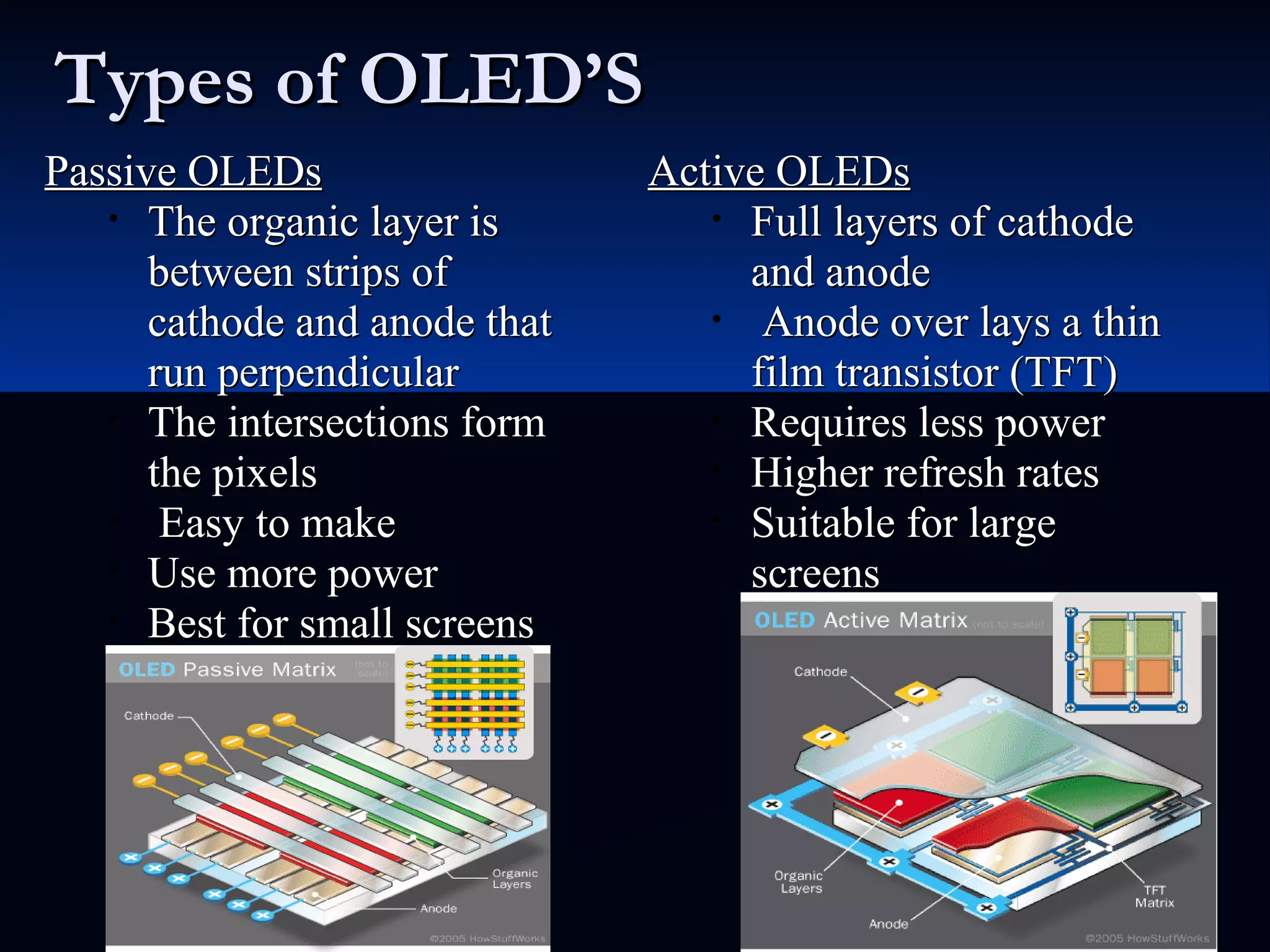
Passive OLEDsPassive OLEDs
• The organic layer isThe organic layer is
between strips ofbetween strips of
cathode and anode thatcathode and anode that
run perpendicularrun perpendicular
• The intersections formThe intersections form
the pixelsthe pixels
• Easy to makeEasy to make
• Use more powerUse more power
• Best for small screensBest for small screens
Active OLEDsActive OLEDs
• Full layers of cathodeFull layers of cathode
and anodeand anode
• Anode over lays a thinAnode over lays a thin
film transistor (TFT)film transistor (TFT)
• Requires less powerRequires less power
• Higher refresh ratesHigher refresh rates
• Suitable for largeSuitable for large
screensscreens
ADVANTAGESADVANTAGES
OLEDOLED vsvs. Plasma/LCD. Plasma/LCD
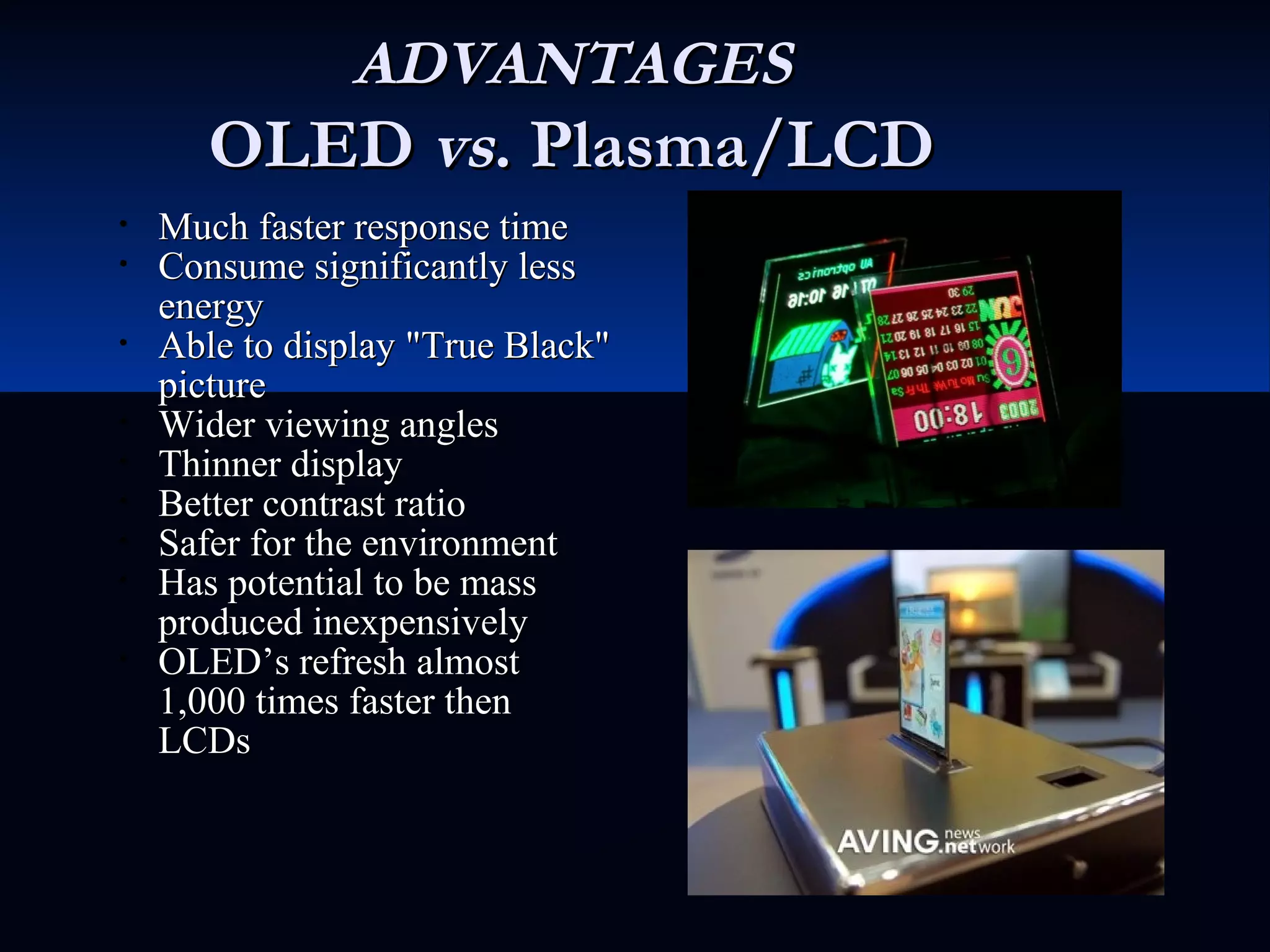
• Much faster response timeMuch faster response time
• Consume significantly lessConsume significantly less
energyenergy
• Able to display "True Black"Able to display "True Black"
picturepicture
• Wider viewing anglesWider viewing angles
• Thinner displayThinner display
• Better contrast ratioBetter contrast ratio
• Safer for the environmentSafer for the environment
• Has potential to be massHas potential to be mass
produced inexpensivelyproduced inexpensively
• OLED’s refresh almostOLED’s refresh almost
1,000 times faster then1,000 times faster then
LCDsLCDs
ContinuedContinued……
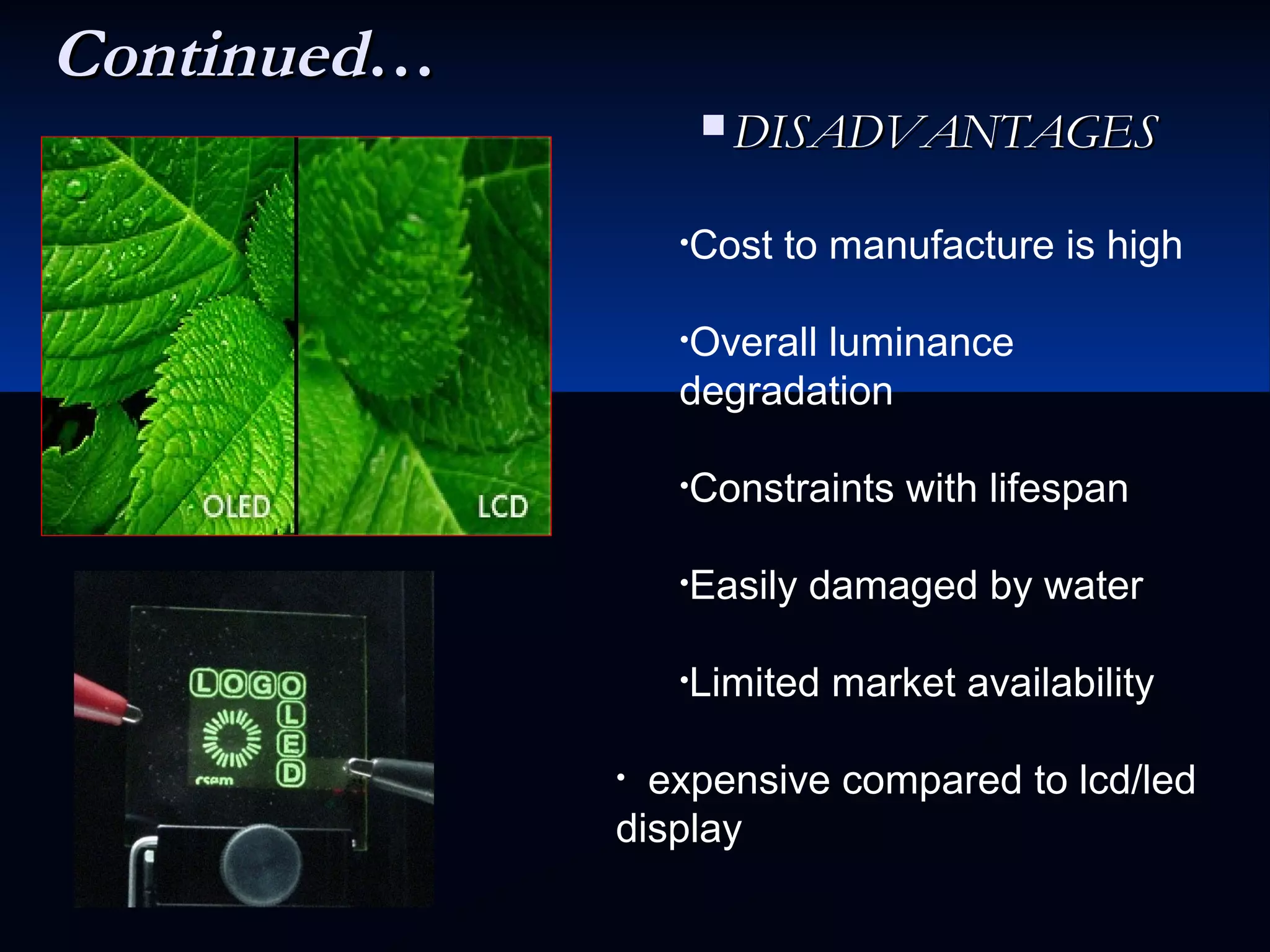
 DISADVANTAGESDISADVANTAGES
•Cost to manufacture is high
•Overall luminance
degradation
•Constraints with lifespan
•Easily damaged by water
•Limited market availability
• expensive compared to lcd/led
display
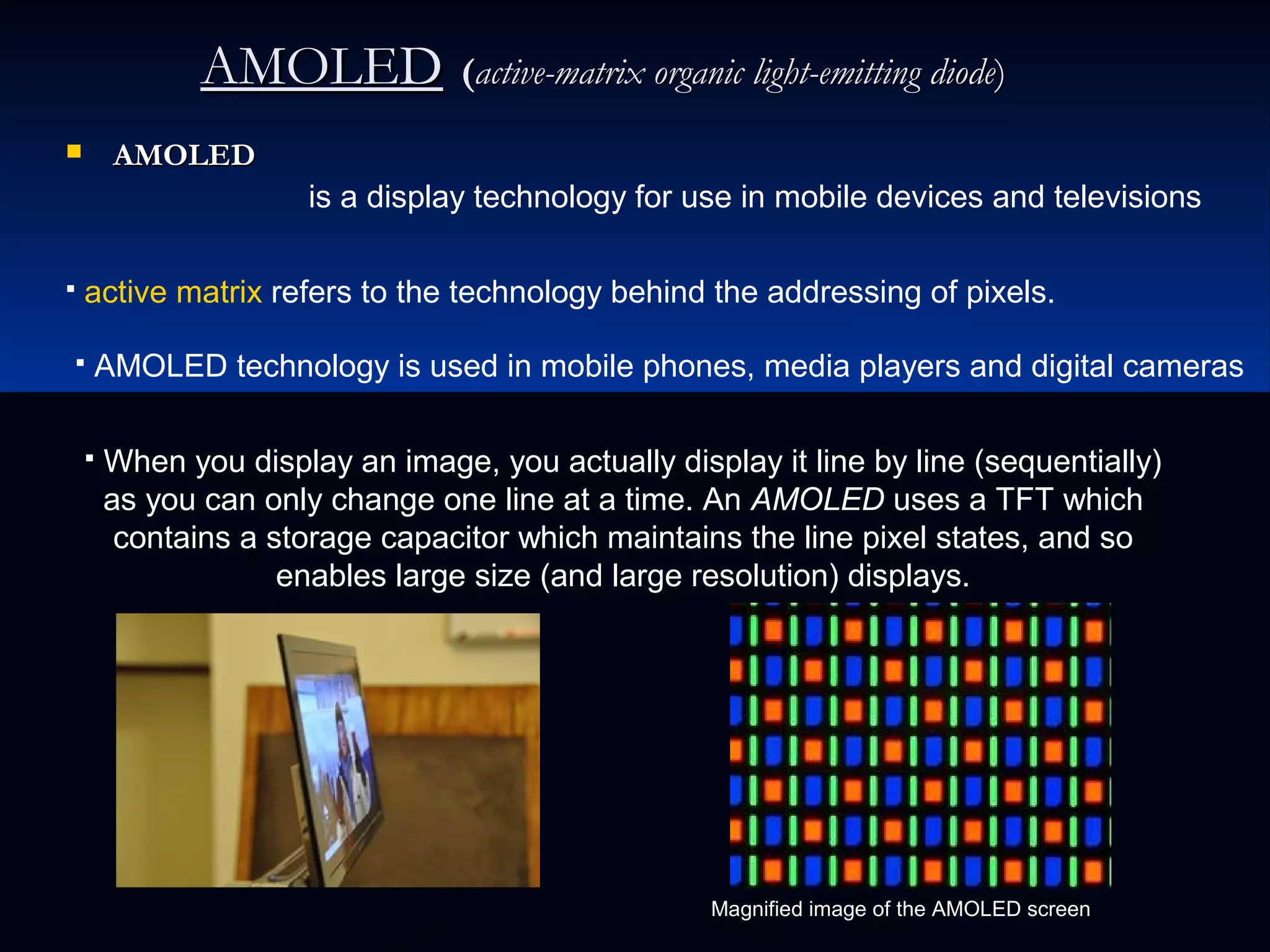
AMOLEDAMOLED  ((active-matrix organic light-emitting diodeactive-matrix organic light-emitting diode))
  
 AMOLEDAMOLED
is a display technology for use in mobile devices and televisions
 active matrix refers to the technology behind the addressing of pixels.
 AMOLED technology is used in mobile phones, media players and digital cameras
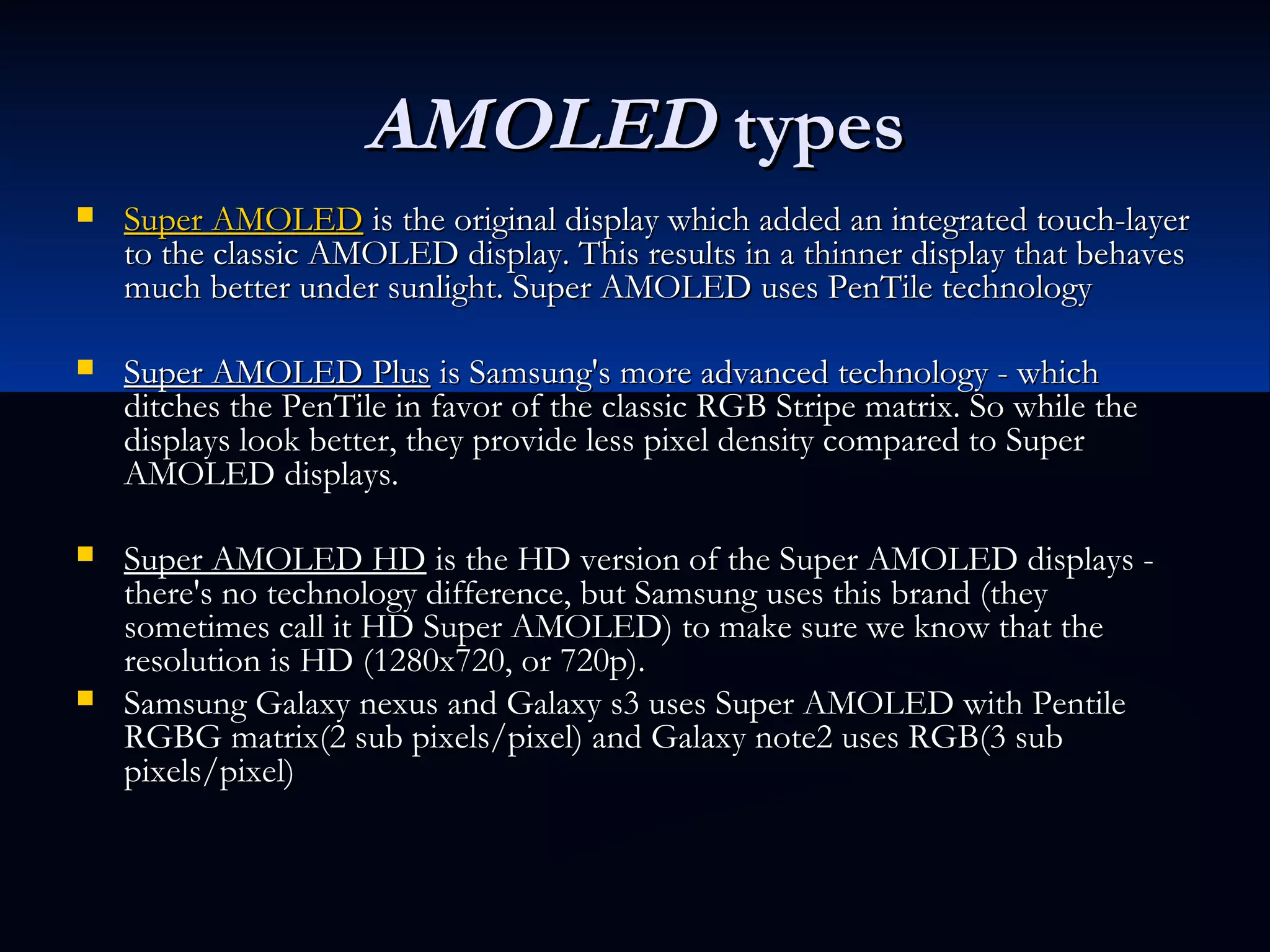
 When you display an image, you actually display it line by line (sequentially)
as you can only change one line at a time. An AMOLED uses a TFT which
contains a storage capacitor which maintains the line pixel states, and so
enables large size (and large resolution) displays.
Magnified image of the AMOLED screen
AMOLEDAMOLED typestypes
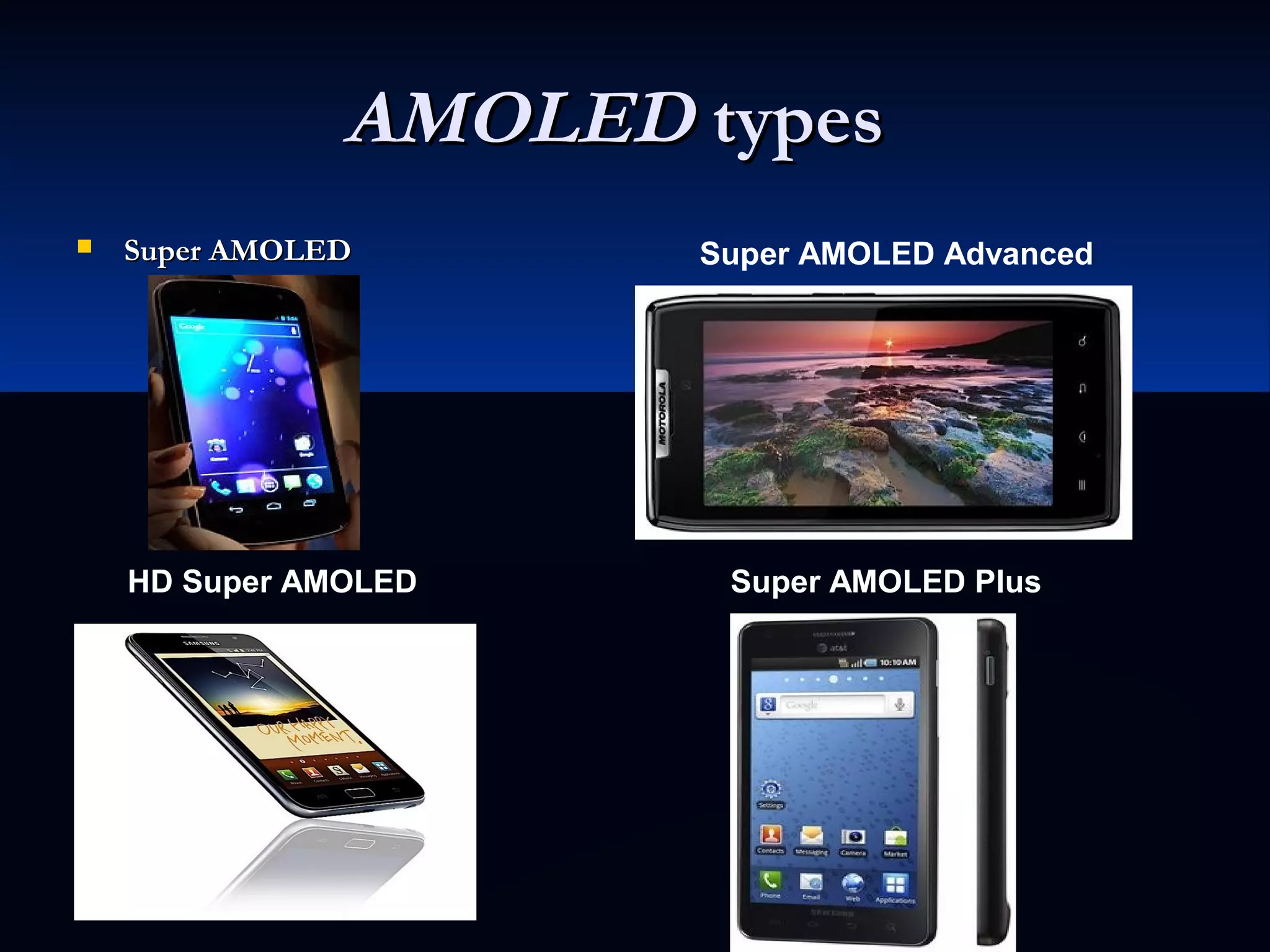
 Super AMOLEDSuper AMOLED is the original display which added an integrated touch-layer is the original display which added an integrated touch-layer
to the classic AMOLED display. This results in a thinner display that behavesto the classic AMOLED display. This results in a thinner display that behaves
much better under sunlight. Super AMOLED uses PenTile technologymuch better under sunlight. Super AMOLED uses PenTile technology
 Super AMOLED PlusSuper AMOLED Plus is Samsung's more advanced technology - which is Samsung's more advanced technology - which
ditches the PenTile in favor of the classic RGB Stripe matrix. So while theditches the PenTile in favor of the classic RGB Stripe matrix. So while the
displays look better, they provide less pixel density compared to Superdisplays look better, they provide less pixel density compared to Super
AMOLED displays.AMOLED displays.
 Super AMOLED HDSuper AMOLED HD is the HD version of the Super AMOLED displays - is the HD version of the Super AMOLED displays -
there's no technology difference, but Samsung uses this brand (theythere's no technology difference, but Samsung uses this brand (they
sometimes call it HD Super AMOLED) to make sure we know that thesometimes call it HD Super AMOLED) to make sure we know that the
resolution is HD (1280x720, or 720p).resolution is HD (1280x720, or 720p).
 Samsung Galaxy nexus and Galaxy s3 uses Super AMOLED with PentileSamsung Galaxy nexus and Galaxy s3 uses Super AMOLED with Pentile
RGBG matrix(2 sub pixels/pixel) and Galaxy note2 uses RGB(3 subRGBG matrix(2 sub pixels/pixel) and Galaxy note2 uses RGB(3 sub
pixels/pixel)pixels/pixel)
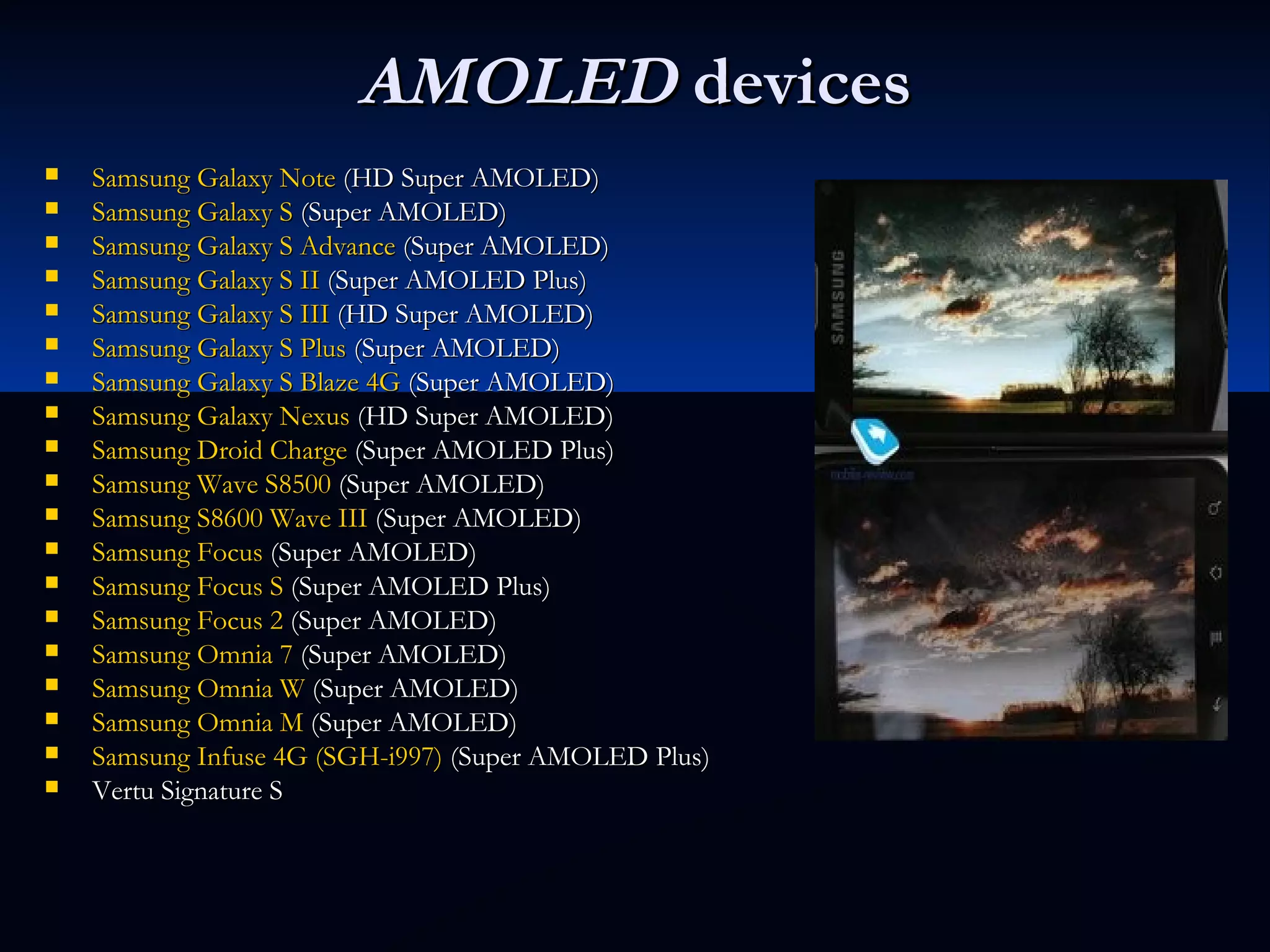
AMOLEDAMOLED devicesdevices
 Samsung Galaxy NoteSamsung Galaxy Note (HD Super AMOLED) (HD Super AMOLED)
 Samsung Galaxy SSamsung Galaxy S (Super AMOLED) (Super AMOLED)
 Samsung Galaxy S AdvanceSamsung Galaxy S Advance (Super AMOLED) (Super AMOLED)
 Samsung Galaxy S IISamsung Galaxy S II (Super AMOLED Plus) (Super AMOLED Plus)
 Samsung Galaxy S IIISamsung Galaxy S III (HD Super AMOLED) (HD Super AMOLED)
 Samsung Galaxy S PlusSamsung Galaxy S Plus (Super AMOLED) (Super AMOLED)
 Samsung Galaxy S Blaze 4GSamsung Galaxy S Blaze 4G (Super AMOLED) (Super AMOLED)
 Samsung Galaxy NexusSamsung Galaxy Nexus (HD Super AMOLED) (HD Super AMOLED)
 Samsung Droid ChargeSamsung Droid Charge (Super AMOLED Plus) (Super AMOLED Plus)
 Samsung Wave S8500Samsung Wave S8500 (Super AMOLED) (Super AMOLED)
 Samsung S8600 Wave IIISamsung S8600 Wave III (Super AMOLED) (Super AMOLED)
 Samsung FocusSamsung Focus (Super AMOLED) (Super AMOLED)
 Samsung Focus SSamsung Focus S (Super AMOLED Plus) (Super AMOLED Plus)
 Samsung Focus 2Samsung Focus 2 (Super AMOLED) (Super AMOLED)
 Samsung Omnia 7Samsung Omnia 7 (Super AMOLED) (Super AMOLED)
 Samsung Omnia WSamsung Omnia W (Super AMOLED) (Super AMOLED)
 Samsung Omnia MSamsung Omnia M (Super AMOLED) (Super AMOLED)
 Samsung Infuse 4G (SGH-i997)Samsung Infuse 4G (SGH-i997) (Super AMOLED Plus) (Super AMOLED Plus)
 Vertu Signature SVertu Signature S
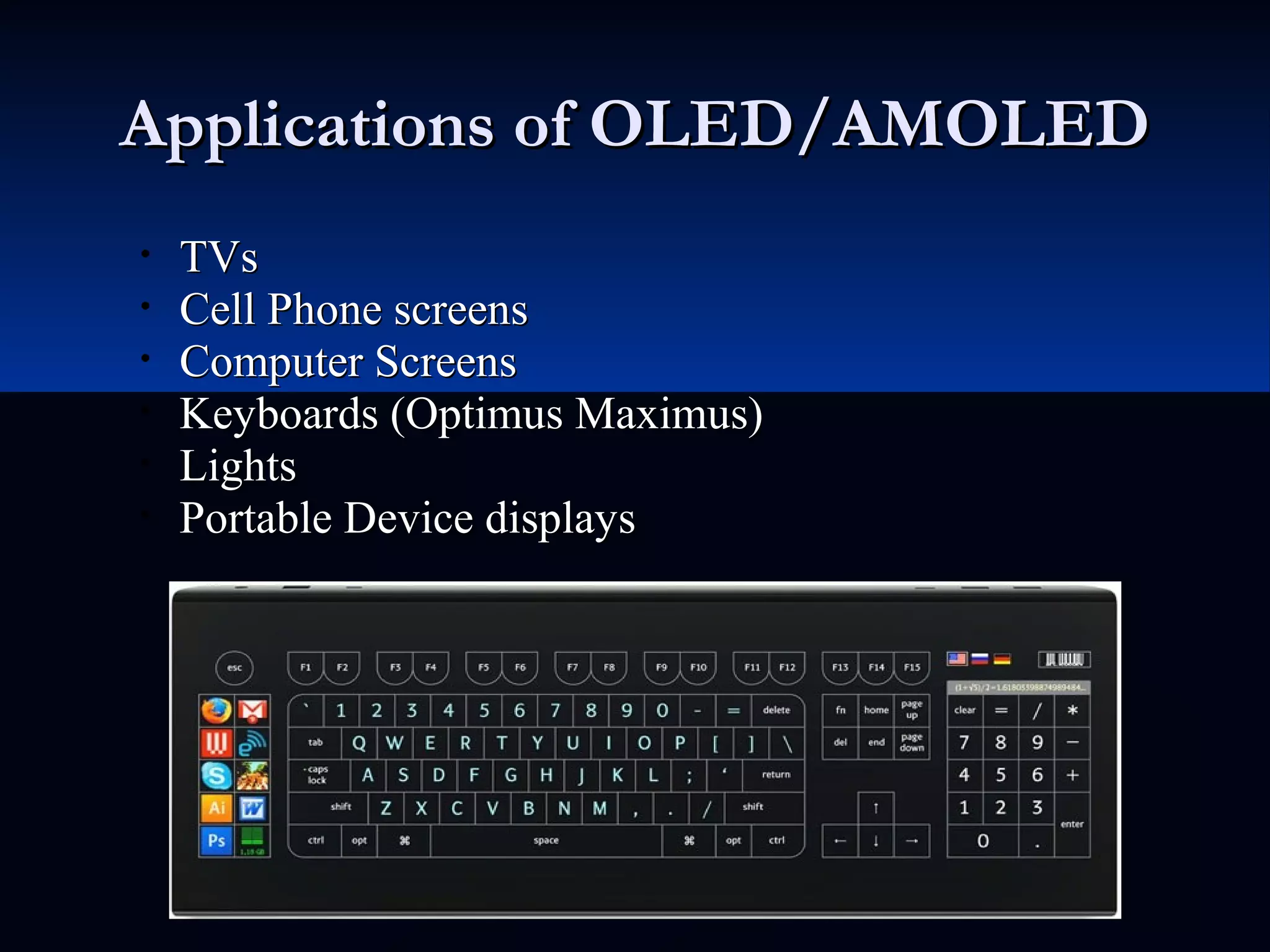
Applications of OLED/AMOLEDApplications of OLED/AMOLED
• TVsTVs
• Cell Phone screensCell Phone screens
• Computer ScreensComputer Screens
• Keyboards (Optimus Maximus)Keyboards (Optimus Maximus)
• LightsLights
• Portable Device displaysPortable Device displays
AMOLEDAMOLED typestypes
 Super AMOLEDSuper AMOLED Super AMOLED Advanced
Super AMOLED PlusHD Super AMOLED
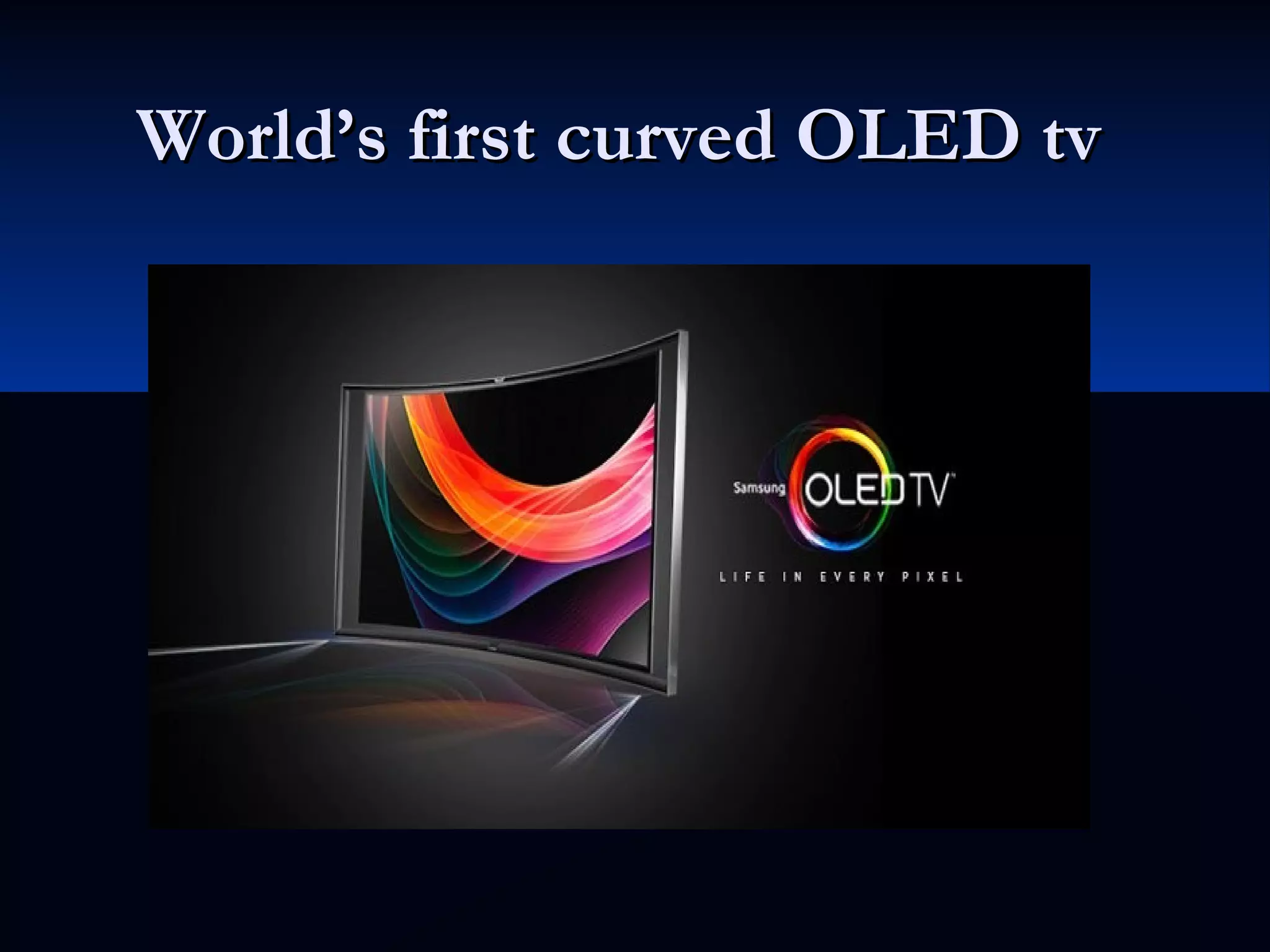
World’s first curved OLED tvWorld’s first curved OLED tv
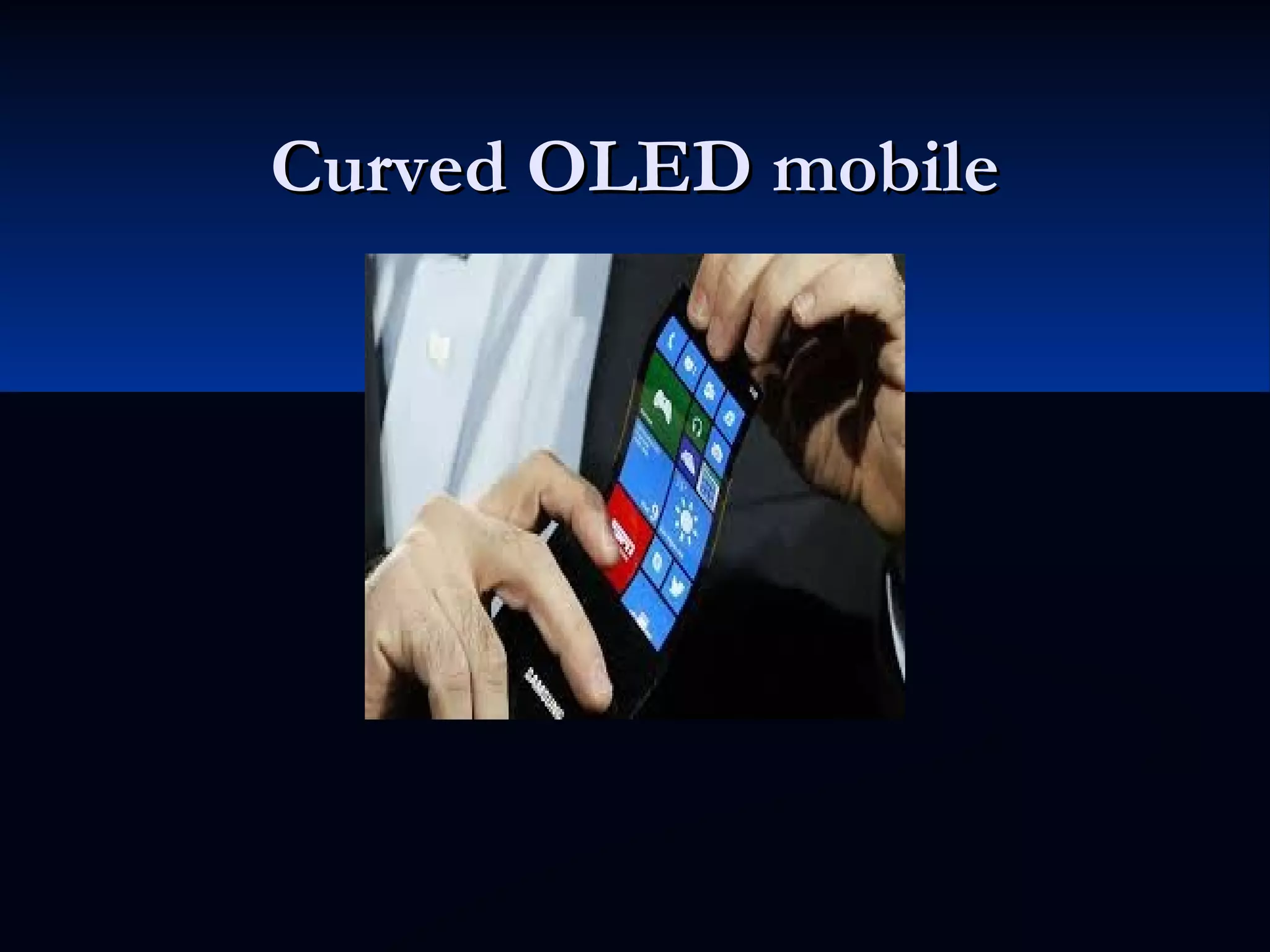
Curved OLED mobileCurved OLED mobile
SourcesSources
 http://ezinearticles.com/?OLED-Lighting-and-LED-Lighting:--http://ezinearticles.com/?OLED-Lighting-and-LED-Lighting:--
The-Difference-between-LED-and-OLED&id=460933The-Difference-between-LED-and-OLED&id=460933
 http://en.wikipedia.org/wiki/Oledhttp://en.wikipedia.org/wiki/Oled
 http://www.universaldisplay.com/index.htmlhttp://www.universaldisplay.com/index.html
 http://www.oled-info.com/oledTVhttp://www.oled-info.com/oledTV
 http://www.youtube.com/watch?v=3Ufs9Wx0VXQhttp://www.youtube.com/watch?v=3Ufs9Wx0VXQ
Thank you!!!Thank you!!!

Oledtechnology

  • 1.
  • 2.
    CONTENTSCONTENTS……  What isan OLED?What is an OLED?  How It Works?How It Works?  Types of OLEDsTypes of OLEDs  OLEDOLED vsvs. Plasma/LCD. Plasma/LCD  Advantages of OLEDAdvantages of OLED  AMOLEDAMOLED  AMOLEDAMOLED typestypes  AMOLEDAMOLED devices/applicationsdevices/applications
  • 3.
    What is anOLED?What is an OLED?  An OLED is any light emitting diode (LED) in which emissiveAn OLED is any light emitting diode (LED) in which emissive electroluminescent layer is composed of a film of organicelectroluminescent layer is composed of a film of organic compoundscompounds OLED - Organic Light Emitting Diode Demonstration of a flexible OLED device
  • 4.
    How It Works?HowIt Works?  Composed of two substrate layers on theComposed of two substrate layers on the outsideoutside  Emissive and conductive layer lie betweenEmissive and conductive layer lie between the cathode and the anode layersthe cathode and the anode layers  A current is applied across the LED,A current is applied across the LED, where electrons move from cathode towhere electrons move from cathode to anodeanode  The cathode gives electrons to theThe cathode gives electrons to the emissive layer, where the anode withdrawsemissive layer, where the anode withdraws these electrons from the conductive layerthese electrons from the conductive layer  The emissive layer becomes rich inThe emissive layer becomes rich in negative charge while the conductive layernegative charge while the conductive layer becomes more positively chargedbecomes more positively charged  The two charges recombine in theThe two charges recombine in the emissive layer, creating a drop in energyemissive layer, creating a drop in energy levels of the electronslevels of the electrons  The drop in energy levels results inThe drop in energy levels results in radiation that is on the visible spectrum,radiation that is on the visible spectrum, emitting lightemitting light
  • 5.
    Types of OLEDsTypesof OLEDs  Passive-matrix OLEDPassive-matrix OLED  Active-matrix OLEDActive-matrix OLED  Transparent OLEDTransparent OLED  Top-emitting OLEDTop-emitting OLED  Foldable OLEDFoldable OLED  White OLEDWhite OLED
  • 6.
     As OLEDsemit light, they can be used to make lighting panels - these will be thin, efficient, and potential transparent too. Your window can become a lamp at night  OLEDs can also be used to make white lighting panels. OLEDs provide great area lighting, and a curved or flexible OLED will enable a wide range of beautiful lamp designs.
  • 7.
    Types of OLED’STypesof OLED’S Passive OLEDsPassive OLEDs • The organic layer isThe organic layer is between strips ofbetween strips of cathode and anode thatcathode and anode that run perpendicularrun perpendicular • The intersections formThe intersections form the pixelsthe pixels • Easy to makeEasy to make • Use more powerUse more power • Best for small screensBest for small screens Active OLEDsActive OLEDs • Full layers of cathodeFull layers of cathode and anodeand anode • Anode over lays a thinAnode over lays a thin film transistor (TFT)film transistor (TFT) • Requires less powerRequires less power • Higher refresh ratesHigher refresh rates • Suitable for largeSuitable for large screensscreens
  • 8.
    ADVANTAGESADVANTAGES OLEDOLED vsvs. Plasma/LCD.Plasma/LCD • Much faster response timeMuch faster response time • Consume significantly lessConsume significantly less energyenergy • Able to display "True Black"Able to display "True Black" picturepicture • Wider viewing anglesWider viewing angles • Thinner displayThinner display • Better contrast ratioBetter contrast ratio • Safer for the environmentSafer for the environment • Has potential to be massHas potential to be mass produced inexpensivelyproduced inexpensively • OLED’s refresh almostOLED’s refresh almost 1,000 times faster then1,000 times faster then LCDsLCDs
  • 9.
    ContinuedContinued……  DISADVANTAGESDISADVANTAGES •Cost tomanufacture is high •Overall luminance degradation •Constraints with lifespan •Easily damaged by water •Limited market availability • expensive compared to lcd/led display
  • 10.
    AMOLEDAMOLED  ((active-matrix organic light-emittingdiodeactive-matrix organic light-emitting diode))     AMOLEDAMOLED is a display technology for use in mobile devices and televisions  active matrix refers to the technology behind the addressing of pixels.  AMOLED technology is used in mobile phones, media players and digital cameras  When you display an image, you actually display it line by line (sequentially) as you can only change one line at a time. An AMOLED uses a TFT which contains a storage capacitor which maintains the line pixel states, and so enables large size (and large resolution) displays. Magnified image of the AMOLED screen
  • 11.
    AMOLEDAMOLED typestypes  SuperAMOLEDSuper AMOLED is the original display which added an integrated touch-layer is the original display which added an integrated touch-layer to the classic AMOLED display. This results in a thinner display that behavesto the classic AMOLED display. This results in a thinner display that behaves much better under sunlight. Super AMOLED uses PenTile technologymuch better under sunlight. Super AMOLED uses PenTile technology  Super AMOLED PlusSuper AMOLED Plus is Samsung's more advanced technology - which is Samsung's more advanced technology - which ditches the PenTile in favor of the classic RGB Stripe matrix. So while theditches the PenTile in favor of the classic RGB Stripe matrix. So while the displays look better, they provide less pixel density compared to Superdisplays look better, they provide less pixel density compared to Super AMOLED displays.AMOLED displays.  Super AMOLED HDSuper AMOLED HD is the HD version of the Super AMOLED displays - is the HD version of the Super AMOLED displays - there's no technology difference, but Samsung uses this brand (theythere's no technology difference, but Samsung uses this brand (they sometimes call it HD Super AMOLED) to make sure we know that thesometimes call it HD Super AMOLED) to make sure we know that the resolution is HD (1280x720, or 720p).resolution is HD (1280x720, or 720p).  Samsung Galaxy nexus and Galaxy s3 uses Super AMOLED with PentileSamsung Galaxy nexus and Galaxy s3 uses Super AMOLED with Pentile RGBG matrix(2 sub pixels/pixel) and Galaxy note2 uses RGB(3 subRGBG matrix(2 sub pixels/pixel) and Galaxy note2 uses RGB(3 sub pixels/pixel)pixels/pixel)
  • 12.
    AMOLEDAMOLED devicesdevices  SamsungGalaxy NoteSamsung Galaxy Note (HD Super AMOLED) (HD Super AMOLED)  Samsung Galaxy SSamsung Galaxy S (Super AMOLED) (Super AMOLED)  Samsung Galaxy S AdvanceSamsung Galaxy S Advance (Super AMOLED) (Super AMOLED)  Samsung Galaxy S IISamsung Galaxy S II (Super AMOLED Plus) (Super AMOLED Plus)  Samsung Galaxy S IIISamsung Galaxy S III (HD Super AMOLED) (HD Super AMOLED)  Samsung Galaxy S PlusSamsung Galaxy S Plus (Super AMOLED) (Super AMOLED)  Samsung Galaxy S Blaze 4GSamsung Galaxy S Blaze 4G (Super AMOLED) (Super AMOLED)  Samsung Galaxy NexusSamsung Galaxy Nexus (HD Super AMOLED) (HD Super AMOLED)  Samsung Droid ChargeSamsung Droid Charge (Super AMOLED Plus) (Super AMOLED Plus)  Samsung Wave S8500Samsung Wave S8500 (Super AMOLED) (Super AMOLED)  Samsung S8600 Wave IIISamsung S8600 Wave III (Super AMOLED) (Super AMOLED)  Samsung FocusSamsung Focus (Super AMOLED) (Super AMOLED)  Samsung Focus SSamsung Focus S (Super AMOLED Plus) (Super AMOLED Plus)  Samsung Focus 2Samsung Focus 2 (Super AMOLED) (Super AMOLED)  Samsung Omnia 7Samsung Omnia 7 (Super AMOLED) (Super AMOLED)  Samsung Omnia WSamsung Omnia W (Super AMOLED) (Super AMOLED)  Samsung Omnia MSamsung Omnia M (Super AMOLED) (Super AMOLED)  Samsung Infuse 4G (SGH-i997)Samsung Infuse 4G (SGH-i997) (Super AMOLED Plus) (Super AMOLED Plus)  Vertu Signature SVertu Signature S
  • 13.
    Applications of OLED/AMOLEDApplicationsof OLED/AMOLED • TVsTVs • Cell Phone screensCell Phone screens • Computer ScreensComputer Screens • Keyboards (Optimus Maximus)Keyboards (Optimus Maximus) • LightsLights • Portable Device displaysPortable Device displays
  • 14.
    AMOLEDAMOLED typestypes  SuperAMOLEDSuper AMOLED Super AMOLED Advanced Super AMOLED PlusHD Super AMOLED
  • 15.
    World’s first curvedOLED tvWorld’s first curved OLED tv
  • 16.
  • 17.
    SourcesSources  http://ezinearticles.com/?OLED-Lighting-and-LED-Lighting:--http://ezinearticles.com/?OLED-Lighting-and-LED-Lighting:-- The-Difference-between-LED-and-OLED&id=460933The-Difference-between-LED-and-OLED&id=460933  http://en.wikipedia.org/wiki/Oledhttp://en.wikipedia.org/wiki/Oled http://www.universaldisplay.com/index.htmlhttp://www.universaldisplay.com/index.html  http://www.oled-info.com/oledTVhttp://www.oled-info.com/oledTV  http://www.youtube.com/watch?v=3Ufs9Wx0VXQhttp://www.youtube.com/watch?v=3Ufs9Wx0VXQ
  • 18.