Amino acid classification
Dr.Sujit Ghosh
J K College
Purulia
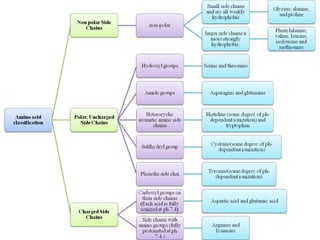
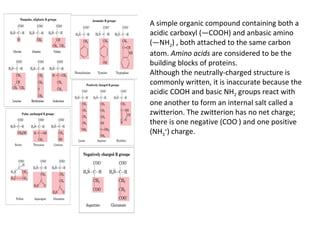
A simple organic compound containing both a
acidic carboxyl (—COOH) and anbasic amino
(—NH2) , both attached to the same carbon
atom. Amino acids are considered to be the
building blocks of proteins.
Although the neutrally-charged structure is
commonly written, it is inaccurate because the
acidic COOH and basic NH2 groups react with
one another to form an internal salt called a
zwitterion. The zwitterion has no net charge;
there is one negative (COO-
) and one positive
(NH3
+
) charge.
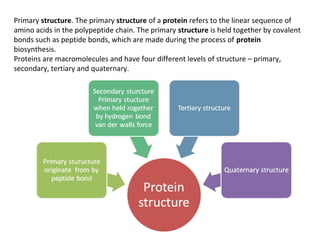
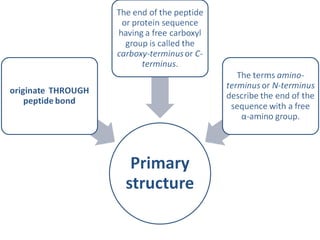
Primary structure. The primary structure of a protein refers to the linear sequence of
amino acids in the polypeptide chain. The primary structure is held together by covalent
bonds such as peptide bonds, which are made during the process of protein
biosynthesis.
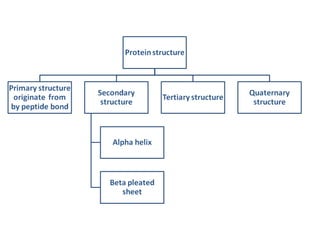
Proteins are macromolecules and have four different levels of structure – primary,
secondary, tertiary and quaternary.
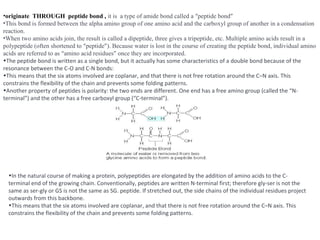
•originate THROUGH peptide bond , it is a type of amide bond called a “peptide bond”
•This bond is formed between the alpha amino group of one amino acid and the carboxyl group of another in a condensation
reaction.
•When two amino acids join, the result is called a dipeptide, three gives a tripeptide, etc. Multiple amino acids result in a
polypeptide (often shortened to “peptide”). Because water is lost in the course of creating the peptide bond, individual amino
acids are referred to as “amino acid residues” once they are incorporated. 
•The peptide bond is written as a single bond, but it actually has some characteristics of a double bond because of the 
resonance between the C-O and C-N bonds:
•This means that the six atoms involved are coplanar, and that there is not free rotation around the C–N axis. This 
constrains the flexibility of the chain and prevents some folding patterns.
•Another property of peptides is polarity: the two ends are different. One end has a free amino group (called the “N-
terminal”) and the other has a free carboxyl group (“C-terminal”).
•In the natural course of making a protein, polypeptides are elongated by the addition of amino acids to the C-
terminal end of the growing chain. Conventionally, peptides are written N-terminal first; therefore gly-ser is not the 
same as ser-gly or GS is not the same as SG. peptide. If stretched out, the side chains of the individual residues project 
outwards from this backbone.
•This means that the six atoms involved are coplanar, and that there is not free rotation around the C–N axis. This 
constrains the flexibility of the chain and prevents some folding patterns.
Amino acid classification

Amino acid classification

  • 1.
    Amino acid classification Dr.SujitGhosh J K College Purulia
  • 3.
    A simple organiccompound containing both a acidic carboxyl (—COOH) and anbasic amino (—NH2) , both attached to the same carbon atom. Amino acids are considered to be the building blocks of proteins. Although the neutrally-charged structure is commonly written, it is inaccurate because the acidic COOH and basic NH2 groups react with one another to form an internal salt called a zwitterion. The zwitterion has no net charge; there is one negative (COO- ) and one positive (NH3 + ) charge.
  • 4.
    Primary structure. Theprimary structure of a protein refers to the linear sequence of amino acids in the polypeptide chain. The primary structure is held together by covalent bonds such as peptide bonds, which are made during the process of protein biosynthesis. Proteins are macromolecules and have four different levels of structure – primary, secondary, tertiary and quaternary.
  • 7.
    •originate THROUGH peptidebond , it is a type of amide bond called a “peptide bond” •This bond is formed between the alpha amino group of one amino acid and the carboxyl group of another in a condensation reaction. •When two amino acids join, the result is called a dipeptide, three gives a tripeptide, etc. Multiple amino acids result in a polypeptide (often shortened to “peptide”). Because water is lost in the course of creating the peptide bond, individual amino acids are referred to as “amino acid residues” once they are incorporated.  •The peptide bond is written as a single bond, but it actually has some characteristics of a double bond because of the  resonance between the C-O and C-N bonds: •This means that the six atoms involved are coplanar, and that there is not free rotation around the C–N axis. This  constrains the flexibility of the chain and prevents some folding patterns. •Another property of peptides is polarity: the two ends are different. One end has a free amino group (called the “N- terminal”) and the other has a free carboxyl group (“C-terminal”). •In the natural course of making a protein, polypeptides are elongated by the addition of amino acids to the C- terminal end of the growing chain. Conventionally, peptides are written N-terminal first; therefore gly-ser is not the  same as ser-gly or GS is not the same as SG. peptide. If stretched out, the side chains of the individual residues project  outwards from this backbone. •This means that the six atoms involved are coplanar, and that there is not free rotation around the C–N axis. This  constrains the flexibility of the chain and prevents some folding patterns.