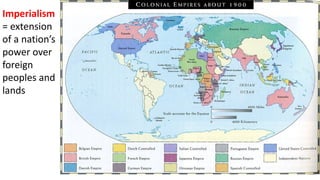
Imperialism
= extension
of a nation’s
power over
foreign
peoples and
lands
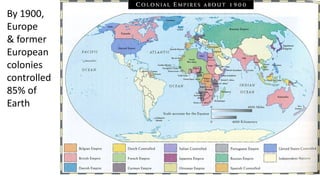
By 1900,
Europe
& former
European
colonies
controlled
85% of
Earth
Major Powers:
• Britain
• France
• Germany
• United States
• Russia
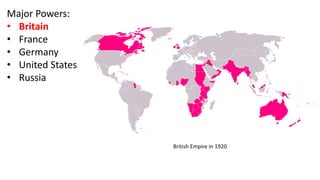
British Empire in 1920
Major Powers:
• Britain
• France
• Germany
• United States
• Russia
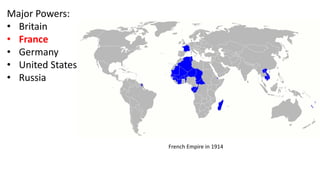
French Empire in 1914
Major Powers:
• Britain
• France
• Germany
• United States
• Russia
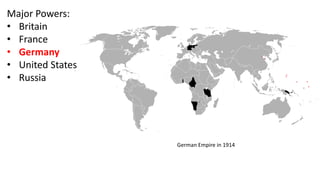
German Empire in 1914
Major Powers:
• Britain
• France
• Germany
• United States
• Russia
Major Powers:
• Britain
• France
• Germany
• United States
• Russia
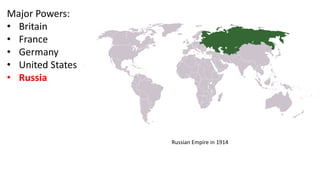
Russian Empire in 1914
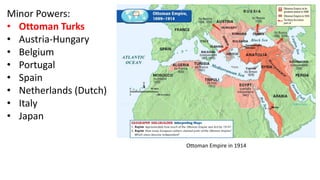
Ottoman Empire in 1914
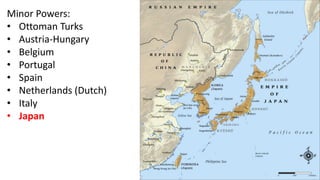
Minor Powers:
• Ottoman Turks
• Austria-Hungary
• Belgium
• Portugal
• Spain
• Netherlands (Dutch)
• Italy
• Japan
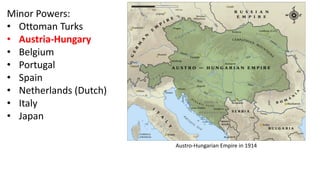
Austro-Hungarian Empire in 1914
Minor Powers:
• Ottoman Turks
• Austria-Hungary
• Belgium
• Portugal
• Spain
• Netherlands (Dutch)
• Italy
• Japan
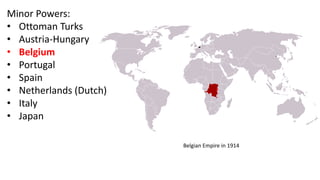
Belgian Empire in 1914
Minor Powers:
• Ottoman Turks
• Austria-Hungary
• Belgium
• Portugal
• Spain
• Netherlands (Dutch)
• Italy
• Japan
Minor Powers:
• Ottoman Turks
• Austria-Hungary
• Belgium
• Portugal
• Spain
• Netherlands (Dutch)
• Italy
• Japan
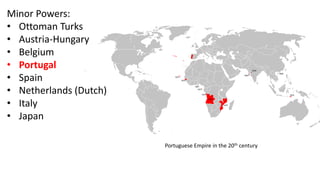
Portuguese Empire in the 20th century
Minor Powers:
• Ottoman Turks
• Austria-Hungary
• Belgium
• Portugal
• Spain
• Netherlands (Dutch)
• Italy
• Japan
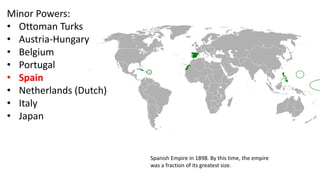
Spanish Empire in 1898. By this time, the empire
was a fraction of its greatest size.
Minor Powers:
• Ottoman Turks
• Austria-Hungary
• Belgium
• Portugal
• Spain
• Netherlands (Dutch)
• Italy
• Japan
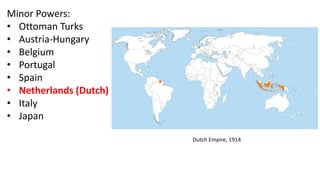
Dutch Empire, 1914
Minor Powers:
• Ottoman Turks
• Austria-Hungary
• Belgium
• Portugal
• Spain
• Netherlands (Dutch)
• Italy
• Japan
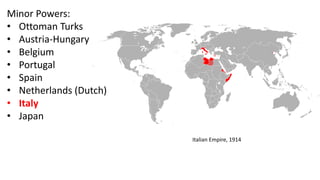
Italian Empire, 1914
Minor Powers:
• Ottoman Turks
• Austria-Hungary
• Belgium
• Portugal
• Spain
• Netherlands (Dutch)
• Italy
• Japan
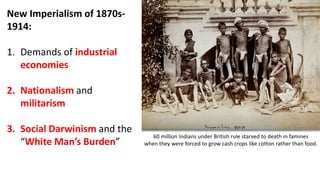
New Imperialism of 1870s-
1914:
1. Demands of industrial
economies
2. Nationalism and
militarism
3. Social Darwinism and the
“White Man’s Burden”
60 million Indians under British rule starved to death in famines
when they were forced to grow cash crops like cotton rather than food.
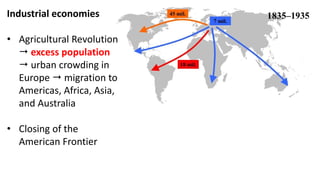
Industrial economies
• Agricultural Revolution
 excess population
 urban crowding in
Europe  migration to
Americas, Africa, Asia,
and Australia
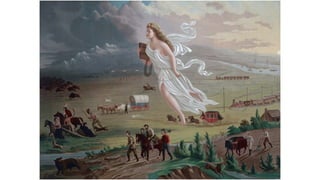
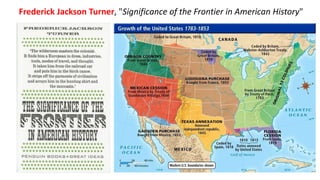
• Closing of the
American Frontier
Frederick Jackson Turner, "Significance of the Frontier in American History"
Industrial economies: markets
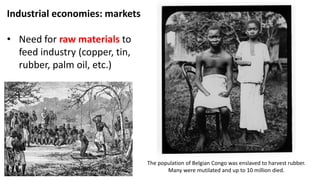
• Need for raw materials to
feed industry (copper, tin,
rubber, palm oil, etc.)
The population of Belgian Congo was enslaved to harvest rubber.
Many were mutilated and up to 10 million died.
Industrial economies: markets
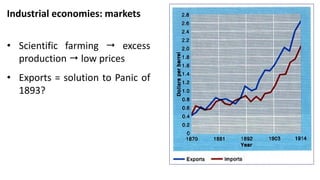
• Scientific farming  excess
production  low prices
• Exports = solution to Panic of
1893?
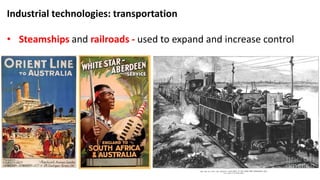
Industrial technologies: transportation
• Steamships and railroads - used to expand and increase control
Industrial technologies:
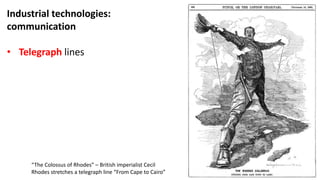
communication
• Telegraph lines
“The Colossus of Rhodes” – British imperialist Cecil
Rhodes stretches a telegraph line “From Cape to Cairo”
Industrial technologies:
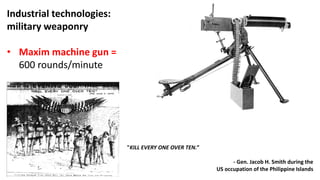
military weaponry
• Maxim machine gun =
600 rounds/minute
"KILL EVERY ONE OVER TEN.”
- Gen. Jacob H. Smith during the
US occupation of the Philippine Islands
Industrial technologies:
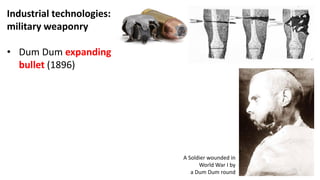
military weaponry
• Dum Dum expanding
bullet (1896)
A Soldier wounded in
World War I by
a Dum Dum round
Industrial technologies:
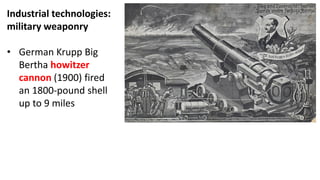
military weaponry
• German Krupp Big
Bertha howitzer
cannon (1900) fired
an 1800-pound shell
up to 9 miles
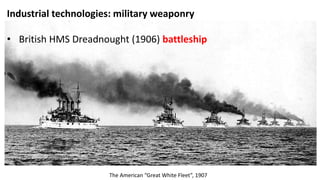
Industrial technologies: military weaponry
• British HMS Dreadnought (1906) battleship
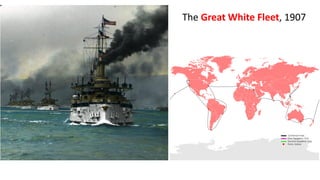
The American “Great White Fleet”, 1907
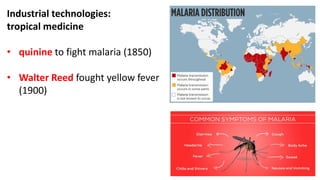
Industrial technologies:
tropical medicine
• quinine to fight malaria (1850)
• Walter Reed fought yellow fever
(1900)
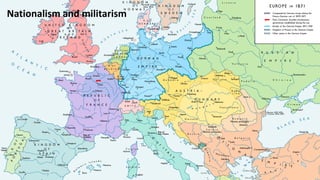
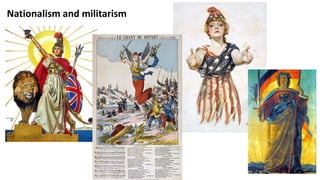
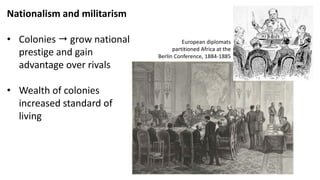
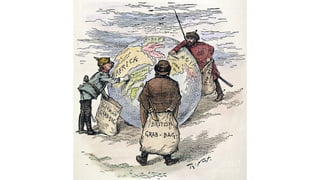
Nationalism and militarism
• Colonies  grow national
prestige and gain
advantage over rivals
• Wealth of colonies
increased standard of
living
European diplomats
partitioned Africa at the
Berlin Conference, 1884-1885
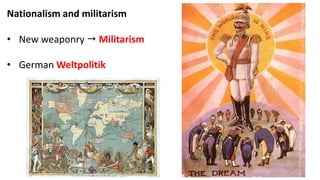
Nationalism and militarism
• New weaponry  Militarism
• German Weltpolitik
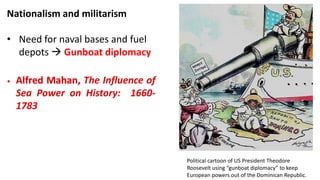
Nationalism and militarism
• Need for naval bases and fuel
depots  Gunboat diplomacy
• Alfred Mahan, The Influence of
Sea Power on History: 1660-
1783
Political cartoon of US President Theodore
Roosevelt using “gunboat diplomacy” to keep
European powers out of the Dominican Republic.
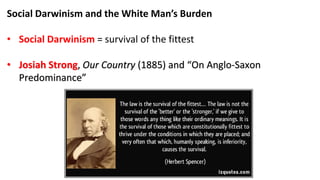
Social Darwinism and the White Man’s Burden
• Social Darwinism = survival of the fittest
• Josiah Strong, Our Country (1885) and “On Anglo-Saxon
Predominance”
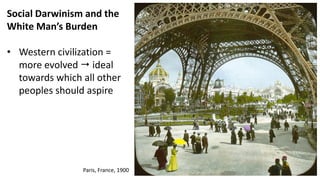
Social Darwinism and the
White Man’s Burden
• Western civilization =
more evolved  ideal
towards which all other
peoples should aspire
Paris, France, 1900
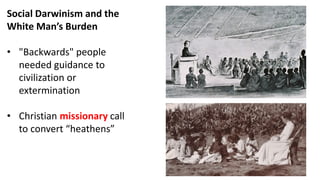
Social Darwinism and the
White Man’s Burden
• "Backwards" people
needed guidance to
civilization or
extermination
• Christian missionary call
to convert “heathens”
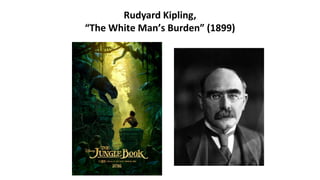
Rudyard Kipling,
“The White Man’s Burden” (1899)
Social Darwinism and
the White Man’s
Burden
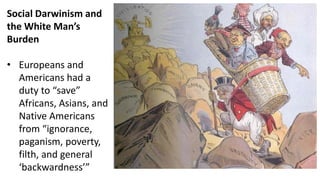
• Europeans and
Americans had a
duty to “save”
Africans, Asians, and
Native Americans
from “ignorance,
paganism, poverty,
filth, and general
‘backwardness’”
Social Darwinism and the
White Man’s Burden
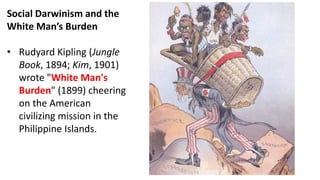
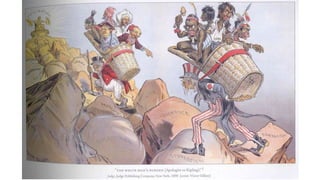
• Rudyard Kipling (Jungle
Book, 1894; Kim, 1901)
wrote "White Man's
Burden" (1899) cheering
on the American
civilizing mission in the
Philippine Islands.
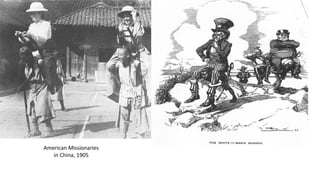
American Missionaries
in China, 1905
Social Darwinism and
the White Man’s Burden
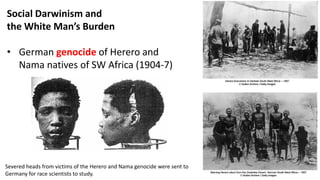
• German genocide of Herero and
Nama natives of SW Africa (1904-7)
Severed heads from victims of the Herero and Nama genocide were sent to
Germany for race scientists to study.
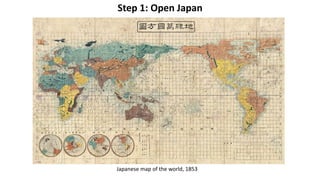
Step 1: Open Japan
Japanese map of the world, 1853
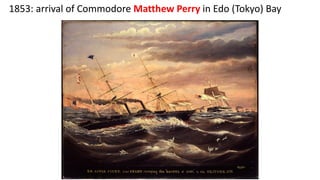
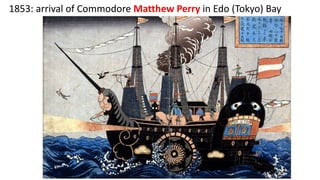
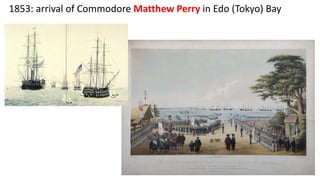
1853: arrival of Commodore Matthew Perry in Edo (Tokyo) Bay
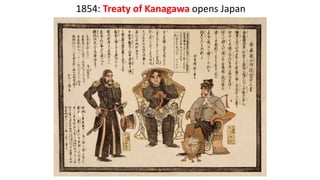
1854: Treaty of Kanagawa opens Japan
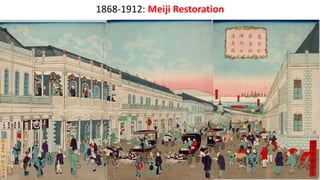
1868-1912: Meiji Restoration
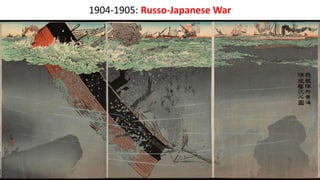
1904-1905: Russo-Japanese War
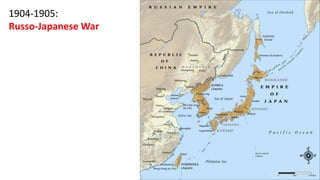
1904-1905:
Russo-Japanese War
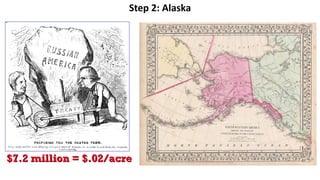
$7.2 million = $.02/acre
Step 2: Alaska
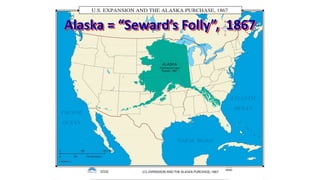
Alaska = “Seward’s Folly”, 1867
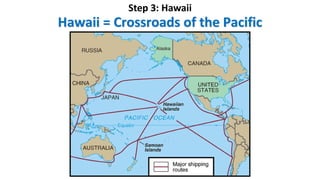
Hawaii = Crossroads of the Pacific
Step 3: Hawaii
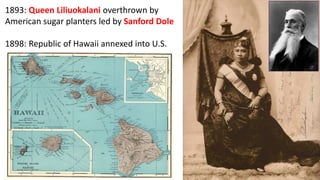
1893: Queen Liliuokalani overthrown by
American sugar planters led by Sanford Dole
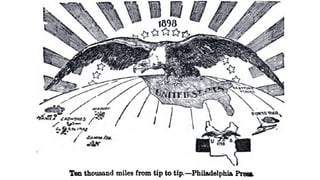
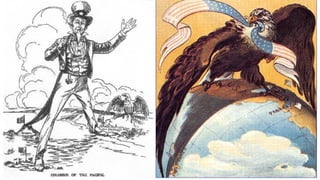
1898: Republic of Hawaii annexed into U.S.
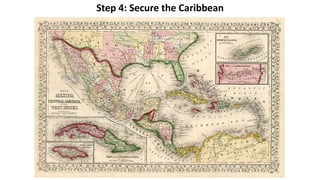
Step 4: Secure the Caribbean
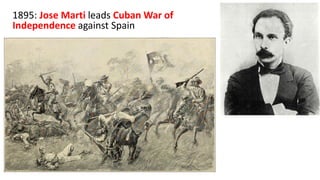
1895: Jose Marti leads Cuban War of
Independence against Spain
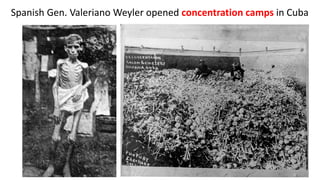
Spanish Gen. Valeriano Weyler opened concentration camps in Cuba
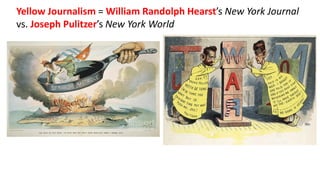
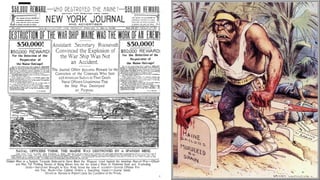
Yellow Journalism = William Randolph Hearst’s New York Journal
vs. Joseph Pulitzer’s New York World
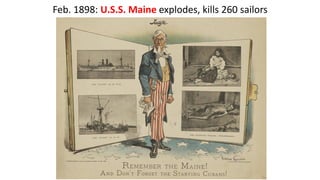
Feb. 1898: U.S.S. Maine explodes, kills 260 sailors
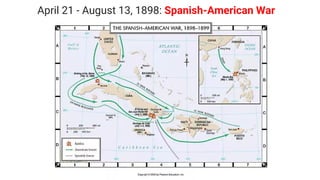
April 21 - August 13, 1898: Spanish-American War
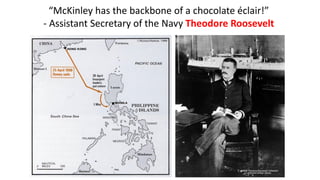
“McKinley has the backbone of a chocolate éclair!”
- Assistant Secretary of the Navy Theodore Roosevelt
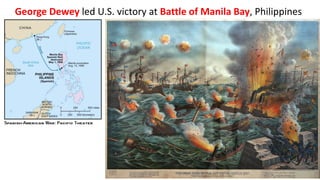
George Dewey led U.S. victory at Battle of Manila Bay, Philippines
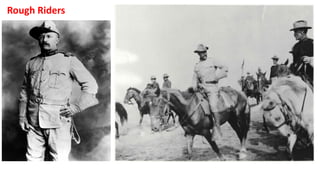
Rough Riders
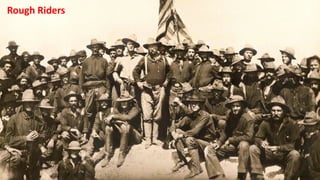
Rough Riders
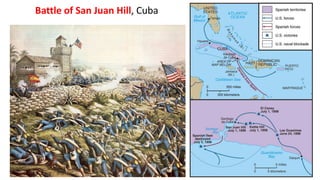
Battle of San Juan Hill, Cuba
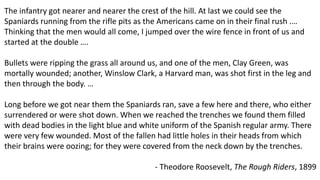
The infantry got nearer and nearer the crest of the hill. At last we could see the
Spaniards running from the rifle pits as the Americans came on in their final rush .…
Thinking that the men would all come, I jumped over the wire fence in front of us and
started at the double ….
Bullets were ripping the grass all around us, and one of the men, Clay Green, was
mortally wounded; another, Winslow Clark, a Harvard man, was shot first in the leg and
then through the body. …
Long before we got near them the Spaniards ran, save a few here and there, who either
surrendered or were shot down. When we reached the trenches we found them filled
with dead bodies in the light blue and white uniform of the Spanish regular army. There
were very few wounded. Most of the fallen had little holes in their heads from which
their brains were oozing; for they were covered from the neck down by the trenches.
- Theodore Roosevelt, The Rough Riders, 1899
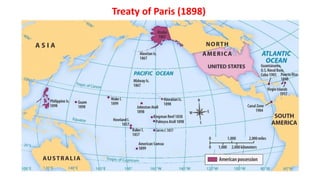
Treaty of Paris (1898)
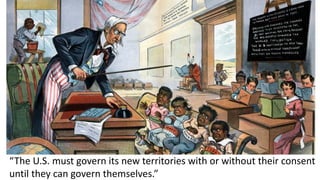
“The U.S. must govern its new territories with or without their consent
until they can govern themselves.”
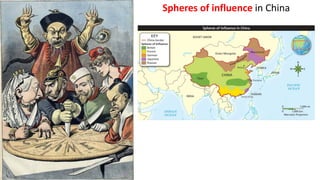
Spheres of influence in China
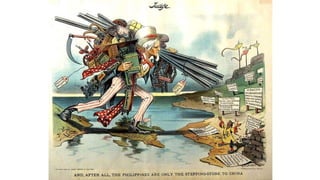
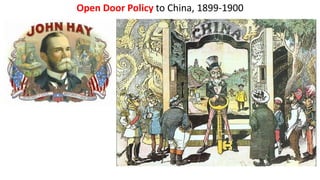
Open Door Policy to China, 1899-1900
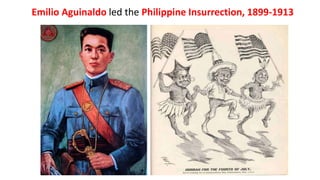
Emilio Aguinaldo led the Philippine Insurrection, 1899-1913
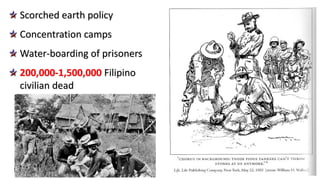
Scorched earth policy
Concentration camps
Water-boarding of prisoners
200,000-1,500,000 Filipino
civilian dead
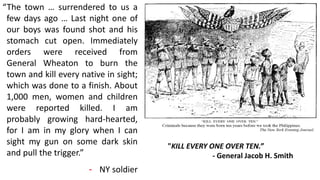
“The town … surrendered to us a
few days ago … Last night one of
our boys was found shot and his
stomach cut open. Immediately
orders were received from
General Wheaton to burn the
town and kill every native in sight;
which was done to a finish. About
1,000 men, women and children
were reported killed. I am
probably growing hard-hearted,
for I am in my glory when I can
sight my gun on some dark skin
and pull the trigger.”
- NY soldier
"KILL EVERY ONE OVER TEN.”
- General Jacob H. Smith
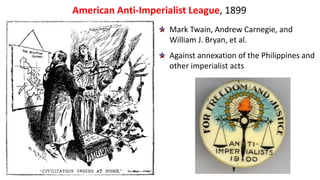
Mark Twain, Andrew Carnegie, and
William J. Bryan, et al.
Against annexation of the Philippines and
other imperialist acts
American Anti-Imperialist League, 1899
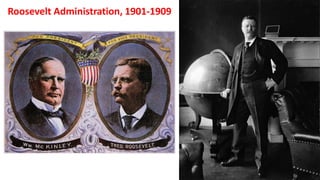
Roosevelt Administration, 1901-1909
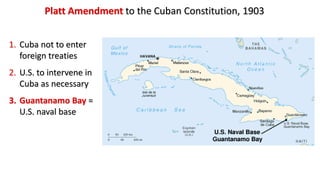
1. Cuba not to enter
foreign treaties
2. U.S. to intervene in
Cuba as necessary
3. Guantanamo Bay =
U.S. naval base
Platt Amendment to the Cuban Constitution, 1903
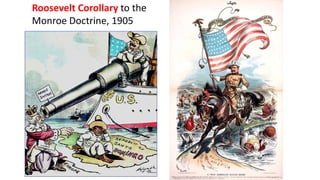
Roosevelt Corollary to the
Monroe Doctrine, 1905
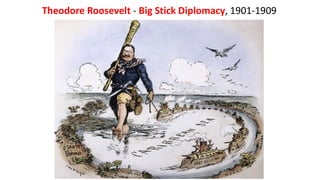
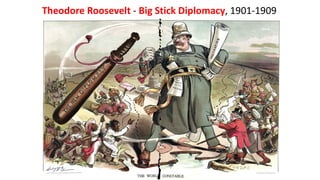
Theodore Roosevelt - Big Stick Diplomacy, 1901-1909
The Great White Fleet, 1907
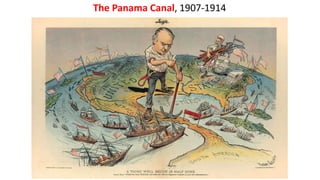
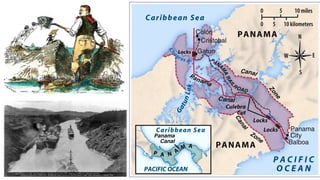
The Panama Canal, 1907-1914
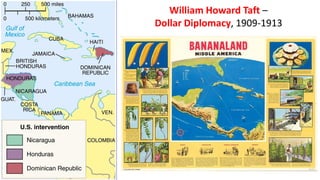
William Howard Taft –
Dollar Diplomacy, 1909-1913
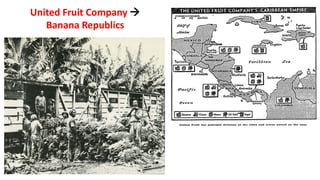
United Fruit Company 
Banana Republics
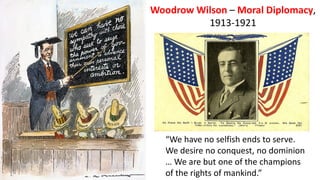
Woodrow Wilson – Moral Diplomacy,
1913-1921
“We have no selfish ends to serve.
We desire no conquest, no dominion
… We are but one of the champions
of the rights of mankind.”
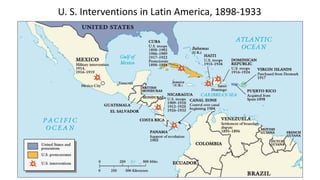
U. S. Interventions in Latin America, 1898-1933
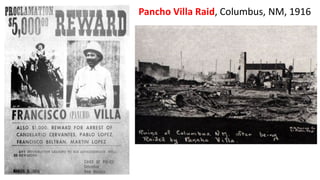
Pancho Villa Raid, Columbus, NM, 1916
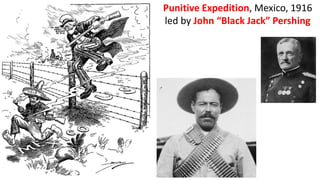
Punitive Expedition, Mexico, 1916
led by John “Black Jack” Pershing
The American Empire.pdf

The American Empire.pdf