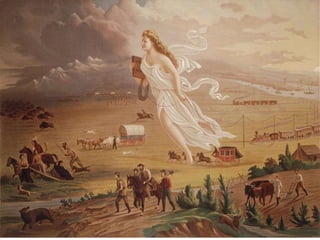
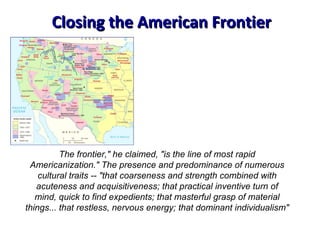
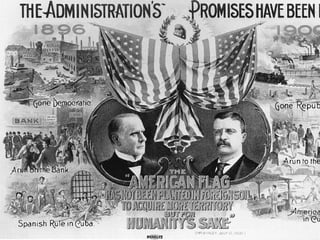
Closing the American Frontier The frontier," he claimed, "is the line of most rapid Americanization." The presence and predominance of numerous cultural traits -- "that coarseness and strength combined with acuteness and acquisitiveness; that practical inventive turn of mind, quick to find expedients; that masterful grasp of material things... that restless, nervous energy; that dominant individualism"
Discussion   Groups How was America’s expansion overseas similar to previous continental expansion westward, and how was it different? West Overseas
Empire and Expansion
Learning Objectives Explain why the United States suddenly abandoned its isolationism and turned outward at the end of the nineteenth century. Describe the forces pushing for American overseas expansion, and the causes of the Spanish-American War.
Learning Objectives Describe and explain the unintended results of the Spanish-American War, especially the conquest of Puerto Rico and the Philippines. Explain McKinley’s decision to keep the Philippines, and list the opposing arguments in the debate about imperialism. Analyze the consequences of the Spanish-American War, including the Filipino rebellion against U.S. rule and the war to suppress it.
Learning Objectives Explain the growing U.S. involvement in East Asia, and summarize America’s “Open Door” policy toward China.  Discuss the significance of the “pro-imperialist” Republican victory in 1900 and the rise of Theodore Roosevelt as a strong advocate of American power in international affairs. Describe Roosevelt’s assertive polities in Panama and elsewhere in Latin America, and explain why his “corollary” to the Monroe Doctrine aroused such controversy.  Discuss Roosevelt’s foreign policies and diplomatic achievements, especially regarding Japan.
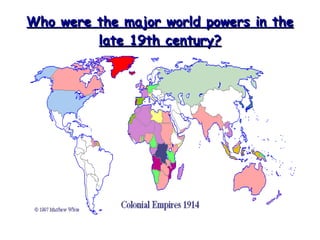
Who were the major world powers in the late 19th century?
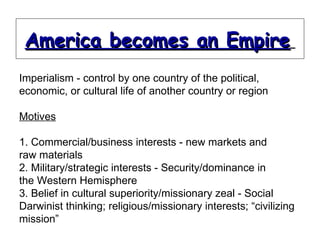
Imperialism - control by one country of the political, economic, or cultural life of another country or region Motives 1. Commercial/business interests - new markets and raw materials 2. Military/strategic interests - Security/dominance in the Western Hemisphere 3. Belief in cultural superiority/missionary zeal - Social Darwinist thinking; religious/missionary interests; “civilizing mission” America becomes an Empire
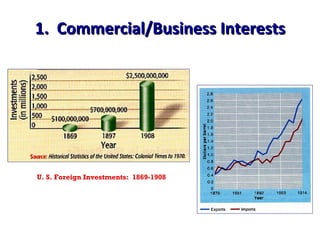
1.  Commercial/Business Interests U. S. Foreign Investments:  1869-1908
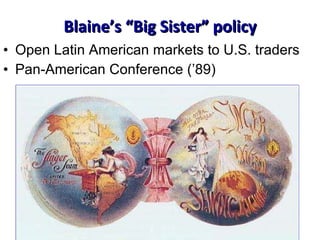
Blaine’s “Big Sister” policy Open Latin American markets to U.S. traders Pan-American Conference (’89)
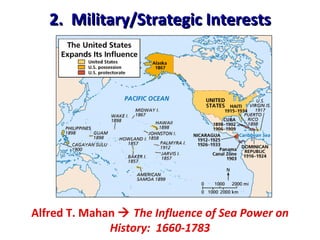
2.  Military/Strategic Interests Alfred T. Mahan     The Influence of Sea Power on History:  1660-1783
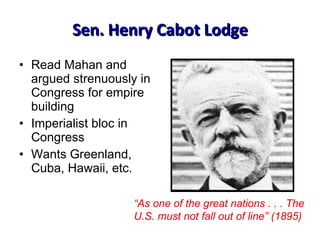
Read Mahan and argued strenuously in Congress for empire building Imperialist bloc in Congress Wants Greenland, Cuba, Hawaii, etc. Sen. Henry Cabot Lodge “ As one of the great nations . . . The U.S. must not fall out of line” (1895)
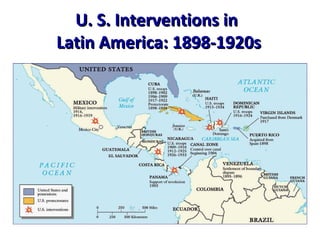
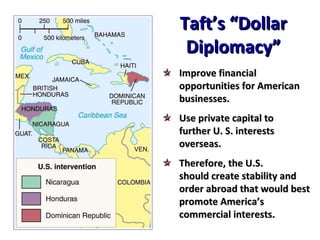
U. S. Interventions in  Latin America: 1898-1920s
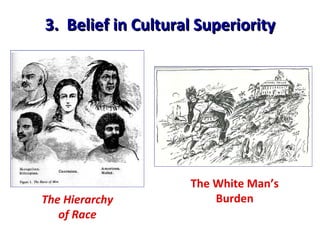
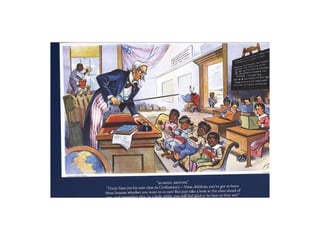
3.  Belief in Cultural Superiority The White Man’s Burden The Hierarchy of Race
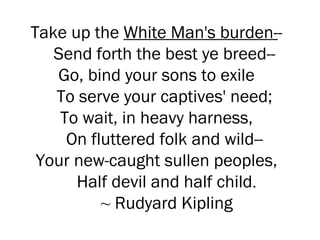
Take up the  White Man's burden- -  Send forth the best ye breed--  Go, bind your sons to exile  To serve your captives' need;  To wait, in heavy harness,  On fluttered folk and wild--  Your new-caught sullen peoples,  Half devil and half child . ~  Rudyard Kipling
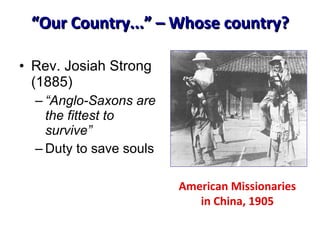
“ Our Country...” – Whose country? Rev. Josiah Strong (1885) “ Anglo-Saxons are the fittest to survive” Duty to save souls American Missionaries in China, 1905
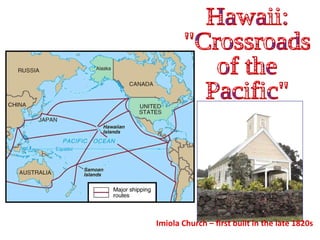
Hawaii: "Crossroads of the Pacific" Imiola Church – first built in the late 1820s
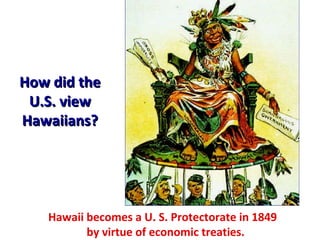
How did the U.S. view Hawaiians? Hawaii becomes a U. S. Protectorate in 1849   by virtue of economic treaties.
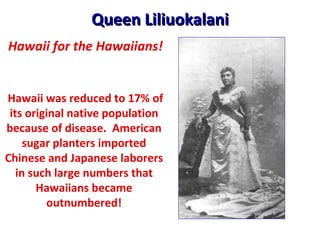
Queen Liliuokalani Hawaii was reduced to 17% of its original native population because of disease.  American sugar planters imported Chinese and Japanese laborers in such large numbers that Hawaiians became outnumbered! Hawaii for the Hawaiians!
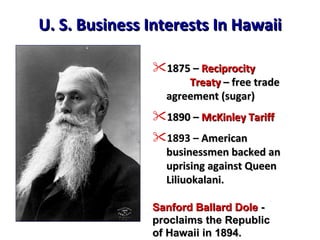
U. S. Business Interests In Hawaii 1875 –  Reciprocity    Treaty  – free trade agreement (sugar) 1890 –  McKinley Tariff 1893 –   American businessmen backed an uprising against Queen  Liliuokalani. Sanford Ballard Dole  - proclaims the Republic  of Hawaii in 1894.
What events expedited the annexation of Hawaii in 1898? What is the justification used for annexation?
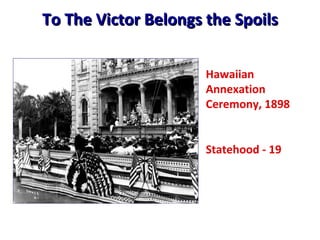
To The Victor Belongs the Spoils Hawaiian Annexation Ceremony, 1898 Statehood - 19
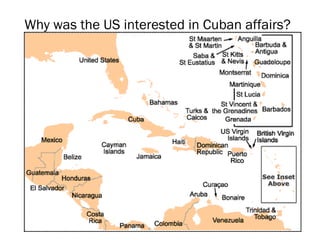
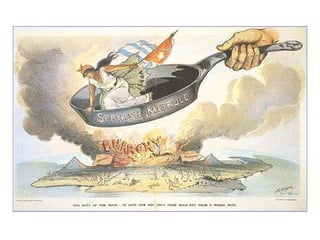
Why was the US interested in Cuban affairs?
 
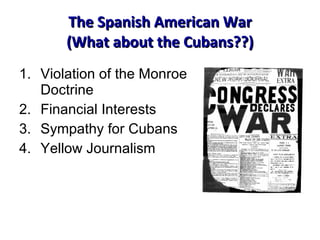
The Spanish American War (What about the Cubans??) Violation of the Monroe Doctrine Financial Interests Sympathy for Cubans Yellow Journalism
FINANCIAL INTERESTS Americans had $50 million invested in Cuba (sugar and fruit); $100 million in trade investments
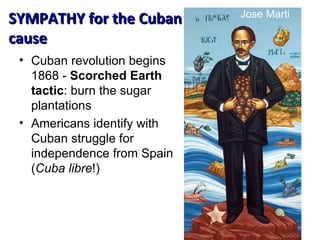
Cuban revolution begins 1868 -  Scorched Earth tactic : burn the sugar plantations Americans identify with Cuban struggle for independence from Spain ( Cuba libre !) SYMPATHY for the Cuban cause Jose Marti
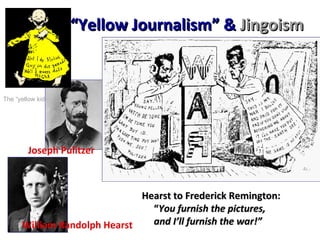
“ Yellow Journalism” &  Jingoism Joseph Pulitzer Hearst to Frederick Remington:   “ You furnish the pictures,   and I’ll furnish the war!” William Randolph Hearst The “yellow kid”
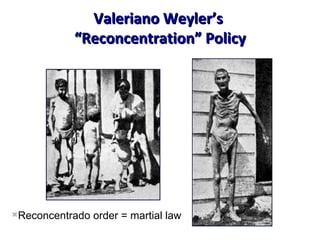
Valeriano Weyler’s  “Reconcentration” Policy Reconcentrado order = martial law
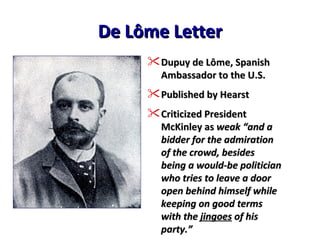
De Lôme Letter Dupuy de Lôme, Spanish Ambassador to the U.S. Published by Hearst Criticized President McKinley as  weak “and a bidder for the admiration of the crowd, besides being a would-be politician who tries to leave a door open behind himself while keeping on good terms with the  jingoes  of his party.”
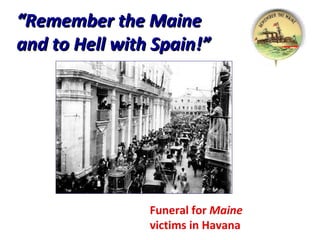
“ Remember the Maine and to Hell with Spain!” Funeral for  Maine  victims in Havana
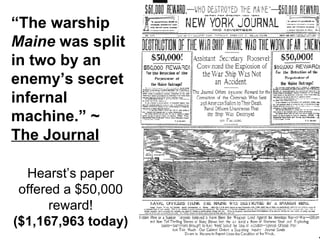
“ The warship  Maine  was split in two by an enemy’s secret infernal machine.” ~  The Journal Hearst’s paper offered a $50,000 reward! ($1,167,963 today)
McKinley   v.   Congress McKinley – wanted ceasefire Congress – supported Cuba Libre, no annexation Teller Amendment  (1898) Intervention without recognition US would secure “stable” self-government in Cuba; wouldn’t interfere with sovereignty; occupied Cuba until 1902
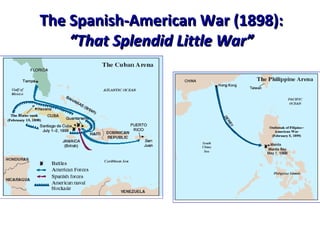
The Spanish-American War (1898): “That Splendid Little War”
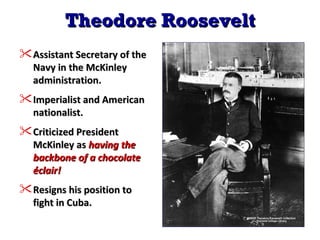
Theodore Roosevelt Assistant Secretary of the Navy in the McKinley administration. Imperialist and American nationalist. Criticized President McKinley as  having the backbone of a chocolate éclair! Resigns his position to fight in Cuba.
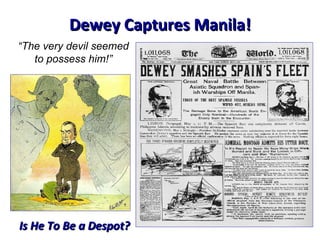
Dewey Captures Manila! “ The very devil seemed to possess him!” Is He To Be a Despot?
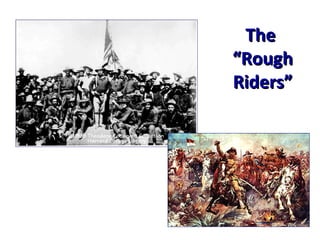
The  “Rough Riders”
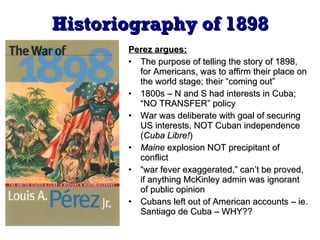
Historiography of 1898 Perez argues: The purpose of telling the story of 1898, for Americans, was to affirm their place on the world stage; their “coming out” 1800s – N and S had interests in Cuba; “NO TRANSFER” policy War was deliberate with goal of securing US interests, NOT Cuban independence ( Cuba Libre! ) Maine  explosion NOT precipitant of conflict “ war fever exaggerated,” can’t be proved, if anything McKinley admin was ignorant of public opinion Cubans left out of American accounts – ie. Santiago de Cuba – WHY??
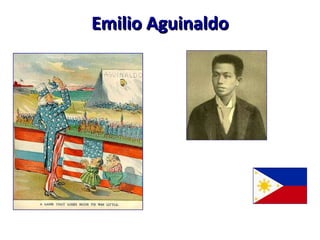
Emilio Aguinaldo
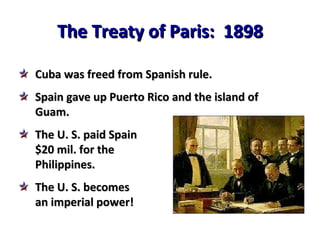
The Treaty of Paris:  1898 Cuba was freed from Spanish rule. Spain gave up Puerto Rico and the island of Guam. The U. S. paid Spain $20 mil. for the Philippines. The U. S. becomes an imperial power!
DILEMMA--Did U. S. citizenship follow the flag?? Look at the Constitution.  Pull out any phrases related to territorial acquisition that support/refute arguments of imperialism.
Puerto Rico:  1898 1900 -  Foraker Act . PR became an “unincorporated territory.” Citizens of PR, not of the US. Import duties on PR goods 1901-1903     the  Insular Cases . Constitutional rights were not automatically extended to territorial possessions. Congress had the power to decide these rights. Import duties laid down by the Foraker Act were legal!
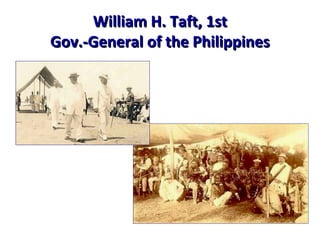
William H. Taft, 1st Gov.-General of the Philippines
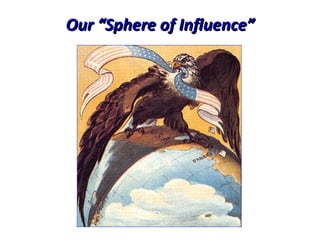
Our “Sphere of Influence”
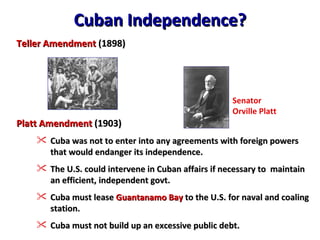
Teller Amendment  (1898) Platt Amendment  (1903) Cuba was not to enter into any agreements with foreign powers that would endanger its independence. The U.S. could intervene in Cuban affairs if necessary to  maintain an efficient, independent govt. Cuba must lease  Guantanamo Bay  to the U.S. for naval and coaling station. Cuba must not build up an excessive public debt. Cuban Independence? Senator  Orville Platt
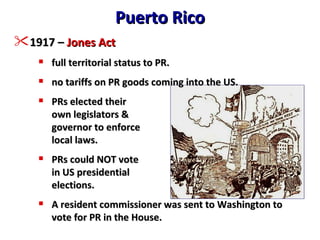
Puerto Rico 1917 –  Jones Act full territorial status to PR. no tariffs on PR goods coming into the US. PRs elected their own legislators & governor to enforce local laws. PRs could NOT vote in US presidential elections. A resident commissioner was sent to Washington to vote for PR in the House.
Results of the Spanish American War Affirmed U.S. presence as world power More respect for U.S. from European powers Brought together North and South “ navyism” (Mahan) Far-Eastern power Philippines becomes “Achilles heel” Willing to defend?
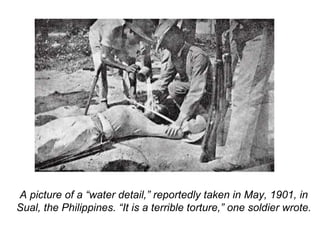
A picture of a “water detail,” reportedly taken in May, 1901, in Sual, the Philippines. “It is a terrible torture,” one soldier wrote.
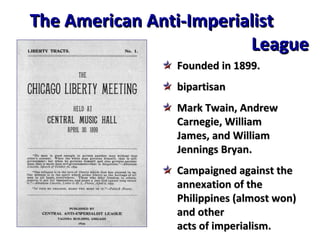
The American Anti-Imperialist    League Founded in 1899. bipartisan Mark Twain, Andrew  Carnegie, William James, and William Jennings Bryan. Campaigned against the annexation of the Philippines (almost won) and other acts of imperialism.
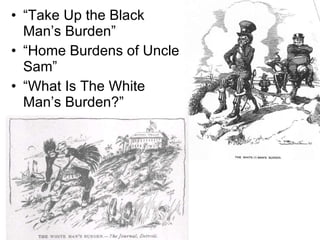
Opposing Viewpoints:  White Man’s Burden Rebuttal Poems While you’re reading the rebuttal poem, answer the following questions: What actions/recommendations does the poem advocate? From what perspective is the poem written? what values are projected by the author? How does the poem’s message compare to Kipling’s poem?
“Take Up the Black Man’s Burden” “Home Burdens of Uncle Sam” “What Is The White Man’s Burden?”
Anti-Imperialist   Arguments Imperialism = hostile to liberty Violation of “consent of the governed” ( Dec. of Indep.) Despotism abroad might lead to despotism at home Annexation would propel the United States into the political and military cauldron of the Far East The Filipinos wanted freedom, not colonial rule Destruction of American ideals; “un-American;” problems at home
Was the taking of Hawaii, Puerto Rico, and the Philippines really a violation of fundamental American ideals of self government and democracy? Why was the Philippine American War such a brutal affair, and why is it not as well remembered as the less costly Spanish American War? Questioning Empire
China
Stereotypes of the Chinese  Immigrant Oriental [Chinese] Exclusion Act, 1887
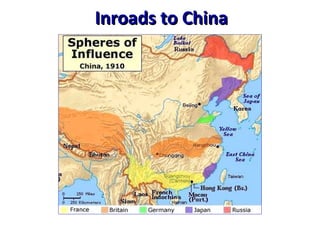
Inroads to China
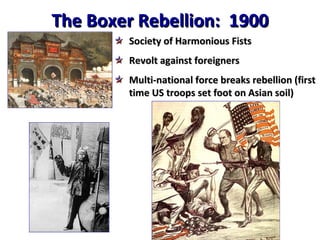
The Boxer Rebellion:  1900 Society of Harmonious Fists Revolt against foreigners Multi-national force breaks rebellion (first time US troops set foot on Asian soil)
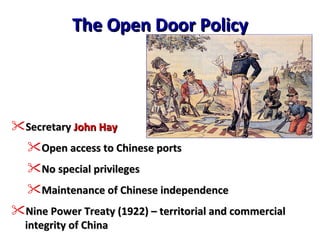
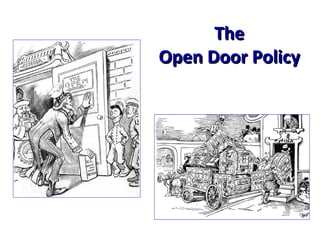
The Open Door Policy Secretary  John Hay Open access to Chinese ports No special privileges Maintenance of Chinese independence Nine Power Treaty (1922) – territorial and commercial integrity of China
The Open Door Policy
 
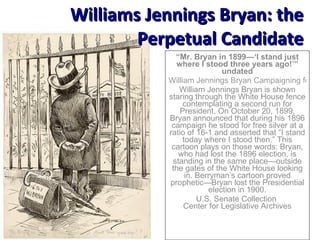
“ Mr. Bryan in 1899—‘I stand just where I stood three years ago!’” undated William Jennings Bryan Campaigning for the Presidency, 1896 William Jennings Bryan is shown staring through the White House fence contemplating a second run for President. On October 20, 1899, Bryan announced that during his 1896 campaign he stood for free silver at a ratio of 16-1 and asserted that “I stand today where I stood then.” This cartoon plays on those words: Bryan, who had lost the 1896 election, is standing in the same place—outside the gates of the White House looking in. Berryman’s cartoon proved prophetic—Bryan lost the Presidential election in 1900. U.S. Senate Collection  Center for Legislative Archives Williams Jennings Bryan: the Perpetual Candidate
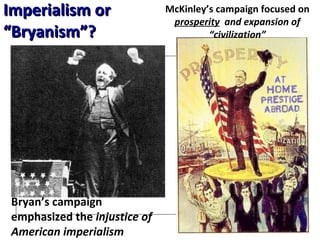
Imperialism or “Bryanism”? Bryan’s campaign emphasized the  injustice of American imperialism McKinley’s campaign focused on  prosperity   and expansion of “civilization”
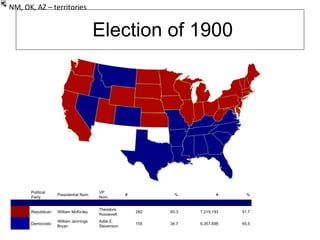
Election of 1900 * NM, OK, AZ – territories Political Party Presidential Nom. VP Nom. # % # % Republican William McKinley Theodore Roosevelt 292 65.3 7,219,193 51.7 Democratic William Jennings Bryan Adlai E. Stevenson 155 34.7 6,357,698 45.5
Panama
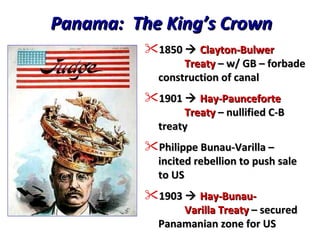
Panama:  The King’s Crown 1850     Clayton-Bulwer   Treaty  – w/ GB – forbade construction of canal 1901     Hay-Paunceforte   Treaty  – nullified C-B treaty Philippe Bunau-Varilla – incited rebellion to push sale to US 1903     Hay-Bunau-   Varilla Treaty  – secured Panamanian zone for US
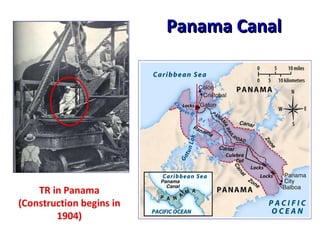
Panama Canal TR in Panama (Construction begins in 1904)
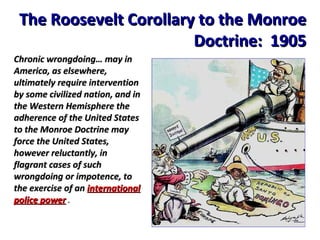
The Roosevelt Corollary to the Monroe Doctrine:  1905 Chronic wrongdoing… may in America, as elsewhere, ultimately require intervention by some civilized nation, and in the Western Hemisphere the adherence of the United States to the Monroe Doctrine may force the United States, however reluctantly, in flagrant cases of such  wrongdoing or impotence, to the exercise of an  international police power  .
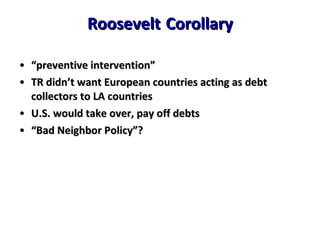
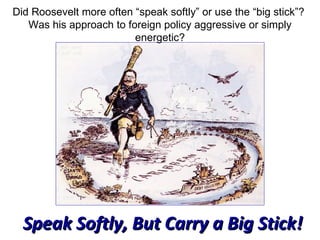
Roosevelt   Corollary “ preventive intervention” TR didn’t want European countries acting as debt collectors to LA countries U.S. would take over, pay off debts “ Bad Neighbor Policy”?
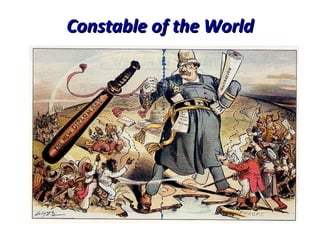
Speak Softly, But Carry a Big Stick! Did Roosevelt more often “speak softly” or use the “big stick”?  Was his approach to foreign policy aggressive or simply energetic?
Japan
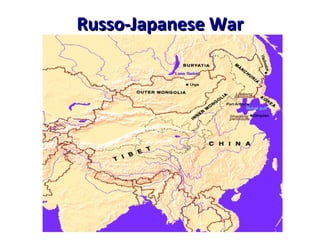
Russo-Japanese War
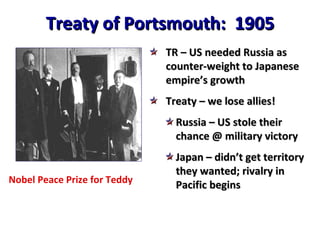
Treaty of Portsmouth:  1905 Nobel Peace Prize for Teddy TR – US needed Russia as counter-weight to Japanese empire’s growth Treaty – we lose allies! Russia – US stole their chance @ military victory Japan – didn’t get territory they wanted; rivalry in Pacific begins
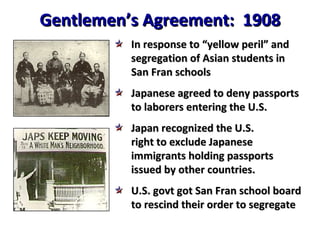
Gentlemen’s Agreement:  1908 In response to “yellow peril” and segregation of Asian students in San Fran schools Japanese agreed to deny passports to laborers entering the U.S. Japan recognized the U.S. right to exclude Japanese immigrants holding passports issued by other countries. U.S. govt got San Fran school board to rescind their order to segregate
Root-Takahira Agreement: 1908 A pledge to maintain the status quo in the Far East. Recognition of China’s independence and territorial integrity, and support for continuation of the Open-Door Policy. An agreement to mutual consultation in the event of future Far Eastern crises.
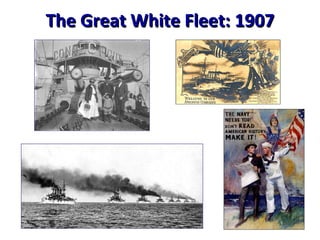
The Great White Fleet: 1907
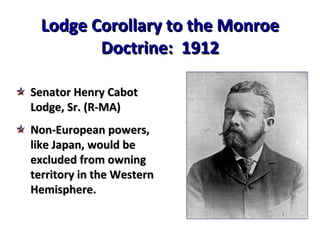
Lodge Corollary to the Monroe Doctrine:  1912 Senator Henry Cabot Lodge, Sr. (R-MA) Non-European powers, like Japan, would be excluded from owning territory in the Western Hemisphere.
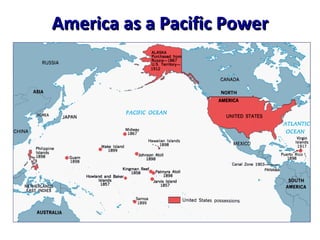
America as a Pacific Power
America's New Role
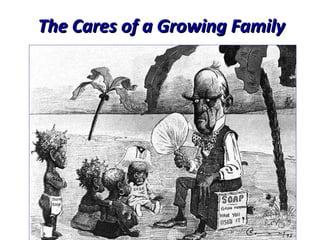
The Cares of a Growing Family
Constable of the World
Taft’s “Dollar Diplomacy” Improve financial opportunities for American businesses. Use private capital to further U. S. interests overseas. Therefore, the U.S.  should create stability and order abroad that would best promote America’s commercial interests.
Mexico
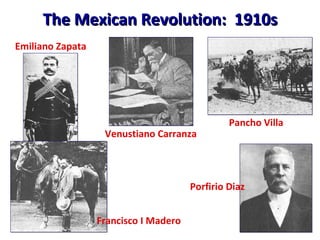
The Mexican Revolution: 1910s Victoriano Huerta seizes control of Mexico  and puts Madero in prison where he was  murdered. Venustiano Carranza, Pancho Villa, Emiliano  Zapata, and Alvaro Obregon fought against Huerta. The U.S. also got involved by occupying  Veracruz and Huerta fled the country. Eventually Carranza would gain power in  Mexico.
The Mexican Revolution:  1910s Emiliano Zapata Francisco I Madero  Venustiano Carranza  Porfirio Diaz Pancho Villa
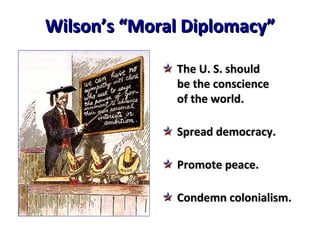
Wilson’s “Moral Diplomacy” The U. S. should be the conscience of the world. Spread democracy. Promote peace. Condemn colonialism.
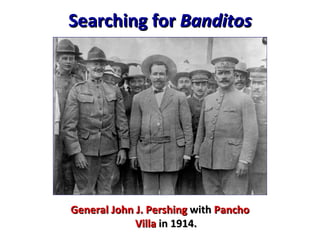
Searching for  Banditos General John J. Pershing  with  Pancho Villa  in 1914.
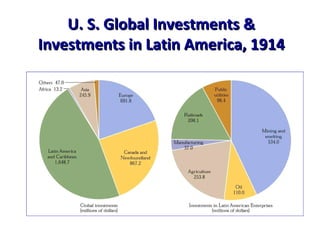
U. S. Global Investments & Investments in Latin America, 1914
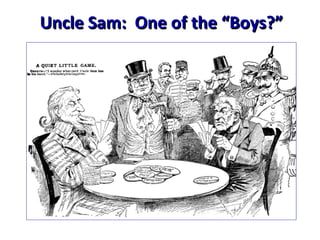
Uncle Sam:  One of the “Boys?”
 
 
Alaska
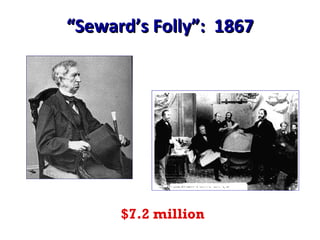
“ Seward’s Folly”:  1867 $7.2 million
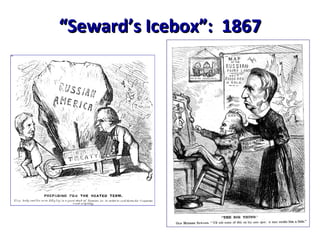
“ Seward’s Icebox”:  1867

Empire and Expansion

  • 1.
  • 2.
    Closing the AmericanFrontier The frontier," he claimed, "is the line of most rapid Americanization." The presence and predominance of numerous cultural traits -- "that coarseness and strength combined with acuteness and acquisitiveness; that practical inventive turn of mind, quick to find expedients; that masterful grasp of material things... that restless, nervous energy; that dominant individualism"
  • 3.
    Discussion Groups How was America’s expansion overseas similar to previous continental expansion westward, and how was it different? West Overseas
  • 4.
  • 5.
    Learning Objectives Explainwhy the United States suddenly abandoned its isolationism and turned outward at the end of the nineteenth century. Describe the forces pushing for American overseas expansion, and the causes of the Spanish-American War.
  • 6.
    Learning Objectives Describeand explain the unintended results of the Spanish-American War, especially the conquest of Puerto Rico and the Philippines. Explain McKinley’s decision to keep the Philippines, and list the opposing arguments in the debate about imperialism. Analyze the consequences of the Spanish-American War, including the Filipino rebellion against U.S. rule and the war to suppress it.
  • 7.
    Learning Objectives Explainthe growing U.S. involvement in East Asia, and summarize America’s “Open Door” policy toward China. Discuss the significance of the “pro-imperialist” Republican victory in 1900 and the rise of Theodore Roosevelt as a strong advocate of American power in international affairs. Describe Roosevelt’s assertive polities in Panama and elsewhere in Latin America, and explain why his “corollary” to the Monroe Doctrine aroused such controversy. Discuss Roosevelt’s foreign policies and diplomatic achievements, especially regarding Japan.
  • 8.
    Who were themajor world powers in the late 19th century?
  • 9.
    Imperialism - controlby one country of the political, economic, or cultural life of another country or region Motives 1. Commercial/business interests - new markets and raw materials 2. Military/strategic interests - Security/dominance in the Western Hemisphere 3. Belief in cultural superiority/missionary zeal - Social Darwinist thinking; religious/missionary interests; “civilizing mission” America becomes an Empire
  • 10.
    1. Commercial/BusinessInterests U. S. Foreign Investments: 1869-1908
  • 11.
    Blaine’s “Big Sister”policy Open Latin American markets to U.S. traders Pan-American Conference (’89)
  • 12.
    2. Military/StrategicInterests Alfred T. Mahan  The Influence of Sea Power on History: 1660-1783
  • 13.
    Read Mahan andargued strenuously in Congress for empire building Imperialist bloc in Congress Wants Greenland, Cuba, Hawaii, etc. Sen. Henry Cabot Lodge “ As one of the great nations . . . The U.S. must not fall out of line” (1895)
  • 14.
    U. S. Interventionsin Latin America: 1898-1920s
  • 15.
    3. Beliefin Cultural Superiority The White Man’s Burden The Hierarchy of Race
  • 16.
    Take up the White Man's burden- - Send forth the best ye breed-- Go, bind your sons to exile To serve your captives' need; To wait, in heavy harness, On fluttered folk and wild-- Your new-caught sullen peoples, Half devil and half child . ~ Rudyard Kipling
  • 17.
    “ Our Country...”– Whose country? Rev. Josiah Strong (1885) “ Anglo-Saxons are the fittest to survive” Duty to save souls American Missionaries in China, 1905
  • 18.
    Hawaii: "Crossroads ofthe Pacific" Imiola Church – first built in the late 1820s
  • 19.
    How did theU.S. view Hawaiians? Hawaii becomes a U. S. Protectorate in 1849 by virtue of economic treaties.
  • 20.
    Queen Liliuokalani Hawaiiwas reduced to 17% of its original native population because of disease. American sugar planters imported Chinese and Japanese laborers in such large numbers that Hawaiians became outnumbered! Hawaii for the Hawaiians!
  • 21.
    U. S. BusinessInterests In Hawaii 1875 – Reciprocity Treaty – free trade agreement (sugar) 1890 – McKinley Tariff 1893 – American businessmen backed an uprising against Queen Liliuokalani. Sanford Ballard Dole - proclaims the Republic of Hawaii in 1894.
  • 22.
    What events expeditedthe annexation of Hawaii in 1898? What is the justification used for annexation?
  • 23.
    To The VictorBelongs the Spoils Hawaiian Annexation Ceremony, 1898 Statehood - 19
  • 24.
    Why was theUS interested in Cuban affairs?
  • 25.
  • 26.
    The Spanish AmericanWar (What about the Cubans??) Violation of the Monroe Doctrine Financial Interests Sympathy for Cubans Yellow Journalism
  • 27.
    FINANCIAL INTERESTS Americanshad $50 million invested in Cuba (sugar and fruit); $100 million in trade investments
  • 28.
    Cuban revolution begins1868 - Scorched Earth tactic : burn the sugar plantations Americans identify with Cuban struggle for independence from Spain ( Cuba libre !) SYMPATHY for the Cuban cause Jose Marti
  • 29.
    “ Yellow Journalism”& Jingoism Joseph Pulitzer Hearst to Frederick Remington: “ You furnish the pictures, and I’ll furnish the war!” William Randolph Hearst The “yellow kid”
  • 30.
    Valeriano Weyler’s “Reconcentration” Policy Reconcentrado order = martial law
  • 31.
    De Lôme LetterDupuy de Lôme, Spanish Ambassador to the U.S. Published by Hearst Criticized President McKinley as weak “and a bidder for the admiration of the crowd, besides being a would-be politician who tries to leave a door open behind himself while keeping on good terms with the jingoes of his party.”
  • 32.
    “ Remember theMaine and to Hell with Spain!” Funeral for Maine victims in Havana
  • 33.
    “ The warship Maine was split in two by an enemy’s secret infernal machine.” ~ The Journal Hearst’s paper offered a $50,000 reward! ($1,167,963 today)
  • 34.
    McKinley v. Congress McKinley – wanted ceasefire Congress – supported Cuba Libre, no annexation Teller Amendment (1898) Intervention without recognition US would secure “stable” self-government in Cuba; wouldn’t interfere with sovereignty; occupied Cuba until 1902
  • 35.
    The Spanish-American War(1898): “That Splendid Little War”
  • 36.
    Theodore Roosevelt AssistantSecretary of the Navy in the McKinley administration. Imperialist and American nationalist. Criticized President McKinley as having the backbone of a chocolate éclair! Resigns his position to fight in Cuba.
  • 37.
    Dewey Captures Manila!“ The very devil seemed to possess him!” Is He To Be a Despot?
  • 38.
    The “RoughRiders”
  • 39.
    Historiography of 1898Perez argues: The purpose of telling the story of 1898, for Americans, was to affirm their place on the world stage; their “coming out” 1800s – N and S had interests in Cuba; “NO TRANSFER” policy War was deliberate with goal of securing US interests, NOT Cuban independence ( Cuba Libre! ) Maine explosion NOT precipitant of conflict “ war fever exaggerated,” can’t be proved, if anything McKinley admin was ignorant of public opinion Cubans left out of American accounts – ie. Santiago de Cuba – WHY??
  • 40.
  • 41.
    The Treaty ofParis: 1898 Cuba was freed from Spanish rule. Spain gave up Puerto Rico and the island of Guam. The U. S. paid Spain $20 mil. for the Philippines. The U. S. becomes an imperial power!
  • 42.
    DILEMMA--Did U. S.citizenship follow the flag?? Look at the Constitution. Pull out any phrases related to territorial acquisition that support/refute arguments of imperialism.
  • 43.
    Puerto Rico: 1898 1900 - Foraker Act . PR became an “unincorporated territory.” Citizens of PR, not of the US. Import duties on PR goods 1901-1903  the Insular Cases . Constitutional rights were not automatically extended to territorial possessions. Congress had the power to decide these rights. Import duties laid down by the Foraker Act were legal!
  • 44.
    William H. Taft,1st Gov.-General of the Philippines
  • 45.
    Our “Sphere ofInfluence”
  • 46.
    Teller Amendment (1898) Platt Amendment (1903) Cuba was not to enter into any agreements with foreign powers that would endanger its independence. The U.S. could intervene in Cuban affairs if necessary to maintain an efficient, independent govt. Cuba must lease Guantanamo Bay to the U.S. for naval and coaling station. Cuba must not build up an excessive public debt. Cuban Independence? Senator Orville Platt
  • 47.
    Puerto Rico 1917– Jones Act full territorial status to PR. no tariffs on PR goods coming into the US. PRs elected their own legislators & governor to enforce local laws. PRs could NOT vote in US presidential elections. A resident commissioner was sent to Washington to vote for PR in the House.
  • 48.
    Results of theSpanish American War Affirmed U.S. presence as world power More respect for U.S. from European powers Brought together North and South “ navyism” (Mahan) Far-Eastern power Philippines becomes “Achilles heel” Willing to defend?
  • 49.
    A picture ofa “water detail,” reportedly taken in May, 1901, in Sual, the Philippines. “It is a terrible torture,” one soldier wrote.
  • 50.
    The American Anti-Imperialist League Founded in 1899. bipartisan Mark Twain, Andrew Carnegie, William James, and William Jennings Bryan. Campaigned against the annexation of the Philippines (almost won) and other acts of imperialism.
  • 51.
    Opposing Viewpoints: White Man’s Burden Rebuttal Poems While you’re reading the rebuttal poem, answer the following questions: What actions/recommendations does the poem advocate? From what perspective is the poem written? what values are projected by the author? How does the poem’s message compare to Kipling’s poem?
  • 52.
    “Take Up theBlack Man’s Burden” “Home Burdens of Uncle Sam” “What Is The White Man’s Burden?”
  • 53.
    Anti-Imperialist Arguments Imperialism = hostile to liberty Violation of “consent of the governed” ( Dec. of Indep.) Despotism abroad might lead to despotism at home Annexation would propel the United States into the political and military cauldron of the Far East The Filipinos wanted freedom, not colonial rule Destruction of American ideals; “un-American;” problems at home
  • 54.
    Was the takingof Hawaii, Puerto Rico, and the Philippines really a violation of fundamental American ideals of self government and democracy? Why was the Philippine American War such a brutal affair, and why is it not as well remembered as the less costly Spanish American War? Questioning Empire
  • 55.
  • 56.
    Stereotypes of theChinese Immigrant Oriental [Chinese] Exclusion Act, 1887
  • 57.
  • 58.
    The Boxer Rebellion: 1900 Society of Harmonious Fists Revolt against foreigners Multi-national force breaks rebellion (first time US troops set foot on Asian soil)
  • 59.
    The Open DoorPolicy Secretary John Hay Open access to Chinese ports No special privileges Maintenance of Chinese independence Nine Power Treaty (1922) – territorial and commercial integrity of China
  • 60.
  • 61.
  • 62.
    “ Mr. Bryanin 1899—‘I stand just where I stood three years ago!’” undated William Jennings Bryan Campaigning for the Presidency, 1896 William Jennings Bryan is shown staring through the White House fence contemplating a second run for President. On October 20, 1899, Bryan announced that during his 1896 campaign he stood for free silver at a ratio of 16-1 and asserted that “I stand today where I stood then.” This cartoon plays on those words: Bryan, who had lost the 1896 election, is standing in the same place—outside the gates of the White House looking in. Berryman’s cartoon proved prophetic—Bryan lost the Presidential election in 1900. U.S. Senate Collection Center for Legislative Archives Williams Jennings Bryan: the Perpetual Candidate
  • 63.
    Imperialism or “Bryanism”?Bryan’s campaign emphasized the injustice of American imperialism McKinley’s campaign focused on prosperity and expansion of “civilization”
  • 64.
    Election of 1900* NM, OK, AZ – territories Political Party Presidential Nom. VP Nom. # % # % Republican William McKinley Theodore Roosevelt 292 65.3 7,219,193 51.7 Democratic William Jennings Bryan Adlai E. Stevenson 155 34.7 6,357,698 45.5
  • 65.
  • 66.
    Panama: TheKing’s Crown 1850  Clayton-Bulwer Treaty – w/ GB – forbade construction of canal 1901  Hay-Paunceforte Treaty – nullified C-B treaty Philippe Bunau-Varilla – incited rebellion to push sale to US 1903  Hay-Bunau- Varilla Treaty – secured Panamanian zone for US
  • 67.
    Panama Canal TRin Panama (Construction begins in 1904)
  • 68.
    The Roosevelt Corollaryto the Monroe Doctrine: 1905 Chronic wrongdoing… may in America, as elsewhere, ultimately require intervention by some civilized nation, and in the Western Hemisphere the adherence of the United States to the Monroe Doctrine may force the United States, however reluctantly, in flagrant cases of such wrongdoing or impotence, to the exercise of an international police power .
  • 69.
    Roosevelt Corollary “ preventive intervention” TR didn’t want European countries acting as debt collectors to LA countries U.S. would take over, pay off debts “ Bad Neighbor Policy”?
  • 70.
    Speak Softly, ButCarry a Big Stick! Did Roosevelt more often “speak softly” or use the “big stick”? Was his approach to foreign policy aggressive or simply energetic?
  • 71.
  • 72.
  • 73.
    Treaty of Portsmouth: 1905 Nobel Peace Prize for Teddy TR – US needed Russia as counter-weight to Japanese empire’s growth Treaty – we lose allies! Russia – US stole their chance @ military victory Japan – didn’t get territory they wanted; rivalry in Pacific begins
  • 74.
    Gentlemen’s Agreement: 1908 In response to “yellow peril” and segregation of Asian students in San Fran schools Japanese agreed to deny passports to laborers entering the U.S. Japan recognized the U.S. right to exclude Japanese immigrants holding passports issued by other countries. U.S. govt got San Fran school board to rescind their order to segregate
  • 75.
    Root-Takahira Agreement: 1908A pledge to maintain the status quo in the Far East. Recognition of China’s independence and territorial integrity, and support for continuation of the Open-Door Policy. An agreement to mutual consultation in the event of future Far Eastern crises.
  • 76.
    The Great WhiteFleet: 1907
  • 77.
    Lodge Corollary tothe Monroe Doctrine: 1912 Senator Henry Cabot Lodge, Sr. (R-MA) Non-European powers, like Japan, would be excluded from owning territory in the Western Hemisphere.
  • 78.
    America as aPacific Power
  • 79.
  • 80.
    The Cares ofa Growing Family
  • 81.
  • 82.
    Taft’s “Dollar Diplomacy”Improve financial opportunities for American businesses. Use private capital to further U. S. interests overseas. Therefore, the U.S. should create stability and order abroad that would best promote America’s commercial interests.
  • 83.
  • 84.
    The Mexican Revolution:1910s Victoriano Huerta seizes control of Mexico and puts Madero in prison where he was murdered. Venustiano Carranza, Pancho Villa, Emiliano Zapata, and Alvaro Obregon fought against Huerta. The U.S. also got involved by occupying Veracruz and Huerta fled the country. Eventually Carranza would gain power in Mexico.
  • 85.
    The Mexican Revolution: 1910s Emiliano Zapata Francisco I Madero Venustiano Carranza Porfirio Diaz Pancho Villa
  • 86.
    Wilson’s “Moral Diplomacy”The U. S. should be the conscience of the world. Spread democracy. Promote peace. Condemn colonialism.
  • 87.
    Searching for Banditos General John J. Pershing with Pancho Villa in 1914.
  • 88.
    U. S. GlobalInvestments & Investments in Latin America, 1914
  • 89.
    Uncle Sam: One of the “Boys?”
  • 90.
  • 91.
  • 92.
  • 93.
    “ Seward’s Folly”: 1867 $7.2 million
  • 94.