Product life cycle management of
                                          Ambassador Car


Mohammed Umair- 3rd sem B.com
Product life cycle management


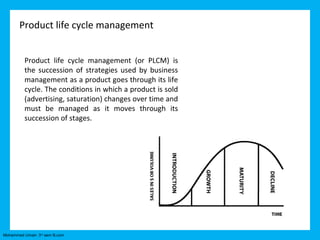
          Product life cycle management (or PLCM) is
          the succession of strategies used by business
          management as a product goes through its life
          cycle. The conditions in which a product is sold
          (advertising, saturation) changes over time and
          must be managed as it moves through its
          succession of stages.


Mohammed Umair- 3rd sem B.com
Introduction


     The Hindustan Ambassador is a car manufactured by Hindustan Motors of India. It has
     been in production since 1958 with few modifications or changes and is based on the
     Morris Oxford III model first made by the Morris Motor Company at Cowley, Oxford in
     the United Kingdom from 1956 to 1959.

     Despite its British origins, the Ambassador is considered as a definitive Indian car and is
     fondly called "The king of Indian roads". The automobile is manufactured by Hindustan
     Motors at its Uttarpara plant near Kolkata, West Bengal. It was the most popular car in
     India and is perceived to be best suited to the harsh Indian terrain due to its very good
     suspension. Its iconic status was helped by the fact that it was the preferred means of
     conveyance of India's political leadership, including the Prime Minister of India, before
     they moved on to other luxury cars and SUVs. In 2002, then-Indian PM Atal Bihari
     Vajpayee started traveling in an armored BMW 7 Series for security purposes. However,
     some prominent Indian politicians, such as Sonia Gandhi, continue with their preference
     for the Hindustan Ambassador


Mohammed Umair- 3rd sem B.com
Origins
      When the Birlas wanted a new model to replace their already old Hindustan models
      based on Morris Oxford Series II (Hindustan Landmaster), they scouted for the then-
      new Morris Oxford Series III. The car initially came with a side valve engine but was later
      improved to an overhead valve engine. Also the car at that point was quite an
      innovation with a fully enclosed monocoque chassis, which is why it is spacious inside.

      Hindustan Motors Limited (HM), India's pioneering automobile manufacturing company
      and flagship company of the C.K. Birla Group was established just before Indian
      independence, in 1942 by B.M. Birla, commencing operations in a small assembly plant
      in Port Okha near Gujarat,


Mohammed Umair- 3rd sem B.com
Evolution


          The Amby, as it is affectionately called, has been in continuous production since its
          inception, with very few changes to its frame.

          In 1948, Hindustan Motors shifted its assembly plant from Port Okha in Gujarat to
          Uttarpara in West Bengal's Hooghly district and strengthened its manufacturing
          capacity in the automobile segment.

          The 1954 Morris Oxford series II in India was licence-built at Uttarpara, (Hooghly
          dist.), West Bengal, three years after its debut in England and labelled as the 1957
          Hindustan Landmaster. It had a rounded rear squab and a curvaceous sloping hood.
          Engaged in the manufacture of the Ambassador, Contessa and utility vehicles like
          the Trekker, Porter and Pushpak, the plant also has to its credit, many innovations
          and improvements in the automobile industry in India. Hindustan Motors is the only
          manufacturing facility in the world to manufacture parts for Bedford trucks
          currently.

Mohammed Umair- 3rd sem B.com
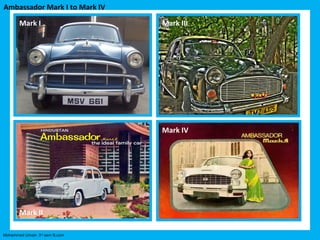
Ambassador Mark I to Mark IV


          The Amby, as it is affectionately called, has been in continuous production since its
          inception, with very few changes to its frame.

          In 1948, Hindustan Motors shifted its assembly plant from Port Okha in Gujarat to
          Uttarpara in West Bengal's Hooghly district and strengthened its manufacturing
          capacity in the automobile segment.

          The 1954 Morris Oxford series II in India was licence-built at Uttarpara, (Hooghly
          dist.), West Bengal, three years after its debut in England and labelled as the 1957
          Hindustan Landmaster. It had a rounded rear squab and a curvaceous sloping hood.
          Engaged in the manufacture of the Ambassador, Contessa and utility vehicles like
          the Trekker, Porter and Pushpak, the plant also has to its credit, many innovations
          and improvements in the automobile industry in India. Hindustan Motors is the only
          manufacturing facility in the world to manufacture parts for Bedford trucks
          currently.

Mohammed Umair- 3rd sem B.com
Ambassador Mark I to Mark IV
       Mark I                   Mark III


                                Mark IV


       Mark II

Mohammed Umair- 3rd sem B.com
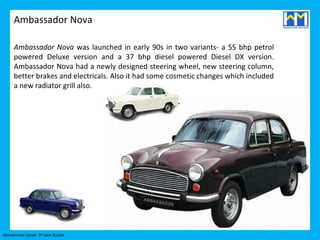
Ambassador Nova

     Ambassador Nova was launched in early 90s in two variants- a 55 bhp petrol
     powered Deluxe version and a 37 bhp diesel powered Diesel DX version.
     Ambassador Nova had a newly designed steering wheel, new steering column,
     better brakes and electricals. Also it had some cosmetic changes which included
     a new radiator grill also.


Mohammed Umair- 3rd sem B.com
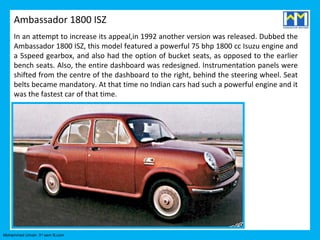
Ambassador 1800 ISZ
     In an attempt to increase its appeal,in 1992 another version was released. Dubbed the
     Ambassador 1800 ISZ, this model featured a powerful 75 bhp 1800 cc Isuzu engine and
     a 5speed gearbox, and also had the option of bucket seats, as opposed to the earlier
     bench seats. Also, the entire dashboard was redesigned. Instrumentation panels were
     shifted from the centre of the dashboard to the right, behind the steering wheel. Seat
     belts became mandatory. At that time no Indian cars had such a powerful engine and it
     was the fastest car of that time.


Mohammed Umair- 3rd sem B.com
Ambassador Ambassador Classic

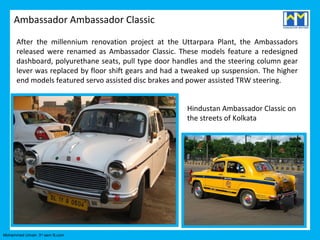
      After the millennium renovation project at the Uttarpara Plant, the Ambassadors
      released were renamed as Ambassador Classic. These models feature a redesigned
      dashboard, polyurethane seats, pull type door handles and the steering column gear
      lever was replaced by floor shift gears and had a tweaked up suspension. The higher
      end models featured servo assisted disc brakes and power assisted TRW steering.


                                                        Hindustan Ambassador Classic on
                                                        the streets of Kolkata


Mohammed Umair- 3rd sem B.com
Ambassador Avigo
       Its most radical revision, a part of a brand revitalization kicked off in the middle of
       2003, was the Avigo (a break from the Ambassador marque indicating a different
       marketing strategy), launched in the summer of 2004. The revitalization consisted of
       the Ambassador Classic of mid-2003, the Ambassador Grand of late-2003, and the
       aforementioned Avigo, designed by Manvindra Singh. Car enthusiasts, however see
       this as a desperate attempt to claw back the dwindling market share. Notable
       influences on the new design include the new Mini, and even the Porsche 356.
       However, the most overpowering influence on the front and bonnet has been that of
       the original Landmaster series (also based on Morris Oxford). The rear of the car has
       been left untouched, and this leads some to feel that the car is not really different
       from an Ambassador. Retro-car enthusiasts would have preferred a rounded back
       (without the small fins), while as a current car, the regular-look Ambassador is very
       good itself. The Avigo, however, has much more classic-touch internals, like a centrally
       mounted console (like the Mark IV models), beige colored seats and wood-grain
       interiors


Mohammed Umair- 3rd sem B.com
Engines
     In the early 1990s, the old BMC 1.5L petrol engine was replaced in favour of an Isuzu
     1.8 litre engine and became the fastest production car in India, beating Fiats, and the
     Maruti Suzuki cars at that time. The engines currently available are the 1.8L 75 bhp
     MPFI petrol engine and a 2.0L 50 bhp Isuzu diesel engine.

      Extended version
      Many local customisers offer stretched versions, though they are not very popular. One
      such manufacturer is Parikh, whose effort is called the "Ambylimo"

      Customized version
       Car designer Dilip Chhabria created a concept inspired by the Ambassador. version,
       the Ambierod. This car is not manufactured by Hindustan Motors nor is it based on
       the ambassador. Several styling ques however have been borrowed from the
       Ambassador.


Mohammed Umair- 3rd sem B.com
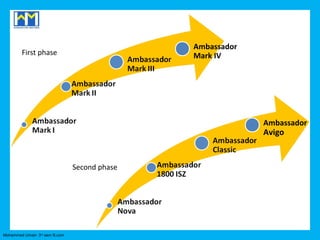
Ambassador
        First phase                            Mark IV


                                                            Ambassador
                                                            Avigo


                                Second phase


Mohammed Umair- 3rd sem B.com
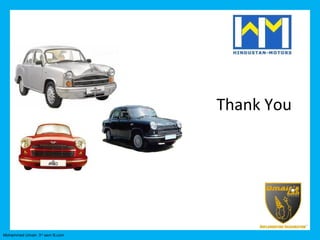
Thank You


Mohammed Umair- 3rd sem B.com

Ambassador plc

  • 1.
    Product life cyclemanagement of Ambassador Car Mohammed Umair- 3rd sem B.com
  • 2.
    Product life cyclemanagement Product life cycle management (or PLCM) is the succession of strategies used by business management as a product goes through its life cycle. The conditions in which a product is sold (advertising, saturation) changes over time and must be managed as it moves through its succession of stages. Mohammed Umair- 3rd sem B.com
  • 3.
    Introduction The Hindustan Ambassador is a car manufactured by Hindustan Motors of India. It has been in production since 1958 with few modifications or changes and is based on the Morris Oxford III model first made by the Morris Motor Company at Cowley, Oxford in the United Kingdom from 1956 to 1959. Despite its British origins, the Ambassador is considered as a definitive Indian car and is fondly called "The king of Indian roads". The automobile is manufactured by Hindustan Motors at its Uttarpara plant near Kolkata, West Bengal. It was the most popular car in India and is perceived to be best suited to the harsh Indian terrain due to its very good suspension. Its iconic status was helped by the fact that it was the preferred means of conveyance of India's political leadership, including the Prime Minister of India, before they moved on to other luxury cars and SUVs. In 2002, then-Indian PM Atal Bihari Vajpayee started traveling in an armored BMW 7 Series for security purposes. However, some prominent Indian politicians, such as Sonia Gandhi, continue with their preference for the Hindustan Ambassador Mohammed Umair- 3rd sem B.com
  • 4.
    Origins When the Birlas wanted a new model to replace their already old Hindustan models based on Morris Oxford Series II (Hindustan Landmaster), they scouted for the then- new Morris Oxford Series III. The car initially came with a side valve engine but was later improved to an overhead valve engine. Also the car at that point was quite an innovation with a fully enclosed monocoque chassis, which is why it is spacious inside. Hindustan Motors Limited (HM), India's pioneering automobile manufacturing company and flagship company of the C.K. Birla Group was established just before Indian independence, in 1942 by B.M. Birla, commencing operations in a small assembly plant in Port Okha near Gujarat, Mohammed Umair- 3rd sem B.com
  • 5.
    Evolution The Amby, as it is affectionately called, has been in continuous production since its inception, with very few changes to its frame. In 1948, Hindustan Motors shifted its assembly plant from Port Okha in Gujarat to Uttarpara in West Bengal's Hooghly district and strengthened its manufacturing capacity in the automobile segment. The 1954 Morris Oxford series II in India was licence-built at Uttarpara, (Hooghly dist.), West Bengal, three years after its debut in England and labelled as the 1957 Hindustan Landmaster. It had a rounded rear squab and a curvaceous sloping hood. Engaged in the manufacture of the Ambassador, Contessa and utility vehicles like the Trekker, Porter and Pushpak, the plant also has to its credit, many innovations and improvements in the automobile industry in India. Hindustan Motors is the only manufacturing facility in the world to manufacture parts for Bedford trucks currently. Mohammed Umair- 3rd sem B.com
  • 6.
    Ambassador Mark Ito Mark IV The Amby, as it is affectionately called, has been in continuous production since its inception, with very few changes to its frame. In 1948, Hindustan Motors shifted its assembly plant from Port Okha in Gujarat to Uttarpara in West Bengal's Hooghly district and strengthened its manufacturing capacity in the automobile segment. The 1954 Morris Oxford series II in India was licence-built at Uttarpara, (Hooghly dist.), West Bengal, three years after its debut in England and labelled as the 1957 Hindustan Landmaster. It had a rounded rear squab and a curvaceous sloping hood. Engaged in the manufacture of the Ambassador, Contessa and utility vehicles like the Trekker, Porter and Pushpak, the plant also has to its credit, many innovations and improvements in the automobile industry in India. Hindustan Motors is the only manufacturing facility in the world to manufacture parts for Bedford trucks currently. Mohammed Umair- 3rd sem B.com
  • 7.
    Ambassador Mark Ito Mark IV Mark I Mark III Mark IV Mark II Mohammed Umair- 3rd sem B.com
  • 8.
    Ambassador Nova Ambassador Nova was launched in early 90s in two variants- a 55 bhp petrol powered Deluxe version and a 37 bhp diesel powered Diesel DX version. Ambassador Nova had a newly designed steering wheel, new steering column, better brakes and electricals. Also it had some cosmetic changes which included a new radiator grill also. Mohammed Umair- 3rd sem B.com
  • 9.
    Ambassador 1800 ISZ In an attempt to increase its appeal,in 1992 another version was released. Dubbed the Ambassador 1800 ISZ, this model featured a powerful 75 bhp 1800 cc Isuzu engine and a 5speed gearbox, and also had the option of bucket seats, as opposed to the earlier bench seats. Also, the entire dashboard was redesigned. Instrumentation panels were shifted from the centre of the dashboard to the right, behind the steering wheel. Seat belts became mandatory. At that time no Indian cars had such a powerful engine and it was the fastest car of that time. Mohammed Umair- 3rd sem B.com
  • 10.
    Ambassador Ambassador Classic After the millennium renovation project at the Uttarpara Plant, the Ambassadors released were renamed as Ambassador Classic. These models feature a redesigned dashboard, polyurethane seats, pull type door handles and the steering column gear lever was replaced by floor shift gears and had a tweaked up suspension. The higher end models featured servo assisted disc brakes and power assisted TRW steering. Hindustan Ambassador Classic on the streets of Kolkata Mohammed Umair- 3rd sem B.com
  • 11.
    Ambassador Avigo Its most radical revision, a part of a brand revitalization kicked off in the middle of 2003, was the Avigo (a break from the Ambassador marque indicating a different marketing strategy), launched in the summer of 2004. The revitalization consisted of the Ambassador Classic of mid-2003, the Ambassador Grand of late-2003, and the aforementioned Avigo, designed by Manvindra Singh. Car enthusiasts, however see this as a desperate attempt to claw back the dwindling market share. Notable influences on the new design include the new Mini, and even the Porsche 356. However, the most overpowering influence on the front and bonnet has been that of the original Landmaster series (also based on Morris Oxford). The rear of the car has been left untouched, and this leads some to feel that the car is not really different from an Ambassador. Retro-car enthusiasts would have preferred a rounded back (without the small fins), while as a current car, the regular-look Ambassador is very good itself. The Avigo, however, has much more classic-touch internals, like a centrally mounted console (like the Mark IV models), beige colored seats and wood-grain interiors Mohammed Umair- 3rd sem B.com
  • 12.
    Engines In the early 1990s, the old BMC 1.5L petrol engine was replaced in favour of an Isuzu 1.8 litre engine and became the fastest production car in India, beating Fiats, and the Maruti Suzuki cars at that time. The engines currently available are the 1.8L 75 bhp MPFI petrol engine and a 2.0L 50 bhp Isuzu diesel engine. Extended version Many local customisers offer stretched versions, though they are not very popular. One such manufacturer is Parikh, whose effort is called the "Ambylimo" Customized version Car designer Dilip Chhabria created a concept inspired by the Ambassador. version, the Ambierod. This car is not manufactured by Hindustan Motors nor is it based on the ambassador. Several styling ques however have been borrowed from the Ambassador. Mohammed Umair- 3rd sem B.com
  • 13.
    Ambassador First phase Mark IV Ambassador Avigo Second phase Mohammed Umair- 3rd sem B.com
  • 14.