Let’s


AAKASH SETHI
PRESTIGE
     INSTITUTE OF MANAGEMENT & RESEARCH


                 ASSINGMENT ON
                  YEAR 2013-14

       PRODUCT           LIFE     CYCLE


        GUIDED BY                SUBMITED BY
PROF. KHUSHBOO MAKWANA           AAKASH SETHI
APPROCHES TO KNOW

      INTRODUCTION


DECLINE              GROWTH


          MATURITY
THE LEGEND
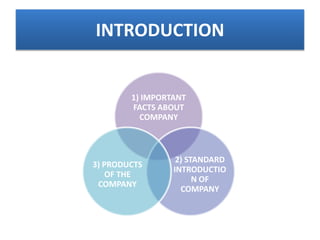
INTRODUCTION


        1) IMPORTANT
        FACTS ABOUT
          COMPANY


                  2) STANDARD
3) PRODUCTS
                 INTRODUCTIO
    OF THE
                       N OF
 COMPANY
                   COMPANY
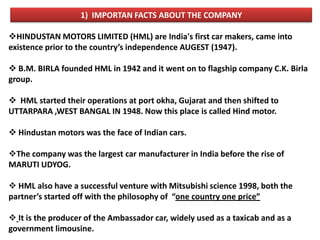
1) IMPORTAN FACTS ABOUT THE COMPANY

HINDUSTAN MOTORS LIMITED (HML) are India's first car makers, came into
existence prior to the country’s independence AUGEST (1947).

 B.M. BIRLA founded HML in 1942 and it went on to flagship company C.K. Birla
group.

 HML started their operations at port okha, Gujarat and then shifted to
UTTARPARA ,WEST BANGAL IN 1948. Now this place is called Hind motor.

 Hindustan motors was the face of Indian cars.

The company was the largest car manufacturer in India before the rise of
MARUTI UDYOG.

 HML also have a successful venture with Mitsubishi science 1998, both the
partner’s started off with the philosophy of “one country one price”

 It is the producer of the Ambassador car, widely used as a taxicab and as a
government limousine.
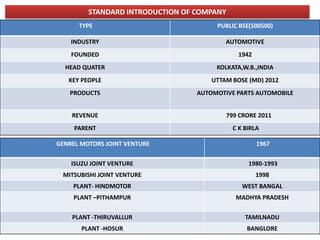
STANDARD INTRODUCTION OF COMPANY
      TYPE                             PUBLIC BSE(500500)

    INDUSTRY                              AUTOMOTIVE
    FOUNDED                                   1942
  HEAD QUATER                          KOLKATA,W.B.,INDIA
   KEY PEOPLE                         UTTAM BOSE (MD) 2012
   PRODUCTS                       AUTOMOTIVE PARTS AUTOMOBILE


    REVENUE                               799 CRORE 2011
     PARENT                                 C K BIRLA

GENREL MOTORS JOINT VENTURE                          1967

    ISUZU JOINT VENTURE                          1980-1993
 MITSUBISHI JOINT VENTURE                            1998
    PLANT- HINDMOTOR                           WEST BANGAL
     PLANT –PITHAMPUR                        MADHYA PRADESH

    PLANT -THIRUVALLUR                          TAMILNADU
       PLANT -HOSUR                             BANGLORE
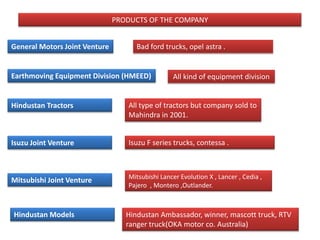
PRODUCTS OF THE COMPANY


General Motors Joint Venture         Bad ford trucks, opel astra .


Earthmoving Equipment Division (HMEED)           All kind of equipment division


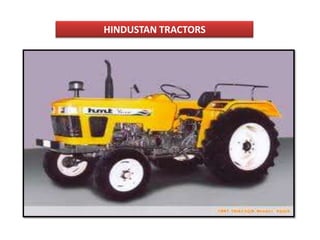
Hindustan Tractors                All type of tractors but company sold to
                                  Mahindra in 2001.


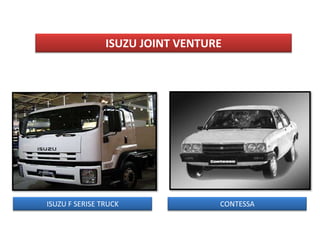
Isuzu Joint Venture               Isuzu F series trucks, contessa .


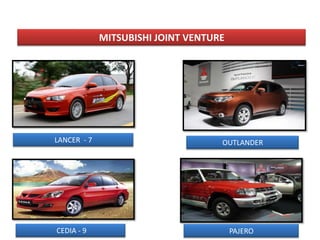
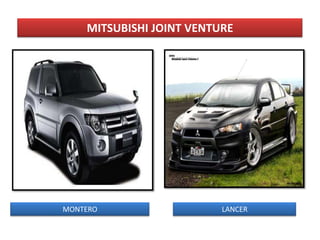
                                  Mitsubishi Lancer Evolution X , Lancer , Cedia ,
Mitsubishi Joint Venture
                                  Pajero , Montero ,Outlander.


Hindustan Models                  Hindustan Ambassador, winner, mascott truck, RTV
                                  ranger truck(OKA motor co. Australia)
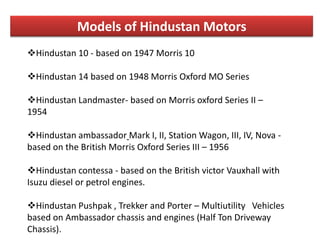
Models of Hindustan Motors
Hindustan 10 - based on 1947 Morris 10

Hindustan 14 based on 1948 Morris Oxford MO Series

Hindustan Landmaster- based on Morris oxford Series II –
1954

Hindustan ambassador Mark I, II, Station Wagon, III, IV, Nova -
based on the British Morris Oxford Series III – 1956

Hindustan contessa - based on the British victor Vauxhall with
Isuzu diesel or petrol engines.

Hindustan Pushpak , Trekker and Porter – Multiutility Vehicles
based on Ambassador chassis and engines (Half Ton Driveway
Chassis).
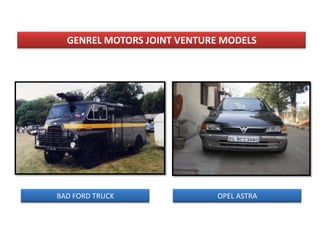
GENREL MOTORS JOINT VENTURE MODELS


BAD FORD TRUCK               OPEL ASTRA
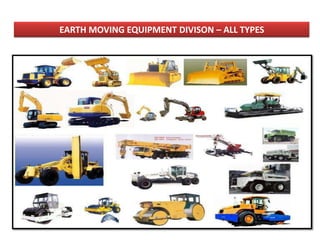
EARTH MOVING EQUIPMENT DIVISON – ALL TYPES
HINDUSTAN TRACTORS
ISUZU JOINT VENTURE


ISUZU F SERISE TRUCK              CONTESSA
MITSUBISHI JOINT VENTURE


LANCER - 7                          OUTLANDER


CEDIA - 9                               PAJERO
MITSUBISHI JOINT VENTURE


MONTERO                   LANCER
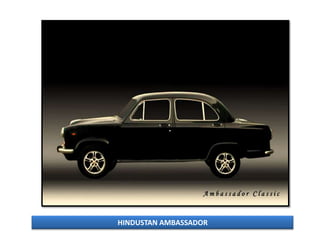
THE KING OF INDIAN ROADS
HINDUSTAN AMBASSADOR
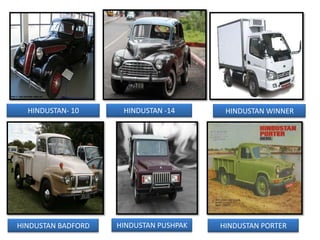
HINDUSTAN- 10      HINDUSTAN -14       HINDUSTAN WINNER


HINDUSTAN BADFORD   HINDUSTAN PUSHPAK   HINDUSTAN PORTER
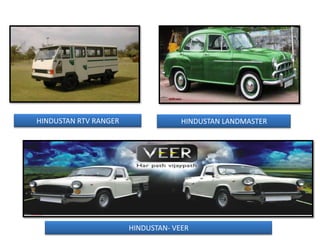
HINDUSTAN RTV RANGER                HINDUSTAN LANDMASTER


                       HINDUSTAN- VEER
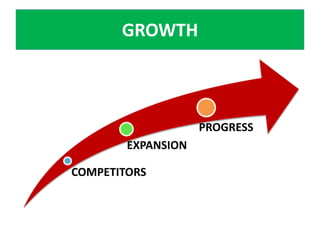
GROWTH


                    PROGRESS
        EXPANSION

COMPETITORS
COMPETITORS
THERE ARE SOME MAJOR REASONS FOR THE GROWTH OF THE
COMPANY-

 Manufacturing is licensed – this period of time is called LICENSE
RAAJ(till 1993).

 High custom duty on export of any vehicle .

 High excise duty with sales tax.

There are only 3 players in the automobile industries HINDUSTAN
MOTORS , PRIMIER AUTOMOBILE , PADMINI AUTOMOBILE.

 Only Hindustan motors and premier motors are two major player
in the market.
EXPANSION
Mile stones of Hindustan motors-

1) In 1942, Hindustan Motors Limited was established by B. M. Birla on February 11.
   (Gujarat)

2) In 1945, company issued 45,75,000 shares in the market.

3) In 1948, all production operations of this company were shifted to Uttarpara, West
   Bengal and the Ambassador was the first model which was produced in this plant.

4) In 1954, production of the Landmaster began and this vehicle was based on the
   Morris Oxford.
5) In 1959, HM and Caterpillar Tractor Company, USA joined hands for the production
and sale of bulldozers and scrapers.

6) In 1967, Hindustan Motors was collaborating with the General Motors
Corporation, USA, for manufacturing earthmoving equipment at its assembly
plant, Trivellore.

7) In 1978, diesel engine version of Ambassador Model became available in vehicle
market.
8) In late 1980s, Hindustan Motors began a joint venture with Isuzu
. Till the end of this year, this brand was the leader in car sales.

9) In 1983, the government accepted the proposal of HM to increase the
manufacturing capacity of passenger car models to 50,000 units per annum
out of which 20,000 models were to be manufactured in Madhya Pradesh.

10) In 1984, Hindustan Motors launched its new Contessa model.

11) In 1985 company established a plant in hosur, tamil nadu for
manufacturing heavy duty transmission.

12) In 1997, Hindustan Motors tied up with Mitsubishi Motors for
production of 20,000 Lancer passenger MMC sedan cars.

13) After a Memorandum of understanding(MOU), PNB would offer
attractive and easy finance schemes for at least three years.
PROGRESS
THERE ARE SOME FACTORS WHICH MADE HM PROGRESSIVE ARE FOLLOWING -:

1) Parent company of C.K. BIRLA give it a high jump in the market.

2) During the license raj company get a lot of profit in the market.

3) Holding in the market is more then 70 percent till 1980 because of low competition.

4)    Best quality and low custom duty and British model design attract people.

5) In 1983 government accepted the proposal to increase the sales of HM 20000 to
   50000.

6)    Joint ventures with different companies improve the quality and variety of its
     product.

7) It became the face of Indian automobile industries, people used to buy this product
   mostly.

8) Working in almost all segment improves the sells of HM.
MATURITY
        BRAND IMAGE

1) It’s a one million turnover major company manufacturing passenger
   cars, utility vehicle ,earthmoving equipment.
2) Ambassador- the first car to be manufacture in India has been ruling the
   Indian roads and only automobile to ply Indian roads for more then 6 decades.
3) According to the perception of the people its truly indainised car because of
   its time tasted and practical characteristics .
4) Hindustan ambassador has a vast service network the whole market of HM is
   attendant by 115 strong dealer, 50 service and parts dealer, 60 exclusive parts
   dealer, regional office.
CONTINUE……
1) All cars are manufactured according to EURO-1EMISSION GOV.
   norms.
2) The biggest USP of ambassador is its sturdy & tough model.
3) Ambassador most popular for its taxi segment , 65 % of the sales
   of ambassador is just because of this segment, for its
   safety, comfort ,and best structure for Indian roads .
4) BHARAT RATAN awarded our president A.P.J. Abdul kalam used to
   travel by old ambassador car for its simplicity ,also without VIP
   cap .
5) There is no government order to buy this car but all politician
   , senior , top civil servant, judges and generals used to buying it as
   a prestige to own it.
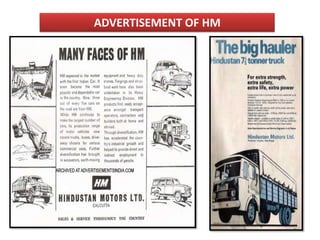
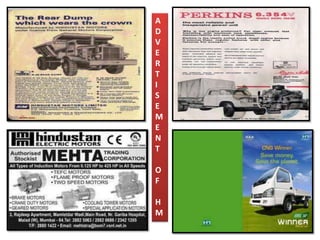
ADVERTISEMENT OF HM
A
D
V
E
R
T
I
S
E
M
E
N
T

O
F

H
M
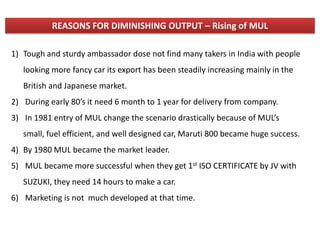
REASONS FOR DIMINISHING OUTPUT – Rising of MUL

1) Tough and sturdy ambassador dose not find many takers in India with people
   looking more fancy car its export has been steadily increasing mainly in the
   British and Japanese market.
2) During early 80’s it need 6 month to 1 year for delivery from company.
3) In 1981 entry of MUL change the scenario drastically because of MUL’s
   small, fuel efficient, and well designed car, Maruti 800 became huge success.
4) By 1980 MUL became the market leader.
5) MUL became more successful when they get 1st ISO CERTIFICATE by JV with
   SUZUKI, they need 14 hours to make a car.
6) Marketing is not much developed at that time.
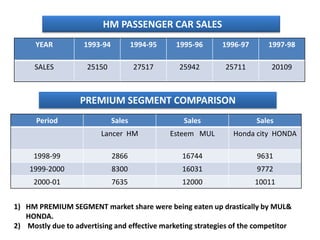
HM PASSENGER CAR SALES
      YEAR          1993-94           1994-95    1995-96     1996-97      1997-98

      SALES          25150            27517       25942      25711         20109


                   PREMIUM SEGMENT COMPARISON
      Period                  Sales                Sales               Sales
                         Lancer HM              Esteem MUL      Honda city HONDA

     1998-99                  2866                16744                9631
    1999-2000                 8300                16031                9772
     2000-01                  7635                12000                10011


1) HM PREMIUM SEGMENT market share were being eaten up drastically by MUL&
   HONDA.
2) Mostly due to advertising and effective marketing strategies of the competitor
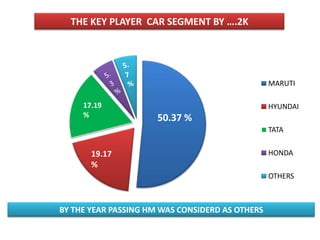
THE KEY PLAYER CAR SEGMENT BY ….2K


                                                    MARUTI

         17.19                                      HYUNDAI
17.19%   %               50.37 %
                                                    TATA


           19.17                                    HONDA
           %
                                                    OTHERS


   BY THE YEAR PASSING HM WAS CONSIDERD AS OTHERS
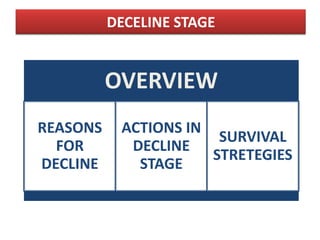
DECELINE STAGE


          OVERVIEW
REASONS    ACTIONS IN
                       SURVIVAL
  FOR       DECLINE
                      STRETEGIES
DECLINE      STAGE
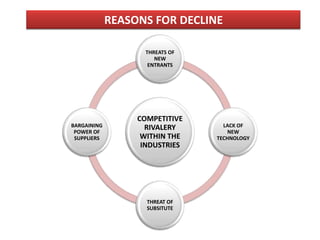
REASONS FOR DECLINE

                    THREATS OF
                       NEW
                     ENTRANTS


                  COMPETITIVE
BARGAINING          RIVALERY       LACK OF
 POWER OF                            NEW
 SUPPLIERS         WITHIN THE    TECHNOLOGY
                   INDUSTRIES


                    THREAT OF
                    SUBSITUTE
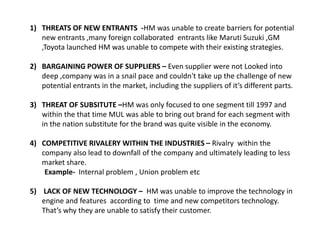
1) THREATS OF NEW ENTRANTS -HM was unable to create barriers for potential
   new entrants ,many foreign collaborated entrants like Maruti Suzuki ,GM
   ,Toyota launched HM was unable to compete with their existing strategies.

2) BARGAINING POWER OF SUPPLIERS – Even supplier were not Looked into
   deep ,company was in a snail pace and couldn't take up the challenge of new
   potential entrants in the market, including the suppliers of it’s different parts.

3) THREAT OF SUBSITUTE –HM was only focused to one segment till 1997 and
   within the that time MUL was able to bring out brand for each segment with
   in the nation substitute for the brand was quite visible in the economy.

4) COMPETITIVE RIVALERY WITHIN THE INDUSTRIES – Rivalry within the
   company also lead to downfall of the company and ultimately leading to less
   market share.
    Example- Internal problem , Union problem etc

5) LACK OF NEW TECHNOLOGY – HM was unable to improve the technology in
   engine and features according to time and new competitors technology.
   That’s why they are unable to satisfy their customer.
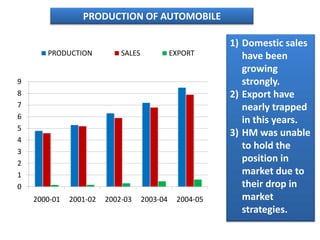
PRODUCTION OF AUTOMOBILE

                                                         1) Domestic sales
       PRODUCTION           SALES             EXPORT        have been
                                                            growing
9                                                           strongly.
8                                                        2) Export have
7                                                           nearly trapped
6
                                                            in this years.
5
                                                         3) HM was unable
4
                                                            to hold the
3
2
                                                            position in
1                                                           market due to
0                                                           their drop in
    2000-01   2001-02   2002-03     2003-04    2004-05      market
                                                            strategies.
HM didn’t
now
where
they fit in
the
existing
economy.
ACTION IN DECLINE STAGE

1) HM decide to tap new segments ease the
   competitive pressure from other giants.
2) HM collaborated with OKA MOTORS CO. to develop
   targeting at rural market.
3) HM launched trekker in 1995 in 3 northern states
   (state on hills).
4) In 1999 HM launched the re-designed trekker and
   upgraded version of amby.
5) Cost cutting measure – company also do some cost
   cutting exercise and announce a voluntary retirement
   scheme. For workers in April 1998. and offer (0.01)
   million rupees
6) HM sold the earthmoving equipment company to
   caterpillar company in 2001.
SURVIVAL STRATGIES
1) HM decide to look beyond its existing portfolio and company explored the global
   auto component business in 2000 and start a plant in indore to assemble engines &
   gear boxes.

2) By this time many foreign companies entered into the market and establish tie-
   ups/ JV with various companies.

3) HM start supplying components in both domestic and global market.

4) HM executive director (SARKAR NARAYAN) said- we are open to such
   opportunities it brings in extra cash and its an expansive way to upgrade our skills
   by working with different customers.

5) HM overhauled the distribution system in order to become more market friendly –
            Green – rural market - trekker
            Blue – semi urban - contessa
            Red – metro – lancer(selling and services)
PRODUCT LIFE CYCLE –GRAPH


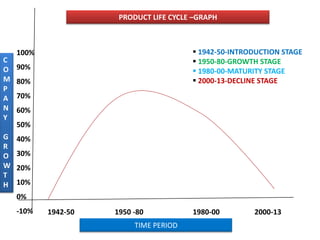
    100%                                 1942-50-INTRODUCTION STAGE
C                                        1950-80-GROWTH STAGE
O   90%
                                         1980-00-MATURITY STAGE
M   80%                                  2000-13-DECLINE STAGE
P
A   70%
N   60%
Y
    50%
G   40%
R
O   30%
W   20%
T
H   10%
    0%
    -10%   1942-50   1950 -80           1980-00        2000-13
                          TIME PERIOD
BUT IT’S NOT THE END OF
         HM
THE KING IS COMING BACK
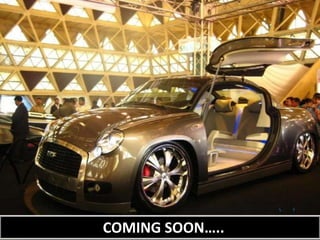
COMING SOON…..
THANK YOU


  REGARDS
       AAKASH SETHI

Aakash sethi

  • 1.
  • 2.
    PRESTIGE INSTITUTE OF MANAGEMENT & RESEARCH ASSINGMENT ON YEAR 2013-14 PRODUCT LIFE CYCLE GUIDED BY SUBMITED BY PROF. KHUSHBOO MAKWANA AAKASH SETHI
  • 3.
    APPROCHES TO KNOW INTRODUCTION DECLINE GROWTH MATURITY
  • 4.
  • 6.
    INTRODUCTION 1) IMPORTANT FACTS ABOUT COMPANY 2) STANDARD 3) PRODUCTS INTRODUCTIO OF THE N OF COMPANY COMPANY
  • 7.
    1) IMPORTAN FACTSABOUT THE COMPANY HINDUSTAN MOTORS LIMITED (HML) are India's first car makers, came into existence prior to the country’s independence AUGEST (1947).  B.M. BIRLA founded HML in 1942 and it went on to flagship company C.K. Birla group.  HML started their operations at port okha, Gujarat and then shifted to UTTARPARA ,WEST BANGAL IN 1948. Now this place is called Hind motor.  Hindustan motors was the face of Indian cars. The company was the largest car manufacturer in India before the rise of MARUTI UDYOG.  HML also have a successful venture with Mitsubishi science 1998, both the partner’s started off with the philosophy of “one country one price”  It is the producer of the Ambassador car, widely used as a taxicab and as a government limousine.
  • 8.
    STANDARD INTRODUCTION OFCOMPANY TYPE PUBLIC BSE(500500) INDUSTRY AUTOMOTIVE FOUNDED 1942 HEAD QUATER KOLKATA,W.B.,INDIA KEY PEOPLE UTTAM BOSE (MD) 2012 PRODUCTS AUTOMOTIVE PARTS AUTOMOBILE REVENUE 799 CRORE 2011 PARENT C K BIRLA GENREL MOTORS JOINT VENTURE 1967 ISUZU JOINT VENTURE 1980-1993 MITSUBISHI JOINT VENTURE 1998 PLANT- HINDMOTOR WEST BANGAL PLANT –PITHAMPUR MADHYA PRADESH PLANT -THIRUVALLUR TAMILNADU PLANT -HOSUR BANGLORE
  • 9.
    PRODUCTS OF THECOMPANY General Motors Joint Venture Bad ford trucks, opel astra . Earthmoving Equipment Division (HMEED) All kind of equipment division Hindustan Tractors All type of tractors but company sold to Mahindra in 2001. Isuzu Joint Venture Isuzu F series trucks, contessa . Mitsubishi Lancer Evolution X , Lancer , Cedia , Mitsubishi Joint Venture Pajero , Montero ,Outlander. Hindustan Models Hindustan Ambassador, winner, mascott truck, RTV ranger truck(OKA motor co. Australia)
  • 10.
    Models of HindustanMotors Hindustan 10 - based on 1947 Morris 10 Hindustan 14 based on 1948 Morris Oxford MO Series Hindustan Landmaster- based on Morris oxford Series II – 1954 Hindustan ambassador Mark I, II, Station Wagon, III, IV, Nova - based on the British Morris Oxford Series III – 1956 Hindustan contessa - based on the British victor Vauxhall with Isuzu diesel or petrol engines. Hindustan Pushpak , Trekker and Porter – Multiutility Vehicles based on Ambassador chassis and engines (Half Ton Driveway Chassis).
  • 11.
    GENREL MOTORS JOINTVENTURE MODELS BAD FORD TRUCK OPEL ASTRA
  • 12.
    EARTH MOVING EQUIPMENTDIVISON – ALL TYPES
  • 13.
  • 14.
    ISUZU JOINT VENTURE ISUZUF SERISE TRUCK CONTESSA
  • 15.
    MITSUBISHI JOINT VENTURE LANCER- 7 OUTLANDER CEDIA - 9 PAJERO
  • 16.
  • 17.
    THE KING OFINDIAN ROADS
  • 18.
  • 19.
    HINDUSTAN- 10 HINDUSTAN -14 HINDUSTAN WINNER HINDUSTAN BADFORD HINDUSTAN PUSHPAK HINDUSTAN PORTER
  • 20.
    HINDUSTAN RTV RANGER HINDUSTAN LANDMASTER HINDUSTAN- VEER
  • 21.
    GROWTH PROGRESS EXPANSION COMPETITORS
  • 22.
    COMPETITORS THERE ARE SOMEMAJOR REASONS FOR THE GROWTH OF THE COMPANY-  Manufacturing is licensed – this period of time is called LICENSE RAAJ(till 1993).  High custom duty on export of any vehicle .  High excise duty with sales tax. There are only 3 players in the automobile industries HINDUSTAN MOTORS , PRIMIER AUTOMOBILE , PADMINI AUTOMOBILE.  Only Hindustan motors and premier motors are two major player in the market.
  • 23.
    EXPANSION Mile stones ofHindustan motors- 1) In 1942, Hindustan Motors Limited was established by B. M. Birla on February 11. (Gujarat) 2) In 1945, company issued 45,75,000 shares in the market. 3) In 1948, all production operations of this company were shifted to Uttarpara, West Bengal and the Ambassador was the first model which was produced in this plant. 4) In 1954, production of the Landmaster began and this vehicle was based on the Morris Oxford. 5) In 1959, HM and Caterpillar Tractor Company, USA joined hands for the production and sale of bulldozers and scrapers. 6) In 1967, Hindustan Motors was collaborating with the General Motors Corporation, USA, for manufacturing earthmoving equipment at its assembly plant, Trivellore. 7) In 1978, diesel engine version of Ambassador Model became available in vehicle market.
  • 24.
    8) In late1980s, Hindustan Motors began a joint venture with Isuzu . Till the end of this year, this brand was the leader in car sales. 9) In 1983, the government accepted the proposal of HM to increase the manufacturing capacity of passenger car models to 50,000 units per annum out of which 20,000 models were to be manufactured in Madhya Pradesh. 10) In 1984, Hindustan Motors launched its new Contessa model. 11) In 1985 company established a plant in hosur, tamil nadu for manufacturing heavy duty transmission. 12) In 1997, Hindustan Motors tied up with Mitsubishi Motors for production of 20,000 Lancer passenger MMC sedan cars. 13) After a Memorandum of understanding(MOU), PNB would offer attractive and easy finance schemes for at least three years.
  • 25.
    PROGRESS THERE ARE SOMEFACTORS WHICH MADE HM PROGRESSIVE ARE FOLLOWING -: 1) Parent company of C.K. BIRLA give it a high jump in the market. 2) During the license raj company get a lot of profit in the market. 3) Holding in the market is more then 70 percent till 1980 because of low competition. 4) Best quality and low custom duty and British model design attract people. 5) In 1983 government accepted the proposal to increase the sales of HM 20000 to 50000. 6) Joint ventures with different companies improve the quality and variety of its product. 7) It became the face of Indian automobile industries, people used to buy this product mostly. 8) Working in almost all segment improves the sells of HM.
  • 26.
    MATURITY BRAND IMAGE 1) It’s a one million turnover major company manufacturing passenger cars, utility vehicle ,earthmoving equipment. 2) Ambassador- the first car to be manufacture in India has been ruling the Indian roads and only automobile to ply Indian roads for more then 6 decades. 3) According to the perception of the people its truly indainised car because of its time tasted and practical characteristics . 4) Hindustan ambassador has a vast service network the whole market of HM is attendant by 115 strong dealer, 50 service and parts dealer, 60 exclusive parts dealer, regional office.
  • 27.
    CONTINUE…… 1) All carsare manufactured according to EURO-1EMISSION GOV. norms. 2) The biggest USP of ambassador is its sturdy & tough model. 3) Ambassador most popular for its taxi segment , 65 % of the sales of ambassador is just because of this segment, for its safety, comfort ,and best structure for Indian roads . 4) BHARAT RATAN awarded our president A.P.J. Abdul kalam used to travel by old ambassador car for its simplicity ,also without VIP cap . 5) There is no government order to buy this car but all politician , senior , top civil servant, judges and generals used to buying it as a prestige to own it.
  • 28.
  • 29.
  • 30.
    REASONS FOR DIMINISHINGOUTPUT – Rising of MUL 1) Tough and sturdy ambassador dose not find many takers in India with people looking more fancy car its export has been steadily increasing mainly in the British and Japanese market. 2) During early 80’s it need 6 month to 1 year for delivery from company. 3) In 1981 entry of MUL change the scenario drastically because of MUL’s small, fuel efficient, and well designed car, Maruti 800 became huge success. 4) By 1980 MUL became the market leader. 5) MUL became more successful when they get 1st ISO CERTIFICATE by JV with SUZUKI, they need 14 hours to make a car. 6) Marketing is not much developed at that time.
  • 31.
    HM PASSENGER CARSALES YEAR 1993-94 1994-95 1995-96 1996-97 1997-98 SALES 25150 27517 25942 25711 20109 PREMIUM SEGMENT COMPARISON Period Sales Sales Sales Lancer HM Esteem MUL Honda city HONDA 1998-99 2866 16744 9631 1999-2000 8300 16031 9772 2000-01 7635 12000 10011 1) HM PREMIUM SEGMENT market share were being eaten up drastically by MUL& HONDA. 2) Mostly due to advertising and effective marketing strategies of the competitor
  • 32.
    THE KEY PLAYERCAR SEGMENT BY ….2K MARUTI 17.19 HYUNDAI 17.19% % 50.37 % TATA 19.17 HONDA % OTHERS BY THE YEAR PASSING HM WAS CONSIDERD AS OTHERS
  • 33.
    DECELINE STAGE OVERVIEW REASONS ACTIONS IN SURVIVAL FOR DECLINE STRETEGIES DECLINE STAGE
  • 34.
    REASONS FOR DECLINE THREATS OF NEW ENTRANTS COMPETITIVE BARGAINING RIVALERY LACK OF POWER OF NEW SUPPLIERS WITHIN THE TECHNOLOGY INDUSTRIES THREAT OF SUBSITUTE
  • 35.
    1) THREATS OFNEW ENTRANTS -HM was unable to create barriers for potential new entrants ,many foreign collaborated entrants like Maruti Suzuki ,GM ,Toyota launched HM was unable to compete with their existing strategies. 2) BARGAINING POWER OF SUPPLIERS – Even supplier were not Looked into deep ,company was in a snail pace and couldn't take up the challenge of new potential entrants in the market, including the suppliers of it’s different parts. 3) THREAT OF SUBSITUTE –HM was only focused to one segment till 1997 and within the that time MUL was able to bring out brand for each segment with in the nation substitute for the brand was quite visible in the economy. 4) COMPETITIVE RIVALERY WITHIN THE INDUSTRIES – Rivalry within the company also lead to downfall of the company and ultimately leading to less market share. Example- Internal problem , Union problem etc 5) LACK OF NEW TECHNOLOGY – HM was unable to improve the technology in engine and features according to time and new competitors technology. That’s why they are unable to satisfy their customer.
  • 36.
    PRODUCTION OF AUTOMOBILE 1) Domestic sales PRODUCTION SALES EXPORT have been growing 9 strongly. 8 2) Export have 7 nearly trapped 6 in this years. 5 3) HM was unable 4 to hold the 3 2 position in 1 market due to 0 their drop in 2000-01 2001-02 2002-03 2003-04 2004-05 market strategies.
  • 37.
    HM didn’t now where they fitin the existing economy.
  • 38.
    ACTION IN DECLINESTAGE 1) HM decide to tap new segments ease the competitive pressure from other giants. 2) HM collaborated with OKA MOTORS CO. to develop targeting at rural market. 3) HM launched trekker in 1995 in 3 northern states (state on hills). 4) In 1999 HM launched the re-designed trekker and upgraded version of amby. 5) Cost cutting measure – company also do some cost cutting exercise and announce a voluntary retirement scheme. For workers in April 1998. and offer (0.01) million rupees 6) HM sold the earthmoving equipment company to caterpillar company in 2001.
  • 39.
    SURVIVAL STRATGIES 1) HMdecide to look beyond its existing portfolio and company explored the global auto component business in 2000 and start a plant in indore to assemble engines & gear boxes. 2) By this time many foreign companies entered into the market and establish tie- ups/ JV with various companies. 3) HM start supplying components in both domestic and global market. 4) HM executive director (SARKAR NARAYAN) said- we are open to such opportunities it brings in extra cash and its an expansive way to upgrade our skills by working with different customers. 5) HM overhauled the distribution system in order to become more market friendly – Green – rural market - trekker Blue – semi urban - contessa Red – metro – lancer(selling and services)
  • 40.
    PRODUCT LIFE CYCLE–GRAPH 100%  1942-50-INTRODUCTION STAGE C  1950-80-GROWTH STAGE O 90%  1980-00-MATURITY STAGE M 80%  2000-13-DECLINE STAGE P A 70% N 60% Y 50% G 40% R O 30% W 20% T H 10% 0% -10% 1942-50 1950 -80 1980-00 2000-13 TIME PERIOD
  • 41.
    BUT IT’S NOTTHE END OF HM
  • 42.
    THE KING ISCOMING BACK
  • 43.
  • 44.
    THANK YOU REGARDS AAKASH SETHI