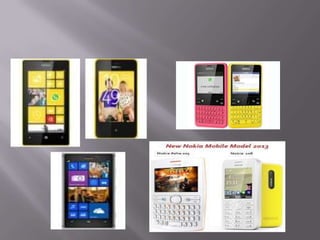
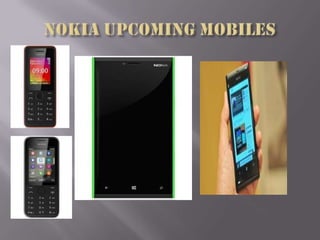
IN INDIA
Name Roll No
ANSHU TIWARI 2012098
SHOAIB SAYYED 2012080
SHOAIB SHAIKH 2012078
RUPESH SHARMA 2012081
This Idea of ‘Connecting People’ by Nokia
provides Service to people with the help of the
Products”
 Nokia owns a company named Nokia Solutions and Networks, which provides
telecommunications network equipment and services.
 Nokia was the world's largest vendor of mobile phones from 1998 to 2012.
 However, over the past five years its market share declined as a result of the
growing use of touch screen smart phones from other vendors—principally
the iPhone, by Apple, and devices running on Android, an operating system
created by Google—in which Nokia did not take enough advantage of.
 As a result, the corporation's share price fell from a high of US$40 in late 2007 to
under US$2 in mid-2012.
 As of 2012, Nokia employs 101,982 people across 120 countries, conducts sales
in more than 150 countries, and reports annual revenues of around €30 billion.
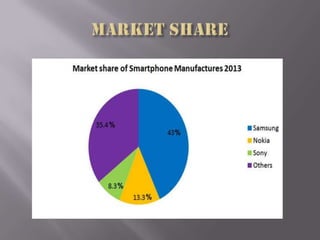
 By 2012, it was the world's second-largest mobile phone maker in terms of unit
sales (after Samsung), with a global market share of 18.0% in the fourth quarter
of that year.
 Nokia is a public limited-liability company listed on the Helsinki Stock
Exchange and New York Stock Exchange.
 It is the world's 274th-largest company measured by 2013 revenues according to
the Fortune Global 500.
• Nokia Corporation (NYSE: NOK) is one of the world's largest
telecommunications equipment manufacturers.
• Headquarters in Keilaniemi of Espoo, Finland .
• Nokia provides mobile communication equipment for every major market
and protocol, including GSM, CDMA.
• Nokia was established in 1865. The name Nokia originated from the river
which flowed through the town of the same name (Nokia).
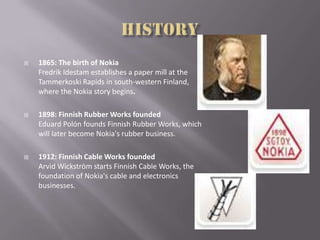
 1865: The birth of Nokia
Fredrik Idestam establishes a paper mill at the
Tammerkoski Rapids in south-western Finland,
where the Nokia story begins.
 1898: Finnish Rubber Works founded
Eduard Polón founds Finnish Rubber Works, which
will later become Nokia's rubber business.
 1912: Finnish Cable Works founded
Arvid Wickström starts Finnish Cable Works, the
foundation of Nokia's cable and electronics
businesses.
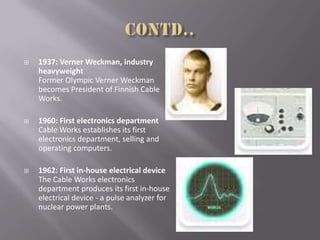
 1937: Verner Weckman, industry
heavyweight
Former Olympic Verner Weckman
becomes President of Finnish Cable
Works.
 1960: First electronics department
Cable Works establishes its first
electronics department, selling and
operating computers.
 1962: First in-house electrical device
The Cable Works electronics
department produces its first in-house
electrical device - a pulse analyzer for
nuclear power plants.
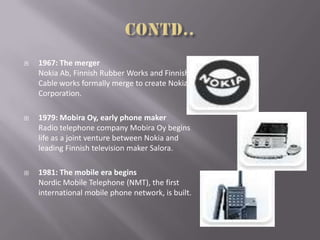
 1967: The merger
Nokia Ab, Finnish Rubber Works and Finnish
Cable works formally merge to create Nokia
Corporation.
 1979: Mobira Oy, early phone maker
Radio telephone company Mobira Oy begins
life as a joint venture between Nokia and
leading Finnish television maker Salora.
 1981: The mobile era begins
Nordic Mobile Telephone (NMT), the first
international mobile phone network, is built.
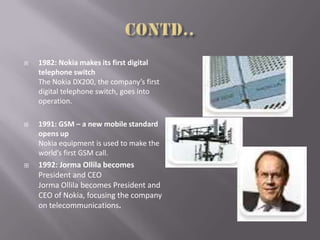
 1982: Nokia makes its first digital
telephone switch
The Nokia DX200, the company’s first
digital telephone switch, goes into
operation.
 1991: GSM – a new mobile standard
opens up
Nokia equipment is used to make the
world’s first GSM call.
 1992: Jorma Ollila becomes
President and CEO
Jorma Ollila becomes President and
CEO of Nokia, focusing the company
on telecommunications.
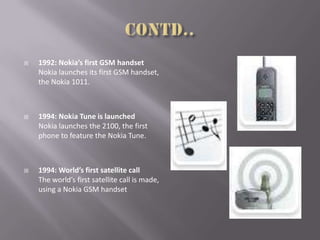
 1992: Nokia’s first GSM handset
Nokia launches its first GSM handset,
the Nokia 1011.
 1994: Nokia Tune is launched
Nokia launches the 2100, the first
phone to feature the Nokia Tune.
 1994: World’s first satellite call
The world’s first satellite call is made,
using a Nokia GSM handset
 1997: Snake – a classic mobile game
The Nokia 6110 is the first phone to feature
Nokia’s Snake game.
 1998: Nokia leads the world
Nokia becomes the world leader in mobile
phones.
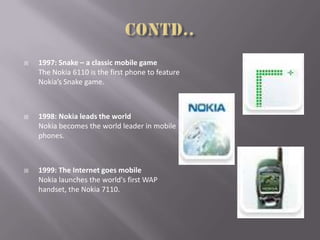
 1999: The Internet goes mobile
Nokia launches the world's first WAP
handset, the Nokia 7110.
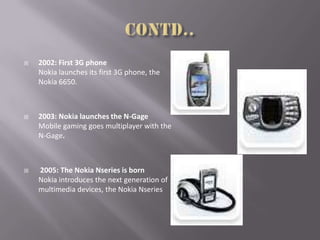
 2002: First 3G phone
Nokia launches its first 3G phone, the
Nokia 6650.
 2003: Nokia launches the N-Gage
Mobile gaming goes multiplayer with the
N-Gage.
 2005: The Nokia Nseries is born
Nokia introduces the next generation of
multimedia devices, the Nokia Nseries
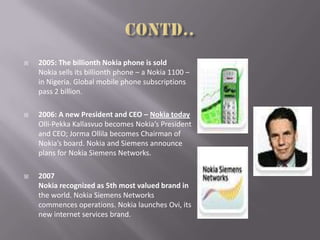
 2005: The billionth Nokia phone is sold
Nokia sells its billionth phone – a Nokia 1100 –
in Nigeria. Global mobile phone subscriptions
pass 2 billion.
 2006: A new President and CEO – Nokia today
Olli-Pekka Kallasvuo becomes Nokia’s President
and CEO; Jorma Ollila becomes Chairman of
Nokia’s board. Nokia and Siemens announce
plans for Nokia Siemens Networks.
 2007
Nokia recognized as 5th most valued brand in
the world. Nokia Siemens Networks
commences operations. Nokia launches Ovi, its
new internet services brand.
 2008
Nokia's three mobile device business
groups and the supporting horizontal
groups are replaced by an integrated
business segment, Devices &
Services.
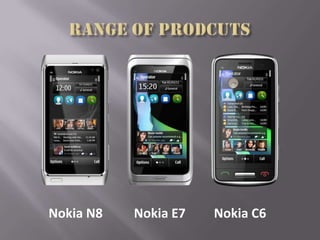
Nokia E7Nokia N8 Nokia C6
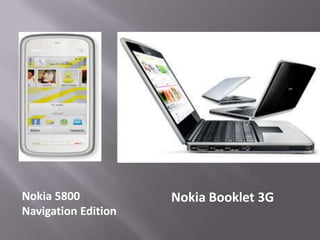
Nokia 5800
Navigation Edition
Nokia Booklet 3G
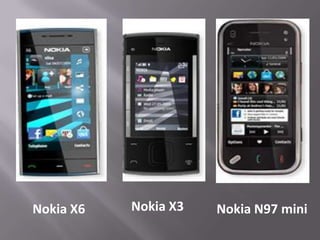
Nokia X6 Nokia X3 Nokia N97 mini
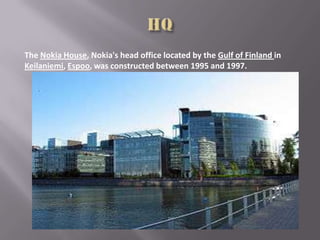
The Nokia House, Nokia's head office located by the Gulf of Finland in
Keilaniemi, Espoo, was constructed between 1995 and 1997.
 Nokia India Pvt. Ltd. designs, manufactures, and markets mobile phones and
communication network devices. It offers mobile phones and devices based on
the GSM/EDGE, 3G/CDMA, and CDMA cellular standards under the Nokia brand.
 In addition, it offers services and software through mobile devices in the areas
of advertising, business, entertainment, navigation, and social communities.
Further, the company provides wireless and fixed network infrastructure,
communications, and networks service platforms.
 In July 2011, Nokia was recognized as the best place to work in Central America
and the Caribbean for its great culture and work environment. It was also
selected for Economic Times Most Trusted Brand in India in 2010, at the number
one position.
 It is a fast paced organization with a competitive work environment. It
appreciates novel suggestions from its people. It is multicultural and believes in
just treatment for its employees
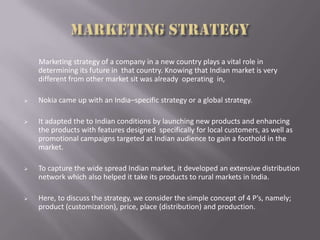
Marketing strategy of a company in a new country plays a vital role in
determining its future in that country. Knowing that Indian market is very
different from other market sit was already operating in,
 Nokia came up with an India–specific strategy or a global strategy.
 It adapted the to Indian conditions by launching new products and enhancing
the products with features designed specifically for local customers, as well as
promotional campaigns targeted at Indian audience to gain a foothold in the
market.
 To capture the wide spread Indian market, it developed an extensive distribution
network which also helped it take its products to rural markets in India.
 Here, to discuss the strategy, we consider the simple concept of 4 P’s, namely;
product (customization), price, place (distribution) and production.
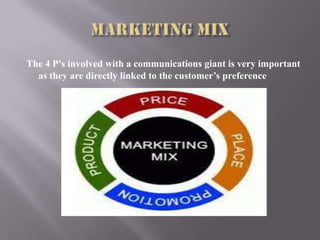
The 4 P’s involved with a communications giant is very important
as they are directly linked to the customer’s preference
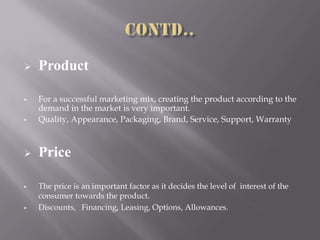
 Product
 For a successful marketing mix, creating the product according to the
demand in the market is very important.
 Quality, Appearance, Packaging, Brand, Service, Support, Warranty
 Price
 The price is an important factor as it decides the level of interest of the
consumer towards the product.
 Discounts, Financing, Leasing, Options, Allowances.
 Place
 The place of distribution is very important as it should be
convenient for the consumer to access it and should be available at
various locations.
 Logistics, Channel Members, Channel Motivation, Market
Coverage, Service Levels, Internet, Accessibility.
 Promotion
 Nokia performs both above the line and below the line forms of
advertising.
 Front Line Service, Public Relations, Message, Sales, Media etc.
 I Phone-Apple
 Samsung
 Micro Max
 Karbon
 Htc
 Mobile phone maker Nokia is down, but not out. The company’s India division
claims it is leaving no stone unturned in trying to reclaim its top spot in the
growing Indian mobile phone market.
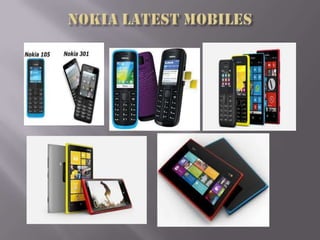
 Speaking on the sidelines of the launch of new phones in Nokia’s Lumia series,
Viral Oza, director-marketing, Nokia India, told The Hindu about the company’s
strategies, its USP and its most ambitious offering in its smart phone Lumia
series – the Lumia 920.
 HELSINKI — Nokia shares surged on Monday after it announced plans to buy out
Siemens AG’s share of their network equipment joint venture, betting on the
technology to run 4G networks as it struggles in the smartphones business.
 Loss-making Nokia gains full control of the profitable venture
Nokia Siemens Networks (NSN) for US$2.2 billion, a cheaper
than-expected price, analysts said, though they also noted the
acquisition would put pressure on Nokia’s balance sheet.
 Nokia Corporation Stock Exchange Release July 1,
2013.
 Espoo, Finland and Munich, Germany - Nokia
Corporation and Siemens AG today announced that
they have entered into a definitive agreement pursuant
to which Nokia acquires Siemens' entire 50% stake in
their joint venture, Nokia Siemens
 Nokia has is to make sustained growth. For this, we have been
executing on three pillars: future disruption, connecting the
next billion. Innovation gives us the competitive edge,”.
 The acquisition has been approved by the Board of Directors of
Nokia as well as the Managing and Supervisory Boards of Siemens,
and is subject to the customary regulatory approval process.
 The purchase price for Siemens' stake is EUR 1.7 billion and the
transaction is expected to close during the third calendar quarter of
2013. Upon closing of the planned acquisition, Nokia Siemens
Networks will become a wholly owned subsidiary of Nokia.
 Nokia is pleased with these developments and looks forward to
continue supporting these efforts to create more shareholder value
for the Nokia group.“
 SUGGESTIONS AND RECOMMENDATIONS
PRESENTED TO
Prof.VIVEK
Presentation on nokia overall started

Presentation on nokia overall started

  • 1.
  • 2.
    Name Roll No ANSHUTIWARI 2012098 SHOAIB SAYYED 2012080 SHOAIB SHAIKH 2012078 RUPESH SHARMA 2012081 This Idea of ‘Connecting People’ by Nokia provides Service to people with the help of the Products”
  • 3.
     Nokia ownsa company named Nokia Solutions and Networks, which provides telecommunications network equipment and services.  Nokia was the world's largest vendor of mobile phones from 1998 to 2012.  However, over the past five years its market share declined as a result of the growing use of touch screen smart phones from other vendors—principally the iPhone, by Apple, and devices running on Android, an operating system created by Google—in which Nokia did not take enough advantage of.  As a result, the corporation's share price fell from a high of US$40 in late 2007 to under US$2 in mid-2012.
  • 4.
     As of2012, Nokia employs 101,982 people across 120 countries, conducts sales in more than 150 countries, and reports annual revenues of around €30 billion.  By 2012, it was the world's second-largest mobile phone maker in terms of unit sales (after Samsung), with a global market share of 18.0% in the fourth quarter of that year.  Nokia is a public limited-liability company listed on the Helsinki Stock Exchange and New York Stock Exchange.  It is the world's 274th-largest company measured by 2013 revenues according to the Fortune Global 500.
  • 5.
    • Nokia Corporation(NYSE: NOK) is one of the world's largest telecommunications equipment manufacturers. • Headquarters in Keilaniemi of Espoo, Finland . • Nokia provides mobile communication equipment for every major market and protocol, including GSM, CDMA. • Nokia was established in 1865. The name Nokia originated from the river which flowed through the town of the same name (Nokia).
  • 6.
     1865: Thebirth of Nokia Fredrik Idestam establishes a paper mill at the Tammerkoski Rapids in south-western Finland, where the Nokia story begins.  1898: Finnish Rubber Works founded Eduard Polón founds Finnish Rubber Works, which will later become Nokia's rubber business.  1912: Finnish Cable Works founded Arvid Wickström starts Finnish Cable Works, the foundation of Nokia's cable and electronics businesses.
  • 7.
     1937: VernerWeckman, industry heavyweight Former Olympic Verner Weckman becomes President of Finnish Cable Works.  1960: First electronics department Cable Works establishes its first electronics department, selling and operating computers.  1962: First in-house electrical device The Cable Works electronics department produces its first in-house electrical device - a pulse analyzer for nuclear power plants.
  • 8.
     1967: Themerger Nokia Ab, Finnish Rubber Works and Finnish Cable works formally merge to create Nokia Corporation.  1979: Mobira Oy, early phone maker Radio telephone company Mobira Oy begins life as a joint venture between Nokia and leading Finnish television maker Salora.  1981: The mobile era begins Nordic Mobile Telephone (NMT), the first international mobile phone network, is built.
  • 9.
     1982: Nokiamakes its first digital telephone switch The Nokia DX200, the company’s first digital telephone switch, goes into operation.  1991: GSM – a new mobile standard opens up Nokia equipment is used to make the world’s first GSM call.  1992: Jorma Ollila becomes President and CEO Jorma Ollila becomes President and CEO of Nokia, focusing the company on telecommunications.
  • 10.
     1992: Nokia’sfirst GSM handset Nokia launches its first GSM handset, the Nokia 1011.  1994: Nokia Tune is launched Nokia launches the 2100, the first phone to feature the Nokia Tune.  1994: World’s first satellite call The world’s first satellite call is made, using a Nokia GSM handset
  • 11.
     1997: Snake– a classic mobile game The Nokia 6110 is the first phone to feature Nokia’s Snake game.  1998: Nokia leads the world Nokia becomes the world leader in mobile phones.  1999: The Internet goes mobile Nokia launches the world's first WAP handset, the Nokia 7110.
  • 12.
     2002: First3G phone Nokia launches its first 3G phone, the Nokia 6650.  2003: Nokia launches the N-Gage Mobile gaming goes multiplayer with the N-Gage.  2005: The Nokia Nseries is born Nokia introduces the next generation of multimedia devices, the Nokia Nseries
  • 13.
     2005: Thebillionth Nokia phone is sold Nokia sells its billionth phone – a Nokia 1100 – in Nigeria. Global mobile phone subscriptions pass 2 billion.  2006: A new President and CEO – Nokia today Olli-Pekka Kallasvuo becomes Nokia’s President and CEO; Jorma Ollila becomes Chairman of Nokia’s board. Nokia and Siemens announce plans for Nokia Siemens Networks.  2007 Nokia recognized as 5th most valued brand in the world. Nokia Siemens Networks commences operations. Nokia launches Ovi, its new internet services brand.
  • 14.
     2008 Nokia's threemobile device business groups and the supporting horizontal groups are replaced by an integrated business segment, Devices & Services.
  • 15.
  • 16.
  • 17.
    Nokia X6 NokiaX3 Nokia N97 mini
  • 18.
    The Nokia House,Nokia's head office located by the Gulf of Finland in Keilaniemi, Espoo, was constructed between 1995 and 1997.
  • 19.
     Nokia IndiaPvt. Ltd. designs, manufactures, and markets mobile phones and communication network devices. It offers mobile phones and devices based on the GSM/EDGE, 3G/CDMA, and CDMA cellular standards under the Nokia brand.  In addition, it offers services and software through mobile devices in the areas of advertising, business, entertainment, navigation, and social communities. Further, the company provides wireless and fixed network infrastructure, communications, and networks service platforms.  In July 2011, Nokia was recognized as the best place to work in Central America and the Caribbean for its great culture and work environment. It was also selected for Economic Times Most Trusted Brand in India in 2010, at the number one position.  It is a fast paced organization with a competitive work environment. It appreciates novel suggestions from its people. It is multicultural and believes in just treatment for its employees
  • 21.
    Marketing strategy ofa company in a new country plays a vital role in determining its future in that country. Knowing that Indian market is very different from other market sit was already operating in,  Nokia came up with an India–specific strategy or a global strategy.  It adapted the to Indian conditions by launching new products and enhancing the products with features designed specifically for local customers, as well as promotional campaigns targeted at Indian audience to gain a foothold in the market.  To capture the wide spread Indian market, it developed an extensive distribution network which also helped it take its products to rural markets in India.  Here, to discuss the strategy, we consider the simple concept of 4 P’s, namely; product (customization), price, place (distribution) and production.
  • 22.
    The 4 P’sinvolved with a communications giant is very important as they are directly linked to the customer’s preference
  • 23.
     Product  Fora successful marketing mix, creating the product according to the demand in the market is very important.  Quality, Appearance, Packaging, Brand, Service, Support, Warranty  Price  The price is an important factor as it decides the level of interest of the consumer towards the product.  Discounts, Financing, Leasing, Options, Allowances.
  • 24.
     Place  Theplace of distribution is very important as it should be convenient for the consumer to access it and should be available at various locations.  Logistics, Channel Members, Channel Motivation, Market Coverage, Service Levels, Internet, Accessibility.  Promotion  Nokia performs both above the line and below the line forms of advertising.  Front Line Service, Public Relations, Message, Sales, Media etc.
  • 25.
     I Phone-Apple Samsung  Micro Max  Karbon  Htc
  • 30.
     Mobile phonemaker Nokia is down, but not out. The company’s India division claims it is leaving no stone unturned in trying to reclaim its top spot in the growing Indian mobile phone market.  Speaking on the sidelines of the launch of new phones in Nokia’s Lumia series, Viral Oza, director-marketing, Nokia India, told The Hindu about the company’s strategies, its USP and its most ambitious offering in its smart phone Lumia series – the Lumia 920.  HELSINKI — Nokia shares surged on Monday after it announced plans to buy out Siemens AG’s share of their network equipment joint venture, betting on the technology to run 4G networks as it struggles in the smartphones business.
  • 31.
     Loss-making Nokiagains full control of the profitable venture Nokia Siemens Networks (NSN) for US$2.2 billion, a cheaper than-expected price, analysts said, though they also noted the acquisition would put pressure on Nokia’s balance sheet.  Nokia Corporation Stock Exchange Release July 1, 2013.  Espoo, Finland and Munich, Germany - Nokia Corporation and Siemens AG today announced that they have entered into a definitive agreement pursuant to which Nokia acquires Siemens' entire 50% stake in their joint venture, Nokia Siemens  Nokia has is to make sustained growth. For this, we have been executing on three pillars: future disruption, connecting the next billion. Innovation gives us the competitive edge,”.
  • 32.
     The acquisitionhas been approved by the Board of Directors of Nokia as well as the Managing and Supervisory Boards of Siemens, and is subject to the customary regulatory approval process.  The purchase price for Siemens' stake is EUR 1.7 billion and the transaction is expected to close during the third calendar quarter of 2013. Upon closing of the planned acquisition, Nokia Siemens Networks will become a wholly owned subsidiary of Nokia.  Nokia is pleased with these developments and looks forward to continue supporting these efforts to create more shareholder value for the Nokia group.“
  • 33.
     SUGGESTIONS ANDRECOMMENDATIONS PRESENTED TO Prof.VIVEK