Dr. Rafiq Zakaria Campus

      Millennium Institute
       of Management
      Presentation on


       Presented By:
 Quazi Ghous Mohiuddin
MBA Ist Year     Roll No. 29
         Guide By:
   Dr. Anwar Akhtar
Introduction About Company
   Bajaj Auto is a major Indian vehicle manufacturer
   started by Jamnalal Bajaj from Rajasthan in the
   1930s.

   Bajaj Auto came into existence on 29 November
   1945 as M/s Bachraj Trading Corporation Private
   Limited.

   Bajaj Auto makes and exports automobiles,
   Scooters, motorcycles and the auto rickshaw.

   The company is headed by Rahul Bajaj who is worth
   more than US$1.5 billion
About Industry

  In 1953, the government of India and the Indian
  private sector initiated manufacturing processes to
  help develop the automobile industry.


  In 2009, the automobile industry is expected to
  see a growth rate of around 9%


  The automobile industry in India happens to be
  the ninth largest in the world.
Market Segmentation

      Category Wise Market Share
       Passenger        Commercial
     Vehicle 15.96%    Vehicle 3.95%

                                       Three-wheeler
                                           3.60%


        Two-wheeler
          76.49%
History

  The Bajaj Group was formed in the first days of
  India's independence from Britain.


  Bajaj Auto had been formed on November 29, 1945
  as M/s Bachraj Trading Ltd. and obtained a
  manufacturing license from the government 11 years
  later. And in the next year 1960, Bajaj Auto became a
  public limited company.


  Rahul Bajaj became the group's chief executive
  officer in 1968.
Achievements

 The company has been vested with India’s lagest
 exporter of tow and three wheelers, 196710 units in
 2004-05 a great 26 percent jump over the previous
 year.

 Discover DTSi is one most successful bike of
 Bajaj Auto ltd. on Indian roads in 2004.


 Bjaj Auto Ltd. Sales have increased by approximately
 21 percent in the year 2004-05, which exeeds Rs.
 65.4 billion, a record in the history of the company.
Financial Highlights

particulars        2010-11    2009-10   2008-09


Cost of Sales      13199.29   9309.96   7605.78
(crore)
Operating Profit   3252.51    2303.29   1094.39
(crore)

Net Profit         4192.72    1700.11   654.50
(crore)

Equity Dividend    1157.47    578.73    318.30
Products

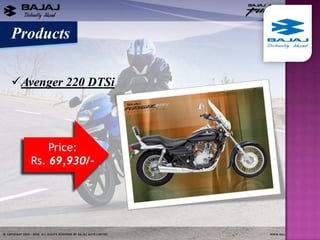
Avenger 220 DTSi


       Price:
   Rs. 69,930/-
Products


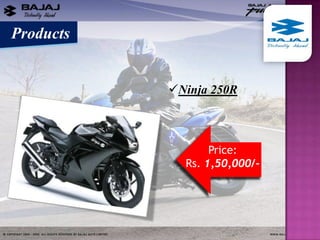
           Ninja 250R


                  Price:
             Rs. 1,50,000/-
Products


Bajaj Pulsar 220


      Price:
  Rs. 95,000/-
Products   Bajaj Pulsar 300
Product Life Cycle
Exports

  Bajaj Auto, Indian number two, two wheeler
  manufacturers are looking towards foreign shores to
  help increase their sales.


  the company sold 1.37 lakh three wheelers out of
  which 81000 were exported while 55000 were
  retailed in India.

  Bajaj Auto also sold 10.27 lakh motorbikes during
  July to September out of which 3.43 lakhs were
  exported while 6.85 lakhs were for Indian markets.
Organizational Structure

           Name                Designation
      Abraham Joseph    Chief Technology Officer
                         Vice President (Human
        Amrut Rath
                               Resources)
        C P Tripathi      Vice President (CSR)
       D J Balaji Rao            Director
         D S Mehta               Director
          Eric Vas      President (New Projects)
        J N Godrej               Director
                          Company Secretary &
         J Sridhar
                           Compliance Officer
         J Sridhar              Secretary
Management Team
SWOT Analysis
Strength:
  Highly experienced management.

  High export to domestic sales ratio.

  Great financial support network

  Product design and development capabilities.

  High performance products across all categories.
Weaknesses:

 Hasn't employed the excess cash for long.


 Still has no established brand to match Hero Honda's
 Splendor in the Market.


 Not a globally recognizable brand
Threats:

  The competition catches-up any new innovation
  in no time.

  Threat of cheap imported motorcycles from China.


  Margins getting squeezed from           both   the
  directions (Price as well as Cost)

  TATA Ace is a serious competition for the three-
  wheeler cargo segment.
Opportunities:

  Double-digit growth in two-wheeler market.


  Untapped market above 180 cc in motorcycles.

  More maturity and movement towards higher-
  end motorcycles.

  Growing world demand for entry-level motorcycles
Conclusion

 Bajaj Auto is a major Indian Automobile manufacturer.
 It is India’s Largest and the World’s 4th largest two and
 three wheeler maker.
  BAL is committed to prevention of pollution, continual
  improvement of environment performance and
  compliance with all environmental legislation and
  regulations.

  They always believe in providing the customer 'value
  for money' and keeps an special eye upon quality,
  safety, productivity, cost and delivery.
Suggestion

 The company needs to review its products line-up and
 launch new products to cater the changed demand.

  Bajaj need to adapt to the latest trends. The company
  needs to tap the export market more efficiently as there
  is a huge potential to make India as the world's two-
  wheelers production base.

  Bajaj needs to look for joint ventures abroad. It
  needs to target the young age group more effectively
Bibliography

 www.bajajauto.com


  www.google.com


  www.msn.com
Bajaj

Bajaj

  • 1.
    Dr. Rafiq ZakariaCampus Millennium Institute of Management Presentation on Presented By: Quazi Ghous Mohiuddin MBA Ist Year Roll No. 29 Guide By: Dr. Anwar Akhtar
  • 2.
    Introduction About Company Bajaj Auto is a major Indian vehicle manufacturer started by Jamnalal Bajaj from Rajasthan in the 1930s. Bajaj Auto came into existence on 29 November 1945 as M/s Bachraj Trading Corporation Private Limited. Bajaj Auto makes and exports automobiles, Scooters, motorcycles and the auto rickshaw. The company is headed by Rahul Bajaj who is worth more than US$1.5 billion
  • 3.
    About Industry In 1953, the government of India and the Indian private sector initiated manufacturing processes to help develop the automobile industry. In 2009, the automobile industry is expected to see a growth rate of around 9% The automobile industry in India happens to be the ninth largest in the world.
  • 4.
    Market Segmentation Category Wise Market Share Passenger Commercial Vehicle 15.96% Vehicle 3.95% Three-wheeler 3.60% Two-wheeler 76.49%
  • 5.
    History TheBajaj Group was formed in the first days of India's independence from Britain. Bajaj Auto had been formed on November 29, 1945 as M/s Bachraj Trading Ltd. and obtained a manufacturing license from the government 11 years later. And in the next year 1960, Bajaj Auto became a public limited company. Rahul Bajaj became the group's chief executive officer in 1968.
  • 6.
    Achievements The companyhas been vested with India’s lagest exporter of tow and three wheelers, 196710 units in 2004-05 a great 26 percent jump over the previous year. Discover DTSi is one most successful bike of Bajaj Auto ltd. on Indian roads in 2004. Bjaj Auto Ltd. Sales have increased by approximately 21 percent in the year 2004-05, which exeeds Rs. 65.4 billion, a record in the history of the company.
  • 7.
    Financial Highlights particulars 2010-11 2009-10 2008-09 Cost of Sales 13199.29 9309.96 7605.78 (crore) Operating Profit 3252.51 2303.29 1094.39 (crore) Net Profit 4192.72 1700.11 654.50 (crore) Equity Dividend 1157.47 578.73 318.30
  • 8.
    Products Avenger 220 DTSi Price: Rs. 69,930/-
  • 9.
    Products Ninja 250R Price: Rs. 1,50,000/-
  • 10.
    Products Bajaj Pulsar 220 Price: Rs. 95,000/-
  • 11.
    Products Bajaj Pulsar 300
  • 12.
  • 13.
    Exports BajajAuto, Indian number two, two wheeler manufacturers are looking towards foreign shores to help increase their sales. the company sold 1.37 lakh three wheelers out of which 81000 were exported while 55000 were retailed in India. Bajaj Auto also sold 10.27 lakh motorbikes during July to September out of which 3.43 lakhs were exported while 6.85 lakhs were for Indian markets.
  • 14.
    Organizational Structure Name Designation Abraham Joseph Chief Technology Officer Vice President (Human Amrut Rath Resources) C P Tripathi Vice President (CSR) D J Balaji Rao Director D S Mehta Director Eric Vas President (New Projects) J N Godrej Director Company Secretary & J Sridhar Compliance Officer J Sridhar Secretary
  • 15.
  • 16.
    SWOT Analysis Strength: Highly experienced management. High export to domestic sales ratio. Great financial support network Product design and development capabilities. High performance products across all categories.
  • 17.
    Weaknesses: Hasn't employedthe excess cash for long. Still has no established brand to match Hero Honda's Splendor in the Market. Not a globally recognizable brand
  • 18.
    Threats: Thecompetition catches-up any new innovation in no time. Threat of cheap imported motorcycles from China. Margins getting squeezed from both the directions (Price as well as Cost) TATA Ace is a serious competition for the three- wheeler cargo segment.
  • 19.
    Opportunities: Double-digitgrowth in two-wheeler market. Untapped market above 180 cc in motorcycles. More maturity and movement towards higher- end motorcycles. Growing world demand for entry-level motorcycles
  • 20.
    Conclusion Bajaj Autois a major Indian Automobile manufacturer. It is India’s Largest and the World’s 4th largest two and three wheeler maker. BAL is committed to prevention of pollution, continual improvement of environment performance and compliance with all environmental legislation and regulations. They always believe in providing the customer 'value for money' and keeps an special eye upon quality, safety, productivity, cost and delivery.
  • 21.
    Suggestion The companyneeds to review its products line-up and launch new products to cater the changed demand. Bajaj need to adapt to the latest trends. The company needs to tap the export market more efficiently as there is a huge potential to make India as the world's two- wheelers production base. Bajaj needs to look for joint ventures abroad. It needs to target the young age group more effectively
  • 22.
    Bibliography www.bajajauto.com www.google.com www.msn.com