BAJAJ AUTO LIMITED
OPERATIONAL ACTIVITIES
Contents
•
•
•
•
•
•

Introduction
Manufacturing model in 80s & 90s
Model in late 90s-early 2000s
Assembly line layout
Supply chain management
Different plant locations
Introduction to Bajaj Auto Limited
• Bajaj Auto Limited is an Indian motorized vehicleproducing company and a part of Bajaj Group
• Founded on 29 November 1945 as M/s Bachraj
Trading Corporation Private Limited
• Currently the company is headed by Rahul Bajaj
• It is based in Pune (Maharashtra), world’s thirdlargest manufacturer of motorcycles and secondlargest in India
• Bajaj Auto Limited, is an ISO-9001 company, having
ISO-9001 (2000) Quality Management certification.
Introduction to Bajaj Auto Limited (cont..)
• The vehicles are manufactured in three modern mass
production facilities in India with plants in Akurdi
and Chakan (near Pune), Waluj (near Aurangabad)
and Pantnagar in Uttaranchal and one in Indonesia.
• The combined manufacturing capacity is about 4
Million vehicles.
• The Product range covers motorcycles, un-geared
scooters and 3-wheelers.
Manufacturing model in 80s & 90s
• The key objectives - Economies of Scale and High
utilization of Investment
• Batch Flows with high Set-Up time on high cost
machines / equipment.
• Model specific dedicated assembly lines
• High raw material inventory in stores and high WIP
on shop-floors
• Narrow, specialized Labour skills. Quality through lot
inspection, high rejection rates.
Result of Manufacturing model in 80s & 90s
• High fixed cost, high cost of change and lower
flexibility.
• Large inventory with hidden quality issues.
• In-efficiencies hidden under huge demand and less
competition.
Model in late 90s-early 2000s
• Economic scenario developing through liberalization
• Strong competition.
• Higher customer aspirations – More models and
upgrades
• Move to Lean Manufacturing
• Bajaj Auto did The Project 110% that involved the reorganization and a fundamental re-design of the core
business processes.
Model in late 90s-early 2000s (cont..)
• Manufacturing approach was changed towards
• Lean Manufacturing (in lines of Toyota Production
System).
• TPM (Total Productivity Management), a Japanese
methodology
• SPC (Statistical process Control) in manufacturing
operation.
• Furthermore, they follow the JIT(Just in Time)
philosophy to reduce manufacturing costs, improve
quality, and reduce changeover times
Result of 90s Model
• Multi-model assembly lines, with off-the-line setups.
• Flexible machining centers - quick change modules &
tooling.
• Plant layout for single-piece & unidirectional flow.
• In-process quality assurance (inspection).
• Quality assurance through SPC & Poka-Yoke
• Direct-On-Line Supply based on Pull System (Kanban)
• No stores for in-coming material and WIP
• Multi-Skilled labour; self-supervision & self-certification
Result of 90s Model (cont..)
• Productivity - vehicles per employee - increase10 X.
• The component inventory – reduced 1 week’s to half shift’s
stock.
• The finished goods inventory - reduced 1 month to 3 days’
stock
• The quality improvements - improved 20000 PPM to <2000
PPM.
• Truck turn-around time - reduced 4 hours to ½ hour.
• Material un-loading rate / person – increased 150 to 350
loads per shift.
• Improved accuracy in invoice data - faster payment
processing.
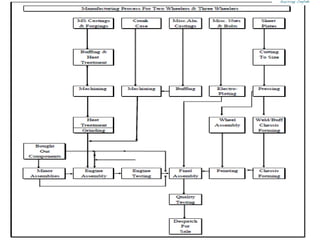
Assembly line layout
• Bajaj Auto Ltd. have modern and technologically advance
machines and state of the art assembly lines. These
machineries are arranged in operation department
systematically.
• The production process is step by step, the raw material
move from one line to another line systematically
• Assembly line technology is for facilities that produce a
narrow range of standardized products
Supply chain management
• Bajaj Auto Limited does not manufacture all the
parts
• Major portion are outsourced from various suppliers
• Whitney Framework for Make or Buy Decision
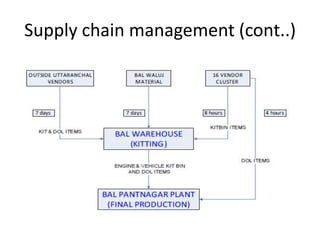
Supply chain management (cont..)
• Bajaj Auto successfully implemented SAP’s my SAP
Enterprise Portal simultaneously with the current
SAP R/3 ERP implementation.
• Bajaj has linked 165 out of a total of 200 suppliers
through this system.
• Helps in up-to-date information on purchase orders
and contracts, material schedules, and payment
details. This helps in streamlining the supply chain,
optimizing inventories and reducing non-valueadding activities at both ends
Supply chain management (cont..)
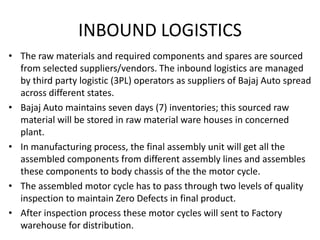
INBOUND LOGISTICS
• The raw materials and required components and spares are sourced
from selected suppliers/vendors. The inbound logistics are managed
by third party logistic (3PL) operators as suppliers of Bajaj Auto spread
across different states.
• Bajaj Auto maintains seven days (7) inventories; this sourced raw
material will be stored in raw material ware houses in concerned
plant.
• In manufacturing process, the final assembly unit will get all the
assembled components from different assembly lines and assembles
these components to body chassis of the the motor cycle.
• The assembled motor cycle has to pass through two levels of quality
inspection to maintain Zero Defects in final product.
• After inspection process these motor cycles will sent to Factory
warehouse for distribution.
OUTBOUND LOGISTICS
• The outbound logistic operations depend upon Bajaj
Auto market segments. Bajaj Auto market is segmented
by geographical wise. The geographical segmentation of
Bajaj can be divided into two broad categories.
1. National Level Markets
2. Global Level Markets
• The national and Global level segments are further
divided into sub-segments for smooth logistic and
physical distribution operations.
Akurdi, Pune Plant
• Manufacturing locations Akurdi, Pune This is one of
the oldest plant of bajaj auto ltd with production
capacity of 0.6 million vehicles/ year. The plant has
been closed in order to equip for four wheeler
production
Chakan , Pune Plant
• Chakan Industrial Area, Chakan , Pune This is the
biggest plant of bajaj auto Production Capacity of 1.2
million/ year . Product manufactured here are pulsar
and avenger and commercial Ge series
Waluj Aurangabad Plant
• Bajaj Nagar, Waluj Aurangabad This is second plant with
production capacity of 0.86 million/ year. Products
manufactured here are Kristal, XCD and platina and
commerial GC series
• Waluj is now the export hub of Bajaj Auto
• The basic raw materials are steel and aluminium. Surface
treatment processes like heat treatment, painting and
electroplating are carried out in the factory.
Pantnagar , Uttarakhand Plant
• Pantnagar , Uttarakhand The most advanced plant of
bajaj auto . It has Capacity of 0.9 million vehicles per
year , product manufactured here are platina and
XCD.
• To maximize tax benefits available at Uttarakhand, the
Company has shifted products like Discover and Pulsar
135 to Pantnagar
Pantnagar , Uttarakhand Plant (cont..)
• They outsource machinery and have four assembly lines
which operate in two shifts with 950 manpower,
manufacturing 6000 vehicles per day and targeting 1.5
Lakh vehicles per month. The efficiency of the plant is
96%.
Thank you

Bajaj operation

  • 1.
  • 2.
    Contents • • • • • • Introduction Manufacturing model in80s & 90s Model in late 90s-early 2000s Assembly line layout Supply chain management Different plant locations
  • 3.
    Introduction to BajajAuto Limited • Bajaj Auto Limited is an Indian motorized vehicleproducing company and a part of Bajaj Group • Founded on 29 November 1945 as M/s Bachraj Trading Corporation Private Limited • Currently the company is headed by Rahul Bajaj • It is based in Pune (Maharashtra), world’s thirdlargest manufacturer of motorcycles and secondlargest in India • Bajaj Auto Limited, is an ISO-9001 company, having ISO-9001 (2000) Quality Management certification.
  • 4.
    Introduction to BajajAuto Limited (cont..) • The vehicles are manufactured in three modern mass production facilities in India with plants in Akurdi and Chakan (near Pune), Waluj (near Aurangabad) and Pantnagar in Uttaranchal and one in Indonesia. • The combined manufacturing capacity is about 4 Million vehicles. • The Product range covers motorcycles, un-geared scooters and 3-wheelers.
  • 5.
    Manufacturing model in80s & 90s • The key objectives - Economies of Scale and High utilization of Investment • Batch Flows with high Set-Up time on high cost machines / equipment. • Model specific dedicated assembly lines • High raw material inventory in stores and high WIP on shop-floors • Narrow, specialized Labour skills. Quality through lot inspection, high rejection rates.
  • 6.
    Result of Manufacturingmodel in 80s & 90s • High fixed cost, high cost of change and lower flexibility. • Large inventory with hidden quality issues. • In-efficiencies hidden under huge demand and less competition.
  • 7.
    Model in late90s-early 2000s • Economic scenario developing through liberalization • Strong competition. • Higher customer aspirations – More models and upgrades • Move to Lean Manufacturing • Bajaj Auto did The Project 110% that involved the reorganization and a fundamental re-design of the core business processes.
  • 8.
    Model in late90s-early 2000s (cont..) • Manufacturing approach was changed towards • Lean Manufacturing (in lines of Toyota Production System). • TPM (Total Productivity Management), a Japanese methodology • SPC (Statistical process Control) in manufacturing operation. • Furthermore, they follow the JIT(Just in Time) philosophy to reduce manufacturing costs, improve quality, and reduce changeover times
  • 9.
    Result of 90sModel • Multi-model assembly lines, with off-the-line setups. • Flexible machining centers - quick change modules & tooling. • Plant layout for single-piece & unidirectional flow. • In-process quality assurance (inspection). • Quality assurance through SPC & Poka-Yoke • Direct-On-Line Supply based on Pull System (Kanban) • No stores for in-coming material and WIP • Multi-Skilled labour; self-supervision & self-certification
  • 10.
    Result of 90sModel (cont..) • Productivity - vehicles per employee - increase10 X. • The component inventory – reduced 1 week’s to half shift’s stock. • The finished goods inventory - reduced 1 month to 3 days’ stock • The quality improvements - improved 20000 PPM to <2000 PPM. • Truck turn-around time - reduced 4 hours to ½ hour. • Material un-loading rate / person – increased 150 to 350 loads per shift. • Improved accuracy in invoice data - faster payment processing.
  • 11.
    Assembly line layout •Bajaj Auto Ltd. have modern and technologically advance machines and state of the art assembly lines. These machineries are arranged in operation department systematically. • The production process is step by step, the raw material move from one line to another line systematically • Assembly line technology is for facilities that produce a narrow range of standardized products
  • 14.
    Supply chain management •Bajaj Auto Limited does not manufacture all the parts • Major portion are outsourced from various suppliers • Whitney Framework for Make or Buy Decision
  • 15.
    Supply chain management(cont..) • Bajaj Auto successfully implemented SAP’s my SAP Enterprise Portal simultaneously with the current SAP R/3 ERP implementation. • Bajaj has linked 165 out of a total of 200 suppliers through this system. • Helps in up-to-date information on purchase orders and contracts, material schedules, and payment details. This helps in streamlining the supply chain, optimizing inventories and reducing non-valueadding activities at both ends
  • 16.
  • 17.
    INBOUND LOGISTICS • Theraw materials and required components and spares are sourced from selected suppliers/vendors. The inbound logistics are managed by third party logistic (3PL) operators as suppliers of Bajaj Auto spread across different states. • Bajaj Auto maintains seven days (7) inventories; this sourced raw material will be stored in raw material ware houses in concerned plant. • In manufacturing process, the final assembly unit will get all the assembled components from different assembly lines and assembles these components to body chassis of the the motor cycle. • The assembled motor cycle has to pass through two levels of quality inspection to maintain Zero Defects in final product. • After inspection process these motor cycles will sent to Factory warehouse for distribution.
  • 18.
    OUTBOUND LOGISTICS • Theoutbound logistic operations depend upon Bajaj Auto market segments. Bajaj Auto market is segmented by geographical wise. The geographical segmentation of Bajaj can be divided into two broad categories. 1. National Level Markets 2. Global Level Markets • The national and Global level segments are further divided into sub-segments for smooth logistic and physical distribution operations.
  • 19.
    Akurdi, Pune Plant •Manufacturing locations Akurdi, Pune This is one of the oldest plant of bajaj auto ltd with production capacity of 0.6 million vehicles/ year. The plant has been closed in order to equip for four wheeler production
  • 20.
    Chakan , PunePlant • Chakan Industrial Area, Chakan , Pune This is the biggest plant of bajaj auto Production Capacity of 1.2 million/ year . Product manufactured here are pulsar and avenger and commercial Ge series
  • 21.
    Waluj Aurangabad Plant •Bajaj Nagar, Waluj Aurangabad This is second plant with production capacity of 0.86 million/ year. Products manufactured here are Kristal, XCD and platina and commerial GC series • Waluj is now the export hub of Bajaj Auto • The basic raw materials are steel and aluminium. Surface treatment processes like heat treatment, painting and electroplating are carried out in the factory.
  • 22.
    Pantnagar , UttarakhandPlant • Pantnagar , Uttarakhand The most advanced plant of bajaj auto . It has Capacity of 0.9 million vehicles per year , product manufactured here are platina and XCD. • To maximize tax benefits available at Uttarakhand, the Company has shifted products like Discover and Pulsar 135 to Pantnagar
  • 23.
    Pantnagar , UttarakhandPlant (cont..) • They outsource machinery and have four assembly lines which operate in two shifts with 950 manpower, manufacturing 6000 vehicles per day and targeting 1.5 Lakh vehicles per month. The efficiency of the plant is 96%.
  • 24.

Editor's Notes

  • #4 part of Bajaj Group founded in 1930s by Jamnalal Bajaj at Rajasthan
  • #5 It is Bajaj Auto Ltd, had started its 4th plant in the year 2007 at SIDCUL /State Industrial Development Corporation of Uttarakhand (Pantnagar) which now manufactures two brands of motorcycles (Platina and Discover) which mostly cater to the demands of domestic market. 
  • #13 Assembly Line: Assembly line technology is for facilities that produce a narrow range of standardized products
  • #16 Bajaj Auto, in turn, gets invoicing information from suppliers for its automated material receipt system.