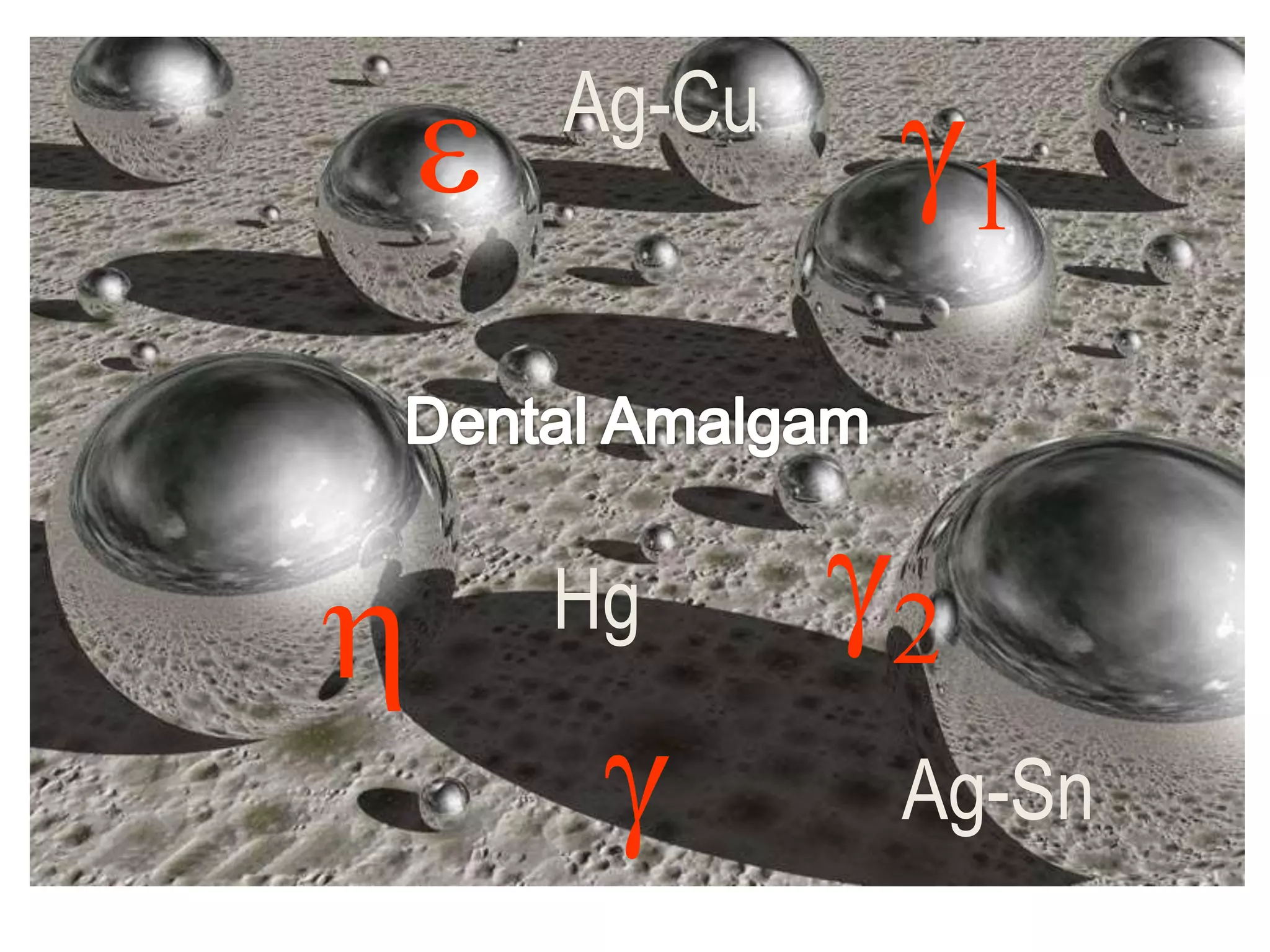







g
g1
g2h
e
Ag-Sn
Ag-Cu
Hg
9. Metallurgical phases and
amalgamation
10. Lowe copper alloys
Introduction
*In dentistry, amalgam has been successfully used for more than a
century as a restoration material for tooth decay.
*An amalgam is defined as a special type of alloy in which mercury is
one of the components.
*Mercury is able to react with certain alloys to form a plastic mass (
putty like consistency), which is conveniently packed into a prepared
cavity in a tooth. This plastic mass hardens and is stronger than any
dental cement or anterior filling material.
*Dental amalgam is the most widely used filling material for posterior
teeth.
*No other direct restorative material has the durability, ease of
handling, good physical characteristics, wear resistance and
compressive strength of amalgam.
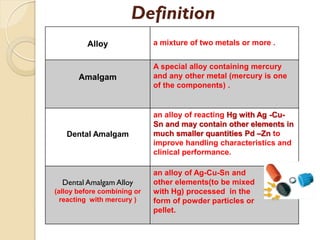
Alloy a mixture of two metals or more .
Amalgam
A special alloy containing mercury
and any other metal (mercury is one
of the components) .
Dental Amalgam
an alloy of reacting Hg with Ag -Cu-
Sn and may contain other elements in
much smaller quantities Pd โ€“Zn to
improve handling characteristics and
clinical performance.
Dental Amalgam Alloy
(alloy before combining or
reacting with mercury )
an alloy of Ag-Cu-Sn and
other elements(to be mixed
with Hg) processed in the
form of powder particles or
pellet.
Definition
Definition
Creep time - dependent plastic deformation
(When stress is applied to an
amalgam, it will undergo plastic
deformation).
Increases susceptibility to marginal
breakdown.
Corrosion is an actual deterioration of metal
by reaction with its environment .
โ€ซุงู„ุญุดูˆุฉโ€ฌ โ€ซุฅู†ู‡โ€ฌ โ€ซูŠุนู†ูŠโ€ฌโ€ซุชุขูƒู„โ€ฌ โ€ซุตุงุฑู„ู‡ุงโ€ฌ(โ€ซุดูƒู„โ€ฌ โ€ซุนู„ู‰โ€ฌ โ€ซุชุธู‡ุฑโ€ฌ
โ€ซุตุฏุฃโ€ฌ โ€ซู„ูŠุณโ€ฌ โ€ซูˆโ€ฌ โ€ซุดู‚ูˆู‚โ€ฌ)โ€ซุงุฃู„ู…ู„ุบู…โ€ฌ โ€ซู„ุชูุงุนู„โ€ฌ โ€ซู†ุชูŠุฌุฉโ€ฌ(โ€ซุงู„ู…ุนุงุฏู†โ€ฌ
โ€ซููŠู‡โ€ฌ โ€ซุงู„ูŠโ€ฌ)โ€ซุงู„ุจูŠุฆุฉโ€ฌ โ€ซู…ุนโ€ฌ
Tarnish
is a surface observable
discoloration on a metal without
any loss of structure.
โ€ซุงู„ู…ุนุฏู†โ€ฌ โ€ซุณุทุญโ€ฌ โ€ซู„ูˆู†โ€ฌ โ€ซููŠโ€ฌ โ€ซุชุบูŠุฑโ€ฌ(โ€ซุตุฏุฃโ€ฌ)
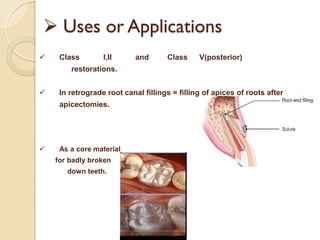
๏ƒ˜ Uses or Applications
๏ƒผ Class I,II and Class V(posterior)
restorations.
๏ƒผ In retrograde root canal fillings = filling of apices of roots after
apicectomies.
๏ƒผ As a core material
for badly broken
down teeth.
๏ƒ˜ Packing :-
๏ƒ˜ Trituration is achieved either by:
๏ƒผ Manually by hand with mortar and pestle
๏ƒผ Mechanical mixing by device
called amalgamator
The excess mercury was removed from the amalgam by
using a squeeze cloth to squeeze out the excess
mercury.
Advantages of mechanical trituration:
1. Shorter mixing time.
2. More standardized procedure.
3. Requires less mercury when compared to
hand mixing technique and hence less health
hazard.
Hand mixing
This older method of mixing the
amalgam has declined in use, because:-
*manual mixing often leak mercury into
the operatory during mixing,
*mixes are not as consistent ,
*health hazard.
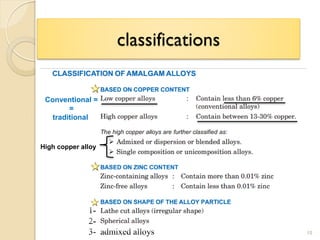
classifications
10
Conventional =
=
traditional
High copper alloy
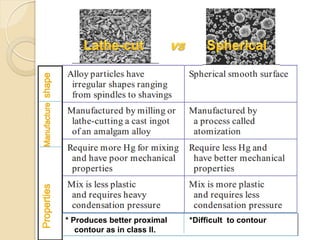
* Produces better proximal *Difficult to contour
contour as in class II.
Result
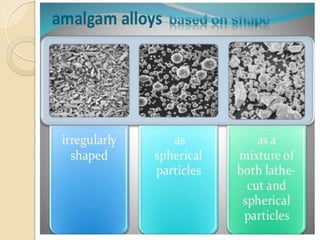
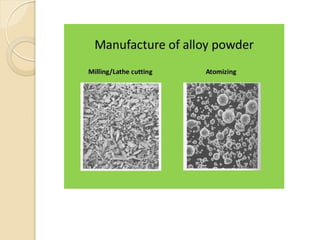
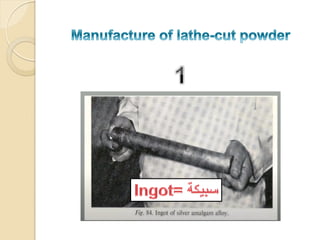
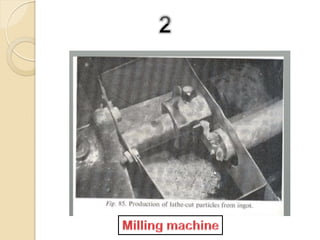
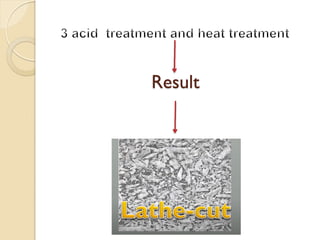
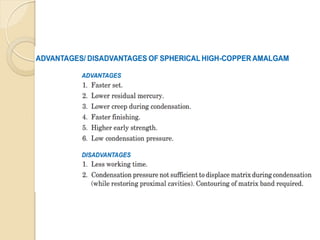
The spherical alloy is prepared by an atomization process.
Desired elements melted together to form molten alloy .The
molten alloy is sprayed under high pressure of an inert gas
through a fine crack into a large chamber.
If the droplets solidify before hitting a surface, the spherical
shape is preserved. Like lathe-cut, spherical powders are
given an annealing heat treatment and surface washing.
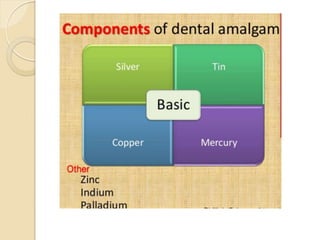
Components of dental amalgam
and the function of each constituent
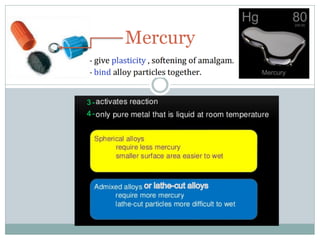
Mercury
3-
4-
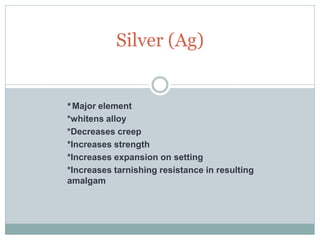
*Major element
*whitens alloy
*Decreases creep
*Increases strength
*Increases expansion on setting
*Increases tarnishing resistance in resulting
amalgam
Silver (Ag)
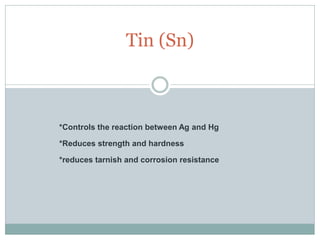
*Controls the reaction between Ag and Hg
*Reduces strength and hardness
*reduces tarnish and corrosion resistance
Tin (Sn)
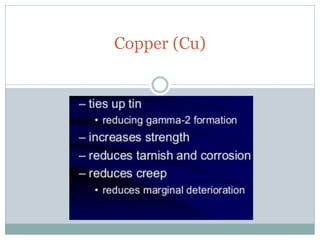
Copper (Cu)
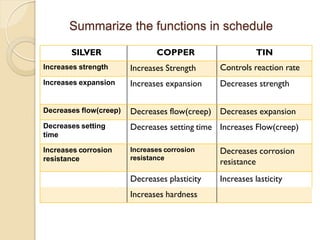
Summarize the functions in schedule
SILVER COPPER TIN
Increases strength Increases Strength Controls reaction rate
Increases expansion Increases expansion Decreases strength
Decreases flow(creep) Decreases flow(creep) Decreases expansion
Decreases setting
time
Decreases setting time Increases Flow(creep)
Increases corrosion
resistance
Increases corrosion
resistance
Decreases corrosion
resistance
Decreases plasticity Increases lasticity
Increases hardness
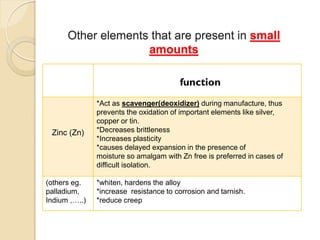
Other elements that are present in small
amounts
function
Zinc (Zn)
*Act as scavenger(deoxidizer) during manufacture, thus
prevents the oxidation of important elements like silver,
copper or tin.
*Decreases brittleness
*Increases plasticity
*causes delayed expansion in the presence of
moisture so amalgam with Zn free is preferred in cases of
difficult isolation.
(others eg.
palladium,
Indium ,โ€ฆ..)
*whiten, hardens the alloy
*increase resistance to corrosion and tarnish.
*reduce creep
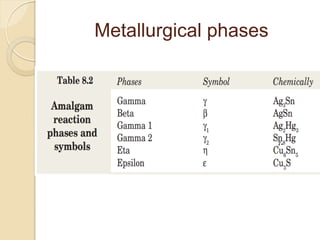
Metallurgical phases
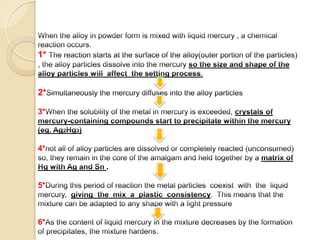
1*
2*
3*
4*
5*
6*
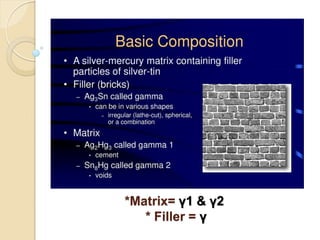
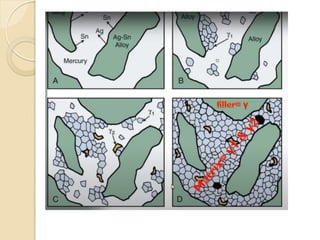
*Matrix= ฮณ1 & ฮณ2
* Filler = ฮณ
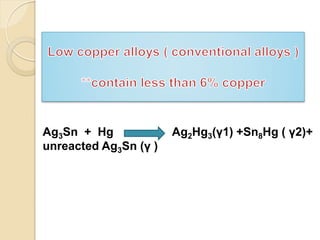
Ag3Sn + Hg Ag2Hg3(ฮณ1) +Sn8Hg ( ฮณ2)+
unreacted Ag3Sn (ฮณ )
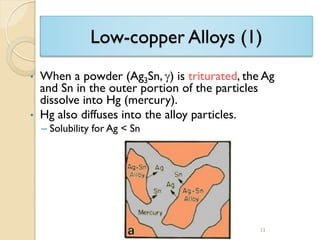
Low-copper Alloys (1)
โ€ข When a powder (Ag3Sn, g) is triturated, the Ag
and Sn in the outer portion of the particles
dissolve into Hg (mercury).
โ€ข Hg also diffuses into the alloy particles.
โ€“ Solubility for Ag < Sn
33
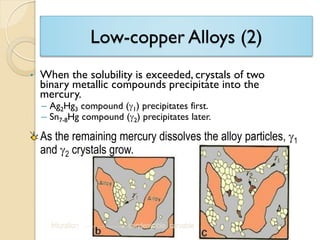
Low-copper Alloys (2)
โ€ข When the solubility is exceeded, crystals of two
binary metallic compounds precipitate into the
mercury.
โ€“ Ag2Hg3 compound (g1) precipitates first.
โ€“ Sn7-8Hg compound (g2) precipitates later.
34
As the remaining mercury dissolves the alloy particles, g1
and g2 crystals grow.
trituration condensable, carvable
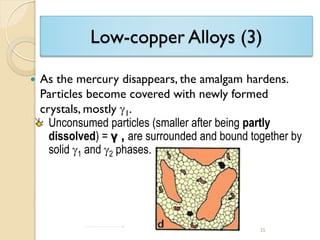
Low-copper Alloys (3)
๏‚— As the mercury disappears, the amalgam hardens.
Particles become covered with newly formed
crystals, mostly g1.
35
Unconsumed particles (smaller after being partly
dissolved) = ฮณ , are surrounded and bound together by
solid g1 and g2 phases.
Low-copper Alloys (4)
๏‚— In summary,
Alloy particles (b + g) + Hg ๏ƒ  g1 + g2 + unconsumed alloy
particles (b + g)
๏‚— Physical properties
1. g-phase ๏ƒ  strongest,
2. g2 phase ๏ƒ  weakest
3. Hardness: g > g1 >>> g2
4. g2 ๏ƒ  poor corrosion resistance
37
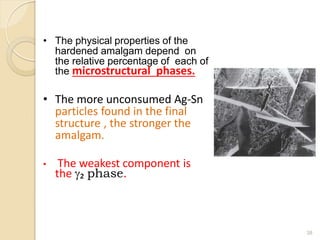
โ€ข The physical properties of the
hardened amalgam depend on
the relative percentage of each of
the microstructural phases.
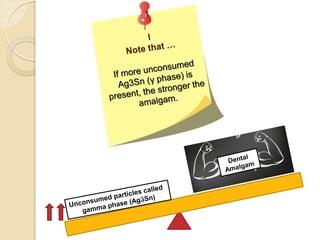
โ€ข The more unconsumed Ag-Sn
particles found in the final
structure , the stronger the
amalgam.
โ€ข The weakest component is
the gโ‚‚ phase.
38
High copper alloys contain between 13 to 30% wt. copper. They are
preferred because of their :
๏ƒผ improved mechanical properties,
๏ƒผ resistance to corrosion and
๏ƒผ better marginal integrity
Types:
1. Admixed alloy(mixture of lathe-cut and spherical particles โ€ซุงุณู…ู‡ุงโ€ฌ โ€ซ)ู…ู†โ€ฌ
2. Single-composition alloy.
High copper alloys or low copper alloys?? โ€ซุฃูุถู„โ€ฌ โ€ซู…ูŠู†โ€ฌ
reduction or elimination of g2 and high copper
particles aid to :-
*improved mechanical properties,
*resistance to corrosion and
*better marginal integrity.
โ€ซุจุงุฎุชุตุงุฑโ€ฌ...
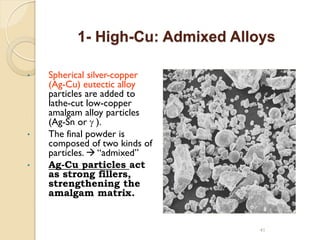
1- High-Cu: Admixed Alloys
โ€ข Spherical silver-copper
(Ag-Cu) eutectic alloy
particles are added to
lathe-cut low-copper
amalgam alloy particles
(Ag-Sn or g ).
โ€ข The final powder is
composed of two kinds of
particles. ๏ƒ  โ€œadmixedโ€
โ€ข Ag-Cu particles act
as strong fillers,
strengthening the
amalgam matrix.
41
42
43
44
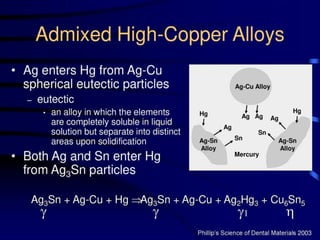
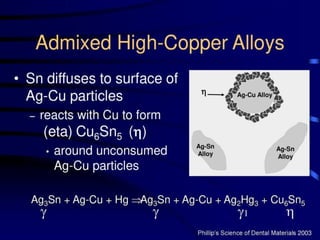
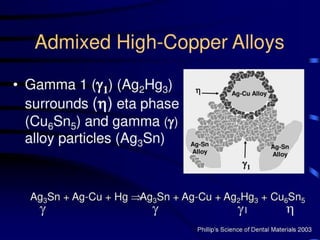
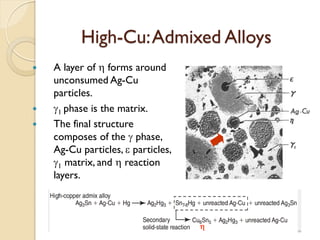
High-Cu:Admixed Alloys
๏‚— A layer of h forms around
unconsumed Ag-Cu
particles.
๏‚— g1 phase is the matrix.
๏‚— The final structure
composes of the g phase,
Ag-Cu particles, e particles,
g1 matrix, and h reaction
layers.
45
h
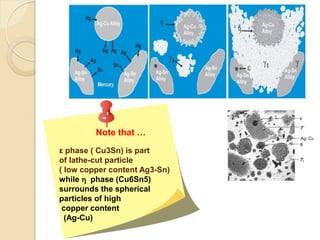
Note that โ€ฆ
ฮต phase ) Cu3Sn) is part
of lathe-cut particle
( low copper content Ag3-Sn)
while h phase (Cu6Sn5)
surrounds the spherical
particles of high
copper content
(Ag-Cu)
High-Cu:Admixed Alloys
๏‚— In summary:
Alloy particles (g) + Ag-Cu eutectic + Hg ๏ƒ  g1 + h + unconsumed
alloy of both types of particles
๏‚— g2 has been eliminated in this reaction,
being replaced by h.
๏‚— The effectiveness in eliminating g2
depends on % of copper-containing
particles.
47
๏‚— These are high copper amalgam alloys. Unlike admixed
alloy powders, each particle of the alloy powder has
the same composition.Therefore they are called single
composition or unicompositional alloys.
๏‚— Major components:Ag-Cu-Sn
48
2- High-Cu: Single-composition Alloys
Admixed vs spherical single composition
High-Cu: Single-composition Alloys
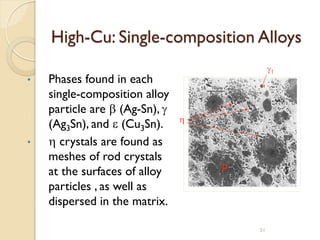
โ€ข Phases found in each
single-composition alloy
particle are b (Ag-Sn), g
(Ag3Sn), and e (Cu3Sn).
โ€ข h crystals are found as
meshes of rod crystals
at the surfaces of alloy
particles , as well as
dispersed in the matrix.
51
g1
h
P
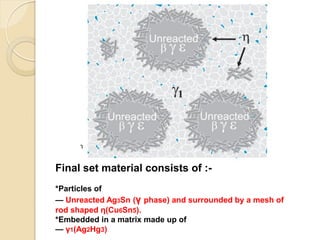
Final set material consists of :-
*Particles of
โ€” Unreacted Ag3Sn (ฮณ phase) and surrounded by a mesh of
rod shaped ฮท)Cu6Sn5).
*Embedded in a matrix made up of
โ€” ฮณ1(Ag2Hg3)
High-Cu: Single-composition Alloys
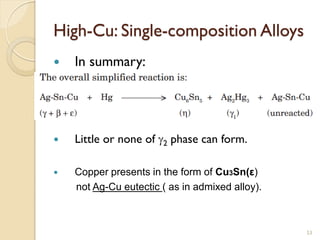
๏‚— In summary:
๏‚— Little or none of g2 phase can form.
๏‚— Copper presents in the form of Cu3Sn)ฮต)
not Ag-Cu eutectic ( as in admixed alloy).
53
**Functions of ฮท)Cu6Sn5) phase:
*strengthen the bond between alloy particles
and g1
*interlocks the ฮณ1 phase thus improving the
amalgams resistance to deformation.
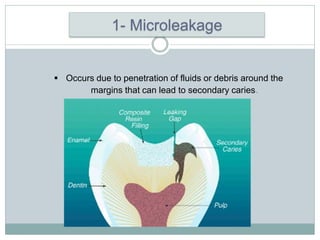
๏‚ง Occurs due to penetration of fluids or debris around the
margins that can lead to secondary caries.
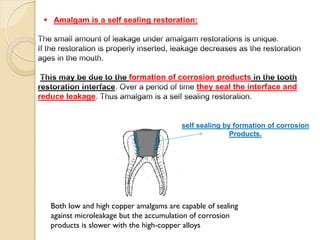
1- Microleakage
formation of corrosion products
they seal the interface and
reduce leakage
๏‚ง Amalgam is a self sealing restoration:
self sealing by formation of corrosion
Products.
Both low and high copper amalgams are capable of sealing
against microleakage but the accumulation of corrosion
products is slower with the high-copper alloys
๏ƒผ Both low and high copper amalgams are capable of
sealing against microleakage but the accumulation
of corrosion products is slower with the high-
copper alloys.
๏ƒผ Microleakage can be reduced through the
application of varnish on the cavity walls.
2- Dimensional Change
๏‚ง The earliest amalgams exhibited expansion while
setting. This was because of the greater
mercury/alloy ratio used .
๏‚ง Amalgams may expand or contract, depending on
its manipulation.
๏‚ง Ideally, dimensional change should be small.
๏‚ง Excessive contraction can lead to microleakage,
sensitivity and secondary caries.
๏‚ง Excessive expansion can produce pressure on
the pulp and postoperative sensitivity.
Protrusion of the restoration can also occur.
๏‚ง ADA Sp. no. 1 requires that amalgam should not expand more than
20 ฮผm/cm or contract less than 15 ฮผm at 37ยฐC, between 5 minutes
and 24 hours from the start of trituration.
๏‚ง Mechanically triturated modern amalgams, both low and high
copper, prepared from low mercury/alloy ratios show a slight
contraction.
๏ถ Theory of Dimensional Change
๏‚— Contraction
When the alloy and mercury are mixed contraction results
initially as the particles dissolve and the ฮณ1 grows. The final
volume of ฮณ1 is less than the initial volumes of silver and
mercury that go into making the ฮณ1.
Therefore, contraction will continue as long as growth of ฮณ1
continue.
๏ถ Theory of Dimensional Change
๏‚— Expansion
The ฮณ1 crystals as they grow, impinge against one another, and
produce an outward pressure tending to oppose contraction.
If there is sufficient mercury present to provide a plastic matrix,
an expansion will occur when ฮณ1 crystals impinge on each other.
After a rigid ฮณ1 matrix has formed, growth of ฮณ1 crystals cannot
force the matrix to expand.
Therefore, reducing mercury in the mix will favor
Contraction.
๏‚— Thus factors favoring contraction are:
๏ƒ˜ Low mercury/alloy ratio
๏ƒ˜ Higher condensation pressure (squeezes out mercury)
๏ƒ˜ Smaller particles (consumes more mercury because of increased
surface area)
๏ƒ˜ More trituration (accelerates setting).
๏‚— New amalgams or modern amalgams exhibit a net
contraction on setting.
๏‚— older amalgams always showed expansion ( due to high
mercury/alloy ratio + hand trituration was used)
๏ถ Effect of moisture contamination (delayed expansion)
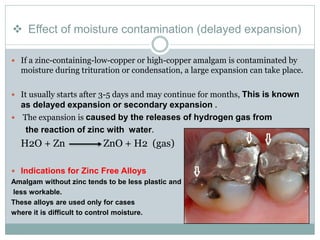
๏‚— If a zinc-containing-low-copper or high-copper amalgam is contaminated by
moisture during trituration or condensation, a large expansion can take place.
๏‚— It usually starts after 3-5 days and may continue for months, This is known
as delayed expansion or secondary expansion .
๏‚— The expansion is caused by the releases of hydrogen gas from
the reaction of zinc with water.
H2O + Zn ZnO + H2 (gas)
๏‚— Indications for Zinc Free Alloys
Amalgam without zinc tends to be less plastic and
less workable.
These alloys are used only for cases
where it is difficult to control moisture.
Moisture ( saliva ,โ€ฆetc) + zin-containing
=
amalgam
๏‚— Well designed amalgam restorations have sufficient
compressive strength to withstand normal intraoral
masticatory forces.
3- compressive strength
๏‚— Resistance to compression forces is the most favorable
strength characteristic of amalgam.
๏‚— compressive strength of high-Cu single alloy is the highest(after 24
hrs, reaches 510 MPa) > high-Cu admixed > low-Cu
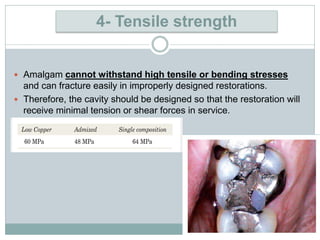
๏‚— Amalgam cannot withstand high tensile or bending stresses
and can fracture easily in improperly designed restorations.
๏‚— Therefore, the cavity should be designed so that the restoration will
receive minimal tension or shear forces in service.
4- Tensile strength
Amalgam is
๏‚–
๏‚™ Effect of Rate of Hardening
๏‚— When stress is applied to an amalgam, it will undergo
plastic deformation this characteristic refers to as creep.
๏‚— It is a time dependent plastic deformation.
๏‚— Creep of dental amalgam is a slow progressive permanent
deformation of set amalgam which occurs under constant
stress (static creep) or intermittent stress (dynamic creep).
๏‚— The ฮณ2 phase is associated with higher creep rates.
๏‚— In general lathe-cut low-copper alloys show the highest
creep values.
4- Creep
5- Tarnish and corrosion
๏‚— Corrosion :
is an actual deterioration of metal by reaction with its
environment .
๏‚— Tarnish: is a surface observable discoloration on a metal
without any loss of structure. โ€ซุงู„ู…ุนุฏู†โ€ฌ โ€ซุณุทุญโ€ฌ โ€ซู„ูˆู†โ€ฌ โ€ซููŠโ€ฌ โ€ซุชุบูŠุฑโ€ฌ
โ€ซุชุขูƒู„โ€ฌ โ€ซุตุงุฑู„ู‡ุงโ€ฌ โ€ซุงู„ุญุดูˆุฉโ€ฌ โ€ซุฅู†ู‡โ€ฌ โ€ซูŠุนู†ูŠโ€ฌ(โ€ซุตุฏุฃโ€ฌ โ€ซู„ูŠุณโ€ฌ โ€ซูˆโ€ฌ โ€ซุดู‚ูˆู‚โ€ฌ โ€ซุดูƒู„โ€ฌ โ€ซุนู„ู‰โ€ฌ โ€ซุชุธู‡ุฑโ€ฌ)
โ€ซุงุฃู„ู…ู„ุบู…โ€ฌ โ€ซู„ุชูุงุนู„โ€ฌ โ€ซู†ุชูŠุฌุฉโ€ฌ(โ€ซููŠู‡โ€ฌ โ€ซุงู„ูŠโ€ฌ โ€ซุงู„ู…ุนุงุฏู†โ€ฌ)โ€ซุงู„ุจูŠุฆุฉโ€ฌ โ€ซู…ุนโ€ฌ.
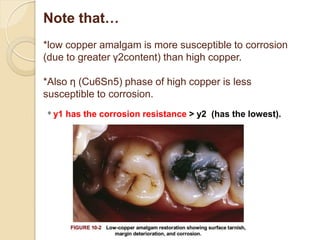
Note thatโ€ฆ
*low copper amalgam is more susceptible to corrosion
(due to greater ฮณ2content) than high copper.
*Also ฮท (Cu6Sn5) phase of high copper is less
susceptible to corrosion.
* y1 has the corrosion resistance > y2 (has the lowest).
Effect of Particle size
Free mercury should not be sprayed or exposed to the
atmosphere.
This hazard can arise during trituration, condensation and
finishing of the restoration, and also during the removal of old
restorations at high speed.
Mercury vapors can be inhaled. Skin contact with mercury
should be avoided as it can be absorbed.
The clinic should be well ventilated. All excess mercury and
amalgam waste should be stored in well-sealed containers.
Proper disposal systems should be followed, to avoid
environmental pollution.
75

Dental Amalgam (Dental Materials Course)

  • 1.
  • 3.
    9. Metallurgical phasesand amalgamation 10. Lowe copper alloys
  • 4.
    Introduction *In dentistry, amalgamhas been successfully used for more than a century as a restoration material for tooth decay. *An amalgam is defined as a special type of alloy in which mercury is one of the components. *Mercury is able to react with certain alloys to form a plastic mass ( putty like consistency), which is conveniently packed into a prepared cavity in a tooth. This plastic mass hardens and is stronger than any dental cement or anterior filling material. *Dental amalgam is the most widely used filling material for posterior teeth. *No other direct restorative material has the durability, ease of handling, good physical characteristics, wear resistance and compressive strength of amalgam.
  • 5.
    Alloy a mixtureof two metals or more . Amalgam A special alloy containing mercury and any other metal (mercury is one of the components) . Dental Amalgam an alloy of reacting Hg with Ag -Cu- Sn and may contain other elements in much smaller quantities Pd โ€“Zn to improve handling characteristics and clinical performance. Dental Amalgam Alloy (alloy before combining or reacting with mercury ) an alloy of Ag-Cu-Sn and other elements(to be mixed with Hg) processed in the form of powder particles or pellet. Definition
  • 6.
    Definition Creep time -dependent plastic deformation (When stress is applied to an amalgam, it will undergo plastic deformation). Increases susceptibility to marginal breakdown. Corrosion is an actual deterioration of metal by reaction with its environment . โ€ซุงู„ุญุดูˆุฉโ€ฌ โ€ซุฅู†ู‡โ€ฌ โ€ซูŠุนู†ูŠโ€ฌโ€ซุชุขูƒู„โ€ฌ โ€ซุตุงุฑู„ู‡ุงโ€ฌ(โ€ซุดูƒู„โ€ฌ โ€ซุนู„ู‰โ€ฌ โ€ซุชุธู‡ุฑโ€ฌ โ€ซุตุฏุฃโ€ฌ โ€ซู„ูŠุณโ€ฌ โ€ซูˆโ€ฌ โ€ซุดู‚ูˆู‚โ€ฌ)โ€ซุงุฃู„ู…ู„ุบู…โ€ฌ โ€ซู„ุชูุงุนู„โ€ฌ โ€ซู†ุชูŠุฌุฉโ€ฌ(โ€ซุงู„ู…ุนุงุฏู†โ€ฌ โ€ซููŠู‡โ€ฌ โ€ซุงู„ูŠโ€ฌ)โ€ซุงู„ุจูŠุฆุฉโ€ฌ โ€ซู…ุนโ€ฌ Tarnish is a surface observable discoloration on a metal without any loss of structure. โ€ซุงู„ู…ุนุฏู†โ€ฌ โ€ซุณุทุญโ€ฌ โ€ซู„ูˆู†โ€ฌ โ€ซููŠโ€ฌ โ€ซุชุบูŠุฑโ€ฌ(โ€ซุตุฏุฃโ€ฌ)
  • 7.
    ๏ƒ˜ Uses orApplications ๏ƒผ Class I,II and Class V(posterior) restorations. ๏ƒผ In retrograde root canal fillings = filling of apices of roots after apicectomies. ๏ƒผ As a core material for badly broken down teeth.
  • 8.
    ๏ƒ˜ Packing :- ๏ƒ˜Trituration is achieved either by: ๏ƒผ Manually by hand with mortar and pestle ๏ƒผ Mechanical mixing by device called amalgamator
  • 9.
    The excess mercurywas removed from the amalgam by using a squeeze cloth to squeeze out the excess mercury. Advantages of mechanical trituration: 1. Shorter mixing time. 2. More standardized procedure. 3. Requires less mercury when compared to hand mixing technique and hence less health hazard. Hand mixing This older method of mixing the amalgam has declined in use, because:- *manual mixing often leak mercury into the operatory during mixing, *mixes are not as consistent , *health hazard.
  • 10.
  • 12.
    * Produces betterproximal *Difficult to contour contour as in class II.
  • 18.
  • 19.
    The spherical alloyis prepared by an atomization process. Desired elements melted together to form molten alloy .The molten alloy is sprayed under high pressure of an inert gas through a fine crack into a large chamber. If the droplets solidify before hitting a surface, the spherical shape is preserved. Like lathe-cut, spherical powders are given an annealing heat treatment and surface washing.
  • 20.
    Components of dentalamalgam and the function of each constituent
  • 22.
  • 23.
    *Major element *whitens alloy *Decreasescreep *Increases strength *Increases expansion on setting *Increases tarnishing resistance in resulting amalgam Silver (Ag)
  • 24.
    *Controls the reactionbetween Ag and Hg *Reduces strength and hardness *reduces tarnish and corrosion resistance Tin (Sn)
  • 25.
  • 26.
    Summarize the functionsin schedule SILVER COPPER TIN Increases strength Increases Strength Controls reaction rate Increases expansion Increases expansion Decreases strength Decreases flow(creep) Decreases flow(creep) Decreases expansion Decreases setting time Decreases setting time Increases Flow(creep) Increases corrosion resistance Increases corrosion resistance Decreases corrosion resistance Decreases plasticity Increases lasticity Increases hardness
  • 27.
    Other elements thatare present in small amounts function Zinc (Zn) *Act as scavenger(deoxidizer) during manufacture, thus prevents the oxidation of important elements like silver, copper or tin. *Decreases brittleness *Increases plasticity *causes delayed expansion in the presence of moisture so amalgam with Zn free is preferred in cases of difficult isolation. (others eg. palladium, Indium ,โ€ฆ..) *whiten, hardens the alloy *increase resistance to corrosion and tarnish. *reduce creep
  • 28.
  • 29.
  • 31.
    *Matrix= ฮณ1 &ฮณ2 * Filler = ฮณ
  • 32.
    Ag3Sn + HgAg2Hg3(ฮณ1) +Sn8Hg ( ฮณ2)+ unreacted Ag3Sn (ฮณ )
  • 33.
    Low-copper Alloys (1) โ€ขWhen a powder (Ag3Sn, g) is triturated, the Ag and Sn in the outer portion of the particles dissolve into Hg (mercury). โ€ข Hg also diffuses into the alloy particles. โ€“ Solubility for Ag < Sn 33
  • 34.
    Low-copper Alloys (2) โ€ขWhen the solubility is exceeded, crystals of two binary metallic compounds precipitate into the mercury. โ€“ Ag2Hg3 compound (g1) precipitates first. โ€“ Sn7-8Hg compound (g2) precipitates later. 34 As the remaining mercury dissolves the alloy particles, g1 and g2 crystals grow. trituration condensable, carvable
  • 35.
    Low-copper Alloys (3) ๏‚—As the mercury disappears, the amalgam hardens. Particles become covered with newly formed crystals, mostly g1. 35 Unconsumed particles (smaller after being partly dissolved) = ฮณ , are surrounded and bound together by solid g1 and g2 phases.
  • 37.
    Low-copper Alloys (4) ๏‚—In summary, Alloy particles (b + g) + Hg ๏ƒ  g1 + g2 + unconsumed alloy particles (b + g) ๏‚— Physical properties 1. g-phase ๏ƒ  strongest, 2. g2 phase ๏ƒ  weakest 3. Hardness: g > g1 >>> g2 4. g2 ๏ƒ  poor corrosion resistance 37
  • 38.
    โ€ข The physicalproperties of the hardened amalgam depend on the relative percentage of each of the microstructural phases. โ€ข The more unconsumed Ag-Sn particles found in the final structure , the stronger the amalgam. โ€ข The weakest component is the gโ‚‚ phase. 38
  • 39.
    High copper alloyscontain between 13 to 30% wt. copper. They are preferred because of their : ๏ƒผ improved mechanical properties, ๏ƒผ resistance to corrosion and ๏ƒผ better marginal integrity Types: 1. Admixed alloy(mixture of lathe-cut and spherical particles โ€ซุงุณู…ู‡ุงโ€ฌ โ€ซ)ู…ู†โ€ฌ 2. Single-composition alloy.
  • 40.
    High copper alloysor low copper alloys?? โ€ซุฃูุถู„โ€ฌ โ€ซู…ูŠู†โ€ฌ reduction or elimination of g2 and high copper particles aid to :- *improved mechanical properties, *resistance to corrosion and *better marginal integrity. โ€ซุจุงุฎุชุตุงุฑโ€ฌ...
  • 41.
    1- High-Cu: AdmixedAlloys โ€ข Spherical silver-copper (Ag-Cu) eutectic alloy particles are added to lathe-cut low-copper amalgam alloy particles (Ag-Sn or g ). โ€ข The final powder is composed of two kinds of particles. ๏ƒ  โ€œadmixedโ€ โ€ข Ag-Cu particles act as strong fillers, strengthening the amalgam matrix. 41
  • 42.
  • 43.
  • 44.
  • 45.
    High-Cu:Admixed Alloys ๏‚— Alayer of h forms around unconsumed Ag-Cu particles. ๏‚— g1 phase is the matrix. ๏‚— The final structure composes of the g phase, Ag-Cu particles, e particles, g1 matrix, and h reaction layers. 45 h
  • 46.
    Note that โ€ฆ ฮตphase ) Cu3Sn) is part of lathe-cut particle ( low copper content Ag3-Sn) while h phase (Cu6Sn5) surrounds the spherical particles of high copper content (Ag-Cu)
  • 47.
    High-Cu:Admixed Alloys ๏‚— Insummary: Alloy particles (g) + Ag-Cu eutectic + Hg ๏ƒ  g1 + h + unconsumed alloy of both types of particles ๏‚— g2 has been eliminated in this reaction, being replaced by h. ๏‚— The effectiveness in eliminating g2 depends on % of copper-containing particles. 47
  • 48.
    ๏‚— These arehigh copper amalgam alloys. Unlike admixed alloy powders, each particle of the alloy powder has the same composition.Therefore they are called single composition or unicompositional alloys. ๏‚— Major components:Ag-Cu-Sn 48 2- High-Cu: Single-composition Alloys
  • 50.
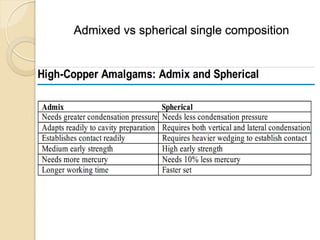
    Admixed vs sphericalsingle composition
  • 51.
    High-Cu: Single-composition Alloys โ€ขPhases found in each single-composition alloy particle are b (Ag-Sn), g (Ag3Sn), and e (Cu3Sn). โ€ข h crystals are found as meshes of rod crystals at the surfaces of alloy particles , as well as dispersed in the matrix. 51 g1 h P
  • 52.
    Final set materialconsists of :- *Particles of โ€” Unreacted Ag3Sn (ฮณ phase) and surrounded by a mesh of rod shaped ฮท)Cu6Sn5). *Embedded in a matrix made up of โ€” ฮณ1(Ag2Hg3)
  • 53.
    High-Cu: Single-composition Alloys ๏‚—In summary: ๏‚— Little or none of g2 phase can form. ๏‚— Copper presents in the form of Cu3Sn)ฮต) not Ag-Cu eutectic ( as in admixed alloy). 53
  • 54.
    **Functions of ฮท)Cu6Sn5)phase: *strengthen the bond between alloy particles and g1 *interlocks the ฮณ1 phase thus improving the amalgams resistance to deformation.
  • 56.
    ๏‚ง Occurs dueto penetration of fluids or debris around the margins that can lead to secondary caries. 1- Microleakage
  • 57.
    formation of corrosionproducts they seal the interface and reduce leakage ๏‚ง Amalgam is a self sealing restoration: self sealing by formation of corrosion Products. Both low and high copper amalgams are capable of sealing against microleakage but the accumulation of corrosion products is slower with the high-copper alloys
  • 58.
    ๏ƒผ Both lowand high copper amalgams are capable of sealing against microleakage but the accumulation of corrosion products is slower with the high- copper alloys. ๏ƒผ Microleakage can be reduced through the application of varnish on the cavity walls.
  • 59.
    2- Dimensional Change ๏‚งThe earliest amalgams exhibited expansion while setting. This was because of the greater mercury/alloy ratio used . ๏‚ง Amalgams may expand or contract, depending on its manipulation. ๏‚ง Ideally, dimensional change should be small. ๏‚ง Excessive contraction can lead to microleakage, sensitivity and secondary caries. ๏‚ง Excessive expansion can produce pressure on the pulp and postoperative sensitivity. Protrusion of the restoration can also occur.
  • 60.
    ๏‚ง ADA Sp.no. 1 requires that amalgam should not expand more than 20 ฮผm/cm or contract less than 15 ฮผm at 37ยฐC, between 5 minutes and 24 hours from the start of trituration. ๏‚ง Mechanically triturated modern amalgams, both low and high copper, prepared from low mercury/alloy ratios show a slight contraction.
  • 61.
    ๏ถ Theory ofDimensional Change ๏‚— Contraction When the alloy and mercury are mixed contraction results initially as the particles dissolve and the ฮณ1 grows. The final volume of ฮณ1 is less than the initial volumes of silver and mercury that go into making the ฮณ1. Therefore, contraction will continue as long as growth of ฮณ1 continue.
  • 62.
    ๏ถ Theory ofDimensional Change ๏‚— Expansion The ฮณ1 crystals as they grow, impinge against one another, and produce an outward pressure tending to oppose contraction. If there is sufficient mercury present to provide a plastic matrix, an expansion will occur when ฮณ1 crystals impinge on each other. After a rigid ฮณ1 matrix has formed, growth of ฮณ1 crystals cannot force the matrix to expand. Therefore, reducing mercury in the mix will favor Contraction.
  • 63.
    ๏‚— Thus factorsfavoring contraction are: ๏ƒ˜ Low mercury/alloy ratio ๏ƒ˜ Higher condensation pressure (squeezes out mercury) ๏ƒ˜ Smaller particles (consumes more mercury because of increased surface area) ๏ƒ˜ More trituration (accelerates setting). ๏‚— New amalgams or modern amalgams exhibit a net contraction on setting. ๏‚— older amalgams always showed expansion ( due to high mercury/alloy ratio + hand trituration was used)
  • 64.
    ๏ถ Effect ofmoisture contamination (delayed expansion) ๏‚— If a zinc-containing-low-copper or high-copper amalgam is contaminated by moisture during trituration or condensation, a large expansion can take place. ๏‚— It usually starts after 3-5 days and may continue for months, This is known as delayed expansion or secondary expansion . ๏‚— The expansion is caused by the releases of hydrogen gas from the reaction of zinc with water. H2O + Zn ZnO + H2 (gas) ๏‚— Indications for Zinc Free Alloys Amalgam without zinc tends to be less plastic and less workable. These alloys are used only for cases where it is difficult to control moisture.
  • 65.
    Moisture ( saliva,โ€ฆetc) + zin-containing = amalgam
  • 66.
    ๏‚— Well designedamalgam restorations have sufficient compressive strength to withstand normal intraoral masticatory forces. 3- compressive strength ๏‚— Resistance to compression forces is the most favorable strength characteristic of amalgam. ๏‚— compressive strength of high-Cu single alloy is the highest(after 24 hrs, reaches 510 MPa) > high-Cu admixed > low-Cu
  • 67.
    ๏‚— Amalgam cannotwithstand high tensile or bending stresses and can fracture easily in improperly designed restorations. ๏‚— Therefore, the cavity should be designed so that the restoration will receive minimal tension or shear forces in service. 4- Tensile strength
  • 68.
  • 69.
    ๏‚– ๏‚™ Effect ofRate of Hardening
  • 70.
    ๏‚— When stressis applied to an amalgam, it will undergo plastic deformation this characteristic refers to as creep. ๏‚— It is a time dependent plastic deformation. ๏‚— Creep of dental amalgam is a slow progressive permanent deformation of set amalgam which occurs under constant stress (static creep) or intermittent stress (dynamic creep). ๏‚— The ฮณ2 phase is associated with higher creep rates. ๏‚— In general lathe-cut low-copper alloys show the highest creep values. 4- Creep
  • 71.
    5- Tarnish andcorrosion ๏‚— Corrosion : is an actual deterioration of metal by reaction with its environment . ๏‚— Tarnish: is a surface observable discoloration on a metal without any loss of structure. โ€ซุงู„ู…ุนุฏู†โ€ฌ โ€ซุณุทุญโ€ฌ โ€ซู„ูˆู†โ€ฌ โ€ซููŠโ€ฌ โ€ซุชุบูŠุฑโ€ฌ โ€ซุชุขูƒู„โ€ฌ โ€ซุตุงุฑู„ู‡ุงโ€ฌ โ€ซุงู„ุญุดูˆุฉโ€ฌ โ€ซุฅู†ู‡โ€ฌ โ€ซูŠุนู†ูŠโ€ฌ(โ€ซุตุฏุฃโ€ฌ โ€ซู„ูŠุณโ€ฌ โ€ซูˆโ€ฌ โ€ซุดู‚ูˆู‚โ€ฌ โ€ซุดูƒู„โ€ฌ โ€ซุนู„ู‰โ€ฌ โ€ซุชุธู‡ุฑโ€ฌ) โ€ซุงุฃู„ู…ู„ุบู…โ€ฌ โ€ซู„ุชูุงุนู„โ€ฌ โ€ซู†ุชูŠุฌุฉโ€ฌ(โ€ซููŠู‡โ€ฌ โ€ซุงู„ูŠโ€ฌ โ€ซุงู„ู…ุนุงุฏู†โ€ฌ)โ€ซุงู„ุจูŠุฆุฉโ€ฌ โ€ซู…ุนโ€ฌ.
  • 72.
    Note thatโ€ฆ *low copperamalgam is more susceptible to corrosion (due to greater ฮณ2content) than high copper. *Also ฮท (Cu6Sn5) phase of high copper is less susceptible to corrosion. * y1 has the corrosion resistance > y2 (has the lowest).
  • 73.
  • 74.
    Free mercury shouldnot be sprayed or exposed to the atmosphere. This hazard can arise during trituration, condensation and finishing of the restoration, and also during the removal of old restorations at high speed. Mercury vapors can be inhaled. Skin contact with mercury should be avoided as it can be absorbed. The clinic should be well ventilated. All excess mercury and amalgam waste should be stored in well-sealed containers. Proper disposal systems should be followed, to avoid environmental pollution.
  • 75.