ALUMINUM
PROPERTIES, USES,
EXTRACTION PROCESS, ALUMINUM ALLOYS
Done By: Anubhav D. Kashyap (04)
Anuj Sharma (05)
Arushi Teotia (06)
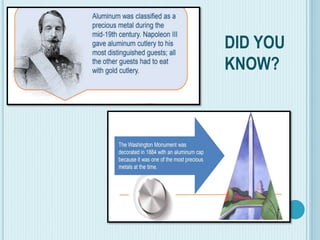
DID YOU
KNOW?
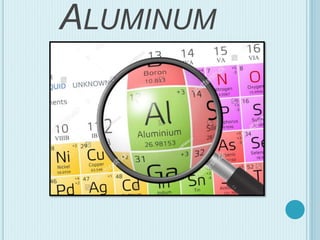
ALUMINUM
HIGHLIGHTS 
History
Ores
Extraction Methods
Properties
Alloys
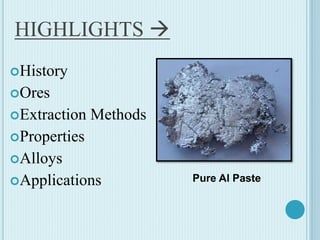
Applications Pure Al Paste
BASIC INFORMATION :
 Atomic number ?
 Electronic configuration?
 Density ?
 Atomic mass?
 Melting point?
 Boiling point ?
13
[Ne]3s23p1
2.7 g/cm3
26.9g
2519∘C
660∘C
HISTORY
 Alum?
is hydrated double sulphate salt of Al
 Commander Archelaus discovered that wood was
practically flame resistant if it was treated using an alum
solution.
 Scientist suspected an unknown metal in alum as
early as 1787.
40 years
Extraction Al
Humphry Davy : that aluminium could be
produced by electrolytic reduction from
alumina (aluminium oxide).
Hans Christian Oersted (Denmark) :
Was successful in extracting but produced an aluminium
alloy rather than pure aluminium.
Friedrich Woehler [German] :
continued Hans Christian’s work.
1808
1825
1827
1846
Friedrich created small balls of
solidified molten aluminium (globules)
1856 Henri-Etienne Sainte-Claire Deville[French] :
industrial applications. [DEVILLE PROCESS]
1856-1890
200 tonnes
of Al were produced in 36 years
BUT……
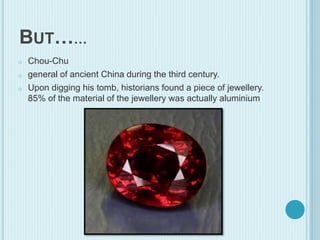
o Chou-Chu
o general of ancient China during the third century.
o Upon digging his tomb, historians found a piece of jewellery.
85% of the material of the jewellery was actually aluminium
INTRODUCTION
 Aluminium is found in many rock minerals, usually
combined with silicon and oxygen in compounds called
Alumino silicates. Example: Kayanite (Al₂O(SIO₄)),
Topaz (Al₂O(SIO₄)(OH,F)₂), Kaolinite (Al₂Si₂O₃(OH)₄)
etc.
 Under certain types of tropical soil weathering these
alumina-silicate compounds are separated into layers
of hydrated iron oxide, hydrated alumina and silica.
Example: Al(OH)₃, Al₂O₃.3H₂O etc.
 When such deposits are rich in alumina, this comprise
the mineral bauxite. Bauxite is a mixture of gibbsite
(Al(OH)₃), boehmite (AlO(OH)) and diaspore
(AlO(OH)); and has a general formula of Al₂O₃.x2H₂O
ALUMINUM ORES
 There are a large number of minerals and rocks containing
aluminum; however, only a few of them can be used for extracting
metallic aluminum.
 Bauxites are the most widely used raw materials for aluminum.
 Initially a semifinished product, alumina (A12O3) is extracted from
the ores, and the metallic aluminum is produced electrolytically
from the alumina.
 Nepheline-syenites as well as nepheline-apatites are also used as
aluminum ores. These minerals are simultaneously used as a
source of phosphates.
 Other minerals which can be used as a source of aluminum
include alunites, leucitic lavas (the mineral leucite), labradorites,
anorthosites, and high-alumina clays and kaolins.
BAUXITE
 Bauxite is the most important aluminium ore. It consists
largely of the minerals gibbsite Al(OH)3, boehmite γ-
AlO(OH), and diaspore α-AlO(OH), together with the iron
oxides goethite and hematite.
 Bauxite does not have a specific composition. It is a
mixture of hydrous aluminum oxides, aluminum
hydroxides, clay minerals, and insoluble materials such as
quartz, hematite, magnetite, siderite, and goethite.
 Bauxite is typically a soft (H:1-3), white to gray to reddish
brown material with a pisolitic structure, earthy luster and
a low specific gravity (SG: 2.0-2.5).
 Bayer’s Process is the main process for the production
of bauxite.
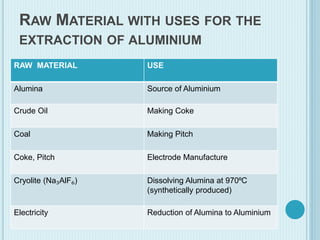
RAW MATERIAL WITH USES FOR THE
EXTRACTION OF ALUMINIUM
RAW MATERIAL USE
Alumina Source of Aluminium
Crude Oil Making Coke
Coal Making Pitch
Coke, Pitch Electrode Manufacture
Cryolite (Na₃AlF₆) Dissolving Alumina at 970⁰C
(synthetically produced)
Electricity Reduction of Alumina to Aluminium
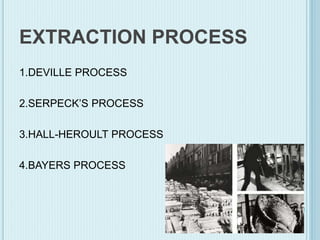
EXTRACTION PROCESS
1.DEVILLE PROCESS
2.SERPECK’S PROCESS
3.HALL-HEROULT PROCESS
4.BAYERS PROCESS
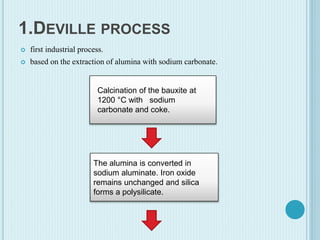
1.DEVILLE PROCESS
 first industrial process.
 based on the extraction of alumina with sodium carbonate.
Calcination of the bauxite at
1200 °C with sodium
carbonate and coke.
The alumina is converted in
sodium aluminate. Iron oxide
remains unchanged and silica
forms a polysilicate.
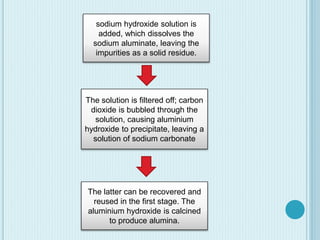
sodium hydroxide solution is
added, which dissolves the
sodium aluminate, leaving the
impurities as a solid residue.
The solution is filtered off; carbon
dioxide is bubbled through the
solution, causing aluminium
hydroxide to precipitate, leaving a
solution of sodium carbonate
The latter can be recovered and
reused in the first stage. The
aluminium hydroxide is calcined
to produce alumina.
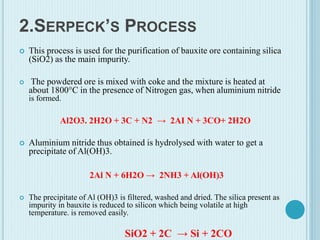
2.SERPECK’S PROCESS
 This process is used for the purification of bauxite ore containing silica
(SiO2) as the main impurity.
 The powdered ore is mixed with coke and the mixture is heated at
about 1800°C in the presence of Nitrogen gas, when aluminium nitride
is formed.
Al2O3. 2H2O + 3C + N2 → 2AI N + 3CO+ 2H2O
 Aluminium nitride thus obtained is hydrolysed with water to get a
precipitate of Al(OH)3.
2Al N + 6H2O → 2NH3 + Al(OH)3
 The precipitate of Al (OH)3 is filtered, washed and dried. The silica present as
impurity in bauxite is reduced to silicon which being volatile at high
temperature. is removed easily.
SiO2 + 2C → Si + 2CO
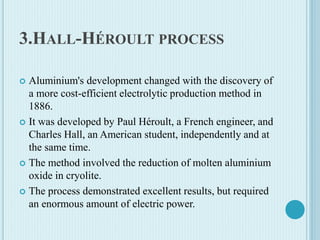
3.HALL-HÉROULT PROCESS
 Aluminium's development changed with the discovery of
a more cost-efficient electrolytic production method in
1886.
 It was developed by Paul Héroult, a French engineer, and
Charles Hall, an American student, independently and at
the same time.
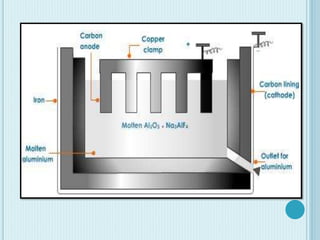
 The method involved the reduction of molten aluminium
oxide in cryolite.
 The process demonstrated excellent results, but required
an enormous amount of electric power.
4.BAYER’S PROCESS
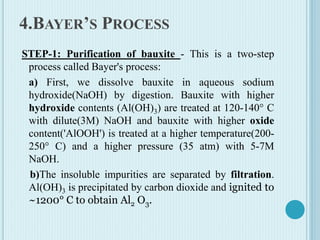
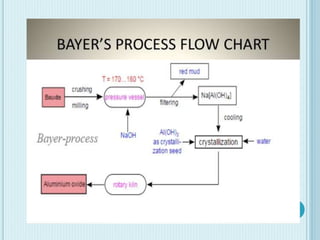
STEP-1: Purification of bauxite - This is a two-step
process called Bayer's process:
a) First, we dissolve bauxite in aqueous sodium
hydroxide(NaOH) by digestion. Bauxite with higher
hydroxide contents (Al(OH)3) are treated at 120-140° C
with dilute(3M) NaOH and bauxite with higher oxide
content('AlOOH') is treated at a higher temperature(200-
250° C) and a higher pressure (35 atm) with 5-7M
NaOH.
b)The insoluble impurities are separated by filtration.
Al(OH)3 is precipitated by carbon dioxide and ignited to
~1200° C to obtain Al2 O3.
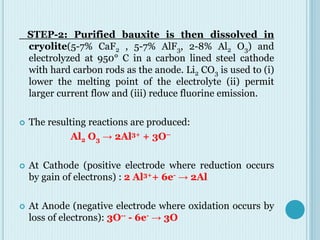
STEP-2: Purified bauxite is then dissolved in
cryolite(5-7% CaF2 , 5-7% AlF3, 2-8% Al2 O3) and
electrolyzed at 950° C in a carbon lined steel cathode
with hard carbon rods as the anode. Li2 CO3 is used to (i)
lower the melting point of the electrolyte (ii) permit
larger current flow and (iii) reduce fluorine emission.
 The resulting reactions are produced:
Al2 O3 → 2Al3+ + 3O–
 At Cathode (positive electrode where reduction occurs
by gain of electrons) : 2 Al3++ 6e- → 2Al
 At Anode (negative electrode where oxidation occurs by
loss of electrons): 3O-- - 6e- → 3O
ALLOYS OF ALUMINIUM
 Aluminium alloy Aluminium (Al) is the
predominant metal.
 The typical alloying elements are copper,
magnesium, manganese, silicon, tin and zinc.
 There are two principal classifications, namely
casting alloys and wrought alloys, both of which are
further subdivided into the categories heat -
treatable and non-heat-treatable.
 The most important cast aluminium alloy system is
Al–Si, where the high levels of silicon (4.0–13%)
contribute to give good casting characteristics.
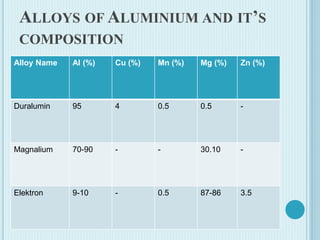
ALLOYS OF ALUMINIUM AND IT’S
COMPOSITION
Alloy Name Al (%) Cu (%) Mn (%) Mg (%) Zn (%)
Duralumin 95 4 0.5 0.5 -
Magnalium 70-90 - - 30.10 -
Elektron 9-10 - 0.5 87-86 3.5
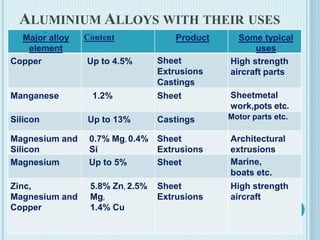
ALUMINIUM ALLOYS WITH THEIR USES
Major alloy
element
Content Product Some typical
uses
Copper Up to 4.5% Sheet
Extrusions
Castings
High strength
aircraft parts
Manganese 1.2% Sheet Sheetmetal
work,pots etc.
Silicon Up to 13% Castings Motor parts etc.
Magnesium and
Silicon
0.7% Mg, 0.4%
Si
Sheet
Extrusions
Architectural
extrusions
Magnesium Up to 5% Sheet Marine,
boats etc.
Zinc,
Magnesium and
Copper
5.8% Zn, 2.5%
Mg,
1.4% Cu
Sheet
Extrusions
High strength
aircraft
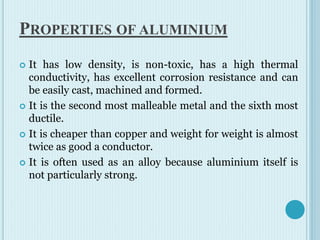
PROPERTIES OF ALUMINIUM
 It has low density, is non-toxic, has a high thermal
conductivity, has excellent corrosion resistance and can
be easily cast, machined and formed.
 It is the second most malleable metal and the sixth most
ductile.
 It is cheaper than copper and weight for weight is almost
twice as good a conductor.
 It is often used as an alloy because aluminium itself is
not particularly strong.
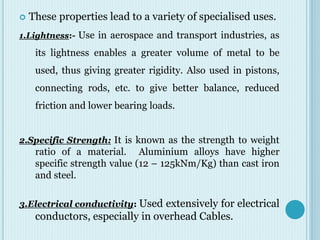
 These properties lead to a variety of specialised uses.
1.Lightness:- Use in aerospace and transport industries, as
its lightness enables a greater volume of metal to be
used, thus giving greater rigidity. Also used in pistons,
connecting rods, etc. to give better balance, reduced
friction and lower bearing loads.
2.Specific Strength: It is known as the strength to weight
ratio of a material. Aluminium alloys have higher
specific strength value (12 – 125kNm/Kg) than cast iron
and steel.
3.Electrical conductivity: Used extensively for electrical
conductors, especially in overhead Cables.
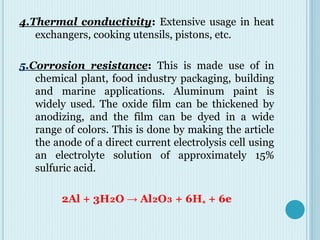
4.Thermal conductivity: Extensive usage in heat
exchangers, cooking utensils, pistons, etc.
5.Corrosion resistance: This is made use of in
chemical plant, food industry packaging, building
and marine applications. Aluminum paint is
widely used. The oxide film can be thickened by
anodizing, and the film can be dyed in a wide
range of colors. This is done by making the article
the anode of a direct current electrolysis cell using
an electrolyte solution of approximately 15%
sulfuric acid.
2Al + 3H₂O → Al₂O₃ + 6H₊ + 6e
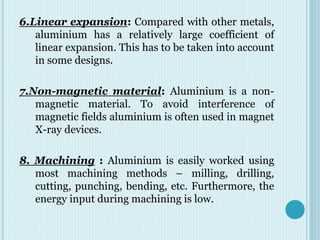
6.Linear expansion: Compared with other metals,
aluminium has a relatively large coefficient of
linear expansion. This has to be taken into account
in some designs.
7.Non-magnetic material: Aluminium is a non-
magnetic material. To avoid interference of
magnetic fields aluminium is often used in magnet
X-ray devices.
8. Machining : Aluminium is easily worked using
most machining methods – milling, drilling,
cutting, punching, bending, etc. Furthermore, the
energy input during machining is low.
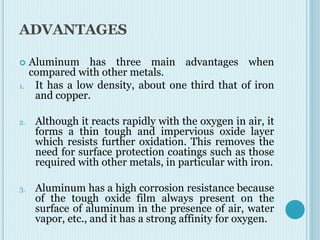
ADVANTAGES
 Aluminum has three main advantages when
compared with other metals.
1. It has a low density, about one third that of iron
and copper.
2. Although it reacts rapidly with the oxygen in air, it
forms a thin tough and impervious oxide layer
which resists further oxidation. This removes the
need for surface protection coatings such as those
required with other metals, in particular with iron.
3. Aluminum has a high corrosion resistance because
of the tough oxide film always present on the
surface of aluminum in the presence of air, water
vapor, etc., and it has a strong affinity for oxygen.
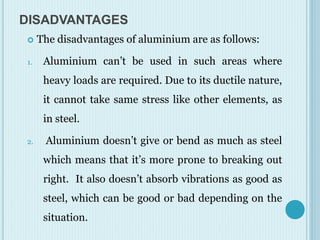
DISADVANTAGES
 The disadvantages of aluminium are as follows:
1. Aluminium can’t be used in such areas where
heavy loads are required. Due to its ductile nature,
it cannot take same stress like other elements, as
in steel.
2. Aluminium doesn’t give or bend as much as steel
which means that it’s more prone to breaking out
right. It also doesn’t absorb vibrations as good as
steel, which can be good or bad depending on the
situation.
APPLICATIONS OF AL
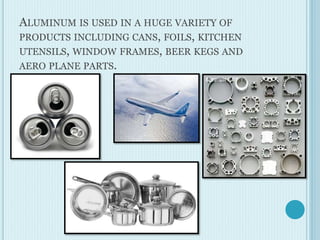
ALUMINUM IS USED IN A HUGE VARIETY OF
PRODUCTS INCLUDING CANS, FOILS, KITCHEN
UTENSILS, WINDOW FRAMES, BEER KEGS AND
AERO PLANE PARTS.
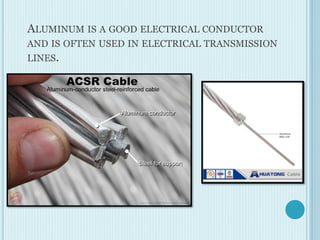
ALUMINUM IS A GOOD ELECTRICAL CONDUCTOR
AND IS OFTEN USED IN ELECTRICAL TRANSMISSION
LINES.
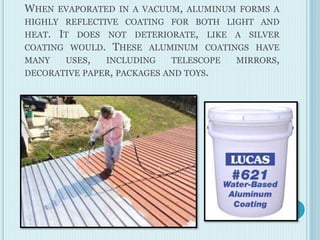
WHEN EVAPORATED IN A VACUUM, ALUMINUM FORMS A
HIGHLY REFLECTIVE COATING FOR BOTH LIGHT AND
HEAT. IT DOES NOT DETERIORATE, LIKE A SILVER
COATING WOULD. THESE ALUMINUM COATINGS HAVE
MANY USES, INCLUDING TELESCOPE MIRRORS,
DECORATIVE PAPER, PACKAGES AND TOYS.
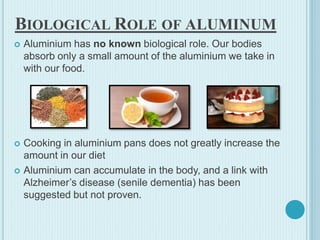
BIOLOGICAL ROLE OF ALUMINUM
 Aluminium has no known biological role. Our bodies
absorb only a small amount of the aluminium we take in
with our food.
 Cooking in aluminium pans does not greatly increase the
amount in our diet
 Aluminium can accumulate in the body, and a link with
Alzheimer’s disease (senile dementia) has been
suggested but not proven.
aluminium extraction

aluminium extraction

  • 1.
    ALUMINUM PROPERTIES, USES, EXTRACTION PROCESS,ALUMINUM ALLOYS Done By: Anubhav D. Kashyap (04) Anuj Sharma (05) Arushi Teotia (06)
  • 2.
  • 3.
  • 4.
  • 5.
    BASIC INFORMATION : Atomic number ?  Electronic configuration?  Density ?  Atomic mass?  Melting point?  Boiling point ? 13 [Ne]3s23p1 2.7 g/cm3 26.9g 2519∘C 660∘C
  • 6.
    HISTORY  Alum? is hydrateddouble sulphate salt of Al  Commander Archelaus discovered that wood was practically flame resistant if it was treated using an alum solution.  Scientist suspected an unknown metal in alum as early as 1787. 40 years Extraction Al
  • 7.
    Humphry Davy :that aluminium could be produced by electrolytic reduction from alumina (aluminium oxide). Hans Christian Oersted (Denmark) : Was successful in extracting but produced an aluminium alloy rather than pure aluminium. Friedrich Woehler [German] : continued Hans Christian’s work. 1808 1825 1827 1846 Friedrich created small balls of solidified molten aluminium (globules) 1856 Henri-Etienne Sainte-Claire Deville[French] : industrial applications. [DEVILLE PROCESS] 1856-1890 200 tonnes of Al were produced in 36 years
  • 8.
    BUT…… o Chou-Chu o generalof ancient China during the third century. o Upon digging his tomb, historians found a piece of jewellery. 85% of the material of the jewellery was actually aluminium
  • 9.
    INTRODUCTION  Aluminium isfound in many rock minerals, usually combined with silicon and oxygen in compounds called Alumino silicates. Example: Kayanite (Al₂O(SIO₄)), Topaz (Al₂O(SIO₄)(OH,F)₂), Kaolinite (Al₂Si₂O₃(OH)₄) etc.  Under certain types of tropical soil weathering these alumina-silicate compounds are separated into layers of hydrated iron oxide, hydrated alumina and silica. Example: Al(OH)₃, Al₂O₃.3H₂O etc.  When such deposits are rich in alumina, this comprise the mineral bauxite. Bauxite is a mixture of gibbsite (Al(OH)₃), boehmite (AlO(OH)) and diaspore (AlO(OH)); and has a general formula of Al₂O₃.x2H₂O
  • 10.
    ALUMINUM ORES  Thereare a large number of minerals and rocks containing aluminum; however, only a few of them can be used for extracting metallic aluminum.  Bauxites are the most widely used raw materials for aluminum.  Initially a semifinished product, alumina (A12O3) is extracted from the ores, and the metallic aluminum is produced electrolytically from the alumina.  Nepheline-syenites as well as nepheline-apatites are also used as aluminum ores. These minerals are simultaneously used as a source of phosphates.  Other minerals which can be used as a source of aluminum include alunites, leucitic lavas (the mineral leucite), labradorites, anorthosites, and high-alumina clays and kaolins.
  • 11.
    BAUXITE  Bauxite isthe most important aluminium ore. It consists largely of the minerals gibbsite Al(OH)3, boehmite γ- AlO(OH), and diaspore α-AlO(OH), together with the iron oxides goethite and hematite.  Bauxite does not have a specific composition. It is a mixture of hydrous aluminum oxides, aluminum hydroxides, clay minerals, and insoluble materials such as quartz, hematite, magnetite, siderite, and goethite.  Bauxite is typically a soft (H:1-3), white to gray to reddish brown material with a pisolitic structure, earthy luster and a low specific gravity (SG: 2.0-2.5).  Bayer’s Process is the main process for the production of bauxite.
  • 12.
    RAW MATERIAL WITHUSES FOR THE EXTRACTION OF ALUMINIUM RAW MATERIAL USE Alumina Source of Aluminium Crude Oil Making Coke Coal Making Pitch Coke, Pitch Electrode Manufacture Cryolite (Na₃AlF₆) Dissolving Alumina at 970⁰C (synthetically produced) Electricity Reduction of Alumina to Aluminium
  • 13.
    EXTRACTION PROCESS 1.DEVILLE PROCESS 2.SERPECK’SPROCESS 3.HALL-HEROULT PROCESS 4.BAYERS PROCESS
  • 14.
    1.DEVILLE PROCESS  firstindustrial process.  based on the extraction of alumina with sodium carbonate. Calcination of the bauxite at 1200 °C with sodium carbonate and coke. The alumina is converted in sodium aluminate. Iron oxide remains unchanged and silica forms a polysilicate.
  • 15.
    sodium hydroxide solutionis added, which dissolves the sodium aluminate, leaving the impurities as a solid residue. The solution is filtered off; carbon dioxide is bubbled through the solution, causing aluminium hydroxide to precipitate, leaving a solution of sodium carbonate The latter can be recovered and reused in the first stage. The aluminium hydroxide is calcined to produce alumina.
  • 16.
    2.SERPECK’S PROCESS  Thisprocess is used for the purification of bauxite ore containing silica (SiO2) as the main impurity.  The powdered ore is mixed with coke and the mixture is heated at about 1800°C in the presence of Nitrogen gas, when aluminium nitride is formed. Al2O3. 2H2O + 3C + N2 → 2AI N + 3CO+ 2H2O  Aluminium nitride thus obtained is hydrolysed with water to get a precipitate of Al(OH)3. 2Al N + 6H2O → 2NH3 + Al(OH)3  The precipitate of Al (OH)3 is filtered, washed and dried. The silica present as impurity in bauxite is reduced to silicon which being volatile at high temperature. is removed easily. SiO2 + 2C → Si + 2CO
  • 17.
    3.HALL-HÉROULT PROCESS  Aluminium'sdevelopment changed with the discovery of a more cost-efficient electrolytic production method in 1886.  It was developed by Paul Héroult, a French engineer, and Charles Hall, an American student, independently and at the same time.  The method involved the reduction of molten aluminium oxide in cryolite.  The process demonstrated excellent results, but required an enormous amount of electric power.
  • 19.
    4.BAYER’S PROCESS STEP-1: Purificationof bauxite - This is a two-step process called Bayer's process: a) First, we dissolve bauxite in aqueous sodium hydroxide(NaOH) by digestion. Bauxite with higher hydroxide contents (Al(OH)3) are treated at 120-140° C with dilute(3M) NaOH and bauxite with higher oxide content('AlOOH') is treated at a higher temperature(200- 250° C) and a higher pressure (35 atm) with 5-7M NaOH. b)The insoluble impurities are separated by filtration. Al(OH)3 is precipitated by carbon dioxide and ignited to ~1200° C to obtain Al2 O3.
  • 20.
    STEP-2: Purified bauxiteis then dissolved in cryolite(5-7% CaF2 , 5-7% AlF3, 2-8% Al2 O3) and electrolyzed at 950° C in a carbon lined steel cathode with hard carbon rods as the anode. Li2 CO3 is used to (i) lower the melting point of the electrolyte (ii) permit larger current flow and (iii) reduce fluorine emission.  The resulting reactions are produced: Al2 O3 → 2Al3+ + 3O–  At Cathode (positive electrode where reduction occurs by gain of electrons) : 2 Al3++ 6e- → 2Al  At Anode (negative electrode where oxidation occurs by loss of electrons): 3O-- - 6e- → 3O
  • 22.
    ALLOYS OF ALUMINIUM Aluminium alloy Aluminium (Al) is the predominant metal.  The typical alloying elements are copper, magnesium, manganese, silicon, tin and zinc.  There are two principal classifications, namely casting alloys and wrought alloys, both of which are further subdivided into the categories heat - treatable and non-heat-treatable.  The most important cast aluminium alloy system is Al–Si, where the high levels of silicon (4.0–13%) contribute to give good casting characteristics.
  • 23.
    ALLOYS OF ALUMINIUMAND IT’S COMPOSITION Alloy Name Al (%) Cu (%) Mn (%) Mg (%) Zn (%) Duralumin 95 4 0.5 0.5 - Magnalium 70-90 - - 30.10 - Elektron 9-10 - 0.5 87-86 3.5
  • 24.
    ALUMINIUM ALLOYS WITHTHEIR USES Major alloy element Content Product Some typical uses Copper Up to 4.5% Sheet Extrusions Castings High strength aircraft parts Manganese 1.2% Sheet Sheetmetal work,pots etc. Silicon Up to 13% Castings Motor parts etc. Magnesium and Silicon 0.7% Mg, 0.4% Si Sheet Extrusions Architectural extrusions Magnesium Up to 5% Sheet Marine, boats etc. Zinc, Magnesium and Copper 5.8% Zn, 2.5% Mg, 1.4% Cu Sheet Extrusions High strength aircraft
  • 25.
    PROPERTIES OF ALUMINIUM It has low density, is non-toxic, has a high thermal conductivity, has excellent corrosion resistance and can be easily cast, machined and formed.  It is the second most malleable metal and the sixth most ductile.  It is cheaper than copper and weight for weight is almost twice as good a conductor.  It is often used as an alloy because aluminium itself is not particularly strong.
  • 26.
     These propertieslead to a variety of specialised uses. 1.Lightness:- Use in aerospace and transport industries, as its lightness enables a greater volume of metal to be used, thus giving greater rigidity. Also used in pistons, connecting rods, etc. to give better balance, reduced friction and lower bearing loads. 2.Specific Strength: It is known as the strength to weight ratio of a material. Aluminium alloys have higher specific strength value (12 – 125kNm/Kg) than cast iron and steel. 3.Electrical conductivity: Used extensively for electrical conductors, especially in overhead Cables.
  • 27.
    4.Thermal conductivity: Extensiveusage in heat exchangers, cooking utensils, pistons, etc. 5.Corrosion resistance: This is made use of in chemical plant, food industry packaging, building and marine applications. Aluminum paint is widely used. The oxide film can be thickened by anodizing, and the film can be dyed in a wide range of colors. This is done by making the article the anode of a direct current electrolysis cell using an electrolyte solution of approximately 15% sulfuric acid. 2Al + 3H₂O → Al₂O₃ + 6H₊ + 6e
  • 28.
    6.Linear expansion: Comparedwith other metals, aluminium has a relatively large coefficient of linear expansion. This has to be taken into account in some designs. 7.Non-magnetic material: Aluminium is a non- magnetic material. To avoid interference of magnetic fields aluminium is often used in magnet X-ray devices. 8. Machining : Aluminium is easily worked using most machining methods – milling, drilling, cutting, punching, bending, etc. Furthermore, the energy input during machining is low.
  • 29.
    ADVANTAGES  Aluminum hasthree main advantages when compared with other metals. 1. It has a low density, about one third that of iron and copper. 2. Although it reacts rapidly with the oxygen in air, it forms a thin tough and impervious oxide layer which resists further oxidation. This removes the need for surface protection coatings such as those required with other metals, in particular with iron. 3. Aluminum has a high corrosion resistance because of the tough oxide film always present on the surface of aluminum in the presence of air, water vapor, etc., and it has a strong affinity for oxygen.
  • 30.
    DISADVANTAGES  The disadvantagesof aluminium are as follows: 1. Aluminium can’t be used in such areas where heavy loads are required. Due to its ductile nature, it cannot take same stress like other elements, as in steel. 2. Aluminium doesn’t give or bend as much as steel which means that it’s more prone to breaking out right. It also doesn’t absorb vibrations as good as steel, which can be good or bad depending on the situation.
  • 31.
  • 32.
    ALUMINUM IS USEDIN A HUGE VARIETY OF PRODUCTS INCLUDING CANS, FOILS, KITCHEN UTENSILS, WINDOW FRAMES, BEER KEGS AND AERO PLANE PARTS.
  • 33.
    ALUMINUM IS AGOOD ELECTRICAL CONDUCTOR AND IS OFTEN USED IN ELECTRICAL TRANSMISSION LINES.
  • 34.
    WHEN EVAPORATED INA VACUUM, ALUMINUM FORMS A HIGHLY REFLECTIVE COATING FOR BOTH LIGHT AND HEAT. IT DOES NOT DETERIORATE, LIKE A SILVER COATING WOULD. THESE ALUMINUM COATINGS HAVE MANY USES, INCLUDING TELESCOPE MIRRORS, DECORATIVE PAPER, PACKAGES AND TOYS.
  • 35.
    BIOLOGICAL ROLE OFALUMINUM  Aluminium has no known biological role. Our bodies absorb only a small amount of the aluminium we take in with our food.  Cooking in aluminium pans does not greatly increase the amount in our diet  Aluminium can accumulate in the body, and a link with Alzheimer’s disease (senile dementia) has been suggested but not proven.