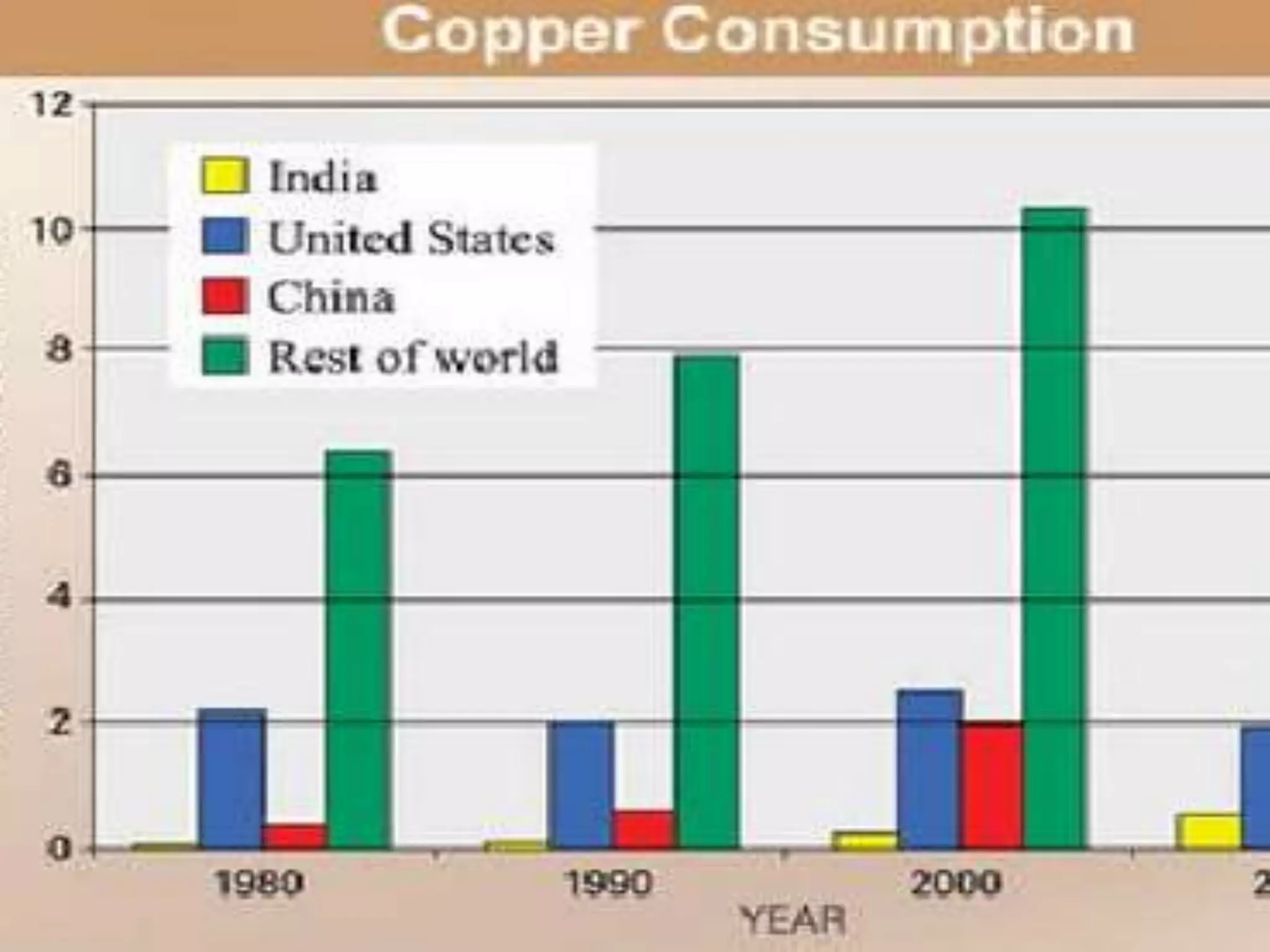
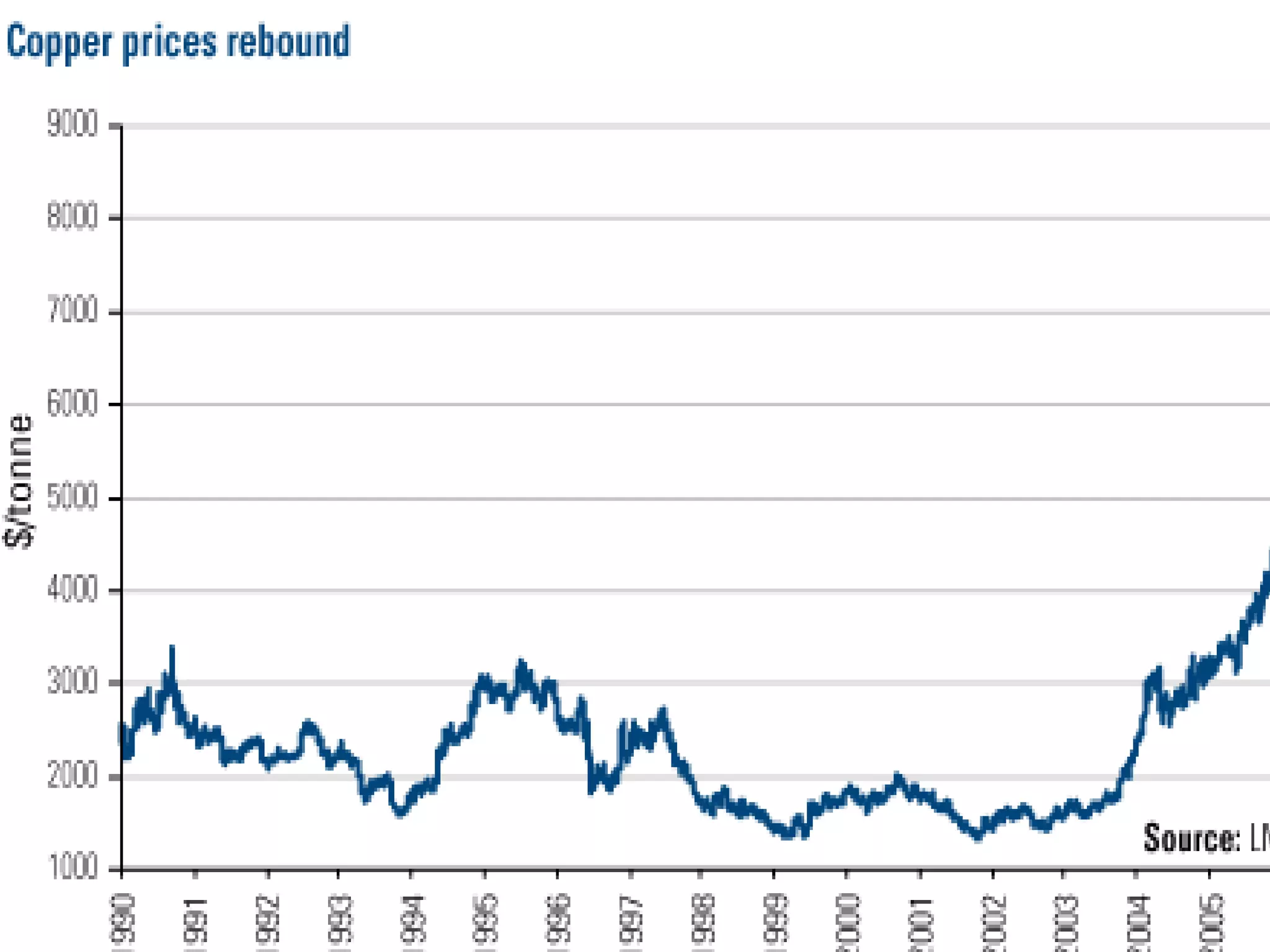
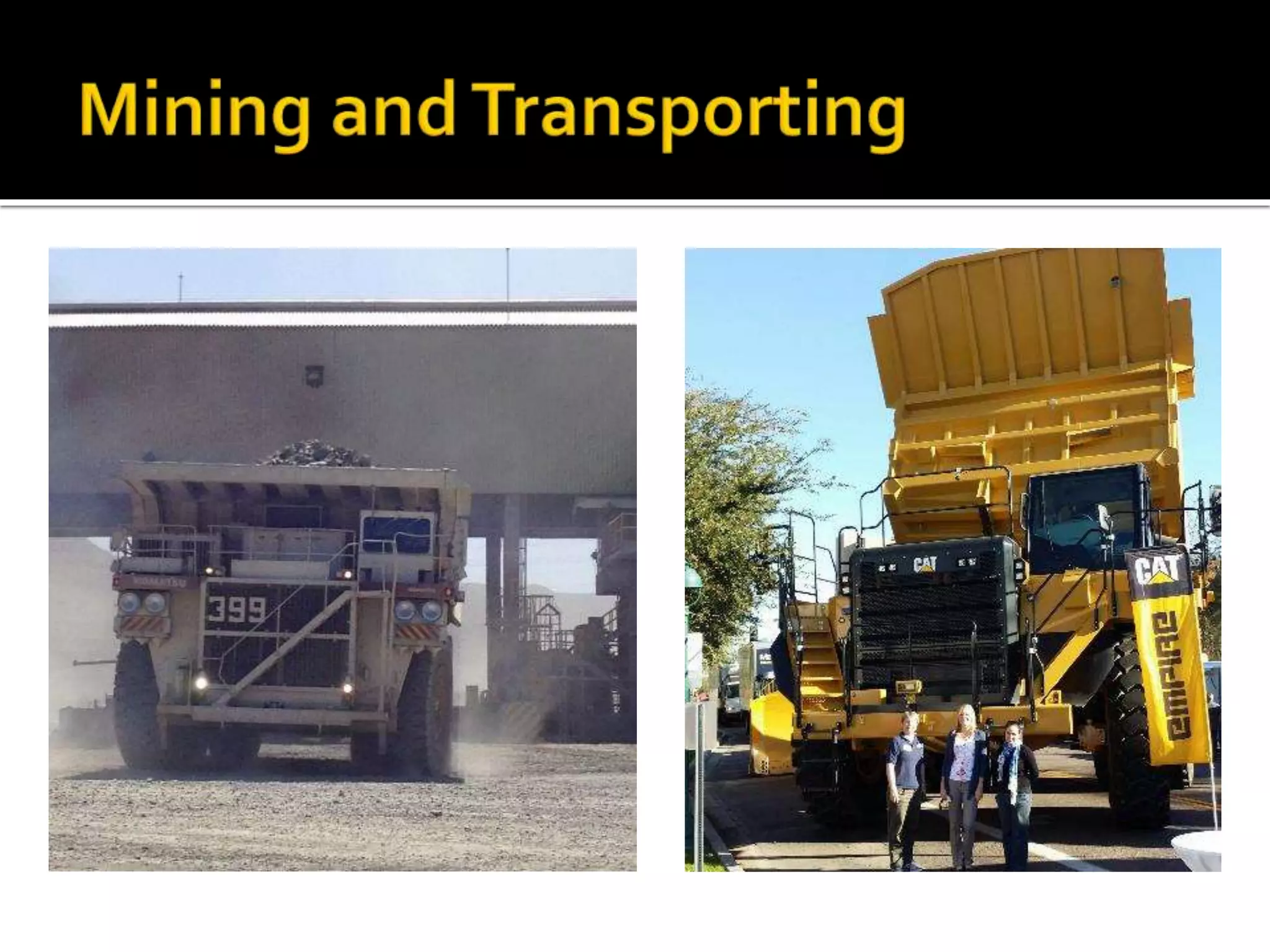
This document provides information about copper, including its properties, common ores, extraction processes, history of use, applications, and modern uses. It notes that copper is a reddish-orange metal that is highly conductive and resistant to corrosion. It can be extracted from native copper deposits or various copper-containing ores using hydrometallurgy (for oxide ores) or pyrometallurgy (for sulfide ores) to yield 99.99% pure copper. Major applications of copper include electrical wiring, electronics, cooking pots, jewelry, and alloys like bronze and brass.
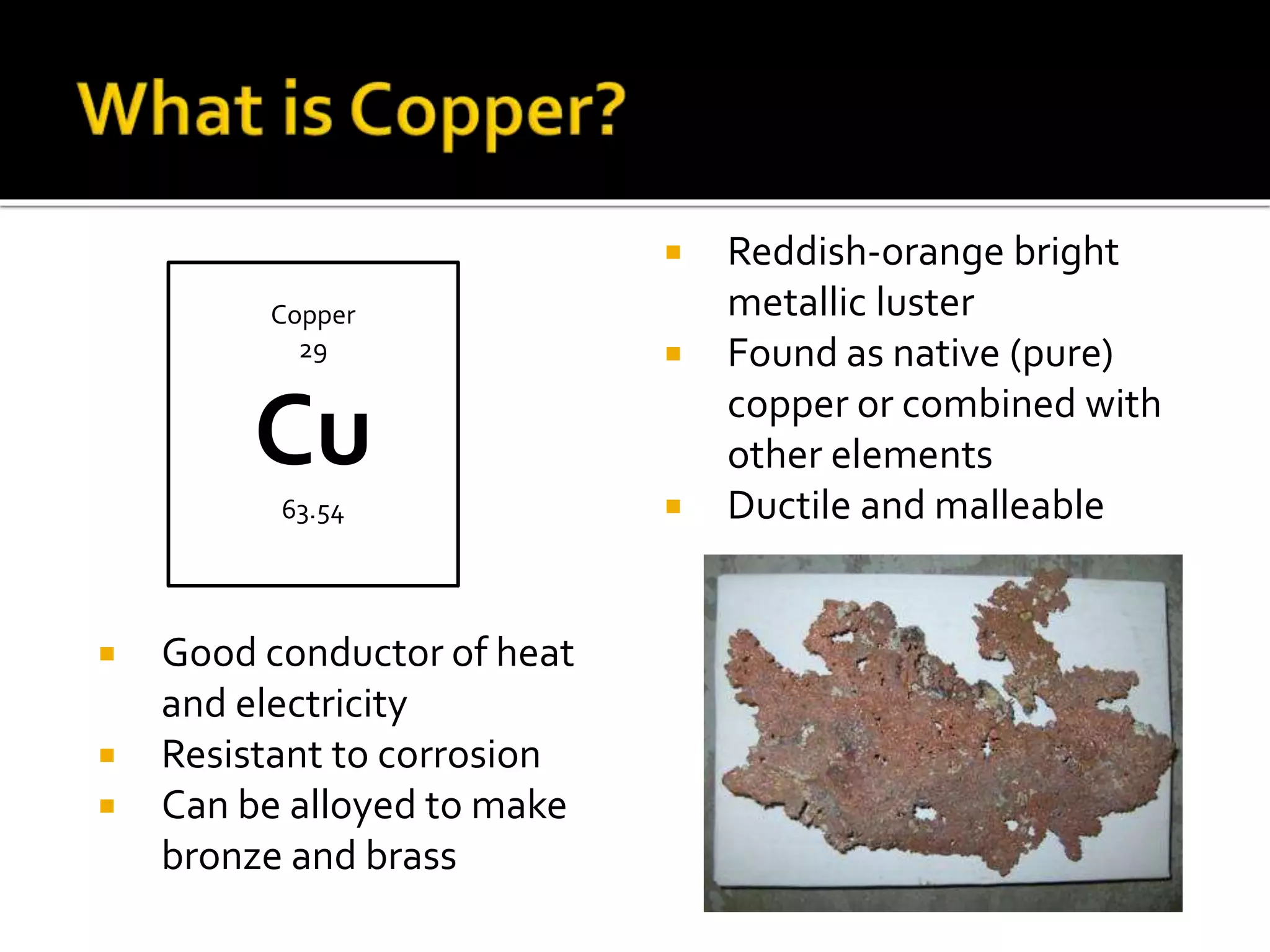
Reddish-orange bright
metallicluster
Found as native (pure)
copper or combined with
other elements
Ductile and malleable
Good conductor of heat
and electricity
Resistant to corrosion
Can be alloyed to make
bronze and brass
Copper
29
Cu
63.54
3.
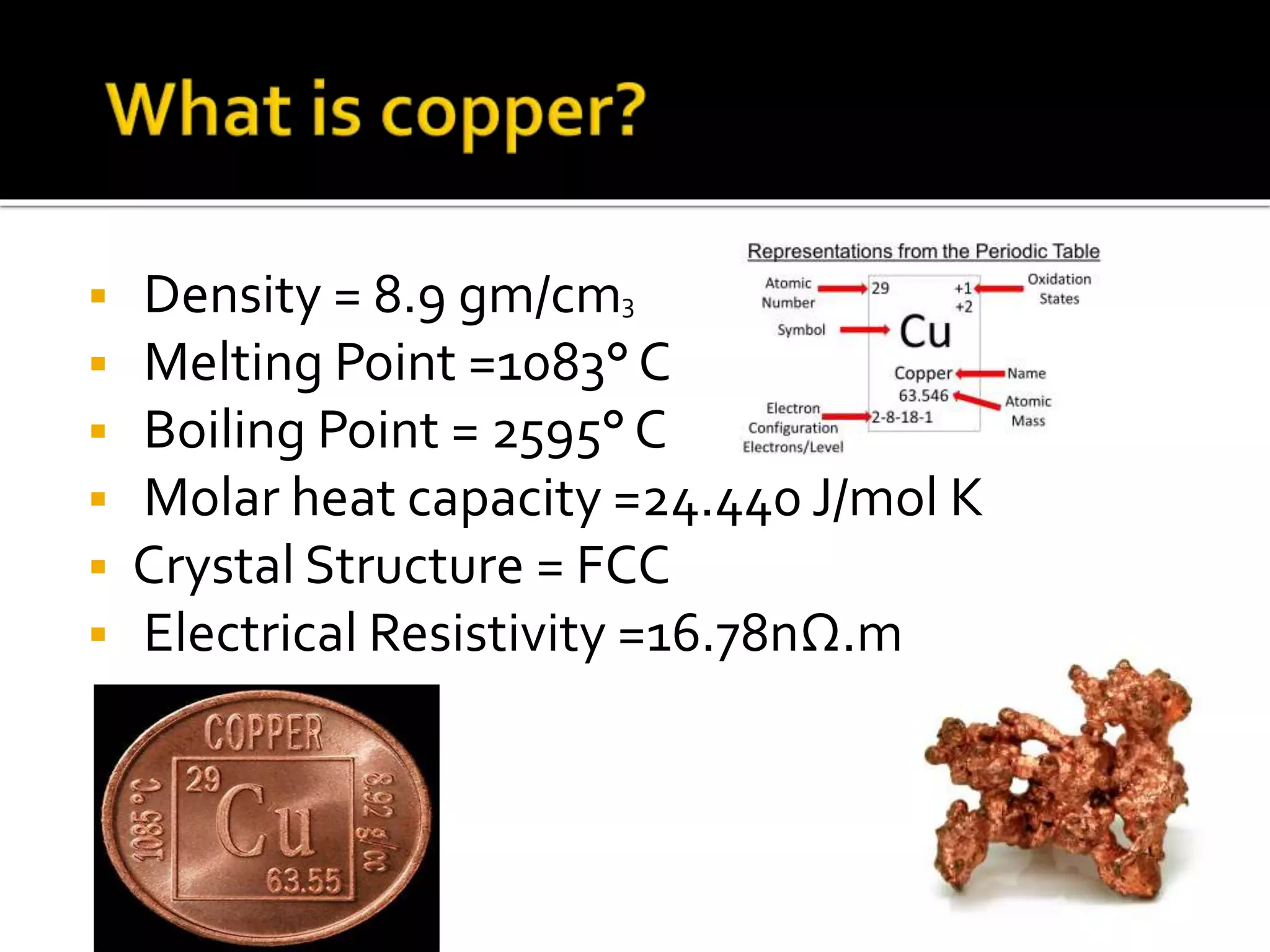
Density =8.9 gm/cm3
Melting Point =1083° C
Boiling Point = 2595° C
Molar heat capacity =24.440 J/mol K
Crystal Structure = FCC
Electrical Resistivity =16.78nΩ.m
Copper oresare complex
Can contain metals, other elements, and non-
metallic minerals
Depending on the ore, it requires different
mining and extraction processes to yield
99.99% pure copper
6.
Discovered: early9000 BC in Middle East
Early artifacts used native (pure) copper
Utensils, tools, weapons, piping, ornaments, and
jewelry
Chalcolithic period: ~3500-2500 BC
Rise in the use and smelting of copper
Discovery of bronze alloy
Early Romans discovered brass alloy
Copper and brass as currency
7.
Largest depositof native copper found in
Michigan at Keweenaw mines
NativeAmericans mined copper~5000–1200 BC
Found as knives, arrows, spear heads, and axes
throughout Americas
Copper not mined on a commercial scale until
1840s
8.
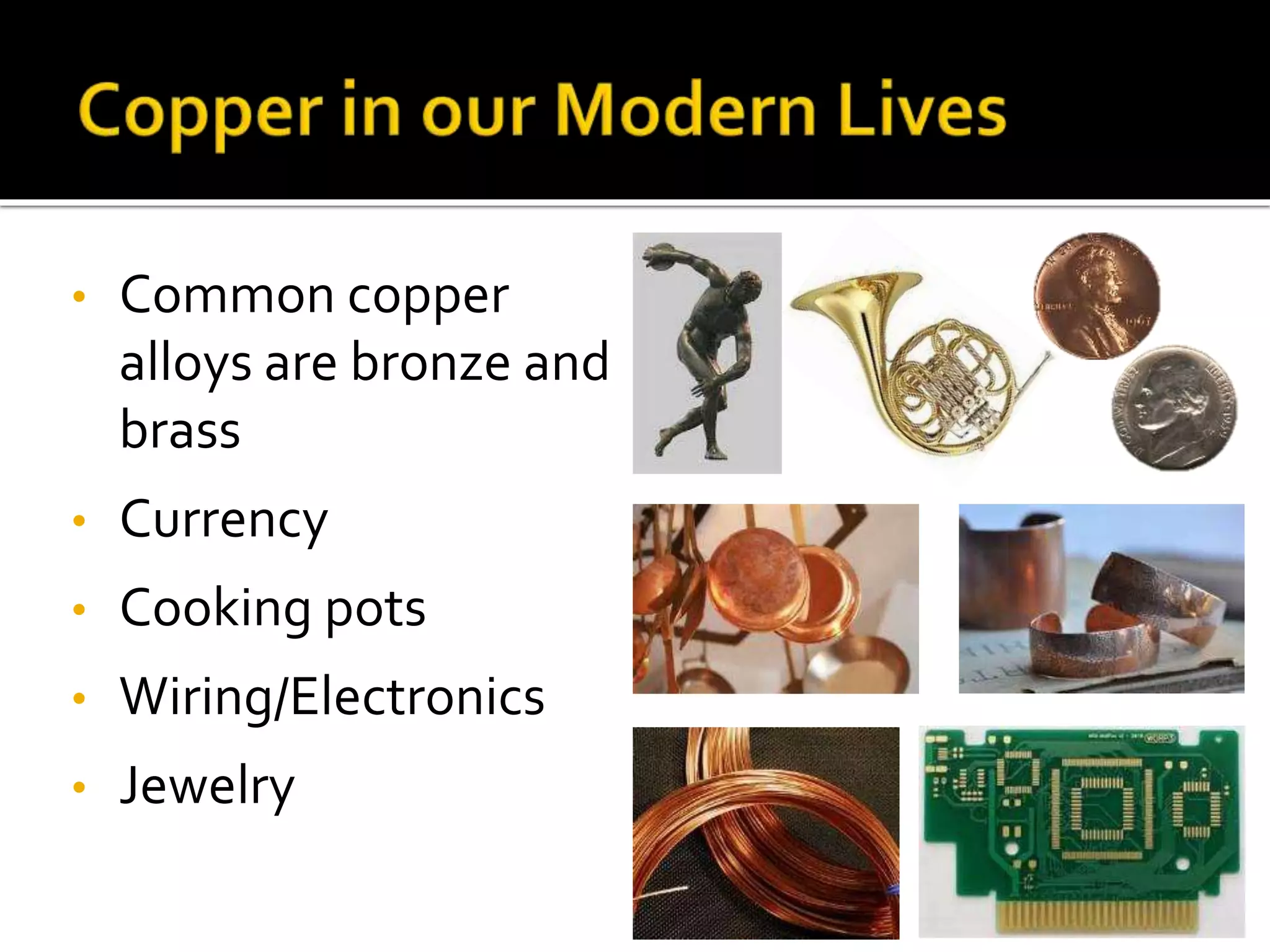
• Common copper
alloysare bronze and
brass
• Currency
• Cooking pots
• Wiring/Electronics
• Jewelry
9.
Excellent Electrical&Thermal Conductor
ExcellentCorrosion Resistance
ExcellentWorkability
Antimicrobial
An Abundant Element
10.
Copper consumption bymajor U.S. markets in 2013. Source: Copper Development Association Inc. Annual Data (2014).
Type of Market
Copper
Consumption
[million lbs.]
Examples
Construction 2,233 Wiring, heating/refrigeration, and plumbing
Electrical and
Electronics
978
Power utilities, cell phones, computers, lighting, and
anything with an on/off switch
Consumer and
General Products
627
Currency, cookware, household appliances, coins,
etc.
Transportation
Equipment
982 Airplanes, cars, trucks, trains, etc.
Industrial Equipment 378
Manufacturing machinery, on-site equipment, off-
highway vehicles, and transmission lines
14.
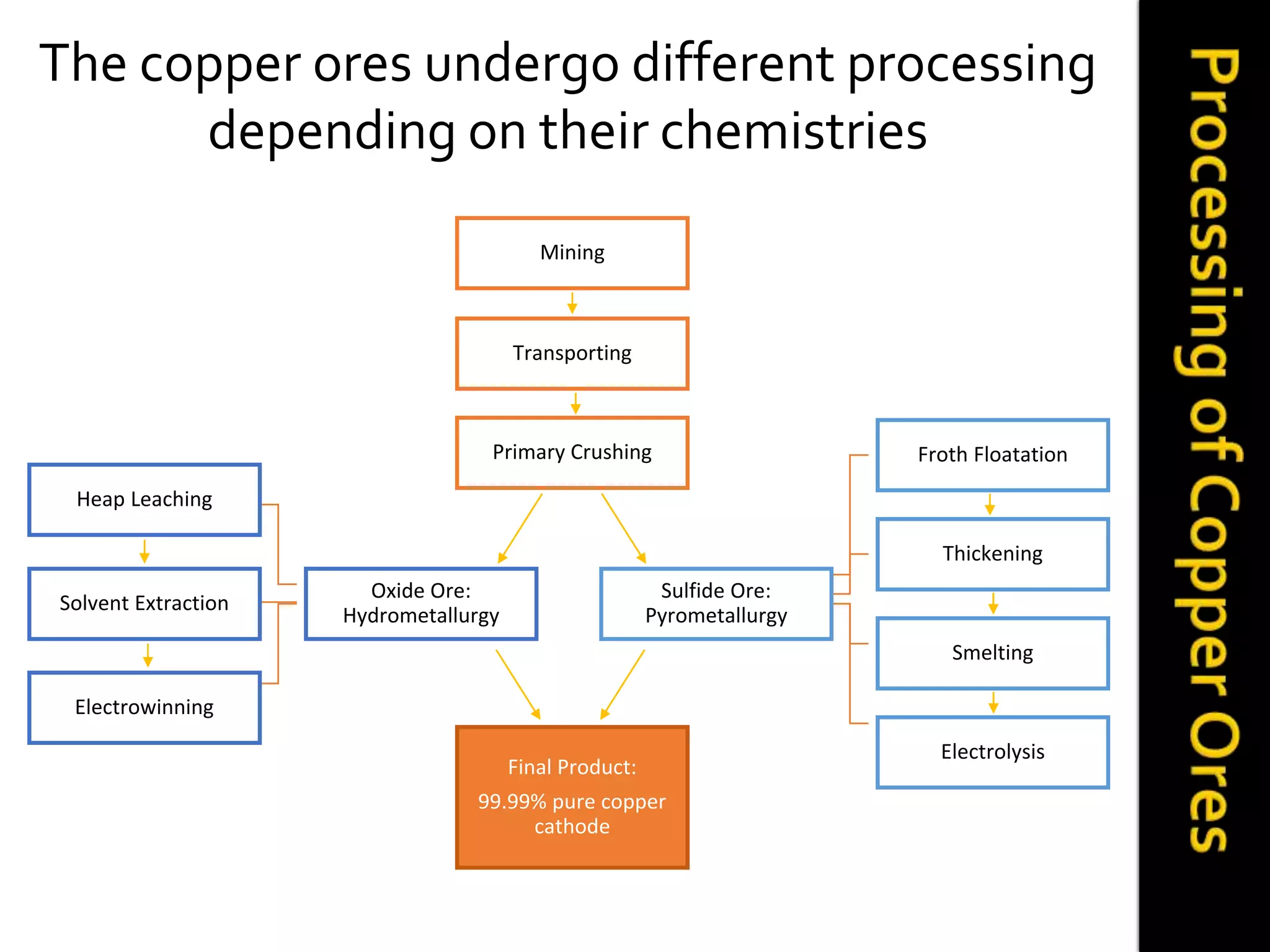
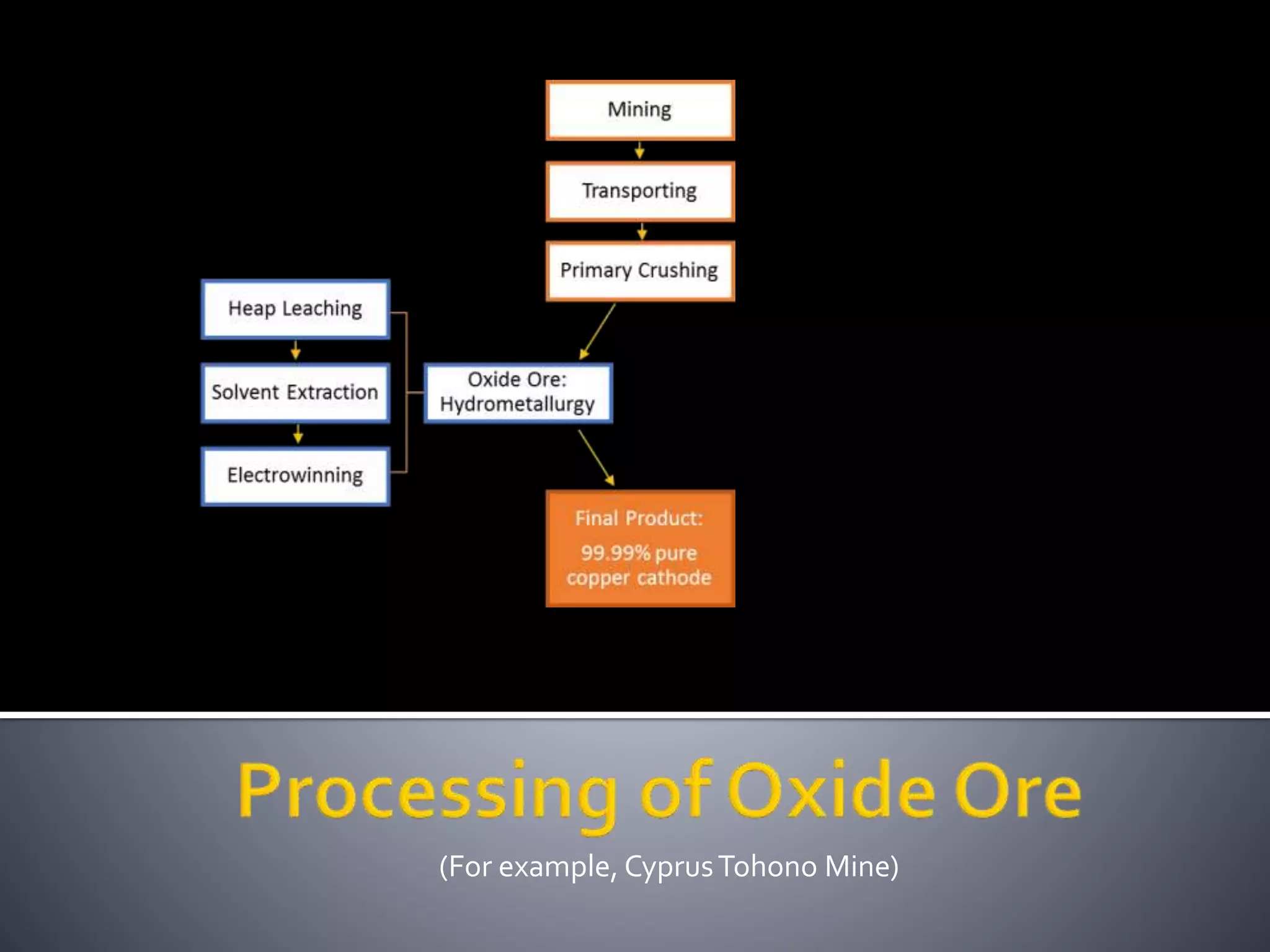
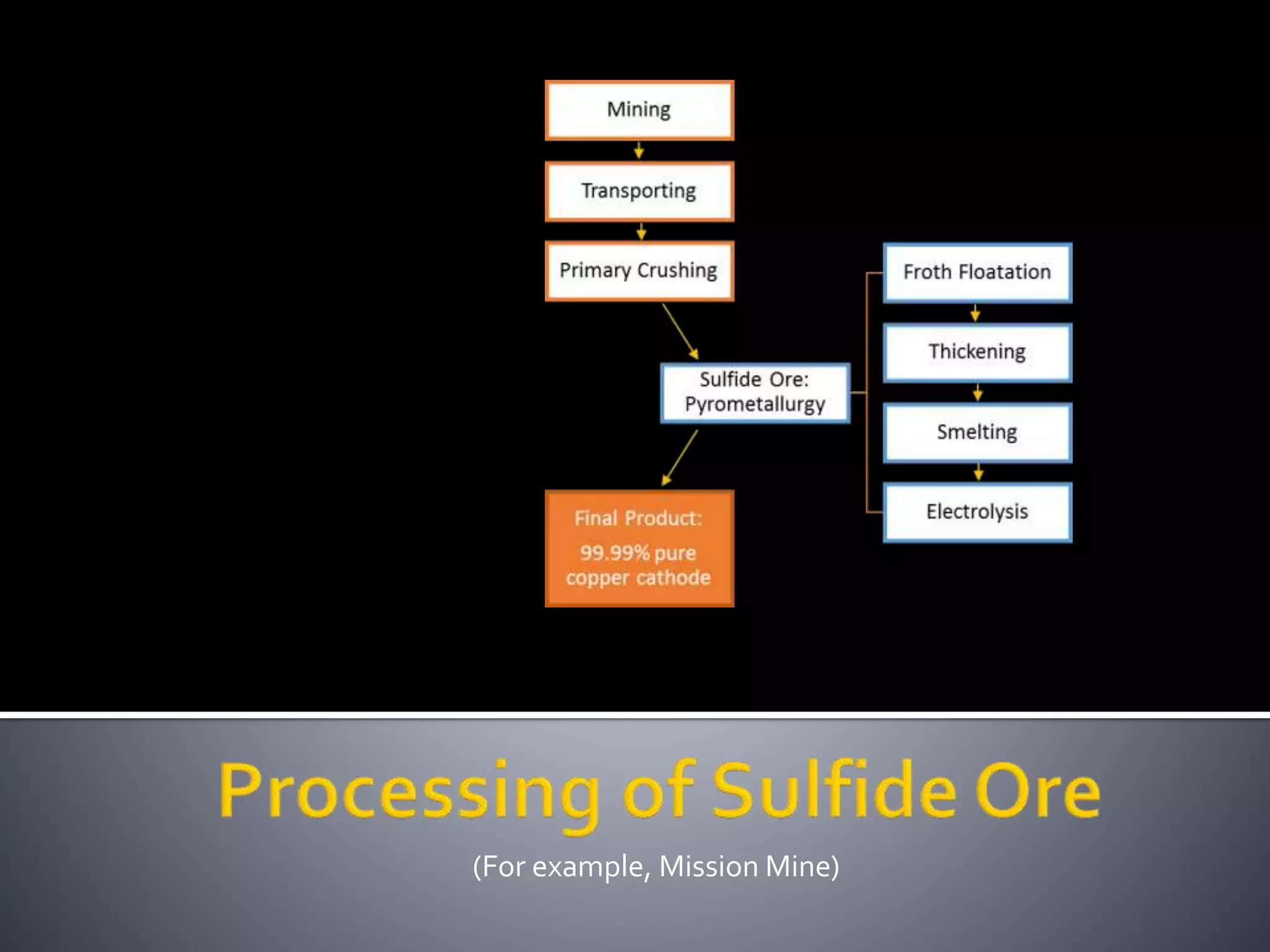
The copper oresundergo different processing
depending on their chemistries
Oxide Ore:
Hydrometallurgy
Heap Leaching
Solvent Extraction
Electrowinning
Mining
Transporting
Primary Crushing
Sulfide Ore:
Pyrometallurgy
Froth Floatation
Thickening
Smelting
Electrolysis
Final Product:
99.99% pure copper
cathode
16.
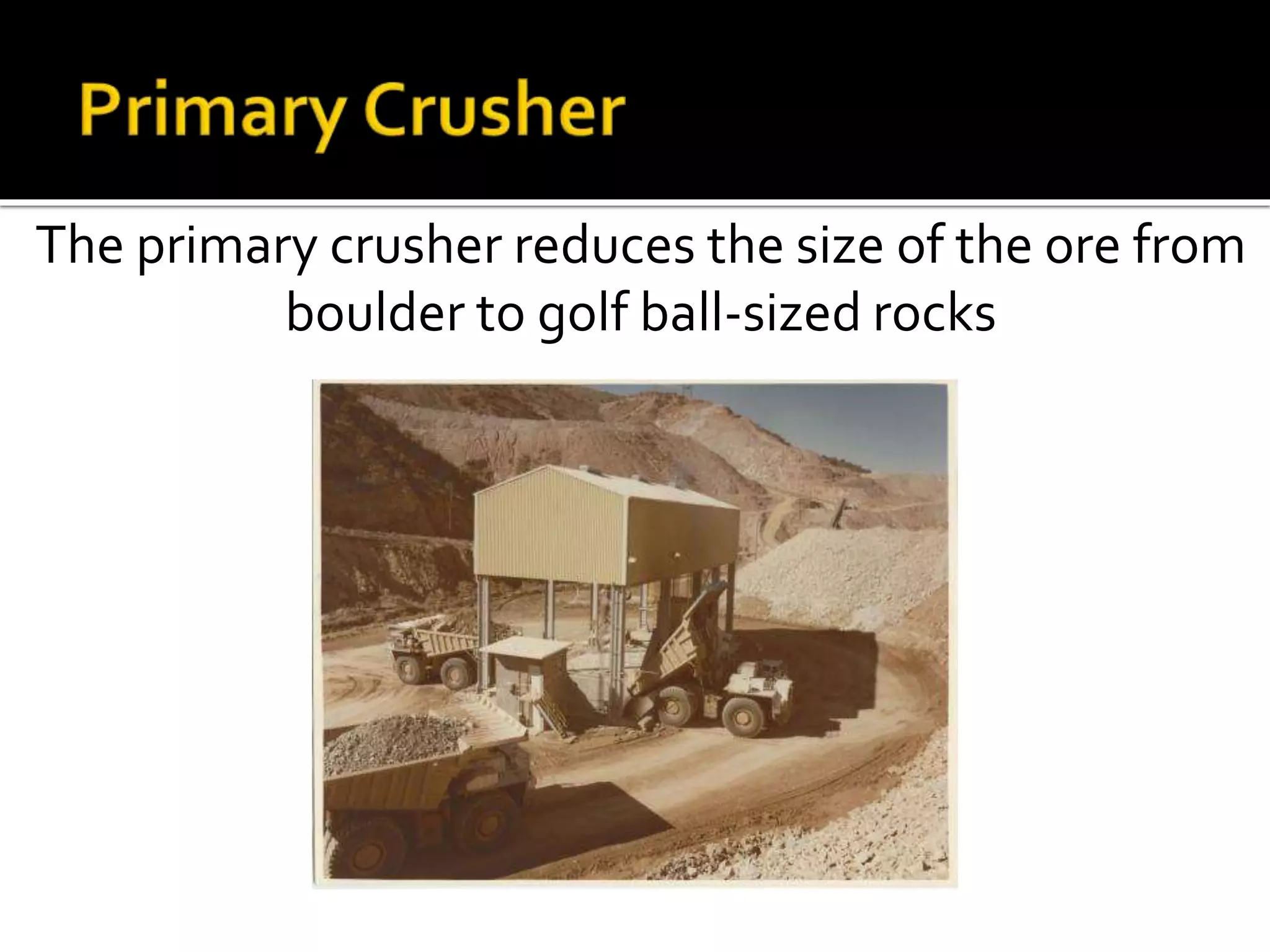
The primary crusherreduces the size of the ore from
boulder to golf ball-sized rocks
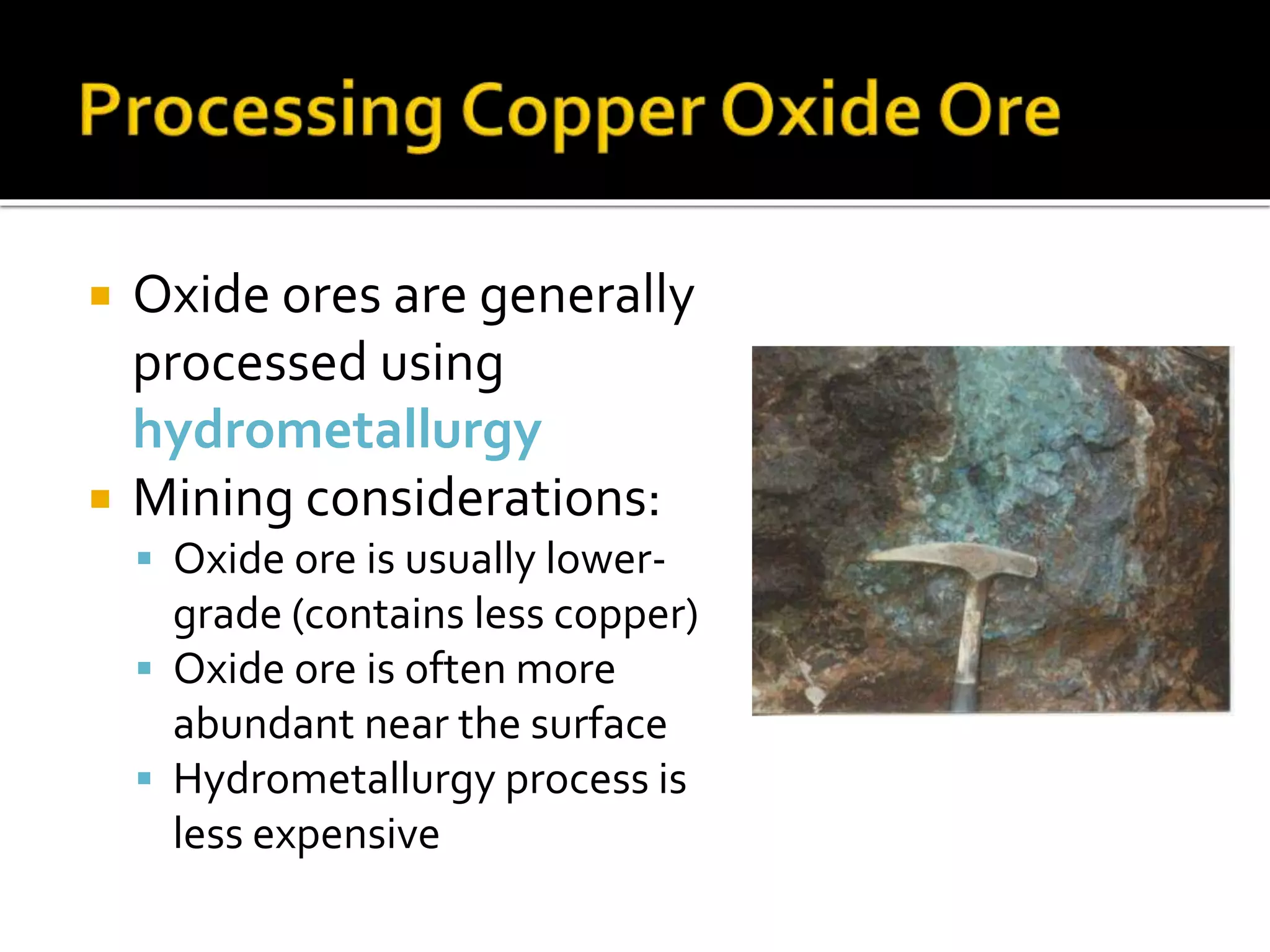
Oxide oresare generally
processed using
hydrometallurgy
Mining considerations:
Oxide ore is usually lower-
grade (contains less copper)
Oxide ore is often more
abundant near the surface
Hydrometallurgy process is
less expensive
19.
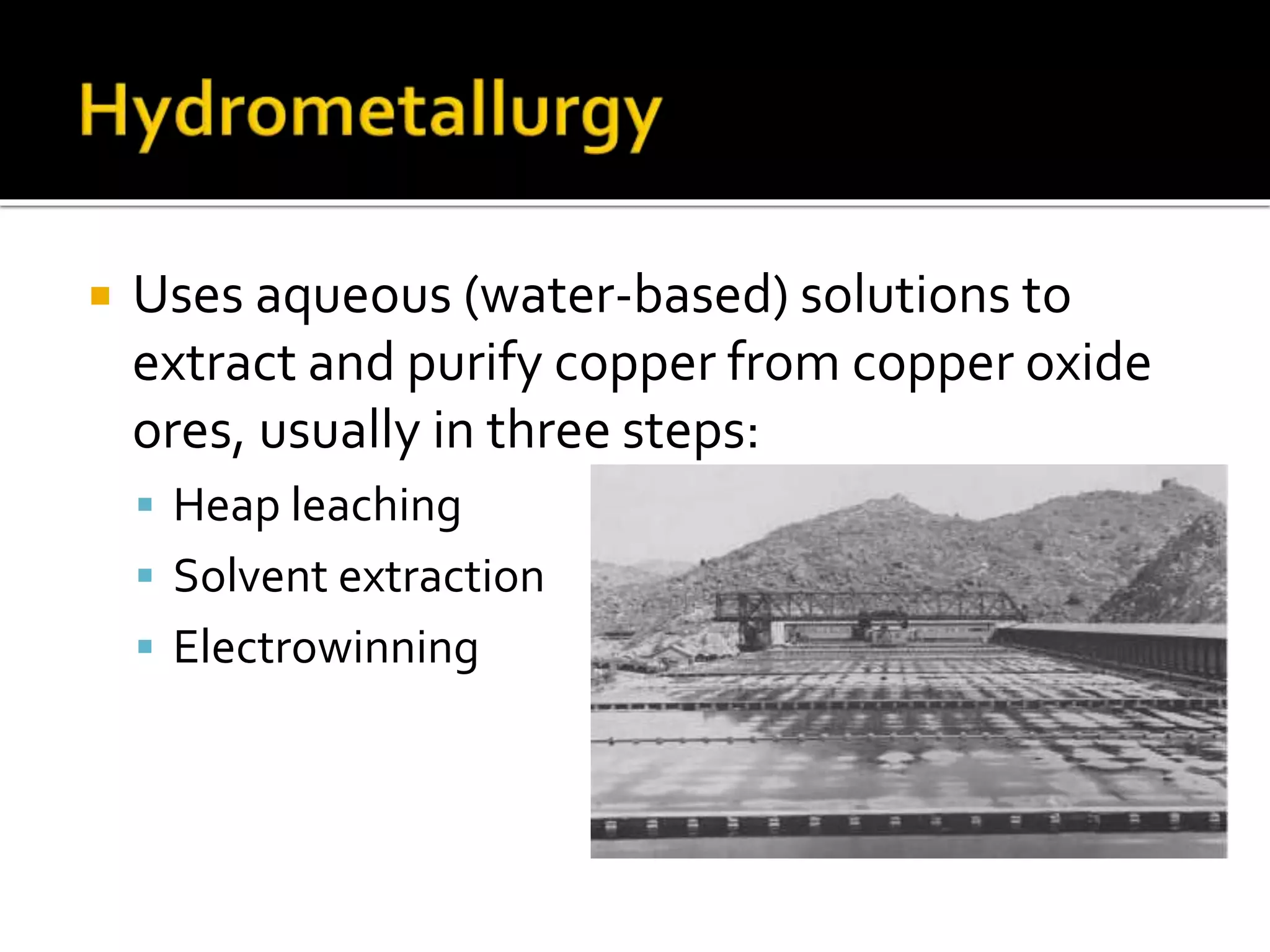
Uses aqueous(water-based) solutions to
extract and purify copper from copper oxide
ores, usually in three steps:
Heap leaching
Solvent extraction
Electrowinning
20.
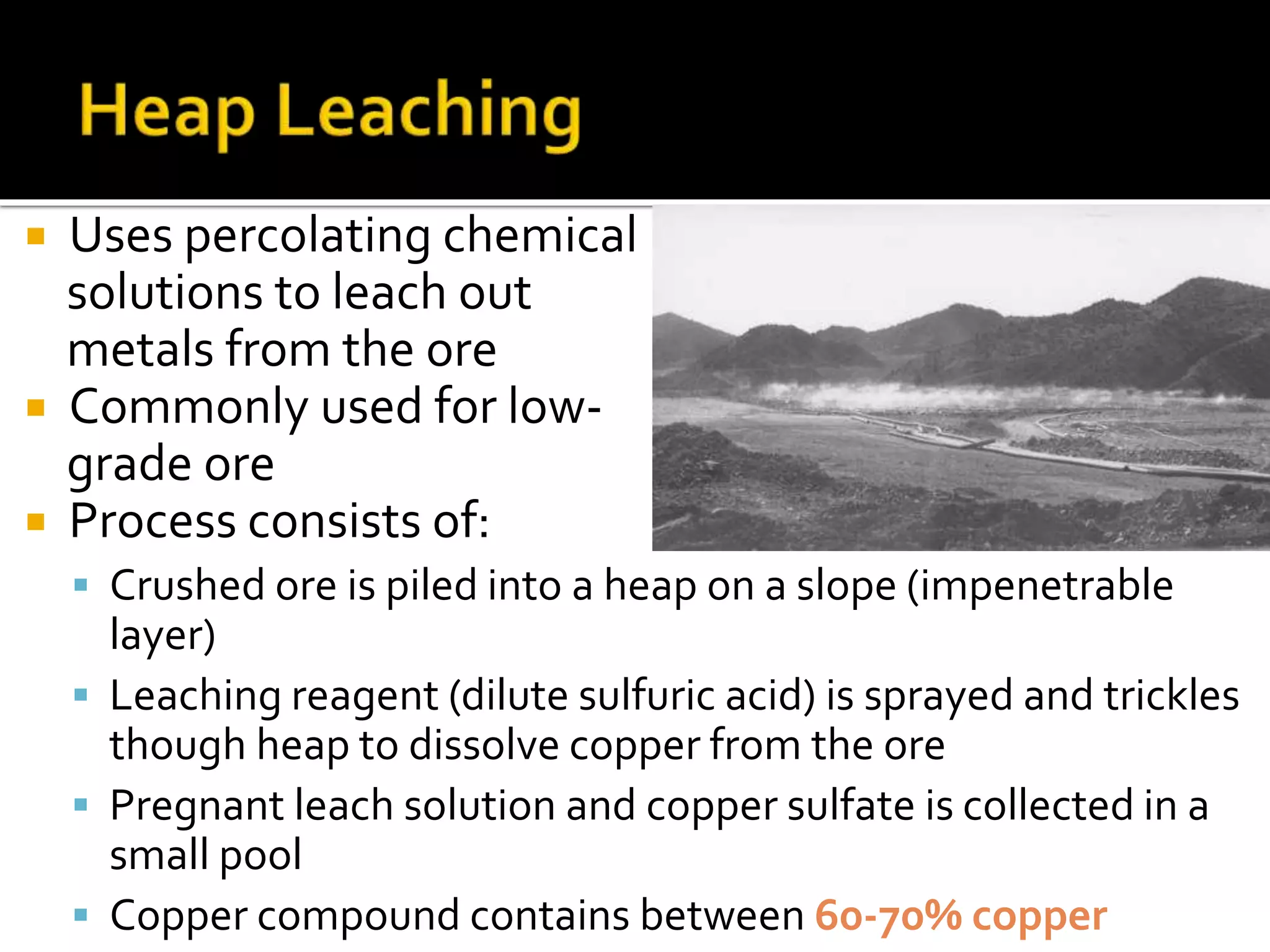
Uses percolatingchemical
solutions to leach out
metals from the ore
Commonly used for low-
grade ore
Process consists of:
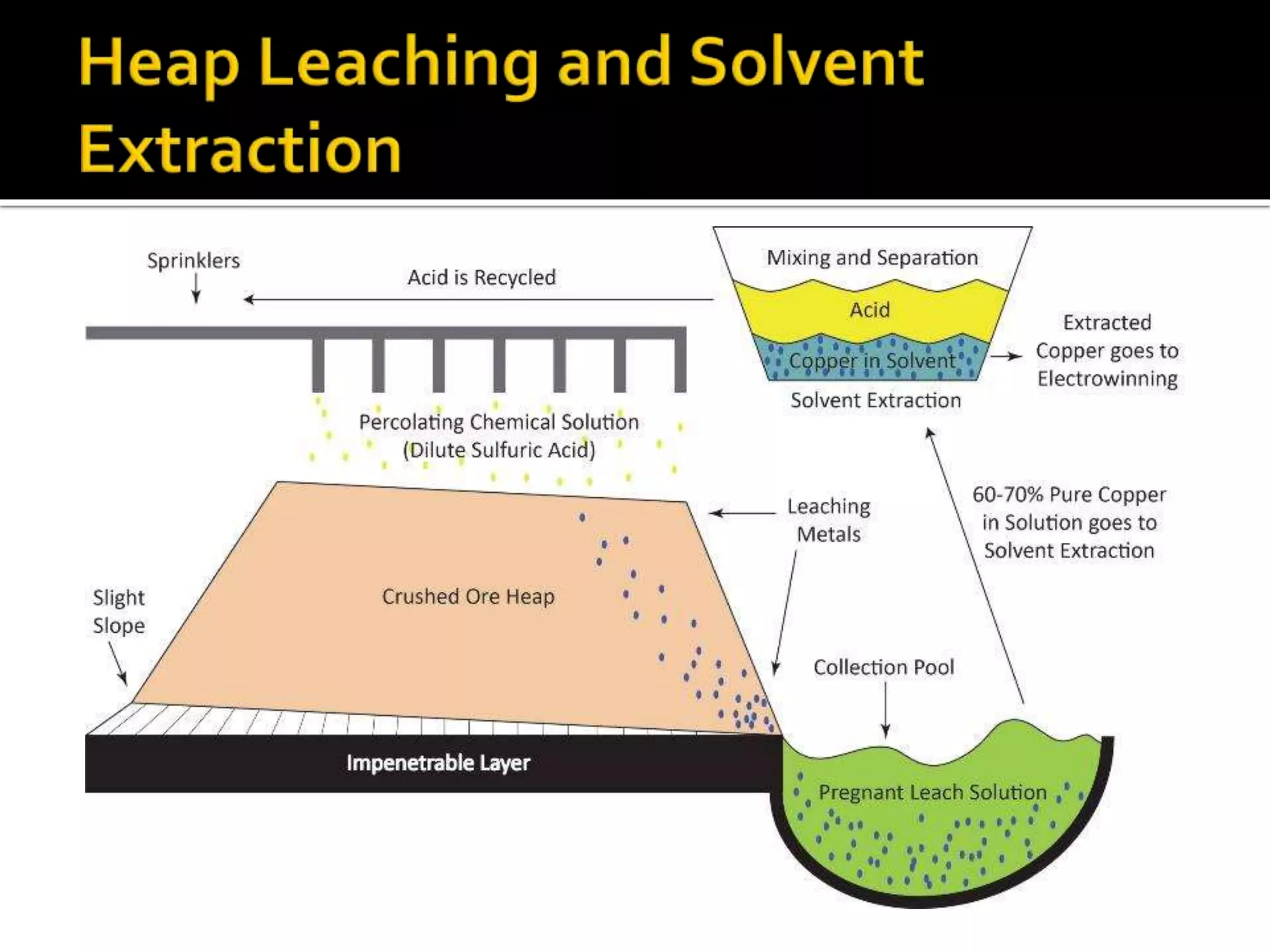
Crushed ore is piled into a heap on a slope (impenetrable
layer)
Leaching reagent (dilute sulfuric acid) is sprayed and trickles
though heap to dissolve copper from the ore
Pregnant leach solution and copper sulfate is collected in a
small pool
Copper compound contains between 60-70% copper
21.
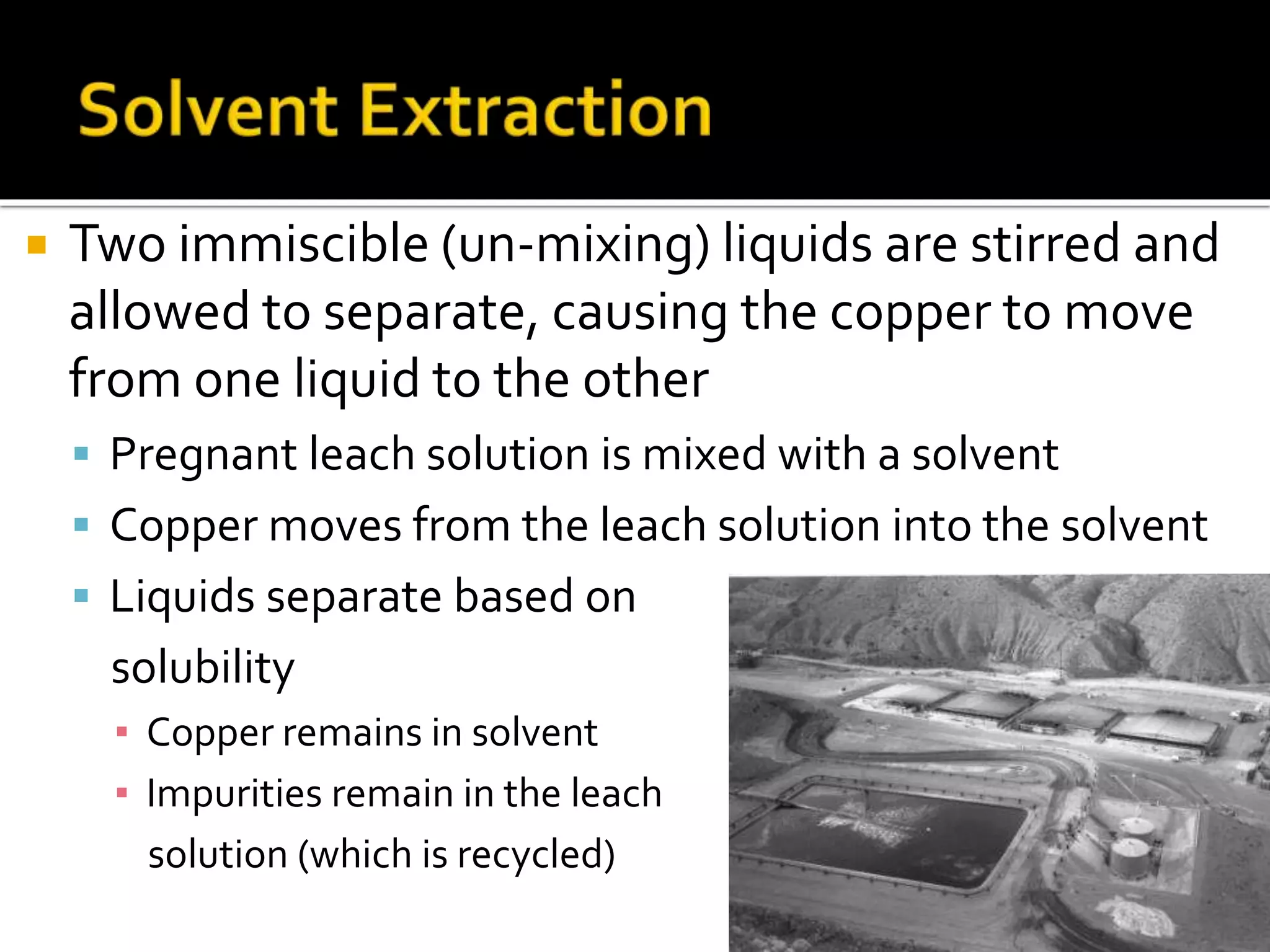
Two immiscible(un-mixing) liquids are stirred and
allowed to separate, causing the copper to move
from one liquid to the other
Pregnant leach solution is mixed with a solvent
Copper moves from the leach solution into the solvent
Liquids separate based on
solubility
▪ Copper remains in solvent
▪ Impurities remain in the leach
solution (which is recycled)
23.
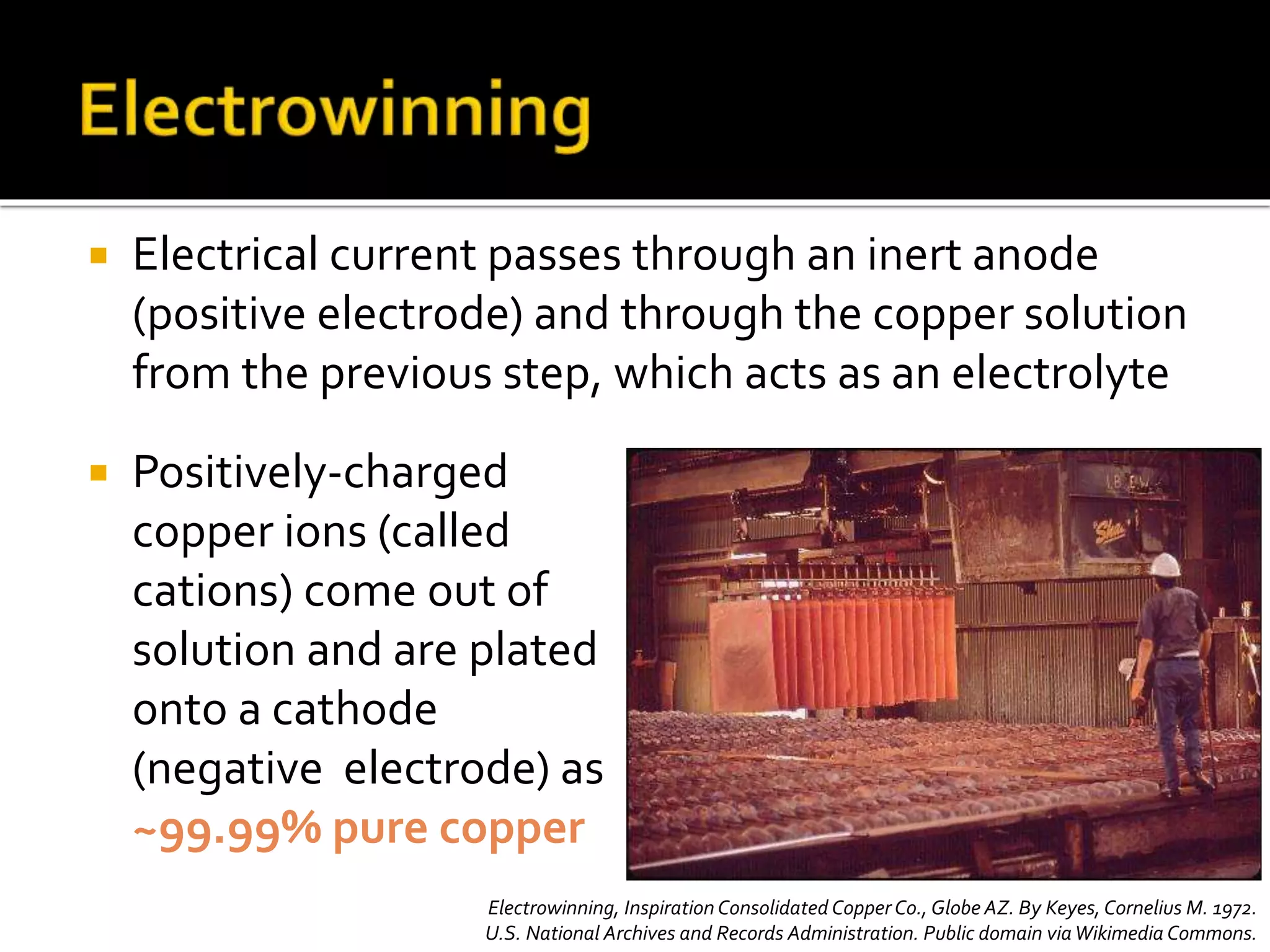
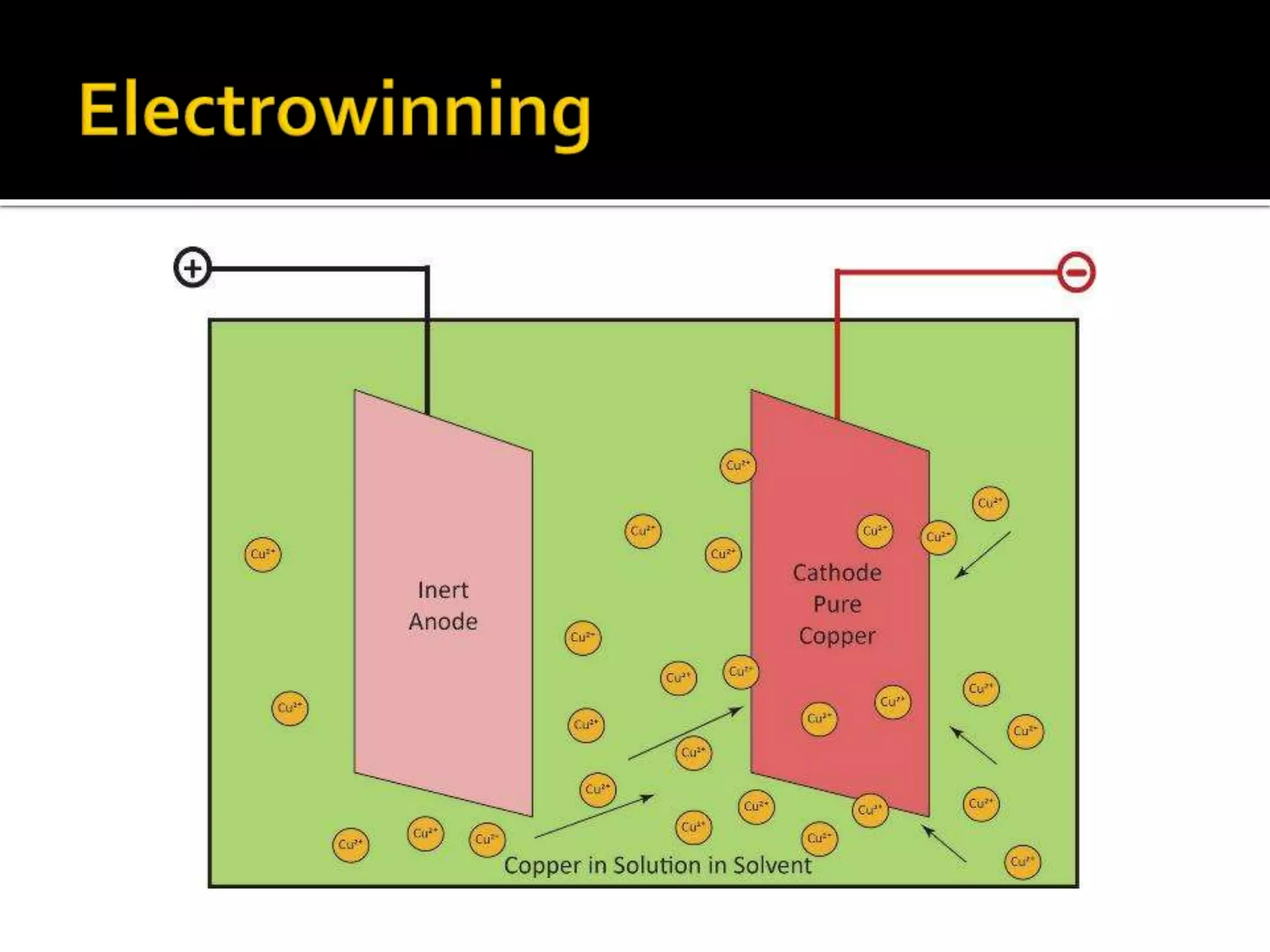
Electrical currentpasses through an inert anode
(positive electrode) and through the copper solution
from the previous step, which acts as an electrolyte
Positively-charged
copper ions (called
cations) come out of
solution and are plated
onto a cathode
(negative electrode) as
~99.99% pure copper
Electrowinning, Inspiration Consolidated Copper Co., Globe AZ. By Keyes, Cornelius M. 1972.
U.S. National Archives and Records Administration. Public domain viaWikimedia Commons.
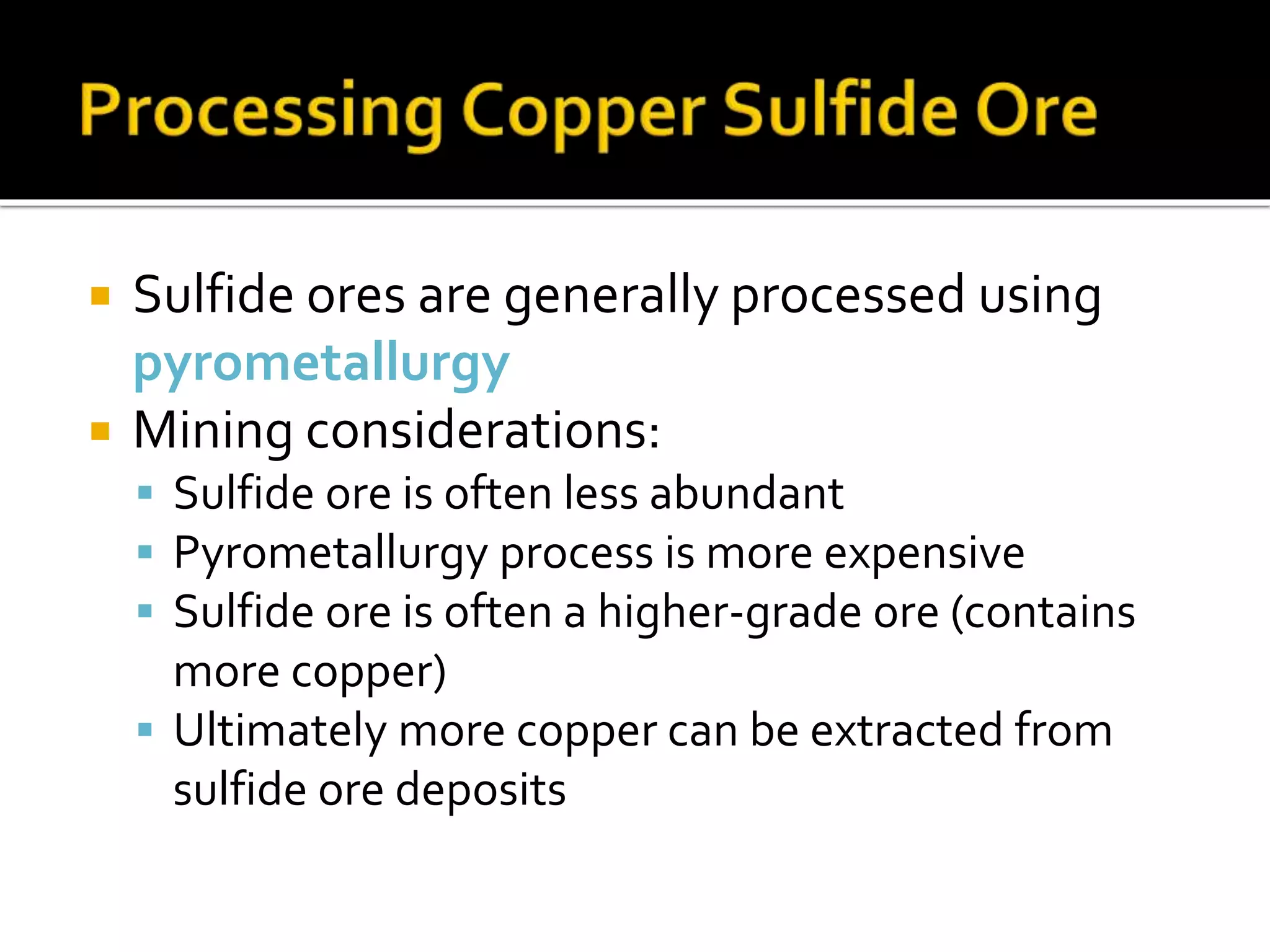
Sulfide oresare generally processed using
pyrometallurgy
Mining considerations:
Sulfide ore is often less abundant
Pyrometallurgy process is more expensive
Sulfide ore is often a higher-grade ore (contains
more copper)
Ultimately more copper can be extracted from
sulfide ore deposits
27.
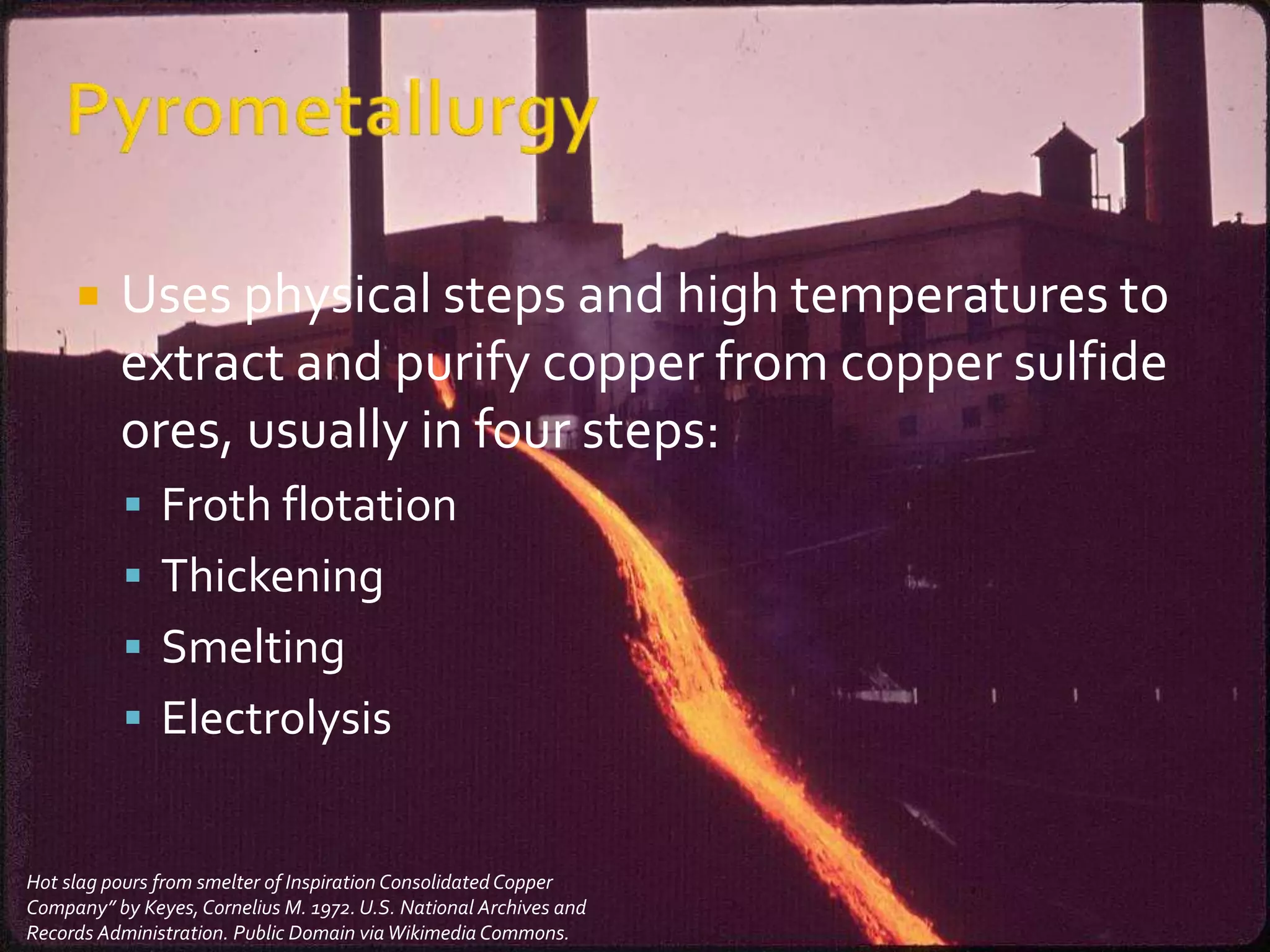
Uses physicalsteps and high temperatures to
extract and purify copper from copper sulfide
ores, usually in four steps:
Froth flotation
Thickening
Smelting
Electrolysis
Hot slag pours from smelter of Inspiration ConsolidatedCopper
Company” by Keyes,Cornelius M. 1972. U.S. National Archives and
Records Administration. Public Domain viaWikimedia Commons.
28.
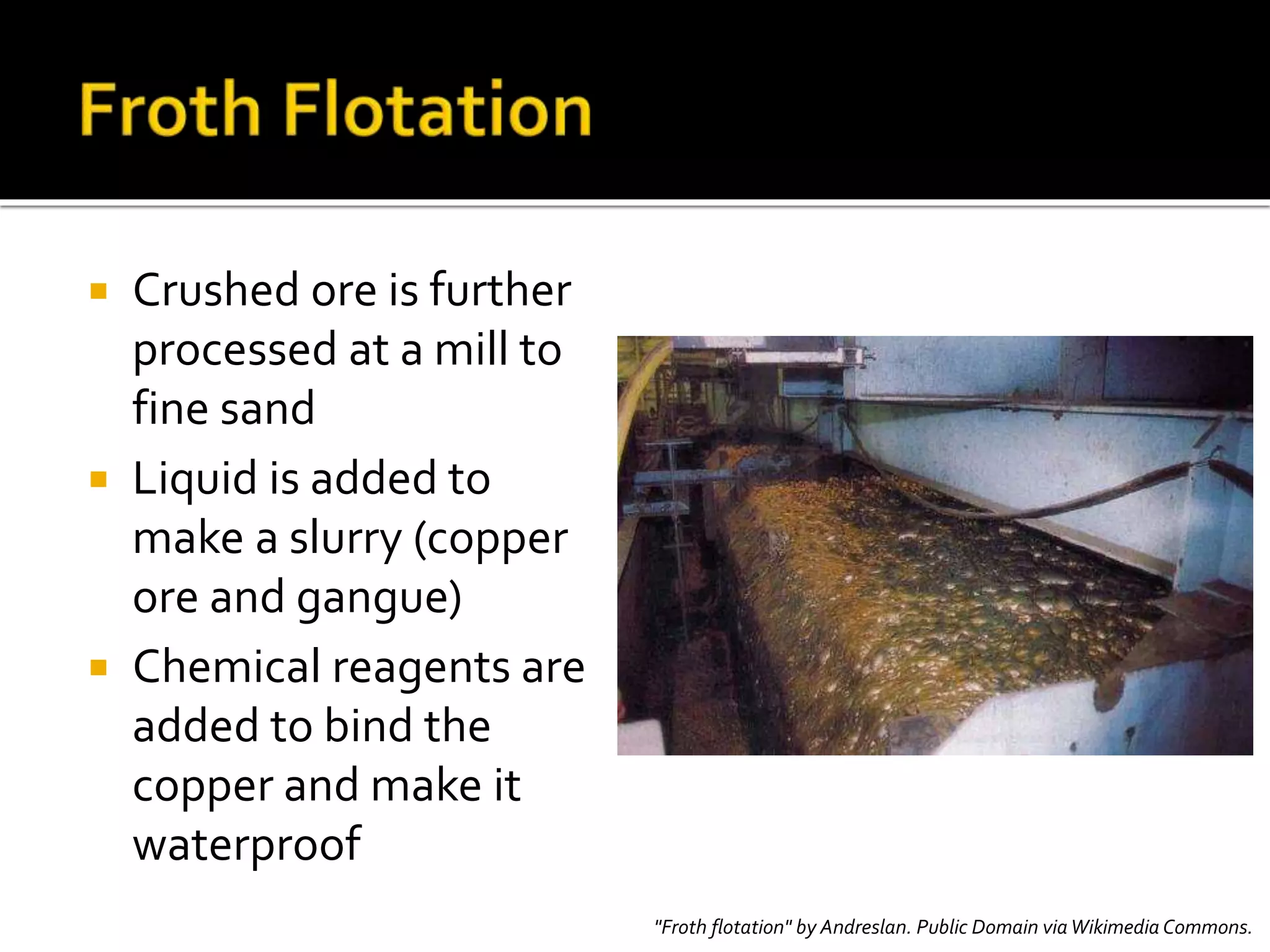
Crushed oreis further
processed at a mill to
fine sand
Liquid is added to
make a slurry (copper
ore and gangue)
Chemical reagents are
added to bind the
copper and make it
waterproof
"Froth flotation" by Andreslan. Public Domain viaWikimedia Commons.
29.
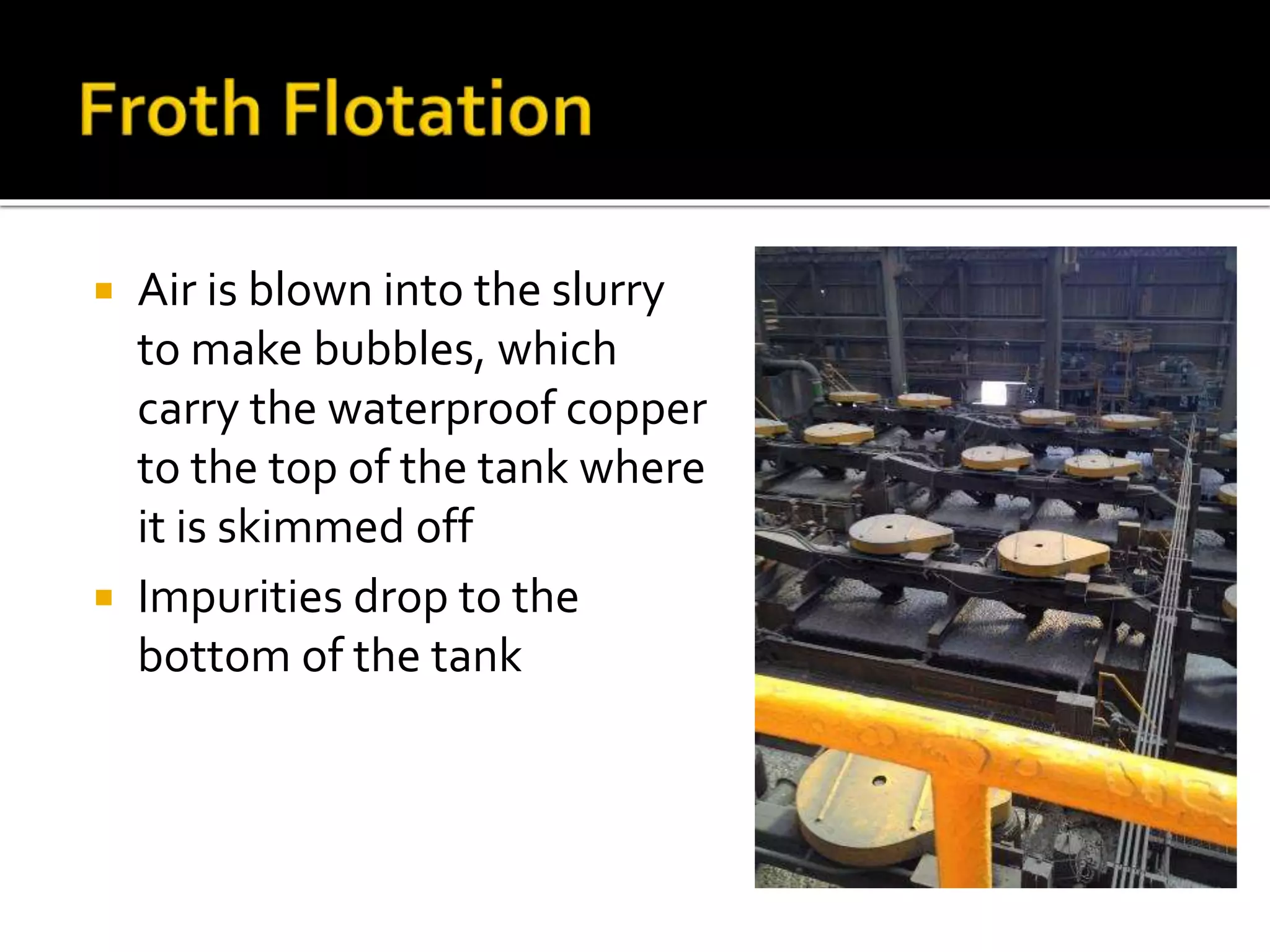
Air isblown into the slurry
to make bubbles, which
carry the waterproof copper
to the top of the tank where
it is skimmed off
Impurities drop to the
bottom of the tank
30.
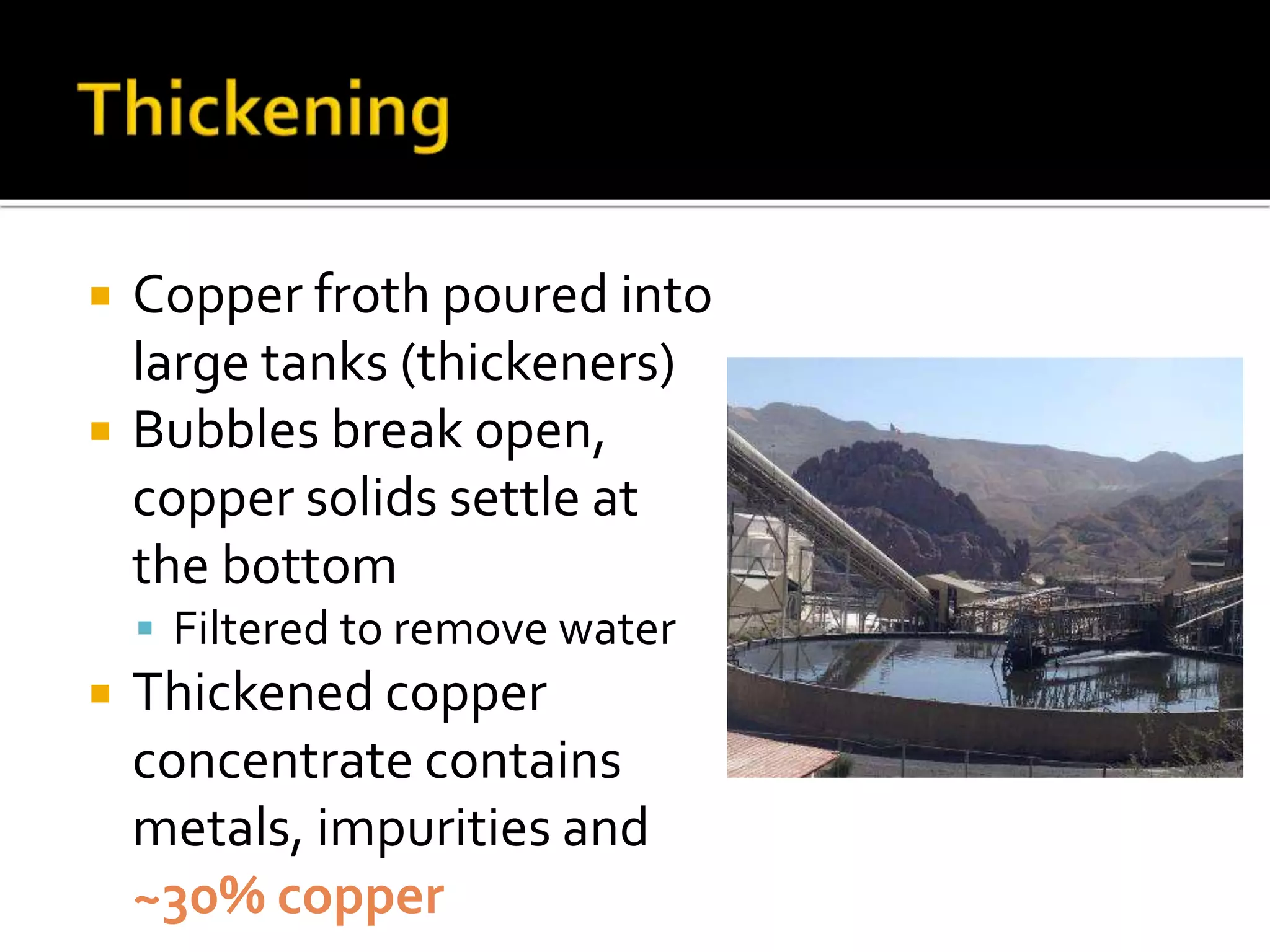
Copper frothpoured into
large tanks (thickeners)
Bubbles break open,
copper solids settle at
the bottom
Filtered to remove water
Thickened copper
concentrate contains
metals, impurities and
~30% copper
31.
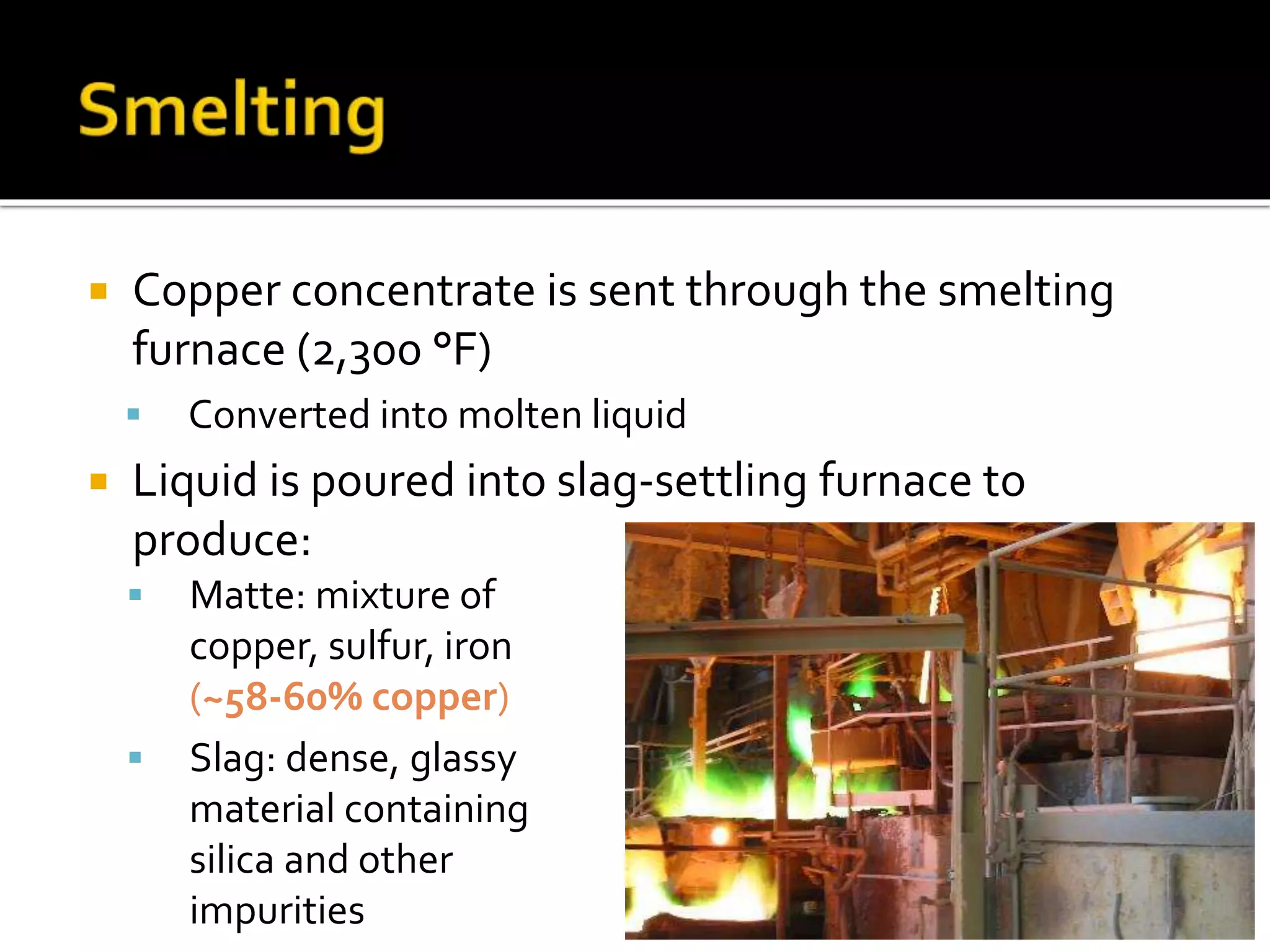
Copper concentrateis sent through the smelting
furnace (2,300 °F)
Converted into molten liquid
Liquid is poured into slag-settling furnace to
produce:
Matte: mixture of
copper, sulfur, iron
(~58-60% copper)
Slag: dense, glassy
material containing
silica and other
impurities
32.
Molten mattecopper is sent to the converter
furnace
Impurities are burned off
Forms yellow blister copper (98% copper)
Molten blister copper is sent to the anode
smelter
Oxygen is burned off, forming blue-green anode
copper
33.
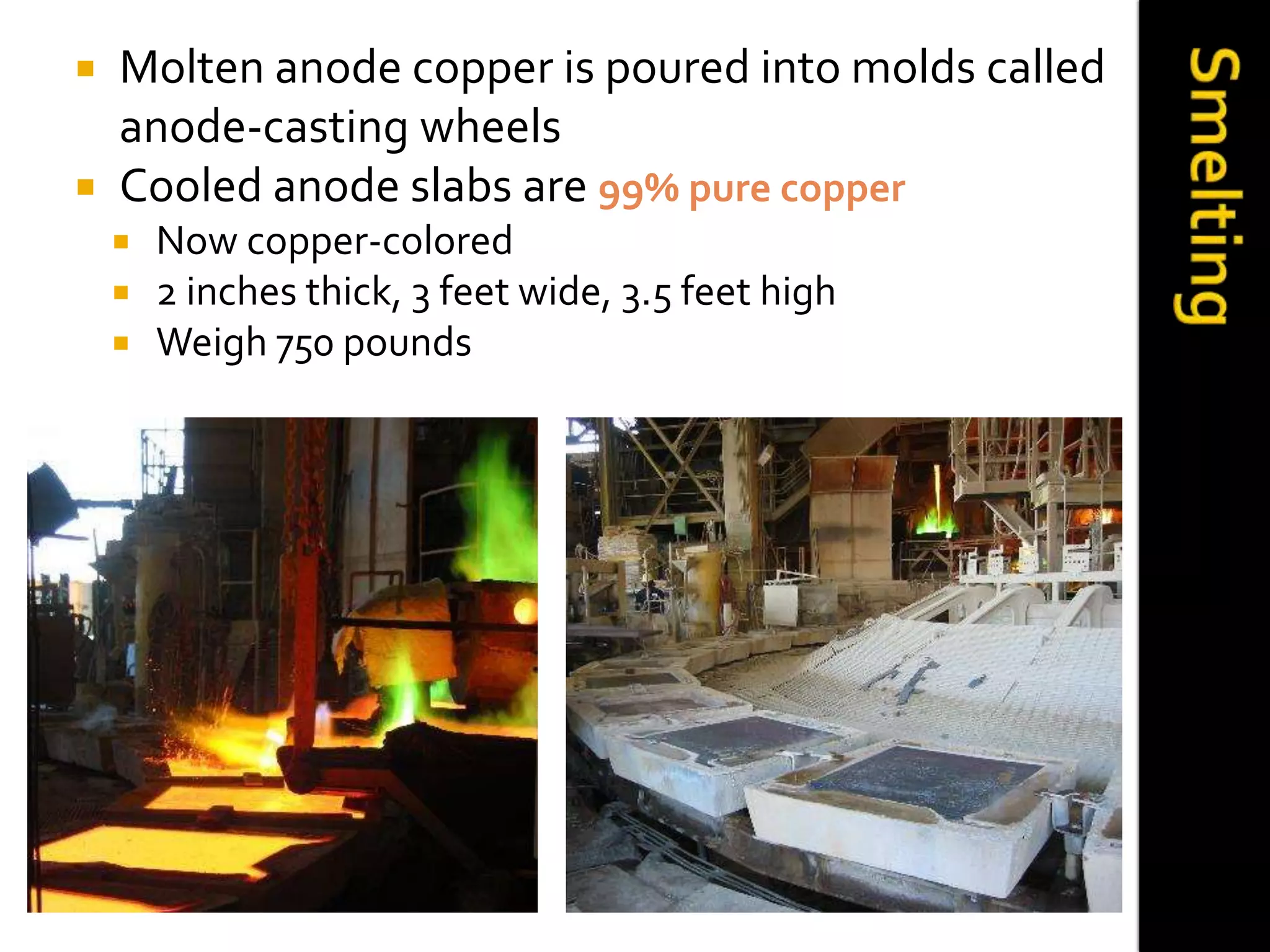
Molten anodecopper is poured into molds called
anode-casting wheels
Cooled anode slabs are 99% pure copper
Now copper-colored
2 inches thick, 3 feet wide, 3.5 feet high
Weigh 750 pounds
34.
Anode slabsare hung in a large tank
Act as positive electrodes
Thin sheets of pure copper (15 lb) are hung in
between anodes
Act as cathodes/negative electrodes
Tank is filled with electrolyte solution
Copper sulfate and sulfuric acid
35.
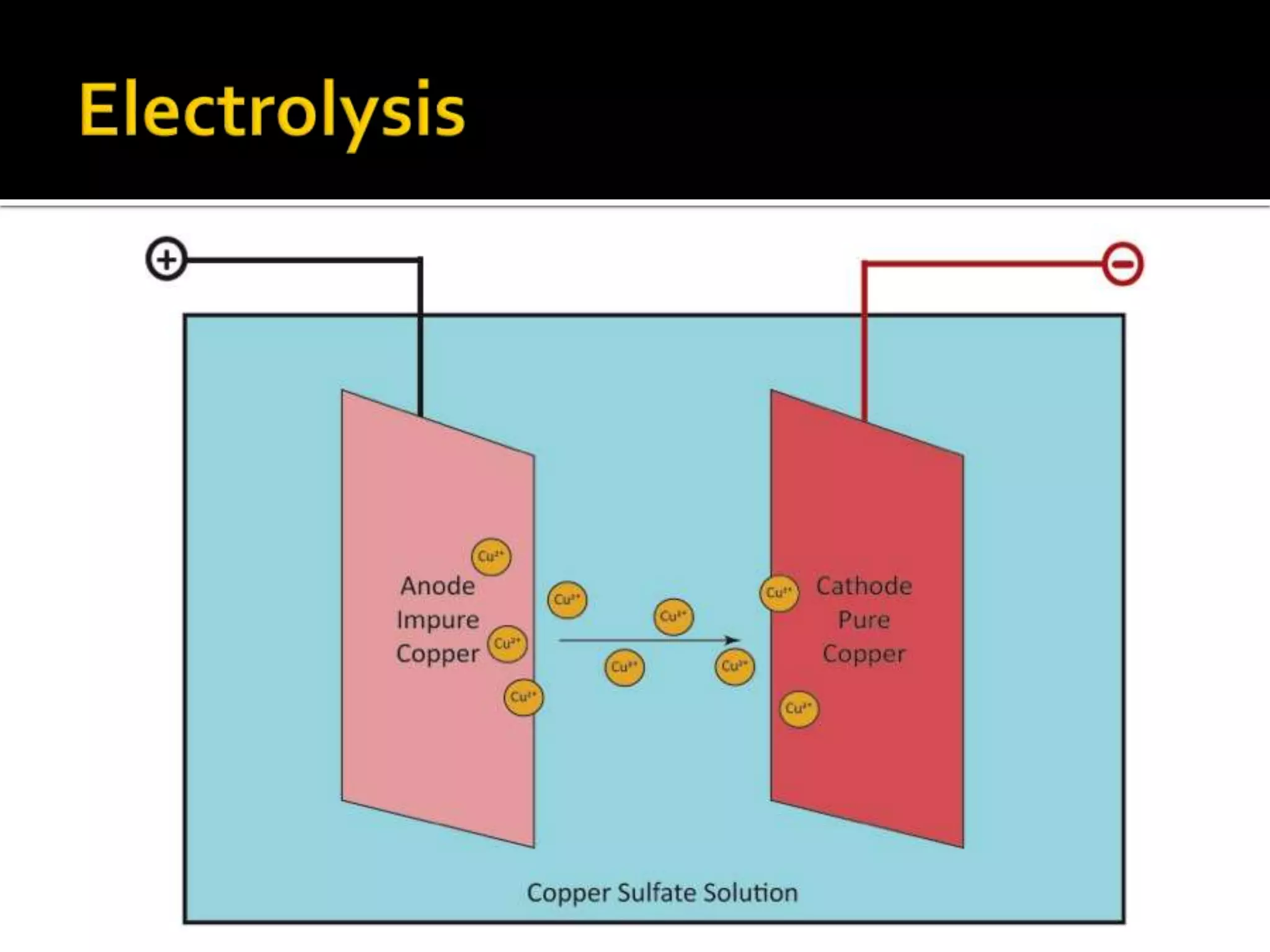
Electric currentis applied
Positively-charged copper ions (cations) leave
the anode (positive electrode)
Cations move through the electrolyte
solution and are plated on the cathode
(negative electrode)
37.
Other metalsand impurities also leave the
anodes
Drop to the bottom of the tank or stay in solution
Can be collected and refined to recover other
valuable metals such as silver and gold
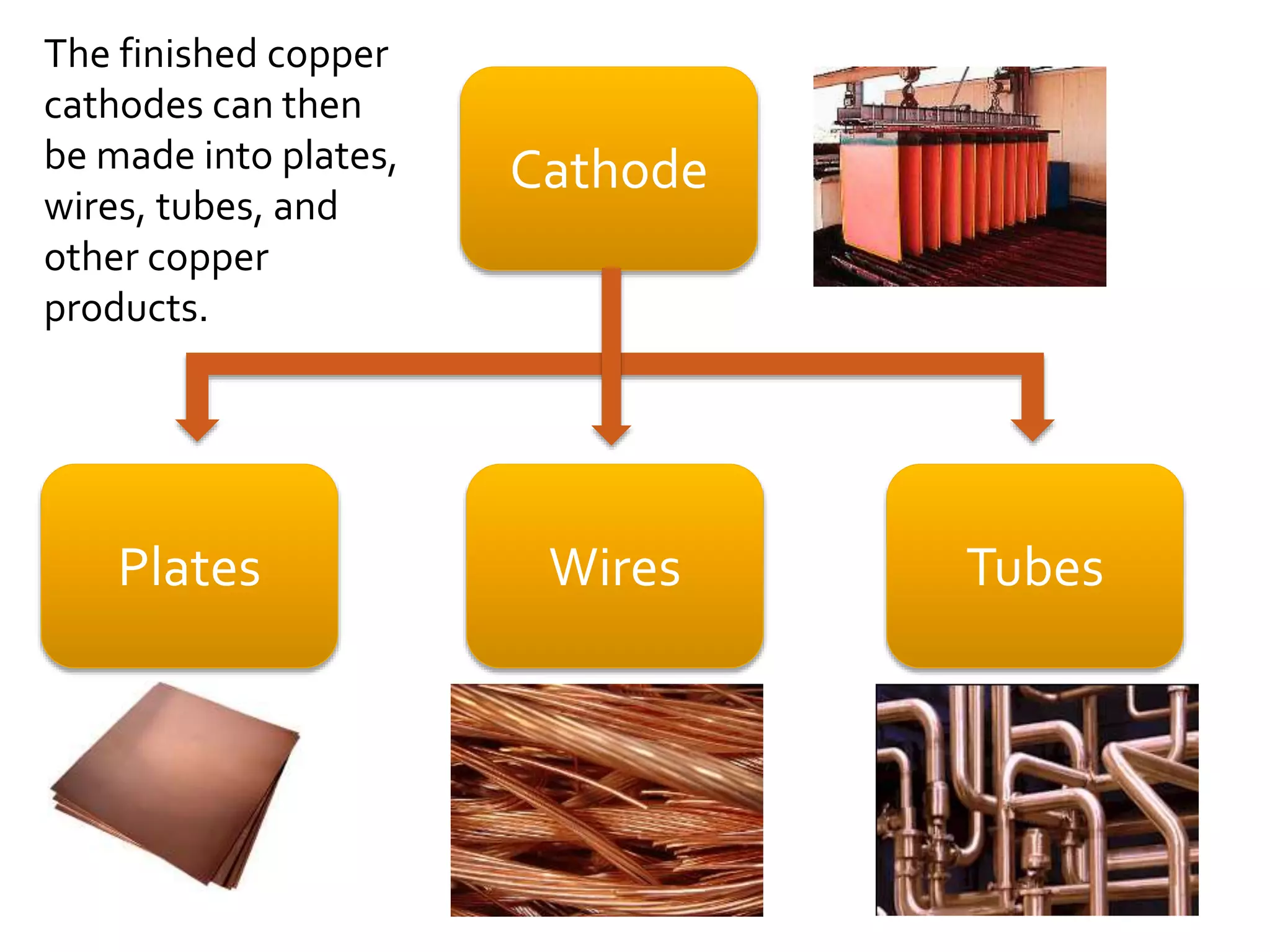
After 14 days of electrolysis, the final
products are copper cathodes
Weigh 375 pounds
Contain 99.99% pure copper
![Copper consumption by major U.S. markets in 2013. Source: Copper Development Association Inc. Annual Data (2014).
Type of Market
Copper
Consumption
[million lbs.]
Examples
Construction 2,233 Wiring, heating/refrigeration, and plumbing
Electrical and
Electronics
978
Power utilities, cell phones, computers, lighting, and
anything with an on/off switch
Consumer and
General Products
627
Currency, cookware, household appliances, coins,
etc.
Transportation
Equipment
982 Airplanes, cars, trucks, trains, etc.
Industrial Equipment 378
Manufacturing machinery, on-site equipment, off-
highway vehicles, and transmission lines](https://image.slidesharecdn.com/1521563016820copperminingprocessinglecturefinal-180503183307/75/1521563016820-copper-mining_processing_lecture_final-10-2048.jpg)