BASIC FORMAT
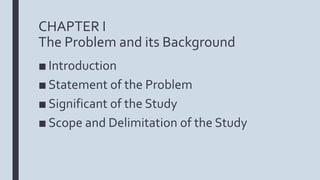
CHAPTER I
The Problem and its Background
■ Introduction
■ Statement of the Problem
■ Significant of the Study
■ Scope and Delimitation of the Study
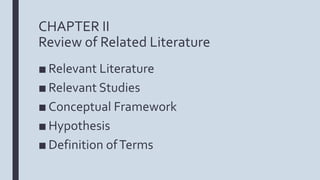
CHAPTER II
Review of Related Literature
■ Relevant Literature
■ Relevant Studies
■ Conceptual Framework
■ Hypothesis
■ Definition ofTerms
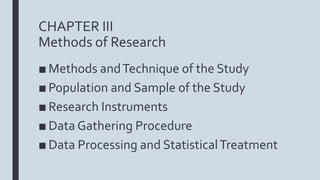
CHAPTER III
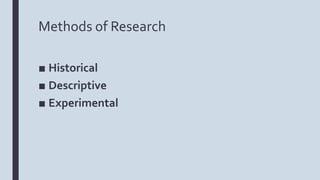
Methods of Research
■ Methods andTechnique of the Study
■ Population and Sample of the Study
■ Research Instruments
■ Data Gathering Procedure
■ Data Processing and StatisticalTreatment
THE PROBLEM AND
ITS BACKGROUND
This chapter presents the introduction, the
statement of the problem, the significance of the study
and the scope and delimitation of the study.
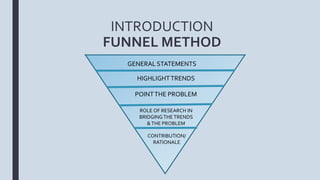
INTRODUCTION
FUNNEL METHOD
GENERAL STATEMENTS
HIGHLIGHTTRENDS
POINTTHE PROBLEM
ROLE OF RESEARCH IN
BRIDGINGTHETRENDS
&THE PROBLEM
CONTRIBUTION/
RATIONALE
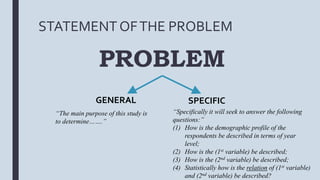
STATEMENTOFTHE PROBLEM
PROBLEM
GENERAL SPECIFIC
“The main purpose of this study is
to determine…….”
“Specifically it will seek to answer the following
questions:”
(1) How is the demographic profile of the
respondents be described in terms of year
level;
(2) How is the (1st variable) be described;
(3) How is the (2nd variable) be described;
(4) Statistically how is the relation of (1st variable)
and (2nd variable) be described?
Significance of the Study
■ Indicates the importance of the study to any group
which may derive any form of benefits from the
findings of the study
– Who do you think will benefit from the result of the
study?
– What particular benefits for particular beneficiaries
could be derived from the study?
The researchers believed that the findings of the study will benefit a number of people.
Teachers. The findings of the study will give them insights ……
Administrators. The study will serve as a challenge to find reason for an intensification of the
program…….
Parents. This will help the parents in understanding….
Students. The researchers believed that the students may greatly benefit from this study.
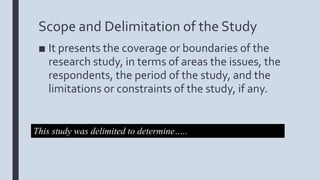
Scope and Delimitation of the Study
■ It presents the coverage or boundaries of the
research study, in terms of areas the issues, the
respondents, the period of the study, and the
limitations or constraints of the study, if any.
This study was delimited to determine…..
REVIEW OF RELATED
LITERATURE AND
STUDIES
This chapter presents, the related literature, local and
foreign studies, and its legal basis.
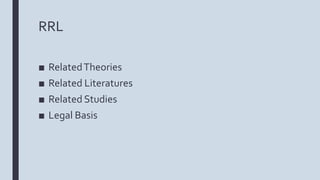
RRL
■ RelatedTheories
■ Related Literatures
■ Related Studies
■ Legal Basis
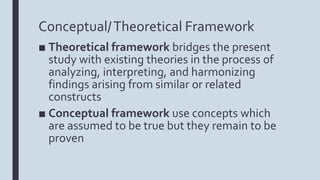
Conceptual/Theoretical Framework
■ Theoretical framework bridges the present
study with existing theories in the process of
analyzing, interpreting, and harmonizing
findings arising from similar or related
constructs
■ Conceptual framework use concepts which
are assumed to be true but they remain to be
proven
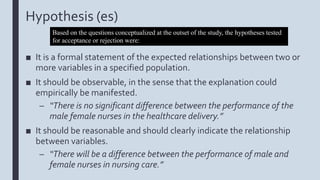
Hypothesis (es)
■ It is a formal statement of the expected relationships between two or
more variables in a specified population.
■ It should be observable, in the sense that the explanation could
empirically be manifested.
– “There is no significant difference between the performance of the
male female nurses in the healthcare delivery.”
■ It should be reasonable and should clearly indicate the relationship
between variables.
– “There will be a difference between the performance of male and
female nurses in nursing care.”
Based on the questions conceptualized at the outset of the study, the hypotheses tested
for acceptance or rejection were:
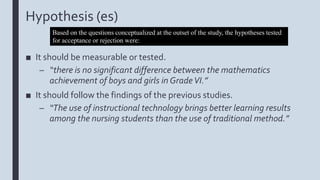
Hypothesis (es)
■ It should be measurable or tested.
– “there is no significant difference between the mathematics
achievement of boys and girls in GradeVI.”
■ It should follow the findings of the previous studies.
– “The use of instructional technology brings better learning results
among the nursing students than the use of traditional method.”
Based on the questions conceptualized at the outset of the study, the hypotheses tested
for acceptance or rejection were:
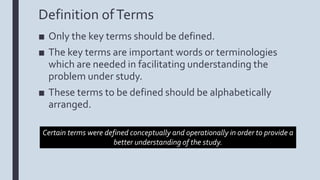
Definition ofTerms
■ Only the key terms should be defined.
■ The key terms are important words or terminologies
which are needed in facilitating understanding the
problem under study.
■ These terms to be defined should be alphabetically
arranged.
Certain terms were defined conceptually and operationally in order to provide a
better understanding of the study.
METHODOLOGY
This chapter presents the method of research utilized in this
study, the respondents, the sampling technique used, the
instrument, the statistical treatment of the data, the research
locale, together with procedure of analysis
Methods of Research
■ Historical
■ Descriptive
■ Experimental
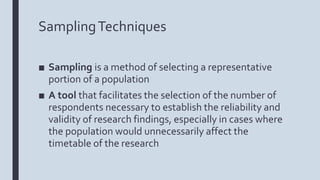
SamplingTechniques
■ Sampling is a method of selecting a representative
portion of a population
■ A tool that facilitates the selection of the number of
respondents necessary to establish the reliability and
validity of research findings, especially in cases where
the population would unnecessarily affect the
timetable of the research
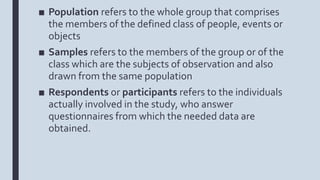
■ Population refers to the whole group that comprises
the members of the defined class of people, events or
objects
■ Samples refers to the members of the group or of the
class which are the subjects of observation and also
drawn from the same population
■ Respondents or participants refers to the individuals
actually involved in the study, who answer
questionnaires from which the needed data are
obtained.
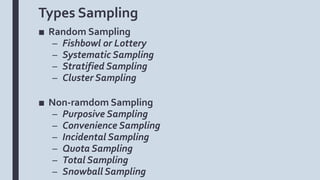
Types Sampling
■ Random Sampling
– Fishbowl or Lottery
– Systematic Sampling
– Stratified Sampling
– Cluster Sampling
■ Non-ramdom Sampling
– Purposive Sampling
– Convenience Sampling
– Incidental Sampling
– Quota Sampling
– Total Sampling
– Snowball Sampling
Research Instruments
■ Explain the construction, validation, and
administration of the research instruments including
the instructions on how each part of the instruments
should be accompanied by the respondents.
■ For an instrument made by the researcher, the
process of validation should clearly be narrated.
Data Gathering Procedure
■ This portion contains instructions or directions
on how to answer each of the problems of the
study.
StatisticalTreatment of Data
■ In choosing the appropriate statistical
evaluative technique, the researcher with the
aid of his/her statistician should first look into
the kind of data that will be gathered for the
study.

Research chapters 1 3

  • 1.
  • 2.
    CHAPTER I The Problemand its Background ■ Introduction ■ Statement of the Problem ■ Significant of the Study ■ Scope and Delimitation of the Study
  • 3.
    CHAPTER II Review ofRelated Literature ■ Relevant Literature ■ Relevant Studies ■ Conceptual Framework ■ Hypothesis ■ Definition ofTerms
  • 4.
    CHAPTER III Methods ofResearch ■ Methods andTechnique of the Study ■ Population and Sample of the Study ■ Research Instruments ■ Data Gathering Procedure ■ Data Processing and StatisticalTreatment
  • 5.
    THE PROBLEM AND ITSBACKGROUND This chapter presents the introduction, the statement of the problem, the significance of the study and the scope and delimitation of the study.
  • 6.
    INTRODUCTION FUNNEL METHOD GENERAL STATEMENTS HIGHLIGHTTRENDS POINTTHEPROBLEM ROLE OF RESEARCH IN BRIDGINGTHETRENDS &THE PROBLEM CONTRIBUTION/ RATIONALE
  • 7.
    STATEMENTOFTHE PROBLEM PROBLEM GENERAL SPECIFIC “Themain purpose of this study is to determine…….” “Specifically it will seek to answer the following questions:” (1) How is the demographic profile of the respondents be described in terms of year level; (2) How is the (1st variable) be described; (3) How is the (2nd variable) be described; (4) Statistically how is the relation of (1st variable) and (2nd variable) be described?
  • 8.
    Significance of theStudy ■ Indicates the importance of the study to any group which may derive any form of benefits from the findings of the study – Who do you think will benefit from the result of the study? – What particular benefits for particular beneficiaries could be derived from the study? The researchers believed that the findings of the study will benefit a number of people. Teachers. The findings of the study will give them insights …… Administrators. The study will serve as a challenge to find reason for an intensification of the program……. Parents. This will help the parents in understanding…. Students. The researchers believed that the students may greatly benefit from this study.
  • 9.
    Scope and Delimitationof the Study ■ It presents the coverage or boundaries of the research study, in terms of areas the issues, the respondents, the period of the study, and the limitations or constraints of the study, if any. This study was delimited to determine…..
  • 10.
    REVIEW OF RELATED LITERATUREAND STUDIES This chapter presents, the related literature, local and foreign studies, and its legal basis.
  • 11.
    RRL ■ RelatedTheories ■ RelatedLiteratures ■ Related Studies ■ Legal Basis
  • 12.
    Conceptual/Theoretical Framework ■ Theoreticalframework bridges the present study with existing theories in the process of analyzing, interpreting, and harmonizing findings arising from similar or related constructs ■ Conceptual framework use concepts which are assumed to be true but they remain to be proven
  • 13.
    Hypothesis (es) ■ Itis a formal statement of the expected relationships between two or more variables in a specified population. ■ It should be observable, in the sense that the explanation could empirically be manifested. – “There is no significant difference between the performance of the male female nurses in the healthcare delivery.” ■ It should be reasonable and should clearly indicate the relationship between variables. – “There will be a difference between the performance of male and female nurses in nursing care.” Based on the questions conceptualized at the outset of the study, the hypotheses tested for acceptance or rejection were:
  • 14.
    Hypothesis (es) ■ Itshould be measurable or tested. – “there is no significant difference between the mathematics achievement of boys and girls in GradeVI.” ■ It should follow the findings of the previous studies. – “The use of instructional technology brings better learning results among the nursing students than the use of traditional method.” Based on the questions conceptualized at the outset of the study, the hypotheses tested for acceptance or rejection were:
  • 15.
    Definition ofTerms ■ Onlythe key terms should be defined. ■ The key terms are important words or terminologies which are needed in facilitating understanding the problem under study. ■ These terms to be defined should be alphabetically arranged. Certain terms were defined conceptually and operationally in order to provide a better understanding of the study.
  • 16.
    METHODOLOGY This chapter presentsthe method of research utilized in this study, the respondents, the sampling technique used, the instrument, the statistical treatment of the data, the research locale, together with procedure of analysis
  • 17.
    Methods of Research ■Historical ■ Descriptive ■ Experimental
  • 18.
    SamplingTechniques ■ Sampling isa method of selecting a representative portion of a population ■ A tool that facilitates the selection of the number of respondents necessary to establish the reliability and validity of research findings, especially in cases where the population would unnecessarily affect the timetable of the research
  • 19.
    ■ Population refersto the whole group that comprises the members of the defined class of people, events or objects ■ Samples refers to the members of the group or of the class which are the subjects of observation and also drawn from the same population ■ Respondents or participants refers to the individuals actually involved in the study, who answer questionnaires from which the needed data are obtained.
  • 20.
    Types Sampling ■ RandomSampling – Fishbowl or Lottery – Systematic Sampling – Stratified Sampling – Cluster Sampling ■ Non-ramdom Sampling – Purposive Sampling – Convenience Sampling – Incidental Sampling – Quota Sampling – Total Sampling – Snowball Sampling
  • 21.
    Research Instruments ■ Explainthe construction, validation, and administration of the research instruments including the instructions on how each part of the instruments should be accompanied by the respondents. ■ For an instrument made by the researcher, the process of validation should clearly be narrated.
  • 22.
    Data Gathering Procedure ■This portion contains instructions or directions on how to answer each of the problems of the study.
  • 23.
    StatisticalTreatment of Data ■In choosing the appropriate statistical evaluative technique, the researcher with the aid of his/her statistician should first look into the kind of data that will be gathered for the study.

Editor's Notes

  • #10 Delimitations aim to narrow the scope of a study. For example, the scope may focus on specific variables, specific participants, specific sites, or narrowed to one type of research design (e.g., ethnography or experimental research). Limitations, however, aim to identify potential weaknesses of the study. For example, all statistical procedures and research strategies, such as surveys or grounded theory studies have limitations. In introductory discussions about these strategies, authors typically mention both their strengths and their weaknesses.
  • #13 These draws up the rationale of the research problem the basis of the research objectives, and the scope of the research work which may be considered as the extent of its parameters
  • #14 NULL (HO) denies the existence of an attribute ALTERNATIVE (H1) is always stated in the positive form
  • #18 -WHAT research was -WHAT research is (qualitative, quantitative) ------qualitative – focus group, observation (checklist), case study, intense interview ------quantitative – experimental (present to future), ex-facto (present to past) -WHAT research will be
  • #23 Narrate in DETAIL how will you conduct the study Future tense muna hehe (proposal)