Student Services Conference - June 2013
Unless otherwise specified, this work by the Colorado Community College System http://www.cccs.edu is licensed under a Creative Commons
Attribution-NonCommercial-ShareAlike 3.0 United States License. The material was created with funds from the Trade Adjustment Assistance
Community College and Career Training (TAACCCT) grant awarded to the Colorado Online Energy Training Consortium (COETC).
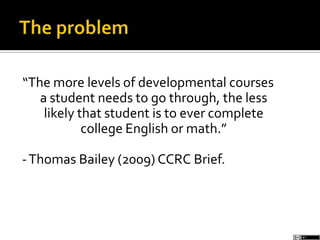
“The more levels of developmental courses
a student needs to go through, the less
likely that student is to ever complete
college English or math.”
-Thomas Bailey (2009) CCRC Brief.
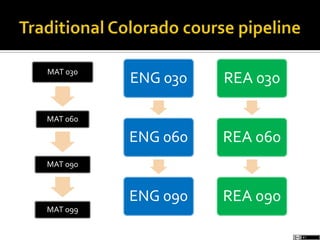
MAT 030
MAT 060
MAT 090
MAT 099
ENG 030
ENG 060
ENG 090
REA 030
REA 060
REA 090
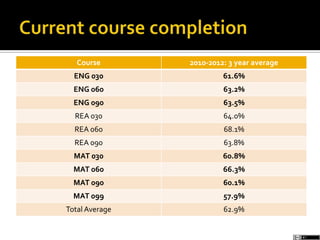
Course 2010-2012: 3 year average
ENG 030 61.6%
ENG 060 63.2%
ENG 090 63.5%
REA 030 64.0%
REA 060 68.1%
REA 090 63.8%
MAT 030 60.8%
MAT 060 66.3%
MAT 090 60.1%
MAT 099 57.9%
Total Average 62.9%
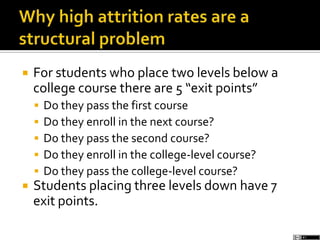
 For students who place two levels below a
college course there are 5 “exit points”
 Do they pass the first course
 Do they enroll in the next course?
 Do they pass the second course?
 Do they enroll in the college-level course?
 Do they pass the college-level course?
 Students placing three levels down have 7
exit points.
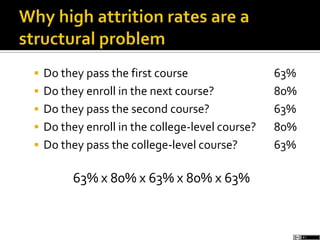
 Do they pass the first course 63%
 Do they enroll in the next course? 80%
 Do they pass the second course? 63%
 Do they enroll in the college-level course? 80%
 Do they pass the college-level course? 63%
63% x 80% x 63% x 80% x 63%
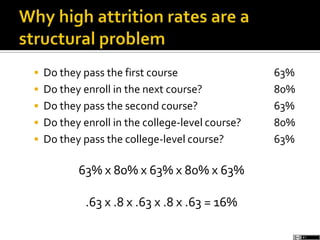
 Do they pass the first course 63%
 Do they enroll in the next course? 80%
 Do they pass the second course? 63%
 Do they enroll in the college-level course? 80%
 Do they pass the college-level course? 63%
63% x 80% x 63% x 80% x 63%
.63 x .8 x .63 x .8 x .63 = 16%
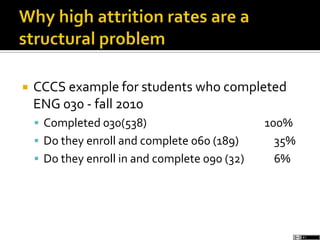
 CCCS example for students who completed
ENG 030 - fall 2010
 Completed 030(538) 100%
 Do they enroll and complete 060 (189) 35%
 Do they enroll in and complete 090 (32) 6%
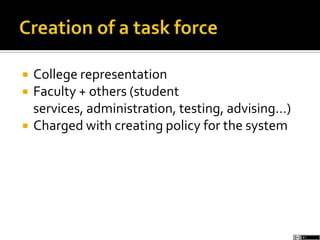
 College representation
 Faculty + others (student
services, administration, testing, advising…)
 Charged with creating policy for the system
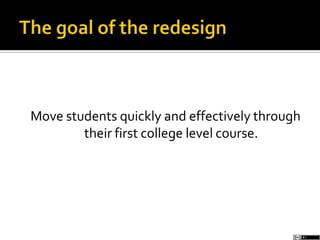
Move students quickly and effectively through
their first college level course.
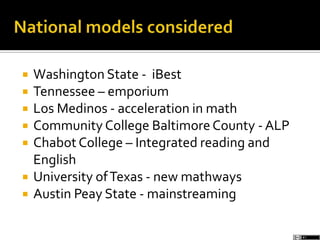
 Washington State - iBest
 Tennessee – emporium
 Los Medinos - acceleration in math
 Community College Baltimore County - ALP
 Chabot College – Integrated reading and
English
 University ofTexas - new mathways
 Austin Peay State - mainstreaming
To accelerate students by reducing the amount
of time, number of developmental credits,
and number of courses in the developmental
sequence so students can have access to and
be supported for success in a college level
course.
 Math – pathways at the developmental level
 Algebra
 Non-Algebra (statistics and math for liberal arts)
 Non-transfer (career math, clinical calculations)
 CollegeComposition and Reading (formerly
reading and English)
 Integrated disciplines
 Tiers of student support in classrooms
 Working with Pearson on a diagnostic
 Likely will get MFL in addition to the diagnostic
allowing students to work through mastery
before any retest
 Tentative timeline – we still don’t have a product
or contract
 Item analysis fall 13
 Test analysis spring 14
 Test pilot fall 14
 Test implementation spring 15
 UseCCCSE practices
 Orientation
 Goal setting and planning
 No late registrations
 First year experience
 Student success course
 Tutoring
 Supplemental instruction
 Case management/academic advising/career coaches
 College develop a plan to use for
planning, initiating, and sustaining success for
developmental students
 Successful developmental students and
programs should be measured in the
following ways:
 In Math – Successful completion of any college
level (100+) math course
 In English and Reading – Successful completion of
any college level (100+) English course or any
college level discipline strands course.
 How many students successfully complete
college English or college math?
 Used to only measure course completion
 Cohort tracking – how many are completing
college courses?
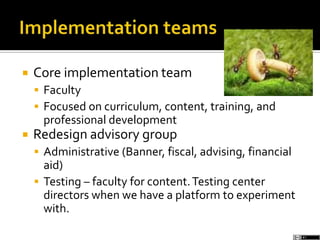
 Core implementation team
 Faculty
 Focused on curriculum, content, training, and
professional development
 Redesign advisory group
 Administrative (Banner, fiscal, advising, financial
aid)
 Testing – faculty for content.Testing center
directors when we have a platform to experiment
with.
 Spring/summer 13 discipline team work to
develop curriculum and to create professional
development training for faculty and staff
 Fall of 13 schools that are already working on
redesign will ramp up projects
 Spring 14 all colleges should transition to the
new models
 Fall of 14 all colleges should be operating with
the new models in place
 Campus advisory
 CCR
 Math
 Student services
 Faculty and staff development
 Resources
 Program evaluation
 Soft landing and/or CCR092 with CCR 091
co-requisite
 Both the CCR 091 and CCR 092 courses will be
offered during the fall 2013 semester.
 Students who are required to take the CCR 091 lab
will be using the same program that LCC will be
piloting for use in the Fast ForWord Soft Landing
 Studio D and/or Studio 121
 Studio 121 will be offered in the fall 2013 semester
 CCR courses will be offered on opposite days from
co-enrolled ENG 121 sections
 For example:
 If a student is in Studio 121 on MW at 11:00 a.m.
they will also be in ENG 121 onTR at 11:00 a.m.
 Instructors in both courses will collaborate weekly
on student progress and instructional needs.
 Delivery
 LCC is exploring the Core Skills Mastery (CSM) in
addition to essential skills labs developed using
NROC content
 Essential skills will include topics like order of
operations and organization of
work, fractions, decimals and percents
 LCC will offer at least one section of each co-
requisite lab
 MAT025: co-requisite to MAT055
 MAT091: co-requisite to MAT107
 MAT 092: co-requisite to one section of MAT 120
 MAT 093: co-requisite to one section of MAT 121
 All co-requisites will be taught by the same
instructor and scheduled to meet
immediately following the college course
 CCSSE strategies for planning, initiating, and
sustaining success. All developmental education
students will:
 Required to seek academic advising prior to the start
of each semester
 Required to meet with the career advisor at least once
each semester
 Students who are in both math and CCR courses will
be required to enroll in an academic success course
 Strongly encouraged to enroll in an academic success
course
 In addition to the successful completion of a
100 level college course, how are you going to
evaluate the redesign on your campus?
 Students will be surveyed in all DE courses each year.
Questions specific to the redesign will be included in the
survey. The instructional team will use this data to modify
courses to be offered in future semesters.
 Are there goals or outcome measures your
faculty have set on your campus?
 “Good idea. We will do that next.”
 CCR
 Math
 Student services
 Timing
 DE site
 Word Press site
 D2L shells
 Campus teams
 Regional training
 Invited presentations
 2:2 sharing
 Respond to the survey – what do you want to
focus on?
 Student services regional workshops
 July 9 – Arapahoe
 July 12 – Front Range
 July 15 - Pueblo
This work by Colorado Community College System COETC Grant is licensed under a Creative Commons Attribution 3.0 Unported License. The
material was created with funds from the Trade Adjustment Assistance Community College and Career Training (TAACCCT) Grant awarded to the
Colorado Online Energy Training Consortium (COETC).Based on a work at www.cccs.edu.Permissions beyond the scope of this license may be
available at www.cccs.edu.

Developmental Education Redesign Update CCCS student services conference June 20 13

  • 1.
  • 2.
    Unless otherwise specified,this work by the Colorado Community College System http://www.cccs.edu is licensed under a Creative Commons Attribution-NonCommercial-ShareAlike 3.0 United States License. The material was created with funds from the Trade Adjustment Assistance Community College and Career Training (TAACCCT) grant awarded to the Colorado Online Energy Training Consortium (COETC).
  • 3.
    “The more levelsof developmental courses a student needs to go through, the less likely that student is to ever complete college English or math.” -Thomas Bailey (2009) CCRC Brief.
  • 4.
    MAT 030 MAT 060 MAT090 MAT 099 ENG 030 ENG 060 ENG 090 REA 030 REA 060 REA 090
  • 5.
    Course 2010-2012: 3year average ENG 030 61.6% ENG 060 63.2% ENG 090 63.5% REA 030 64.0% REA 060 68.1% REA 090 63.8% MAT 030 60.8% MAT 060 66.3% MAT 090 60.1% MAT 099 57.9% Total Average 62.9%
  • 6.
     For studentswho place two levels below a college course there are 5 “exit points”  Do they pass the first course  Do they enroll in the next course?  Do they pass the second course?  Do they enroll in the college-level course?  Do they pass the college-level course?  Students placing three levels down have 7 exit points.
  • 7.
     Do theypass the first course 63%  Do they enroll in the next course? 80%  Do they pass the second course? 63%  Do they enroll in the college-level course? 80%  Do they pass the college-level course? 63% 63% x 80% x 63% x 80% x 63%
  • 8.
     Do theypass the first course 63%  Do they enroll in the next course? 80%  Do they pass the second course? 63%  Do they enroll in the college-level course? 80%  Do they pass the college-level course? 63% 63% x 80% x 63% x 80% x 63% .63 x .8 x .63 x .8 x .63 = 16%
  • 9.
     CCCS examplefor students who completed ENG 030 - fall 2010  Completed 030(538) 100%  Do they enroll and complete 060 (189) 35%  Do they enroll in and complete 090 (32) 6%
  • 10.
     College representation Faculty + others (student services, administration, testing, advising…)  Charged with creating policy for the system
  • 11.
    Move students quicklyand effectively through their first college level course.
  • 12.
     Washington State- iBest  Tennessee – emporium  Los Medinos - acceleration in math  Community College Baltimore County - ALP  Chabot College – Integrated reading and English  University ofTexas - new mathways  Austin Peay State - mainstreaming
  • 13.
    To accelerate studentsby reducing the amount of time, number of developmental credits, and number of courses in the developmental sequence so students can have access to and be supported for success in a college level course.
  • 14.
     Math –pathways at the developmental level  Algebra  Non-Algebra (statistics and math for liberal arts)  Non-transfer (career math, clinical calculations)  CollegeComposition and Reading (formerly reading and English)  Integrated disciplines  Tiers of student support in classrooms
  • 15.
     Working withPearson on a diagnostic  Likely will get MFL in addition to the diagnostic allowing students to work through mastery before any retest  Tentative timeline – we still don’t have a product or contract  Item analysis fall 13  Test analysis spring 14  Test pilot fall 14  Test implementation spring 15
  • 16.
     UseCCCSE practices Orientation  Goal setting and planning  No late registrations  First year experience  Student success course  Tutoring  Supplemental instruction  Case management/academic advising/career coaches  College develop a plan to use for planning, initiating, and sustaining success for developmental students
  • 17.
     Successful developmentalstudents and programs should be measured in the following ways:  In Math – Successful completion of any college level (100+) math course  In English and Reading – Successful completion of any college level (100+) English course or any college level discipline strands course.
  • 18.
     How manystudents successfully complete college English or college math?  Used to only measure course completion  Cohort tracking – how many are completing college courses?
  • 19.
     Core implementationteam  Faculty  Focused on curriculum, content, training, and professional development  Redesign advisory group  Administrative (Banner, fiscal, advising, financial aid)  Testing – faculty for content.Testing center directors when we have a platform to experiment with.
  • 20.
     Spring/summer 13discipline team work to develop curriculum and to create professional development training for faculty and staff  Fall of 13 schools that are already working on redesign will ramp up projects  Spring 14 all colleges should transition to the new models  Fall of 14 all colleges should be operating with the new models in place
  • 21.
     Campus advisory CCR  Math  Student services  Faculty and staff development  Resources  Program evaluation
  • 23.
     Soft landingand/or CCR092 with CCR 091 co-requisite  Both the CCR 091 and CCR 092 courses will be offered during the fall 2013 semester.  Students who are required to take the CCR 091 lab will be using the same program that LCC will be piloting for use in the Fast ForWord Soft Landing
  • 24.
     Studio Dand/or Studio 121  Studio 121 will be offered in the fall 2013 semester  CCR courses will be offered on opposite days from co-enrolled ENG 121 sections  For example:  If a student is in Studio 121 on MW at 11:00 a.m. they will also be in ENG 121 onTR at 11:00 a.m.  Instructors in both courses will collaborate weekly on student progress and instructional needs.
  • 25.
     Delivery  LCCis exploring the Core Skills Mastery (CSM) in addition to essential skills labs developed using NROC content  Essential skills will include topics like order of operations and organization of work, fractions, decimals and percents
  • 26.
     LCC willoffer at least one section of each co- requisite lab  MAT025: co-requisite to MAT055  MAT091: co-requisite to MAT107  MAT 092: co-requisite to one section of MAT 120  MAT 093: co-requisite to one section of MAT 121  All co-requisites will be taught by the same instructor and scheduled to meet immediately following the college course
  • 27.
     CCSSE strategiesfor planning, initiating, and sustaining success. All developmental education students will:  Required to seek academic advising prior to the start of each semester  Required to meet with the career advisor at least once each semester  Students who are in both math and CCR courses will be required to enroll in an academic success course  Strongly encouraged to enroll in an academic success course
  • 28.
     In additionto the successful completion of a 100 level college course, how are you going to evaluate the redesign on your campus?  Students will be surveyed in all DE courses each year. Questions specific to the redesign will be included in the survey. The instructional team will use this data to modify courses to be offered in future semesters.  Are there goals or outcome measures your faculty have set on your campus?  “Good idea. We will do that next.”
  • 29.
     CCR  Math Student services  Timing
  • 30.
     DE site Word Press site  D2L shells  Campus teams  Regional training  Invited presentations  2:2 sharing
  • 31.
     Respond tothe survey – what do you want to focus on?  Student services regional workshops  July 9 – Arapahoe  July 12 – Front Range  July 15 - Pueblo
  • 33.
    This work byColorado Community College System COETC Grant is licensed under a Creative Commons Attribution 3.0 Unported License. The material was created with funds from the Trade Adjustment Assistance Community College and Career Training (TAACCCT) Grant awarded to the Colorado Online Energy Training Consortium (COETC).Based on a work at www.cccs.edu.Permissions beyond the scope of this license may be available at www.cccs.edu.