Badges? Badges?
Today’s Workforce Demands
Connected Credentials
Brenda Perea, Colorado Community College System
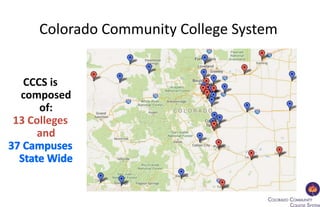
Colorado Community College System
CCCS is
composed
of:
13 Colleges
and
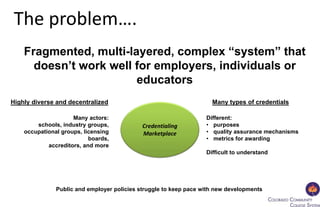
Credentialing
Marketplace
Many types of credentials
Fragmented, multi-layered, complex “system” that
doesn’t work well for employers, individuals or
educators
Highly diverse and decentralized
Many actors:
schools, industry groups,
occupational groups, licensing
boards,
accreditors, and more
Different:
• purposes
• quality assurance mechanisms
• metrics for awarding
Difficult to understand
Public and employer policies struggle to keep pace with new developments
The problem….
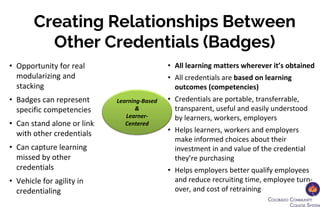
Learning-Based
&
Learner-
Centered
• All learning matters wherever it’s obtained
• All credentials are based on learning
outcomes (competencies)
• Credentials are portable, transferrable,
transparent, useful and easily understood
by learners, workers, employers
• Helps learners, workers and employers
make informed choices about their
investment in and value of the credential
they’re purchasing
• Helps employers better qualify employees
and reduce recruiting time, employee turn-
over, and cost of retraining
• Opportunity for real
modularizing and
stacking
• Badges can represent
specific competencies
• Can stand alone or link
with other credentials
• Can capture learning
missed by other
credentials
• Vehicle for agility in
credentialing
Creating Relationships Between
Other Credentials (Badges)
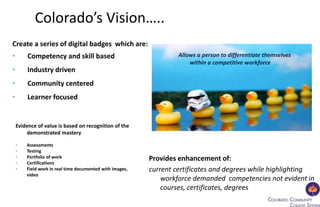
Colorado’s Vision…..
Create a series of digital badges which are:
• Competency and skill based
• Industry driven
• Community centered
• Learner focused
Evidence of value is based on recognition of the
demonstrated mastery
• Assessments
• Testing
• Portfolio of work
• Certifications
• Field work in real time documented with images,
video
Provides enhancement of:
current certificates and degrees while highlighting
workforce demanded competencies not evident in
courses, certificates, degrees
Allows a person to differentiate themselves
within a competitive workforce
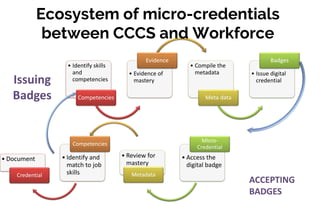
• Document
Credential
• Identify and
match to job
skills
Competencies
• Review for
mastery
Metadata
• Access the
digital badge
Micro-
Credential
• Identify skills
and
competencies
Competencies
• Evidence of
mastery
Evidence
• Compile the
metadata
Meta data
• Issue digital
credential
Badges
Ecosystem of micro-credentials
between CCCS and Workforce
Issuing
Badges
ACCEPTING
BADGES
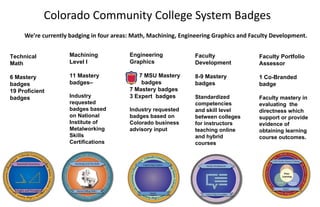
Colorado Community College System Badges
We’re currently badging in four areas: Math, Machining, Engineering Graphics and Faculty Development.
Technical
Math
6 Mastery
badges
19 Proficient
badges
Machining
Level I
11 Mastery
badges–
Industry
requested
badges based
on National
Institute of
Metalworking
Skills
Certifications
Engineering
Graphics
7 MSU Mastery
badges
7 Mastery badges
3 Expert badges
Industry requested
badges based on
Colorado business
advisory input
Faculty
Development
8-9 Mastery
badges
Standardized
competencies
and skill level
between colleges
for instructors
teaching online
and hybrid
courses
Faculty Portfolio
Assessor
1 Co-Branded
badge
Faculty mastery in
evaluating the
directness which
support or provide
evidence of
obtaining learning
course outcomes.
Provides transparency of learning
• Competencies at a granular level
• Link what knowledge to what a badge earner “can do”
• Allows portability
• Follows the learner through a life long learning pathway
• Data can be verified and certified by badge consumer
Why does Colorado Workforce need Badges?
Identified Competencies that are Learner
Focused, Community Centered and Industry
Driven
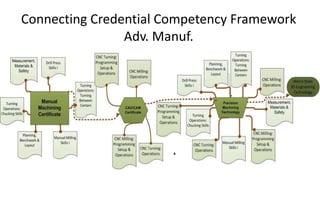
Connecting Credential Competency Framework
Adv. Manuf.
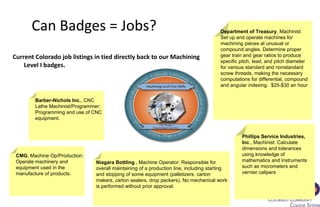
Can Badges = Jobs?
Current Colorado job listings in tied directly back to our Machining
Level I badges.
Department of Treasury, Machinist:
Set up and operate machines for
machining pieces at unusual or
compound angles. Determine proper
gear train and gear ratios to produce
specific pitch, lead, and pitch diameter
for various standard and nonstandard
screw threads, making the necessary
computations for differential, compound
and angular indexing. $25-$30 an hour
CMG, Machine Op/Production:
Operate machinery and
equipment used in the
manufacture of products.
Phillips Service Industries,
Inc., Machinist: Calculate
dimensions and tolerances
using knowledge of
mathematics and instruments
such as micrometers and
vernier calipers
Barber-Nichols Inc., CNC
Lathe Machinist/Programmer:
Programming and use of CNC
equipment.
Niagara Bottling , Machine Operator: Responsible for
overall maintaining of a production line, including starting
and stopping of some equipment (palletizers, carton
makers, carton sealers, drop packers). No mechanical work
is performed without prior approval.
Thanks!
Any questions?
• You can find us at:
Brenda Perea
brenda.perea@cccs.edu
Creative Commons Attribution
Workforce Development presentation by Brenda M. Perea and Larry Good is licensed under a Creative
Commons Attribution 4.0 International License. Permissions beyond the scope of this license may be
available at https://www.cccs.edu/partnering-for-success/trade-adjustment-assistance/taa-champ/.
This workforce solution was funded by a grant awarded by the U.S. Department of Labor’s Employment and
Training Administration. The solution was created by the grantee and does not necessarily reflect the official
position of the U.S. Department of Labor. The Department of Labor makes no guarantees, warranties, or
assurances of any kind, express or implied, with respect to such information, including any information on
linked sites, and including, but not limited to accuracy of the information or its completeness, timeliness,
usefulness, adequacy, continued availability or ownership.

CCCS-Advanced Manufacturing badge presentation WCET june-2016

  • 1.
    Badges? Badges? Today’s WorkforceDemands Connected Credentials Brenda Perea, Colorado Community College System
  • 2.
    Colorado Community CollegeSystem CCCS is composed of: 13 Colleges and
  • 3.
    Credentialing Marketplace Many types ofcredentials Fragmented, multi-layered, complex “system” that doesn’t work well for employers, individuals or educators Highly diverse and decentralized Many actors: schools, industry groups, occupational groups, licensing boards, accreditors, and more Different: • purposes • quality assurance mechanisms • metrics for awarding Difficult to understand Public and employer policies struggle to keep pace with new developments The problem….
  • 4.
    Learning-Based & Learner- Centered • All learningmatters wherever it’s obtained • All credentials are based on learning outcomes (competencies) • Credentials are portable, transferrable, transparent, useful and easily understood by learners, workers, employers • Helps learners, workers and employers make informed choices about their investment in and value of the credential they’re purchasing • Helps employers better qualify employees and reduce recruiting time, employee turn- over, and cost of retraining • Opportunity for real modularizing and stacking • Badges can represent specific competencies • Can stand alone or link with other credentials • Can capture learning missed by other credentials • Vehicle for agility in credentialing Creating Relationships Between Other Credentials (Badges)
  • 5.
    Colorado’s Vision….. Create aseries of digital badges which are: • Competency and skill based • Industry driven • Community centered • Learner focused Evidence of value is based on recognition of the demonstrated mastery • Assessments • Testing • Portfolio of work • Certifications • Field work in real time documented with images, video Provides enhancement of: current certificates and degrees while highlighting workforce demanded competencies not evident in courses, certificates, degrees Allows a person to differentiate themselves within a competitive workforce
  • 6.
    • Document Credential • Identifyand match to job skills Competencies • Review for mastery Metadata • Access the digital badge Micro- Credential • Identify skills and competencies Competencies • Evidence of mastery Evidence • Compile the metadata Meta data • Issue digital credential Badges Ecosystem of micro-credentials between CCCS and Workforce Issuing Badges ACCEPTING BADGES
  • 7.
    Colorado Community CollegeSystem Badges We’re currently badging in four areas: Math, Machining, Engineering Graphics and Faculty Development. Technical Math 6 Mastery badges 19 Proficient badges Machining Level I 11 Mastery badges– Industry requested badges based on National Institute of Metalworking Skills Certifications Engineering Graphics 7 MSU Mastery badges 7 Mastery badges 3 Expert badges Industry requested badges based on Colorado business advisory input Faculty Development 8-9 Mastery badges Standardized competencies and skill level between colleges for instructors teaching online and hybrid courses Faculty Portfolio Assessor 1 Co-Branded badge Faculty mastery in evaluating the directness which support or provide evidence of obtaining learning course outcomes.
  • 8.
    Provides transparency oflearning • Competencies at a granular level • Link what knowledge to what a badge earner “can do” • Allows portability • Follows the learner through a life long learning pathway • Data can be verified and certified by badge consumer Why does Colorado Workforce need Badges? Identified Competencies that are Learner Focused, Community Centered and Industry Driven
  • 9.
    Connecting Credential CompetencyFramework Adv. Manuf.
  • 10.
    Can Badges =Jobs? Current Colorado job listings in tied directly back to our Machining Level I badges. Department of Treasury, Machinist: Set up and operate machines for machining pieces at unusual or compound angles. Determine proper gear train and gear ratios to produce specific pitch, lead, and pitch diameter for various standard and nonstandard screw threads, making the necessary computations for differential, compound and angular indexing. $25-$30 an hour CMG, Machine Op/Production: Operate machinery and equipment used in the manufacture of products. Phillips Service Industries, Inc., Machinist: Calculate dimensions and tolerances using knowledge of mathematics and instruments such as micrometers and vernier calipers Barber-Nichols Inc., CNC Lathe Machinist/Programmer: Programming and use of CNC equipment. Niagara Bottling , Machine Operator: Responsible for overall maintaining of a production line, including starting and stopping of some equipment (palletizers, carton makers, carton sealers, drop packers). No mechanical work is performed without prior approval.
  • 11.
    Thanks! Any questions? • Youcan find us at: Brenda Perea brenda.perea@cccs.edu
  • 12.
    Creative Commons Attribution WorkforceDevelopment presentation by Brenda M. Perea and Larry Good is licensed under a Creative Commons Attribution 4.0 International License. Permissions beyond the scope of this license may be available at https://www.cccs.edu/partnering-for-success/trade-adjustment-assistance/taa-champ/. This workforce solution was funded by a grant awarded by the U.S. Department of Labor’s Employment and Training Administration. The solution was created by the grantee and does not necessarily reflect the official position of the U.S. Department of Labor. The Department of Labor makes no guarantees, warranties, or assurances of any kind, express or implied, with respect to such information, including any information on linked sites, and including, but not limited to accuracy of the information or its completeness, timeliness, usefulness, adequacy, continued availability or ownership.

Editor's Notes

  • #2 Badges? Badges? We don’t need no stinking badges! Except We Do in Today’s Workplace
  • #4 We know that the range of students served by our educational system and the range of their needs for credentials is greater than ever. Many of today’s postsecondary students no longer conform to a traditional profile of the newly minted high school graduate in pursuit o a 2/4 year degree. Today’s marketplace for education credentials is highly fragmented ranging from badges and industry-based certifications to two- and four-year degrees and beyond. It’s a complex, multi-layered ecosystem that presents major challenges for students, employers, workers and policymakers. Individuals encounter too many dead ends as they work to gain the skills and credentials they need to advance. Employers have lost trust in credentials as they seek the skilled employees they need to compete globally. Policymakers at all levels are unsure about how to protect users and assure quality education and credentials in an increasingly diversified learning environment. In short, the credentialing world is confusing, at times even chaotic. To enhance the utility of credentials and reduce costs borne by individuals and employers, we need a common language – a unified analytic framework that helps stakeholders compare the value and suitability of different types of credentials. Connecting Credentials uses competencies – what the learner knows and is able to do – as common reference points to help understand and compare levels of knowledge, skills and abilities that underlie degrees, certificates, industry certifications, licenses, apprenticeships, badges and other credentials. Competencies are understood both in industry and academia and can be applied in multiple contexts, making them a powerful unifying way to examine credentials. The Framework is intended to connect the dots among diverse credentials by using common language to describe what recipients of each credential should know and be able to do. This would help clarify the meaning of credentials, make them easier to compare, and make it possible to translate the learning gained from one credential toward securing another.
  • #5 4
  • #6 Colorado’s Vision Create a series of digital badges which are: Competency and skill based Industry driven Community centered Learner focused Enhancement of: current certificates and degrees while highlighting workforce demanded competencies not evident in courses, certificates, degrees Evidence of value is based on recognition of the demonstrated mastery Evidence includes: Assessments Testing Portfolio of work Certifications Field work in real time documented with images, video Allows a person to differentiate themselves within a competitive workforce
  • #7 Two processes for developing and using badges Issuing badges Who is the audience? Accepting badges What do they represent?
  • #8 Colorado Community College System Badges We’re currently badging in four areas: Math, Machining, Engineering Graphics and Faculty Development. Technical Math 6 Mastery badges 19 Proficient badges Machining Level I 11 Mastery badges– Industry requested badges based on National Institute of Metalworking Skills Certifications Engineering Graphics 7 MSU Mastery badges 7 Mastery badges 3 Expert badges Industry requested badges based on Colorado business advisory input Faculty Development 8-9 Mastery badges Standardized competencies and skill level between colleges to ensure a mastery skill level for instructors teaching online and hybrid courses
  • #9 Why does CCCS need those Stinkin’ Badges? Identified Competencies that are Learner Focused, Community Centered and Industry Driven Provides transparency of learning Competencies at a granular level Link what knowledge to what a badge earner “can do” Allows portability Follows the learner through a life long learning pathway Data can be verified and certified by badge consumer
  • #10 Connecting Credential Competency Framework Adv. Manuf. 6 badges in Manual machining certificate, 4 additional badges in CAD/CAM certificate, all 11 badges in the AAS Precision Machining Technology which then can be articulated to MSU BS Engineering Techology
  • #11 Can Badges equal jobs…..here are some examples of how
  • #13  Creative Commons Attribution Workforce Development presentation by Brenda M. Perea  and Larry Good is licensed under a Creative Commons Attribution 4.0 International License. Permissions beyond the scope of this license may be available at https://www.cccs.edu/partnering-for-success/trade-adjustment-assistance/taa-champ/. This workforce solution was funded by a grant awarded by the U.S. Department of Labor’s Employment and Training Administration. The solution was created by the grantee and does not necessarily reflect the official position of the U.S. Department of Labor. The Department of Labor makes no guarantees, warranties, or assurances of any kind, express or implied, with respect to such information, including any information on linked sites, and including, but not limited to accuracy of the information or its completeness, timeliness, usefulness, adequacy, continued availability or ownership.