MYRA L. DELOS REYES
SURVEY
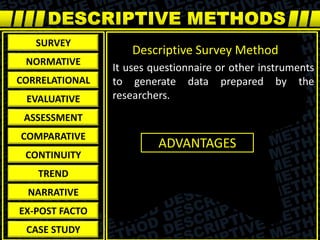
It uses questionnaire or other instruments
to generate data prepared by the
researchers.
NORMATIVE
CORRELATIONAL
EVALUATIVE
ASSESSMENT
COMPARATIVE
CONTINUITY
TREND
NARRATIVE
EX-POST FACTO
CASE STUDY
Descriptive Survey Method
ADVANTAGES
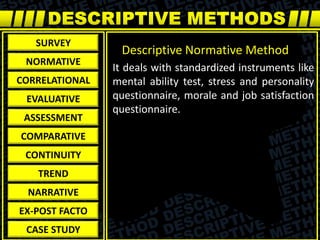
It deals with standardized instruments like
mental ability test, stress and personality
questionnaire, morale and job satisfaction
questionnaire.
Descriptive Normative Method
SURVEY
NORMATIVE
CORRELATIONAL
EVALUATIVE
ASSESSMENT
COMPARATIVE
CONTINUITY
TREND
NARRATIVE
EX-POST FACTO
CASE STUDY
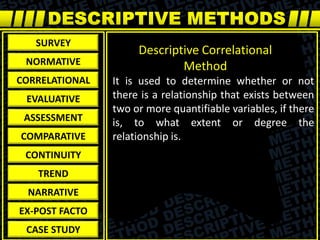
It is used to determine whether or not
there is a relationship that exists between
two or more quantifiable variables, if there
is, to what extent or degree the
relationship is.
Descriptive Correlational
Method
SURVEY
NORMATIVE
CORRELATIONAL
EVALUATIVE
ASSESSMENT
COMPARATIVE
CONTINUITY
TREND
NARRATIVE
EX-POST FACTO
CASE STUDY
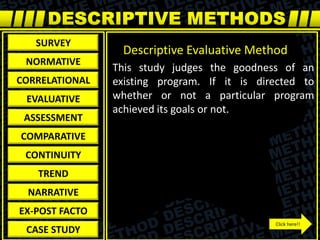
This study judges the goodness of an
existing program. If it is directed to
whether or not a particular program
achieved its goals or not.
Descriptive Evaluative Method
Click here!!
SURVEY
NORMATIVE
CORRELATIONAL
EVALUATIVE
ASSESSMENT
COMPARATIVE
CONTINUITY
TREND
NARRATIVE
EX-POST FACTO
CASE STUDY
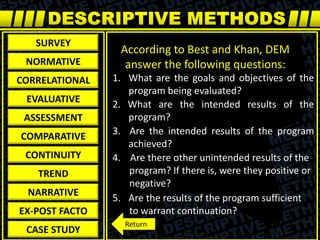
4. Are there other unintended results of the
program? If there is, were they positive or
negative?
According to Best and Khan, DEM
answer the following questions:
SURVEY
NORMATIVE
CORRELATIONAL
EVALUATIVE
ASSESSMENT
COMPARATIVE
CONTINUITY
TREND
NARRATIVE
EX-POST FACTO
CASE STUDY
Return
2. What are the intended results of the
program?
1. What are the goals and objectives of the
program being evaluated?
3. Are the intended results of the program
achieved?
5. Are the results of the program sufficient
to warrant continuation?
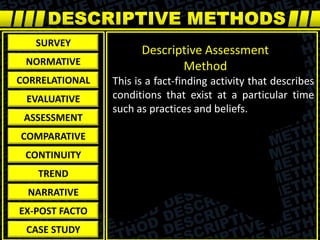
This is a fact-finding activity that describes
conditions that exist at a particular time
such as practices and beliefs.
Descriptive Assessment
Method
SURVEY
NORMATIVE
CORRELATIONAL
EVALUATIVE
ASSESSMENT
COMPARATIVE
CONTINUITY
TREND
NARRATIVE
EX-POST FACTO
CASE STUDY
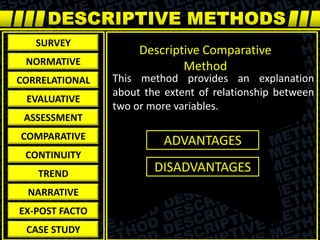
This method provides an explanation
about the extent of relationship between
two or more variables.
Descriptive Comparative
Method
SURVEY
NORMATIVE
CORRELATIONAL
EVALUATIVE
ASSESSMENT
COMPARATIVE
CONTINUITY
TREND
NARRATIVE
EX-POST FACTO
CASE STUDY
ADVANTAGES
DISADVANTAGES
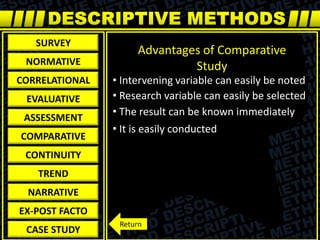
• Intervening variable can easily be noted
Advantages of Comparative
Study
SURVEY
NORMATIVE
CORRELATIONAL
EVALUATIVE
ASSESSMENT
COMPARATIVE
CONTINUITY
TREND
NARRATIVE
EX-POST FACTO
CASE STUDY
• Research variable can easily be selected
• The result can be known immediately
• It is easily conducted
Return
• The findings are limited
Disadvantages of Comparative
Study
Return
SURVEY
NORMATIVE
CORRELATIONAL
EVALUATIVE
ASSESSMENT
COMPARATIVE
CONTINUITY
TREND
NARRATIVE
EX-POST FACTO
CASE STUDY
• Variables to be selected are limited
• It is difficult to get samples which have
the same characteristics or attributes.
The researcher is knowledgeable about
the operation of natural or social forces
which may be obtained by watching them
analytically at stated intervals in their
development over a long period of time as
seen desirable and possible.
Descriptive Continuity Method
SURVEY
NORMATIVE
CORRELATIONAL
EVALUATIVE
ASSESSMENT
COMPARATIVE
CONTINUITY
TREND
NARRATIVE
EX-POST FACTO
CASE STUDY
Based upon a longitudinal consideration of
recorded data, indicating what has been
happening in the past, what the present
situation reveals, and on the basis of these
data it projects what is likely to happen in
the future.
Descriptive Trend Method
SURVEY
NORMATIVE
CORRELATIONAL
EVALUATIVE
ASSESSMENT
COMPARATIVE
CONTINUITY
TREND
NARRATIVE
EX-POST FACTO
CASE STUDY
This method tells us about the results of
the study.
Descriptive Narrative Method
SURVEY
NORMATIVE
CORRELATIONAL
EVALUATIVE
ASSESSMENT
COMPARATIVE
CONTINUITY
TREND
NARRATIVE
EX-POST FACTO
CASE STUDY
Also known as causal-comparative
research or after-the-fact research.
Descriptive Ex-Post Facto
Method
SURVEY
NORMATIVE
CORRELATIONAL
EVALUATIVE
ASSESSMENT
COMPARATIVE
CONTINUITY
TREND
NARRATIVE
EX-POST FACTO
CASE STUDY
Limitations of Ex-Post Facto Research
It is an intensive and descriptive analysis of
a single subject. It examines a social unit
as a whole, and the unit may be a single
typical individual, a family, a social
group, a social institution, or a community.
Descriptive Case Study Method
SURVEY
NORMATIVE
CORRELATIONAL
EVALUATIVE
ASSESSMENT
COMPARATIVE
CONTINUITY
TREND
NARRATIVE
EX-POST FACTO
CASE STUDY
Click Here
SURVEY
NORMATIVE
CORRELATIONAL
EVALUATIVE
ASSESSMENT
COMPARATIVE
CONTINUITY
TREND
NARRATIVE
EX-POST FACTO
CASE STUDY
Advantages of the Descriptive
Survey Method
• Typical, average or normal.
• The result of the survey may be used for
prediction.
• It makes possible the formulation of
generalization.
• It reveals problem for which timely
remedial measures may be instituted.
Return
SURVEY
NORMATIVE
CORRELATIONAL
EVALUATIVE
ASSESSMENT
COMPARATIVE
CONTINUITY
TREND
NARRATIVE
EX-POST FACTO
CASE STUDY
SURVEY
NORMATIVE
CORRELATIONAL
EVALUATIVE
ASSESSMENT
COMPARATIVE
CONTINUITY
TREND
NARRATIVE
EX-POST FACTO
CASE STUDY
Limitations of Ex-Post Facto
Research
• The information used in this study may
not be complete.
• Causes are often multiple rather than
single.
• Lack of knowledge on the part of the
researcher regarding what variable were
controlled makes this type of research
very difficult to do.
Click Here
SURVEY
NORMATIVE
CORRELATIONAL
EVALUATIVE
ASSESSMENT
COMPARATIVE
CONTINUITY
TREND
NARRATIVE
EX-POST FACTO
CASE STUDY
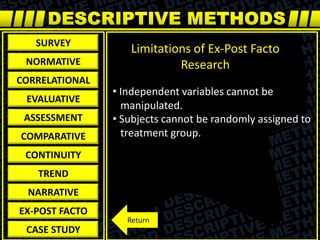
Limitations of Ex-Post Facto
Research
• Independent variables cannot be
manipulated.
• Subjects cannot be randomly assigned to
treatment group.
Return
SURVEY
NORMATIVE
CORRELATIONAL
EVALUATIVE
ASSESSMENT
COMPARATIVE
CONTINUITY
TREND
NARRATIVE
EX-POST FACTO
CASE STUDY
SURVEY
NORMATIVE
CORRELATIONAL
EVALUATIVE
ASSESSMENT
COMPARATIVE
CONTINUITY
TREND
NARRATIVE
EX-POST FACTO
CASE STUDY

descriptive method

  • 1.
  • 2.
    SURVEY It uses questionnaireor other instruments to generate data prepared by the researchers. NORMATIVE CORRELATIONAL EVALUATIVE ASSESSMENT COMPARATIVE CONTINUITY TREND NARRATIVE EX-POST FACTO CASE STUDY Descriptive Survey Method ADVANTAGES
  • 3.
    It deals withstandardized instruments like mental ability test, stress and personality questionnaire, morale and job satisfaction questionnaire. Descriptive Normative Method SURVEY NORMATIVE CORRELATIONAL EVALUATIVE ASSESSMENT COMPARATIVE CONTINUITY TREND NARRATIVE EX-POST FACTO CASE STUDY
  • 4.
    It is usedto determine whether or not there is a relationship that exists between two or more quantifiable variables, if there is, to what extent or degree the relationship is. Descriptive Correlational Method SURVEY NORMATIVE CORRELATIONAL EVALUATIVE ASSESSMENT COMPARATIVE CONTINUITY TREND NARRATIVE EX-POST FACTO CASE STUDY
  • 5.
    This study judgesthe goodness of an existing program. If it is directed to whether or not a particular program achieved its goals or not. Descriptive Evaluative Method Click here!! SURVEY NORMATIVE CORRELATIONAL EVALUATIVE ASSESSMENT COMPARATIVE CONTINUITY TREND NARRATIVE EX-POST FACTO CASE STUDY
  • 6.
    4. Are thereother unintended results of the program? If there is, were they positive or negative? According to Best and Khan, DEM answer the following questions: SURVEY NORMATIVE CORRELATIONAL EVALUATIVE ASSESSMENT COMPARATIVE CONTINUITY TREND NARRATIVE EX-POST FACTO CASE STUDY Return 2. What are the intended results of the program? 1. What are the goals and objectives of the program being evaluated? 3. Are the intended results of the program achieved? 5. Are the results of the program sufficient to warrant continuation?
  • 7.
    This is afact-finding activity that describes conditions that exist at a particular time such as practices and beliefs. Descriptive Assessment Method SURVEY NORMATIVE CORRELATIONAL EVALUATIVE ASSESSMENT COMPARATIVE CONTINUITY TREND NARRATIVE EX-POST FACTO CASE STUDY
  • 8.
    This method providesan explanation about the extent of relationship between two or more variables. Descriptive Comparative Method SURVEY NORMATIVE CORRELATIONAL EVALUATIVE ASSESSMENT COMPARATIVE CONTINUITY TREND NARRATIVE EX-POST FACTO CASE STUDY ADVANTAGES DISADVANTAGES
  • 9.
    • Intervening variablecan easily be noted Advantages of Comparative Study SURVEY NORMATIVE CORRELATIONAL EVALUATIVE ASSESSMENT COMPARATIVE CONTINUITY TREND NARRATIVE EX-POST FACTO CASE STUDY • Research variable can easily be selected • The result can be known immediately • It is easily conducted Return
  • 10.
    • The findingsare limited Disadvantages of Comparative Study Return SURVEY NORMATIVE CORRELATIONAL EVALUATIVE ASSESSMENT COMPARATIVE CONTINUITY TREND NARRATIVE EX-POST FACTO CASE STUDY • Variables to be selected are limited • It is difficult to get samples which have the same characteristics or attributes.
  • 11.
    The researcher isknowledgeable about the operation of natural or social forces which may be obtained by watching them analytically at stated intervals in their development over a long period of time as seen desirable and possible. Descriptive Continuity Method SURVEY NORMATIVE CORRELATIONAL EVALUATIVE ASSESSMENT COMPARATIVE CONTINUITY TREND NARRATIVE EX-POST FACTO CASE STUDY
  • 12.
    Based upon alongitudinal consideration of recorded data, indicating what has been happening in the past, what the present situation reveals, and on the basis of these data it projects what is likely to happen in the future. Descriptive Trend Method SURVEY NORMATIVE CORRELATIONAL EVALUATIVE ASSESSMENT COMPARATIVE CONTINUITY TREND NARRATIVE EX-POST FACTO CASE STUDY
  • 13.
    This method tellsus about the results of the study. Descriptive Narrative Method SURVEY NORMATIVE CORRELATIONAL EVALUATIVE ASSESSMENT COMPARATIVE CONTINUITY TREND NARRATIVE EX-POST FACTO CASE STUDY
  • 14.
    Also known ascausal-comparative research or after-the-fact research. Descriptive Ex-Post Facto Method SURVEY NORMATIVE CORRELATIONAL EVALUATIVE ASSESSMENT COMPARATIVE CONTINUITY TREND NARRATIVE EX-POST FACTO CASE STUDY Limitations of Ex-Post Facto Research
  • 15.
    It is anintensive and descriptive analysis of a single subject. It examines a social unit as a whole, and the unit may be a single typical individual, a family, a social group, a social institution, or a community. Descriptive Case Study Method SURVEY NORMATIVE CORRELATIONAL EVALUATIVE ASSESSMENT COMPARATIVE CONTINUITY TREND NARRATIVE EX-POST FACTO CASE STUDY Click Here
  • 16.
    SURVEY NORMATIVE CORRELATIONAL EVALUATIVE ASSESSMENT COMPARATIVE CONTINUITY TREND NARRATIVE EX-POST FACTO CASE STUDY Advantagesof the Descriptive Survey Method • Typical, average or normal. • The result of the survey may be used for prediction. • It makes possible the formulation of generalization. • It reveals problem for which timely remedial measures may be instituted. Return
  • 17.
  • 18.
    SURVEY NORMATIVE CORRELATIONAL EVALUATIVE ASSESSMENT COMPARATIVE CONTINUITY TREND NARRATIVE EX-POST FACTO CASE STUDY Limitationsof Ex-Post Facto Research • The information used in this study may not be complete. • Causes are often multiple rather than single. • Lack of knowledge on the part of the researcher regarding what variable were controlled makes this type of research very difficult to do. Click Here
  • 19.
    SURVEY NORMATIVE CORRELATIONAL EVALUATIVE ASSESSMENT COMPARATIVE CONTINUITY TREND NARRATIVE EX-POST FACTO CASE STUDY Limitationsof Ex-Post Facto Research • Independent variables cannot be manipulated. • Subjects cannot be randomly assigned to treatment group. Return
  • 20.
  • 21.